What Is Black Soldier Fly Larvae Used For, and Who Buys It?

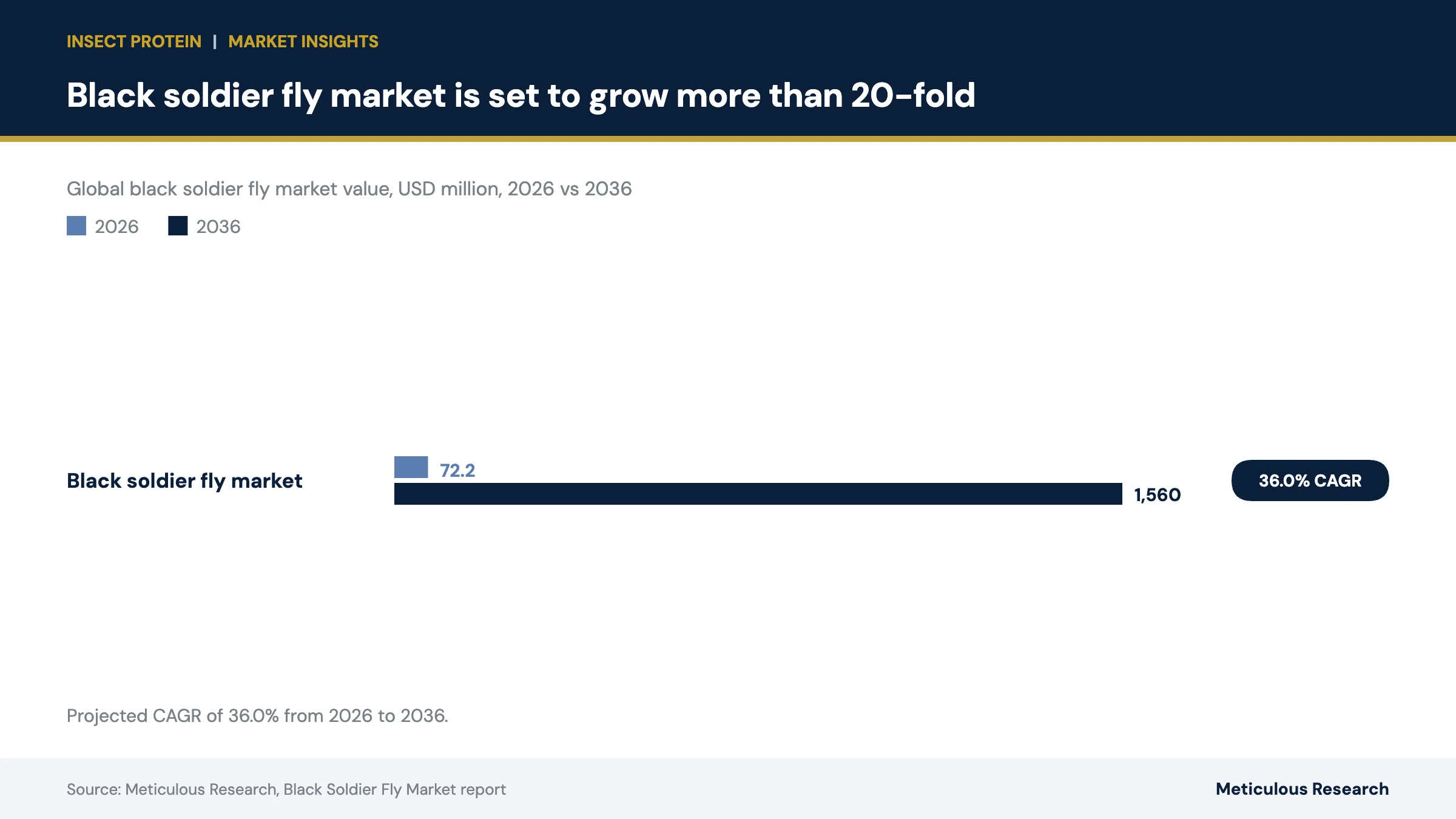
Black soldier fly larvae are processed into three products: protein meal, which aquafeed and pet food makers buy, oil, which is sold into the same feed and pet food formulations, and frass, which farmers buy as organic fertiliser. According to the Meticulous Research report, Black Soldier Fly Market, the market is estimated at USD 72.2 million in 2026 and is projected to reach USD 1.56 billion by 2036, at a CAGR of 36.0% from 2026 to 2036.
Protein meal is the largest product type and aquafeed is the largest application, while frass makes up most of the tonnage. A producer that sells all three outputs earns revenue from several buyers instead of depending on one feed contract.
Who buys black soldier fly protein meal?
Aquafeed companies are the largest buyers. NaturAlleva announced a commercial partnership with Innovafeed on 22 January 2026 to use black soldier fly ingredients across all of its sea bass and sea bream feed formulations, with a phased rollout across the Mediterranean. The ingredients contain chitin, lauric acid and antimicrobial peptides, and the two companies will jointly fund research on the functional benefits of chitin in other aquaculture species. The partnership shows that aquafeed buyers value the ingredient for more than its protein.
Pet food is the second largest application. Purina launched its Beyond Nature's Protein line made with black soldier fly larvae in Swiss Coop stores in November 2020, and Nestlé said it wanted to diversify protein sources for environmental goals. Vobra Special Petfoods and Réglo, a hypoallergenic dog food brand, buy Innovafeed ingredients today, which shows that insect protein now sits in both mainstream and specialist pet food.
Livestock feed is a third buyer group, and poultry is the largest species within animal feed. Regulation (EU) 2021/1372, which applies from 7 September 2021, allows insect processed animal protein in pig and poultry feed in addition to aquaculture, so the legal basis for these sales is in place in Europe.
The Meticulous Next brief, Feed and Food Ingredients Outlook 2026 to 2036, expects pet food and aquafeed to be the first uses to adopt insect protein, and lists BioMar and Nutreco among the feed companies and Mars, Nestlé and Colgate-Palmolive among the pet food companies that buy ingredients. The brief values the market at USD 0.60 to 1.00 billion in 2026 and USD 3.14 to 5.23 billion by 2036, at a CAGR of 18%.
Who buys the oil and the frass?
Innovafeed sells black soldier fly protein and oil under its Hilucia range into aquaculture and pet food, and raised EUR 51 million on 5 June 2026 to accelerate that growth. Larvae oil and chitin and chitosan are listed as separate product types in the Meticulous Research report, with chitin and chitosan the fastest growing product type and their recovery for high value applications named as an opportunity. Oil and chitin are the products that give a producer revenue beyond feed protein.
Farmers buy the frass. Innovafeed describes Hilucia Frass as a dehydrated pellet made entirely from black soldier fly frass, with more than 75% organic matter and a balanced mix of nitrogen, phosphorus and potassium, and it says the product delivered equal or improved yields in Champagne vineyards compared with conventional fertilisers. The company names grapevines, fruit trees, vegetables and cereals as target crops, and the US Department of Agriculture awarded it a grant of USD 11 million on 14 November 2024 under the Fertilizer Production Expansion Program to produce the pellet at Decatur, Illinois.
European rules treat frass as an organic fertiliser. Regulation (EU) 2021/1925, adopted on 29 November 2021, defines frass and requires heat treatment at 70°C for at least one hour, and Delegated Regulation (EU) 2023/1605, adopted on 22 May 2023 and in force from 28 August 2023, sets the point at which processed frass leaves the animal by-product rules. Frass producers can now place the product on the fertiliser market under defined conditions, which opens a buyer group that does not depend on feed approvals.
The Meticulous Next brief, Nutrient-Efficient Farming Outlook 2026 to 2034, values farm inputs that raise nutrient efficiency at USD 4.0 to 6.0 billion in 2026 and projects USD 9.22 to 13.83 billion by 2034, at a CAGR of 11%, and notes that the EU Fertilising Products Regulation has applied since 16 July 2022. Frass producers sell into a farm input market that is already regulated and growing.
How big is the market, and which segments and regions lead?
The Black Soldier Fly Market report covers protein meal, whole larvae, biofertiliser and frass, larvae oil, and chitin and chitosan. Protein meal is the largest product type in 2026 and chitin and chitosan is the fastest growing, while aquafeed is the largest application and pet food is the second largest. Europe holds the largest share, with France the largest country market, and the Middle East and Africa is the fastest growing region. Asia-Pacific is the fastest growing major producing region, Brazil is the largest market in Latin America and Canada is growing faster than the United States.
The growth of this market is mainly driven by the demand for alternative proteins in aquafeed and pet food, and regulatory authorisation across the major feed markets of the EU, the US and Canada. However, factors such as the cost gap against fishmeal and soybean meal, and substrate restrictions that limit access to low cost feedstock are expected to restrain the growth of this market to some extent. Multi product revenue models, and phased capacity building and technology licensing are the main trends, and restoring investor confidence after the insolvencies is the main challenge.
Some of the key players operating in this market are Protix, Innovafeed, Darling Ingredients, Sentara Group, Entobel, Entosystem, nextProtein, HiProMine, Loopworm, Hexafly, Nasekomo and Insectta, among others.
The Black Soldier Fly Oil Market report covers the oil, the Insect Fertilizers Market report covers frass, and the Europe Black Soldier Fly Market report covers the largest region, where the Netherlands holds the largest share and France is expected to grow fastest.
Producers, feed manufacturers and fertiliser buyers who want segment values, company profiles and country forecasts can find them in the Meticulous Research Black Soldier Fly Market report.
Frequently Asked Questions
What is black soldier fly larvae used for?
It is processed into protein meal for aquafeed, pet food and livestock feed, oil for feed and pet food formulations, and frass for organic fertiliser. Chitin and chitosan are a further product with the fastest growth.
Who buys black soldier fly protein?
Aquafeed companies such as NaturAlleva, pet food brands such as Purina, Vobra Special Petfoods and Réglo, and livestock feed producers. Aquafeed is the largest application and pet food the second largest.
What is black soldier fly frass used for?
It is sold to farmers as an organic fertiliser for grapevines, fruit trees, vegetables and cereals. Regulation (EU) 2021/1925 sets the production rules in the EU.
How big is the black soldier fly market?
The Meticulous Research report, Black Soldier Fly Market, estimates USD 72.2 million in 2026 and projects USD 1.56 billion by 2036, at a CAGR of 36.0%.
Which region leads the market?
Europe holds the largest share, led by France, while the Middle East and Africa is the fastest growing region.
Sources
- Innovafeed, partnership with NaturAlleva, 22 January 2026
- Innovafeed, funding round of EUR 51 million, 5 June 2026
- Innovafeed, USDA grant for organic fertilizer production, 14 November 2024
- NPR, Purina to offer bug based dog and cat food, 6 November 2020
- EUR-Lex, Commission Regulation (EU) 2021/1372
- EUR-Lex, Commission Delegated Regulation (EU) 2023/1605
- IPIFF, Insect frass as fertiliser
- Meticulous Research, Black Soldier Fly Market
- Meticulous Research, Black Soldier Fly Oil Market
- Meticulous Research, Insect Fertilizers Market
- Meticulous Research, Europe Black Soldier Fly Market
- Meticulous Next, Feed and Food Ingredients Outlook 2026 to 2036
- Meticulous Next, Nutrient-Efficient Farming Outlook 2026 to 2034
Looking for full market sizing & granular datasets?
Access our comprehensive market forecast reports:
- Black Soldier Fly Market - Global Opportunity Analysis and Industry Forecast (2026–2036)MRFB - 104375
- Black Soldier Fly Oil Market - Global Opportunity Analysis and Industry Forecast (2022-2029)MRFB - 104584
- Insect Fertilizers Market - Global Opportunity Analysis and Industry Forecast (2022-2029)MRAGR - 104619
- Europe Black Soldier Fly Market - Opportunity Analysis and Industry Forecast (2025-2033)MRFB - 104879
Related Market Intelligence Briefings
Recommended reading from the same research domain
METICULOUS INSIGHT
Why Edible Insects Are Still Growing While Insect Startups Fail
The edible insects market is estimated at USD 90.38 million in 2026 and is projected to reach USD 1,656.16 million by 2036, at a CAGR of 33....

METICULOUS INSIGHT
Spirulina, Chlorella and Phycocyanin Compared: Which Market Is Larger and Which Grows Faster?
Spirulina is the largest of the three markets at USD 0.77 billion in 2026 and grows at 8.4% a year to USD 1.72 billion by 2036. Chlorella is...

METICULOUS INSIGHT
Why Insect Farming Startups Failed, and What the Survivors Did Differently
In December 2025, a French commercial court placed Ÿnsect into judicial liquidation. The company had raised more than USD 600 million &...