Why Edible Insects Are Still Growing While Insect Startups Fail

The edible insects market is estimated at USD 90.38 million in 2026 and is projected to reach USD 1,656.16 million by 2036, at a CAGR of 33.8% from 2026 to 2036, according to the Meticulous Research report, Edible Insects Market. Animal nutrition carries the growth, led by aquaculture feed and pet food, while human food and beverages hold a meaningful share of value but a very small share of tonnage.
Ÿnsect, the French mealworm company, raised more than EUR 600 million in public and private funding and still entered judicial liquidation on 1 December 2025. The whole edible insects market was worth only USD 72.30 million in 2025, so the capital that went into a handful of plants was far larger than the revenue pool they were built to serve.
Why are insect startups failing?
Ÿnsect reported turnover of only EUR 656,000 in 2023, excluding internal transactions, against losses of more than EUR 80 million, and its insect meal cost 2 to 10 times more than fish or soy meal. Diseases, parasites and overly fatty worms that clogged machines, energy costs for keeping insects above 25°C, and construction delays of more than two years added to the gap. The company switched from organic waste to agricultural by-products that are costly and compete with other uses, which removed the feedstock advantage the business plan relied on.
Ÿnsect dropped the human food market in 2023 to focus on premium dog and cat food, entered safeguard proceedings in September 2024, went into receivership on 3 March 2025 and cut more than 150 jobs, two thirds of its workforce, in June 2025. Liquidation followed on 1 December 2025, 15 months after safeguard proceedings began.
Other producers followed the same pattern of building large plants before costs were competitive. ENORM in Denmark was declared bankrupt on 30 October 2025 after raising EUR 50 million in 2022 and opening a plant designed for about 11,000 tons of protein meal a year, and its chief operating officer said sales were not as expected. Aspire Food Group, the Canadian cricket producer, went into receivership and its assets were sold to Halali Group Holdings in September 2025. Inseco in South Africa ceased operations in 2025, and its co founder said the company scaled too quickly and pivoted too slowly.
Funding to the sector fell from USD 151.9 million in 2024 to USD 88.45 million in 2025, according to AgFunder data. Protix shelved its plans for a plant in Poland and its Nebraska project with Tyson Foods is on hold, which shows that even the largest producers are slowing plant construction until unit costs improve. The earlier Meticulous blog, Why Insect Farming Startups Failed and What the Survivors Did Differently, covers the survivors in more detail.
Why is the edible insects market still growing?
The market is growing because the producers that remain sell into aquaculture feed and premium pet food, where insect ingredients can be positioned as functional ingredients and not only as a cheaper protein. Animal nutrition is the largest application, aquaculture feed is its largest sub segment and pet food is its fastest growing sub segment. Human food and beverages hold a meaningful share of value but a very small share of tonnage, so volume comes from feed.
Innovafeed shows how a surviving producer is positioned. The company raised EUR 51 million on 5 June 2026 from existing shareholders including Creadev, QIA, Temasek and ADM, and sells its Hilucia range of black soldier fly protein and oil into aquaculture and pet food. NaturAlleva, an aquafeed producer, signed a partnership on 22 January 2026 to use the ingredients across all of its sea bass and sea bream feed formulations, and Vobra Special Petfoods and Réglo use them in pet food and hypoallergenic dog food. Innovafeed reports production of over 15,000 tons of protein and oil in three years, with production costs divided by seven and revenues doubling each year, and it says its Nesle plant is on track to be profitable by the end of 2027.
Survivors outside Europe run at lower cost. Entobel produces 300 to 400 tons of insect meal a month in Vietnam, Protenga in Southeast Asia says it has reached operating profitability and Loopworm in India says its silkworm protein business is already profitable. Warm climates lower the energy cost that weighed on Ÿnsect, which explains why capacity is moving toward Asia.
Regulation supports feed demand in Europe. Regulation (EU) 2021/1372, adopted on 17 August 2021 and applying from 7 September 2021, allows insect processed animal protein in pig and poultry feed in addition to aquaculture, which widened the addressable feed market beyond fish.
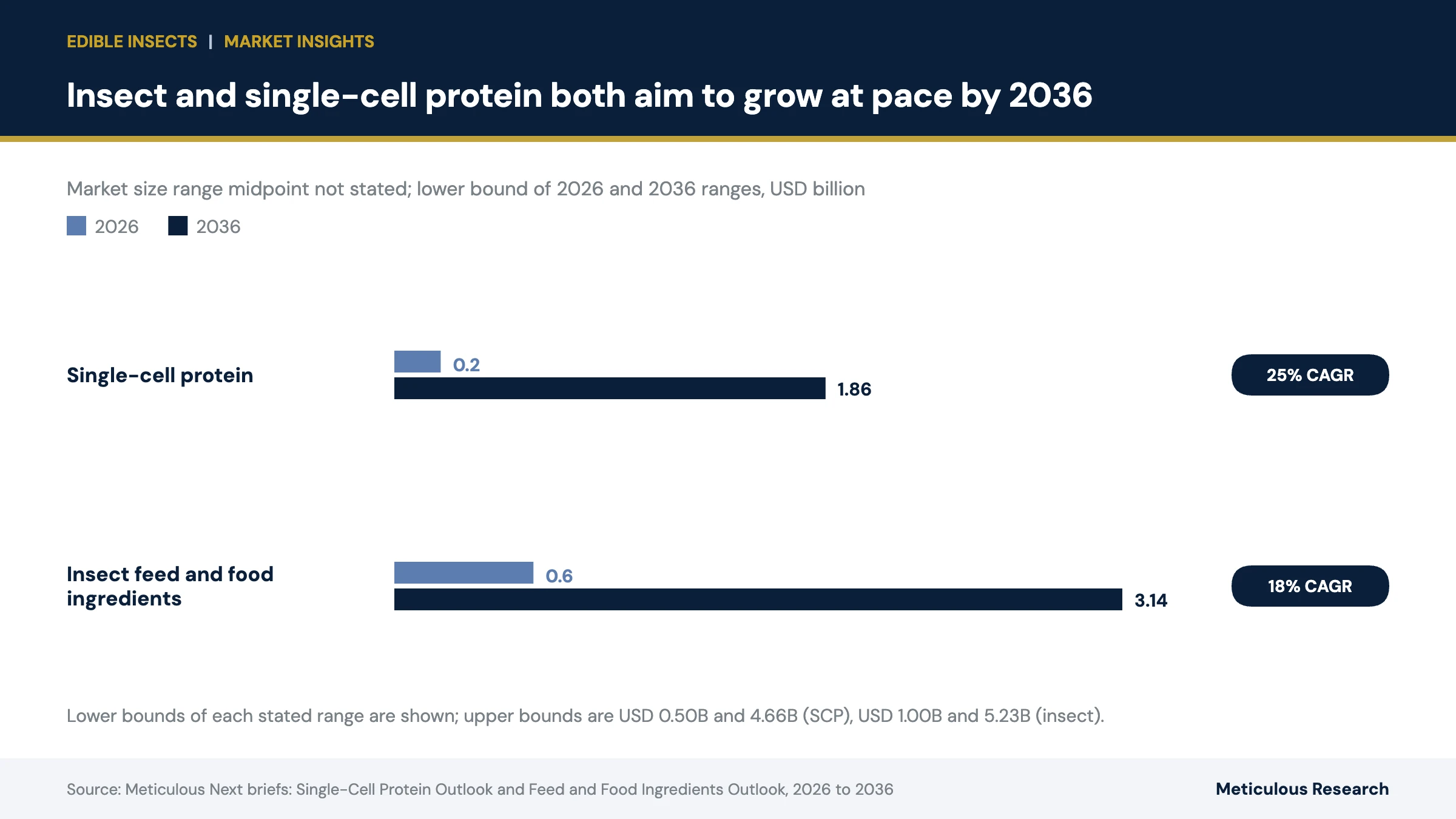
Single cell protein is the closest competing ingredient in aquafeed and pet food. The Meticulous Next brief, Single-Cell Protein Outlook 2026 to 2036, values the market at USD 0.20 to 0.50 billion in 2026 and projects USD 1.86 to 4.66 billion by 2036, at a CAGR of 25%, and notes that Calysta expects aquafeed prices capped at about USD 2,000 per tonne with pet food prices almost double that level. Pet food pays almost double the aquafeed price, so single cell protein and insect protein are both aiming at that segment first.
How big is the market, and which segments and regions lead?
Insect meal is the largest product type and accounts for the majority of tonnage, while insect oil and fat is the fastest growing product type. Black soldier flies are the largest insect type and silkworms are the fastest growing. Europe holds the largest share of the market, with France the largest country market and Spain and Poland the fastest growing in the region. Asia-Pacific is the second largest region, led by Vietnam and China, and the Middle East and Africa is the fastest growing region from the lowest base, led by Kenya.
The growth of this market is mainly driven by the demand for alternative proteins in aquaculture and pet food, and the regulatory authorisation of insect processed animal proteins in EU feed markets. However, factors such as the cost gap against fishmeal and soybean meal, and substrate restrictions that limit access to low cost feedstock are expected to restrain the growth of this market to some extent. Restoring investor confidence after the insolvencies and demonstrating utilisation at commercial scale remain the main challenges, and the shift from whole insects toward processed ingredients and the consolidation around black soldier fly and mealworm production are the main trends.
Some of the key players operating in this market are Protix, Innovafeed, Entobel, Tebrio, Entosystem, nextProtein, Sentara Group, HiProMine, Darling Ingredients, Nasekomo and Entomo Farms, among others.
The Meticulous Next brief, Feed and Food Ingredients Outlook 2026 to 2036, covers insect protein meal, oil and frass from black soldier fly, mealworm and cricket larvae, and values the market at USD 0.60 to 1.00 billion in 2026 and USD 3.14 to 5.23 billion by 2036, at a CAGR of 18%. It notes that the forecast is sensitive to the price of soy and fishmeal and that higher prices for them would bring the mainstream inflection to 2029, so feed prices decide how fast insect ingredients scale.
Regional detail is available in the Meticulous Research reports on the Europe Edible Insects Market, the South East Asia Edible Insects Market and the Middle East and Africa Edible Insects Market. Frass, the other output of insect rearing, is covered in the Insect Fertilizers Market report.
Producers, feed manufacturers and investors who want segment values, company profiles and country forecasts can find them in the Meticulous Research Edible Insects Market report.
Frequently Asked Questions
How big is the edible insects market?
The Meticulous Research report, Edible Insects Market, estimates USD 90.38 million in 2026 and projects USD 1,656.16 million by 2036, at a CAGR of 33.8%.
Why did Ÿnsect fail?
Its insect meal cost 2 to 10 times more than fish or soy meal, energy and feedstock costs were high, and its plant was delayed by more than two years. It entered judicial liquidation on 1 December 2025.
Which applications drive edible insects demand?
Animal nutrition is the largest application, with aquaculture feed the largest sub segment and pet food the fastest growing. Human food and beverages hold a very small share of tonnage.
Which region leads the edible insects market?
Europe holds the largest share, led by France, while the Middle East and Africa is the fastest growing region.
Which insect is used most?
Black soldier fly is the largest insect type, and silkworm is the fastest growing.
Sources
- ONEI, Ÿnsect: how the global leader in insect technology ended up in receivership
- AgFunderNews, Insect ag recalibrates after a brutal shakeout, 26 March 2026
- AgFunderNews, Danish insect ag firm ENORM declared bankrupt, 4 November 2025
- Innovafeed, funding round of EUR 51 million, 5 June 2026
- Innovafeed, partnership with NaturAlleva, 22 January 2026
- EUR-Lex, Commission Regulation (EU) 2021/1372
- Meticulous Research, Edible Insects Market
- Meticulous Research, Europe Edible Insects Market
- Meticulous Research, South East Asia Edible Insects Market
- Meticulous Research, Middle East and Africa Edible Insects Market
- Meticulous Research, Insect Fertilizers Market
- Meticulous Next, Feed and Food Ingredients Outlook 2026 to 2036
- Meticulous Next, Single-Cell Protein Outlook 2026 to 2036
Looking for full market sizing & granular datasets?
Access our comprehensive market forecast reports:
Related Market Intelligence Briefings
Recommended reading from the same research domain

METICULOUS INSIGHT
What Is Black Soldier Fly Larvae Used For, and Who Buys It?
Black soldier fly larvae are processed into three products: protein meal, which aquafeed and pet food makers buy, oil, which is sold into th...

METICULOUS INSIGHT
Spirulina, Chlorella and Phycocyanin Compared: Which Market Is Larger and Which Grows Faster?
Spirulina is the largest of the three markets at USD 0.77 billion in 2026 and grows at 8.4% a year to USD 1.72 billion by 2036. Chlorella is...

METICULOUS INSIGHT
Why Insect Farming Startups Failed, and What the Survivors Did Differently
In December 2025, a French commercial court placed Ÿnsect into judicial liquidation. The company had raised more than USD 600 million &...