CO2 Utilization and the Future of Chemicals and Fuels: Foresight, Key Signals and Strategic Implications
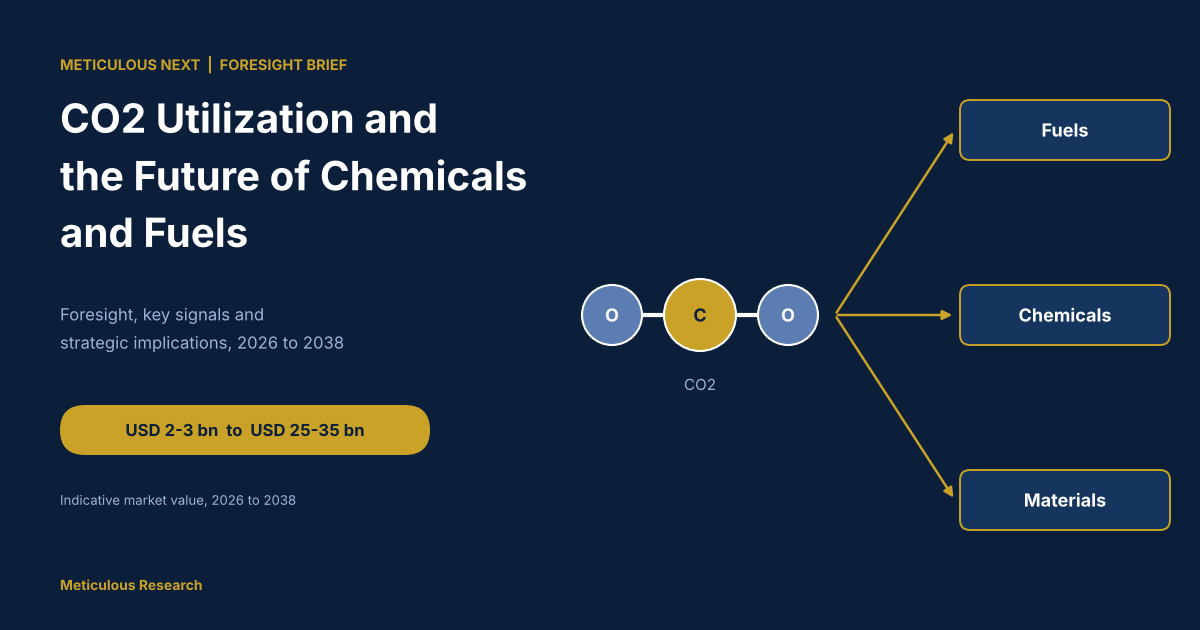
Carbon dioxide is turning from a waste stream into a raw material, and the next twelve years will decide which routes reach scale. Meticulous Next tracks that shift in Carbon-to-Value Market Outlook 2026 to 2038, a 112 page foresight brief on CO2 utilization in chemicals, fuels and materials.
The brief gives an indicative market of USD 2.0 to 3.0 billion in 2026, rising to USD 25 to 35 billion by 2038, at a CAGR of 22 to 24%. That is a young market, so the useful question is not the size today. It is which signals show that the curve is bending.
This blog sets out where CO2 utilization stands, the signals worth watching, a timeline to 2038 and what each type of player should do about it.
Where CO2 Utilization Stands Today
The market is small but no longer a pilot story. The brief excludes enhanced oil recovery, conventional urea and food grade CO2, so the figures cover only new routes: e-fuels and e-methanol, gas fermentation, chemicals and polymers, and mineralization in building materials.
Four commercial markers show the change:
- Fuels: Twelve opened AirPlant One in Moses Lake, Washington in June 2026, making ASTM certified E-Jet fuel and E-Naphtha for Alaska Airlines and Microsoft, backed by a USD 645 million funding round.
- Methanol: The Kassø plant in Denmark, rated at 42,000 tonnes a year of e-methanol, holds ISCC RFNBO certification and was selected in May 2026 for German hydrogen auction funding.
- Materials: Neustark reports 19 plants operating, and CarbonCure is in more than 450 plants, cutting cement use by about 5%.
- Chemicals: OCOchem began shipping formate in October 2025 from an electrolysis system at 85% Faradaic efficiency.
The pattern is that the first plants are real, but each is small. Scale depends on policy and on cost, which is where the signals come in.
Key Signals to Watch
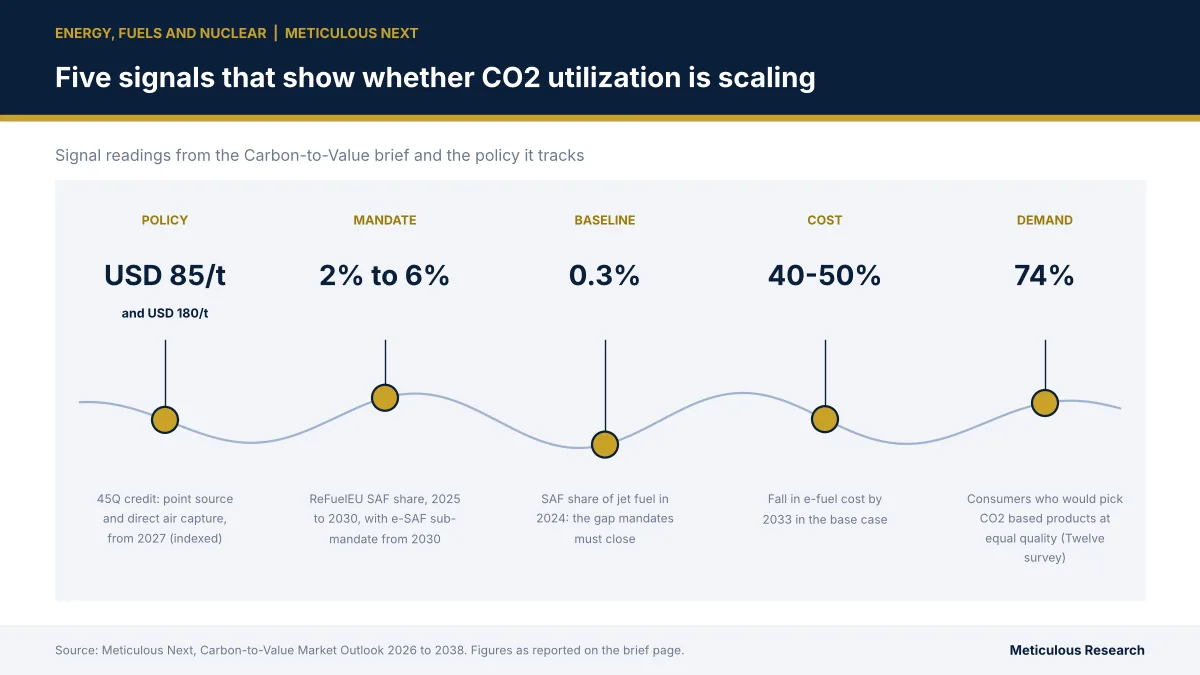
Policy is paying for utilization. The brief notes that the US law passed on 4 July 2025 extended 45Q parity to utilization, at USD 85 a tonne for point source CO2 and USD 180 a tonne for direct air capture, indexed from 2027. India has allocated INR 20,000 crore, about USD 2.2 billion, over five years for CCUS, and its CCUS roadmap sets a capture target of 750 million tonnes by 2050. Support of this kind lowers the cost of the first plants.
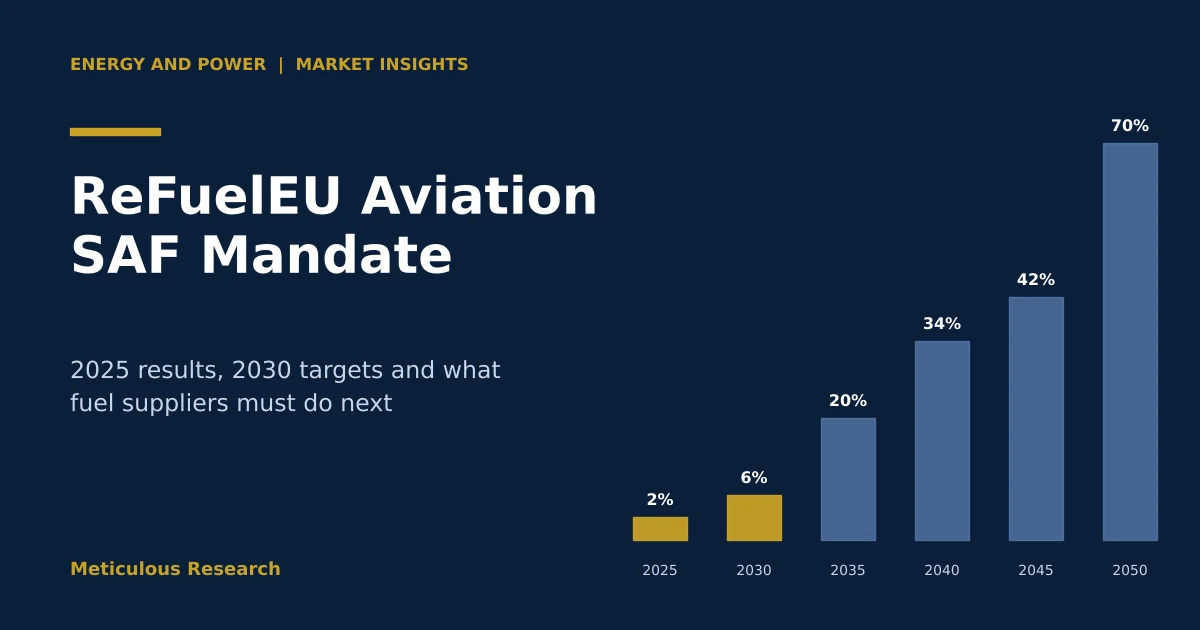
Mandates create the offtake. ReFuelEU requires 2% sustainable aviation fuel from 2025, rising to 6% by 2030, with a sub-mandate for e-SAF from 2030. SAF was only 0.3% of jet fuel in 2024, so the mandate is the main source of new demand.
Capital is moving, unevenly. Neustark raised USD 69 million in October 2026 toward one million tonnes of CO2 removed by 2030, while LanzaJet had to secure at least USD 20 million amid a debt restructuring the same month. Money is available for projects with offtake and scarce for those without.
Cost must fall. In the base case of the brief, e-fuel costs fall 40 to 50% by 2033. That is the single number most worth tracking, because it decides when e-fuels compete without support.
Buyers are willing. A Twelve survey cited in the brief finds that 74% of consumers would choose CO2 based products at equal quality. This is a company survey, so treat it as direction, not proof.
Timeline to 2038: Three Phases and Three Scenarios
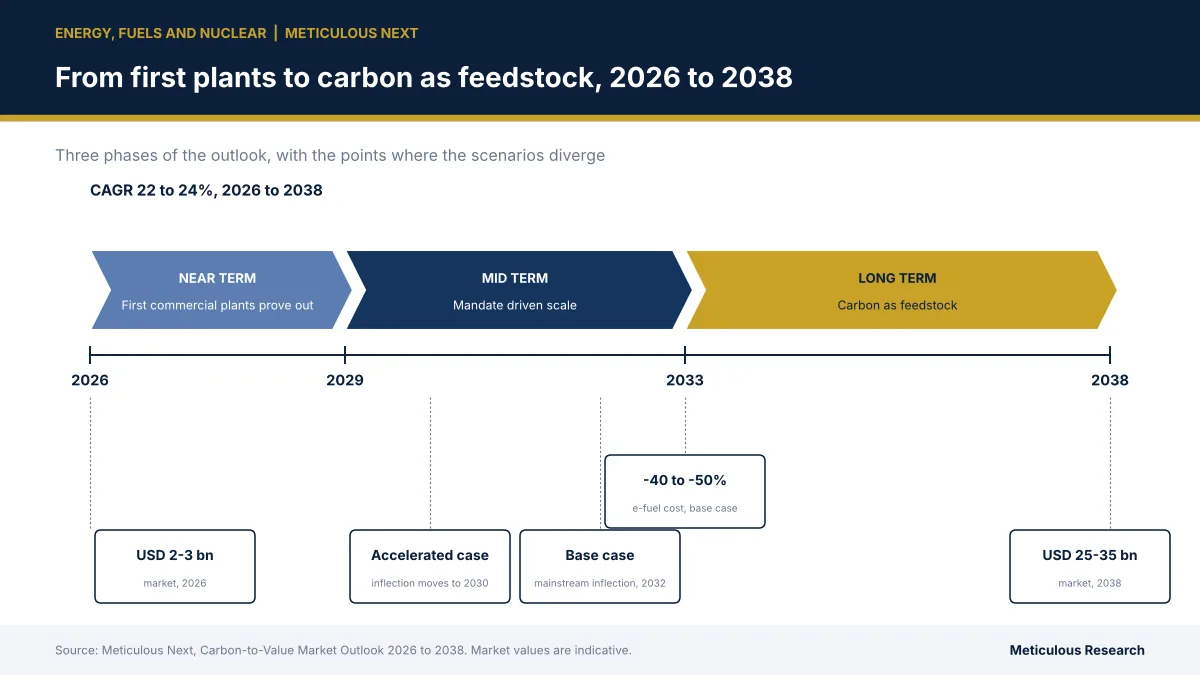
The brief splits the outlook into three phases:
- 2026 to 2029: first commercial plants prove out.
- 2029 to 2033: mandate driven scale.
- 2033 to 2038: carbon becomes a feedstock.
In the base case, mainstream inflection arrives around 2032, and mineralization reaches several hundred cement plant integrations by 2030. In the accelerated case, the inflection moves to 2030 and the 2038 value sits at the top of the range. In the delayed case, growth stays at the bottom of the range.
The gap between the cases is cost and policy, not technology. The first plants show the chemistry works at small scale. What is open is how fast the cost per tonne falls and whether mandates hold.
Strategic Implications
Fuel and chemical producers. Secure offtake before capital. Twelve placed its fuel with Alaska Airlines and Microsoft, and Kassø qualified for auction funding, which shows that contracted demand unlocks financing.
Cement and building materials. Mineralization has the clearest near term route, since it sells into an existing product and can be added to a plant. Carbon Upcycling secured up to USD 10 million in April 2026 for a 30,000 tonne a year line at a cement plant in Canada.
Investors. Back projects with contracts and a path to lower cost, and be careful with developers that depend on a single funding round. The LanzaJet restructuring is the reminder.
Policy makers. Mandates and credits are the main lever, and clear, indexed support such as 45Q gives developers the certainty they need to commit capital.
For all four, the shared advice is to track the signals above each quarter and update the plan when e-fuel cost, mandates or funding move.
Go Deeper: The Brief and Related Reports
The full brief, Carbon-to-Value Market Outlook 2026 to 2038, covers about 50 named players across six archetypes, three scenarios and the phase by phase timeline summarized here. A free preview is available on the page.
For a closer look at one of the main fuel routes, read the Bio-SAF Market report.
Frequently Asked Questions
What is CO2 utilization? It is the use of captured carbon dioxide as a raw material for fuels, chemicals and building materials. The brief excludes enhanced oil recovery, conventional urea and food grade CO2.
How big is the market? The brief gives an indicative USD 2.0 to 3.0 billion in 2026, rising to USD 25 to 35 billion by 2038, at a CAGR of 22 to 24%.
When will CO2 utilization reach the mainstream? The base case points to about 2032. The accelerated case moves that to 2030.
Which routes are closest to commercial scale? Mineralization in cement and concrete, and e-fuels and e-methanol, which have first commercial plants running or certified.
What could delay the market? Slower cost reduction for e-fuels, weaker mandates or tight funding, which is the delayed scenario in the brief.
Sources
- Meticulous Next, Carbon-to-Value Market Outlook 2026 to 2038, brief page, October 2026. The policy, company and plant figures above are as reported on this page and should be checked against the primary announcements before publishing.
- Meticulous Research, Bio-SAF Market
Related Market Intelligence Briefings
Recommended reading from the same research domain
METICULOUS INSIGHT
ReFuelEU Aviation SAF Mandate: 2025 Results, 2030 Targets and What Fuel Suppliers Must Do Next
The first year of the ReFuelEU Aviation SAF mandate is complete, and Europe cleared the bar. According to the European Union Aviation Safety...
METICULOUS INSIGHT
Sustainable Fuels for Aviation and Shipping: How SAF, Bio-Methanol and Waste-to-Hydrogen Compare
Aircraft and large ships cannot run on batteries over long distances. A long haul flight or an ocean crossing needs a dense liquid fuel, and...