Optical Network Equipment Market Outlook: Growth Drivers, Segments and Key Players

Optical network equipment market size and forecast
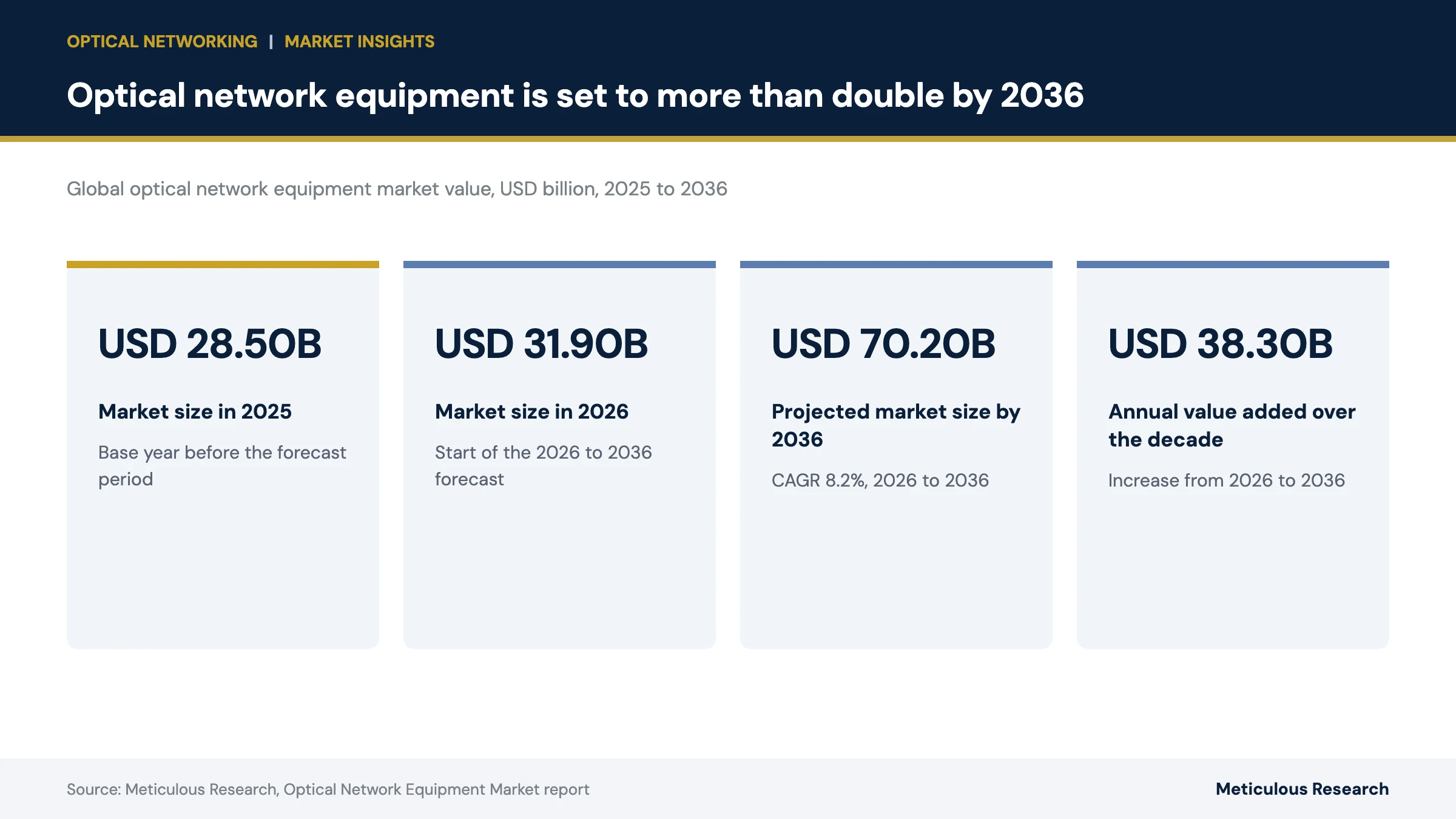
According to the Meticulous Research report, Optical Network Equipment Market, the market is valued at USD 31.90 billion in 2026 and is projected to reach USD 70.20 billion by 2036, at a CAGR of 8.2% from 2026 to 2036. The market stood at USD 28.50 billion in 2025.
A CAGR of 8.2% on a base this large adds USD 38.30 billion of annual market value over the decade. Optical gear is the transport layer under cloud, mobile and broadband traffic, so its growth tracks the build-out of all three.
Asia-Pacific holds the largest share of the market in 2026, driven by Chinese carrier networks and the largest fibre access base in the world. North America is the fastest-growing region, because hyperscale cloud operators are building data centres and linking them with optical capacity.
The mix of equipment is also shifting. Optical transport leads today, while optical transceivers and pluggables grow fastest, and coherent optics gains share within technology as networks move from 400G toward 800G and higher.
Optical network equipment market segments and growth drivers
Optical transport is the largest equipment type, and optical transceivers and pluggables are the fastest-growing. Dense wavelength division multiplexing (DWDM) leads by technology, while coherent optics grows fastest. Equipment running at 400G to 800G holds the largest share by data rate, and equipment above 800G grows fastest, as the share of up to 100G equipment declines.
Metro and regional networks are the largest application, and data centre interconnect is the fastest-growing. Telecom service providers are the largest end user, and cloud and hyperscale operators are the fastest-growing. Brownfield upgrades lead by deployment type, and greenfield builds grow fastest.
The report lists five drivers: AI data centre construction and the interconnect capacity needed to link it, coherent migration from 400G to 800G and higher, continued fibre access deployment, replacement of higher-risk vendors in European networks, and submarine cable construction.
Supplier results show how fast demand has moved. Ciena reported fiscal 2025 revenue of USD 4,769.5 million, up 18.8% from USD 4.01 billion a year earlier, and guided fiscal 2026 revenue to USD 5.7 billion to USD 6.1 billion. Optical Networking contributed USD 3,246.3 million, or 68.1%, of fiscal 2025 revenue. Guidance implies growth of about 20% to 28% in the current fiscal year, a pace well above the 8.2% CAGR of the wider market.
Fibre demand follows the same path. On 27 January 2026 Corning and Meta announced a multi-year commitment of up to USD 6 billion for optical fibre, cable and connectivity for AI data centres, including a new optical cable plant in Hickory, North Carolina. Hyperscale buyers are therefore signing multi-year supply agreements, which gives equipment and cable makers a firm base to expand capacity.
The restraints are capital expenditure discipline among telecom service providers, long qualification and procurement cycles in carrier networks, a declining cost per bit that offsets capacity growth in revenue terms, and component and optical supply constraints. Revenue therefore grows more slowly than the volume of bandwidth installed.
Optical network equipment market by region and key players
Asia-Pacific holds the largest share in 2026 on Chinese carrier networks and the largest fibre access base. Japan, India, South Korea, Australia and South-East Asia add to regional demand. North America is the fastest-growing region, with the United States holding the large majority of regional value.
Europe holds the third-largest share, and replacement of higher-risk vendors makes security policy part of the demand picture. On 20 January 2026 the European Commission proposed amending the Cybersecurity Act so that Member States must ensure components from high-risk suppliers are not used in key network infrastructure, with three years to comply. The proposal covers 18 critical sectors, including 5G and fibre optics, and it is still subject to approval by the Council and the European Parliament. The Commission has not yet named any suppliers. The report cites an Adtran estimate of nearly USD 1 billion a year of European replacement demand, a company estimate that is still being refined.
Latin America holds about 5.5% of the 2026 market, led by Brazil and then Mexico. The Middle East and Africa hold about 4.5%, led by Saudi Arabia and the UAE in the Gulf, with South Africa, Egypt, Nigeria, Kenya and Morocco named in Africa.
Some of the key players in the optical network equipment market are Huawei Technologies, Ciena, Nokia, ZTE, Cisco Systems (Acacia), Fujitsu, NEC, FiberHome, Adtran Holdings, Calix, Ribbon Communications, DZS and Juniper Networks, among others.
Opportunities lie in pluggable coherent optics inside routing platforms, open and disaggregated line systems, upgrades of passive optical networks to 25G and 50G, and extension of optical capacity into enterprise and private networks.
Related reports and Meticulous Next briefs
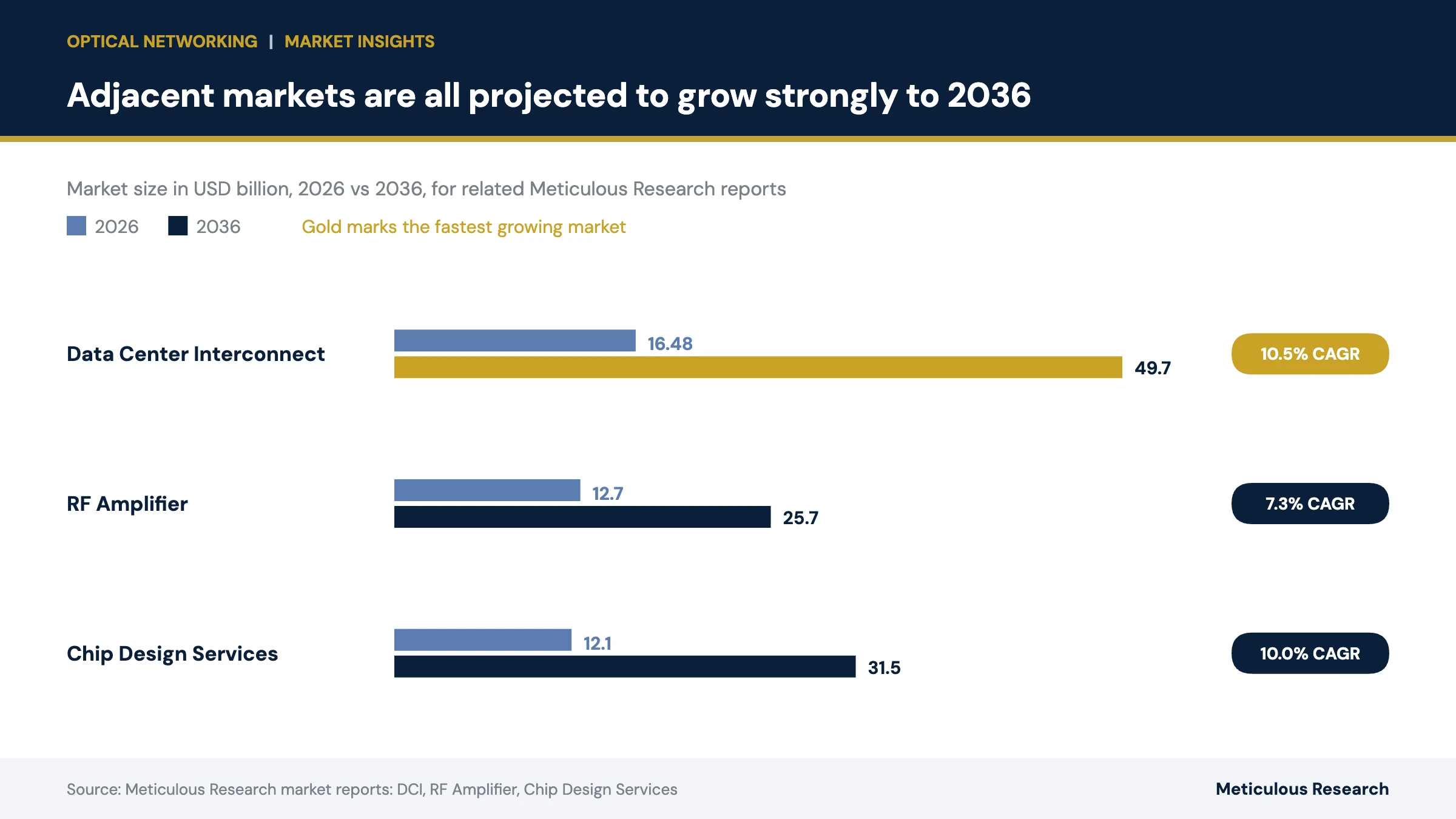
The Data Center Interconnect (DCI) Market report values the market at USD 16.48 billion in 2026 and projects USD 49.7 billion by 2036, at a CAGR of 10.5%. Long-haul connectivity is the fastest-growing type, and the shift from 100G to 400G and 800G coherent optics is a named driver, which is the same transition that lifts coherent optical equipment.
The RF Amplifier Market report values the market at USD 12.70 billion in 2026 and projects USD 25.70 billion by 2036, at a CAGR of 7.3%. It treats optical driver and transimpedance amplifiers as optical rather than RF components, so the two reports cover adjacent radio and fibre layers of the same networks. Satellite communications is the fastest-growing application in the RF report.
The Chip Design Services Market report values the market at USD 12.1 billion in 2026 and projects USD 31.5 billion by 2036, at a CAGR of 10.0%. AI and data centre is both the largest and the fastest-growing application, and Broadcom revenue tied to custom AI accelerators and networking is cited as a driver. Custom silicon for hyperscalers is therefore pulling optical interconnect demand along with it.
Two Meticulous Next briefs cover the technology and connectivity edges of the market:
- Neuromorphic and Photonic Computing Outlook 2026 to 2038 sizes the market at USD 1.5 to 2.5 billion in 2026, rising to USD 45 to 70 billion by 2038, at an indicative CAGR of 32 to 36%. Optical interconnect is expected to hold the largest share, which links the brief directly to optical equipment demand in AI infrastructure.
- Satellite Ground Station Networks Market Outlook 2026 to 2034 sizes the market at USD 1.00 to 1.60 billion in 2026, rising to USD 3.51 to 5.62 billion by 2034, at a CAGR of 17%. It lists optical ground stations among the enablers of shared, cloud-linked downlink networks.
Frequently Asked Questions
How big is the optical network equipment market?
The Meticulous Research report values the optical network equipment market at USD 31.90 billion in 2026 and projects USD 70.20 billion by 2036, at a CAGR of 8.2% from 2026 to 2036.
Which segments lead the optical network equipment market?
Optical transport, DWDM, 400G to 800G equipment, metro and regional networks, telecom service providers and brownfield upgrades are the largest segments. Optical transceivers and pluggables, coherent optics, equipment above 800G, data centre interconnect, cloud and hyperscale operators and greenfield builds are the fastest-growing.
Which region leads the optical network equipment market?
Asia-Pacific holds the largest share in 2026, and North America is the fastest-growing region.
What is driving demand for optical network equipment?
AI data centre construction and the interconnect capacity to link it, coherent migration from 400G to 800G and higher, fibre access deployment, replacement of higher-risk vendors in Europe and submarine cable construction.
Who are the key players?
Huawei Technologies, Ciena, Nokia, ZTE, Cisco Systems (Acacia), Fujitsu, NEC, FiberHome, Adtran Holdings, Calix, Ribbon Communications, DZS and Juniper Networks, among others.
Where can I find the full report?
The full report is available from Meticulous Research: Optical Network Equipment Market. Related reports cover Data Center Interconnect, RF Amplifiers and Chip Design Services.
Sources
- Meticulous Research, Optical Network Equipment Market, Data Center Interconnect Market, RF Amplifier Market and Chip Design Services Market report pages.
- Meticulous Research, Next briefs: Neuromorphic and Photonic Computing and Satellite Ground Station Networks.
- Ciena, Fiscal Fourth Quarter 2025 and Year End Financial Results, 11 December 2025.
- Corning, Corning and Meta announce multi-year, up to USD 6 billion agreement, 27 January 2026.
- Eunews, Critical infrastructure: Commission aims to ban Member States from selecting suppliers, 20 January 2026, reporting the European Commission cybersecurity package.
Looking for full market sizing & granular datasets?
Access our comprehensive market forecast reports:
- Optical Network Equipment Market - Global Opportunity Analysis and Industry Forecast (2026-2036)MRSE - 1042302
- Used & Refurbished Data Center GPU Market - Global Opportunity Analysis and Industry Forecast (2026-2036)MRSE - 1042299
- Chip Design Services Market - Global Opportunity Analysis and Industry Forecast (2026-2036)MRSE - 1042321
- Data Center Interconnect (DCI) Market - Global Opportunity Analysis And Industry Forecast (2026-2036)MRSE - 1041862
Related Market Intelligence Briefings
Recommended reading from the same research domain

METICULOUS INSIGHT
Liquid and Immersion Cooling Outlook 2026 to 2034: Key Signals, Technology Shifts and Strategic Implications
Liquid cooling has moved from a specialist option to the default design for rack-scale AI. According to the Meticulous Next brief, Liquid an...

METICULOUS INSIGHT
Data Center Cooling Technologies Compared: Liquid, Immersion, Waterless and Heat Reuse
Air is still the largest way to cool a data center, but every faster growing segment in our research points to liquid. Liquid, immersion, wa...

METICULOUS INSIGHT
Used and Refurbished Data Center GPU Market 2026: Demand Drivers, Challenges and Opportunities
When a new AI accelerator is hard to get and the wait is long, a GPU that has already done a few years of work in someone else rack starts t...