Battery Pack Market by Segment and Region: Where the Opportunity Sits
Every electric vehicle, grid battery and data center backup system ships with a battery pack, and the pack is where cells, electronics, cooling and structure become a product a customer can use. That makes the battery pack market a useful place to see where battery demand is actually turning into revenue, and which segments and regions will carry it to 2036.
Battery Pack Market Size and Forecast
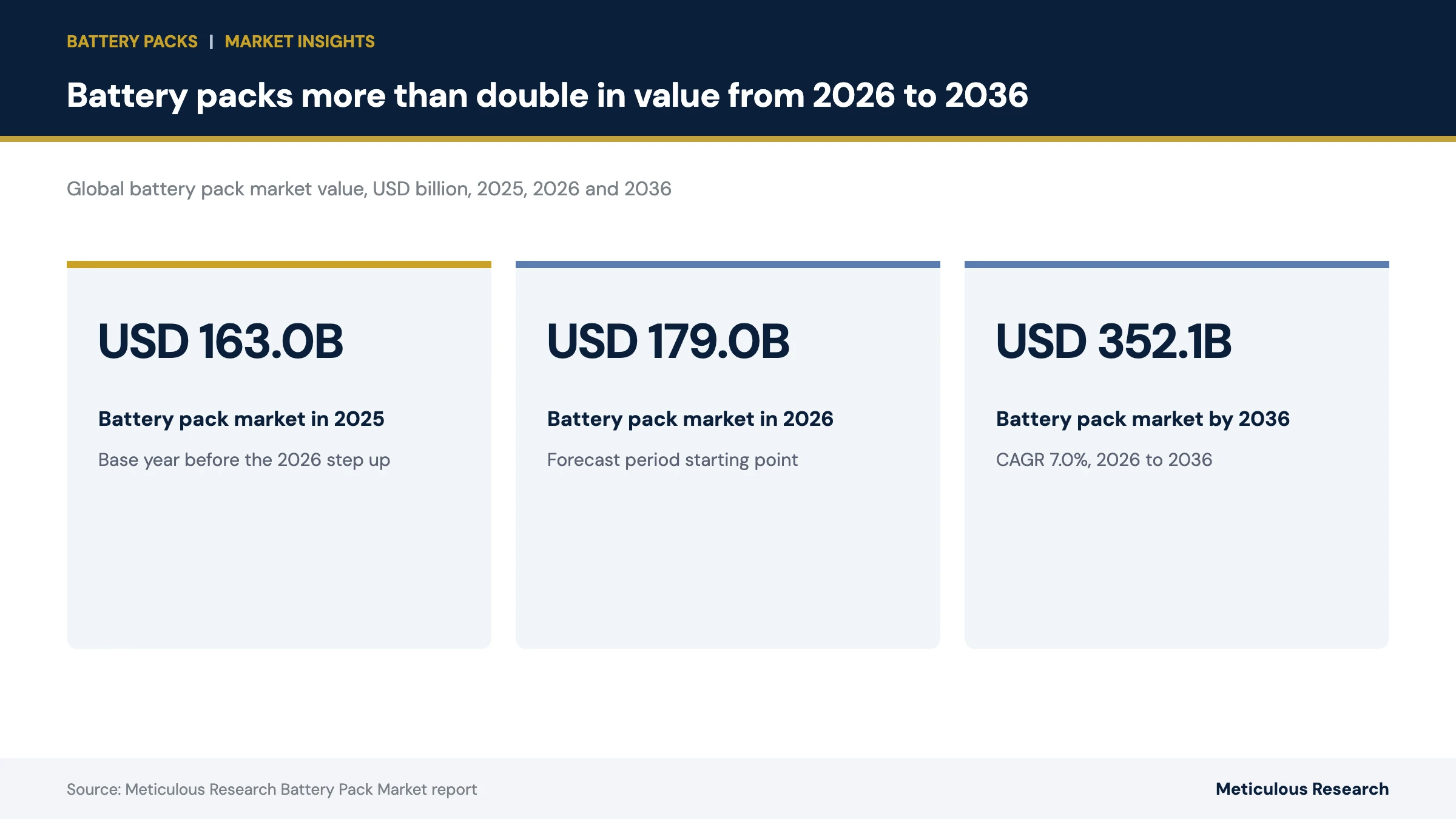
The battery pack market is valued at USD 179.0 billion in 2026 and is projected to reach USD 352.1 billion by 2036, at a CAGR of 7.0%. The market stood at USD 163.0 billion in 2025, so the step into 2026 is larger than the long run rate, and the forecast treats growth after 2026 as steadier. Packs sold in 2036 are worth more than twice those sold in 2026.
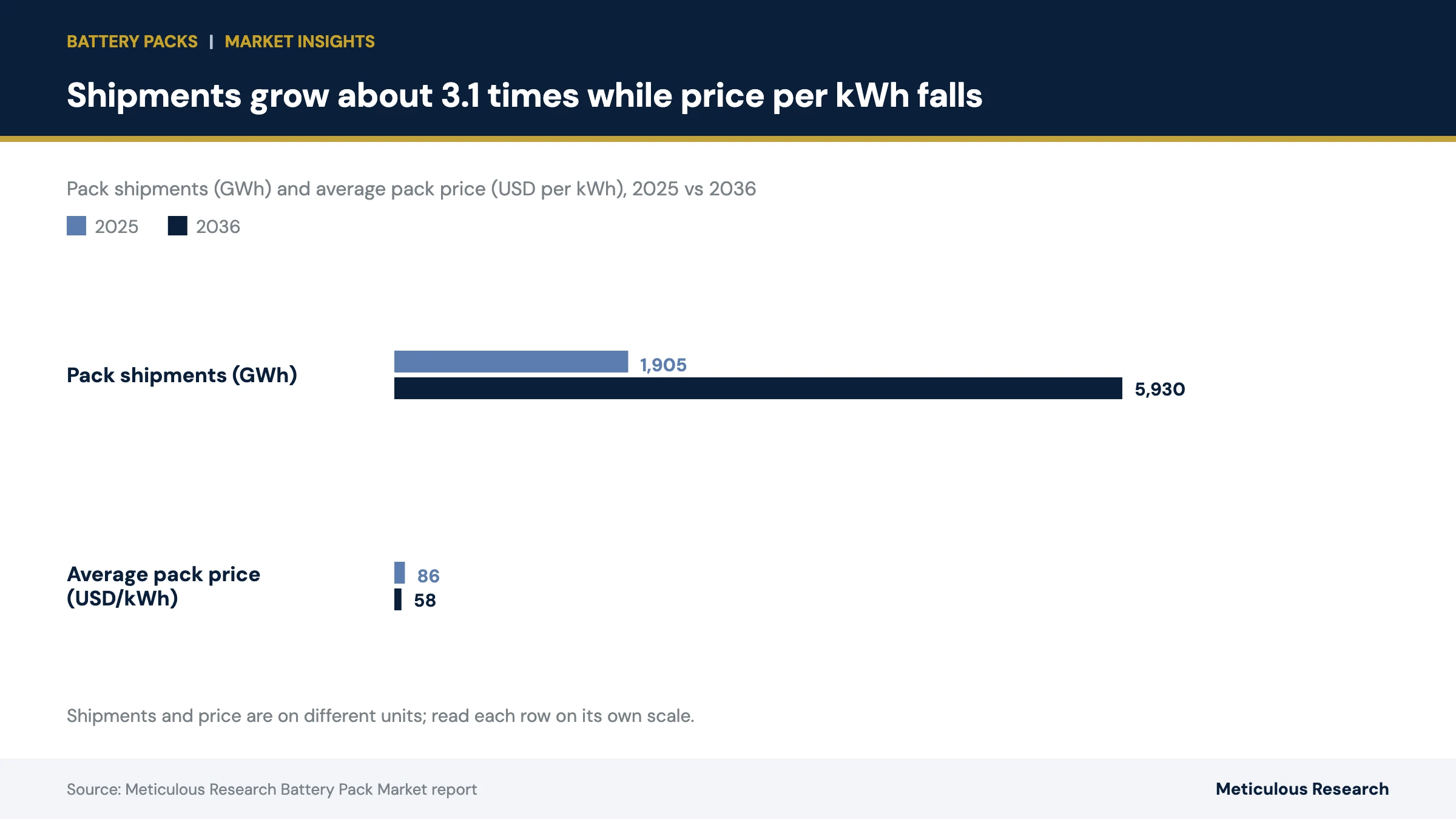
The volume and price picture explains why value grows more slowly than the energy shipped. Pack shipments are expected to rise from about 1,905 GWh in 2025 to about 5,930 GWh in 2036, while the average pack price falls from about USD 86 per kWh to about USD 58 per kWh. Shipped energy grows by roughly 3.1 times and price per kWh falls by about a third, which leaves market value at roughly 2.2 times its 2025 level. For pack makers, growth in revenue therefore depends on selling many more kilowatt hours at a lower price each, which puts the weight on manufacturing scale and cost control.
The key players in the market are CATL, BYD, LG Energy Solution, Samsung SDI, SK On, Panasonic Energy, CALB, EVE Energy, Gotion High-Tech and Sunwoda.
Battery Pack Market by Segment
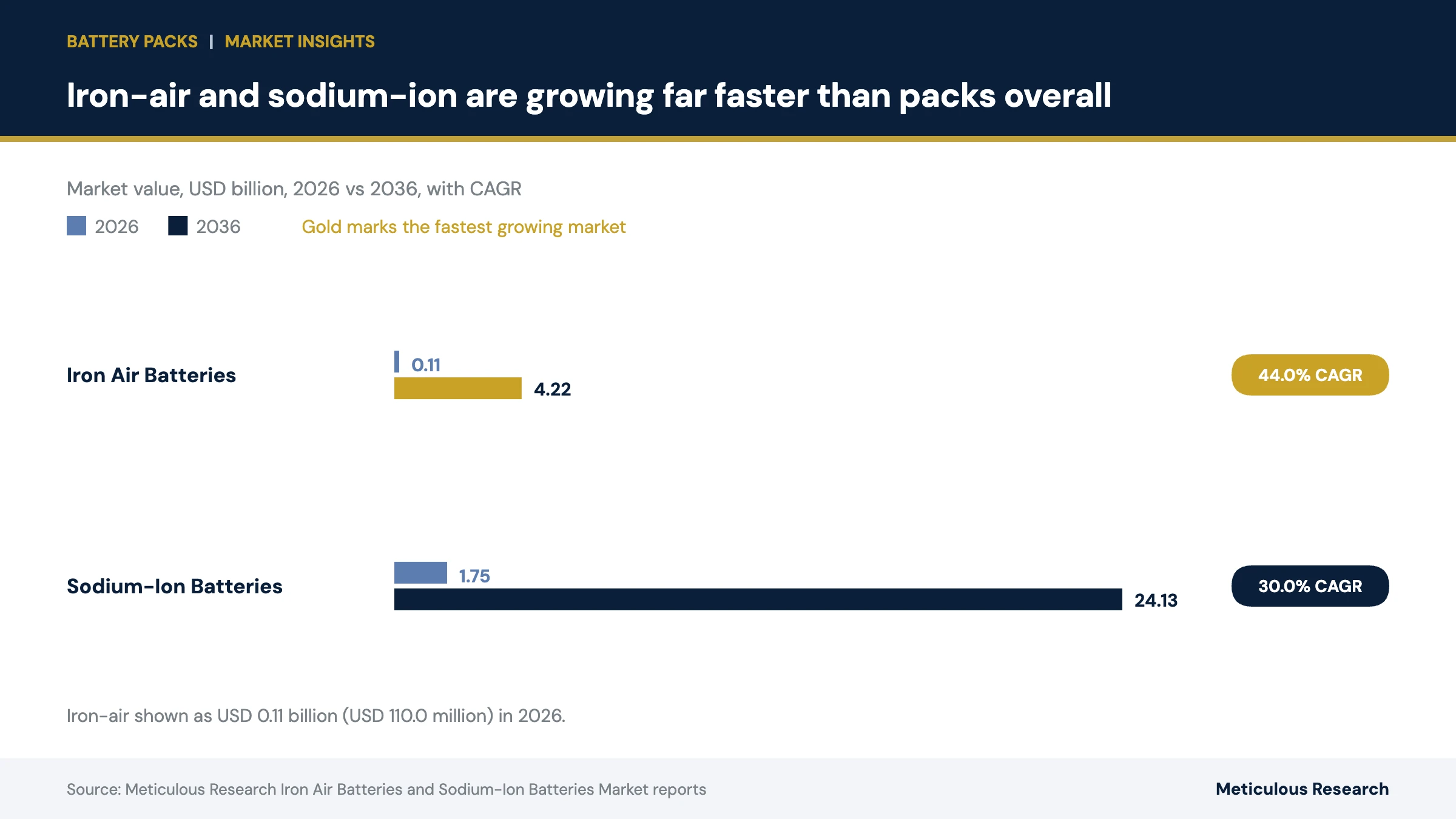
Lithium-ion packs are the largest battery type segment in 2026, and sodium-ion packs are the fastest growing. Lithium-ion holds the lead because cell supply, pack designs and qualification data are all built around it, while sodium-ion is growing from a very small base as cell makers begin commercial supply. The sodium-ion opportunity is covered in the Sodium-Ion Batteries Market report, which values that market at USD 1.75 billion in 2026 and projects USD 24.13 billion by 2036, at a CAGR of 30.0%.
By component, cells are the largest segment, because they carry most of the cost of a pack, and battery management systems are the fastest growing as every pack needs more sensing, balancing and software to manage safety and warranty risk. By pack architecture, module-based packs lead while cell-to-pack designs grow fastest. Removing the module stage lets more cells fit into the same volume and cuts parts, which is why vehicle makers and pack builders are moving toward it.
Prismatic is the largest cell format and cylindrical is the fastest growing. By capacity, packs of 50 to 100 kWh are the largest, which matches mainstream passenger vehicles, while packs above 250 kWh grow fastest as storage systems and heavy vehicles take a larger share of demand. By voltage, 100 to 400 V packs lead and 400 to 800 V packs grow fastest, in line with faster charging and higher power vehicles.
Automotive and transportation is the largest application, and stationary energy storage is the fastest growing. This is the clearest shift in the market, since packs for grids and data centers are built to different cycle life and cost targets than vehicle packs. Pack assembly by battery manufacturers is the largest assembly model, while in-house assembly by vehicle makers grows fastest. Original equipment manufacturers are the largest sales channel, and the aftermarket and replacement channel grows fastest as the installed base of packs ages.
Battery Pack Market by Region
Asia-Pacific holds the largest share of the battery pack market in 2026. China accounted for 60% of EV battery deployment in 2025 and produced over 80% of battery cells, according to the IEA. The leading pack makers reflect this, with CATL, BYD, CALB, EVE Energy, Gotion High-Tech and Sunwoda based in China, LG Energy Solution, Samsung SDI and SK On in South Korea, and Panasonic Energy in Japan. Cells, pack assembly and vehicle production sit close together in the region, which is why it leads in both volume and value.
North America is the fastest growing region. The US accounted for only about 10% of EV battery deployment in 2025, against almost 15% for the EU, so growth builds from a smaller base, and storage adds to it, since the US follows China in battery storage additions. Local content rules in the US also push pack assembly closer to the customer. Europe is the third largest region, shaped by vehicle electrification and by Regulation (EU) 2023/1542, which has applied to batteries placed on the EU market since 18 February 2024. Latin America is smaller, and the Middle East and Africa is the smallest region.
For pack suppliers, the regional split points to two strategies. In Asia-Pacific the contest is about cost and scale, while in North America and Europe it is about local content, compliance and proximity to customers.
Battery Pack Market Growth Drivers and Challenges
Electric vehicles remain the base of demand. EV battery deployment reached about 1.2 TWh in 2025, up almost 30% on 2024, and global electric car sales passed 20 million, about a quarter of all new cars, according to the IEA. Pack demand therefore keeps rising with vehicle output, and larger capacity and higher voltage packs follow the move to faster charging. BYD launched a 1,000 V platform with 1 MW charging in March 2025, which shows the power levels that pack design now has to meet.
Stationary storage and data centers add a second source of demand. Battery storage additions reached 108 GW in 2025, up 40% on 2024, and about 90% of deployments used LFP chemistry. Data center electricity demand rose 17% in 2025, and battery UPS capacity, mostly at data centers, grew 30% to 45 GW. The IEA describes onsite storage as becoming critical for AI data centers, which supports the high growth of packs above 250 kWh.
Pack design and chemistry are also changing what is sold. Cell-to-pack and cell-to-chassis designs remove modules and raise energy density, and the IEA notes that they were key to putting LFP into electric vehicles. LFP made up over 55% of EV batteries deployed in 2025 and its packs are more than 40% cheaper per kWh than NMC on average. Sodium-ion is the next step, with CATL launching its Naxtra cells in April 2025 at up to 175 Wh/kg and unveiling a sodium-ion passenger car with Changan in February 2026, although sodium-ion manufacturing capacity is still just over 1% of lithium-ion cell capacity.
Policy is moving supply chains toward the regions that buy the packs. In the US, Notice 2026-15 sets prohibited foreign entity rules for clean energy tax credits, with the material assistance threshold for storage at 55% for construction starting in 2026 and rising to 75% after 2029. In the EU, the Battery Regulation sets requirements that every pack placed on the market must meet. Packs that carry local content and compliance data gain access to these markets.
Price pressure is the main challenge. Average battery prices fell 8% in 2025, and the pack price per kWh in the forecast falls further, so margins depend on scale. Chinese regulators held a symposium on below cost pricing and blind capacity expansion, which shows how seriously overcapacity is taken. Lithium prices in early 2026 were more than double early 2025 levels, although about 70% below the 2022 peak, so raw material cost still moves pack pricing.
Trade policy adds further risk. China announced export controls on lithium battery, cathode and graphite anode items on 9 October 2025, and the suspension of these controls runs to 10 November 2026. The export VAT rebate on battery products fell from 9% to 6% on 1 April 2026 and is due to end on 1 January 2027. Pack makers outside China therefore plan for supply and cost changes, while cell-to-pack designs raise a recycling question that the IEA flags, since packs without modules are harder to take apart.
Related Battery Markets: Iron Air and Sodium-Ion
Two newer chemistries show where pack demand could widen. The Iron Air Batteries Market is valued at USD 110.0 million in 2026 and is projected to reach USD 4.22 billion by 2036, at a CAGR of 44.0%. Battery systems are the largest offering and data center power is the fastest growing application, with North America the largest region and Europe the fastest growing.
The Sodium-Ion Batteries Market is valued at USD 1.75 billion in 2026 and is projected to reach USD 24.13 billion by 2036, at a CAGR of 30.0%. Layered oxide is the largest cathode chemistry and polyanionic is the fastest growing, while grid scale energy storage is the largest application and electric vehicles are the fastest growing.
For the wider view of sodium-ion, iron-air, silicon anode and structural battery technologies, read our group blog, Next Generation Batteries: Sodium-Ion, Iron-Air, Silicon Anode and Structural Battery Technologies.
Frequently Asked Questions
How big is the battery pack market?
The battery pack market is valued at USD 179.0 billion in 2026 and is projected to reach USD 352.1 billion by 2036, at a CAGR of 7.0%.
Which battery pack segments are the largest and fastest growing?
Lithium-ion is the largest battery type and sodium-ion the fastest growing. Module-based packs lead by architecture while cell-to-pack grows fastest, and automotive and transportation is the largest application while stationary energy storage grows fastest.
Which region leads the battery pack market?
Asia-Pacific holds the largest share in 2026. North America is the fastest growing region and Europe is the third largest.
Why does market value grow more slowly than shipments?
Shipments are expected to rise from about 1,905 GWh in 2025 to about 5,930 GWh in 2036, while the average pack price falls from about USD 86 to about USD 58 per kWh, so each kilowatt hour sold earns less.
Who are the key players?
CATL, BYD, LG Energy Solution, Samsung SDI, SK On, Panasonic Energy, CALB, EVE Energy, Gotion High-Tech and Sunwoda.
Sources
- Meticulous Research, Battery Pack Market
- Meticulous Research, Iron Air Batteries Market
- Meticulous Research, Sodium-Ion Batteries Market
- IEA, Global EV Outlook 2026, Electric vehicle batteries
- IEA, Global EV Outlook 2026, Executive summary
- IEA, Global Energy Review 2026, Battery storage
- IEA, Data centre electricity use surged in 2025
- European Commission, Regulation (EU) 2023/1542 on batteries
- BYD, Super e-Platform with megawatt flash charging
- CnEVPost, CATL sodium batteries begin deployment in production passenger vehicles
- White & Case, Notice 2026-15 on prohibited foreign entity rules
- JD Supra, China suspends export controls
- Gasgoo, Battery industry entering the first year of anti-involution
Looking for full market sizing & granular datasets?
Access our comprehensive market forecast reports:
Related Market Intelligence Briefings
Recommended reading from the same research domain
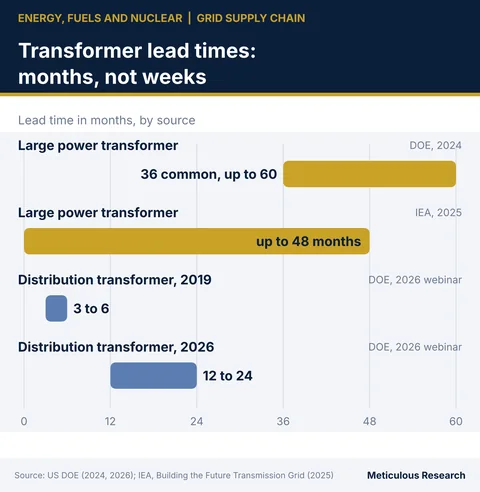
METICULOUS INSIGHT
Transformer Components Market Outlook: Growth Drivers, Segments and Key Players
A transformer is only as dependable as the parts inside it, and those parts are now where the supply chain is tightest. Winding conductors,...
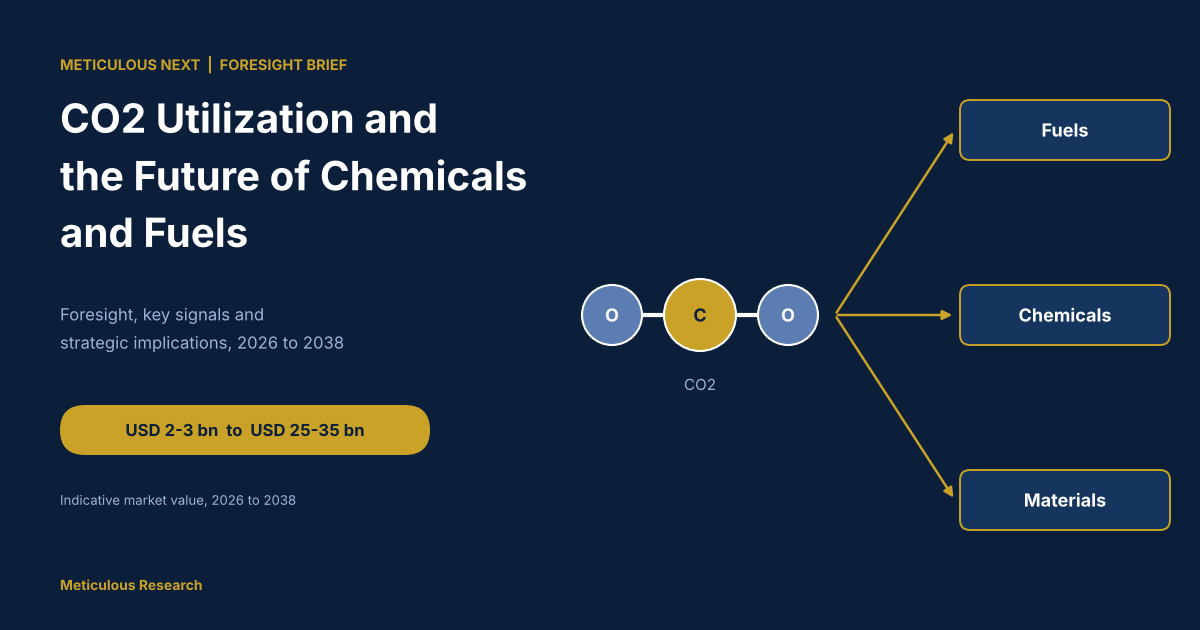
METICULOUS INSIGHT
CO2 Utilization and the Future of Chemicals and Fuels: Foresight, Key Signals and Strategic Implications
Carbon dioxide is turning from a waste stream into a raw material, and the next twelve years will decide which routes reach scale. Meticulou...
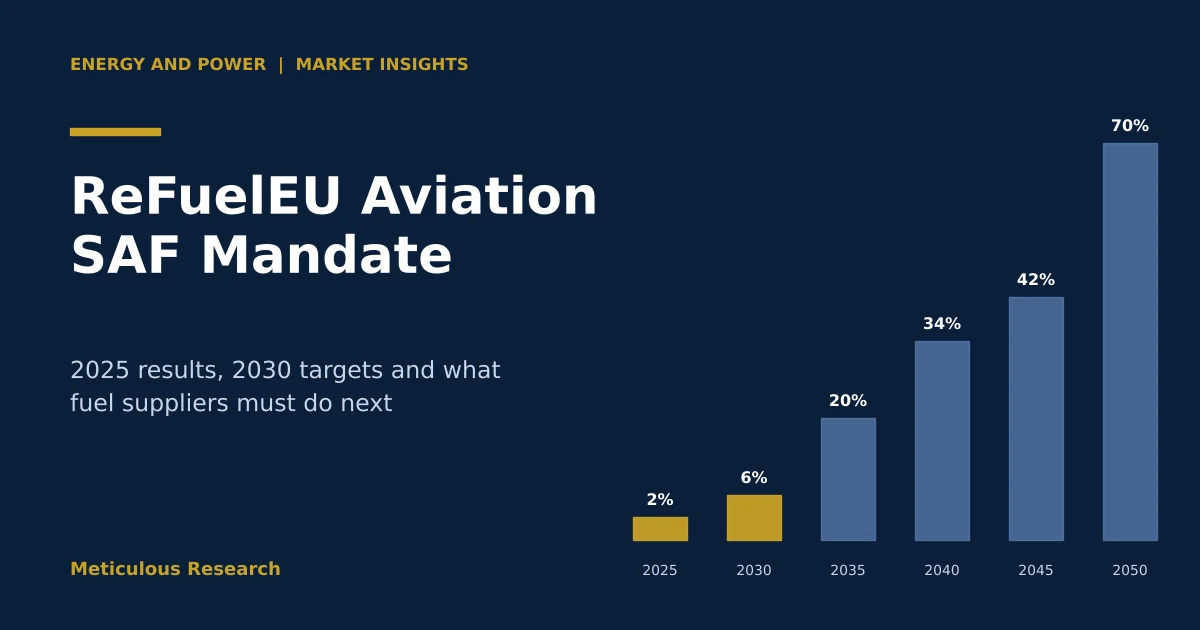
METICULOUS INSIGHT
ReFuelEU Aviation SAF Mandate: 2025 Results, 2030 Targets and What Fuel Suppliers Must Do Next
The first year of the ReFuelEU Aviation SAF mandate is complete, and Europe cleared the bar. According to the European Union Aviation Safety...