Spirulina, Chlorella and Phycocyanin Compared: Which Market Is Larger and Which Grows Faster?
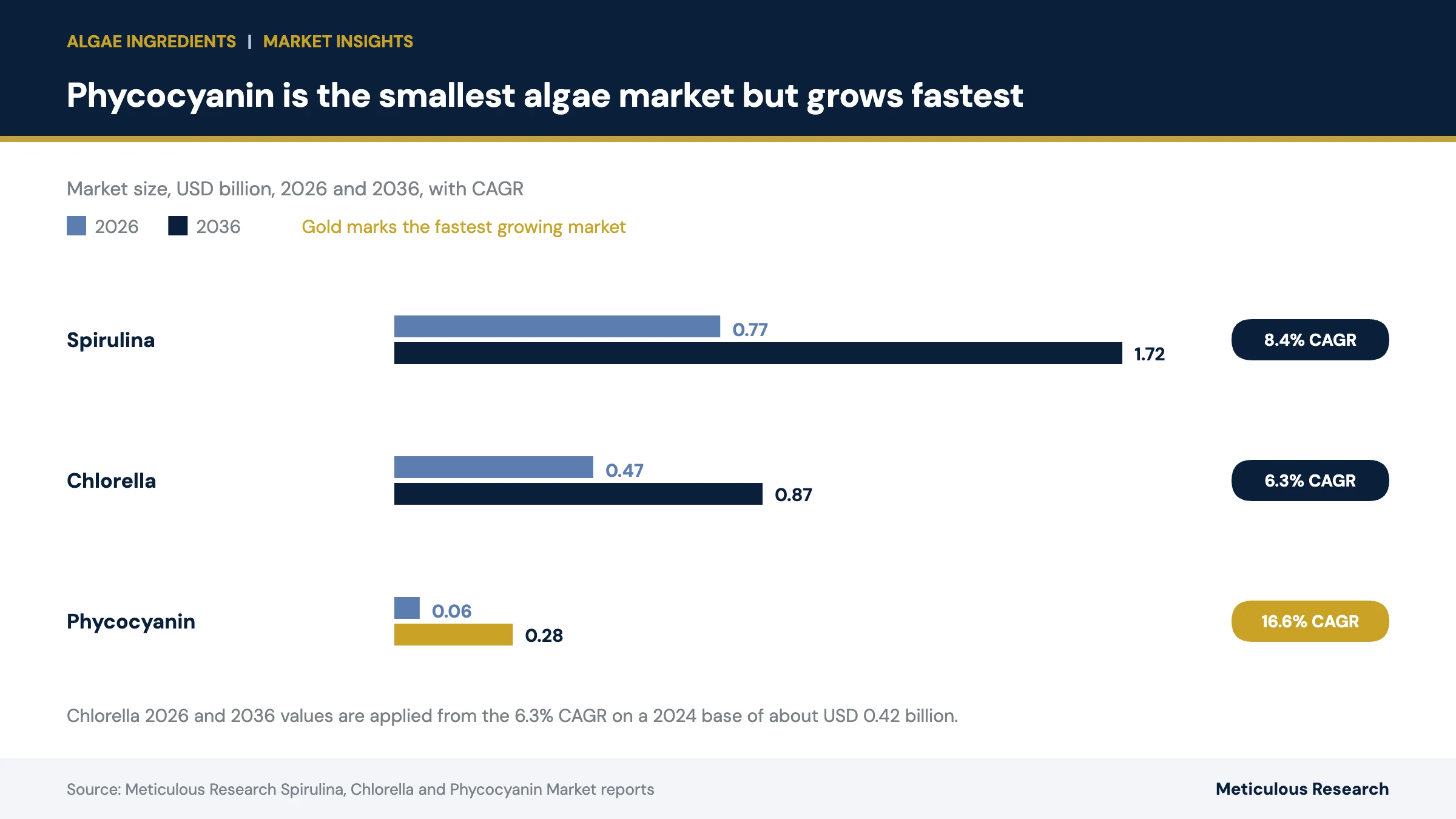
Spirulina is the largest of the three markets at USD 0.77 billion in 2026 and grows at 8.4% a year to USD 1.72 billion by 2036. Chlorella is the second largest at about USD 0.47 billion in 2026 and grows at 6.3% a year. Phycocyanin is the smallest at USD 0.06 billion in 2026 and the fastest, at 16.6% a year to USD 0.28 billion by 2036. Spirulina leads on size and phycocyanin leads on growth. The figures come from the Meticulous Research Spirulina Market, Phycocyanin Market and Chlorella Market reports.
The three markets overlap. Phycocyanin is the blue pigment extracted from spirulina, so a rise in colour demand lifts both. The spirulina report lists phycocyanin as the fastest growing product type inside the spirulina market, at 18.7% a year. Chlorella sits apart. The earlier chlorella edition puts powder at 69.9% of sales and nutraceuticals at 66.5% of use, so demand follows the supplement trade and not the colour trade.
Spirulina: the largest market at USD 0.77 billion
Spirulina was valued at USD 0.70 billion in 2025 and reaches USD 0.77 billion in 2026, about 75,455 tons. The Spirulina Market report forecasts USD 1.72 billion and about 160,205 tons by 2036, a value CAGR of 8.4% and a volume CAGR of 7.8%. Value grows faster than volume, so average prices per ton are rising.
The growth of this market is mainly driven by rising consumer focus on health and wellness, the expanding dietary supplements industry and the shift toward natural colorants. However, factors such as limited awareness of the benefits of spirulina, production complexities and contamination risks are expected to restrain the growth of this market to some extent.
Powder is the leading product type, ponds are the leading production technique and nutraceuticals are the leading application. Food and beverages is the fastest growing application, so the colour and ingredient trades are closing the gap on supplements. North America is the largest region and Europe grows fastest, at 13.7% a year.
Contamination is a regulatory matter as well as a commercial one. The US specification for spirulina extract used as a colour requires lead and arsenic at no more than 2 mg/kg, mercury at no more than 1 mg/kg and a negative result for microcystin toxin (21 CFR 73.530). Every batch sold into the colour trade has to pass that test, so contamination control is a cost of entry for growers.
Chlorella and phycocyanin: the steady market and the fast one
Chlorella is the older and steadier market. The earlier edition of the Chlorella Market report forecasts USD 0.64 billion by 2031 at a 6.3% CAGR, with volume growing faster at 7.4%. Applied to the 2024 base of about USD 0.42 billion, that rate gives USD 0.47 billion in 2026 and USD 0.87 billion in 2036. Europe holds 38.0% of sales and also grows fastest, at 7.2% a year. Chlorella extracts grow fastest by product at 9.1% a year, so the higher value lies in extracts and not in powder.
Phycocyanin is the smallest market and the fastest. The Phycocyanin Market report puts it at USD 59.23 million in 2026, up from USD 50.80 million in 2025, and USD 275.0 million by 2036, a CAGR of 16.6%. The report names two trends behind that rate: the clean-label movement away from synthetic colorants and rising use in cosmetics and personal care. Europe is the largest region and Asia-Pacific the fastest. Liquid grows faster than powder, cosmetic grade faster than food grade and organic faster than non-organic.
The colour trade is also where phycocyanin meets competition. The US FDA permits spirulina extract in confectionery, frozen desserts, beverages, yogurts and cereals (21 CFR 73.530). In May 2025 the agency also approved galdieria extract blue, a colour from the red alga Galdieria sulphuraria, for beverages, dairy products, candies and frozen desserts (HHS). A second algal blue gives buyers a choice, which is a risk to phycocyanin pricing as well as a sign that algal colours are gaining ground.
Where growth is fastest and what comes next
Europe appears in the fast lane of all three reports. It is the fastest spirulina region at 13.7% a year, the largest phycocyanin region and the largest and fastest chlorella region at 7.2% a year in the earlier edition. Producers that sell into Europe therefore see the strongest pull in each product.
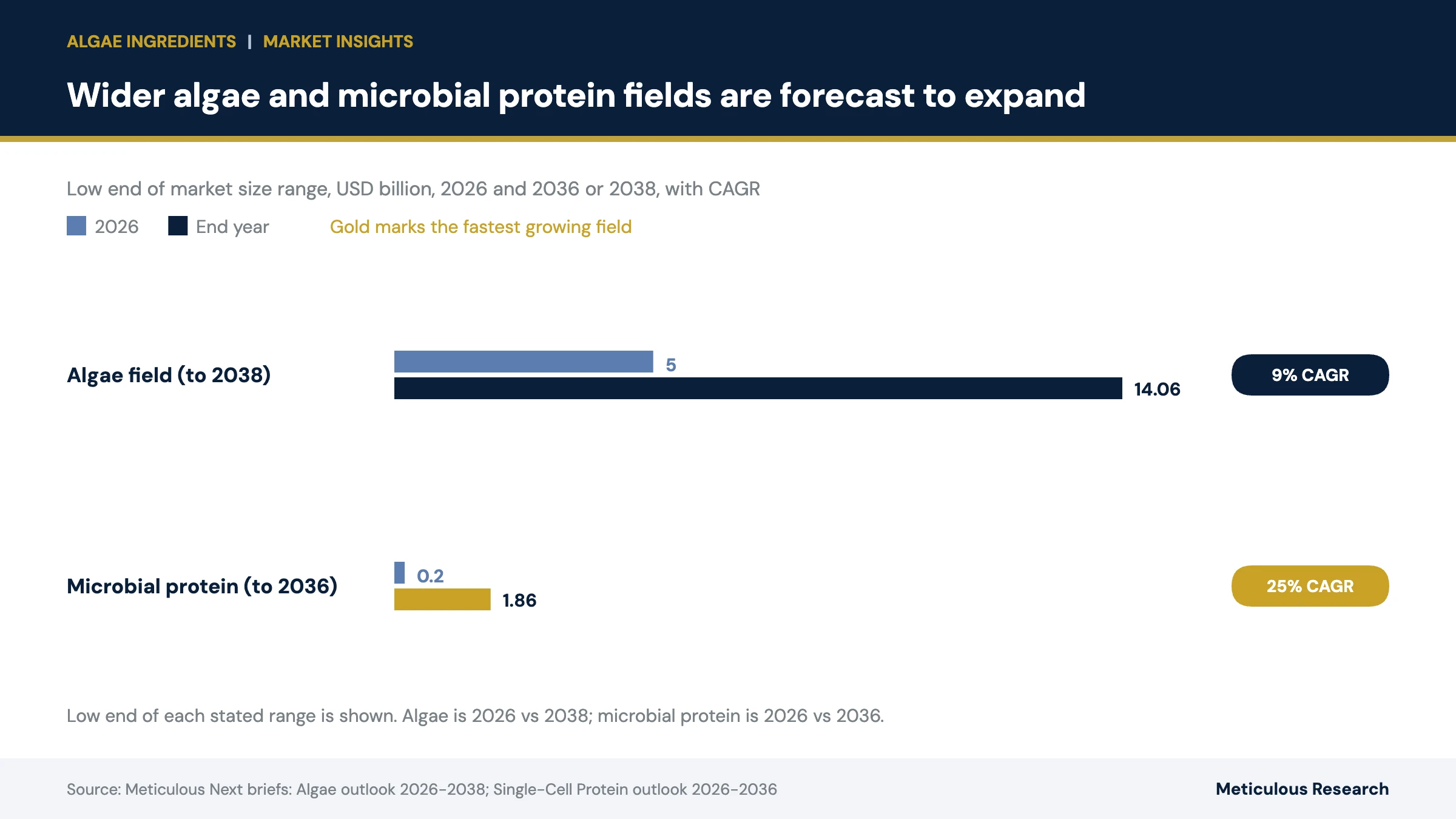
Two Meticulous Next briefs show where supply is heading. Algae and the Future of Biofuels, Feed and Biomaterials values the wider algae field at USD 5.00 to 8.00 billion in 2026 and USD 14.06 to 22.50 billion by 2038, a 9% CAGR. It names strain engineering and lower-cost photobioreactors as the main levers for cutting production cost. Single-Cell Protein and Gas Fermentation for Food and Feed sizes microbial protein, which includes microalgae, at USD 0.20 to 0.50 billion in 2026, rising to USD 1.86 to 4.66 billion by 2036 at 25% a year. Microalgae is one of four microbial routes in that brief, next to bacteria, yeast and fungi.
Spirulina is the larger market, chlorella the steadier one and phycocyanin the fastest. The full forecasts sit in the Spirulina Market, Phycocyanin Market and Chlorella Market reports.
Frequently Asked Questions
Which is larger, the spirulina market or the chlorella market?
Spirulina is larger. It is valued at USD 0.77 billion in 2026, against about USD 0.47 billion for chlorella.
Which grows faster, spirulina, chlorella or phycocyanin?
Phycocyanin grows fastest at 16.6% a year to 2036, ahead of spirulina at 8.4% and chlorella at 6.3%.
What is phycocyanin?
Phycocyanin is the blue pigment extracted from spirulina. In the US it is sold as spirulina extract, a colour permitted in foods under 21 CFR 73.530.
How large is the phycocyanin market?
The phycocyanin market is USD 59.23 million in 2026 and reaches USD 275.0 million by 2036.
Which region leads each market?
North America leads spirulina and Europe leads phycocyanin and chlorella.
Sources
- Meticulous Research, Spirulina Market
- Meticulous Research, Phycocyanin Market
- Meticulous Research, Chlorella Market
- Meticulous Next, Algae and the Future of Biofuels, Feed and Biomaterials
- Meticulous Next, Single-Cell Protein and Gas Fermentation for Food and Feed
- US eCFR, 21 CFR 73.530 Spirulina extract (Cornell LII)
- HHS, FDA approves three new natural food color additives
Looking for full market sizing & granular datasets?
Access our comprehensive market forecast reports:
Related Market Intelligence Briefings
Recommended reading from the same research domain
METICULOUS INSIGHT
What Is Black Soldier Fly Larvae Used For, and Who Buys It?
Black soldier fly larvae are processed into three products: protein meal, which aquafeed and pet food makers buy, oil, which is sold into th...
METICULOUS INSIGHT
Why Edible Insects Are Still Growing While Insect Startups Fail
The edible insects market is estimated at USD 90.38 million in 2026 and is projected to reach USD 1,656.16 million by 2036, at a CAGR of 33....

METICULOUS INSIGHT
Why Insect Farming Startups Failed, and What the Survivors Did Differently
In December 2025, a French commercial court placed Ÿnsect into judicial liquidation. The company had raised more than USD 600 million &...