Polyurethane Foam Catalysts Market (2026-2036)
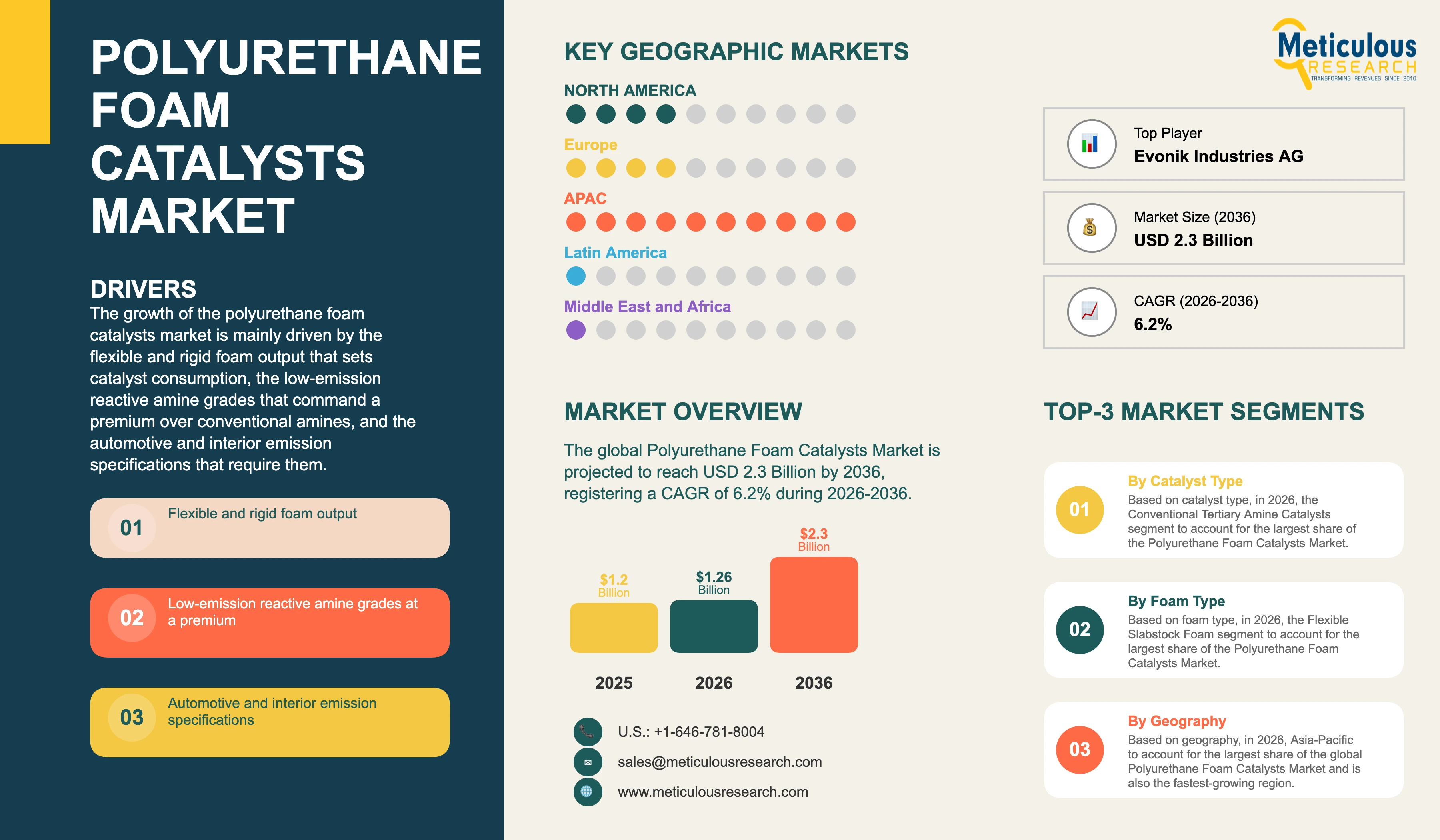
The global polyurethane foam catalysts market was valued at USD 1.20 billion in 2025. This market is expected to reach USD 2.30 billion by 2036 from an estimated USD 1.26 billion in 2026, registering a CAGR of 6.2% during the forecast period (2026-2036).
- Published
- Nov 2026
- Pages
- 254
- Format
- PDF + Excel
- Report ID
- MRCHM - 1042820
- Base year
- 2025
- 2025 · BASELINE
- $1.20B
- 2036
- $2.30B
- CAGR 2026–2036
- 6.2%
2025 baseline · 2026–2036 forecast at 6.2% CAGR · hover a bar for the value
Key highlights
The global polyurethane foam catalysts market is estimated at USD 1.26 billion in 2026 and is projected to reach USD 2.30 billion by 2036.
Market volume is estimated at 150.00 kilotons in 2026 and is projected to reach 205.54 kilotons by 2036 at a CAGR of 3.2%, measured as catalyst as supplied, including the diluent or carrier.
The average selling price is estimated at USD 8.40 per kg in 2026 and is projected to reach USD 11.20 per kg by 2036 as the low-emission reactive amine grades take a larger share.
Volume grows at 3.2% against value at 6.2%, and the gap is a mix shift toward emission-engineered grades rather than any growth in foam output.
Conventional tertiary amine catalysts are expected to account for the largest catalyst type share in 2026, while low-emission reactive amine catalysts are projected to register the highest CAGR of 11.0%.
Tin and organometallic catalysts are projected to grow at only 3.0%, the slowest catalyst type, as emission-optimised and alternative grades displace conventional stannous octoate.
Flexible slabstock foam is expected to hold the largest foam type share in 2026, while flexible moulded foam is projected to grow fastest at a CAGR of 7.4%.
Building and construction is expected to hold the largest end-use share in 2026, while automotive and transportation is projected to grow fastest at a CAGR of 7.4%.
Asia-Pacific is expected to hold the largest regional share in 2026 and is also projected to grow fastest at a CAGR of 7.6%.
Covestro AG reported on 26 February 2026 that its Performance Materials segment, which supplies the isocyanates and polyols the foam industry consumes, recorded fiscal 2025 sales of EUR 6.1 billion, down 12.1% from EUR 7.0 billion.
Segment EBITDA fell 34.1% to EUR 375 million from EUR 569 million, on lower margins and higher programme expenses, mainly from closing the Maasvlakte plant in the Netherlands that was operated jointly with LyondellBasell.
Group sales fell 8.7% to EUR 12.9 billion from EUR 14.2 billion, group EBITDA fell 30.9% to EUR 740 million from EUR 1.1 billion, free operating cash flow was negative EUR 283 million against positive EUR 89 million, and the group net result was negative EUR 644 million against negative EUR 266 million.
The company states that a sustainable recovery in global demand is not in sight, with overcapacity, price pressure and protectionist trade policy persisting, and selling prices declined across all regions.
Its 2026 guidance is for EBITDA in the region of the previous year level, which may deviate by a single-digit percentage, with free operating cash flow and return on capital employed above the weighted average cost of capital significantly improved against 2025 but given qualitatively rather than as ranges.
A fire at the Dormagen Chempark reduced full-year EBITDA by a low three-digit million euro amount, and no dividend was declared for fiscal 2025.
The Vencorex acquisition, covering sites at Rayong in Thailand and Freeport in Texas, was expected to close in the first half of 2026 if possible, and the XRG strategic partnership was completed on 10 December 2025 alongside a EUR 1.17 billion capital increase.
That release gives no core volume growth for the group or the segment, no raw material costs, no percentage change in selling prices, no sales volume, and no commentary at all on isocyanate or polyol demand, utilisation or capacity, or on furniture, mattress, construction, insulation or automotive end markets.
The Evonik additives guide for flexible polyether foam, carrying a 10/2021 marking and issued by Evonik Operations GmbH, shows a conventional catalyst set alongside a parallel low-emission reactive family built for emissions rather than for reactivity.
The conventional set includes DABCO 33 LV, triethylenediamine in dipropylene glycol, as the standard gel catalyst, DABCO BL 11, bis(2-dimethylaminoethyl)ether, as the standard blowing catalyst, DABCO BL 13 as a diluted version of it, DABCO DMEA as a moderately active blowing catalyst and DABCO BLV as a standard balanced catalyst.
The low-emission reactive family runs to seven grades across the same duties, with DABCO NE 300 and NE 340 for blowing, DABCO NE 500, NE 1082 and NE 750 for gelling, and DABCO NE 650 and NE 660 as balanced grades.
DABCO NE 750 is described as an extra low emission amine catalyst with outstanding gel selectivity, recommended for viscoelastic and hyper soft foams, and is tied to the LGA and OEKO-TEX comfort industry labels and to automotive specifications including VDA 278.
On the tin side KOSMOS T 9 is stannous octoate, KOSMOS T 900 is described as an alternative to stannous octoate offering improved environment, health and safety performance, and KOSMOS EF is described as an emission optimised stannous catalyst, so tin is being reformulated rather than removed.
KOSMOS 54 is a co-catalyst for cold flow prevention in high resilience and viscoelastic foams, and DABCO BA 100 is an acid-based blocking agent that delays cream time and reduces or eliminates pinholes.
That guide gives no CAS numbers for most grades, no stated function at all for the three tin catalysts, no recommended dosage for any grade other than two points on one compression set chart, no tin content, no quantitative emission or VOC values, no fogging data and no physical properties.
It also labels that chart DABCO T 9 where the product is named KOSMOS T 9 elsewhere, carries chart values that cannot be read as numbers, and includes chart labels whose meaning is not stated.
Report summary
| Particulars | Details |
|---|---|
| Base Year | 2025 |
| Forecast Period | 2026-2036 |
| Market Size in 2025 | USD 1.20 billion |
| Market Size in 2026 | USD 1.26 billion |
| Market Size by 2036 | USD 2.30 billion |
| Value CAGR (2026-2036) | 6.2% |
| Format | PDF, Excel & Cloud Portal · 254 pages |
| Volume in 2026 | 150.00 kilotons |
| Volume by 2036 | 205.54 kilotons |
| Volume CAGR (2026-2036) | 3.2% |
| Volume Basis | Catalyst as supplied, including the diluent or carrier in which a grade is sold |
| Average Selling Price in 2026 | USD 8.40 per kg |
| Average Selling Price by 2036 | USD 11.20 per kg |
| Price Direction | The average selling price rises across the forecast period as low-emission reactive amine grades replace conventional amines in the same positions in the same formulations, rather than through any increase in the price of an individual grade |
| Volume Basis Note | The as-supplied basis is imposed by disclosure rather than chosen: a leading supplier describes DABCO 33 LV as triethylenediamine in dipropylene glycol and DABCO BL 13 as a diluted version of DABCO BL 11, gives no active content for any grade and no tin content for KOSMOS T 9, KOSMOS T 900 or KOSMOS EF, so an active basis would require figures no supplier publishes; this diverges deliberately from the phase transfer catalysts title in this series, which is measured on a 100% active basis because that supplier range does publish concentrations |
| Scope Exclusion Note | The polyol and isocyanate themselves are excluded, as are surfactants, blowing agents, flame retardants, chain extenders and crosslinkers; those exclusions are far larger than this market, since the catalyst package is typically one to three parts per hundred polyol while the polyol and isocyanate account for the great majority of the formulation mass |
| Measurement Basis | Catalysts controlling the gelling, blowing and trimerisation reactions in polyurethane and polyisocyanurate foam, including conventional tertiary amines, low-emission reactive amines, tin and organometallic catalysts, potassium and other metal carboxylates, and blocked and delayed-action catalysts, by catalyst type, foam type, end-use industry and geography |
| Relationship to Adjacent Markets | Quaternary ammonium carboxylate catalysts used for isocyanurate trimerisation are counted here rather than in the phase transfer catalysts market in this series, because they act as a base catalyst within a single phase rather than transferring an anion across a phase boundary; quaternary ammonium compounds supplied as biocides are counted in the quaternary ammonium biocides market; the tertiary amines in this market are excluded from the organocatalysts market, which covers the asymmetric and fine chemical synthesis classes; and this market is not additive to any of the metal or heterogeneous catalyst titles in this series |
| Note on the Output Driver | Covestro AG reported on 26 February 2026 that its Performance Materials segment, which supplies the isocyanates and polyols the foam industry consumes, recorded fiscal 2025 sales of EUR 6.1 billion, down 12.1% from EUR 7.0 billion, and segment EBITDA of EUR 375 million, down 34.1% from EUR 569 million, on lower margins and higher programme expenses mainly from closing the Maasvlakte plant in the Netherlands operated jointly with LyondellBasell; group sales fell 8.7% to EUR 12.9 billion, group EBITDA fell 30.9% to EUR 740 million, free operating cash flow was negative EUR 283 million against positive EUR 89 million, the group net result was negative EUR 644 million against negative EUR 266 million, a Dormagen Chempark fire reduced full-year EBITDA by a low three-digit million euro amount, and no dividend was declared |
| Note on the Demand Outlook | The same release states that a sustainable recovery in global demand is not in sight, with overcapacity, price pressure and protectionist trade policy persisting and selling price declines across all regions, and guides 2026 EBITDA to the region of the previous year level with a possible single-digit percentage deviation, with free operating cash flow and return on capital employed above the weighted average cost of capital significantly improved but stated qualitatively; catalyst volume in this report is forecast at 3.2% accordingly, and the value growth rests on catalyst mix rather than on foam tonnage |
| Note on the Catalyst Range | The Evonik additives guide for flexible polyether foam, carrying a 10/2021 marking and issued by Evonik Operations GmbH, lists a conventional set of DABCO 33 LV (triethylenediamine in dipropylene glycol, gelling), DABCO BL 11 (bis(2-dimethylaminoethyl)ether, blowing), DABCO BL 13 (a diluted version of BL 11), DABCO DMEA (moderately active blowing) and DABCO BLV (balanced), alongside a parallel low-emission reactive family of DABCO NE 300 and NE 340 (blowing), NE 500, NE 1082 and NE 750 (gelling) and NE 650 and NE 660 (balanced); on the tin side KOSMOS T 9 is stannous octoate, KOSMOS T 900 an alternative to it offering improved environment, health and safety performance, and KOSMOS EF an emission optimised stannous catalyst; KOSMOS 54 is a co-catalyst for cold flow prevention in high resilience and viscoelastic foams and DABCO BA 100 an acid-based blocking agent that delays cream time and reduces or eliminates pinholes |
| Note on Emission Specifications | DABCO NE 750 is described as an extra low emission amine catalyst with outstanding gel selectivity, recommended for viscoelastic and hyper soft foams, and is tied to the LGA and OEKO-TEX comfort industry labels and automotive specifications including VDA 278, with reduced tack free time, reduced odour and foams that can meet PVC staining tests; the guide states only that the reactive grades have reduced emissions compared with traditional amines and lower VOC exposure for workers and consumers, without attaching any figure to either claim |
| Note on Tin Catalysts | Conventional stannous octoate, an alternative to it and an emission optimised stannous catalyst all remain in the same supplier range with no tin content disclosed for any of them, so the 3.0% forecast for tin and organometallic catalysts describes reformulation within the position and partial displacement at its edges rather than removal from flexible slabstock, and nothing in the available disclosure supports a forecast of tin being removed |
| Note on Source Limitations | The Covestro release gives no core volume growth for the group or the segment, no raw material costs, no percentage change in selling prices, no sales volume, and no commentary on isocyanate or polyol demand, utilisation or capacity, or on furniture, mattress, construction, insulation or automotive end markets; the Evonik guide gives no CAS numbers for most grades, no stated function at all for the three tin catalysts, no recommended dosage other than two points on one compression set chart, no tin content, no quantitative emission or VOC values, no fogging data and no physical properties, labels that chart DABCO T 9 where the product is named KOSMOS T 9 elsewhere, carries chart values that cannot be read as numbers and two chart labels whose meaning is not stated, and its 10/2021 marking appears near the disclaimer without being identified as a publication or revision date |
| Note on Market Structure | Catalyst is supplied alongside surfactant and technical service because a foam formulation is developed as a package, and replacing a catalyst in a qualified foam means requalifying that foam against its emission specification, so the five companies profiled account for an estimated 58.6% of this market; Chinese amine catalyst producers supply a further part, particularly in conventional triethylenediamine and ether amine grades, and organotin specialists supply part of the tin position, with those positions described in this report rather than listed because available disclosure does not support attributing a share to individual producers |
| Largest Catalyst Type | Conventional tertiary amine catalysts |
| Fastest-Growing Catalyst Type | Low-emission reactive amine catalysts (CAGR 11.0%) |
| Slowest-Growing Catalyst Type | Tin and organometallic catalysts (CAGR 3.0%) |
| Largest Foam Type | Flexible slabstock foam |
| Fastest-Growing Foam Type | Flexible moulded foam (CAGR 7.4%) |
| Largest End-Use Industry | Building and construction |
| Fastest-Growing End-Use Industry | Automotive and transportation (CAGR 7.4%) |
| Largest Region | Asia-Pacific |
| Fastest-Growing Region | Asia-Pacific (CAGR 7.6%) |
| Slowest-Growing Region | Europe (CAGR 3.8%), with the Netherlands at 3.0% following the Maasvlakte closure |
| Segments Covered | Catalyst Type, Foam Type, End-Use Industry, and Geography |
| Geographies Covered | Asia-Pacific, North America, Europe, Latin America, and Middle East & Africa |
| Companies Profiled | 5 companies, including Evonik Industries AG, Huntsman Corporation, Tosoh Corporation, Kao Corporation, and The Shepherd Chemical Company |
Report overview
Segments covered: catalyst type, foam type, end-use industry.
In volume terms, this market is estimated at 150.00 kilotons in 2026 and is projected to reach 205.54 kilotons by 2036, registering a CAGR of 3.2% during the same period, measured as catalyst as supplied, including the diluent or carrier in which a grade is sold. The average selling price is estimated at USD 8.40 per kg in 2026 and is projected to rise to USD 11.20 per kg by 2036 as the low-emission reactive amine grades take a larger share of a market whose tonnage sits in the conventional tertiary amines.
The as-supplied basis is set by what suppliers disclose rather than chosen. The Evonik range describes DABCO 33 LV as triethylenediamine in dipropylene glycol and DABCO BL 13 as a diluted version of DABCO BL 11, and gives no active content for any grade and no tin content for any tin catalyst, so an active basis cannot be constructed from available disclosure. That is a deliberate divergence from the phase transfer catalysts title in this series, which is measured on a 100% active basis, and the reason is the difference in what the two supplier ranges publish.
The growth of this market is mainly driven by the flexible and rigid foam output that sets catalyst consumption, the low-emission reactive amine grades that command a premium over conventional amines, the automotive and interior emission specifications that require them, and the insulation and appliance demand that carries the rigid foam catalyst packages. However, factors such as the polyurethane raw material overcapacity and price pressure that the leading producer describes as persisting, the absence of any sustainable demand recovery in the view of that producer, the European and Japanese foam bases that are not expanding, and the capacity closures already taken in the chain are expected to restrain the growth of this market to some extent.
Conventional tertiary amine catalysts account for the largest catalyst type share of this market, while low-emission reactive amine catalysts grow fastest. Asia-Pacific holds the largest regional share and is also the fastest-growing region.
Polyurethane foam catalysts control the balance between the gelling reaction that builds polymer and the blowing reaction that generates gas, and in rigid systems the trimerisation that forms isocyanurate rings. Market sizing in this report is on both a value basis in USD and a volume basis in kilotons measured as catalyst as supplied, including the diluent or carrier in which a grade is sold, with average selling price derived from the two.
The as-supplied basis is imposed by disclosure. The Evonik range describes DABCO 33 LV as triethylenediamine in dipropylene glycol and DABCO BL 13 as a diluted version of DABCO BL 11, gives no active content for any grade, and gives no tin content for KOSMOS T 9, KOSMOS T 900 or KOSMOS EF. An active basis would require numbers no supplier publishes, and the phase transfer catalysts title in this series is measured on a 100% active basis only because that range does publish concentrations.
The polyol and isocyanate themselves are outside this market, as are surfactants, blowing agents, flame retardants, chain extenders and crosslinkers. Those exclusions are far larger than this market, since the catalyst package is typically one to three parts per hundred polyol while the polyol and isocyanate account for the great majority of the formulation mass.
The driver named for this title is foam output, and the most current primary evidence on the state of that output runs against it. Covestro AG reported on 26 February 2026 that its Performance Materials segment, which supplies the isocyanates and polyols the foam industry consumes, recorded fiscal 2025 sales of EUR 6.1 billion, down 12.1% from EUR 7.0 billion, and segment EBITDA of EUR 375 million, down 34.1% from EUR 569 million.
The reasons given are lower margins and higher programme expenses, mainly from closing the Maasvlakte plant in the Netherlands that had been operated jointly with LyondellBasell. A producer at that position in the chain closing capacity is a stronger statement about demand than any forecast of foam growth.
The group figures are worse again. Sales fell 8.7% to EUR 12.9 billion, EBITDA fell 30.9% to EUR 740 million, free operating cash flow turned negative at EUR 283 million against positive EUR 89 million, the group net result was negative EUR 644 million against negative EUR 266 million, and no dividend was declared. A fire at the Dormagen Chempark reduced full-year EBITDA by a low three-digit million euro amount.
The forward statement is the part that governs this forecast. The company states that a sustainable recovery in global demand is not in sight, with overcapacity, price pressure and protectionist trade policy persisting, and guides 2026 EBITDA to the region of the previous year level with a possible single-digit percentage deviation. Selling price declines occurred across all regions.
Catalyst volume in this market is forecast at 3.2% for that reason, which is a deliberately restrained figure against a driver expressed as foam output. Catalyst consumption follows foam actually produced, and the producer closest to the raw material says the demand recovery that would lift that output is not in sight.
Where the value growth comes from instead is visible in what a leading catalyst supplier now sells. The Evonik additives guide for flexible polyether foam, carrying a 10/2021 marking and issued by Evonik Operations GmbH, lists a conventional catalyst set and, alongside it, a parallel low-emission reactive family covering the same duties.
The conventional set is the long-established one: DABCO 33 LV, triethylenediamine in dipropylene glycol, as the standard gel catalyst; DABCO BL 11, bis(2-dimethylaminoethyl)ether, as the standard blowing catalyst; DABCO BL 13 as a diluted version of it; DABCO DMEA as a moderately active blowing catalyst; and DABCO BLV as a standard balanced catalyst.
The low-emission reactive family runs to seven grades across the same three duties, with DABCO NE 300 and NE 340 for blowing, DABCO NE 500, NE 1082 and NE 750 for gelling, and DABCO NE 650 and NE 660 as balanced grades. A parallel product line of that size exists because emissions rather than reactivity is now the property being sold, and it is the reason value in this market grows at 6.2% against volume at 3.2%.
The specifications those grades are written against are named. DABCO NE 750 is described as an extra low emission amine catalyst with outstanding gel selectivity, recommended for viscoelastic and hyper soft foams, and is tied to the LGA and OEKO-TEX comfort industry labels and to automotive specifications including VDA 278, with reduced tack free time, reduced odour and foams that can meet PVC staining tests.
A reactive amine catalyst carries a hydroxyl or other isocyanate-reactive group and is built into the polymer rather than remaining free to migrate, which is what reduces emission and odour. The guide states only that the NE grades have reduced emissions compared with traditional amines and lower VOC exposure for workers and consumers, without attaching any figure to either claim.
Tin is being engineered rather than eliminated, and the range shows it directly. KOSMOS T 9 is stannous octoate, KOSMOS T 900 is described as an alternative to stannous octoate offering improved environment, health and safety performance, and KOSMOS EF is described as an emission optimised stannous catalyst. All three remain in the range, and no tin content is given for any of them.
Tin and organometallic catalysts are accordingly forecast at 3.0%, the slowest catalyst type in this report, which reflects substitution within the tin position and partial displacement by amine and carboxylate chemistry rather than a prohibition. Nothing in the available disclosure supports a forecast of tin being removed from flexible slabstock.
Two further grades in that range describe duties a general account of this market usually omits. KOSMOS 54 is a co-catalyst for cold flow prevention in high resilience and viscoelastic foams, and DABCO BA 100 is an acid-based blocking agent that delays cream time and reduces or eliminates pinholes. Delayed action and blocked catalysts are sold for process control rather than for reaction rate, and they are forecast at 8.4%.
What neither source discloses limits what can be built on them. The Covestro release gives no core volume growth for the group or the segment, no raw material costs, no percentage change in selling prices, no sales volume, and no commentary on isocyanate or polyol demand, utilisation or capacity, or on furniture, mattress, construction, insulation or automotive end markets. The Vencorex acquisition covering Rayong in Thailand and Freeport in Texas was expected to close in the first half of 2026 if possible, and the XRG strategic partnership was completed on 10 December 2025 with a EUR 1.17 billion capital increase and an intended squeeze-out.
The Evonik guide gives no CAS numbers for most grades, no stated function at all for the three tin catalysts, no recommended dosage other than two points on a single compression set chart, no tin content, no quantitative emission or VOC values, no fogging data and no physical properties. It labels that chart DABCO T 9 where the product is named KOSMOS T 9 elsewhere, its chart values cannot be read as numbers, and two of its chart labels carry no stated meaning. The 10/2021 marking appears near the disclaimer and is not identified as a publication or revision date.
Quaternary ammonium carboxylate catalysts used for isocyanurate trimerisation in rigid systems are counted here rather than in the phase transfer catalysts market in this series, because they act as a base catalyst within a single phase rather than transferring an anion across a phase boundary. Quaternary ammonium compounds supplied as biocides are counted in the quaternary ammonium biocides market. The tertiary amines in this market are excluded from the organocatalysts market, which covers the asymmetric and fine chemical synthesis classes, and this market is not additive to any of the metal or heterogeneous catalyst titles in this series.
Asia-Pacific is expected to account for the largest share in 2026, on the concentration of furniture, bedding, appliance and automotive manufacture there and on the isocyanate and polyol capacity built in the region. India is projected to grow at 9.4%, China at 8.0%, South Korea at 4.0% and Japan at 2.6%.
Asia-Pacific is also projected to register the highest CAGR of 7.6% during the forecast period, holding both the largest share and the fastest growth.
Europe is projected to grow at a CAGR of 3.8%, the slowest of the five regions, with Italy at 3.6%, Germany at 3.4% and the Netherlands at 3.0%. The Netherlands is the slowest country rate in this report, following the closure of the Maasvlakte plant that had been operated jointly with LyondellBasell.
The Middle East & Africa is projected to grow at a CAGR of 7.4%, with Saudi Arabia at 7.4%, from the smallest base as insulation demand follows construction and downstream polyurethane capacity is added to existing petrochemical positions. Latin America is projected to grow at a CAGR of 6.0%, with Brazil at 6.4% on furniture, bedding and appliance manufacture.
Evonik Industries AG, Huntsman Corporation, Tosoh Corporation, Kao Corporation and The Shepherd Chemical Company are the 5 companies profiled in this report, and together they accounted for an estimated 58.6% of this market in 2026, with Evonik Industries AG holding the leading position on the breadth of its conventional and low-emission reactive ranges.
Report infographic
Market dynamics
7 factors across 2 forcesFlexible and Rigid Foam Output
Catalyst consumption is set by foam actually produced, at a package typically running one to three parts per hundred polyol, so the volume in this market tracks the tonnage of flexible and rigid foam coming out of the industry rather than any property of the catalyst.
That dependence is the driver and also its limit. Volume is forecast at 3.2% because the leading supplier of the isocyanates and polyols that foam is made from states that a sustainable recovery in global demand is not in sight, with overcapacity and price pressure persisting.
Insulation and appliance demand carries the rigid foam share of that output, where the catalyst package is larger per hundred parts of polyol than in flexible systems because trimerisation and the blowing reaction both need to be driven. Building and construction accordingly holds the largest end-use share of this market at a forecast 6.6%, and appliances and refrigeration grow at the same rate.
Low-Emission Reactive Amine Grades at a Premium
A reactive amine catalyst carries an isocyanate-reactive group and is built into the polymer rather than remaining free to migrate, and the Evonik range now runs a parallel family of seven such grades across blowing, gelling and balanced duties alongside the conventional set.
Those grades are sold on emission performance rather than on reaction rate, and they carry a premium over conventional amines. Low-emission reactive amine catalysts are forecast at 11.0%, the fastest catalyst type, and they are the reason the average selling price rises from USD 8.40 per kg in 2026 to USD 11.20 per kg by 2036.
Automotive and Interior Emission Specifications
DABCO NE 750 is tied to the LGA and OEKO-TEX comfort industry labels and to automotive specifications including VDA 278, and is credited with reduced odour, reduced tack free time and foams that can meet PVC staining tests.
A named specification converts an emission preference into a purchase requirement, and the segments where those specifications apply grow fastest in this report, with automotive and transportation at 7.4% and flexible moulded foam at 7.4%.
Process Control Through Delayed Action and Blocked Catalysts
DABCO BA 100 is an acid-based blocking agent that delays cream time and reduces or eliminates pinholes, and KOSMOS 54 is a co-catalyst for cold flow prevention in high resilience and viscoelastic foams.
Grades of that kind are bought to control a defect or a filling behaviour rather than to speed a reaction, which makes them specification-driven rather than output-driven. Blocked and delayed-action catalysts are forecast at 8.4%, second only to the low-emission reactive grades.
Nothing about a catalyst package changes that dependence, which is why the volume forecast in this report is the most constrained figure in it. A formulation running at one to three parts per hundred polyol consumes catalyst strictly in proportion to the polyol it processes, and no change of grade alters that ratio materially.
Rigid systems carry the larger package of the two, because a polyisocyanurate formulation needs a trimerisation catalyst alongside the gelling and blowing catalysts rather than instead of them. Rigid foam is accordingly forecast at 7.2% against 4.6% for flexible slabstock, on a smaller tonnage but a heavier dosage.
What a reactive amine delivers is a property the conventional grade cannot have at any dosage. An amine carrying an isocyanate-reactive group is consumed into the polymer network during the rise, so it is not present afterwards to migrate to the surface, fog a windscreen, carry an odour or stain an adjacent material.
That the supplier maintains seven such grades across blowing, gelling and balanced duties rather than one or two indicates the conversion is being made position by position across whole formulations. Low-emission reactive amine catalysts are forecast at 11.0%, by a wide margin the fastest type in this report.
A named standard is what separates this driver from a preference, because it removes the catalyst choice from the cost discussion. Where a part has to pass VDA 278 or a foam has to carry a comfort label, a grade that cannot meet it is not a cheaper option but an unusable one.
The segments governed by such requirements are accordingly the fastest in their axes, with automotive and transportation at 7.4% among end uses and flexible moulded foam at 7.4% among foam types, both well ahead of the furniture and bedding and flexible slabstock positions that carry more tonnage.
Process-control grades are bought against a defect rather than a rate, which makes their demand independent of how fast a plant wants to run. A blocking agent that delays cream time buys mould-filling distance in a complex part, and a co-catalyst preventing cold flow addresses a dimensional problem that appears after the foam has cured.
Because the problem they solve is set by the part geometry and the specification rather than by output, blocked and delayed-action catalysts are forecast at 8.4%, second only to the reactive amines and well ahead of the conventional amines they sit alongside.
Table of contents
11 chapters · 133 sections · 254 pages · click to expandSegmental analysis
| Segment | Largest share (2026) | Fastest growth (2026–2036) |
|---|---|---|
| By Catalyst Type | Conventional tertiary amine catalysts | Low-emission reactive amine catalysts |
| By Foam Type | Flexible slabstock foam | Flexible moulded foam |
| By End-Use Industry | Building and construction | Automotive and transportation |
| Other segments | Conventional tertiary amine catalysts | Low-emission reactive amine catalysts |
By Catalyst Type
- Polyurethane Foam Catalysts Market Analysis by Catalyst Type
- The conventional tertiary amine catalysts segment is expected to account for the largest share of the global polyurethane foam catalysts market.
- The large share of this segment is mainly due to triethylenediamine and bis(2-dimethylaminoethyl)ether being the standard gelling and blowing catalysts across flexible and rigid systems, to their presence in essentially every formulation in production, and to their low cost relative to every alternative in the range.
- However, the low-emission reactive amine catalysts segment is projected to register the highest CAGR of 11.0% during the forecast period.
- The rapid growth of this segment is attributed to a reactive amine carrying an isocyanate-reactive group so that it is built into the polymer rather than remaining free to migrate, to the named comfort labels and automotive specifications that require the resulting emission performance, and to a parallel family of seven grades being available to replace each conventional position.
- Tin and organometallic catalysts grow at only 3.0%, the slowest type, and the range explains why: conventional stannous octoate, an alternative to it offering improved environment, health and safety performance, and an emission optimised stannous catalyst all remain in supply, so the chemistry is being reformulated within its position rather than removed.
- Potassium and other metal carboxylates grow at 6.6% on rigid foam trimerisation.
- Blocked and delayed-action catalysts grow at 8.4%, bought to control cream time, pinholes or cold flow rather than reaction rate.
By Foam Type
- Polyurethane Foam Catalysts Market Analysis by Foam Type
- The flexible slabstock foam segment is expected to account for the largest share of the global polyurethane foam catalysts market.
- The large share of this segment is mainly due to the tonnage of foam produced for furniture, bedding and carpet underlay exceeding every other foam type, and to the slabstock process running continuously at high output where a small catalyst dosage multiplied across that tonnage is substantial.
- However, the flexible moulded foam segment is projected to register the highest CAGR of 7.4% during the forecast period.
- The rapid growth of this segment is attributed to automotive seating and interior components being specified against named emission requirements including VDA 278, which makes the low-emission reactive grades a condition of supply rather than an option, and to the higher catalyst value those grades carry.
- Rigid foam grows at 7.2% on insulation and appliance demand, and it carries a larger catalyst package per hundred parts of polyol than a flexible system because trimerisation and blowing both have to be driven.
- Flexible slabstock grows at 4.6%, the slowest foam type, because furniture and bedding output is the part of the chain most exposed to the demand conditions the raw material producer describes.
- Microcellular, integral skin and semi-rigid foam grows at 6.0%.
By End-Use Industry
- Polyurethane Foam Catalysts Market Analysis by End-Use Industry
- The building and construction segment is expected to account for the largest share of the global polyurethane foam catalysts market.
- The large share of this segment is mainly due to rigid insulation boards, panels and spray foam consuming a larger catalyst package per unit of polyol than any other application, and to thermal performance requirements in building codes sustaining that demand independently of discretionary spending.
- However, the automotive and transportation segment is projected to register the highest CAGR of 7.4% during the forecast period.
- The rapid growth of this segment is attributed to interior air quality and emission specifications including VDA 278 that require low-emission reactive grades, and to those grades carrying a materially higher value than the conventional amines they replace in the same position.
- Appliances and refrigeration grow at 6.6% on the same rigid foam catalyst packages that serve construction.
- Furniture and bedding grow at 4.4%, the slowest end-use segment, and that is the demand most directly exposed to the conditions Covestro describes, with its Performance Materials sales down 12.1% and no sustainable recovery in sight.
- Footwear, packaging and other applications grow at 7.0% on microcellular and integral skin systems.
- The catalyst type axis separates on what a grade is sold for rather than on what chemistry it belongs to, which is why conventional and reactive amines are treated as distinct segments despite both being tertiary amines.
- One is bought to control the rise profile and the other to meet an emission specification, and they carry different prices for the same function.
- That distinction is also where the forecast spread in this axis comes from, running from 3.0% for tin and organometallic catalysts to 11.0% for the reactive amines.
- A conventional amine competes on cost against an identical molecule from another producer; a reactive amine competes on a measured property against a specification.
- The foam type axis separates on process rather than on end use, because the catalyst package is determined by how the foam is made.
- A continuous slabstock line, a moulded part, a rigid panel and a microcellular shoe sole each impose a different balance of gelling, blowing and trimerisation, and that balance decides the grades in the package.
- Flexible slabstock is the slowest foam type at 4.6% and it holds the largest share, which is the clearest single illustration of the divergence in this market.
- The tonnage is there and it is not growing, while the catalyst value is moving toward the moulded and rigid systems where specifications and package size respectively are higher.
- The end-use axis carries the demand conditions the primary record describes, and the two slowest segments in it are the two most exposed to them.
- Furniture and bedding at 4.4% is discretionary consumer demand, and it is the application most directly behind the Performance Materials sales decline of 12.1% reported for fiscal 2025.
- Building and construction and appliances and refrigeration both grow at 6.6% on rigid foam packages, where thermal performance requirements in codes and in appliance efficiency standards sustain demand independently of discretionary spending.
- Footwear, packaging and other applications grow at 7.0% on microcellular and integral skin systems at small volumes and high catalyst value.
Other segments
- Conventional tertiary amine catalysts are expected to account for the largest share in 2026, on triethylenediamine and bis(2-dimethylaminoethyl)ether being the standard gelling and blowing catalysts across flexible and rigid systems and on their low cost relative to every alternative.
- Low-emission reactive amine catalysts are projected to register the highest CAGR of 11.0% during the forecast period, on a reactive amine being built into the polymer rather than remaining free to migrate, and on the comfort labels and automotive specifications that require the resulting emission performance.
- Flexible slabstock foam is expected to hold the largest share in 2026, on the tonnage produced for furniture, bedding and carpet underlay exceeding every other foam type and on the slabstock process running continuously at high output.
- Flexible moulded foam is projected to register the highest CAGR of 7.4% during the forecast period, on automotive seating and interior components being specified against named emission requirements including VDA 278, which makes the low-emission reactive grades a condition of supply.
- Building and construction is expected to hold the largest share in 2026, on rigid insulation boards, panels and spray foam consuming a larger catalyst package per unit of polyol than any other application and on thermal performance requirements in building codes sustaining that demand.
- Automotive and transportation is projected to register the highest CAGR of 7.4% during the forecast period, on interior air quality and emission specifications including VDA 278 and on the materially higher value the required reactive grades carry.
Geographic analysis
Asia-Pacific
Largest shareIn 2026, Asia-Pacific is expected to account for the largest share of the global polyurethane foam catalysts market and is also projected to register the highest CAGR of 7.6% during the forecast period. The large share and rapid growth of this region are attributed to the concentration of furniture, bedding, appliance and automotive manufacture there, to the insulation demand that follows construction activity in China and India, and to the isocyanate and polyol capacity built in the region. China is projected to register a CAGR of 8.0%, India a CAGR of 9.4%, South Korea a CAGR of 4.0% and Japan a CAGR of 2.6%. India at 9.4% and China at 8.0% carry furniture, bedding, appliance and automotive manufacture that is still being built out, together with the isocyanate and polyol capacity that feeds it. Japan at 2.6% is the slowest country rate in Asia-Pacific on a domestic foam base that is static, and the European figures are slower still, with Italy at 3.6% on furniture and bedding, Germany at 3.4% on automotive and construction, and the Netherlands at 3.0% following a closure recorded in the primary evidence rather than projected here.
Europe
Europe is projected to grow at 3.8%, the slowest of the five regions, with Italy at 3.6%, Germany at 3.4% and the Netherlands at 3.0%. The Netherlands is the slowest country rate in this report and the reason is in the primary record: the higher programme expenses behind the fall in Covestro Performance Materials EBITDA came mainly from closing the Maasvlakte plant there, which had been operated jointly with LyondellBasell.
North America
North America is projected to grow at 5.0%, with the United States at 5.0%, on insulation and appliance demand and on the automotive interior specifications that carry the reactive grades. Covestro notes that the Vencorex acquisition covers sites at Rayong in Thailand and Freeport in Texas and was expected to close in the first half of 2026 if possible, which bears on raw material position rather than on catalyst demand.
Latin America
Latin America is projected to grow at 6.0%, with Brazil at 6.4% on furniture, bedding and appliance manufacture.
Middle East & Africa
The Middle East & Africa is projected to grow at 7.4%, with Saudi Arabia at 7.4%, from the smallest base as insulation demand follows construction and as downstream polyurethane capacity is added to existing petrochemical positions. What separates the regions is whether foam capacity is being added or closed, and the European figures reflect a closure already taken rather than a forecast. Country rates in this market separate on whether foam capacity is being added or removed rather than on any difference in catalyst practice.
Competitive landscape
The global polyurethane foam catalysts market is concentrated among a small number of additive houses that supply the catalyst alongside the surfactant and the technical service, because a foam formulation is developed as a package rather than assembled from individually sourced components. The five companies profiled in this report together accounted for an estimated 58.6% of this market in 2026, with Evonik Industries AG holding the leading position on the breadth of its conventional and low-emission reactive ranges.
Competition is contested on the position a grade occupies in a formulation rather than on price per kilogram. Replacing a catalyst in a qualified flexible moulded foam used in automotive seating means requalifying the foam against its emission specification, so an incumbent grade is displaced by a measurable emission or process advantage and not by a quotation.
That structure is also why the technical service matters as much as the molecule. A supplier able to name the comfort labels and automotive specifications a grade helps meet, as the Evonik range does for DABCO NE 750 against LGA, OEKO-TEX and VDA 278, is selling into a qualification process rather than into a purchase order. Chinese amine catalyst producers supply a further part of this market, particularly in conventional triethylenediamine and ether amine grades where the chemistry is established, and organotin specialists supply part of the tin position; those positions are described here rather than listed because available disclosure does not support attributing a share to individual producers. Some of the key players operating in the polyurethane foam catalysts market are Evonik Industries AG (Germany), Huntsman Corporation (U.S.), Tosoh Corporation (Japan), Kao Corporation (Japan), and The Shepherd Chemical Company (U.S.), among others.
Where that structure is most restrictive is in a formulation already qualified against an emission specification, because the cost of changing the catalyst is the cost of requalifying the foam. A supplier holding such a position is not defending it on price, and a challenger cannot win it on price either.
The conventional grades behave differently and sit closer to a commodity contest. Triethylenediamine in a glycol carrier and bis(2-dimethylaminoethyl)ether are established molecules made by several producers, so the position in a flexible slabstock formulation is more readily contested than the equivalent position in an automotive moulded foam.
- —
Covestro AG reported on 26 February 2026 that its Performance Materials segment, which supplies the isocyanates and polyols the foam industry consumes, recorded fiscal 2025 sales of EUR 6.1 billion, down 12.1% from EUR 7.0 billion, and segment EBITDA of EUR 375 million, down 34.1% from EUR 569 million, on lower margins and higher programme expenses mainly from closing the Maasvlakte plant in the Netherlands operated jointly with LyondellBasell. Group sales fell 8.7% to EUR 12.9 billion, group EBITDA fell 30.9% to EUR 740 million, free operating cash flow was negative EUR 283 million against positive EUR 89 million, and the group net result was negative EUR 644 million against negative EUR 266 million, with a Dormagen Chempark fire reducing full-year EBITDA by a low three-digit million euro amount and no dividend declared. The company states that a sustainable recovery in global demand is not in sight, with overcapacity, price pressure and protectionist trade policy persisting and selling price declines across all regions, and guides 2026 EBITDA to the region of the previous year level with a possible single-digit percentage deviation. The Vencorex acquisition covering Rayong in Thailand and Freeport in Texas was expected to close in the first half of 2026 if possible, and the XRG strategic partnership was completed on 10 December 2025 alongside a EUR 1.17 billion capital increase, with XRG intending a squeeze-out supported by both boards. On the catalyst side, the Evonik additives guide for flexible polyether foam carrying a 10/2021 marking shows a conventional set of DABCO 33 LV, DABCO BL 11, DABCO BL 13, DABCO DMEA and DABCO BLV alongside a parallel low-emission reactive family of DABCO NE 300, NE 340, NE 500, NE 1082, NE 750, NE 650 and NE 660, with DABCO NE 750 tied to the LGA and OEKO-TEX comfort industry labels and automotive specifications including VDA 278. On the tin side KOSMOS T 9 is stannous octoate, KOSMOS T 900 an alternative to it offering improved environment, health and safety performance, and KOSMOS EF an emission optimised stannous catalyst, with no tin content disclosed for any of them. KOSMOS 54 is a co-catalyst for cold flow prevention in high resilience and viscoelastic foams and DABCO BA 100 an acid-based blocking agent that delays cream time and reduces or eliminates pinholes. That guide attaches no figure to its emission or VOC claims, gives no function for the tin grades, no tin content, no fogging data and no physical properties, and labels one chart DABCO T 9 where the product is named KOSMOS T 9 elsewhere.
- Evonik Industries AG
- Huntsman Corporation
- Tosoh Corporation
- Kao Corporation
- Shepherd Chemical Company
Expert perspectives
Value grows at 6.2% against 3.2% in volume over the forecast period, and the average selling price rises from USD 8.40 per kg in 2026 to USD 11.20 per kg by 2036. That gap is the whole finding in this title: catalyst value is growing at nearly twice the rate of catalyst tonnage.
The driver named for this market is foam output, and the most current primary evidence contradicts it. Covestro AG reported on 26 February 2026 that Performance Materials sales fell 12.1% to EUR 6.1 billion and segment EBITDA 34.1% to EUR 375 million, that the Maasvlakte plant in the Netherlands was closed, that selling prices declined across all regions, and that a sustainable recovery in global demand is not in sight with overcapacity and price pressure persisting.
Volume here is accordingly forecast at 3.2%, which is lower than a reading of the driver alone would produce. A catalyst is consumed in proportion to foam actually made, and the producer closest to the raw material has guided 2026 EBITDA flat and declared no dividend after a negative group result of EUR 644 million.
What carries the value instead is the composition of the catalyst package. The Evonik range covers blowing, gelling and balanced duties twice over, conventionally and with seven low-emission reactive grades, and a reactive amine built into the polymer rather than free to migrate is sold on emission performance at a premium to the conventional grade it replaces in the same position.
The specifications make that conversion a condition rather than a preference, which is why it will continue through a flat output environment. DABCO NE 750 is tied to the LGA and OEKO-TEX comfort labels and to automotive specifications including VDA 278, and the segments governed by such specifications grow fastest here, with automotive and transportation and flexible moulded foam both at 7.4%.
Tin deserves a more careful reading than it usually gets. Conventional stannous octoate, an alternative offering improved environment, health and safety performance, and an emission optimised stannous catalyst all remain in the same range, with no tin content disclosed for any of them, so the forecast of 3.0% describes reformulation within the position rather than its removal. Evidence on both sides is thin: the catalyst supplier quantifies no emission or VOC value and gives no function at all for its tin grades, and the raw material producer gives no core volume growth and no isocyanate, polyol or end-market commentary.
Customer perspectives
DABCO NE 750 is described as helping to meet the LGA and OEKO-TEX comfort industry labels and automotive specifications including VDA 278, with reduced odour and reduced tack free time.
A named emission specification converts the catalyst decision into a condition of supply.
Covestro AG reported Performance Materials sales down 12.1% to EUR 6.1 billion for fiscal 2025 and states that a sustainable recovery in global demand is not in sight, while catalyst value in this market is forecast to grow at nearly twice the rate of catalyst tonnage.
A rigid polyisocyanurate system requires a trimerisation catalyst alongside the gelling and blowing catalysts, which is why building and construction holds the largest end-use share of this market and why potassium and other metal carboxylates are forecast at 6.6%.
A reactive grade also tends to be held in place once the part has passed, since changing it means repeating the qualification, which is why conversions in this market move position by position rather than across a product line at once.
That same requalification cost is what allows catalyst value to keep rising through a period in which foam tonnage does not, because the grade in a qualified formulation is chosen against a specification rather than against a quotation.
“The emission number is in the specification, so the reactive catalyst is not a choice we get to make on price. It is what lets us ship the part.”
“Our tonnage has not moved in three years. What has changed is what goes into the package and what it costs us.”
“A rigid system needs the trimer catalyst as well as the gel and the blow, so our package is simply bigger per hundred parts than anything on the flexible side.”
Frequently asked questions
This market was valued at USD 1.16 billion in 2024 and USD 1.20 billion in 2025, and is estimated at USD 1.26 billion in 2026. In volume terms it is estimated at 150.00 kilotons in 2026, measured as catalyst as supplied including the diluent or carrier.
This market is projected to reach USD 2.30 billion by 2036 in value and 205.54 kilotons in volume.
This market is projected to register a value CAGR of 6.2% and a volume CAGR of 3.2% during the forecast period 2026-2036. The average selling price is projected to move from USD 8.40 per kg in 2026 to USD 11.20 per kg by 2036 as the catalyst type mix shifts.
Growth is driven by the flexible and rigid foam output that sets catalyst consumption, the low-emission reactive amine grades that command a premium over conventional amines, the automotive and interior emission specifications that require them, and the delayed-action and blocked catalysts bought for process control.
The leading supplier of polyurethane raw materials reported fiscal 2025 Performance Materials sales down 12.1% and segment EBITDA down 34.1%, and states that a sustainable recovery in global demand is not in sight with overcapacity and price pressure persisting. It closed the Maasvlakte plant in the Netherlands, and catalyst suppliers attach no figures to their emission claims.
Conversion of conventional amine positions to reactive grades, the latter growing at 11.0%. Automotive interior and comfort label qualification, with automotive and transportation at 7.4%, rigid foam trimerisation and insulation packages with metal carboxylates at 6.6%, and emission-optimised and alternative tin chemistry.
Conventional tertiary amine catalysts are expected to account for the largest share in 2026, on triethylenediamine and bis(2-dimethylaminoethyl)ether being the standard gelling and blowing catalysts across flexible and rigid systems and on their low cost relative to every alternative.
Low-emission reactive amine catalysts are projected to register the highest CAGR of 11.0% during the forecast period, on a reactive amine being built into the polymer rather than remaining free to migrate, and on the comfort labels and automotive specifications that require the resulting emission performance.
Flexible slabstock foam is expected to hold the largest share in 2026, on the tonnage produced for furniture, bedding and carpet underlay exceeding every other foam type and on the slabstock process running continuously at high output.
Flexible moulded foam is projected to register the highest CAGR of 7.4% during the forecast period, on automotive seating and interior components being specified against named emission requirements including VDA 278, which makes the low-emission reactive grades a condition of supply.
Building and construction is expected to hold the largest share in 2026, on rigid insulation boards, panels and spray foam consuming a larger catalyst package per unit of polyol than any other application and on thermal performance requirements in building codes sustaining that demand.
Automotive and transportation is projected to register the highest CAGR of 7.4% during the forecast period, on interior air quality and emission specifications including VDA 278 and on the materially higher value the required reactive grades carry.
Asia-Pacific is expected to account for the largest share in 2026, on the concentration of furniture, bedding, appliance and automotive manufacture there and on the isocyanate and polyol capacity built in the region. India is projected to grow at 9.4%, China at 8.0%, South Korea at 4.0% and Japan at 2.6%.
Asia-Pacific is also projected to register the highest CAGR of 7.6% during the forecast period, holding both the largest share and the fastest growth.
Europe is projected to grow at a CAGR of 3.8%, the slowest of the five regions, with Italy at 3.6%, Germany at 3.4% and the Netherlands at 3.0%. The Netherlands is the slowest country rate in this report, following the closure of the Maasvlakte plant that had been operated jointly with LyondellBasell.
The Middle East & Africa is projected to grow at a CAGR of 7.4%, with Saudi Arabia at 7.4%, from the smallest base as insulation demand follows construction. Latin America is projected to grow at a CAGR of 6.0%, with Brazil at 6.4% on furniture, bedding and appliance manufacture.
Evonik Industries AG, Huntsman Corporation, Tosoh Corporation, Kao Corporation and The Shepherd Chemical Company are the 5 companies profiled in this report, and together they accounted for an estimated 58.6% of this market in 2026. Evonik Industries AG holds the leading position on the breadth of its conventional and low-emission reactive ranges.
Covestro AG reported on 26 February 2026 that its Performance Materials segment recorded fiscal 2025 sales of EUR 6.1 billion, down 12.1%, and segment EBITDA of EUR 375 million, down 34.1%, and stated that a sustainable recovery in global demand is not in sight. The Vencorex acquisition was expected to close in the first half of 2026 if possible, and the XRG strategic partnership was completed on 10 December 2025 alongside a EUR 1.17 billion capital increase.
Cite this report
Meticulous Research. (2026). Polyurethane Foam Catalysts Market - Global Opportunity Analysis and Industry Forecast (2026-2036) (Report No. MRCHM - 1042820). Meticulous Market Research Pvt. Ltd. https://www.meticulousresearch.com/product/polyurethane-foam-catalysts-market-7503