Phase Transfer Catalysts Market (2026-2036)
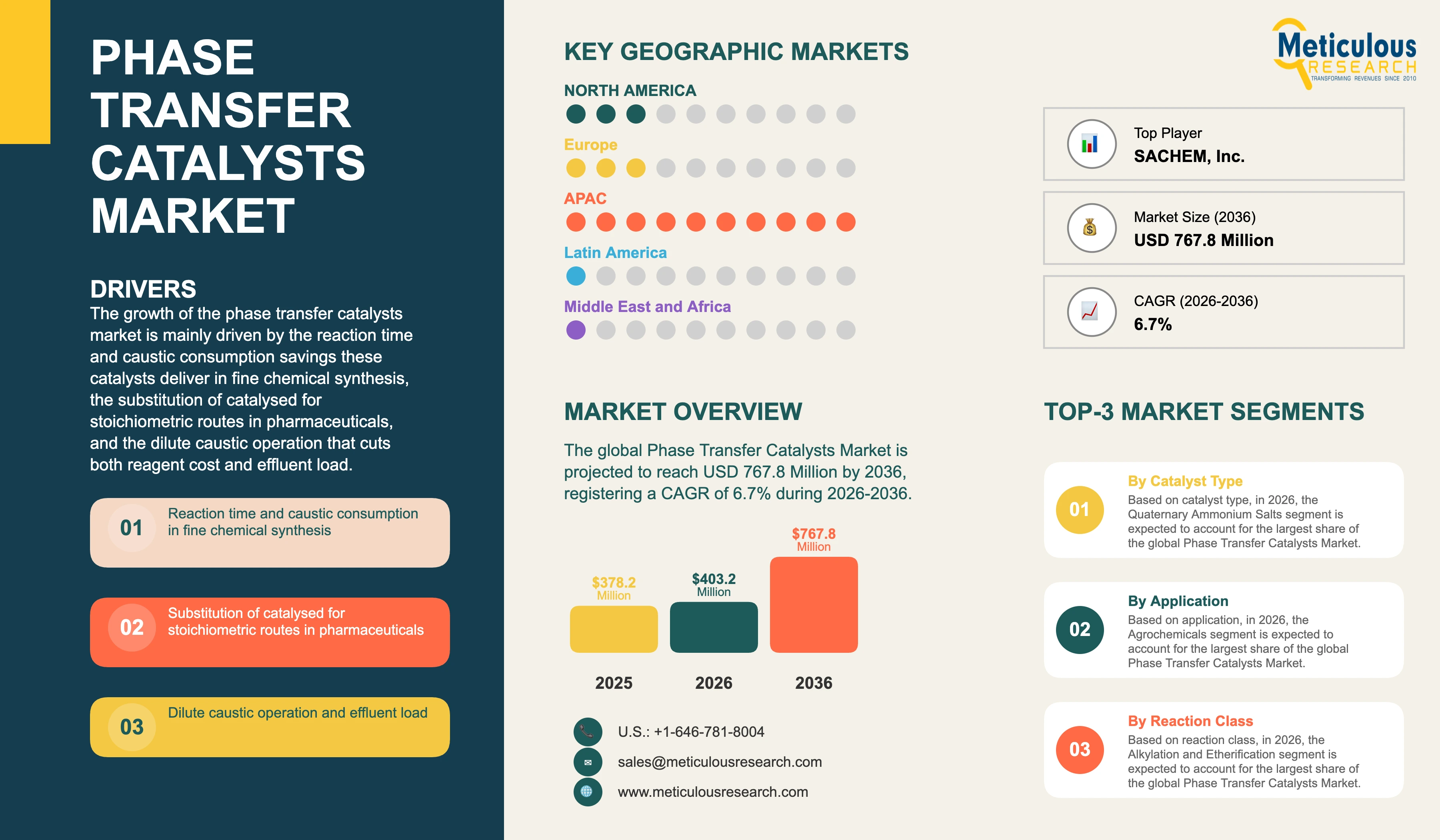
The global phase transfer catalysts market was valued at USD 378.2 million in 2025. This market is expected to reach USD 767.8 million by 2036 from an estimated USD 403.2 million in 2026, registering a CAGR of 6.7% during the forecast period (2026-2036).
- Published
- Nov 2026
- Pages
- 263
- Format
- PDF + Excel
- Report ID
- MRCHM - 1042816
- Base year
- 2025
- 2025 · BASELINE
- $378.2M
- 2036
- $767.8M
- CAGR 2026–2036
- 6.7%
2025 baseline · 2026–2036 forecast at 6.7% CAGR · hover a bar for the value
Key highlights
The global phase transfer catalysts market is estimated at USD 403.2 million in 2026 and is projected to reach USD 767.8 million by 2036.
Market volume is estimated at 32.00 kilotons in 2026 and is projected to reach 49.22 kilotons by 2036 at a CAGR of 4.4%, measured as catalyst on a 100% active basis.
The average selling price is estimated at USD 12.60 per kg in 2026 and is projected to reach USD 15.60 per kg by 2036 as the longer-chain ammonium and phosphonium grades take a larger share.
Quaternary ammonium compounds supplied as biocides are counted in the quaternary ammonium biocides market in this series and not here, since the use rather than the molecule decides which market a volume belongs to.
Quaternary ammonium salts are expected to account for the largest catalyst type share in 2026, while chiral and asymmetric phase transfer catalysts are projected to register the highest CAGR of 11.0%.
Agrochemicals are expected to hold the largest application share in 2026, while pharmaceuticals and intermediates are projected to grow fastest at a CAGR of 8.0%.
Alkylation and etherification is expected to hold the largest reaction class share in 2026, while dehydrohalogenation and elimination is projected to grow fastest at a CAGR of 8.6%.
Asia-Pacific is expected to hold the largest regional share in 2026 and is also projected to grow fastest at a CAGR of 7.6%.
A process intensification study published in Green Chemistry on 11 February 2025 by researchers at Tsinghua University quantifies the efficiency driver precisely for a dehydrochlorination used in fine chemical manufacture.
Without a catalyst the reaction reached only 31% conversion in 60 minutes at 50 degrees Celsius.
At 0.05 equivalents of catalyst under the same conditions, tetramethylammonium hydroxide gave 88% in 60 minutes, tetraethylammonium hydroxide 95% in 60 minutes, tetrapropylammonium hydroxide 96% in 15 minutes and tetrabutylammonium hydroxide 97% in 5 minutes.
That ordering follows the lipophilicity of the cation, with the measured octanol-water partition coefficient at 50 degrees Celsius rising from minus 2.1 for the tetramethyl salt to minus 0.3 for the tetrabutyl salt.
Tetrabutylammonium chloride was selected for operational simplicity, and the optimised process reached 97.4% conversion in about three minutes at 100 degrees Celsius with 20 wt% caustic at 1.05 equivalents.
Against the conventional route at 40 wt% caustic and 1.8 equivalents over 120 minutes, the study reports reaction time reduced by more than 95%, excess caustic reduced by over 92% and caustic concentration halved.
Side-product formation was also lower, at 0.59 mol% of one impurity and 1.6 mol% of the other against 0.64 and 2.3 mol% for the conventional route, although the abstract of the same paper gives 0.4 and 1 mol% and the figures were measured after five days of settling.
The authors state that microreactors and co-extractants were less effective than phase transfer catalysts, because a microreactor cannot overcome a thermodynamic driving-force limit.
The paper also records that tetrabutylammonium chloride is more soluble in the product than the tetramethyl salt previously used, so more wash water may be needed.
No catalyst recovery or recycling experiments were run for that reaction, no continuous or scale-up work was carried out, and no cost, energy, E-factor or process mass intensity figures are given, so the green claims in that study are qualitative.
The work was carried out in a 4 millilitre glass vial with magnetic stirring and temperature control to plus or minus 3 degrees Celsius, and the paper reports no stirring-speed dependence, no rate constants and no activation energy.
The SACHEM, Inc. CATANA phase transfer catalyst range names nine grades with CAS numbers, all quaternary ammonium and none phosphonium, for biphasic organic transitions in the polymer industry with epoxy given as the example application.
That page claims enhanced reaction rates and yields, lower production, energy and waste costs, use of inexpensive inorganic bases such as sodium hydroxide, and simpler process equipment, with no figure attached to any of them, no loadings, no reaction conditions and no visible date.
Report summary
| Particulars | Details |
|---|---|
| Base Year | 2025 |
| Forecast Period | 2026-2036 |
| Market Size in 2025 | USD 378.2 million |
| Market Size in 2026 | USD 403.2 million |
| Market Size by 2036 | USD 767.8 million |
| Value CAGR (2026-2036) | 6.7% |
| Format | PDF, Excel & Cloud Portal · 263 pages |
| Volume in 2026 | 32.00 kilotons |
| Volume by 2036 | 49.22 kilotons |
| Volume CAGR (2026-2036) | 4.4% |
| Volume Basis | Catalyst on a 100% active basis, excluding the water or solvent in which a grade is supplied |
| Average Selling Price in 2026 | USD 12.60 per kg |
| Average Selling Price by 2036 | USD 15.60 per kg |
| Price Direction | The average selling price rises across the forecast period as the longer-chain ammonium and phosphonium grades take share from the cheap benzyltrimethyl and benzyltriethyl salts that carry the tonnage, rather than through any increase in the price of an individual grade |
| Volume Basis Note | Commercial grades are supplied both dry and as solutions, with a leading supplier listing benzyltriethylammonium chloride at 60% and dry, benzyltrimethylammonium chloride at 60% and dry, methyltributylammonium chloride at 75% and tetrabutylammonium hydrogen sulfate at 98%, without stating what those percentages refer to or giving a purity for the dry grades, so an as-supplied basis would compare a solution against a solid and is not used here |
| Scope Exclusion Note | Quaternary ammonium compounds supplied as biocides are counted in the quaternary ammonium biocides market in this series and not here, since the use rather than the molecule decides which market a volume belongs to; non-catalytic quaternary ammonium applications including fabric softeners, hair conditioning, organoclays, asphalt emulsifiers and oilfield chemicals are outside this market and together exceed it in tonnage |
| Measurement Basis | Catalysts transferring a reactant between phases in a biphasic reaction, including quaternary ammonium salts, quaternary phosphonium salts, crown ethers, cryptands and podands, polyethylene glycols and glycol ethers, and chiral and asymmetric phase transfer catalysts, by catalyst type, application, reaction class and geography |
| Relationship to Adjacent Markets | Chiral and asymmetric phase transfer catalysts are counted here and also within the organocatalysts market in this series, so the two titles are not additive and the overlap is that one subset, which accounts for a small share of this market; this market is distinct from the metallocene, hydrogenation, hydrotreating, ammonia synthesis, diesel oxidation and selective catalytic reduction catalyst titles, which measure metal-containing or heterogeneous systems, and is not additive to any of them |
| Note on the Efficiency Driver | A process intensification study published in Green Chemistry on 11 February 2025 by researchers at the State Key Laboratory of Chemical Engineering at Tsinghua University reports a beta-chlorohydrin dehydrochlorination reaching only 31% conversion in 60 minutes at 50 degrees Celsius without a catalyst, against 88% in 60 minutes with tetramethylammonium hydroxide, 95% in 60 minutes with tetraethylammonium hydroxide, 96% in 15 minutes with tetrapropylammonium hydroxide and 97% in 5 minutes with tetrabutylammonium hydroxide, all at 0.05 equivalents; the optimised process on tetrabutylammonium chloride reached 97.4% conversion in about three minutes at 100 degrees Celsius with 20 wt% caustic at 1.05 equivalents, and against the conventional route at 40 wt% and 1.8 equivalents over 120 minutes the authors report reaction time reduced by more than 95%, excess caustic reduced by over 92% and caustic concentration halved |
| Note on the Measured Mechanism | Octanol-water partition coefficients measured in the same study at 50 degrees Celsius rise from minus 2.1 for the tetramethylammonium cation through minus 1.7 and minus 0.8 to minus 0.3 for the tetrabutylammonium cation, and the hydroxide partition coefficient in the catalyst system rises from minus 2.6 with no catalyst to minus 1.2 at 0.1 equivalents, so the conversion ordering follows cation lipophilicity and the commercial price ordering follows the conversion ordering |
| Note on Chemistry Against Equipment | The same authors state that microreactors and co-extractants were less effective than phase transfer catalysts because a microreactor cannot overcome a thermodynamic driving-force limit, and their catalysed batch route at 3 to 7 minutes compares with a published microreactor route at 2.7 minutes requiring 4 equivalents of caustic at 40 wt%, so on this reaction a process improvement delivered through chemistry outperformed one delivered through hardware |
| Note on Catalyst Loadings | The study describes typical phase transfer catalyst loadings as 0.01 to 0.1 equivalents and ran its own optimised process at 0.05 to 0.1 equivalents, which is one to ten mol% of substrate, so a phase transfer catalyst is a reagent-scale input whose cost per kilogram of product is set by its own price rather than by turnover, which is why this market carries a substantial tonnage at a low average selling price |
| Note on Source Limitations | That study ran no catalyst recovery or recycling experiments for the reaction examined, recyclability being described only from earlier literature, and carried out no continuous or scale-up work, with continuous operation proposed as future work; it gives no rate constants, reaction order, activation energy or stirring-speed dependence, no cost, energy, E-factor or process mass intensity figures, and no isolated yields; the work was done in a 4 millilitre glass vial with magnetic stirring and temperature control to plus or minus 3 degrees Celsius; it notes that tetrabutylammonium chloride is more soluble in the product than the tetramethyl salt previously used so more wash water may be needed; its abstract gives side-product selectivities of 0.4 and 1 mol% against 0.59 and 1.6 mol% in its own table, those figures were measured after five days of settling, and the text states that 100 degrees Celsius was selected for later experiments while most optimisation figures use 50 degrees Celsius |
| Note on Supplier Disclosure | The SACHEM, Inc. CATANA phase transfer catalyst range names nine grades with CAS numbers, all quaternary ammonium and none phosphonium, for biphasic organic transitions in the polymer industry with epoxy given as the only named example, and claims enhanced reaction rates and yields, lower production, energy and waste costs, use of inexpensive inorganic bases such as sodium hydroxide and simpler process equipment, with no figure attached to any of them, no loadings, no reaction conditions, no yields, no purity for the dry grades and no visible date in the page body, page metadata showing a published time of 2013 against a 2026 copyright line |
| Note on Market Structure | The grades carrying most of the tonnage are long-established quaternary ammonium salts with published CAS numbers and no process exclusivity, made by many producers in China and India, so the five companies profiled account for an estimated 34.6% of this market, a low leading share by the standards of the catalyst titles in this series, and the sizing here is built from grade population, process adoption and catalyst loading rather than from supplier performance claims |
| Largest Catalyst Type | Quaternary ammonium salts |
| Fastest-Growing Catalyst Type | Chiral and asymmetric phase transfer catalysts (CAGR 11.0%) |
| Largest Application | Agrochemicals |
| Fastest-Growing Application | Pharmaceuticals and intermediates (CAGR 8.0%) |
| Largest Reaction Class | Alkylation and etherification |
| Fastest-Growing Reaction Class | Dehydrohalogenation and elimination (CAGR 8.6%) |
| Largest Region | Asia-Pacific |
| Fastest-Growing Region | Asia-Pacific (CAGR 7.6%) |
| Slowest-Growing Region | Europe (CAGR 5.2%), where the fine chemical base the catalyst serves is not expanding |
| Segments Covered | Catalyst Type, Application, Reaction Class, and Geography |
| Geographies Covered | Asia-Pacific, Europe, North America, Latin America, and Middle East & Africa |
| Companies Profiled | 5 companies, including SACHEM, Inc., Merck KGaA, Tokyo Chemical Industry Co., Ltd., Evonik Industries AG, and Dishman Carbogen Amcis Limited |
Report overview
Segments covered: catalyst type, application, reaction class.
The growth of this market is mainly driven by the fine chemical synthesis efficiency that a phase transfer catalyst delivers in reaction time and caustic consumption, the pharmaceutical and intermediate processes substituting catalysed routes for stoichiometric ones, the dilute caustic operation that reduces both reagent cost and effluent load, and the agrochemical and fine chemical manufacturing concentrated in Asia-Pacific. However, factors such as the catalyst loadings of one to ten mol% that make these catalysts a reagent-scale input rather than a trace additive, the absence of demonstrated recovery in the published process work, the additional wash water that a more product-soluble catalyst requires, and the fragmentation among regional producers of what are essentially commodity quaternary salts are expected to restrain the growth of this market to some extent.
Phase transfer catalysts carry a reactant from one phase into another in a biphasic reaction, most often transporting an anion from an aqueous or solid phase into an organic phase where it can react, which allows an inexpensive inorganic base or salt to be used in place of a more hazardous or more costly reagent dissolved in a single phase. Market sizing in this report is on both a value basis in USD and a volume basis in kilotons measured as catalyst on a 100% active basis, with average selling price derived from the two.
The active basis is forced by how the product is sold. The SACHEM, Inc. CATANA range lists benzyltriethylammonium chloride, CAS 56-37-1, at 60% and also dry; benzyltrimethylammonium chloride, CAS 56-93-9, at 60% and also dry; methyltributylammonium chloride, CAS 56375-79-2, at 75%; tetrabutylammonium hydrogen sulfate, CAS 32503-27-8, at 98%; and benzyltributylammonium chloride, tetrabutylammonium bromide and tetraethylammonium bromide dry, without stating what the percentages refer to or giving a purity for the dry grades. Measuring as supplied would compare a solution against a solid.
Quaternary ammonium compounds supplied as biocides are counted in the quaternary ammonium biocides market in this series rather than here. The molecule can be the same; the use decides which market a given volume belongs to, and the two do not overlap. Non-catalytic quaternary ammonium applications, including fabric softeners, hair conditioning, organoclays, asphalt emulsifiers and oilfield chemicals, are outside this market altogether and together exceed it in tonnage.
The efficiency driver named for this title is quantified in a process intensification study published in Green Chemistry on 11 February 2025 by researchers at the State Key Laboratory of Chemical Engineering at Tsinghua University, covering the dehydrochlorination of a beta-chlorohydrin used in fine chemical manufacture.
The uncatalysed baseline is the most useful figure in it. Without a catalyst the reaction reached 31% conversion in 60 minutes at 50 degrees Celsius. At 0.05 equivalents of catalyst under the same conditions, tetramethylammonium hydroxide gave 88% in 60 minutes, tetraethylammonium hydroxide 95% in 60 minutes, tetrapropylammonium hydroxide 96% in 15 minutes and tetrabutylammonium hydroxide 97% in five minutes.
The ordering is not arbitrary and the paper measures why. Octanol-water partition coefficients at 50 degrees Celsius rise from minus 2.1 for the tetramethyl cation through minus 1.7 and minus 0.8 to minus 0.3 for the tetrabutyl cation, and the hydroxide partition coefficient in the catalyst system rises from minus 2.6 with no catalyst to minus 1.2 at 0.1 equivalents. The longer the alkyl chains, the more anion is delivered into the organic phase.
That measurement explains the price structure of this market directly. Tetrabutylammonium bromide and tetrabutylammonium hydrogen sulfate cost several times what benzyltrimethylammonium chloride costs, and the premium buys the transfer capability the partition coefficients record. It is also why the average selling price rises from USD 12.60 per kg in 2026 to USD 15.60 per kg by 2036 as the longer-chain grades take share, with no individual grade becoming more expensive.
The comparison against conventional practice is where the driver becomes a commercial argument. The conventional route ran at 40 wt% caustic and 1.8 equivalents for 120 minutes to 99% conversion; the optimised catalysed route ran at 20 wt% caustic and 1.05 equivalents for five minutes to 98%, and the authors report reaction time reduced by more than 95%, excess caustic reduced by over 92% and caustic concentration halved.
Side-product formation also fell, at 0.59 mol% of one impurity and 1.6 mol% of the other against 0.64 and 2.3 mol% conventionally. Those figures carry two qualifications the paper itself supplies: the abstract of the same study gives 0.4 and 1 mol%, which does not match its own table, and the measurements were taken after five days of settling rather than immediately after reaction.
A finding in that paper runs against the usual account of how a biphasic reaction is improved. The authors state that microreactors and co-extractants were less effective than phase transfer catalysts, because a microreactor cannot overcome a thermodynamic driving-force limit. Better mixing moves a reaction toward its equilibrium faster; it does not change where the equilibrium sits, and the catalyst does.
That matters commercially because process intensification is more often approached through equipment than through chemistry. A study comparing both on the same reaction, and finding the catalyst the more effective route, is a stronger argument for this market than any supplier claim, and it is the reason dehydrohalogenation and elimination is forecast as the fastest reaction class at 8.6%.
The limits of that evidence should be read with it. No catalyst recovery or recycling experiments were run for the reaction studied, recyclability being described only from earlier literature. No continuous or scale-up work was carried out, with continuous operation proposed as future work. The study gives no rate constants, no reaction order, no activation energy and no stirring-speed dependence, and the work was done in a 4 millilitre glass vial with magnetic stirring and temperature control to plus or minus 3 degrees Celsius.
Nor are the green claims quantified. The paper reports no cost, no energy use, no E-factor and no process mass intensity, and it notes that tetrabutylammonium chloride is more soluble in the product than the tetramethyl salt previously used so more wash water may be needed. A reduction in caustic consumption bought with an increase in wash water is a trade rather than a saving until both are measured.
The loadings are the structural fact that sets the shape of this market. The study describes typical phase transfer catalyst loadings as 0.01 to 0.1 equivalents and ran its own process at 0.05 to 0.1, which is one to ten mol%. A catalyst used at that level is a reagent-scale input, not a trace additive, and that is why this market carries 32.00 kilotons of volume against USD 403.2 million of value.
On the commercial side the quantification simply does not exist. The SACHEM, Inc. CATANA page lists nine grades with CAS numbers, all quaternary ammonium and none phosphonium, for biphasic organic transitions in the polymer industry with epoxy given as the only named example, and claims enhanced reaction rates and yields, lower production, energy and waste costs, use of inexpensive inorganic bases such as sodium hydroxide and simpler process equipment.
Not one of those claims carries a number. There are no loadings, no reaction conditions, no yields, no rate improvements, no cost savings, no purity for the dry grades and no visible date in the page body, with page metadata showing a published time of 2013 against a 2026 copyright line. The gap between what the academic literature measures and what the commercial literature asserts is wide in this market, and the sizing here rests on the former.
This market is also a superset of part of another title in this series. Chiral and asymmetric phase transfer catalysts are counted here and are also counted within the organocatalysts market, so the two are not additive and the overlap is that one subset, which accounts for a small share of this market. This market is distinct from the metallocene, hydrogenation, hydrotreating, ammonia synthesis, diesel oxidation and selective catalytic reduction catalyst titles, which measure metal-containing or heterogeneous systems, and is not additive to any of them.
Asia-Pacific is expected to account for the largest share in 2026, on the concentration of agrochemical intermediate, fine chemical and active pharmaceutical ingredient manufacture in China and India and on the regional production of the quaternary salts themselves. India is projected to grow at 8.6%, China at 8.4%, South Korea at 5.0% and Japan at 3.4%.
Asia-Pacific is also projected to register the highest CAGR of 7.6% during the forecast period, holding both the largest share and the fastest growth.
Europe is projected to grow at a CAGR of 5.2%, the slowest of the five regions, with Switzerland at 5.6%, Germany at 5.0% and the Netherlands at 4.6%, on pharmaceutical and specialty chemical manufacture rather than intermediate volume, and because the fine chemical base the catalyst serves is not expanding.
The Middle East & Africa is projected to grow at a CAGR of 7.4%, with Saudi Arabia at 7.6%, from the smallest base as downstream specialty capacity is added to existing petrochemical positions. Latin America is projected to grow at a CAGR of 6.6%, with Brazil at 7.0% on agrochemical formulation and intermediate manufacture.
SACHEM, Inc., Merck KGaA, Tokyo Chemical Industry Co., Ltd., Evonik Industries AG and Dishman Carbogen Amcis Limited are the 5 companies profiled in this report, and together they accounted for an estimated 34.6% of this market in 2026. That share is low by the standards of the catalyst titles in this series because the grades carrying most of the tonnage are published molecules with no process exclusivity, made by many producers in China and India.
Report infographic
Market dynamics
11 factors across 3 forcesReaction Time and Caustic Consumption in Fine Chemical Synthesis
The Tsinghua study reports reaction time reduced by more than 95%, excess caustic reduced by over 92% and caustic concentration halved against the conventional route for the same dehydrochlorination, with conversion held at 98%.
A reduction of that order in cycle time releases reactor capacity without capital expenditure, and a reduction of that order in caustic consumption cuts both the reagent bill and the neutralisation load downstream, which together are the commercial argument for the catalyst.
The uncatalysed baseline makes the dependence explicit rather than incremental. At 31% conversion in 60 minutes without a catalyst against 97% in five minutes with one, the reaction is not merely faster with the catalyst but commercially viable only with it, which is the position of a substantial part of fine chemical manufacture.
Cycle time and reagent consumption are the two costs a fine chemical plant can act on without capital, and a phase transfer catalyst addresses both at once. The caustic saving is doubled in effect because less base consumed means less acid required to neutralise it and less salt reaching effluent treatment.
The scale of the gain is what distinguishes this driver from an incremental improvement. A route going from 120 minutes to five on half the caustic concentration and a twentieth of the excess is a different process on the same equipment, and that is the comparison the Tsinghua work sets out on a single reaction.
Substitution of Catalysed for Stoichiometric Routes in Pharmaceuticals
A phase transfer catalysed alkylation or substitution allows an inexpensive inorganic base in water to replace a stoichiometric organic base or an anhydrous alkoxide, which removes a hazardous reagent, a dry solvent requirement and the waste stream that both generate.
Pharmaceuticals and intermediates are projected to grow at 8.0%, the fastest of the application segments, against 5.8% for agrochemicals, which hold the largest share.
Replacing a stoichiometric organic base or an anhydrous alkoxide with aqueous caustic removes several requirements together rather than one. The hazardous reagent goes, the dry solvent and the inert handling that protects it go with it, and the waste stream that both generate is replaced by an aqueous phase that existing effluent treatment can take.
That combination weighs more heavily in a regulated manufacturing environment than the catalyst cost weighs against it, which is why pharmaceuticals and intermediates are forecast at 8.0% against 5.8% for agrochemicals despite agrochemicals holding the larger share.
Dilute Caustic Operation and Effluent Load
The optimised process in the Tsinghua study ran at 20 wt% caustic against 40 wt% conventionally and reached more than 95% conversion within 15 minutes even at 5 wt%, which is a reduction in both the concentration handled and the quantity consumed.
Operating a biphasic reaction on dilute caustic reduces the corrosion duty on the vessel, the hazard classification of the operation and the salt load reaching effluent treatment, none of which require a change to the chemistry beyond adding the catalyst.
Dilute operation changes the plant rather than only the chemistry. Caustic at 20 wt% rather than 40 reduces the corrosion duty on the vessel and the hazard classification of the operation, and the Tsinghua process exceeded 95% conversion within 15 minutes even at 5 wt%, which shows the dependence is on the catalyst rather than on concentration.
The salt load reaching effluent treatment falls in proportion to the base consumed, and for a plant whose discharge consent is written in terms of total dissolved solids that reduction can be the constraint that decides output. None of it requires a change to the chemistry beyond adding the catalyst.
Agrochemical and Fine Chemical Manufacturing in Asia-Pacific
Agrochemical intermediate and fine chemical manufacture is concentrated in China and India, and a phase transfer catalysed route is most attractive where the base chemistry is made at scale on cost rather than developed for the first time.
Asia-Pacific holds the largest regional share and is projected to grow fastest at 7.6%, with India at 8.6% and China at 8.4% against Japan at 3.4%.
A catalysed route is adopted most readily where the chemistry is already established and competing on cost rather than being developed for the first time, because the saving falls straight to margin and the qualification burden is small. Agrochemical intermediate and fine chemical manufacture in China and India is the clearest case of that condition.
Asia-Pacific holds the largest regional share and is projected to grow fastest at 7.6%, with India at 8.6% and China at 8.4%, against Japan at 3.4% and Europe at 5.2% where the base the catalyst serves is not expanding.
Table of contents
11 chapters · 134 sections · 263 pages · click to expandSegmental analysis
| Segment | Largest share (2026) | Fastest growth (2026–2036) |
|---|---|---|
| By Catalyst Type | Quaternary ammonium salts | Chiral and asymmetric phase transfer catalysts |
| By Application | Agrochemicals | Pharmaceuticals and intermediates |
| By Reaction Class | Alkylation and etherification | Dehydrohalogenation and elimination |
| Other segments | Agrochemicals | Chiral and asymmetric phase transfer catalysts |
By Catalyst Type
- Phase Transfer Catalysts Analysis by Catalyst Type
- The quaternary ammonium salts segment is expected to account for the largest share of the global phase transfer catalysts market.
- The large share of this segment is mainly due to the benzyl and tetraalkyl ammonium chlorides, bromides and hydrogen sulfates being the longest established and least expensive catalysts available, to their coverage of alkylation, substitution and elimination chemistry without modification, and to the whole commercial range at a leading supplier consisting of them, with no phosphonium grade listed.
- However, the chiral and asymmetric phase transfer catalysts segment is projected to register the highest CAGR of 11.0% during the forecast period.
- The rapid growth of this segment is attributed to enantioselectivity delivered through ion pairing without any transition metal, which places these catalysts in the same regulatory position as the organocatalysts in this series, and to the segment starting from the smallest base in this axis.
- Quaternary phosphonium salts grow at 7.4% on greater thermal stability where a shortened cycle time permits a higher operating temperature, the Tsinghua process having run at up to 100 degrees Celsius.
- Crown ethers, cryptands and podands grow at 7.0% and carry the highest unit value in this market on small quantities, used where a specific cation must be complexed rather than an anion transferred.
- Polyethylene glycols and glycol ethers grow at 6.6% as the least expensive option where modest transfer capability suffices.
- The catalyst type axis is ordered by a measurable property rather than by convention, which is unusual among the segmentations in this series.
- Cation lipophilicity sets how much anion is delivered into the organic phase, the measured partition coefficients record it, the conversion ordering follows them, and the commercial price ordering follows the conversion ordering.
- That chain is why the average selling price in this market rises from USD 12.60 per kg in 2026 to USD 15.60 per kg by 2036 while no individual grade becomes more expensive.
- The mix moves toward the cations that transfer better, and those cost more because the performance is real.
- Quaternary ammonium salts are expected to account for the largest share in 2026, on the benzyl and tetraalkyl ammonium chlorides, bromides and hydrogen sulfates being the longest established and least expensive catalysts available and covering alkylation, substitution and elimination chemistry without modification.
By Application
- Phase Transfer Catalysts Analysis by Application
- The agrochemicals segment is expected to account for the largest share of the global phase transfer catalysts market.
- The large share of this segment is mainly due to the scale at which herbicide and insecticide intermediates are manufactured, to those processes competing on cost so that a reduction in caustic consumption and cycle time translates directly into margin, and to the concentration of that manufacture in regions where the catalysed route is standard practice.
- However, the pharmaceuticals and intermediates segment is projected to register the highest CAGR of 8.0% during the forecast period.
- The rapid growth of this segment is attributed to catalysed routes replacing stoichiometric organic bases and anhydrous alkoxides, which removes a hazardous reagent and a dry solvent requirement together, and to the hazard and effluent benefit weighing more heavily in a regulated manufacturing environment.
- Polymers and resins grow at 6.4%, and that is the application a leading supplier names explicitly, describing biphasic organic transitions in the polymer industry with epoxy as the example.
- Dyes, pigments and specialty chemicals grow at 6.6% on established alkylation and etherification chemistry.
- Flavours, fragrances and other fine chemicals grow at 7.0% on smaller volumes at higher product value, where a shortened cycle releases capacity across a multi-product plant.
- The application axis separates on where the saving falls rather than on the chemistry involved, since the same alkylation may be run in an agrochemical or a pharmaceutical plant.
- In agrochemicals the saving falls to margin in a cost contest; in pharmaceuticals it falls to hazard, solvent and waste in a regulated environment, and that second set weighs more heavily.
- Polymers and resins is the application a leading supplier names explicitly, describing biphasic organic transitions in the polymer industry with epoxy as its only stated example, and it grows at 6.4%.
- Flavours, fragrances and other fine chemicals grow at 7.0% on small volumes at high product value, where releasing capacity across a multi-product plant is worth more than the reagent saving.
By Reaction Class
- Phase Transfer Catalysts Analysis by Reaction Class
- Alkylation and etherification accounts for the largest reaction class share of this market and grows at 6.0%, because transferring an alkoxide or phenoxide into an organic phase from aqueous caustic is the oldest and most widely practised use of these catalysts and underlies a large part of the agrochemical and dye intermediate chemistry.
- Dehydrohalogenation and elimination grows fastest at 8.6%, and that is the class the Tsinghua study addresses directly, where the uncatalysed reaction reached only 31% conversion in 60 minutes because it is limited by delivering hydroxide into the organic phase rather than by the chemistry itself.
- Substitution and displacement grows at 6.6%, oxidation and epoxidation at 7.0% where the catalyst transfers a peroxy or hypochlorite anion, and polymerisation and polycondensation at 6.0%.
- This axis is included because the size of the gain differs sharply between classes rather than between catalysts.
- Where the uncatalysed route is limited by phase transfer, as in the dehydrochlorination studied, the catalyst changes the reaction from unviable to complete in minutes; where the uncatalysed route already proceeds, the catalyst improves it.
- That distinction decides which processes adopt a catalysed route and therefore where the growth in this market sits.
- The reaction class axis carries the adoption question, because the size of the gain differs far more between classes than between catalysts.
- A process already proceeding without a catalyst adopts one for an improvement; a process limited by phase transfer itself adopts one because there is no route without it.
- Oxidation and epoxidation grows at 7.0%, where the catalyst transfers a peroxy or hypochlorite anion and the same dilute-reagent argument applies.
- Polymerisation and polycondensation grows at 6.0%, tied to polymer output rather than to any change in catalyst practice, and substitution and displacement at 6.6% on long-established chemistry.
Other segments
- Chiral and asymmetric phase transfer catalysts are projected to register the highest CAGR of 11.0% during the forecast period, on enantioselectivity delivered through ion pairing without any transition metal and on the segment starting from the smallest base.
- Agrochemicals are expected to hold the largest share in 2026, on the scale at which herbicide and insecticide intermediates are manufactured and on those processes competing on cost so that a reduction in caustic consumption and cycle time translates directly into margin.
- Pharmaceuticals and intermediates are projected to register the highest CAGR of 8.0% during the forecast period, on catalysed routes replacing stoichiometric organic bases and anhydrous alkoxides, which removes a hazardous reagent and a dry solvent requirement together.
- Alkylation and etherification is expected to hold the largest share in 2026, because transferring an alkoxide or phenoxide into an organic phase from aqueous caustic is the most widely practised use of these catalysts and underlies much of the agrochemical and dye intermediate chemistry.
- Dehydrohalogenation and elimination is projected to register the highest CAGR of 8.6% during the forecast period, being the class where the uncatalysed route is limited by phase transfer itself, reaching only 31% conversion in 60 minutes against 97% in five minutes with a catalyst.
Geographic analysis
Asia-Pacific
Largest shareIn 2026, Asia-Pacific is expected to account for the largest share of the global phase transfer catalysts market and is also projected to register the highest CAGR of 7.6% during the forecast period. The large share and rapid growth of this region are attributed to the concentration of agrochemical intermediate, fine chemical and active pharmaceutical ingredient manufacture in China and India, to the cost basis on which that manufacture competes, and to the regional production of the quaternary salts themselves. India is projected to register a CAGR of 8.6%, China a CAGR of 8.4%, South Korea a CAGR of 5.0% and Japan a CAGR of 3.4%. The process work behind this title is itself from the region, carried out at the State Key Laboratory of Chemical Engineering at Tsinghua University and published in February 2025, which reflects where the applied development in this chemistry is being done as much as where the catalyst is consumed. India at 8.6% and China at 8.4% carry the agrochemical intermediate and active ingredient manufacture that consumes most of the volume, and the applied process development is being done there as well, the Tsinghua study being an instance of it. Japan at 3.4% is the slowest country rate in the report, on a domestic fine chemical base that is static, and Europe at 5.2% is the slowest region for the same reason, its demand weighted toward pharmaceutical and specialty manufacture rather than intermediate volume.
Europe
Europe is projected to grow at 5.2%, with Switzerland at 5.6%, Germany at 5.0% and the Netherlands at 4.6%, on pharmaceutical and specialty chemical manufacture rather than on intermediate volume, and the region grows slowest of the five because the fine chemical base it serves is not expanding. Switzerland at 5.6% leads the region on that weighting and the Netherlands at 4.6% trails it.
North America
North America is projected to grow at 5.4%, with the United States at 5.4%, where a leading catalyst supplier is based and where the demand is weighted toward polymer and specialty applications.
Latin America
Latin America is projected to grow at 6.6%, with Brazil at 7.0% on agrochemical formulation and intermediate manufacture.
Middle East & Africa
The Middle East & Africa is projected to grow at 7.4%, with Saudi Arabia at 7.6%, from the smallest base, as downstream specialty capacity is added to existing petrochemical positions. What separates the regions is whether the fine chemical base the catalyst serves is growing or static, since the catalyst is an input to that base rather than a market of its own. Country rates in this market track whether the fine chemical base is expanding rather than any difference in catalyst practice.
Competitive landscape
The global phase transfer catalysts market is more fragmented than any other catalyst market in this series, and the reason is that the grades carrying most of the tonnage are long-established quaternary ammonium salts with published CAS numbers and no process exclusivity. The five companies profiled in this report together accounted for an estimated 34.6% of this market in 2026, a low leading share by the standards of the catalyst titles in this series.
Competition is contested differently at the two ends of the range. For the bulk benzyl and tetraalkyl ammonium chlorides it is a cost and reliability contest among producers making a known molecule, and many producers in China and India supply it. For the tetrabutyl salts, phosphonium grades and crown ethers it is contested on purity, consistency and documentation, where a buyer running a regulated pharmaceutical process will not change supplier for price alone.
Supplier disclosure does not support a performance comparison between participants. The SACHEM, Inc. CATANA page gives grade identity, CAS number and concentration, and attaches no figure to any of its performance claims, giving no loadings, no reaction conditions, no yields and no purity for the dry grades. Shares here are built from grade population, process adoption and loading rather than from performance claims. Some of the key players operating in the phase transfer catalysts market are SACHEM, Inc. (U.S.), Merck KGaA (Germany), Tokyo Chemical Industry Co., Ltd. (Japan), Evonik Industries AG (Germany), and Dishman Carbogen Amcis Limited (India), among others.
What a buyer is actually selecting on differs so much between the two ends of the range that they function as separate markets served from the same catalogue. A bulk benzyl ammonium chloride is bought on delivered cost and consistency against several interchangeable suppliers; a tetrabutyl salt or crown ether entering a regulated pharmaceutical process is bought on purity, documentation and continuity of supply.
Switching cost explains the difference. Changing supplier for a commodity grade costs an incoming inspection; changing it for a grade written into a filed process costs a regulatory variation, which is why the leading positions in this market are concentrated in the specialist end even though the tonnage sits in the commodity end.
- —
A process intensification study published in Green Chemistry on 11 February 2025 by researchers at the State Key Laboratory of Chemical Engineering at Tsinghua University quantifies the efficiency driver for a beta-chlorohydrin dehydrochlorination used in fine chemical manufacture. Without a catalyst the reaction reached 31% conversion in 60 minutes at 50 degrees Celsius. At 0.05 equivalents, tetramethylammonium hydroxide gave 88% in 60 minutes, tetraethylammonium hydroxide 95% in 60 minutes, tetrapropylammonium hydroxide 96% in 15 minutes and tetrabutylammonium hydroxide 97% in five minutes. Measured octanol-water partition coefficients at 50 degrees Celsius rise from minus 2.1 for the tetramethyl cation to minus 0.3 for the tetrabutyl cation, and the conversion ordering follows them. Tetrabutylammonium chloride was selected for operational simplicity, the anion effect being negligible, and the optimised process reached 97.4% conversion in about three minutes at 100 degrees Celsius with 20 wt% caustic at 1.05 equivalents, exceeding 95% conversion within 15 minutes even at 5 wt% caustic. Against the conventional route at 40 wt% and 1.8 equivalents over 120 minutes, the authors report reaction time reduced by more than 95%, excess caustic reduced by over 92% and caustic concentration halved, with side-product formation at 0.59 and 1.6 mol% against 0.64 and 2.3 mol%. The authors also state that microreactors and co-extractants were less effective than phase transfer catalysts because a microreactor cannot overcome a thermodynamic driving-force limit. The study ran no recovery or recycling experiments for that reaction and no continuous or scale-up work, gives no rate constants, activation energy, cost, energy, E-factor or process mass intensity figures, notes that tetrabutylammonium chloride is more soluble in the product so more wash water may be needed, and contains an inconsistency between its abstract selectivities of 0.4 and 1 mol% and its own table. Separately, the SACHEM, Inc. CATANA phase transfer catalyst range names nine grades with CAS numbers, all quaternary ammonium and none phosphonium, for biphasic organic transitions in the polymer industry with epoxy as the only named example, and claims enhanced reaction rates and yields, lower production, energy and waste costs, use of inexpensive inorganic bases and simpler process equipment, with no figure attached to any of them, no loadings, no reaction conditions and no visible date in the page body.
- SACHEM, Inc.
- Merck KGaA
- Tokyo Chemical Industry Co., Ltd.
- Evonik Industries AG
- Dishman Carbogen Amcis Limited
Expert perspectives
Value grows at 6.7% against 4.4% in volume over the forecast period, and the average selling price rises from USD 12.60 per kg in 2026 to USD 15.60 per kg by 2036. The gap is the longer-chain ammonium and phosphonium grades taking share from the cheap benzyltrimethyl and benzyltriethyl salts that carry the tonnage.
The driver in this title is quantified more cleanly than in most. A Green Chemistry study from Tsinghua University published on 11 February 2025 reports a dehydrochlorination reaching 31% conversion in 60 minutes without a catalyst and 97% in five minutes with 0.05 equivalents of tetrabutylammonium hydroxide, and against the conventional route a reaction time reduced by more than 95%, excess caustic reduced by over 92% and caustic concentration halved.
The mechanism is measured rather than asserted, which makes the catalyst type axis in this report a physical ordering. Octanol-water partition coefficients rise from minus 2.1 for the tetramethyl cation to minus 0.3 for the tetrabutyl cation, the conversion ordering follows them exactly, and the commercial price ordering follows the conversion ordering. That is the whole basis of the price rise forecast here.
The finding worth carrying forward is that the catalyst outperformed the equipment. The authors state that microreactors and co-extractants were less effective than phase transfer catalysts because a microreactor cannot overcome a thermodynamic driving-force limit, and their catalysed batch route at 3 to 7 minutes compares with a published microreactor route needing 4 equivalents of caustic at 40 wt%. Process intensification is more often pursued through hardware, and here chemistry won on the same reaction.
The loadings set the ceiling on this market. The study describes typical loadings as 0.01 to 0.1 equivalents and ran at 0.05 to 0.1, which is one to ten mol%, so a phase transfer catalyst is a reagent-scale input whose cost is set by its price rather than by turnover. That is why 32.00 kilotons of volume carries only USD 403.2 million of value, and why recovery, which the study does not demonstrate, is the most consequential unaddressed step.
Evidence quality is asymmetric in this market and the sizing reflects it. The academic work quantifies conversions, times, caustic equivalents and partition coefficients, while a leading supplier claims enhanced rates, lower costs and simpler equipment with no figure, no loading, no condition and no date. The five profiled companies account for 34.6% of a market where many producers make the same published molecules, and the figures here rest on process adoption and loading rather than on supplier claims.
Customer perspectives
The Tsinghua study reports reaction time reduced by more than 95%, excess caustic reduced by over 92% and caustic concentration halved against the conventional route for the same dehydrochlorination, with conversion held at 98%.
A reduction of that order in cycle time releases reactor capacity without capital expenditure.
The combination also releases reactor capacity without capital expenditure, which is the form the benefit usually takes in a plant running close to its output limit.
The authors of that study state that microreactors and co-extractants were less effective than phase transfer catalysts, because a microreactor cannot overcome a thermodynamic driving-force limit.
The SACHEM, Inc. CATANA page gives grade identity, CAS number and concentration, and attaches no figure to its claims of enhanced reaction rates and yields or lower production, energy and waste costs, giving no loadings, no reaction conditions and no purity for the dry grades.
Grade selection is settled in the laboratory on the buyer side for the same reason, since the catalogue gives the molecule and its concentration while every performance claim attached to it is unquantified.
A phase transfer catalyst is therefore specified against a process rather than bought against a datasheet, and the incumbent grade in an established process tends to stay in place longer than its measured performance would justify.
“Half the caustic and five minutes instead of two hours is a different plant. We did not add a reactor, we added the catalyst.”
“We looked at a flow reactor first. The catalyst did more for the reaction than the equipment did, and it cost nothing to install.”
“The catalogue tells me the CAS number and whether it is dry or sixty percent. Everything about how it performs we have to find out ourselves.”
Frequently asked questions
This market was valued at USD 357.0 million in 2024 and USD 378.2 million in 2025, and is estimated at USD 403.2 million in 2026. In volume terms it is estimated at 32.00 kilotons in 2026, measured as catalyst on a 100% active basis.
This market is projected to reach USD 767.8 million by 2036 in value and 49.22 kilotons in volume.
This market is projected to register a value CAGR of 6.7% and a volume CAGR of 4.4% during the forecast period 2026-2036. The average selling price is projected to move from USD 12.60 per kg in 2026 to USD 15.60 per kg by 2036 as the catalyst type mix shifts.
Growth is driven by the reaction time and caustic consumption savings in fine chemical synthesis, the substitution of catalysed for stoichiometric routes in pharmaceuticals, the dilute caustic operation that cuts reagent cost and effluent load, and the agrochemical and fine chemical manufacturing concentrated in Asia-Pacific.
Loadings run at one to ten mol%, making these catalysts a reagent-scale input, and recovery is not demonstrated in the published process work. A more product-soluble catalyst requires more wash water, bulk grades have no process exclusivity so production is fragmented, and suppliers attach no figures to their performance claims.
Catalysed dehydrohalogenation and elimination routes, growing at 8.6%. Longer-chain ammonium and phosphonium grades, the latter growing at 7.4%. Chiral and asymmetric phase transfer catalysis, growing at 11.0%. Catalyst recovery and reuse, which the published work does not address.
Quaternary ammonium salts are expected to account for the largest share in 2026, on the benzyl and tetraalkyl ammonium chlorides, bromides and hydrogen sulfates being the longest established and least expensive catalysts available and covering alkylation, substitution and elimination chemistry without modification.
Chiral and asymmetric phase transfer catalysts are projected to register the highest CAGR of 11.0% during the forecast period, on enantioselectivity delivered through ion pairing without any transition metal and on the segment starting from the smallest base.
Agrochemicals are expected to hold the largest share in 2026, on the scale at which herbicide and insecticide intermediates are manufactured and on those processes competing on cost so that a reduction in caustic consumption and cycle time translates directly into margin.
Pharmaceuticals and intermediates are projected to register the highest CAGR of 8.0% during the forecast period, on catalysed routes replacing stoichiometric organic bases and anhydrous alkoxides, which removes a hazardous reagent and a dry solvent requirement together.
Alkylation and etherification is expected to hold the largest share in 2026, because transferring an alkoxide or phenoxide into an organic phase from aqueous caustic is the most widely practised use of these catalysts and underlies much of the agrochemical and dye intermediate chemistry.
Dehydrohalogenation and elimination is projected to register the highest CAGR of 8.6% during the forecast period, being the class where the uncatalysed route is limited by phase transfer itself, reaching only 31% conversion in 60 minutes against 97% in five minutes with a catalyst.
Asia-Pacific is expected to account for the largest share in 2026, on the concentration of agrochemical intermediate, fine chemical and active pharmaceutical ingredient manufacture in China and India and on the regional production of the quaternary salts themselves. India is projected to grow at 8.6%, China at 8.4%, South Korea at 5.0% and Japan at 3.4%.
Asia-Pacific is also projected to register the highest CAGR of 7.6% during the forecast period, holding both the largest share and the fastest growth.
Europe is projected to grow at a CAGR of 5.2%, the slowest of the five regions, with Switzerland at 5.6%, Germany at 5.0% and the Netherlands at 4.6%. This reflects pharmaceutical and specialty chemical manufacture rather than intermediate volume, and a fine chemical base that is not expanding.
The Middle East & Africa is projected to grow at a CAGR of 7.4%, with Saudi Arabia at 7.6%, from the smallest base as downstream specialty capacity is added to existing petrochemical positions. Latin America is projected to grow at a CAGR of 6.6%, with Brazil at 7.0% on agrochemical formulation and intermediate manufacture.
SACHEM, Inc., Merck KGaA, Tokyo Chemical Industry Co., Ltd., Evonik Industries AG and Dishman Carbogen Amcis Limited are the 5 companies profiled, and together they accounted for an estimated 34.6% of this market in 2026. That share is low because the grades carrying most of the tonnage are published molecules with no process exclusivity, made by many producers in China and India.
A process intensification study published in Green Chemistry on 11 February 2025 by researchers at the State Key Laboratory of Chemical Engineering at Tsinghua University quantifies the efficiency driver for a beta-chlorohydrin dehydrochlorination, with conversion rising from 31% in 60 minutes uncatalysed to 97% in five minutes with tetrabutylammonium hydroxide. Against the conventional route the authors report reaction time reduced by more than 95%, excess caustic reduced by over 92% and caustic concentration halved, while noting no recovery, scale-up or cost data. Separately, the SACHEM, Inc. CATANA range names nine quaternary ammonium grades and makes performance claims with no figures attached.
Cite this report
Meticulous Research. (2026). Phase Transfer Catalysts Market - Global Opportunity Analysis and Industry Forecast (2026-2036) (Report No. MRCHM - 1042816). Meticulous Market Research Pvt. Ltd. https://www.meticulousresearch.com/product/phase-transfer-catalysts-market-7499