Recycled Polyols from Foam Market (2026-2036)
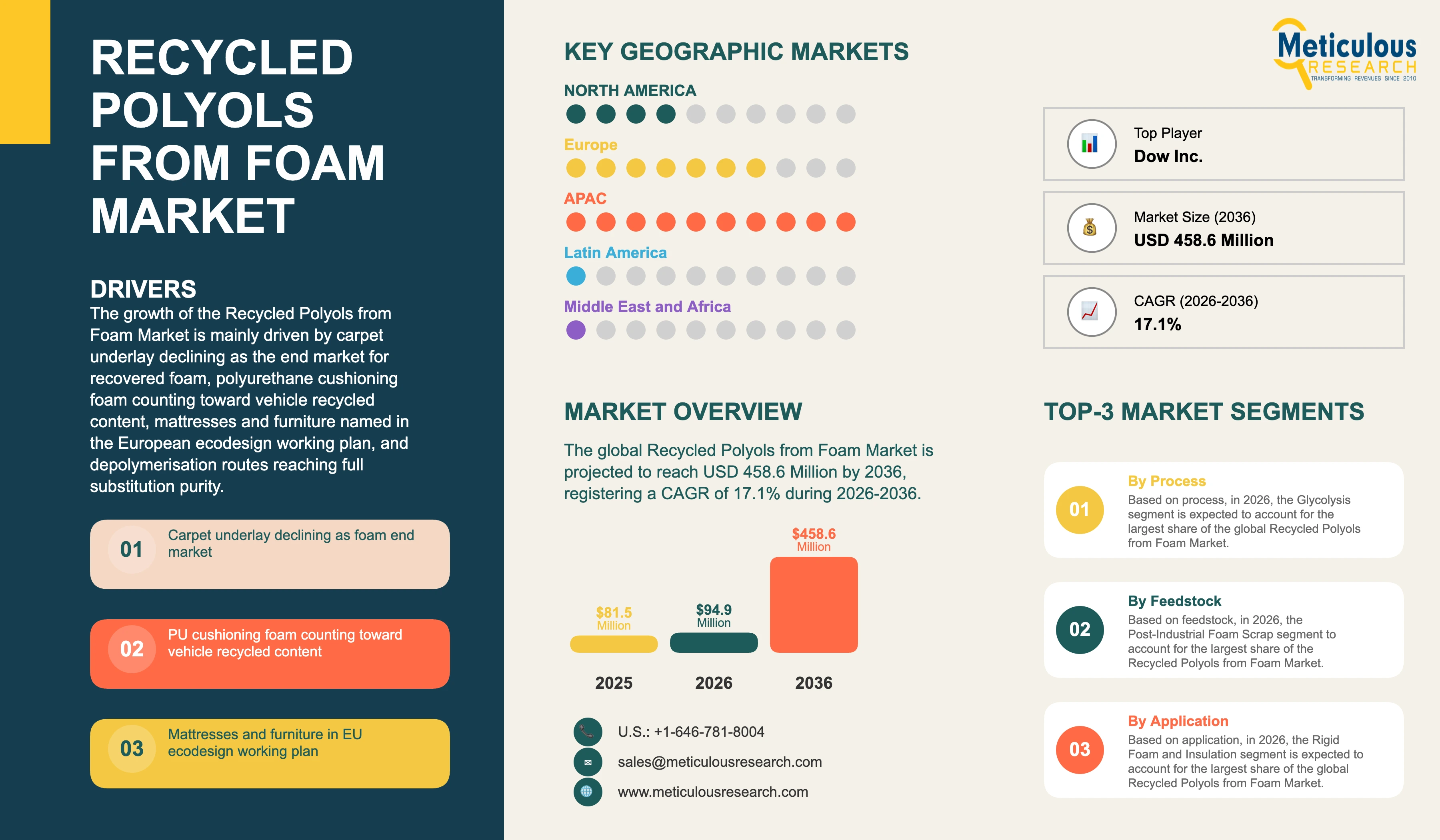
The recycled polyols from foam market is valued at USD 94.9 million in 2026 and is projected to reach USD 458.6 million by 2036, at a CAGR of 17.1% during the forecast period. The market was valued at USD 81.5 million in 2025 and at USD 70.9 million in 2024.
- Published
- Nov 2026
- Pages
- 244
- Format
- PDF + Excel
- Report ID
- MRCHM - 1042750
- Base year
- 2025
- 2024 · HISTORICAL
- $70.9M
- 2036
- $458.6M
- CAGR 2026–2036
- 17.1%
2024–2025 baseline · 2026–2036 forecast at 17.1% CAGR · hover a bar for the value
Key highlights
This market measures polyols recovered from post-consumer and post-industrial polyurethane foam by chemical depolymerisation, taken as recycled polyol sold at the producer gate on a tonne basis.
Virgin and bio-based polyols are excluded, as is mechanically recycled foam where no polyol is recovered, recovered toluenediamine and other amine or isocyanate precursors, collection and dismantling services, and depolymerisation reagents.
Article 6 of Regulation (EU) 2026/1738, adopted on 8 July 2026, requires new vehicle types type-approved from 1 September 2032 to contain a minimum of 15% of plastic recycled by weight from post-consumer plastic waste, rising to 25% from 1 September 2036.
That article does not count elastomers from tyres or thermosets other than polyurethane cushioning foams, which makes polyurethane cushioning foam the only thermoset that counts toward the requirement.
At least 20% of each of those shares must come from plastics recycled from end-of-life vehicles or from parts removed during the use phase, and the Commission must adopt the calculation and verification methodology by 31 August 2028.
The European Commission adopted the ecodesign and energy labelling working plan for 2025 to 2030 in April 2025, with priority product groups covering steel and aluminium, textiles with a focus on apparel, furniture, tyres and mattresses.
The Mattress Recycling Council reported that 134, 121 mattresses and foundations, equivalent to 8 million pounds, were collected in Oregon during 2025, in the first full year of the statewide programme.
Of 5,911,418 pounds reused, recycled or sent to biomass in that programme, steel accounted for 3,107,030 pounds and foam for 1,476,884 pounds, with wood at 904,844 pounds and quilt and toppers at 306,680 pounds.
That programme reported 75.6% by weight reused, recycled or sent to biomass, with recycled commodities alone at 62.5% against a recycler contract target of 70% by weight.
The same report states that nearly all post-consumer foam is sold to carpet underlayment manufacturers for use in carpet padding, and that demand for this foam is expected to decline as consumers shift away from carpet.
A peer-reviewed review published in ACS Sustainable Chemistry & Engineering on 11 February 2026 reports that the European Union discards more than 40 million mattresses a year and that typically 10% to 15% by weight of slabstock production is discarded as scrap.
That review reports split-phase glycolysis using diethylene glycol at a 1:1 glycol to foam ratio with 0.1% by weight DABCO at 200 degrees Celsius for three hours, resulting in 99% recycled polyol purity determined by gel permeation chromatography.
It further reports that split-phase glycolysis polyol could substitute 100% of virgin polyol in the synthesis of new polyurethane foam, while hydrolysis polyol was incorporated up to 40% into virgin polyol.
Ionic-liquid-assisted glycolysis using 1-butyl-3-methylimidazolium chloride or acetate below 100 degrees Celsius at one atmosphere for four hours gave depolymerisation yields above 95% on flexible and rigid foams with toluenediamine content below 0.05% by weight.
Acidolysis operates at temperatures as low as 140 degrees Celsius using dicarboxylic acids with Lewis acid catalysts such as zinc acetate or zinc oxide, with maleic acid showing the highest rate at 175 degrees Celsius over 15 minutes.
Microwave-assisted aminolysis with tris(2-aminoethyl)amine at 220 degrees Celsius in under an hour degraded more than 99% of the urethane groups, while general glycolysis at 170 to 250 degrees Celsius produces a complex oligomer mixture.
Covestro operates a polyol recovery pilot plant at Leverkusen using a chemolysis step to dissolve foam flakes followed by purification and hydrolysis to toluenediamine, with sorting technology developed together with Redwave and Recticel.
Repsol announced a mutual alliance with RAMPF Eco Solutions on 26 July 2021 giving it exclusive rights in Europe to develop and build recycled flexible polyol plants using RAMPF technology, with post-consumer polyurethane waste of various sources and quality grades as feedstock.
Report summary
| Particulars | Details |
|---|---|
| Base Year | 2025 |
| Actual Years | 2024-2025 |
| Forecast Period | 2026-2036 |
| Market Size in 2024 | USD 70.9 million |
| Market Size in 2025 | USD 81.5 million |
| Market Size in 2026 | USD 94.9 million |
| Market Size in 2036 | USD 458.6 million |
| Value CAGR (2026-2036) | 17.1% |
| Format | PDF, Excel & Cloud Portal · 244 pages |
| Volume in 2025 | 36.80 kilotons |
| Volume in 2026 | 42.00 kilotons |
| Volume in 2036 | 182.00 kilotons |
| Volume CAGR (2026-2036) | 15.8% |
| Average Selling Price, 2026 | USD 2,260 per tonne |
| Average Selling Price, 2036 | USD 2,520 per tonne |
| Units | Value in USD million; volume in kilotons of recycled polyol; price in USD per tonne |
| Measurement Basis | Polyols recovered from post-consumer and post-industrial polyurethane foam by chemical depolymerisation, measured as recycled polyol sold at the producer gate on a tonne basis |
| Historical Value Growth | Value grew at 15.7% a year between 2024 and 2026 against volume growth of 13.7% a year; the forecast of 17.1% sits above that rate because the vehicle recycled content requirement applies from 1 September 2032 and tightens from 1 September 2036, so the acceleration falls in the second half of the period |
| Obligation Timing | Article 6 of Regulation (EU) 2026/1738, adopted 8 July 2026, requires new vehicle types type-approved from 1 September 2032 to contain a minimum of 15% of plastic recycled from post-consumer waste, rising to 25% from 1 September 2036, with at least 20% of each share from end-of-life vehicles or parts removed during use; the calculation and verification methodology is due by 31 August 2028 |
| Thermoset Inclusion Note | Article 6 does not count elastomers from tyres or thermosets other than polyurethane cushioning foams, which makes polyurethane cushioning foam the only thermoset earning credit toward that requirement |
| Ecodesign Status Note | The European Commission adopted the ecodesign and energy labelling working plan for 2025 to 2030 in April 2025, naming mattresses and furniture among the priority product groups alongside steel and aluminium, textiles and tyres; naming a product group begins preparatory work and creates no product requirement, so no recycled content or recyclability duty applies to a mattress in the Union |
| End Market Displacement Note | Nearly all post-consumer mattress foam is sold to carpet underlayment manufacturers for carpet padding, and that demand is expected to decline as consumers shift away from carpet, with programme operators researching foam powders, footwear and construction materials; chemical recycling to polyol is being pushed by the loss of that outlet as much as pulled by circularity policy |
| Overlap Note | Recycled polyol sold into flexible and rigid foam is also counted in the Polyether Polyols Market and Polyester Polyols Market titles, so those titles are non-additive with this one on the recycled grades; bio-based polyols are a separate attribute and are excluded here |
| Exclusions | Virgin and bio-based polyols; mechanically recycled foam including rebond carpet underlay and foam powders, where no polyol is recovered; recovered toluenediamine and other amine or isocyanate precursors; mattress and furniture collection, dismantling and sorting services; glycols, acids, amines and ionic liquids used as depolymerisation reagents; polyurethane foam itself; chemical recycling of non-polyurethane foams |
| Segments: Process | Glycolysis; Acidolysis; Hydrolysis; Aminolysis and Other Routes |
| Segments: Feedstock | Post-Industrial Foam Scrap; End-of-Life Mattresses; End-of-Life Furniture and Bedding; Automotive Seating and Trim; Other Feedstocks |
| Segments: Polyol Type | Polyether Polyol; Polyester Polyol; Hybrid and Blended |
| Segments: Application | Rigid Foam and Insulation; Flexible Slabstock Foam; Moulded Flexible Foam; Coatings, Adhesives, Sealants and Elastomers; Other Applications |
| Largest Segment by Process, 2026 | Glycolysis, at 74.0% |
| Fastest-Growing Segment by Process | Aminolysis and Other Routes, at 22.4% |
| Largest Segment by Feedstock, 2026 | Post-Industrial Foam Scrap, at 61.0% |
| Fastest-Growing Segment by Feedstock | Automotive Seating and Trim, at 24.0% |
| Largest Segment by Polyol Type, 2026 | Polyether Polyol, at 78.0% |
| Fastest-Growing Segment by Polyol Type | Hybrid and Blended, at 22.0% |
| Largest Segment by Application, 2026 | Rigid Foam and Insulation, at 38.0% |
| Fastest-Growing Segment by Application | Moulded Flexible Foam, at 19.4% |
| Largest Region, 2026 | Asia-Pacific, at 47.0% |
| Fastest-Growing Region | Europe, at 19.6% |
| Fastest-Growing Country | Germany, at 21.8% |
| Slowest-Growing Country | Canada, at 13.6% |
| Regions Covered | Asia-Pacific; Europe; North America; Latin America; Middle East & Africa |
| Countries Covered | China; India; Japan; South Korea; Germany; Spain; France; U.K.; U.S.; Canada; Mexico; Brazil |
| Key Players | Dow Inc.; Covestro AG; BASF SE; Repsol S.A.; Huntsman Corporation; Wanhua Chemical Group Co., Ltd.; RAMPF Holding GmbH & Co. KG; H&S Anlagentechnik GmbH; Recticel SA/NV; Orrion Chemicals |
| Top Five Share, 2026 | 38.6% |
| Profiled Companies Share, 2026 | 47.2% |
| Currency | USD |
Report overview
Market value is measured in in USD million; volume in kilotons of recycled polyol; price in USD per tonne. Segments covered: process, feedstock, polyol type, application.
In volume terms, the market is estimated at 42.00 kilotons of recycled polyol in 2026, rising to 182.00 kilotons by 2036, at a CAGR of 15.8%. The average selling price is estimated at USD 2,260 per tonne in 2026 and USD 2,520 per tonne in 2036, the increase reflecting a shift in mix toward higher-purity grades able to serve flexible foam rather than rigid foam alone.
The growth of this market is mainly driven by the decline of carpet underlay as the end market for recovered mattress foam, a recycled plastic content requirement for new vehicles under which polyurethane cushioning foams are the only thermoset counted, mattresses and furniture named among the priority product groups of the European ecodesign working plan, and depolymerisation routes now reported to return polyol at purities that allow full substitution for virgin material. However, factors such as mattress collection economics carried by recovered steel rather than foam, an ecodesign requirement for mattresses that does not yet exist, commercial glycolysis returning a complex oligomer mixture suited to rigid foam, and 60% to 80% of used mattresses in Europe not effectively recycled are expected to restrain the growth of this market to some extent.
Among processes, glycolysis is expected to hold the largest share of this market in 2026, while aminolysis and other emerging routes are expected to record the highest CAGR during the forecast period. Geographically, Asia-Pacific is expected to account for the largest share of this market in 2026, while Europe is expected to register the highest CAGR during the forecast period.
Polyurethane is formed by reacting a polyol with an isocyanate, and the urethane linkage that results can be broken by a nucleophile. That is the whole basis of this market. Introducing a glycol, an acid, water or an amine at temperature cleaves the network and returns a polyol-rich phase that can be purified and sold back into foam production. Unlike most thermosets, flexible polyurethane foam was always chemically reversible, so the constraint on recycling it has been economic and logistical rather than chemical.
The routes differ in what they return. General glycolysis at 170 to 250 degrees Celsius with zinc acetate, alkali hydroxides, DABCO or tin catalysts produces a complex oligomer mixture, which is why commercial output has gone into rigid foam where property tolerance is wider. Split-phase glycolysis using diethylene glycol at a 1:1 ratio with 0.1% by weight DABCO at 200 degrees Celsius for three hours has been reported to give 99% recycled polyol purity by gel permeation chromatography, with that polyol able to substitute 100% of virgin polyol in new foam.
Lower-temperature routes are where the development effort sits. Ionic-liquid-assisted glycolysis below 100 degrees Celsius at one atmosphere for four hours has been reported to give depolymerisation yields above 95% on both flexible and rigid foams with toluenediamine content below 0.05% by weight. Acidolysis runs from 140 degrees Celsius with dicarboxylic acids over zinc catalysts, and microwave-assisted aminolysis at 220 degrees Celsius has degraded more than 99% of the urethane groups in under an hour.
Hydrolysis occupies a different position. Older practice ran at 190 to 400 degrees Celsius and up to 40 bar, and superbase catalysts with ionic liquids now allow operation below 100 degrees Celsius, but the recycled polyol has been incorporated only up to 40% into virgin polyol. The route is attractive because it returns the amine as well as the polyol, which is the basis of the pilot operating at Leverkusen where chemolysis dissolves foam flakes and a subsequent hydrolysis step produces toluenediamine.
Feedstock divides the market more sharply than process does. Post-industrial scrap from slabstock production, typically 10% to 15% by weight of output, is clean, compositionally known and available at a single address, and it accounts for the largest feedstock share in 2026. Glycolysis of that scrap back into rigid-foam polyol has been established practice for years, particularly in Asia, and it is the reason this market has a commercial base at all rather than beginning from a pilot.
Post-consumer foam is the larger pool and the harder one. A mattress weighs 18 to 35 kilograms and occupies 0.6 to 0.75 cubic metres, is replaced every eight to twelve years, and must be dismantled before the foam can be separated from steel, wood and textile. The European Union discards more than 40 million mattresses a year, treatment costs run at EUR 15 to 40 a unit, and 60% to 80% of used mattresses are not effectively recycled.
Where collection does work, it is paid for by the steel. In the Oregon programme during 2025, 134,121 mattresses and foundations equivalent to 8 million pounds were collected, and of 5,911,418 pounds reused, recycled or sent to biomass, steel accounted for 3,107,030 pounds against 1,476,884 pounds of foam. Foam is roughly a quarter of recovered weight and a far smaller share of recovered value, so the economics of mattress circularity rest on scrap metal rather than on the polymer.
The commercial reason chemical recycling is being pursued now is that the existing outlet for that foam is going away. Nearly all post-consumer mattress foam is sold to carpet underlayment manufacturers for use in carpet padding, and demand for it is expected to decline as consumers shift away from carpet. Carpet padding is a mechanical, single-step downcycle; when it contracts, the recovered foam needs a different destination or the collection programme loses its outlet.
That reframes what is driving this market. Chemical recycling to polyol is not primarily being pulled by a circularity obligation on mattresses, because no such obligation yet exists. It is being pushed by the loss of the incumbent downcycled market for a material that collection programmes are already obliged to divert, and by the operators of those programmes looking for foam powders, footwear and construction materials as alternatives.
The one dated and binding recycled-content obligation that reaches polyurethane foam is automotive rather than domestic. Article 6 of Regulation (EU) 2026/1738, adopted on 8 July 2026, requires new vehicle types type-approved from 1 September 2032 to contain a minimum of 15% of plastic recycled from post-consumer waste, rising to 25% from 1 September 2036, and it counts no thermoset other than polyurethane cushioning foams. Automotive seating and trim is consequently the fastest-growing feedstock in this market despite the smallest share of the major categories.
The European ecodesign framework is where a mattress requirement would come from. The Commission adopted the working plan for 2025 to 2030 in April 2025, with priority product groups covering steel and aluminium, textiles with a focus on apparel, furniture, tyres and mattresses. Naming a product group begins a process rather than creating a duty, so the effect on polyol demand falls in the second half of the forecast period rather than the first.
Pricing sits below virgin polyol and is rising slowly. Recycled polyol sold at an average of USD 2,180 a tonne in 2024 and USD 2,260 in 2026, and the forecast carries USD 2,520 by 2036, an increase of 1.1% a year that reflects mix rather than inflation. A glycolysis oligomer mixture for rigid foam sells at a discount; a 99% purity split-phase polyol able to substitute fully for virgin material does not, and the price path assumes the second takes share from the first.
Rigid foam and insulation is the largest application for that reason. The polyol a commercial glycolysis plant produces is a mixture rather than a specification product, and a rigid insulation formulation tolerates variation in hydroxyl number and functionality that a flexible slabstock formulation does not. Flexible slabstock and moulded flexible foam grow faster because the purity now demonstrated at laboratory scale opens applications that the installed process base cannot currently serve.
Asia-Pacific holds the largest regional share because the post-industrial scrap and the glycolysis capacity that treats it are concentrated there, alongside the largest flexible and rigid foam production base. Europe grows fastest, carrying the vehicle recycled-content obligation, the ecodesign working plan, national furniture and mattress producer responsibility schemes, and the two most developed technology programmes in the pilot at Leverkusen and the European plant rights held under the RAMPF alliance.
Supply is consolidating around a small number of licensed technologies rather than many independent operators. Repsol announced a mutual alliance with RAMPF Eco Solutions on 26 July 2021 giving it exclusive rights in Europe to develop and build recycled flexible polyol plants using RAMPF technology, taking post-consumer polyurethane waste of various sources and quality grades. Covestro developed its mattress sorting technology with Redwave and Recticel, pairing a recycler and a foam producer with a chemical company.
The structural question is whether recovered polyol becomes a specification product or stays a discounted blend component. The chemistry to make it a specification product has been demonstrated, with 99% purity and full substitution reported, and the feedstock exists in the tens of millions of mattresses discarded each year. What is missing is a purchase obligation on the applications that use the most flexible foam, which automotive acquires in 2032 and domestic bedding does not yet have at all.
Report infographic
Market dynamics
20 factors across 5 forcesCarpet Underlay Declining as the End Market for Recovered Foam
Nearly all post-consumer mattress foam is sold to carpet underlayment manufacturers for use in carpet padding, and demand for that foam is expected to decline as consumers shift away from carpet. The operators of the collection programmes are researching other markets including foam powders, footwear and construction materials.
A collection programme obliged to divert mattresses cannot stop diverting them when the outlet for the foam contracts, so the foam needs a destination with more depth than carpet padding offers. Chemical recycling to polyol returns the material to the application it came from rather than to a single downcycled use.
The volumes involved are already material. The Oregon programme recovered 1,476,884 pounds of foam in 2025 from 134,121 mattresses and foundations, in the first full year of a statewide scheme, and comparable programmes operate in other states.
Polyurethane Cushioning Foam Counting Toward Vehicle Recycled Content
Article 6 of Regulation (EU) 2026/1738, adopted on 8 July 2026, requires new vehicle types type-approved from 1 September 2032 to contain a minimum of 15% of plastic recycled by weight from post-consumer plastic waste, rising to 25% from 1 September 2036.
The article does not count elastomers from tyres or thermosets other than polyurethane cushioning foams, which makes polyurethane cushioning foam the only thermoset that earns credit toward the requirement and gives vehicle seating a reason to specify recycled polyol that no other thermoset application has.
At least 20% of each share must come from plastics recycled from end-of-life vehicles or parts removed during the use phase, and the Commission must adopt the calculation and verification methodology by 31 August 2028. Automotive seating and trim records the highest feedstock CAGR in this market at 24.0%.
Mattresses and Furniture Named in the European Ecodesign Working Plan
The European Commission adopted the ecodesign and energy labelling working plan for 2025 to 2030 in April 2025, with priority product groups covering steel and aluminium, textiles with a focus on apparel, furniture, tyres and mattresses.
Naming a product group starts the preparatory work for product-specific requirements under the ecodesign framework, which is where a recycled content or recyclability duty on a mattress would originate. End-of-life mattresses record a feedstock CAGR of 21.0% over the forecast period on that expectation.
National producer responsibility schemes for furniture and bedding already fund collection in several member states, so the collection infrastructure a future requirement would rely on is in place ahead of the requirement itself.
Depolymerisation Routes Reaching Full Substitution Purity
Split-phase glycolysis using diethylene glycol at a 1:1 glycol to foam ratio with 0.1% by weight DABCO at 200 degrees Celsius for three hours has been reported to give 99% recycled polyol purity determined by gel permeation chromatography.
The same work reports that the resulting polyol could substitute 100% of virgin polyol in the synthesis of new polyurethane foam, against a maximum of 40% incorporation reported for hydrolysis polyol, which is the difference between a blend component and a specification product.
Ionic-liquid-assisted glycolysis below 100 degrees Celsius at one atmosphere for four hours has given depolymerisation yields above 95% on both flexible and rigid foams with toluenediamine content below 0.05% by weight, which removes the high-temperature energy penalty of the conventional route.
Table of contents
12 chapters · 133 sections · 244 pages · click to expandSegmental analysis
| Segment | Largest share (2026) | Fastest growth (2026–2036) |
|---|---|---|
| By Process | Glycolysis | Aminolysis and other emerging routes |
| By Feedstock | Post-industrial foam scrap | Automotive seating and trim |
| By Polyol Type | Polyether polyol | Hybrid and blended recycled polyols |
| By Application | Rigid foam and insulation | Moulded flexible foam |
By Process
- Recycled Polyols from Foam Analysis by Process
- Glycolysis is expected to hold the largest share of this market in 2026.
- The route introduces a glycol at 170 to 250 degrees Celsius over zinc acetate, alkali hydroxide, DABCO or tin catalysts, and it carries the installed commercial base because it is the oldest route, needs no exotic reagent, and has been used on post-industrial slabstock scrap for years.
- Its limitation is the product: general glycolysis returns a complex oligomer mixture rather than a defined polyol, which is why most output goes into rigid foam.
- The process grows at 16.1%.
- Aminolysis and other emerging routes are expected to record the highest CAGR during the forecast period at 22.4%.
- Microwave-assisted aminolysis with tris(2-aminoethyl)amine at 220 degrees Celsius has degraded more than 99% of the urethane groups in under an hour, and a route using 2-(methylamino)ethan-1-ol with a TBD and methanesulfonic acid system at 160 degrees Celsius over three hours achieved complete depolymerisation, though cross-linked rigid foam did not depolymerise.
- Acidolysis grows at 19.8%, operating from 140 degrees Celsius with dicarboxylic acids over Lewis acid catalysts such as zinc acetate or zinc oxide, with maleic acid showing the highest reported rate at 175 degrees Celsius over 15 minutes.
- The lower operating temperature is the commercial attraction, since the energy cost of the reaction is a material part of the gap between recycled and virgin polyol.
- Hydrolysis grows at 18.2% and occupies a distinct position because it returns the amine as well as the polyol.
- Older practice ran at 190 to 400 degrees Celsius and up to 40 bar, superbase catalysts with ionic liquids now allow operation below 100 degrees Celsius, and the recycled polyol has been incorporated up to 40% into virgin polyol, which places the route as a blend component rather than a full substitute.
By Feedstock
- Recycled Polyols from Foam Analysis by Feedstock
- Post-industrial foam scrap is expected to hold the largest share of this market in 2026.
- Typically 10% to 15% by weight of slabstock production is discarded as scrap, and that material is clean, compositionally known and available in tonnage at a single address, which makes it the lowest-cost feedstock here and the reason glycolysis capacity sits next to foam production rather than next to a collection scheme.
- The feedstock grows at 15.1%, the slowest of the five, because it scales with foam output rather than with policy.
- Automotive seating and trim is expected to record the highest CAGR during the forecast period at 24.0%.
- Article 6 of Regulation (EU) 2026/1738 counts no thermoset other than polyurethane cushioning foams toward the minimum recycled plastic content for new vehicles, which is 15% for new types type-approved from 1 September 2032 and 25% from 1 September 2036.
- The feedstock and the obligated application sit in the same industry, since a dismantler already removes the seat.
- End-of-life mattresses grow at 21.0%.
- The European Union discards more than 40 million mattresses a year, extended producer responsibility schemes already fund collection in several jurisdictions, and mattresses are named among the priority product groups of the ecodesign working plan adopted in April 2025.
- The constraint is that collection economics are carried by recovered steel rather than foam, and that the incumbent foam outlet in carpet padding is contracting.
- End-of-life furniture and bedding grows at 18.4%, served by the same producer responsibility schemes and the same dismantling infrastructure as mattresses but with more variable foam grades and smaller unit foam mass.
- Other feedstocks including packaging foam, footwear and insulation offcuts grow at 16.0%, limited by dispersed arising and by rigid foam grades that cross-linked routes do not depolymerise cleanly.
By Polyol Type
- Recycled Polyols from Foam Analysis by Polyol Type
- Polyether polyol is expected to hold the largest share of this market in 2026, because flexible slabstock foam is built on polyether chemistry and flexible foam is what mattress, furniture and seating feedstock consists of.
- Recovering a polyether polyol from a polyether foam returns the material to the chemistry it came from, which is the shortest loop available and the one that requires least reformulation at the foam producer.
- The type grows at 16.5%.
- Hybrid and blended recycled polyols are expected to record the highest CAGR during the forecast period at 22.0%.
- These are products in which recovered polyol is combined with virgin polyol or with a second recovered stream to hit a declared recycled content at a defined hydroxyl number, which is how a producer sells a variable feedstock to a specification.
- The format grows fastest because it converts a blend constraint into a product.
- Polyester polyol grows at 17.8%, recovered mainly from rigid foam and from polyester-based flexible grades, and used in rigid insulation and in coatings, adhesives, sealants and elastomers.
- The chemistry is more readily hydrolysed than polyether and therefore more amenable to the lower-temperature routes, which supports growth above the polyether rate from a smaller base.
By Application
- Recycled Polyols from Foam Analysis by Application
- Rigid foam and insulation is expected to hold the largest share of this market in 2026.
- A rigid insulation formulation tolerates variation in hydroxyl number and functionality that a flexible slabstock formulation does not, and the polyol a commercial glycolysis plant produces is a complex oligomer mixture rather than a specification product, so the installed output has gone where the property window is widest.
- The application grows at 15.6%, the slowest of the five.
- Moulded flexible foam is expected to record the highest CAGR during the forecast period at 19.4%, on vehicle seating.
- Polyurethane cushioning foams are the only thermoset counted toward the automotive recycled plastic content requirement, and moulded flexible foam is how a seat cushion is made, so the obligation applies directly to this application from 1 September 2032 and tightens from 1 September 2036.
- Flexible slabstock foam grows at 18.0%, as the purity now demonstrated at laboratory scale opens an application the installed process base cannot currently serve.
- Split-phase glycolysis polyol reported at 99% purity by gel permeation chromatography and able to substitute 100% of virgin polyol is what would allow mattress and furniture foam to be returned to mattress and furniture foam rather than downcycled.
- Coatings, adhesives, sealants and elastomers grow at 17.8%, taking recovered polyester and hybrid grades where a wide property window and a declared recycled content both have value, and where recovered polyol has been used to synthesise aqueous polyurethane dispersions with thermal stability and particle size comparable to virgin-derived counterparts.
- Other applications grow slowest at 15.0%.
Geographic analysis
Asia-Pacific
Largest shareAsia-Pacific is expected to account for the largest share of this market in 2026, while Europe is expected to register the highest CAGR during the forecast period. Asia-Pacific leads because the post-industrial slabstock scrap and the glycolysis capacity that treats it are concentrated there, alongside the largest flexible and rigid foam production base in the world. The region grows at 16.0%, below the global rate, because its base is already the largest and because growth tracks foam output rather than policy. China accounts for most of the regional total, with India growing from a smaller base on rising foam consumption and an expanding organised recycling sector.
Europe
Fastest growthEurope grows fastest at 19.6%. Article 6 of Regulation (EU) 2026/1738 counts polyurethane cushioning foams toward the vehicle recycled plastic content requirement from 1 September 2032, mattresses and furniture are named among the priority product groups of the ecodesign working plan adopted in April 2025, national producer responsibility schemes already fund furniture and bedding collection, and more than 40 million mattresses are discarded in the Union each year. Germany grows fastest of the countries covered at 21.8%. Germany carries the pilot at Leverkusen, where chemolysis dissolves foam flakes before purification and hydrolysis to toluenediamine, and Spain carries the European plant development rights held under the alliance with RAMPF Eco Solutions announced on 26 July 2021. France and the United Kingdom hold established furniture and bedding collection schemes that supply feedstock rather than conversion capacity.
North America
North America grows at 16.4%. The driver is extended producer responsibility at state level rather than federal regulation, and the Oregon programme recovered 1,476,884 pounds of foam from 134,121 mattresses and foundations in 2025, with nearly all post-consumer foam sold to carpet underlayment manufacturers and that demand expected to decline. The United States holds the great majority of the regional total and Canada grows slowest of the countries covered at 13.6%.
Latin America
Latin America grows at 14.0%. Brazil holds the larger position on domestic foam production and post-industrial scrap arising, with Mexico second on automotive seating manufacture that will face the European recycled content requirement through export programmes. Neither market has a domestic mattress or furniture producer responsibility scheme of scale.
Middle East & Africa
The Middle East and Africa grows slowest at 13.2%. Foam production is modest, collection infrastructure for bulky waste is limited, landfill costs are low, and no jurisdiction in the region conditions market access on recycled polyol content, so activity follows post-industrial scrap arising at the larger foam producers.
Competitive landscape
Three participant types compete here and only one of them sells polyol. Polyurethane raw material producers hold the technology and the customer relationship, and treat recovered polyol as a line extension of an existing polyol business. Technology licensors hold the process and sell plant rights rather than product. Foam producers and recyclers hold the feedstock and the sorting capability, and participate through partnership rather than by entering the polyol market themselves.
Concentration is moderate. The top five participants are estimated to hold 38.6% of this market in 2026 and the profiled companies 47.2%, with the balance spread across the numerous small operators treating post-industrial slabstock scrap by conventional glycolysis, particularly in Asia-Pacific. The fragmentation sits in the oldest and lowest-value part of the market, while the capacity being added is concentrated in a small number of licensed technologies.
Technology is being distributed by licence rather than built independently. Repsol announced a mutual alliance with RAMPF Eco Solutions on 26 July 2021 giving it exclusive rights in Europe to develop and build recycled flexible polyol plants using RAMPF technology, taking post-consumer polyurethane waste of various sources and quality grades as feedstock. That structure gives the licensor reach without capital and the licensee a position without a development programme.
Covestro AG operates a polyol recovery pilot plant at Leverkusen under a patented process that dismantles mattresses, separates the foam, identifies foam types with sorting technology using algorithms, then applies a chemolysis step to dissolve the foam flakes followed by purification and hydrolysis to toluenediamine, the precursor to toluene diisocyanate. The sorting technology was developed together with Redwave and Recticel, pairing a chemical producer with a recycling equipment supplier and a foam manufacturer.
The pattern across the leading positions is a raw material producer securing feedstock through a collection or sorting partner rather than buying foam on a merchant basis, because an unsorted mattress stream yields a polyol that cannot be sold to a specification. That structure gives the polyol producer control of the variable that governs product quality, and gives the recycler an outlet of more depth than carpet padding at a time when that demand is expected to decline.
Some of the key players operating in the recycled polyols from foam market are Dow Inc., Covestro AG, BASF SE, Repsol S.A., Huntsman Corporation, Wanhua Chemical Group Co., Ltd., RAMPF Holding GmbH & Co. KG, H&S Anlagentechnik GmbH, Recticel SA/NV, and Orrion Chemicals, among others.
- Dow Inc.
- Covestro AG
- BASF SE
- Repsol S.A.
- Huntsman Corporation
- Wanhua Chemical Group Co., Ltd.
- RAMPF Holding GmbH & Co. KG
- H&S Anlagentechnik GmbH
- Recticel SA/NV
- Orrion Chemicals
Expert perspectives
The list driver for this title is mattress and foam circularity, and the primary evidence supports the volumes while reversing the direction of causation. Collection schemes already divert mattresses at scale, but the Oregon programme shows what the recovered material is worth: of 5,911,418 pounds reused, recycled or sent to biomass in 2025, steel accounted for 3,107,030 pounds against 1,476,884 pounds of foam. Mattress circularity is paid for by scrap metal, and foam is a quarter of recovered weight.
What is moving the foam toward chemical recycling is the loss of its existing outlet. Nearly all post-consumer mattress foam is sold to carpet underlayment manufacturers for carpet padding, and that demand is expected to decline as consumers shift away from carpet, with the programme operators researching foam powders, footwear and construction materials as alternatives. This is an end-market displacement rather than a circularity pull.
The one dated and binding recycled content obligation that reaches polyurethane foam is automotive. Article 6 of Regulation (EU) 2026/1738, adopted on 8 July 2026, requires 15% of plastic recycled from post-consumer waste in new vehicle types type-approved from 1 September 2032, rising to 25% from 1 September 2036, and counts no thermoset other than polyurethane cushioning foams. That is why automotive seating and trim is the fastest-growing feedstock at 24.0% from the smallest share of the major categories.
For mattresses themselves there is no requirement. The ecodesign working plan adopted in April 2025 names mattresses and furniture among the priority product groups, which begins preparatory work rather than creating a duty, so bedding demand for recovered polyol rests on brand commitments through most of the forecast period. The 17.1% value CAGR sits above the 15.7% a year recorded between 2024 and 2026 for that reason, with the acceleration placed in the second half.
The technical case is stronger than the commercial one and the gap is specific. Split-phase glycolysis has been reported at 99% recycled polyol purity by gel permeation chromatography with the polyol able to substitute 100% of virgin material in new foam, and ionic liquid glycolysis below 100 degrees Celsius has given depolymerisation yields above 95%. The installed base runs conventional glycolysis at 170 to 250 degrees Celsius and returns a complex oligomer mixture, which is why rigid foam and insulation is the largest application and the product sells at a discount.
Feedstock access rather than chemistry or demand is the binding constraint. The European Union discards more than 40 million mattresses a year at a treatment cost of EUR 15 to 40 a unit, and 60% to 80% are not effectively recycled, while post-industrial slabstock scrap at 10% to 15% by weight of production remains the largest feedstock because it is clean and available at a single address. The market grows fastest where an obligated application and an existing dismantling route coincide, which is vehicle seating rather than bedding.
Frequently asked questions
The market is valued at USD 94.9 million in 2026 and is projected to reach USD 458.6 million by 2036, at a CAGR of 17.1%. It was valued at USD 81.5 million in 2025 and USD 70.9 million in 2024.
It measures polyols recovered from post-consumer and post-industrial polyurethane foam by chemical depolymerisation, taken as recycled polyol sold at the producer gate on a tonne basis. Virgin and bio-based polyols, mechanically recycled foam, recovered amine precursors, collection and dismantling services, depolymerisation reagents and chemical recycling of non-polyurethane foams are excluded.
Partly, and not in the direction usually assumed. The Oregon programme shows steel at 3,107,030 pounds against foam at 1,476,884 pounds of 5,911,418 pounds recovered in 2025, and foam is being pushed toward chemical recycling by the expected decline of the carpet underlayment outlet.
Article 6 of Regulation (EU) 2026/1738, adopted on 8 July 2026, requires new vehicle types type-approved from 1 September 2032 to contain a minimum of 15% of plastic recycled by weight from post-consumer plastic waste, rising to 25% from 1 September 2036. The article counts no thermoset other than polyurethane cushioning foams.
Not yet. The European Commission adopted the ecodesign and energy labelling working plan for 2025 to 2030 in April 2025 naming mattresses among the priority product groups, which begins preparatory work rather than creating a duty.
Glycolysis holds the largest share in 2026, carrying the installed commercial base, though it returns a complex oligomer mixture. Aminolysis and other emerging routes record the highest CAGR at 22.4%.
Split-phase glycolysis has been reported to give 99% recycled polyol purity by gel permeation chromatography, with the polyol able to substitute 100% of virgin polyol in new foam. Hydrolysis polyol has been incorporated up to 40% into virgin polyol, and a rigid foam life cycle assessment found 50% to 70% recycled content gave the most favourable results.
Ionic-liquid-assisted glycolysis below 100 degrees Celsius has given depolymerisation yields above 95% on flexible and rigid foams with toluenediamine content below 0.05% by weight. Acidolysis operates from 140 degrees Celsius with dicarboxylic acids over zinc acetate or zinc oxide.
Typically 10% to 15% by weight of slabstock production is discarded as scrap, which is clean, compositionally known and available in tonnage at a single address. End-of-life mattresses are the larger pool but must be dismantled, and 60% to 80% are not effectively recycled.
Automotive seating and trim records the highest feedstock CAGR at 24.0%, and moulded flexible foam records the highest application CAGR at 19.4%, both because polyurethane cushioning foams are the only thermoset counted toward the vehicle recycled plastic content requirement. Rigid foam and insulation holds the largest application share and grows slowest at 15.6%.
A rigid insulation formulation tolerates variation in hydroxyl number and functionality that a flexible slabstock formulation does not, and a commercial glycolysis plant produces a complex oligomer mixture rather than a specification product. Installed output has therefore gone where the property window is widest.
Asia-Pacific holds the largest share in 2026 at 47.0%, because post-industrial slabstock scrap and glycolysis capacity are concentrated there. Europe grows fastest at 19.6%, with Germany the fastest-growing country at 21.8%.
Covestro operates a polyol recovery pilot plant at Leverkusen using chemolysis followed by purification and hydrolysis to toluenediamine, with sorting technology developed together with Redwave and Recticel. Repsol announced a mutual alliance with RAMPF Eco Solutions on 26 July 2021 giving it exclusive rights in Europe to build recycled flexible polyol plants using RAMPF technology.
Key players include Dow Inc., Covestro AG, BASF SE, Repsol S.A., Huntsman Corporation, Wanhua Chemical Group Co., Ltd., RAMPF Holding GmbH & Co. KG, H&S Anlagentechnik GmbH, Recticel SA/NV and Orrion Chemicals. The top five hold an estimated 38.6% in 2026 and the profiled companies 47.2%.
A glycolysis oligomer mixture for rigid foam sells at a discount to virgin polyether polyol, while a high-purity grade able to substitute fully does not. The average selling price was USD 2,180 a tonne in 2024 and USD 2,260 in 2026, with USD 2,520 forecast by 2036.
Mattress collection economics are carried by recovered steel rather than foam, no ecodesign requirement yet applies to a mattress, and commercial glycolysis returns a complex oligomer mixture so purity figures come from laboratory work. In addition, 60% to 80% of used mattresses in Europe are not effectively recycled, which bounds available feedstock.
Cite this report
Meticulous Research. (2026). Recycled Polyols from Foam Market - Global Opportunity Analysis and Industry Forecast (2026-2036) (Report No. MRCHM - 1042750). Meticulous Market Research Pvt. Ltd. https://www.meticulousresearch.com/product/recycled-polyols-from-foam-market-7433