Metallocene Catalysts Market (2026-2036)
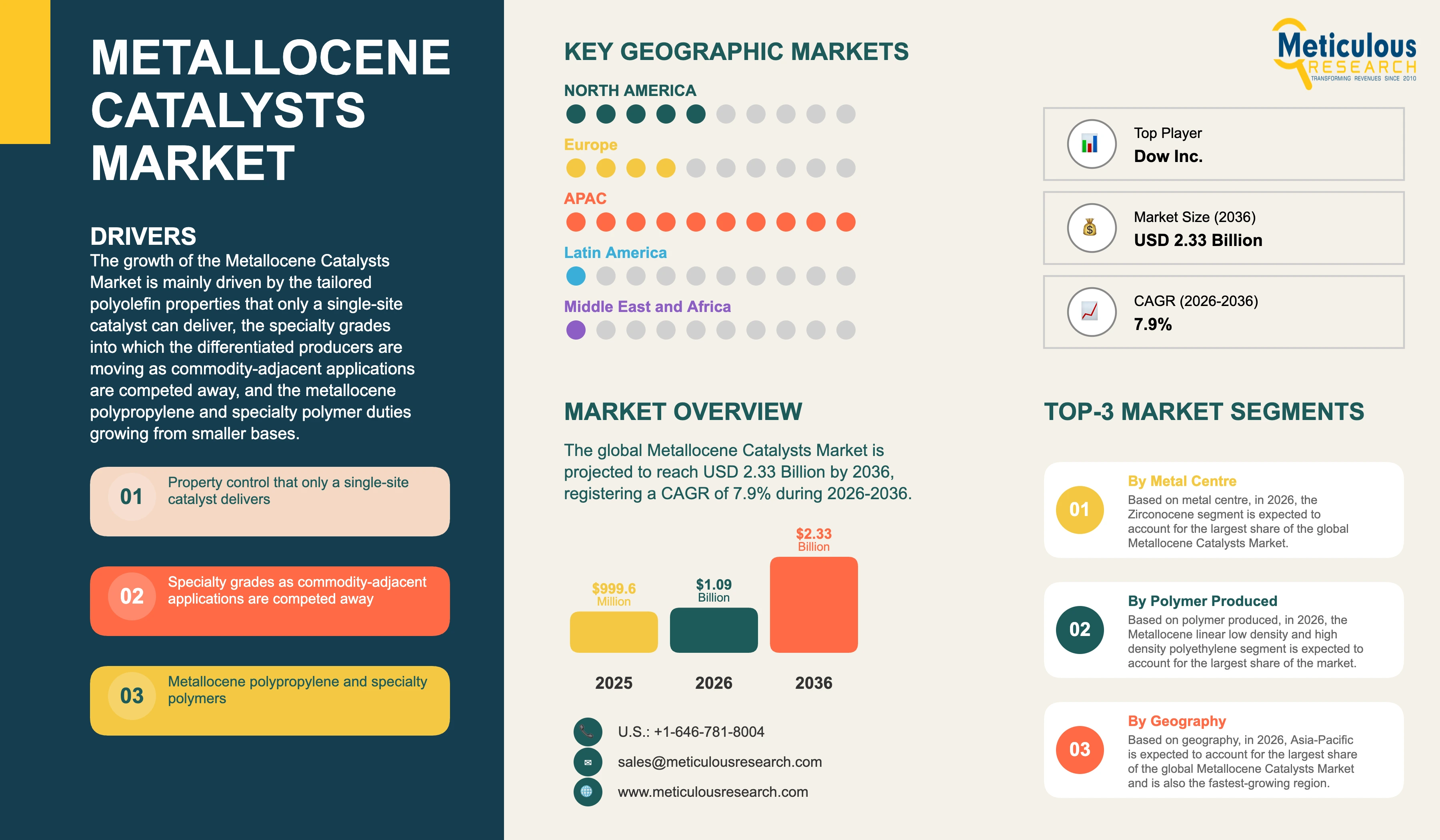
The global metallocene catalysts market was valued at USD 999.6 million in 2025. This market is expected to reach USD 2.33 billion by 2036 from an estimated USD 1.09 billion in 2026, registering a CAGR of 7.9% during the forecast period (2026-2036).
- Published
- Nov 2026
- Pages
- 257
- Format
- PDF + Excel
- Report ID
- MRCHM - 1042812
- Base year
- 2025
- 2025 · BASELINE
- $999.6M
- 2036
- $2.33B
- CAGR 2026–2036
- 7.9%
2025 baseline · 2026–2036 forecast at 7.9% CAGR · hover a bar for the value
Key highlights
The global metallocene catalysts market is estimated at USD 1.09 billion in 2026 and is projected to reach USD 2.33 billion by 2036.
Market volume is estimated at 2.60 kilotons in 2026 and is projected to reach 4.66 kilotons by 2036 at a CAGR of 6.0%, measured as catalyst system as supplied including the activator and any support.
The activator and support dominate the mass of a metallocene system, so a figure quoted for the complex alone would be a small fraction of the one here.
The average selling price is estimated at USD 420.00 per kg in 2026 and is projected to reach USD 500.00 per kg by 2036 as post-metallocene and specialty systems take a larger share.
Zirconocene systems are expected to account for the largest metal centre share in 2026, while post-metallocene and other single-site systems are projected to register the highest CAGR of 11.0%.
Metallocene linear low density and high density polyethylene is expected to hold the largest polymer share in 2026, while metallocene polyalphaolefins and specialty polymers are projected to grow fastest at a CAGR of 11.4%.
Asia-Pacific is expected to hold the largest regional share in 2026 and is also projected to grow fastest at a CAGR of 9.0%.
Mitsui Chemicals reported on 13 May 2026, in its fiscal 2025 results and fiscal 2026 outlook, that commercial operations at its new TAFMER plant in Singapore, designated 6TF, began in April 2026.
The company states that olefin procurement in Singapore has been constrained by the Middle East conflict, so it is limiting operating rates at that plant.
It also states that in fiscal 2025 it reduced the share of solar cell encapsulant applications for TAFMER, shifting toward differentiated areas being high-performance packaging materials, engineering plastics, footwear and automotive, and plans to keep expanding sales in those areas in fiscal 2026.
That is a retreat from the application most often cited as the growth driver for metallocene polyolefin elastomer, stated by a leading producer of it.
Fixed costs are rising from the 6TF expansion and a new 4PP facility at Ichihara Works, which together with other items account for a negative impact of 7.5 billion yen on operating income before special items in fiscal 2026.
The company expects the Middle East conflict to have a negative impact of 15.0 billion yen, mainly on its Basic & Green Materials segment, with cracker operating rates assumed to fall below 70% in the first half of fiscal 2026.
That presentation discloses no sales, operating income, volumes or utilisation for elastomers or TAFMER, no installed capacity or ramp-up schedule for 6TF, no separate cost impact for it, and no demand outlook for solar encapsulant or polyolefin elastomers, and does not mention alpha-olefins or metallocene-based products at all.
Mitsui Chemicals, Idemitsu Kosan and Sumitomo Chemical announced on 24 December 2025 a definitive business integration agreement and joint venture agreement, following a memorandum of understanding of 10 September 2025.
Under it the domestic polypropylene and linear low density polyethylene businesses of Sumitomo Chemical transfer into Prime Polymer Co., Ltd., the existing Mitsui and Idemitsu joint venture, by a two-phase absorption-type split.
Ownership moves from Mitsui at 65% and Idemitsu at 35% to Mitsui at 52%, Idemitsu at 28% and Sumitomo Chemical at 20%, with Sumitomo receiving its 20% stake as consideration in the first phase.
Domestic capacity rises from 1.26 to 1.59 million tonnes a year in polypropylene and from 0.55 to 0.72 million tonnes a year in polyethylene, on combined fiscal 2024 net sales of 387.3 billion yen and a target of more than 8 billion yen a year in cost savings.
The stated rationale is that polyolefins account for about 50% of Japanese plastics demand, that domestic oversupply has not been resolved, and that demand is expected to shrink through population decline and lifestyle changes, so the integration is intended to strengthen competitiveness against imports.
The planned timetable is a first-phase agreement on 1 April 2026 effective 1 July 2026, and a second-phase agreement in January 2027 effective 1 April 2027, all subject to competition-law and other clearances.
That release does not state whether the integrated business holds metallocene or single-site catalyst capability, gives no product grades, no headcount, no named plant closures and no firm closing date.
Report summary
| Particulars | Details |
|---|---|
| Base Year | 2025 |
| Forecast Period | 2026-2036 |
| Market Size in 2025 | USD 999.6 million |
| Market Size in 2026 | USD 1.09 billion |
| Market Size by 2036 | USD 2.33 billion |
| Value CAGR (2026-2036) | 7.9% |
| Format | PDF, Excel & Cloud Portal · 257 pages |
| Volume in 2026 | 2.60 kilotons |
| Volume by 2036 | 4.66 kilotons |
| Volume CAGR (2026-2036) | 6.0% |
| Volume Basis | Catalyst system as supplied, including the activator and any support |
| Average Selling Price in 2026 | USD 420.00 per kg |
| Average Selling Price by 2036 | USD 500.00 per kg |
| Price Direction | The average selling price rises across the forecast period as post-metallocene and specialty systems take a larger share of a market led by the zirconocene polyethylene grades, rather than through any change in the cost of an individual complex |
| Volume Basis Note | A methylaluminoxane activator is used at aluminium to transition metal ratios running into the hundreds, a borate activator at lower but still excess ratios, and a supported catalyst carries a silica support heavier again than either, so the metallocene complex is a minor fraction of the mass delivered to a reactor; a market measured on the complex alone would be numerically trivial while describing the same industry |
| Scope Exclusion Note | Ziegler-Natta and chromium catalysts are excluded, and that exclusion is larger than this market by a wide margin since the great majority of polyolefin produced worldwide is still made on those systems; the polymer produced is also outside the measurement and is counted in the polyolefin markets rather than here |
| Measurement Basis | Single-site polymerisation catalyst systems for olefins, including zirconocene, hafnocene and titanium-based constrained geometry complexes and post-metallocene single-site systems, supplied with their activators and supports, by metal centre, polymer produced, supply model and geography |
| Relationship to Adjacent Markets | This market is distinct from the hydrogenation and hydrotreating catalysts markets in this series, which address the addition of hydrogen rather than the polymerisation of olefins, and is not additive to any of them |
| Note on Market Structure | Most metallocene catalyst never passes through a merchant transaction: a polyolefin producer that developed a single-site family generally makes or has made to order the complex and activator for its own plants or supplies them to licensees of its process, so captive and licensed supply accounts for 72% of this market and a figure built only from merchant transactions would capture less than a third of the catalyst actually consumed |
| Note on the Solar Encapsulant Retreat | Mitsui Chemicals reported on 13 May 2026, covering fiscal 2025 results and the fiscal 2026 outlook, that it reduced the share of solar cell encapsulant applications for TAFMER in fiscal 2025 and is shifting toward high-performance packaging materials, engineering plastics, footwear and automotive, with plans to keep expanding sales in those areas; solar encapsulant is the application most often cited as the growth engine for metallocene polyolefin elastomer, and this report accordingly forecasts the elastomer and plastomer segment below the market average |
| Note on the Japanese Integration | Mitsui Chemicals, Idemitsu Kosan and Sumitomo Chemical announced on 24 December 2025 a definitive business integration agreement following a memorandum of understanding of 10 September 2025, under which the domestic polypropylene and linear low density polyethylene businesses of Sumitomo Chemical transfer into Prime Polymer Co., Ltd. by a two-phase absorption-type split; ownership moves from Mitsui 65% and Idemitsu 35% to Mitsui 52%, Idemitsu 28% and Sumitomo 20%, domestic polypropylene capacity rises from 1.26 to 1.59 million tonnes a year and polyethylene from 0.55 to 0.72, on combined fiscal 2024 net sales of 387.3 billion yen with a target of more than 8 billion yen a year in savings, planned for first-phase effect on 1 July 2026 and second-phase effect on 1 April 2027 subject to clearances; the stated rationale is unresolved domestic oversupply and demand expected to shrink through population decline |
| Note on Source Limitations | The Mitsui Chemicals presentation discloses no sales, operating income, volumes or utilisation for elastomers or TAFMER, no installed capacity or ramp-up schedule for the new 6TF plant, no separate cost impact for it within the 7.5 billion yen figure, no demand outlook for solar encapsulant or polyolefin elastomers, and does not mention alpha-olefins or metallocene-based products; the integration release does not state whether the integrated business holds metallocene or single-site capability, and gives no product grades, headcount, named plant closures or firm closing date, so the sizing here is built from single-site polyolefin capacity and grade mix |
| Largest Metal Centre | Zirconocene |
| Fastest-Growing Metal Centre | Post-metallocene and other single-site systems (CAGR 11.0%) |
| Largest Polymer Produced | Metallocene linear low density and high density polyethylene |
| Fastest-Growing Polymer Produced | Metallocene polyalphaolefins and specialty polymers (CAGR 11.4%) |
| Largest Supply Model | Captive and licensed |
| Fastest-Growing Supply Model | Merchant supply (CAGR 9.4%) |
| Largest Region | Asia-Pacific |
| Fastest-Growing Region | Asia-Pacific (CAGR 9.0%) |
| Segments Covered | Metal Centre, Polymer Produced, Supply Model, and Geography |
| Geographies Covered | Asia-Pacific, North America, Europe, Middle East & Africa, and Latin America |
| Companies Profiled | 6 companies, including Dow Inc., Exxon Mobil Corporation, Mitsui Chemicals, Inc., LG Chem Ltd., Tosoh Corporation, and Boulder Scientific Company |
Report overview
Segments covered: metal centre, polymer produced, supply model.
In volume terms, this market is estimated at 2.60 kilotons in 2026 and is projected to reach 4.66 kilotons by 2036, registering a CAGR of 6.0% during the same period, measured as catalyst system as supplied, including the activator and any support. The average selling price is estimated at USD 420.00 per kg in 2026 and is projected to rise to USD 500.00 per kg by 2036 as the post-metallocene and specialty systems take a larger share.
Measuring the system rather than the complex is necessary rather than a convention, because the metallocene itself is a very small part of what is supplied. A methylaluminoxane or borate activator is used at aluminium to transition metal ratios running into the hundreds, and a supported catalyst carries a silica support besides, so the activator and support together dominate the mass. A figure quoted for the metallocene complex alone would be a small fraction of the one here.
The growth of this market is mainly driven by the tailored polyolefin properties that only a single-site catalyst can deliver, the specialty grades into which the differentiated producers are moving as commodity-adjacent applications are competed away, the metallocene polypropylene and specialty polymer duties growing from smaller bases, and the Asian capacity additions that are being built with single-site capability from the outset. However, factors such as the retreat from solar encapsulant applications by at least one leading elastomer producer, the domestic polyolefin oversupply driving consolidation in the mature markets, the olefin feedstock constraints limiting operating rates, and the captive consumption that keeps much of the demand outside merchant supply are expected to restrain the growth of this market to some extent.
Zirconocene systems account for the largest metal centre share of this market, while post-metallocene and other single-site systems grow fastest. Asia-Pacific holds the largest regional share and is also the fastest-growing region.
Metallocene catalysts are single-site polymerisation catalysts in which a transition metal centre is held between cyclopentadienyl or related ligands, used with an activator to polymerise olefins into polymers with narrow molecular weight distribution and controlled comonomer placement. Market sizing in this report is on both a value basis in USD and a volume basis in kilotons measured as catalyst system as supplied, including the activator and any support, with average selling price derived from the two.
The system basis is the only workable one and the reason is the stoichiometry. A methylaluminoxane activator is used at aluminium to transition metal ratios running into the hundreds, a borate activator at lower ratios but still in excess, and a supported catalyst carries a silica support that is heavier again than either. The metallocene complex is accordingly a minor fraction of the mass delivered to a reactor, and a market measured on the complex alone would be numerically trivial while describing the same industry.
Ziegler-Natta and chromium catalysts are excluded, and that exclusion is larger than this market by a wide margin. The great majority of polyolefin produced worldwide is still made on those systems, which are cheaper, more tolerant and long established, so a figure described as polyolefin catalysts without this exclusion would be of a different order. The polymer produced is also outside the measurement.
Mitsui Chemicals reported on 13 May 2026, covering its fiscal 2025 results and fiscal 2026 outlook, that commercial operations at its new TAFMER plant in Singapore, designated 6TF, began in April 2026, and that olefin procurement in Singapore has been constrained by the Middle East conflict so the company is limiting operating rates there.
The disclosure that matters most for this market sits alongside it and runs against the usual account of why metallocene elastomer demand is growing. The company states that in fiscal 2025 it reduced the share of solar cell encapsulant applications for TAFMER, shifting toward differentiated areas being high-performance packaging materials, engineering plastics, footwear and automotive, and that it plans to keep expanding sales in those areas in fiscal 2026.
Solar encapsulant is the application most often cited as the growth engine for metallocene polyolefin elastomer, and a leading differentiated producer has stated that it deliberately reduced its exposure to it. The reasonable inference is that the application has been competed into a commodity by capacity built for it, and that the producers holding differentiated technology are moving to duties where property control rather than price decides the sale.
That inference is consistent with how this report treats the segment. Polyolefin elastomer and plastomer remains a substantial share of catalyst demand and grows at 6.6%, below the market as a whole, because the volume is real but the application mix within it is shifting away from the one that drove the capacity additions.
The same presentation records rising fixed costs from the 6TF expansion and a new 4PP facility at Ichihara Works, which together with other items account for a negative impact of 7.5 billion yen on operating income before special items in fiscal 2026, and expects the Middle East conflict to cost 15.0 billion yen mainly in its Basic & Green Materials segment with cracker operating rates assumed below 70% in the first half.
A new plant commissioned in April 2026 and then run at limited rates because its olefin feedstock is constrained describes the position of this market more precisely than any growth figure. The single-site capacity has been built; whether it runs depends on feedstock availability and on finding applications that pay for the property control it delivers.
What that presentation does not disclose should temper any use of it. There are no sales, operating income, volumes or utilisation figures for elastomers or TAFMER, no installed capacity or ramp-up schedule for 6TF, no separate cost impact for that plant within the 7.5 billion yen, no demand outlook for solar encapsulant or polyolefin elastomers, and no mention of alpha-olefins or metallocene-based products anywhere in it.
The second development bears on who will hold single-site capability rather than on how much is used. Mitsui Chemicals, Idemitsu Kosan and Sumitomo Chemical announced on 24 December 2025 a definitive business integration agreement and joint venture agreement, following a memorandum of understanding of 10 September 2025, under which the domestic polypropylene and linear low density polyethylene businesses of Sumitomo Chemical transfer into Prime Polymer Co., Ltd.
The structure is a two-phase absorption-type split. In the first phase all in-scope businesses except manufacturing transfer and Sumitomo receives a 20% equity stake as consideration; in the second the manufacturing assets, liabilities and contracts transfer for a split value to be agreed separately. Ownership moves from Mitsui at 65% and Idemitsu at 35% to Mitsui at 52%, Idemitsu at 28% and Sumitomo at 20%.
Domestic capacity rises from 1.26 to 1.59 million tonnes a year in polypropylene and from 0.55 to 0.72 million tonnes a year in polyethylene, on combined fiscal 2024 net sales of 387.3 billion yen, with a target of more than 8 billion yen a year in cost savings and a planned timetable of a first-phase agreement on 1 April 2026 effective 1 July 2026 and a second-phase agreement in January 2027 effective 1 April 2027, subject to clearances.
The rationale given is the more informative part. Polyolefins account for about 50% of Japanese plastics demand, domestic oversupply has not been resolved, and demand is expected to shrink through population decline and lifestyle changes, so the integration is intended to strengthen the domestic business against imports. That is a consolidation driven by structural decline rather than by ambition.
For this market the consequence is that single-site capability in the mature economies is being concentrated into fewer entities operating fewer assets, while the volume growth is in Asia-Pacific outside Japan. Japan is accordingly projected to grow at 3.4%, among the slowest country rates in this report, against China at 10.4% and India at 10.0%.
The release does not state whether the integrated business holds metallocene or single-site catalyst capability, and gives no product grades, no headcount, no named plant closures and no firm closing date. Prime Evolue Singapore Pte. Ltd. appears in its list of Prime Polymer locations, but the release does not characterise the technology at any site, and none is attributed here.
Most metallocene catalyst is not bought on a merchant market, which shapes everything about how this market should be read. A polyolefin producer that developed a single-site family generally makes or has made to order the complex and activator for its own plants, or supplies them to licensees of its process, and merchant supply is concentrated in the specialist complex and activator manufacturers. Captive and licensed supply accordingly holds 72% of this market.
This market is distinct from the hydrogenation and hydrotreating catalysts markets in this series, which address the addition of hydrogen rather than the polymerisation of olefins, and it is not additive to any of them. The polymer produced is counted in the polyolefin markets rather than here.
Asia-Pacific is expected to account for the largest share in 2026, on polyolefin capacity added there being specified with single-site capability from the outset and on the elastomer and specialty grade capacity built in China and Korea. China is projected to grow at 10.4%, India at 10.0%, South Korea at 8.0% and Japan at 3.4%.
Asia-Pacific is also projected to register the highest CAGR of 9.0% during the forecast period, holding both the largest share and the fastest growth.
Europe is projected to grow at a CAGR of 6.4%, with the Netherlands at 6.6% and Germany at 6.0%, on specialty film, automotive and medical grades rather than on commodity volume.
The Middle East & Africa is projected to grow at a CAGR of 9.0%, with Saudi Arabia at 9.0%, where new capacity is being built with single-site capability to reach grades commanding a premium over the commodity polyethylene the region has historically exported. Latin America is projected to grow at a CAGR of 7.4%.
Dow Inc., Exxon Mobil Corporation, Mitsui Chemicals, Inc., LG Chem Ltd. and Tosoh Corporation together accounted for an estimated 58.4% of this market in 2026. The 6 companies profiled in this report together accounted for an estimated 64.6%. Those shares describe catalyst consumed rather than catalyst sold, since captive and licensed supply accounts for 72% of the market.
Report infographic
Market dynamics
8 factors across 2 forcesProperty Control That Only a Single-Site Catalyst Delivers
A single-site catalyst produces a narrow molecular weight distribution and places comonomer uniformly, which gives film toughness, sealing performance, clarity and elastomeric behaviour that a multi-site catalyst cannot reach at the same density.
That is the whole basis of the premium these systems command, and it is why the average selling price is projected to rise from USD 420.00 per kg in 2026 to USD 500.00 per kg by 2036 as the more specialised systems take a larger share.
Specialty Grades as Commodity-Adjacent Applications Are Competed Away
Mitsui Chemicals states that in fiscal 2025 it reduced the share of solar cell encapsulant applications for TAFMER and is shifting toward high-performance packaging materials, engineering plastics, footwear and automotive, and plans to keep expanding sales in those areas.
A differentiated producer moving out of a high-volume application into property-critical ones is demand for single-site technology rather than against it, since the duties it is moving into are those where only a single-site catalyst will meet the specification.
Metallocene Polypropylene and Specialty Polymers
Metallocene polypropylene gives the narrow molecular weight distribution and controlled tacticity that fine-denier fibres, nonwovens and clarity-critical moulding require, and the specialty polymers reach duties no Ziegler-Natta system can address at all.
Metallocene polypropylene is projected to grow at 9.4% and metallocene polyalphaolefins and specialty polymers at 11.4%, the fastest of the polymer segments, against the polyethylene grades that hold the largest share.
Asian Capacity Built With Single-Site Capability
New polyolefin capacity in Asia-Pacific outside Japan is being specified with single-site capability from the outset rather than added later, because the grades it is intended to make require it and because the plants are being built to compete on product rather than on cost alone.
Asia-Pacific holds the largest regional share and is projected to grow fastest at 9.0%, with China at 10.4%, India at 10.0% and South Korea at 8.0%.
The premium a single-site grade commands is not a marketing margin but a property that cannot be bought any other way, which is what makes the driver durable. A converter downgauging a film has no multi-site route to the same toughness and seal at the thinner wall, so the catalyst choice is set by the specification rather than renegotiated at each purchase.
That is also why catalyst consumption in this market tracks grade mix more closely than tonnage. A producer shifting output from commodity to differentiated grades consumes more catalyst value on the same reactor at the same rate, which is the mechanism behind value growing at 7.9% while volume grows at 6.0%.
The specialty direction is visible in what a differentiated producer says it is doing rather than in what it forecasts. Mitsui Chemicals names high-performance packaging materials, engineering plastics, footwear and automotive as the areas into which it is shifting TAFMER, and states that it plans to keep expanding sales in those areas in fiscal 2026.
Each of those four is a duty where a compounder or converter qualifies a grade against a performance specification and then stays with it, which gives the catalyst demand behind them a longer life than demand tied to a single high-volume application subject to price competition.
Metallocene polypropylene grows at 9.4% because the applications that require it are themselves growing and because no substitute catalyst reaches the same combination of narrow molecular weight distribution and controlled tacticity. Fine-denier fibre and nonwoven duties depend on spinning consistency that a broad distribution does not deliver, and clarity-critical moulding depends on a nucleation and crystallisation behaviour that follows from the distribution rather than from an additive.
The specialty polymer segment grows faster still at 11.4%, and from a smaller base, because lubricant base stocks and optical and pharmaceutical packaging pay for performance per unit rather than per tonne. A polyalphaolefin base stock is specified on viscosity index and low-temperature behaviour, and a cyclic olefin copolymer on clarity, moisture permeability and dimensional stability, none of which a multi-site catalyst can reach.
The Asian capacity point is a matter of when single-site capability is designed in rather than of how much capacity exists. A plant specified with it from the outset carries the reactor configuration, the catalyst handling and the grade slate for it, where a plant retrofitted later is limited by what the existing train will accept.
Asia-Pacific accordingly holds the largest regional share and grows fastest at 9.0%, with China at 10.4%, India at 10.0% and South Korea at 8.0%, while Japan grows at 3.4% on capacity that is being consolidated rather than added.
Table of contents
11 chapters · 132 sections · 257 pages · click to expandSegmental analysis
| Segment | Largest share (2026) | Fastest growth (2026–2036) |
|---|---|---|
| By Metal Centre | Zirconocene | Post-metallocene and other single-site |
| By Polymer Produced | — | Metallocene polyalphaolefins and specialty polymers |
| By Supply Model | Captive and licensed supply | — |
| Other segments | Metallocene linear low density and high density polyethylene | Post-metallocene and other single-site systems |
By Metal Centre
- Metallocene Catalysts Analysis by Metal Centre
- The zirconocene segment is expected to account for the largest share of the global metallocene catalysts market.
- The large share of this segment is mainly due to zirconium giving the combination of activity, thermal stability and hydrogen response that commercial polyethylene and polypropylene processes require, to the breadth of ligand chemistry developed around it over four decades, and to its use across the gas phase, slurry and solution processes that account for most single-site capacity.
- However, the post-metallocene and other single-site segment is projected to register the highest CAGR of 11.0% during the forecast period.
- The rapid growth of this segment is attributed to phenoxy-imine and related systems reaching molecular architectures that cyclopentadienyl complexes do not, including the chain-shuttling and block copolymer chemistries that produce polymers no single catalyst can make alone, and to the segment starting from the smallest base.
- Hafnocene systems grow at 8.6% and are specified where very high molecular weight or particular comonomer response is required, hafnium being more expensive and less active than zirconium but distinct in behaviour.
- Titanium-based constrained geometry catalysts grow at 8.0% and underpin the elastomer and plastomer grades.
- The metal centre determines the activity, the comonomer response and the architectures accessible, and those decide which polymer families a producer can make at all.
- Zirconocene is expected to account for the largest share in 2026, on the combination of activity, thermal stability and hydrogen response that commercial polyethylene and polypropylene processes require, and on the breadth of ligand chemistry developed around it.
By Polymer Produced
- Metallocene Catalysts Analysis by Polymer Produced
- The metallocene linear low density and high density polyethylene segment is expected to account for the largest share of the global metallocene catalysts market.
- The large share of this segment is mainly due to film applications where toughness at reduced gauge and sealing performance justify the catalyst premium, and to the installed single-site polyethylene capacity exceeding that of any other polymer family.
- However, the metallocene polyalphaolefins and specialty polymers segment is projected to register the highest CAGR of 11.4% during the forecast period.
- The rapid growth of this segment is attributed to the viscosity index and low-temperature behaviour required of high-performance lubricant base stocks and to specialty polymer duties that no multi-site catalyst can address, both of which pay for the catalyst on performance rather than on tonnage.
- Polyolefin elastomer and plastomer grows at 6.6%, below the market as a whole, because Mitsui Chemicals reduced the share of solar cell encapsulant applications for TAFMER in fiscal 2025 and that application drove much of the capacity built.
- Metallocene polypropylene grows at 9.4% on fine-denier fibre, nonwoven and clarity duties.
- Cyclic olefin copolymer grows at 8.0% on optical and pharmaceutical packaging.
By Supply Model
- Metallocene Catalysts Analysis by Supply Model
- Captive and licensed supply accounts for the largest supply model share of this market and grows at 7.4%.
- A polyolefin producer that developed a single-site family generally makes or has made to order the complex and activator for its own plants, or supplies them to licensees of its process, so the catalyst never passes through a merchant transaction and neither quantity nor price is disclosed.
- Merchant supply grows faster at 9.4%, serving producers without their own synthesis capability and new entrants buying rather than building the chemistry, and it is concentrated in the specialist complex and activator manufacturers.
- This axis is included because it determines how much of this market can be observed at all: a figure built only from merchant transactions would capture less than a third of the catalyst actually consumed.
- The metal centre axis is the most consequential of the three because it decides what a producer can make.
- Zirconium gives the activity and thermal stability that a commercial reactor requires at economic productivity, and four decades of ligand development around it have produced the stereocontrol that isotactic polypropylene and the comonomer response that linear low density polyethylene each need, which is why it anchors most single-site capacity.
- Hafnium is more expensive and generally less active, and is specified where its distinct chain transfer behaviour gives very high molecular weight or a particular comonomer incorporation that zirconium does not reach.
- Titanium-based constrained geometry catalysts open the ligand environment at the metal and allow bulky comonomer to be incorporated at high levels, which is what makes the elastomer and plastomer grades possible at all.
- The polymer axis is where the counter-narrative in this title shows up in the numbers, and the reasoning should be read with the segment rates rather than separately.
- Polyolefin elastomer and plastomer is a large share of catalyst demand and remains so, but it is forecast at 6.6%, below the market as a whole, because the application that drove much of its capacity is being withdrawn from by a leading differentiated producer.
- That is not a forecast that elastomer demand falls.
- It is a forecast that the mix within it shifts from a high-volume application competing on price to differentiated duties competing on property, and that the tonnage growth during that shift is slower than the growth of the segments that were never exposed to the commodity contest.
- The supply model axis exists because this market cannot be read without it.
- A share figure here describes catalyst consumed rather than catalyst sold, and with captive and licensed supply at 72% most of the consumption sits inside a producer or a licence and is never priced in the open.
- Any figure assembled only from observable transactions would describe a different and much smaller market, and would attribute the leading positions to the specialist complex and activator manufacturers rather than to the polyolefin producers who actually consume the most.
Other segments
- Post-metallocene and other single-site systems are projected to register the highest CAGR of 11.0% during the forecast period, on reaching molecular architectures that cyclopentadienyl complexes do not, including chain-shuttling and block copolymer chemistries.
- Metallocene linear low density and high density polyethylene is expected to hold the largest share in 2026, on film applications where toughness at reduced gauge and sealing performance justify the catalyst premium.
- Metallocene polyalphaolefins and specialty polymers are projected to register the highest CAGR of 11.4% during the forecast period, on lubricant base stock performance requirements and on specialty duties no multi-site catalyst can address.
Geographic analysis
Asia-Pacific
Largest shareIn 2026, Asia-Pacific is expected to account for the largest share of the global metallocene catalysts market and is also projected to register the highest CAGR of 9.0% during the forecast period. The large share and rapid growth of this region are attributed to the polyolefin capacity added there over the past decade being specified with single-site capability from the outset, to the elastomer and specialty grade capacity built in China and Korea, and to the film and fibre converting industries that consume those grades. China is projected to register a CAGR of 10.4%, India a CAGR of 10.0%, South Korea a CAGR of 8.0%, Singapore a CAGR of 7.0% and Japan a CAGR of 3.4%. Japan is the slowest country rate in the region and the reason is stated in the integration release of 24 December 2025: polyolefins account for about 50% of Japanese plastics demand, domestic oversupply has not been resolved and demand is expected to shrink through population decline and lifestyle changes, which is why three companies are combining their domestic polypropylene and polyethylene positions into one entity. The country rates in Asia-Pacific span a wider range than any other region in this report, and the two ends are explained by the same structural fact. China at 10.4% and India at 10.0% are adding polyolefin capacity with single-site capability designed in, while Japan at 3.4% is consolidating existing capacity in a market whose own participants describe demand as set to shrink. Singapore at 7.0% sits between them for a reason specific to this forecast period: capacity has been commissioned there, including the TAFMER 6TF plant in April 2026, but the company states that it is limiting operating rates because olefin procurement has been constrained by the Middle East conflict, and catalyst consumption follows output rather than capacity.
North America
North America is projected to grow at 7.0%, with the United States at 7.0%, where the original constrained geometry and metallocene process technologies were developed and where much of the licensed capacity worldwide originates.
Europe
Europe is projected to grow at 6.4%, with the Netherlands at 6.6% and Germany at 6.0%, on specialty film, automotive and medical grades rather than on commodity volume.
Middle East & Africa
The Middle East & Africa is projected to grow at 9.0%, with Saudi Arabia at 9.0%, where new capacity is being built with single-site capability to reach grades that command a premium over the commodity polyethylene the region has historically exported.
Latin America
Latin America is projected to grow at 7.4%. What differs between regions is whether single-site capability is being added to new capacity or concentrated within shrinking capacity, and those two produce very different growth rates from similar technical positions.
Competitive landscape
The global metallocene catalysts market is unusual in structure, because the leading participants are polyolefin producers who developed single-site technology for their own use and license it, rather than catalyst manufacturers selling into a merchant market. Competition is contested on the polymer properties a catalyst family can deliver, on process licence terms, and on the patent position around a ligand or architecture, rather than on catalyst price. Dow Inc., Exxon Mobil Corporation, Mitsui Chemicals, Inc., LG Chem Ltd. and Tosoh Corporation together accounted for an estimated 58.4% of this market in 2026, while the companies profiled in this report together accounted for an estimated 64.6%.
Those shares describe catalyst consumed rather than catalyst sold, and the distinction is material. Captive and licensed supply accounts for 72% of this market, so a participant share here reflects the single-site capacity it operates or licenses rather than revenue it books from catalyst, and the specialist complex and activator manufacturers hold a larger share of merchant transactions than of the market as a whole.
Neither of the disclosures reviewed for this report supports a comparison between participants. The Mitsui Chemicals presentation of 13 May 2026 gives no sales, operating income, volumes or utilisation for elastomers or TAFMER and does not mention metallocene-based products, while the integration release of 24 December 2025 does not state whether the integrated business holds single-site capability or name any product grade. Shares here are built from single-site polyolefin capacity and grade mix. Some of the key players operating in the metallocene catalysts market are Dow Inc. (U.S.), Exxon Mobil Corporation (U.S.), Mitsui Chemicals, Inc. (Japan), LG Chem Ltd. (South Korea), Tosoh Corporation (Japan), and Boulder Scientific Company (U.S.), among others.
Competition in this market is also constrained by the patent position around ligands and architectures, which has no equivalent in the other catalyst titles in this series. A metallocene family is defined by a specific ligand geometry, and the right to make a polymer with a given architecture often turns on the catalyst patent rather than on the process, so a participant competes partly by holding the chemistry that a given grade requires.
That structure also explains why the merchant specialists and the polyolefin producers are not really in the same contest. A complex and activator manufacturer competes on synthesis capability, purity and scale-up for customers who have none, while a polyolefin producer competes on the grade slate its own technology reaches, and the two rarely bid against each other for the same demand.
- —
Mitsui Chemicals reported on 13 May 2026, covering its fiscal 2025 results and fiscal 2026 outlook, that commercial operations at its new TAFMER plant in Singapore, designated 6TF, began in April 2026, and that olefin procurement in Singapore has been constrained by the Middle East conflict so the company is limiting operating rates. It states that in fiscal 2025 it reduced the share of solar cell encapsulant applications for TAFMER, shifting toward differentiated areas being high-performance packaging materials, engineering plastics, footwear and automotive, and plans to keep expanding sales in those areas in fiscal 2026. Fixed costs are rising from the 6TF expansion and a new 4PP facility at Ichihara Works, which together with other items account for a negative impact of 7.5 billion yen on operating income before special items in fiscal 2026, and the company expects the Middle East conflict to have a negative impact of 15.0 billion yen mainly on its Basic & Green Materials segment, with cracker operating rates assumed to fall below 70% in the first half. That presentation discloses no sales, operating income, volumes or utilisation for elastomers or TAFMER, no installed capacity or ramp-up schedule for 6TF, no demand outlook for solar encapsulant or polyolefin elastomers, and does not mention alpha-olefins or metallocene-based products. Separately, Mitsui Chemicals, Idemitsu Kosan and Sumitomo Chemical announced on 24 December 2025 a definitive business integration agreement and joint venture agreement, following a memorandum of understanding of 10 September 2025, under which the domestic polypropylene and linear low density polyethylene businesses of Sumitomo Chemical transfer into Prime Polymer Co., Ltd. by a two-phase absorption-type split, with ownership moving from Mitsui at 65% and Idemitsu at 35% to Mitsui at 52%, Idemitsu at 28% and Sumitomo Chemical at 20%. Domestic capacity rises from 1.26 to 1.59 million tonnes a year in polypropylene and from 0.55 to 0.72 million tonnes a year in polyethylene, on combined fiscal 2024 net sales of 387.3 billion yen and a target of more than 8 billion yen a year in cost savings, with a planned first-phase agreement on 1 April 2026 effective 1 July 2026 and second-phase agreement in January 2027 effective 1 April 2027, subject to competition-law and other clearances. The stated rationale is that polyolefins account for about 50% of Japanese plastics demand, that domestic oversupply has not been resolved and that demand is expected to shrink through population decline and lifestyle changes. That release does not state whether the integrated business holds metallocene or single-site catalyst capability, and gives no product grades, headcount, named plant closures or firm closing date.
- Dow Inc.
- Exxon Mobil Corporation
- Mitsui Chemicals, Inc.
- LG Chem Ltd.
- Tosoh Corporation
- Boulder Scientific Company
Expert perspectives
Value grows at 7.9% against 6.0% in volume over the forecast period, and the average selling price rises from USD 420.00 per kg in 2026 to USD 500.00 per kg by 2036. The gap is the post-metallocene and specialty systems taking a larger share, not a change in the cost of any one complex.
The measurement basis has to be read first. A methylaluminoxane activator is used at aluminium to transition metal ratios running into the hundreds and a supported catalyst carries a silica support besides, so the metallocene complex is a minor fraction of the system mass. This report measures the system as supplied; a figure for the complex alone would be numerically trivial while describing the same industry. Ziegler-Natta and chromium catalysts, which make the great majority of polyolefin, are excluded.
The most useful finding in this title runs against the usual account of why this market is growing. Mitsui Chemicals stated on 13 May 2026 that it reduced the share of solar cell encapsulant applications for TAFMER in fiscal 2025 and is shifting toward high-performance packaging materials, engineering plastics, footwear and automotive. Solar encapsulant is the application most often cited as the growth engine for metallocene elastomer, and a leading differentiated producer has withdrawn from it.
The reasonable reading is that the application was competed into a commodity by the capacity built for it, and that differentiated technology is moving to duties where property control rather than price decides the sale. That is still demand for single-site catalyst, but it grows value faster than tonnage, which is why polyolefin elastomer and plastomer is forecast at 6.6% while the specialty polymer segment reaches 11.4%.
The second disclosure describes where the capability will sit. The integration announced on 24 December 2025 moves the domestic polypropylene and linear low density polyethylene businesses of Sumitomo Chemical into Prime Polymer Co., Ltd., taking polypropylene capacity from 1.26 to 1.59 million tonnes a year and polyethylene from 0.55 to 0.72, on combined fiscal 2024 net sales of 387.3 billion yen, explicitly because domestic oversupply is unresolved and demand is expected to shrink.
Taken together, those two give a market in which single-site capability is concentrating in the mature economies while the volume growth is elsewhere, and in which a new plant commissioned in April 2026 is being run at limited rates because its olefin feedstock is constrained. Captive and licensed supply accounts for 72% of consumption, so most of this market is not observable in any transaction, and the sizing here is built from single-site capacity and grade mix.
Customer perspectives
A single-site catalyst produces a narrow molecular weight distribution and places comonomer uniformly, which gives film toughness at reduced gauge and sealing performance that a multi-site catalyst cannot reach at the same density.
That property control is the whole basis of the premium these systems command.
Mitsui Chemicals states that in fiscal 2025 it reduced the share of solar cell encapsulant applications for TAFMER, shifting toward high-performance packaging materials, engineering plastics, footwear and automotive, and plans to keep expanding sales in those areas.
A polyolefin producer that developed a single-site family generally makes or has made to order the complex and activator for its own plants or supplies them to licensees of its process, and captive and licensed supply accounts for 72% of this market.
A single-site elastomer qualified into footwear or automotive is held against a performance specification rather than renegotiated on price, and the catalyst demand behind it is correspondingly steadier than demand tied to a high-volume application competing on cost.
That structure is also why the captive and licensed share of this market is so large. Where the catalyst arrives as part of a technology package rather than as a purchase, the quantity and the price are internal to the licence, and 72% of consumption in this market is on that basis.
“We specify a metallocene grade when we are downgauging. Nothing from a multi-site catalyst holds the toughness and the seal at that thickness, and that is what we are paying the premium for.”
“Encapsulant became a volume game very quickly once the new plants came on. We are better off selling into footwear and automotive where the specification is about properties.”
“We do not buy a catalyst, we take a licence and the catalyst comes with it. The complex and the activator are part of a technology package, not a purchase order.”
Frequently asked questions
This market was valued at USD 928.0 million in 2024 and USD 999.6 million in 2025, and is estimated at USD 1.09 billion in 2026. In volume terms it is estimated at 2.60 kilotons in 2026, measured as catalyst system as supplied including the activator and any support.
This market is projected to reach USD 2.33 billion by 2036 in value and 4.66 kilotons in volume.
This market is projected to register a value CAGR of 7.9% and a volume CAGR of 6.0% during the forecast period 2026-2036. The average selling price is projected to move from USD 420.00 per kg in 2026 to USD 500.00 per kg by 2036 as the system mix shifts.
Growth is driven by the property control that only a single-site catalyst delivers, the specialty grades into which differentiated producers are moving as commodity-adjacent applications are competed away, metallocene polypropylene and specialty polymers growing from smaller bases, and Asian capacity built with single-site capability from the outset.
Mitsui Chemicals reduced the share of solar cell encapsulant applications for TAFMER in fiscal 2025, and domestic oversupply is driving consolidation in the mature markets. Olefin feedstock constraints are limiting operating rates at new capacity, and captive consumption accounts for 72% of the market with minimal disclosure.
Post-metallocene and non-cyclopentadienyl single-site systems are growing at 11.0%, alongside differentiated applications in packaging, automotive and footwear. Metallocene polyalphaolefins and cyclic olefin copolymers (the former growing at 11.4%) and merchant supply of complexes and activators (growing at 9.4%) are also opportunities.
Zirconocene is expected to account for the largest share in 2026, on the combination of activity, thermal stability and hydrogen response that commercial polyethylene and polypropylene processes require, and on the breadth of ligand chemistry developed around it.
Post-metallocene and other single-site systems are projected to register the highest CAGR of 11.0% during the forecast period, on reaching molecular architectures that cyclopentadienyl complexes do not, including chain-shuttling and block copolymer chemistries.
Metallocene linear low density and high density polyethylene is expected to hold the largest share in 2026, on film applications where toughness at reduced gauge and sealing performance justify the catalyst premium.
Metallocene polyalphaolefins and specialty polymers are projected to register the highest CAGR of 11.4% during the forecast period, on lubricant base stock performance requirements and on specialty duties no multi-site catalyst can address.
Asia-Pacific is expected to account for the largest share in 2026, on polyolefin capacity added there being specified with single-site capability from the outset and on the elastomer and specialty grade capacity built in China and Korea. China is projected to grow at 10.4%, India at 10.0%, South Korea at 8.0% and Japan at 3.4%.
Asia-Pacific is also projected to register the highest CAGR of 9.0% during the forecast period, holding both the largest share and the fastest growth.
Europe is projected to grow at a CAGR of 6.4%, with the Netherlands at 6.6% and Germany at 6.0%, on specialty film, automotive and medical grades rather than on commodity volume.
The Middle East & Africa is projected to grow at a CAGR of 9.0%, with Saudi Arabia at 9.0%, where new capacity is being built with single-site capability to reach grades commanding a premium over commodity polyethylene. Latin America is projected to grow at a CAGR of 7.4%.
Dow Inc., Exxon Mobil Corporation, Mitsui Chemicals, Inc., LG Chem Ltd. and Tosoh Corporation together accounted for an estimated 58.4% of this market in 2026, and the 6 companies profiled together accounted for an estimated 64.6%. Those shares describe catalyst consumed rather than sold, since captive and licensed supply accounts for 72% of the market.
Mitsui Chemicals reported on 13 May 2026 that commercial operations at its new TAFMER 6TF plant in Singapore began in April 2026, that olefin procurement there has been constrained so it is limiting operating rates, and that it reduced the share of solar cell encapsulant applications for TAFMER in fiscal 2025. Separately, Mitsui Chemicals, Idemitsu Kosan and Sumitomo Chemical announced on 24 December 2025 a business integration agreement moving Sumitomo Chemical's domestic polypropylene and linear low density polyethylene businesses into Prime Polymer Co., Ltd., with ownership moving to Mitsui 52%, Idemitsu 28% and Sumitomo Chemical 20%.
Cite this report
Meticulous Research. (2026). Metallocene Catalysts Market - Global Opportunity Analysis and Industry Forecast (2026-2036) (Report No. MRCHM - 1042812). Meticulous Market Research Pvt. Ltd. https://www.meticulousresearch.com/product/metallocene-catalysts-market-7495