Hydrotreating Catalysts Market (2026-2036)
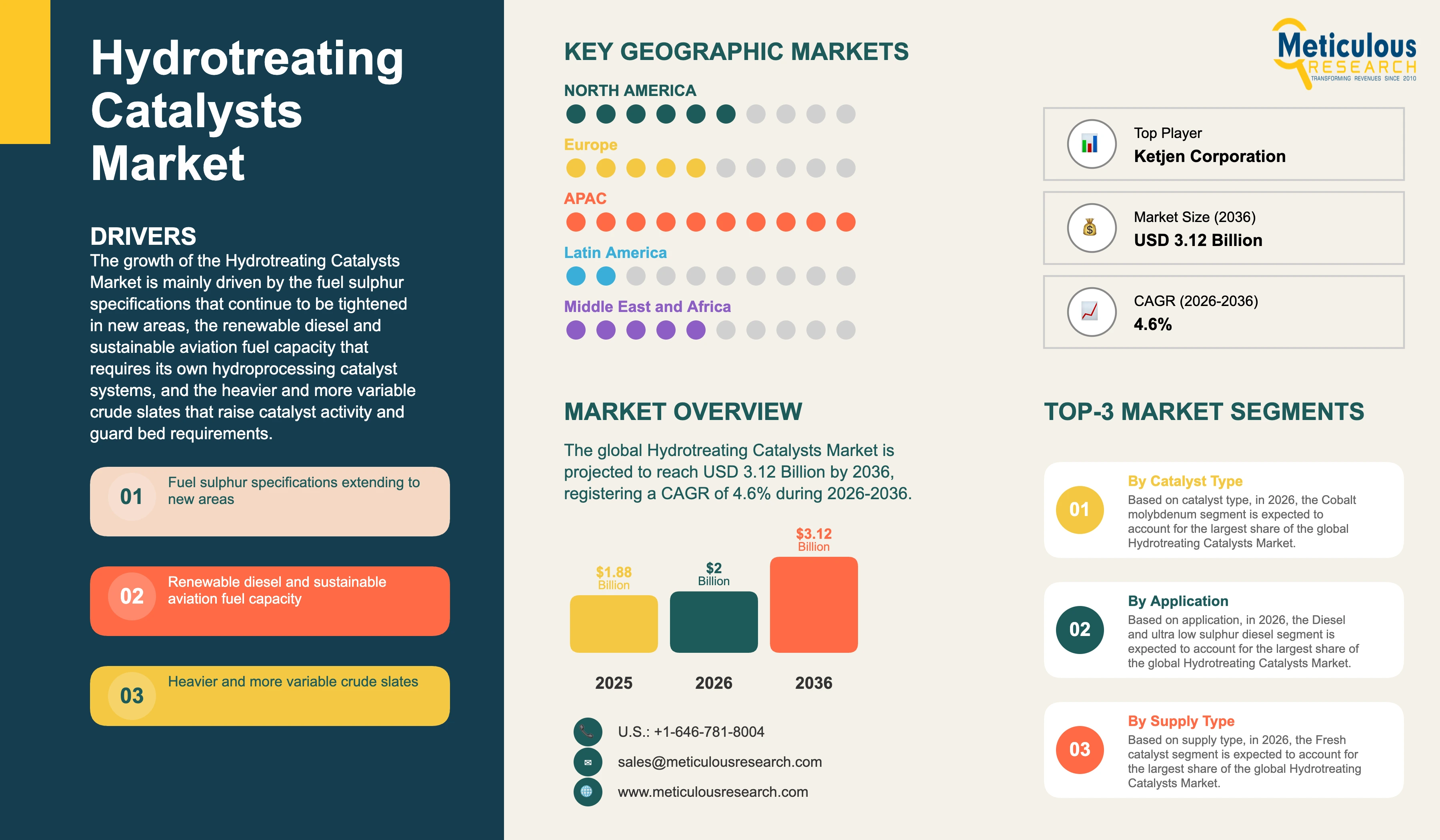
The global hydrotreating catalysts market was valued at USD 1.88 billion in 2025. This market is expected to reach USD 3.12 billion by 2036 from an estimated USD 2.00 billion in 2026, registering a CAGR of 4.6% during the forecast period (2026-2036).
- Published
- Nov 2026
- Pages
- 254
- Format
- PDF + Excel
- Report ID
- MRCHM - 1042806
- Base year
- 2025
- 2025 · BASELINE
- $1.88B
- 2036
- $3.12B
- CAGR 2026–2036
- 4.6%
2025 baseline · 2026–2036 forecast at 4.6% CAGR · hover a bar for the value
Key highlights
The global hydrotreating catalysts market is estimated at USD 2.00 billion in 2026 and is projected to reach USD 3.12 billion by 2036.
Market volume is estimated at 172.00 kilotons in 2026 and is projected to reach 213.63 kilotons by 2036 at a CAGR of 2.2%, measured as catalyst supplied on a mass basis including fresh and regenerated charges.
The average selling price is estimated at USD 11.60 per kg in 2026 and is projected to reach USD 14.60 per kg by 2036 as guard bed, renewable feed and higher-activity grades take a larger share.
Cobalt molybdenum catalysts are expected to account for the largest catalyst type share in 2026, while guard bed and demetallisation catalysts are projected to register the highest CAGR of 6.6%.
Diesel and ultra low sulphur diesel hydrotreating is expected to hold the largest application share in 2026, while renewable feedstock hydrotreating is projected to grow fastest at a CAGR of 11.0%.
Asia-Pacific is expected to hold the largest regional share in 2026, while the Middle East & Africa is projected to register the highest CAGR of 6.0%.
The International Maritime Organization states that the Mediterranean Sea became an Emission Control Area under MARPOL Annex VI on 1 May 2025, capping fuel oil sulphur content inside the area at 0.10% by mass.
Outside sulphur oxide emission control areas the global limit remains 0.50% by mass, which took effect on 1 January 2020.
The Mediterranean area is described as the fifth designated emission control area under MARPOL Annex VI, alongside the Baltic Sea, the North Sea, the North American area and the United States Caribbean Sea area.
The same page states that two further areas were designated in 2024, the Canadian Arctic and the Norwegian Sea, so the count of five does not clearly account for them, an inconsistency recorded here rather than resolved.
It also records that MEPC 83 in April 2025 approved a proposal to designate the North-East Atlantic as an emission control area, which would extend the 0.10% requirement further.
The Mediterranean carries about 20% of seaborne trade, with more than 17% of worldwide cruises and 24% of the world fleet sailing there.
A 70% reduction in total sulphur oxides from shipping is attributed to the 2020 global limit rather than to the Mediterranean area, and no Mediterranean-specific emission or health figures are given.
That page carries no publication date, no geographic boundaries or coordinates for the area, no adopting resolution number for the Mediterranean designation, no compliance methods and no enforcement or monitoring detail.
Ketjen describes the current refining environment as crisis-driven and volatile, with margins high globally because the Iran crisis has tightened diesel and jet fuel supply, the United States holding the strongest margins and Europe high but fragile on energy, hydrogen, logistics and carbon dioxide costs.
The same company states that Asian throughput is falling with crude imports at a ten-year low, without giving a figure, and describes Middle East economics as volume-driven and export-exposed.
It reports regional catalyst priorities differing accordingly, with Europe prioritising cycle length, reliability and hydrogen consumption, the United States running at higher severity and weighing activity against hydrogen use, India shifting toward heavier crudes and so requiring higher-activity catalysts, and the Middle East favouring steady operation.
On cycle length it states that units typically miss target run length because of a major upset such as severe pressure-drop buildup, or because severity rises faster than the operating margin allows, and that weighted average bed temperature slope rather than absolute temperature is the most reliable real-time indicator.
It names STAX for conventional feeds and ReNewSTAX for renewable diesel and sustainable aviation fuel, and a ReNewFine platform covering phosphorus and alkali metal trapping through selective deoxygenation.
It states that over six years the company launched two platforms, PULSAR and QUASAR, and eight hydrotreating grades for diesel and vacuum gas oil, and claims reduced fill cost and lower carbon emissions without quantifying either.
That page carries no publication date, no cycle lengths in months, no activity or hydrogen consumption figures, no cost or margin figures, no customer case study and no quantified co-processing results.
Report summary
| Particulars | Details |
|---|---|
| Base Year | 2025 |
| Forecast Period | 2026-2036 |
| Market Size in 2025 | USD 1.88 billion |
| Market Size in 2026 | USD 2.00 billion |
| Market Size by 2036 | USD 3.12 billion |
| Value CAGR (2026-2036) | 4.6% |
| Format | PDF, Excel & Cloud Portal · 254 pages |
| Volume in 2026 | 172.00 kilotons |
| Volume by 2036 | 213.63 kilotons |
| Volume CAGR (2026-2036) | 2.2% |
| Volume Basis | Catalyst supplied on a mass basis, including fresh and regenerated charges |
| Average Selling Price in 2026 | USD 11.60 per kg |
| Average Selling Price by 2036 | USD 14.60 per kg |
| Price Direction | The average selling price rises across the forecast period as guard bed, renewable feed and higher-activity grades take a larger share of a tonnage dominated by bulk diesel bed fill, rather than through any change in the cost of an individual catalyst |
| Volume Basis Note | Regenerated and rejuvenated catalyst is included in the measurement, because a spent charge treated outside the refinery and returned to service represents catalyst activity bought for the next cycle as surely as a fresh fill does, and the two compete directly for the same reload; excluding it would understate the catalyst actually loaded |
| Value Basis Note | Value includes the metal content, since cobalt, molybdenum and nickel are base metals bought outright with the catalyst and the spent charge is sold for metal reclaim rather than toll-refined back to the user, which differs from the convention applied to diesel oxidation catalysts and electrolyser catalyst coatings in this series |
| Scope Exclusion Note | Hydrocracking catalysts are excluded, since hydrotreating removes heteroatoms while leaving molecular weight largely intact whereas hydrocracking converts heavy molecules to lighter ones over an acidic zeolite function, and the two are specified, priced and bought as separate systems; fluid catalytic cracking, reforming and isomerisation catalysts are excluded on the same basis |
| Measurement Basis | Catalysts for the removal of sulphur, nitrogen, oxygen and metals from petroleum and renewable feedstocks by reaction with hydrogen, including cobalt molybdenum, nickel molybdenum, nickel tungsten and guard bed and demetallisation materials, by catalyst type, application, supply type and geography |
| Relationship to Adjacent Markets | This market is distinct from the hydrogenation catalysts market, where nickel, palladium and platinum catalysts add hydrogen to organic substrates in chemical and oleochemical processing, and the two are not additive; it sits upstream of the diesel oxidation catalysts market rather than overlapping with it, since the low sulphur fuel produced here is what allows vehicle aftertreatment catalysts to function |
| Note on the Regulatory Driver | The International Maritime Organization states that the Mediterranean Sea became an Emission Control Area under MARPOL Annex VI on 1 May 2025, capping fuel oil sulphur inside the area at 0.10% by mass against the global limit of 0.50% by mass in force since 1 January 2020; it describes the area as the fifth designated under MARPOL Annex VI alongside the Baltic Sea, North Sea, North American area and United States Caribbean Sea area, while also stating that the Canadian Arctic and Norwegian Sea were designated in 2024, so the count of five does not clearly account for them and that inconsistency is recorded rather than resolved; MEPC 83 in April 2025 approved a proposal to designate the North-East Atlantic, and the Mediterranean carries about 20% of seaborne trade with more than 17% of worldwide cruises and 24% of the world fleet sailing there |
| Note on Commercial Conditions | Ketjen describes the current refining environment as crisis-driven and volatile, with margins high globally because the Iran crisis has tightened diesel and jet fuel supply, the United States holding the strongest margins, Europe high but fragile on energy, hydrogen, logistics and carbon dioxide costs, Asian throughput falling with crude imports at a ten-year low, and Middle East economics volume-driven and export-exposed; it reports regional catalyst priorities differing accordingly, with Europe prioritising cycle length, reliability and hydrogen consumption, the United States running at higher severity, India shifting toward heavier crudes and requiring higher-activity catalysts, and the Middle East favouring steady operation |
| Note on Source Limitations | The International Maritime Organization page reviewed for this report carries no publication date, no geographic boundaries or coordinates for the Mediterranean area, no adopting resolution number for its designation, no compliance methods and no enforcement or monitoring detail, and attributes the 70% reduction in total sulphur oxides from shipping to the 2020 global limit rather than to the area; the Ketjen material carries no publication date, no cycle lengths in months, no activity or hydrogen consumption figures, no cost or margin numbers, no customer case study or independent validation and no quantified co-processing results, so the sizing here is built from refining throughput, unit inventories and cycle assumptions |
| Largest Catalyst Type | Cobalt molybdenum |
| Fastest-Growing Catalyst Type | Guard bed and demetallisation (CAGR 6.6%) |
| Largest Application | Diesel and ultra low sulphur diesel hydrotreating |
| Fastest-Growing Application | Renewable feedstock hydrotreating (CAGR 11.0%) |
| Largest Supply Type | Fresh catalyst |
| Fastest-Growing Supply Type | Regenerated and rejuvenated catalyst (CAGR 5.6%) |
| Largest Region | Asia-Pacific |
| Fastest-Growing Region | Middle East & Africa (CAGR 6.0%) |
| Segments Covered | Catalyst Type, Application, Supply Type, and Geography |
| Geographies Covered | Asia-Pacific, North America, Middle East & Africa, Europe, and Latin America |
| Companies Profiled | 6 companies, including Ketjen Corporation, Topsoe A/S, Shell plc, Honeywell International Inc., Axens SA, and China Petroleum & Chemical Corporation |
Report overview
Segments covered: catalyst type, application, supply type.
The growth of this market is mainly driven by the fuel sulphur specifications that continue to be tightened in new areas rather than being revised again where they already apply, the renewable diesel and sustainable aviation fuel capacity that requires its own hydroprocessing catalyst systems, the heavier and more variable crude slates that raise catalyst activity and guard bed requirements, and the cycle length discipline that refiners apply to protect margin. However, factors such as the maturity of the diesel specification in the regions where it was first imposed, the declining throughput in some refining regions, the regenerated catalyst that competes with fresh supply, and the long replacement cycles that limit how often a charge is bought are expected to restrain the growth of this market to some extent.
Hydrotreating catalysts are the catalysts used to remove sulphur, nitrogen, oxygen and metals from petroleum and renewable feedstocks by reaction with hydrogen, principally cobalt molybdenum and nickel molybdenum sulphides on alumina together with the guard bed and demetallisation materials that protect them. Market sizing in this report is on both a value basis in USD and a volume basis in kilotons measured as catalyst supplied on a mass basis, including fresh and regenerated charges.
Including regenerated catalyst in the measurement is a deliberate choice and it matters to the figures. A spent hydrotreating charge can be regenerated or rejuvenated outside the refinery and returned to service, and a refiner choosing that route is buying catalyst activity for the next cycle as surely as one buying fresh, so excluding it would understate the catalyst that is actually loaded and would miss the competition between the two routes.
Value includes the metal content, since cobalt, molybdenum and nickel are base metals bought outright with the catalyst and the spent charge is sold for metal reclaim rather than being toll-refined back to the user. That differs from the convention applied to automotive and electrolyser coatings in this series, where the precious metal is customer-supplied or passed through.
Hydrocracking catalysts are excluded, and the distinction is worth stating because the two are often grouped. Hydrotreating removes heteroatoms while leaving the molecular weight largely intact, whereas hydrocracking converts heavy molecules into lighter ones over an acidic zeolite function, and the two are specified, priced and bought as separate systems. Fluid catalytic cracking, reforming and isomerisation catalysts are excluded on the same basis.
The International Maritime Organization states that the Mediterranean Sea became an Emission Control Area under MARPOL Annex VI on 1 May 2025, capping fuel oil sulphur content inside the area at 0.10% by mass against the global limit of 0.50% by mass that took effect on 1 January 2020. The Mediterranean carries about 20% of seaborne trade, with more than 17% of worldwide cruises and 24% of the world fleet sailing there.
That designation is the clearest current illustration of how this market now grows. The headline specifications were set years ago and have not been tightened again where they already apply; what changes is the area over which the stricter limit operates. The Mediterranean is described as the fifth designated area alongside the Baltic Sea, the North Sea, the North American area and the United States Caribbean Sea area, and MEPC 83 in April 2025 approved a proposal to designate the North-East Atlantic as well.
The same page states that two further areas were designated in 2024, the Canadian Arctic and the Norwegian Sea, which means the count of five does not clearly account for them. That inconsistency is recorded here rather than resolved, and the page also carries no publication date, no geographic boundaries or coordinates, no adopting resolution number for the Mediterranean designation, no compliance methods and no enforcement or monitoring detail.
It also attributes the 70% reduction in total sulphur oxides from shipping to the 2020 global limit rather than to the Mediterranean area, and gives no Mediterranean-specific emission or health figures. A reader should therefore treat the area designation as a change in the geography of compliance rather than as a quantified step change in demand.
Ketjen supplies the commercial counterpart to that regulatory picture and it is less comfortable. The company describes the current environment as crisis-driven and volatile, with margins high globally because the Iran crisis has tightened diesel and jet fuel supply, the United States holding the strongest margins, and Europe high but fragile on energy, hydrogen, logistics and carbon dioxide costs.
Its regional account of catalyst priorities is the most useful part of that material. Europe prioritises cycle length, reliability and hydrogen consumption; the United States runs at higher severity and weighs activity against hydrogen use; India is shifting toward heavier crudes and so requires higher-activity catalysts; and the Middle East favours steady, uninterrupted operation. Asian throughput is said to be falling with crude imports at a ten-year low, though no figure is given.
That spread of priorities explains why this market does not behave as a single commodity. The same nominal catalyst type is bought in one region to extend a run, in another to push severity, and in a third to tolerate a worse feed, and a supplier competes on a different attribute in each. It is also why the value growth exceeds the volume growth: the attributes being bought are increasingly in the higher-activity and guard bed grades rather than in bulk bed fill.
On the mechanics of a cycle the same company is specific and it is worth following, because catalyst demand is a function of cycle length. Units typically miss their target run length either because of a major upset such as severe pressure-drop buildup, or because severity has to rise faster than the operating margin allows, and feedstock quality, variability and lower hydrogen partial pressure all increase inhibition and coke formation, especially in ultra low sulphur diesel and cracked-feed services.
High early severity, poor break-in and aggressive introduction of cracked stocks are said to front-load deactivation, and the company states that weighted average bed temperature slope rather than absolute temperature is the most reliable real-time indicator of whether a unit is on track. That is an operational point with a direct commercial consequence: a catalyst that deactivates predictably is worth more than one that is briefly more active.
The renewable feedstock duty is technically distinct rather than an extension of the conventional one, and the contaminant problem is the reason. Ketjen names a ReNewFine platform covering phosphorus and alkali metal trapping through selective deoxygenation, and phosphorus and alkali metals are characteristic of vegetable oils, waste oils and fats rather than of crude oil, so the guard bed system has to be designed for a different contaminant slate entirely.
That is why renewable feedstock hydrotreating is projected to grow fastest among applications at 11.0% while the guard bed and demetallisation catalysts grow fastest among catalyst types at 6.6%. The two are closely connected, since a renewable unit consumes proportionally more guard material than a conventional diesel unit of the same throughput.
The company names STAX for conventional feeds and ReNewSTAX for renewable diesel and sustainable aviation fuel, and states that over six years it launched two platforms, PULSAR and QUASAR, and eight hydrotreating grades for diesel and vacuum gas oil, citing machine learning, combinatorial chemistry and high-throughput experimentation. It claims reduced fill cost and lower carbon emissions without quantifying either.
What that page does not give is the level of disclosure available across this field. It carries no publication date, no cycle lengths in months, no activity or hydrogen consumption figures, no cost or margin numbers, no customer case study or independent validation, no quantified co-processing results and no sulphur levels for the heavier crudes it discusses.
This market is distinct from the hydrogenation catalysts market, where nickel, palladium and platinum catalysts add hydrogen to organic substrates in chemical and oleochemical processing, and the two are not additive. It is also upstream of the diesel oxidation catalysts market rather than overlapping with it, since the low sulphur fuel this market produces is what allows the aftertreatment catalyst in a vehicle to function at all.
A heavier crude slate raises the severity required for the same product specification, and a higher-activity catalyst allows that severity to be reached without exhausting the temperature margin early in the cycle.
Ketjen states that India is shifting toward heavier crudes and so requires higher-activity catalysts, and India is projected to grow at 6.6%, the fastest country rate in Asia-Pacific.
A spent charge can be regenerated or rejuvenated outside the refinery and returned to service at a cost well below a fresh fill, which suits units where the duty is undemanding or where a shortened cycle is acceptable.
Regenerated and rejuvenated catalyst is projected to grow at 5.6% against 4.4% for fresh catalyst, and it competes directly with fresh supply rather than serving a separate requirement.
These four opportunities divide between one that is new capacity and three that are better positions in existing capacity. The renewable duty adds units; the Middle East, the activity grades and the regenerated supply all compete for charges that would be bought anyway.
The renewable opportunity is also the one where a supplier can establish a position without displacing an incumbent, since there is no previous charge and no prior relationship at a new unit. That matters in a market where a position at an existing unit is usually held across successive reloads and is difficult to take.
The regenerated supply opportunity is the most awkward of the four for a catalyst manufacturer, because it competes directly with its own fresh product. A refiner choosing a treated charge for an undemanding duty is buying activity for the next cycle at a cost well below a fresh fill, and the segment grows faster than fresh supply over the forecast period.
The Middle East opportunity is the largest in absolute terms and the most predictable. Capacity built to export specification from the outset is sized for destination market fuel quality rather than for domestic requirements, so the units are specified at the stricter limit from commissioning and the catalyst demand arrives with the plant rather than through a later upgrade.
A fifth route sits alongside them and is the quietest. Co-processing renewable feed alongside petroleum in an existing hydrotreater requires no new unit, only a catalyst system able to tolerate both slates at once, and it brings renewable duty into refineries that will never build a dedicated plant.
Ketjen mentions waste oils, fats and waste plastic oils in that context without giving detail, and the absence of quantified co-processing results in the public material is one of the clearer disclosure gaps in this field.
Asia-Pacific is expected to account for the largest share in 2026, on the scale of refining capacity added there, domestic fuel specifications now matching the mature markets, and heavier crude slates. India is projected to grow at 6.6%, China at 4.0%, South Korea at 3.0% and Japan at 1.4%.
The Middle East & Africa is projected to register the highest CAGR of 6.0% during the forecast period, with Saudi Arabia at 6.4% and the United Arab Emirates at 6.0%, on new and expanded refining capacity built to export specification from the outset.
Europe is projected to grow at a CAGR of 3.4%, the slowest of the regions, with the Netherlands at 4.0% and Germany at 2.6%. Ketjen describes European margins as high but fragile on energy, hydrogen, logistics and carbon dioxide costs, and reports cycle length, reliability and hydrogen consumption as the regional catalyst priorities.
The Middle East & Africa is projected to grow at a CAGR of 6.0%, the fastest of the regions, on export refining capacity, with Ketjen describing the region as volume-driven and export-exposed and as favouring steady, uninterrupted operation. Latin America is projected to grow at a CAGR of 4.6%, with Brazil at 4.6%.
Ketjen Corporation, Topsoe A/S, Shell plc, Honeywell International Inc. and Axens SA together accounted for an estimated 64.6% of this market in 2026. The 6 companies profiled in this report together accounted for an estimated 71.8%.
Report infographic
Market dynamics
12 factors across 5 forcesFuel Sulphur Specifications Extending to New Areas
The International Maritime Organization states that the Mediterranean Sea became an Emission Control Area under MARPOL Annex VI on 1 May 2025, capping fuel oil sulphur at 0.10% by mass inside the area against the 0.50% global limit in force since 1 January 2020.
MEPC 83 in April 2025 approved a proposal to designate the North-East Atlantic as an emission control area, and the Mediterranean carries about 20% of seaborne trade with 24% of the world fleet sailing there, so each designation widens the volume of fuel that must meet the stricter limit.
Renewable Diesel and Sustainable Aviation Fuel Capacity
Hydroprocessing vegetable oils, waste oils and fats into renewable diesel and sustainable aviation fuel requires a catalyst system designed for a contaminant slate that crude oil does not present, particularly phosphorus and alkali metals.
Ketjen names a ReNewFine platform covering phosphorus and alkali metal trapping through selective deoxygenation and a ReNewSTAX system for renewable diesel and sustainable aviation fuel, and renewable feedstock hydrotreating is projected to register the highest application CAGR of 11.0%.
Heavier and More Variable Crude Slates
A heavier or more variable feed raises the contaminant load on the guard bed and the activity demanded of the main catalyst, and Ketjen states that India is shifting toward heavier crudes and so requires higher-activity catalysts.
Guard bed and demetallisation catalysts are projected to register the highest catalyst type CAGR of 6.6%, and the company notes that guard beds must handle higher and more variable contaminant loads while managing pressure buildup.
Cycle Length Discipline to Protect Margin
Catalyst demand is a function of how long a charge lasts, and Ketjen states that units typically miss their target run length either through a major upset such as severe pressure-drop buildup or because severity rises faster than the operating margin allows.
A catalyst system that keeps activity loss low and predictable lets a refiner reach unit constraints later in the cycle, and the company states that weighted average bed temperature slope rather than absolute temperature is the most reliable real-time indicator of whether a unit is on track.
These four drivers operate on different parts of a market whose headline specifications stopped moving years ago, and that is the distinction that matters here. The sulphur limits have not been tightened where they already apply; what grows is the area over which the stricter limit operates, the feed quality the catalyst must tolerate, and the share of throughput that is renewable rather than petroleum.
The first driver is therefore geographic rather than technical. Each emission control area designation moves a defined quantity of marine fuel from the 0.50% limit to the 0.10% limit, and the Mediterranean carrying about 20% of seaborne trade with 24% of the world fleet sailing there gives a sense of the step that one designation represents.
The renewable driver is the only one that creates genuinely new catalyst demand rather than raising the specification of existing demand. A renewable diesel or sustainable aviation fuel unit is a new hydroprocessing installation with its own guard bed and deoxygenation system, and the contaminant slate it faces has no equivalent in petroleum refining.
The cycle length driver is the one a supplier can influence directly and it works in an unusual way. A catalyst that holds activity predictably lets a refiner run to its scheduled turnaround rather than stopping early, which is worth a great deal to the customer and extends the interval before the next order, so the supplier is paid for a benefit that reduces its own order frequency.
What none of the four rests on is a tightening of the limits themselves, which is the usual assumption about this market and no longer true.
Table of contents
11 chapters · 133 sections · 254 pages · click to expandSegmental analysis
| Segment | Largest share (2026) | Fastest growth (2026–2036) |
|---|---|---|
| By Catalyst Type | Cobalt molybdenum | Guard bed and demetallisation |
| By Application | Diesel and ultra low sulphur diesel | Renewable feedstock hydrotreating |
| By Supply Type | Fresh catalyst | Highest growth sits where the feed |
| Other segments | Cobalt molybdenum | — |
By Catalyst Type
- Hydrotreating Catalysts Market Analysis by Catalyst Type
- The cobalt molybdenum segment is expected to account for the largest share of the global hydrotreating catalysts market.
- The large share of this segment is mainly due to its selectivity for sulphur removal at lower hydrogen consumption than the nickel systems, which suits the diesel and naphtha duties that account for most installed hydrotreating capacity, and to the hydrogen cost that Ketjen identifies as a European priority alongside cycle length and reliability.
- However, the guard bed and demetallisation segment is projected to register the highest CAGR of 6.6% during the forecast period.
- The rapid growth of this segment is attributed to heavier and more variable feeds raising the contaminant load, to Ketjen noting that guard beds must handle higher and more variable contaminant loads while managing pressure buildup, and to renewable feeds presenting phosphorus and alkali metals that crude oil does not.
- Nickel molybdenum catalysts grow at 4.6% and are specified where nitrogen removal and aromatic saturation matter more than sulphur selectivity, at a higher hydrogen consumption.
- Nickel tungsten and other systems grow at 6.0% in demanding saturation duties.
- Catalyst type determines the heteroatom selectivity, the hydrogen consumed and the severity required, and those three set the operating cost of the unit rather than only the catalyst cost.
- Guard bed and demetallisation catalysts are projected to register the highest CAGR of 6.6% during the forecast period, on heavier and more variable feeds raising the contaminant load and on renewable feeds presenting phosphorus and alkali metals that crude oil does not.
By Application
- Hydrotreating Catalysts Market Analysis by Application
- The diesel and ultra low sulphur diesel segment is expected to account for the largest share of the global hydrotreating catalysts market.
- The large share of this segment is mainly due to the ten parts per million road diesel specification applying across the major markets, to diesel hydrotreating capacity exceeding that of any other hydrotreating duty, and to the marine fuel limits that have extended low sulphur demand into fuel oil blending.
- However, the renewable feedstock hydrotreating segment is projected to register the highest CAGR of 11.0% during the forecast period.
- The rapid growth of this segment is attributed to renewable diesel and sustainable aviation fuel capacity being added, and to the duty requiring a catalyst system designed for phosphorus, alkali metals and high oxygen content rather than a conventional system adapted to them.
- Naphtha and reformer feed hydrotreating grows at 2.6%, the slowest, protecting downstream reforming catalyst from sulphur.
- Vacuum gas oil and resid hydrotreating grows at 4.4% and consumes the largest charges per unit.
- Application determines the contaminant slate, the severity and the guard bed requirement, and the renewable duty differs from all the petroleum duties in each of those respects.
- Renewable feedstock hydrotreating is projected to register the highest CAGR of 11.0% during the forecast period, on renewable diesel and sustainable aviation fuel capacity being added and on the duty requiring a catalyst system designed for phosphorus, alkali metals and high oxygen content.
By Supply Type
- Hydrotreating Catalysts Market Analysis by Supply Type
- Fresh catalyst accounts for the largest supply type share of this market and grows at 4.4%, being specified wherever the duty is demanding, the cycle length critical or the feed quality uncertain, and it is the route by which any new catalyst technology enters service.
- Regenerated and rejuvenated catalyst grows faster at 5.6%.
- A spent charge can be treated outside the refinery and returned to service at a cost well below a fresh fill, which suits undemanding duties or units where a shortened cycle is acceptable.
- This axis is included because the two compete directly for the same reload rather than serving separate requirements, so a forecast counting only fresh catalyst would overstate the fresh market and understate the catalyst actually loaded.
- The three axes answer different questions and the third is included for a reason specific to this market.
- Catalyst type determines heteroatom selectivity and hydrogen consumption; application determines the contaminant slate and the severity; and supply type determines whether a reload is met with fresh material or with a treated charge, which is a commercial decision taken separately from the technical specification.
- That third axis would be unnecessary in most catalyst markets and is material here because the two routes compete for the same reload rather than serving different duties.
- A forecast counting only fresh catalyst would overstate the fresh market and understate the catalyst actually loaded into reactors, which is the figure that matters for assessing activity in the industry.
- The application axis contains the widest spread of growth rates in this report, from 2.6% for naphtha and reformer feed to 11.0% for renewable feedstock, and that spread rather than the headline rate is what a participant should plan against.
- The two extremes are served by different catalyst systems and different guard bed designs.
- The highest growth sits where the feed is worst.
- Guard bed and demetallisation catalysts grow fastest among catalyst types at 6.6% and renewable feedstock fastest among applications at 11.0%, and the two are closely linked because a renewable unit consumes proportionally more guard material than a petroleum unit of the same throughput.
- One axis is deliberately absent, and that is a split by reactor or unit configuration.
- Trickle bed and other arrangements follow from the duty and the feed rather than determining the catalyst bought, so a configuration split would restate the application axis in different terms.
- The three axes used here divide the market without repeating themselves.
- Reading them together also explains the gap between the two growth rates.
- Volume grows at 2.2% while value grows at 4.6%, and the difference is the mix moving toward guard bed, renewable feed and higher-activity grades, each of which carries a higher price per kilogram than the bulk diesel bed fill that dominates the tonnage.
- The fastest-growing position in this market, read across all three axes, is a fresh guard bed and deoxygenation system supplied into a renewable feedstock unit, and it is that combination rather than any one of its parts that is adding value fastest over the forecast period.
Other segments
- Cobalt molybdenum is expected to account for the largest share in 2026, on its selectivity for sulphur removal at lower hydrogen consumption than the nickel systems, which suits the diesel and naphtha duties that account for most installed hydrotreating capacity.
- Diesel and ultra low sulphur diesel hydrotreating is expected to hold the largest share in 2026, on the ten parts per million road diesel specification applying across the major markets and on diesel hydrotreating capacity exceeding that of any other hydrotreating duty.
Geographic analysis
Middle East & Africa
Fastest growthNew and expanded refining capacity in the Middle East is built to export specification from the outset, which means ultra low sulphur diesel and jet fuel units sized for the fuel quality of the destination markets rather than of the home market. The Middle East & Africa is projected to register the highest regional CAGR at 6.0%, with Saudi Arabia at 6.4% and the United Arab Emirates at 6.0%, and Ketjen describes the region as volume-driven and export-exposed and as favouring steady, uninterrupted operation. However, the Middle East & Africa is projected to register the highest CAGR of 6.0% during the forecast period. The rapid growth of this region is attributed to new and expanded refining capacity built to export specification from the outset, with ultra low sulphur diesel and jet units sized for destination market fuel quality. Saudi Arabia is projected to register a CAGR of 6.4% and the United Arab Emirates a CAGR of 6.0%, and Ketjen describes the region as volume-driven and export-exposed and as favouring steady, uninterrupted operation. Middle East Export Refining Capacity Geographic Analysis
Asia-Pacific
Largest shareIn 2026, Asia-Pacific is expected to account for the largest share of the global hydrotreating catalysts market. The large share of this region is mainly due to the scale of refining capacity added there over the past two decades, to the domestic fuel specifications that now match the mature markets in the principal economies, and to the heavier crude slates being processed. India is projected to register a CAGR of 6.6%, China a CAGR of 4.0%, South Korea a CAGR of 3.0% and Japan a CAGR of 1.4%. Ketjen states that Asian throughput is falling with crude imports at a ten-year low, which restrains the regional rate despite the capacity in place.
North America
North America is projected to grow at 4.4%, with the United States at 4.4%, where Ketjen reports the strongest margins and refiners running at higher severity while weighing activity against hydrogen use.
Europe
Europe is projected to grow at 3.4%, the slowest, with the Netherlands at 4.0% and Germany at 2.6%, where the same company describes margins as high but fragile on energy, hydrogen, logistics and carbon dioxide costs and reports cycle length, reliability and hydrogen consumption as the regional priorities. Europe buys run length and hydrogen efficiency because its energy and carbon costs dominate, North America buys activity because it is running hard into strong margins, India buys activity to handle a worsening feed, and the Middle East buys tolerance of a variable feed for steady export operation. The same nominal product is therefore sold on four different arguments, which is why this market does not price as a commodity. Country rates within each region spread widely and follow feed quality and new capacity rather than specification: India at 6.6% against Japan at 1.4% within Asia-Pacific, and Saudi Arabia at 6.4% against the slower mature European centres.
Latin America
Latin America is projected to grow at 4.6%, with Brazil at 4.6%. What differs between regions is which attribute of a catalyst is being bought.
Competitive landscape
The global hydrotreating catalysts market is concentrated among a small number of catalyst manufacturers and process licensors, and a position is usually held at a specific unit across successive reloads rather than won afresh each cycle. Competition is contested on activity and stability at the conditions of a particular feed, on hydrogen consumption, on guard bed design for the contaminant slate, and on the technical service that supports a cycle, rather than on price per kilogram. Ketjen Corporation, Topsoe A/S, Shell plc, Honeywell International Inc. and Axens SA together accounted for an estimated 64.6% of this market in 2026, while the companies profiled in this report together accounted for an estimated 71.8%.
Ketjen is the only participant among them to publish a substantive account of the commercial conditions in this market, and what it describes is a business sold on system performance rather than on product. It states that refiners should judge overall performance across the cycle, including product specifications, cycle length, hydrogen efficiency and operational stability, and presents supplier commercial experience and technical support as decisive, naming STAX for conventional feeds and ReNewSTAX for renewable diesel and sustainable aviation fuel.
The same company states that over six years it launched two platforms, PULSAR and QUASAR, and eight hydrotreating grades for diesel and vacuum gas oil, citing machine learning, combinatorial chemistry and high-throughput experimentation, and claims reduced fill cost and lower carbon emissions without quantifying either. No participant publishes hydrotreating catalyst revenue separately from its wider business, so shares here are built from refining throughput, unit inventories and cycle assumptions. Some of the key players operating in the hydrotreating catalysts market are Ketjen Corporation (U.S.), Topsoe A/S (Denmark), Shell plc (Netherlands), Honeywell International Inc. (U.S.), Axens SA (France), and China Petroleum & Chemical Corporation (China), among others.
Competition is therefore conducted unit by unit over a long cycle, and incumbency is worth a great deal. A supplier that has characterised a unit feed, designed its guard bed grading and watched a full cycle of deactivation holds information a competitor bidding on a datasheet does not, which is why positions change slowly even where performance claims differ.
That structure also explains why technical service is presented as decisive rather than as support. Ketjen states that refiners should judge overall system performance across the cycle, including product specifications, cycle length, hydrogen efficiency and operational stability, and presents supplier commercial experience and technical support as determining the outcome.
- —
The International Maritime Organization states that the Mediterranean Sea became an Emission Control Area under MARPOL Annex VI on 1 May 2025, capping fuel oil sulphur content inside the area at 0.10% by mass against the global limit of 0.50% by mass which took effect on 1 January 2020. It describes the area as the fifth designated under MARPOL Annex VI alongside the Baltic Sea, the North Sea, the North American area and the United States Caribbean Sea area, while also stating that two further areas were designated in 2024, the Canadian Arctic and the Norwegian Sea, so the count of five does not clearly account for them. It records that MEPC 83 in April 2025 approved a proposal to designate the North-East Atlantic as an emission control area, that the Mediterranean carries about 20% of seaborne trade with more than 17% of worldwide cruises and 24% of the world fleet sailing there, and that a 70% reduction in total sulphur oxides from shipping is attributable to the 2020 global limit rather than to the Mediterranean area. That page carries no publication date, no geographic boundaries or coordinates, no adopting resolution number for the Mediterranean designation, no compliance methods and no enforcement or monitoring detail. Separately, Ketjen describes the current refining environment as crisis-driven and volatile, with margins high globally because the Iran crisis has tightened diesel and jet fuel supply, the United States holding the strongest margins, Europe high but fragile on energy, hydrogen, logistics and carbon dioxide costs, Asian throughput falling with crude imports at a ten-year low and Middle East economics volume-driven and export-exposed. It reports Europe prioritising cycle length, reliability and hydrogen consumption, the United States running at higher severity and weighing activity against hydrogen use, India shifting toward heavier crudes and so requiring higher-activity catalysts, and the Middle East favouring steady, uninterrupted operation. On cycle length it states that units typically miss target run length because of a major upset such as severe pressure-drop buildup or because severity rises faster than the operating margin allows, that feedstock quality, variability and lower hydrogen partial pressure increase inhibition and coke formation especially in ultra low sulphur diesel and cracked-feed services, that high early severity, poor break-in and aggressive introduction of cracked stocks front-load deactivation, and that weighted average bed temperature slope rather than absolute temperature is the most reliable real-time indicator. It names STAX for conventional feeds, ReNewSTAX for renewable diesel and sustainable aviation fuel, and a ReNewFine platform covering phosphorus and alkali metal trapping through selective deoxygenation, and states that over six years it launched two platforms, PULSAR and QUASAR, and eight hydrotreating grades for diesel and vacuum gas oil, claiming reduced fill cost and lower carbon emissions without quantifying either. That page carries no publication date, no cycle lengths in months, no activity or hydrogen consumption figures, no cost or margin figures, no customer case study and no quantified co-processing results.
- Ketjen Corporation
- Topsoe A/S
- Shell plc
- Honeywell International Inc.
- Axens SA
- China Petroleum & Chemical Corporation
Expert perspectives
Value grows at 4.6% against 2.2% in volume over the forecast period, and the average selling price rises from USD 11.60 per kg in 2026 to USD 14.60 per kg by 2036. The gap is the guard bed, renewable feed and higher-activity grades taking a larger share of a tonnage dominated by bulk diesel bed fill, not a change in the cost of any one catalyst.
Two measurement choices should be read before any figure. Regenerated and rejuvenated catalyst is included, because a refiner buying treated catalyst for the next cycle is buying activity as surely as one buying fresh and the two compete for the same reload; and value includes the metal content, since cobalt, molybdenum and nickel are bought outright and the spent charge is sold for reclaim rather than toll-refined back.
Hydrocracking is excluded and the distinction is substantive. Hydrotreating removes heteroatoms while leaving molecular weight largely intact; hydrocracking converts heavy molecules to lighter ones over an acidic zeolite function. They are specified, priced and bought as separate systems, and fluid catalytic cracking, reforming and isomerisation catalysts are excluded on the same basis.
The regulatory driver in this market now works through geography rather than through severity. The International Maritime Organization states that the Mediterranean became an Emission Control Area on 1 May 2025 at 0.10% sulphur against the 0.50% global limit in force since 1 January 2020, that MEPC 83 in April 2025 approved the North-East Atlantic for designation, and that the Mediterranean carries about 20% of seaborne trade with 24% of the world fleet sailing there.
The commercial reality is more mixed than that progression suggests, and Ketjen is unusually candid about it. Margins are high because the Iran crisis has tightened diesel and jet supply, the United States is strongest, Europe is high but fragile on energy, hydrogen, logistics and carbon costs, and Asian throughput is falling with crude imports at a ten-year low. Catalyst demand follows barrels processed rather than capacity installed.
The most useful operational point in that material is that predictability beats peak activity. Ketjen states that weighted average bed temperature slope rather than absolute temperature is the most reliable real-time indicator, that units miss run length through upsets such as pressure-drop buildup or severity rising faster than margin allows, and that high early severity and aggressive cracked stock introduction front-load deactivation. Neither source gives cycle lengths, activity figures or dates.
Customer perspectives
Ketjen reports that Europe prioritises cycle length, reliability and hydrogen consumption, and that a catalyst system keeping activity loss low and predictable lets refiners reach unit constraints later in the cycle.
The company also states that weighted average bed temperature slope rather than absolute temperature is the most reliable real-time indicator of whether a unit is on track.
Vegetable oils, waste oils and fats carry phosphorus and alkali metals that crude oil does not, and Ketjen names a ReNewFine platform covering phosphorus and alkali metal trapping through selective deoxygenation alongside its ReNewSTAX system for renewable diesel and sustainable aviation fuel.
Ketjen states that India is shifting toward heavier crudes and so requires higher-activity catalysts, and that Asian throughput is falling with crude imports at a ten-year low, which is why value in this market grows faster than volume.
What these three accounts share is that none of them is about sulphur removal, which every party takes as given. The European manager is describing hydrogen cost and schedule certainty, the renewable producer a contaminant problem, and the Asian operator a feed that is deteriorating while throughput is not rising.
That is also why this market should be read on its application mix rather than its total, since a mature diesel duty and a fast-growing renewable duty are moving at very different rates inside one figure.
“Hydrogen is our most expensive utility and the turnaround date is fixed years out. We buy run length and predictable decline, not the highest activity number on the datasheet.”
“Our feed brings phosphorus and metals that a crude unit never sees. The guard bed is not an accessory on this service, it is most of the engineering.”
“The crude is getting heavier and the throughput is not rising. We need more activity on the same bed volume rather than more catalyst.”
Frequently asked questions
This market was valued at USD 1.80 billion in 2024 and USD 1.88 billion in 2025, and is estimated at USD 2.00 billion in 2026. In volume terms it is estimated at 172.00 kilotons in 2026, measured as catalyst supplied on a mass basis including fresh and regenerated charges.
Cite this report
Meticulous Research. (2026). Hydrotreating Catalysts Market - Global Opportunity Analysis and Industry Forecast (2026-2036) (Report No. MRCHM - 1042806). Meticulous Market Research Pvt. Ltd. https://www.meticulousresearch.com/product/hydrotreating-catalysts-market-7489