Organocatalysts Market (2026-2036)
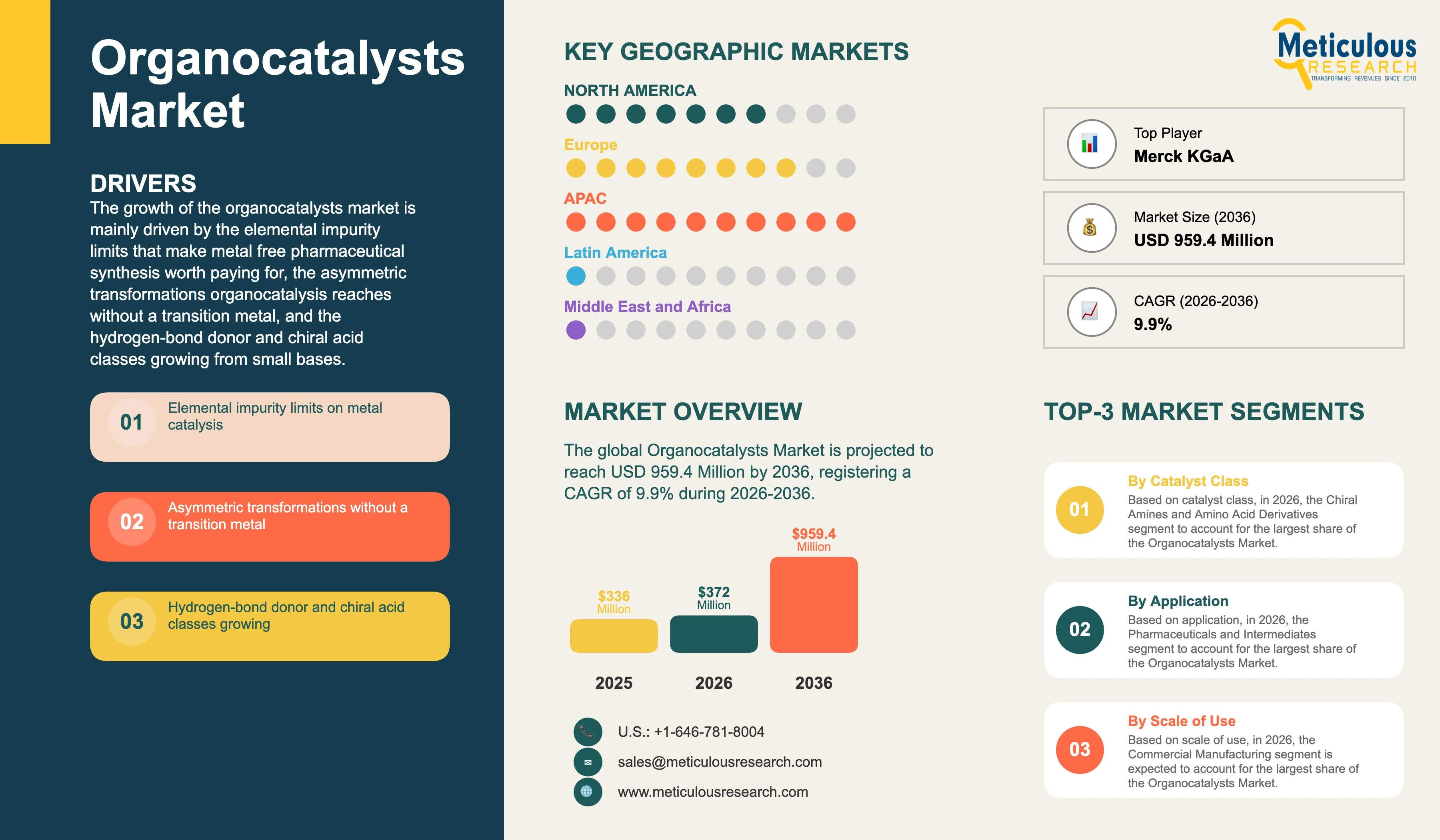
The global organocatalysts market was valued at USD 336.0 million in 2025. This market is expected to reach USD 959.4 million by 2036 from an estimated USD 372.0 million in 2026, registering a CAGR of 9.9% during the forecast period (2026-2036).
- Published
- Nov 2026
- Pages
- 248
- Format
- PDF + Excel
- Report ID
- MRCHM - 1042814
- Base year
- 2025
- 2025 · BASELINE
- $336.0M
- 2036
- $959.4M
- CAGR 2026–2036
- 9.9%
2025 baseline · 2026–2036 forecast at 9.9% CAGR · hover a bar for the value
Key highlights
The global organocatalysts market is estimated at USD 372.0 million in 2026 and is projected to reach USD 959.4 million by 2036.
Market volume is estimated at 0.60 kilotons in 2026 and is projected to reach 1.23 kilotons by 2036 at a CAGR of 7.4%, measured as organocatalyst as supplied on a 100% basis.
The average selling price is estimated at USD 620.00 per kg in 2026 and is projected to reach USD 780.00 per kg by 2036 as the higher-value catalyst classes take a larger share.
Enzymes and other biocatalysts, metal complexes and metal salts, and stoichiometric reagents and chiral auxiliaries are all excluded from the measurement.
Chiral amines and amino acid derivatives are expected to account for the largest catalyst class share in 2026, while hydrogen-bond donors are projected to register the highest CAGR of 13.0%.
Pharmaceuticals and intermediates are expected to hold the largest application share in 2026, while polymers and materials are projected to grow fastest at a CAGR of 12.6%.
Commercial manufacturing is expected to hold the largest scale of use share in 2026, while pilot and clinical supply is projected to grow fastest at a CAGR of 11.6%.
Asia-Pacific is expected to hold the largest regional share in 2026 and is also projected to grow fastest at a CAGR of 12.0%.
The ICH Q3D guideline for elemental impurities, in the revision 2 version adopted by the European Medicines Agency with legal effect from 24 September 2022, is the regulatory basis of the metal free synthesis driver.
The Step 4 guideline assigns platinum, palladium, ruthenium, rhodium, iridium and osmium to class 2B with a permitted daily exposure of 100 micrograms a day by the oral route, 10 by the parenteral route and 1 by inhalation.
Nickel is in class 2A at 200, 20 and 5 micrograms a day by those routes, cobalt at 50, 5 and 3, and vanadium at 100, 10 and 1.
The guideline states that the permitted exposures for iridium, osmium, rhodium and ruthenium were established on the basis of their similarity to palladium, so those four limits carry no element-specific toxicology of their own.
Class 2B elements need no assessment unless they are intentionally added, which is precisely the case for a metal catalyst, so the assessment obligation attaches to the catalyst choice itself.
The copper limit is 3, 000, 300 and 30 micrograms a day and the chromium limit 11,000, 1,100 and 3, both far above the platinum group figures, and the chromium assessment is based on trivalent chromium and excludes the hexavalent form.
The document history records a corrigendum changing the nickel class to read 3 instead of 2, while the table and the body of the guideline list nickel as 2A, and the guideline does not explain the inconsistency.
A process development study published in Organic Process Research & Development on 1 December 2021 by authors at Dr. Reddy’s Laboratories, the University of Bologna and the University of L’Aquila gives the clearest account of what organocatalysis costs on scale.
Its squaramide catalyst, derived from hydroquinidine, ran at 0.5 mol% solvent-free at 20 degrees Celsius for 24 hours, giving 94% conversion at 90 to 91% enantiomeric excess, with full conversion in 18 hours at 0.2 mol% on purified substrate.
The demonstration was at 145 grams of nitroalkene, and the paper reports no performance beyond that scale.
The authors state plainly that organocatalysts often show low turnover numbers and require high loadings, which can make them uneconomic, and that catalyst cost was high for a low-cost active ingredient so recycling was required.
Of the three recovery routes examined, organic solvent nanofiltration gave 90% catalyst rejection against 37% product rejection and was judged not economically viable, organotextile immobilisation failed because the catalyst was unstable under ultraviolet light, and a catch-and-release resin gave 59% assayed recovery against a stated minimum target of 50%.
The paper also records limited natural quinidine supply, catalyst deactivation by traces of acid, loss of enantiomeric excess from residual base, and catalyst poisoning by substrate oligomers.
It gives no turnover frequency, no catalyst cost per kilogram, no cost of goods, no process mass intensity and no quantitative comparison against the metal-catalysed or enzymatic routes it cites.
Report summary
| Particulars | Details |
|---|---|
| Base Year | 2025 |
| Forecast Period | 2026-2036 |
| Market Size in 2025 | USD 336.0 million |
| Market Size in 2026 | USD 372.0 million |
| Market Size by 2036 | USD 959.4 million |
| Value CAGR (2026-2036) | 9.9% |
| Format | PDF, Excel & Cloud Portal · 248 pages |
| Volume in 2026 | 0.60 kilotons |
| Volume by 2036 | 1.23 kilotons |
| Volume CAGR (2026-2036) | 7.4% |
| Volume Basis | Organocatalyst as supplied on a 100% basis, excluding any support or immobilisation carrier |
| Average Selling Price in 2026 | USD 620.00 per kg |
| Average Selling Price by 2036 | USD 780.00 per kg |
| Price Direction | The average selling price rises across the forecast period as the hydrogen-bond donor and chiral acid classes take a larger share of a market whose tonnage sits in the cheaper phase-transfer and amino acid derivative catalysts, rather than through any increase in the price of an individual catalyst |
| Scope Exclusion Note | Enzymes and other biocatalysts are excluded, and that exclusion is larger than the market measured here since industrial biocatalysis operates at a scale small-molecule organocatalysis does not approach; metal complexes and metal salts are excluded as the alternative this market competes against; stoichiometric reagents and chiral auxiliaries consumed in the reaction are excluded because they are not catalysts |
| Measurement Basis | Small organic molecules catalysing chemical transformations without a metal centre, including chiral amines and amino acid derivatives, phase-transfer catalysts, cinchona alkaloid derivatives, hydrogen-bond donors, chiral phosphoric acids, N-heterocyclic carbenes and oxidation organocatalysts, by catalyst class, application, scale of use and geography |
| Relationship to Adjacent Markets | Chiral and achiral phase-transfer catalysts are counted here for their catalytic use only, while quaternary ammonium compounds supplied as biocides are counted in the quaternary ammonium biocides market in this series, so the use rather than the molecule decides which market a given volume belongs to; this market is also distinct from the enzyme immobilisation carriers market and from the hydrogenation, hydrotreating, metallocene and ammonia synthesis catalyst titles, which measure metal-containing systems, and is not additive to any of them |
| Note on the Regulatory Driver | The ICH Q3D guideline for elemental impurities, whose revision 2 version the European Medicines Agency adopted with legal effect from 24 September 2022, assigns platinum, palladium, ruthenium, rhodium, iridium and osmium to class 2B with a permitted daily exposure of 100 micrograms a day by the oral route, 10 by the parenteral route and 1 by inhalation, nickel to class 2A at 200, 20 and 5, cobalt at 50, 5 and 3, vanadium at 100, 10 and 1, and copper and chromium to class 3 at 3,000, 300 and 30 and 11,000, 1,100 and 3 respectively; class 2B elements require assessment only where intentionally added, which is the definition of a catalyst, so the obligation attaches to the catalyst choice itself |
| Note on Guideline Limitations | The guideline states that the permitted exposures for iridium, osmium, rhodium and ruthenium were established on the basis of their similarity to palladium, so those four limits carry no element-specific toxicology; the chromium assessment is based on trivalent chromium and excludes the hexavalent form; and the document history records a corrigendum changing the nickel class to read 3 instead of 2 while the table and the body list nickel as 2A, an inconsistency the guideline does not explain |
| Note on Scale-Up Economics | A process development study published in Organic Process Research & Development on 1 December 2021 by authors at Dr. Reddy’s Laboratories, the University of Bologna and the University of L’Aquila ran a hydroquinidine-derived squaramide catalyst at 0.5 mol% solvent-free at 20 degrees Celsius for 24 hours, giving 94% conversion at 90 to 91% enantiomeric excess and full conversion in 18 hours at 0.2 mol% on purified substrate, demonstrated at 145 grams of nitroalkene with no performance reported beyond that scale; the authors state that organocatalysts often show low turnover numbers and require high loadings which can make them uneconomic, and that catalyst cost was high for a low-cost active ingredient so recycling was required |
| Note on Catalyst Recovery | In the same study organic solvent nanofiltration gave 90% catalyst rejection against 37% product rejection, needed a membrane cascade and was judged not economically viable with oligomers accumulating in the retentate; organotextile immobilisation was abandoned because the catalyst was unstable under ultraviolet light; and a catch-and-release resin bound more than 95% of the catalyst in four hours and released it with ammonia in an hour and a half, giving 59% assayed recovery on a 15 gram proof of concept against a stated minimum target of 50%, with no cumulative recycle count or long-term catalyst loss reported |
| Note on Source Limitations | The European Medicines Agency guideline page gives version status and dates but no element list and no permitted exposure values, which were taken from the Step 4 guideline text of 16 December 2014; the process development study gives no turnover frequency, no catalyst cost per kilogram, no cost of goods, no overall product yield, no process mass intensity, no space-time yield for the organocatalytic reactor and no quantitative comparison against the metal-catalysed or enzymatic routes it cites |
| Note on Market Structure | Catalogue suppliers hold the research and early development demand while commercial-scale demand is largely met by captive synthesis or fine chemical manufacture to order, which the pregabalin study illustrates directly since the catalyst was synthesised by the company that used it at 75.5% yield in its final step at 51 gram scale; the five companies profiled accordingly account for 42.4% of this market, and the sizing here is built from process population and catalyst loading rather than from supplier revenue |
| Largest Catalyst Class | Chiral amines and amino acid derivatives |
| Fastest-Growing Catalyst Class | Hydrogen-bond donors, thioureas and squaramides (CAGR 13.0%) |
| Largest Application | Pharmaceuticals and intermediates |
| Fastest-Growing Application | Polymers and materials (CAGR 12.6%) |
| Largest Scale of Use | Commercial manufacturing |
| Fastest-Growing Scale of Use | Pilot and clinical supply (CAGR 11.6%) |
| Largest Region | Asia-Pacific |
| Fastest-Growing Region | Asia-Pacific (CAGR 12.0%) |
| Segments Covered | Catalyst Class, Application, Scale of Use, and Geography |
| Geographies Covered | Asia-Pacific, Europe, North America, Middle East & Africa, and Latin America |
| Companies Profiled | 5 companies, including Merck KGaA, Thermo Fisher Scientific Inc., Tokyo Chemical Industry Co., Ltd., FUJIFILM Holdings Corporation, and Evonik Industries AG |
Report overview
Segments covered: catalyst class, application, scale of use.
The growth of this market is mainly driven by the metal free pharmaceutical synthesis that elemental impurity limits now require operators to justify, the asymmetric transformations that organocatalysis reaches without a transition metal at all, the hydrogen-bond donor and chiral acid classes growing from small bases, and the pilot and clinical supply work moving organocatalytic steps toward commercial use. However, factors such as the high catalyst loadings and low turnover numbers that process chemists themselves record as a barrier, the catalyst cost that forces recovery on any low-value product, the limited natural supply of the cinchona alkaloids many catalysts are built from, and the captive preparation that keeps commercial-scale demand outside any catalogue supply are expected to restrain the growth of this market to some extent.
Organocatalysts are small organic molecules that catalyse a chemical transformation without a metal centre, acting through covalent intermediates, hydrogen bonding, ion pairing or Brønsted acidity and basicity. Market sizing in this report is on both a value basis in USD and a volume basis in kilotons measured as organocatalyst as supplied on a 100% basis, excluding any support or immobilisation carrier, with average selling price derived from the two.
The exclusions decide what this market is. Enzymes and other biocatalysts are left out, and that exclusion is larger than the market measured here, because industrial biocatalysis operates at a scale small-molecule organocatalysis does not approach. Metal complexes and metal salts are left out as the alternative this market competes against. Stoichiometric reagents are left out because a chiral auxiliary consumed in the reaction is not a catalyst, however effective it is.
The regulatory basis of the metal free synthesis driver is specific and quantified. The ICH Q3D guideline for elemental impurities, whose revision 2 version the European Medicines Agency adopted with legal effect from 24 September 2022, sets permitted daily exposures for the elements most used in catalysis, and the Step 4 version of 16 December 2014 gives the figures.
Platinum, palladium, ruthenium, rhodium, iridium and osmium are class 2B elements with a permitted daily exposure of 100 micrograms a day by the oral route, 10 by the parenteral route and 1 by inhalation. Nickel is class 2A at 200, 20 and 5, cobalt at 50, 5 and 3, and vanadium at 100, 10 and 1. Copper is class 3 at 3,000, 300 and 30, and chromium at 11,000, 1,100 and 3.
A parenteral limit of 10 micrograms a day for the platinum group metals is the number that drives this market, because an injectable product carries the tightest limit on exactly the elements that asymmetric hydrogenation and cross-coupling depend on. Removing a metal to that level requires scavenging, additional purification steps and validated analysis, all of which a route with no metal in it avoids entirely.
The guideline also sets where the obligation falls. Class 2B elements need no assessment unless they are intentionally added, which is the definition of a catalyst, so the assessment attaches to the catalyst choice rather than arising incidentally. A process chemist selecting a palladium catalyst accepts a control and analysis burden that does not exist for an organocatalytic route.
Two features of the guideline temper how firmly it can be read. The permitted exposures for iridium, osmium, rhodium and ruthenium were established on the basis of their similarity to palladium, so those four limits carry no element-specific toxicology, and the chromium assessment is based on trivalent chromium and excludes the hexavalent form. The document history also records a corrigendum changing the nickel class to read 3 instead of 2, while the table and the body list nickel as 2A, and the inconsistency is not explained.
What organocatalysis costs in exchange for that regulatory advantage is set out in a process development study published in Organic Process Research & Development on 1 December 2021 by authors at Dr. Reddy’s Laboratories, the University of Bologna and the University of L’Aquila, describing a route to pregabalin built on asymmetric organocatalysis and continuous chemistry.
The chemistry worked. A squaramide catalyst derived from hydroquinidine ran solvent-free at 20 degrees Celsius for 24 hours at 0.5 mol%, giving 94% conversion at 90 to 91% enantiomeric excess, and reached full conversion in 18 hours at 0.2 mol% when the substrate was purified. The demonstration used 145 grams of nitroalkene with 265 grams of dimethyl malonate, and the paper reports no performance beyond that scale.
The assessment the authors give of the economics is the more useful part and it runs against the way this market is usually described. They state that organocatalysts often show low turnover numbers and require high loadings, which can make them uneconomic, and that catalyst cost was high for a low-cost active ingredient so recycling was required rather than optional.
The recovery work shows how hard that requirement is to meet. Organic solvent nanofiltration gave 90% catalyst rejection against 37% product rejection, needed a membrane cascade and was judged not economically viable, with oligomers accumulating in the retentate. Organotextile immobilisation was abandoned because the catalyst was unstable under ultraviolet light. A catch-and-release resin bound more than 95% of the catalyst in four hours and released it with ammonia in an hour and a half, and on a 15 gram proof of concept gave 59% assayed recovery against a stated minimum target of 50%.
The operating sensitivities recorded alongside are equally instructive. Traces of acid deactivate the catalyst, residual base lowers enantiomeric excess by promoting a racemic competing reaction, substrate oligomers poison the catalyst, and pure nitroalkene deactivates it unless the malonate is added first. Higher temperature raised the initial rate but lowered final conversion through oligomer formation.
The paper also notes limited natural quinidine supply and the environmental consequence of using it in volume, which is a constraint on the cinchona alkaloid class as a whole rather than on one catalyst. The catalyst itself had to be synthesised, at 75.5% yield in its final step at 51 gram scale, from an intermediate made in 68% overall yield.
Taken together the two sources give the real shape of this market. The regulatory case for removing metal from a pharmaceutical process is quantified and binding, and the chemistry to do it exists and works at the enantioselectivity a drug substance requires. The cost of doing it is a loading an order of magnitude above a metal catalyst, a catalyst that must itself be synthesised, and a recovery problem that the people who studied it hardest solved only to 59%.
That is why this market grows at 9.9% rather than faster. The driver is real and the barrier is documented by the same community that would benefit from overcoming it, which makes the barrier more credible than a forecast built on the driver alone.
Much of the commercial-scale demand is also prepared captively, which the pregabalin study illustrates directly: the catalyst was synthesised by the pharmaceutical company that used it rather than bought. Catalogue suppliers serve research and early development, while a manufacturer running an organocatalytic step at commercial scale generally makes the catalyst or has it made to order, so a substantial part of this market passes through no catalogue transaction.
Chiral and achiral phase-transfer catalysts are counted here for their catalytic use only. Quaternary ammonium compounds supplied as biocides are counted in the quaternary ammonium biocides market in this series, and the two do not overlap because the use rather than the molecule decides which market a given volume belongs to. This market is also distinct from the enzyme immobilisation carriers market, where the enzyme and its carrier are counted, and from the hydrogenation, hydrotreating, metallocene, ammonia synthesis and oxidation catalyst titles, which all measure metal-containing systems and to none of which this market is additive.
Asia-Pacific is expected to account for the largest share in 2026, on the concentration of active pharmaceutical ingredient and intermediate manufacturing in China and India and on the fine chemical capacity that supplies catalyst itself. China is projected to grow at 13.4%, India at 13.0%, South Korea at 8.4% and Japan at 7.0%.
Asia-Pacific is also projected to register the highest CAGR of 12.0% during the forecast period, holding both the largest share and the fastest growth.
Europe is projected to grow at a CAGR of 8.4%, with Switzerland at 8.4%, Ireland at 9.4%, Germany at 8.0% and the United Kingdom at 7.4%, on drug substance process development and on the academic organocatalysis research from which the catalyst classes originate.
The Middle East & Africa is projected to grow at a CAGR of 10.0% and Latin America at a CAGR of 9.0%, both from small bases and both following generic active ingredient manufacturing rather than originator development.
Merck KGaA, Thermo Fisher Scientific Inc., Tokyo Chemical Industry Co., Ltd., FUJIFILM Holdings Corporation and Evonik Industries AG are the 5 companies profiled in this report, and together they accounted for an estimated 42.4% of this market in 2026. That share is lower than the leading positions in most catalyst markets because commercial-scale demand is largely met by captive synthesis or fine chemical manufacture to order rather than by catalogue supply.
Report infographic
Market dynamics
11 factors across 3 forcesElemental Impurity Limits on Metal Catalysis
The ICH Q3D guideline sets a permitted daily exposure of 10 micrograms a day by the parenteral route for platinum, palladium, ruthenium, rhodium, iridium and osmium, and 1 microgram a day by inhalation, with nickel at 20 and 5 by those routes.
Meeting those limits from a metal-catalysed route requires scavenging, additional purification and validated analysis at every step where the metal could carry through, and a route with no metal in it avoids the whole chain of controls.
The guideline also places the obligation where the catalyst decision is made. Class 2B elements need no assessment unless they are intentionally added, which is what a catalyst is, so selecting a palladium system accepts a control burden that an organocatalytic step does not create. For an injectable product, where the limit is tightest, that is a direct argument for the metal free route at the point of process design.
Asymmetric Transformations Reached Without a Transition Metal
Hydrogen-bond donors, chiral amines, cinchona derivatives and chiral phosphoric acids deliver enantioselectivity through a defined organic framework rather than through a metal centre, which means the selectivity is available without introducing any element that the impurity guideline covers.
The pregabalin study demonstrates the level reached, with 90 to 91% enantiomeric excess at 0.5 mol% loading solvent-free at 20 degrees Celsius, which is a specification a drug substance process can be built around.
Solvent-free operation at ambient temperature is a second advantage that follows from the chemistry rather than from optimisation. A catalyst that works by hydrogen bonding does not need the inert atmosphere, dry solvent and elevated pressure that many metal systems require, which reduces the plant specification an organocatalytic step demands.
Hydrogen-Bond Donor and Chiral Acid Classes Growing From Small Bases
Thioureas, squaramides and chiral phosphoric acids are the classes where most new catalyst development has been directed, because their activity can be tuned by substitution on a defined scaffold rather than by changing the catalytic element.
Hydrogen-bond donors are projected to grow at 13.0%, the fastest of the catalyst classes, and chiral phosphoric acids and N-heterocyclic carbenes at 12.0%, both well ahead of the chiral amine and phase-transfer classes that hold the largest shares.
Pilot and Clinical Supply Work Moving Steps Toward Commercial Use
An organocatalytic step reaches commercial manufacturing only after it has been run at pilot and clinical supply scale, and the volume of that work is what determines how many steps make the transition over the forecast period.
Pilot and clinical supply is projected to grow at 11.6%, the fastest of the scale of use segments, against 10.2% for commercial manufacturing and 7.0% for research and development.
The cost of that control chain is what makes the driver quantitative rather than directional. A scavenging step adds a unit operation, a purification stage adds yield loss, and an inductively coupled plasma method adds a validated assay at every point the metal could carry through, all of which are absent from a route that never introduces the element.
The limits also tighten by route of administration rather than by product class, falling from 100 micrograms a day orally to 10 parenterally and 1 by inhalation, so the same active ingredient carries a different control burden depending on how it is delivered. That is why the pharmaceuticals and intermediates application holds the largest share of this market and grows at 9.4%.
The enantioselectivity available without a metal is the second condition the driver depends on, because a metal free route is only an option where it reaches the specification. A chiral framework that positions substrate and reagent through hydrogen bonding or ion pairing creates the same facial bias a chiral ligand on a metal does, without any element the impurity guideline covers.
Operating conditions follow from the same chemistry rather than from development effort. A catalyst working through hydrogen bonding does not require the inert atmosphere, dried solvent and elevated pressure many metal systems need, and the pregabalin work ran solvent-free at 20 degrees Celsius, which reduces the plant specification an organocatalytic step demands.
Development attention has concentrated on the hydrogen-bond donor and chiral acid classes because their activity is adjusted by substitution on a fixed scaffold rather than by changing the catalytic element, which means a new catalyst can be screened against a substrate without revalidating the mode of activation.
Hydrogen-bond donors are projected to grow at 13.0% and chiral phosphoric acids and N-heterocyclic carbenes at 12.0%, against 8.6% for chiral amines and amino acid derivatives and 8.4% for phase-transfer catalysts, which are the classes holding the largest shares.
How many organocatalytic steps reach commercial manufacturing depends on the volume of pilot and clinical supply work, since no step makes that transition without being run at that scale first. The published literature is largely at or below the 145 gram demonstration the pregabalin study reports, so the pipeline through pilot scale is the constraint on commercial conversion.
Pilot and clinical supply is projected to grow at 11.6%, the fastest of the scale of use segments, against 10.2% for commercial manufacturing and 7.0% for research and development.
Table of contents
11 chapters · 134 sections · 248 pages · click to expandSegmental analysis
| Segment | Largest share (2026) | Fastest growth (2026–2036) |
|---|---|---|
| By Catalyst Class | Chiral amines and amino acid derivatives | Hydrogen-bond donors segment, covering thioureas and squaramides |
| By Application | Pharmaceuticals and intermediates | Polymers and materials |
| By Scale of Use | Commercial manufacturing | Application axis ties the fastest-growing |
| Other segments | Pharmaceuticals and intermediates | Polymers and materials |
By Catalyst Class
- Organocatalysts Analysis by Catalyst Class
- The chiral amines and amino acid derivatives segment is expected to account for the largest share of the global organocatalysts market.
- The large share of this segment is mainly due to proline and its derivatives being the longest established and least expensive asymmetric organocatalysts, to enamine and iminium activation covering a wide range of carbonyl chemistry, and to the segment being used across research, development and manufacturing rather than concentrated in one of them.
- However, the hydrogen-bond donors segment, covering thioureas and squaramides, is projected to register the highest CAGR of 13.0% during the forecast period.
- The rapid growth of this segment is attributed to activity that can be tuned by substitution on a scaffold that stays the same, which allows a catalyst to be matched to a substrate without changing the mode of activation, and to the segment starting from a small base.
- The squaramide used in the pregabalin study is an instance of that selection, chosen over a trifluoromethyl analogue for higher conversion at the same enantioselectivity.
- Phase-transfer catalysts grow at 8.4% and carry a disproportionate part of the tonnage at low unit value, since many are achiral quaternary ammonium salts used in bulk.
- Cinchona alkaloid derivatives grow at 9.4%, held back by the limited natural quinidine supply the same study records.
- Chiral phosphoric acids and N-heterocyclic carbenes grow at 12.0%, and nitroxyl radicals and oxidation organocatalysts at 11.0%.
- Chiral amines and amino acid derivatives are expected to account for the largest share in 2026, on proline and its derivatives being the longest established and least expensive asymmetric organocatalysts and on enamine and iminium activation covering a wide range of carbonyl chemistry.
- Hydrogen-bond donors, covering thioureas and squaramides, are projected to register the highest CAGR of 13.0% during the forecast period, on activity tunable by substitution on a scaffold that stays the same and on the segment starting from a small base.
By Application
- The pharmaceuticals and intermediates segment is expected to account for the largest share of the global organocatalysts market.
- The large share of this segment is mainly due to the elemental impurity limits that make a metal free route worth paying for in a drug substance, to the enantioselectivity a single-enantiomer active ingredient requires, and to the scale at which a commercial pharmaceutical process consumes catalyst compared with a research application.
- However, the polymers and materials segment is projected to register the highest CAGR of 12.6% during the forecast period.
- The rapid growth of this segment is attributed to organocatalytic ring-opening polymerisation reaching polyesters and polycarbonates without the tin and other metal initiators whose residues restrict medical and food contact use, and to the segment starting from the smallest base in this axis.
- The driver in polymers is the same impurity argument that applies in pharmaceuticals rather than any advantage in the polymer itself, which is worth noting because it ties the fastest-growing application to the same regulatory logic as the largest one.
- Flavours, fragrances and fine chemicals grow at 10.0%, agrochemicals at 9.0% where the registration route does not carry an equivalent elemental impurity limit, and research and academic use at 10.4% on catalyst discovery that feeds the classes above.
By Scale of Use
- Commercial manufacturing accounts for the largest scale of use share of this market and grows at 10.2%, because a commercial process consumes far more catalyst per year than a development or research one even where the number of processes is smaller.
- Pilot and clinical supply grows faster at 11.6%, and it is the segment that determines how many organocatalytic steps reach commercial manufacturing over the forecast period, since no step makes that transition without passing through it.
- Research and development grows at 7.0%, the slowest segment, on catalyst screening and route scouting that consumes small quantities at high unit value.
- This axis is included because it carries the question the pregabalin study raises most directly.
- That work demonstrated the chemistry at 145 grams of substrate and reports nothing beyond that scale, which is the position much of the published organocatalysis literature is in, so how much of this market sits in commercial manufacturing rather than in development is the measure of how far the technology has actually travelled.
- The catalyst class axis separates a market whose tonnage and whose value sit in different places.
- Phase-transfer catalysts carry a disproportionate part of the volume at low unit value, since many are achiral quaternary ammonium salts used in bulk for reactions that need no asymmetry at all, while the chiral acid and hydrogen-bond donor classes carry high unit value on small quantities.
- That split is the reason the average selling price in this market rises from USD 620.00 per kg in 2026 to USD 780.00 per kg by 2036 while no individual catalyst gets more expensive.
- The mix moves toward the classes where a kilogram is worth more.
- The application axis ties the fastest-growing segment to the same regulatory logic as the largest one, which is worth stating because it is not the usual pattern.
- Pharmaceuticals and intermediates lead on the elemental impurity limits that make a metal free route worth paying for, and polymers and materials grow fastest on the metal initiator residues that restrict medical and food contact use.
- Agrochemicals grow at 9.0%, the slowest application segment, because the registration route for a crop protection product does not carry an equivalent elemental impurity limit, so the regulatory driver that operates in pharmaceuticals does not apply there and the catalyst choice turns on cost and selectivity alone.
- The scale of use axis carries the question this title raises most directly, which is how far the technology has actually travelled.
- The pregabalin study demonstrated its chemistry at 145 grams of substrate and reports nothing beyond that scale, and much of the published organocatalysis literature sits in the same position.
- Separating commercial manufacturing from pilot and clinical supply therefore measures conversion rather than activity.
- Research and development grows at 7.0%, the slowest segment, consuming small quantities at high unit value on catalyst screening and route scouting, while the 11.6% growth in pilot and clinical supply is the leading indicator for commercial conversion later in the forecast period.
Other segments
- Pharmaceuticals and intermediates are expected to hold the largest share in 2026, on the elemental impurity limits that make a metal free route worth paying for in a drug substance and on the scale at which a commercial pharmaceutical process consumes catalyst.
- Polymers and materials are projected to register the highest CAGR of 12.6% during the forecast period, on organocatalytic ring-opening polymerisation reaching polyesters and polycarbonates without the metal initiators whose residues restrict medical and food contact use.
- Commercial manufacturing is expected to hold the largest share in 2026, because a commercial process consumes far more catalyst per year than a development or research one even where the number of processes is smaller.
- Pilot and clinical supply is projected to register the highest CAGR of 11.6% during the forecast period, and it determines how many organocatalytic steps reach commercial manufacturing since no step makes that transition without passing through it.
Geographic analysis
Asia-Pacific
Largest shareIn 2026, Asia-Pacific is expected to account for the largest share of the global organocatalysts market and is also projected to register the highest CAGR of 12.0% during the forecast period. The large share and rapid growth of this region are attributed to the concentration of active pharmaceutical ingredient and intermediate manufacturing in China and India, to the fine chemical capacity that supplies catalyst itself, and to process development work being carried out where the manufacturing sits. China is projected to register a CAGR of 13.4%, India a CAGR of 13.0%, South Korea a CAGR of 8.4% and Japan a CAGR of 7.0%. The pregabalin study is itself an illustration of that geography, with the process research carried out by a company whose development organisation spans the United Kingdom and India and whose manufacturing is in India, and with the catalyst synthesised rather than bought. Country rates within Asia-Pacific separate sharply on the same basis. China at 13.4% and India at 13.0% follow the active pharmaceutical ingredient and intermediate manufacturing concentrated there, together with the fine chemical capacity that makes the catalyst itself, while Japan at 7.0% and South Korea at 8.4% follow a smaller and more originator-weighted base.
Europe
Europe is projected to grow at 8.4%, with Switzerland at 8.4%, Germany at 8.0%, Ireland at 9.4% and the United Kingdom at 7.4%. The region carries much of the academic organocatalysis research from which the catalyst classes originate, and the European Medicines Agency adoption of the revision 2 elemental impurity guideline with legal effect from 24 September 2022 applies to every product authorised there. Within Europe, Ireland at 9.4% leads on contract and originator drug substance manufacturing, Switzerland at 8.4% on the same, and the United Kingdom at 7.4% carries a development rather than manufacturing weighting. The European Medicines Agency adoption of the revision 2 elemental impurity guideline with legal effect from 24 September 2022 applies to every product authorised in the region regardless of where it is made.
North America
North America is projected to grow at 8.6%, with the United States at 8.6%, on drug substance process development and on the catalogue supply that serves research and early development across the region.
Middle East & Africa
The Middle East & Africa is projected to grow at 10.0% and Latin America at 9.0%, both from small bases and both following generic active ingredient manufacturing rather than originator development. What differs between regions is whether the catalyst is bought from a catalogue or synthesised alongside the process, and that decides how much of the regional demand is observable at all.
Competitive landscape
The global organocatalysts market is served on two levels that barely compete with each other. Catalogue suppliers hold the research and early development demand, where breadth of range, purity documentation and delivery time decide the sale, while commercial-scale demand is largely met by captive synthesis or by fine chemical manufacture to order. The five companies profiled in this report together accounted for an estimated 42.4% of this market in 2026.
That figure is lower than the leading shares in most catalyst markets and the reason is structural rather than fragmentation among suppliers. A manufacturer running an organocatalytic step at commercial scale generally synthesises the catalyst or has it made to order, which the pregabalin study shows directly, so the share not attributable to any catalogue supplier is substantial and is held by pharmaceutical companies, contract development and manufacturing organisations and fine chemical producers acting for a single customer.
Chinese and Indian fine chemical producers supply a further part of this market, particularly in the phase-transfer and amino acid derivative classes where the chemistry is established and the unit value low, and those positions are described here rather than listed because the available disclosure does not support attributing a share to individual producers. Competition is contested on range and purity at research scale and on synthesis capability and cost at manufacturing scale. Some of the key players operating in the organocatalysts market are Merck KGaA (Germany), Thermo Fisher Scientific Inc. (U.S.), Tokyo Chemical Industry Co., Ltd. (Japan), FUJIFILM Holdings Corporation (Japan), and Evonik Industries AG (Germany), among others.
Where the two levels meet is in custom synthesis, and that is where the structure of this market is decided. A fine chemical producer making a catalyst to a single customer specification is neither a catalogue supplier nor a captive operation, and the volume it handles is attributed to neither in any public disclosure.
Competition at research scale is contested on breadth of range, purity documentation and delivery time, since a screening programme needs many catalysts in small quantities quickly. At manufacturing scale it is contested on synthesis capability, cost at kilogram quantities and the ability to support a regulatory filing, and the suppliers that win on one set of criteria rarely compete on the other.
- —
The ICH Q3D guideline for elemental impurities, in the revision 2 version the European Medicines Agency adopted with legal effect from 24 September 2022, is the regulatory basis of the metal free synthesis driver. The Step 4 guideline text assigns platinum, palladium, ruthenium, rhodium, iridium and osmium to class 2B with a permitted daily exposure of 100 micrograms a day by the oral route, 10 by the parenteral route and 1 by inhalation; nickel to class 2A at 200, 20 and 5; cobalt at 50, 5 and 3; vanadium at 100, 10 and 1; and copper and chromium to class 3 at 3,000, 300 and 30 and 11,000, 1,100 and 3 respectively. Class 2B elements require assessment only where intentionally added, which is the definition of a catalyst. The guideline states that the limits for iridium, osmium, rhodium and ruthenium were established on the basis of their similarity to palladium, the chromium assessment excludes the hexavalent form, and the document history records a corrigendum changing the nickel class to read 3 instead of 2 while the table and body list nickel as 2A, an inconsistency left unexplained. A process development study published in Organic Process Research & Development on 1 December 2021 by authors at Dr. Reddy’s Laboratories, the University of Bologna and the University of L’Aquila ran a hydroquinidine-derived squaramide catalyst at 0.5 mol% solvent-free at 20 degrees Celsius for 24 hours, giving 94% conversion at 90 to 91% enantiomeric excess and full conversion in 18 hours at 0.2 mol% on purified substrate, demonstrated at 145 grams of nitroalkene with nothing reported beyond that scale. The authors state that organocatalysts often show low turnover numbers and require high loadings which can make them uneconomic, and that catalyst cost was high for a low-cost active ingredient so recycling was required. Organic solvent nanofiltration gave 90% catalyst rejection against 37% product rejection and was judged not economically viable; organotextile immobilisation was abandoned on catalyst instability under ultraviolet light; and a catch-and-release resin gave 59% assayed recovery against a minimum target of 50%. The study also records limited natural quinidine supply, catalyst deactivation by traces of acid, loss of enantiomeric excess from residual base, and catalyst poisoning by substrate oligomers, and gives no turnover frequency, catalyst cost, cost of goods or quantitative comparison against the metal-catalysed or enzymatic routes it cites.
- Merck KGaA
- Thermo Fisher Scientific Inc.
- Tokyo Chemical Industry Co., Ltd.
- FUJIFILM Holdings Corporation
- Evonik Industries AG
Expert perspectives
Value grows at 9.9% against 7.4% in volume over the forecast period, and the average selling price rises from USD 620.00 per kg in 2026 to USD 780.00 per kg by 2036. The gap is the tunable catalyst classes taking a larger share of a market whose tonnage sits in the cheap phase-transfer and amino acid catalysts.
The driver in this title is unusually well quantified. The ICH Q3D guideline sets a permitted daily exposure of 10 micrograms a day by the parenteral route for platinum, palladium, ruthenium, rhodium, iridium and osmium, and 1 by inhalation, and attaches the assessment obligation for those elements to intentional addition, which is what a catalyst is. Removing a metal to that level costs scavenging, purification and validated analysis that a metal free route avoids outright.
The barrier is quantified by the same community that would gain from overcoming it, which is what makes it credible. The authors of the pregabalin process study state that organocatalysts often show low turnover numbers and require high loadings, which can make them uneconomic, and that catalyst cost was high for a low-cost active ingredient so recycling was required. Their own process ran at 0.5 mol%, an order of magnitude above a developed metal catalyst.
Their recovery work is the most useful single piece of evidence in this title. Nanofiltration gave 90% catalyst rejection against 37% product rejection and was judged not economically viable; organotextile immobilisation failed on catalyst instability under ultraviolet light; a catch-and-release resin gave 59% assayed recovery against a minimum target of 50%. That is a workable result and a continuing loss, with no cumulative recycle count reported.
The demonstration scale deserves equal weight. The chemistry was shown at 145 grams of substrate at 90 to 91% enantiomeric excess, and the paper reports nothing beyond it. Much of the published organocatalysis literature is in the same position, which is why the scale of use axis in this report separates commercial manufacturing from pilot and clinical supply: the second is the measure of how much is actually moving.
Captive preparation shapes what can be observed. The pregabalin catalyst was synthesised by the company that used it, at 75.5% yield in its final step at 51 gram scale, and that is the normal pattern at commercial scale, so the five profiled companies account for 42.4% of this market and the sizing here is built from process population and loading rather than from supplier revenue.
Customer perspectives
The ICH Q3D guideline sets a permitted daily exposure of 10 micrograms a day by the parenteral route for platinum, palladium, ruthenium, rhodium, iridium and osmium, and 1 microgram a day by inhalation.
That is the strongest argument for a metal free route and it is strongest where the route of administration is tightest.
The pregabalin study records that organocatalysts often show low turnover numbers and require high loadings which can make them uneconomic, that catalyst cost was high for a low-cost active ingredient so recycling was required, and that the best recovery route examined gave 59% assayed recovery.
Catalogue suppliers hold the research and early development demand while commercial-scale demand is largely met by captive synthesis or fine chemical manufacture to order, which is why the five companies profiled in this report account for 42.4% of this market.
A catalyst matched to a process is then generally made to the specification of the manufacturer rather than bought from a catalogue, so the purchasing relationship changes as a process moves from screening to commercial supply.
That is why the five companies profiled in this report account for 42.4% of this market, a lower leading share than in most catalyst markets, and why the figures here rest on process population and catalyst loading rather than on supplier revenue.
“If the product is going into a vial, the metal limit decides the route. Ten micrograms a day means scavenging and analysis at every step, and a route with no metal in it skips all of that.”
“The chemistry is not the problem. Half a mol percent of a catalyst we have to make ourselves is the problem, and if we cannot get most of it back the numbers do not work.”
“At screening scale we buy from a catalogue. Once a process is fixed we have the catalyst made to our specification, and at that point it is a custom synthesis rather than a purchase.”
Frequently asked questions
This market was valued at USD 302.6 million in 2024 and USD 336.0 million in 2025, and is estimated at USD 372.0 million in 2026. In volume terms it is estimated at 0.60 kilotons in 2026, measured as organocatalyst as supplied on a 100% basis.
This market is projected to reach USD 959.4 million by 2036 in value and 1.23 kilotons in volume.
This market is projected to register a value CAGR of 9.9% and a volume CAGR of 7.4% during the forecast period 2026-2036. The average selling price is projected to move from USD 620.00 per kg in 2026 to USD 780.00 per kg by 2036 as the catalyst class mix shifts.
Growth is driven by the elemental impurity limits on metal catalysis, the asymmetric transformations organocatalysis reaches without a transition metal, the hydrogen-bond donor and chiral acid classes growing from small bases, and the pilot and clinical supply work moving organocatalytic steps toward commercial use.
Catalyst loadings run at 0.5 mol% in the best-documented commercial study, an order of magnitude above a developed metal catalyst, and catalyst cost forces recovery, with the best recovery route examined giving 59% assayed recovery. The cinchona alkaloid class depends on limited natural quinidine supply, and captive preparation keeps commercial-scale demand outside catalogue supply.
Injectable and inhaled products, where the permitted metal exposure falls to 10 and 1 micrograms a day, hydrogen-bond donor catalysts on tunable scaffolds growing at 13.0%, and polymers and materials growing at 12.6%. Catalyst recovery and immobilisation is also an opportunity, where the best published result reaches 59%.
Chiral amines and amino acid derivatives are expected to account for the largest share in 2026, on proline and its derivatives being the longest established and least expensive asymmetric organocatalysts and on enamine and iminium activation covering a wide range of carbonyl chemistry.
Hydrogen-bond donors, covering thioureas and squaramides, are projected to register the highest CAGR of 13.0% during the forecast period, on activity tunable by substitution on a scaffold that stays the same and on the segment starting from a small base.
Pharmaceuticals and intermediates are expected to hold the largest share in 2026, on the elemental impurity limits that make a metal free route worth paying for in a drug substance and on the scale at which a commercial pharmaceutical process consumes catalyst.
Polymers and materials are projected to register the highest CAGR of 12.6% during the forecast period, on organocatalytic ring-opening polymerisation reaching polyesters and polycarbonates without the metal initiators whose residues restrict medical and food contact use.
Commercial manufacturing is expected to hold the largest share in 2026, because a commercial process consumes far more catalyst per year than a development or research one even where the number of processes is smaller.
Pilot and clinical supply is projected to register the highest CAGR of 11.6% during the forecast period, and it determines how many organocatalytic steps reach commercial manufacturing since no step makes that transition without passing through it.
Asia-Pacific is expected to account for the largest share in 2026, on the concentration of active pharmaceutical ingredient and intermediate manufacturing in China and India and on the fine chemical capacity that supplies catalyst itself. China is projected to grow at 13.4%, India at 13.0%, South Korea at 8.4% and Japan at 7.0%.
Asia-Pacific is also projected to register the highest CAGR of 12.0% during the forecast period, holding both the largest share and the fastest growth.
Europe is projected to grow at a CAGR of 8.4%, with Switzerland at 8.4%, Ireland at 9.4%, Germany at 8.0% and the United Kingdom at 7.4%, on drug substance process development and on the academic organocatalysis research from which the catalyst classes originate.
The Middle East & Africa is projected to grow at a CAGR of 10.0% and Latin America at a CAGR of 9.0%, both from small bases and both following generic active ingredient manufacturing rather than originator development.
Merck KGaA, Thermo Fisher Scientific Inc., Tokyo Chemical Industry Co., Ltd., FUJIFILM Holdings Corporation and Evonik Industries AG are the 5 companies profiled in this report, and together they accounted for an estimated 42.4% of this market in 2026. That share is lower than the leading positions in most catalyst markets because commercial-scale demand is largely met by captive synthesis or fine chemical manufacture to order rather than by catalogue supply.
The ICH Q3D guideline for elemental impurities, in the revision 2 version the European Medicines Agency adopted with legal effect from 24 September 2022, is the regulatory basis of the metal free synthesis driver. A process development study published in Organic Process Research & Development on 1 December 2021 showed a hydroquinidine-derived squaramide catalyst at 0.5 mol% giving 94% conversion at 90 to 91% enantiomeric excess at 145 grams of nitroalkene, while its best catalyst recovery route gave 59% assayed recovery.
Cite this report
Meticulous Research. (2026). Organocatalysts Market - Global Opportunity Analysis and Industry Forecast (2026-2036) (Report No. MRCHM - 1042814). Meticulous Market Research Pvt. Ltd. https://www.meticulousresearch.com/product/organocatalysts-market-7497