Refinery Catalysts Market (2026-2036)
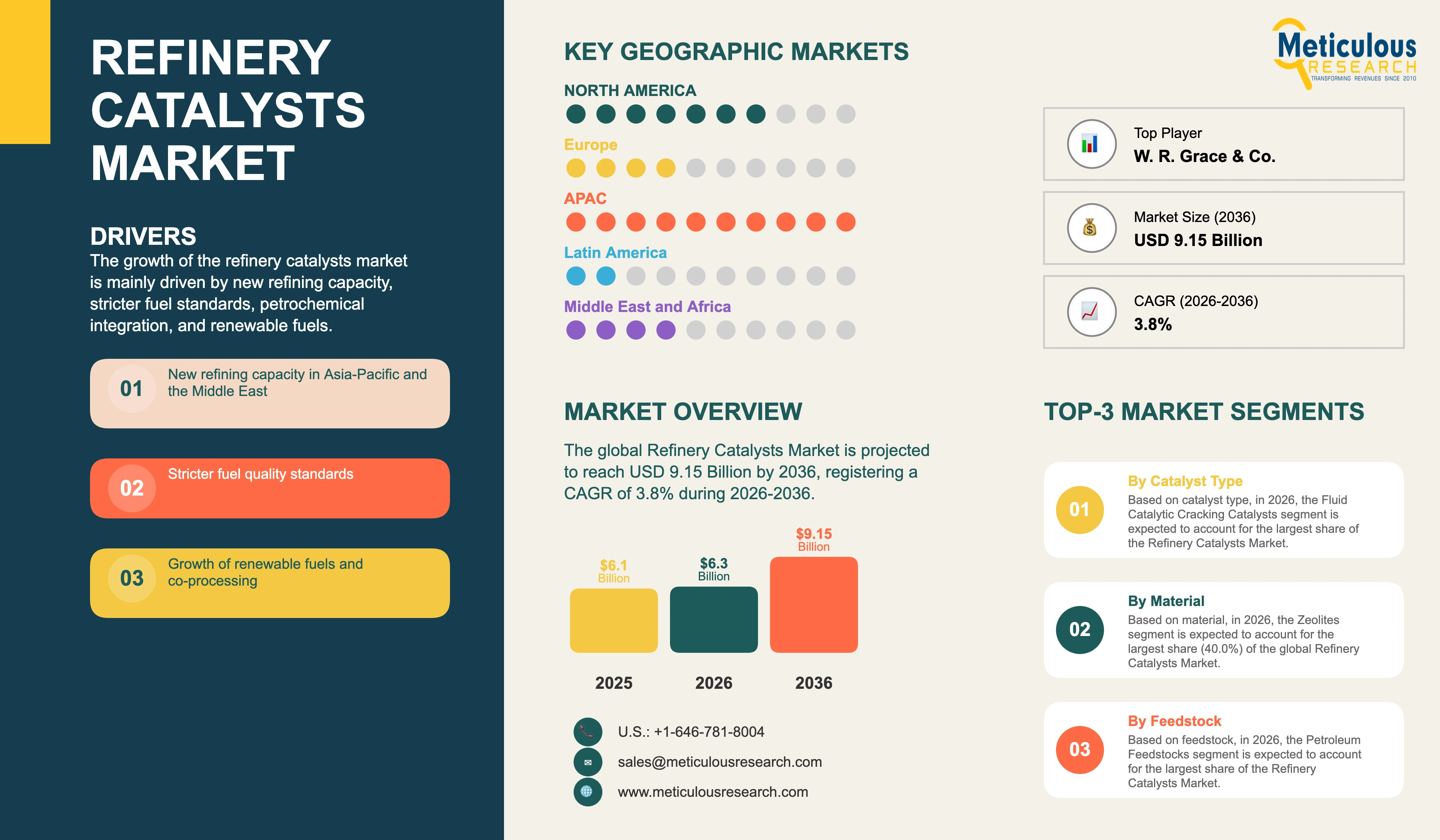
The global refinery catalysts market was valued at USD 6.10 billion in 2025. This market is expected to reach USD 9.15 billion by 2036 from an estimated USD 6.30 billion in 2026, registering a CAGR of 3.8% during the forecast period (2026-2036).
- Published
- Nov 2026
- Pages
- 247
- Format
- PDF + Excel
- Report ID
- MRCHM - 1042731
- Base year
- 2025
- 2025 · BASELINE
- $6.10B
- 2036
- $9.15B
- CAGR 2026–2036
- 3.8%
2025 baseline · 2026–2036 forecast at 3.8% CAGR · hover a bar for the value
Key highlights
Albemarle's Ketjen business, one of the world's leading suppliers of fluid catalytic cracking and hydroprocessing catalysts, reported fourth-quarter 2025 net sales of USD 320.1 million, up 13.5%, with Ketjen volumes up 13% and adjusted EBITDA up 39% year over year.
Albemarle sold its 50% stake in the Eurecat catalyst services joint venture for USD 123 million in January 2026 and was on track to close the sale of a controlling stake in Ketjen in the first quarter of 2026, which marks a major change of ownership in the refinery catalysts industry.
Topsoe, a leading supplier of hydroprocessing catalysts and technologies, reported 2025 revenue of DKK 8,197 million, with its catalyst business, which accounted for about 75% of revenue, delivering revenue of DKK 6,174 million, in line with 2024.
Topsoe reported that global market uncertainty caused some customer projects to be postponed in 2025, and it guided 2026 revenue of DKK 7,600 million to DKK 8,400 million, citing geopolitical uncertainty, shifting trade policies, and raw material price volatility.
Topsoe reported that its catalyst business accounted for about 75% of its revenue in 2025, while its technology business accounted for 23%, which shows the importance of catalyst sales to leading refinery technology companies.
Topsoe's first-half 2026 revenue was DKK 3, 412 million, compared with DKK 3,679 million in the first half of 2025, which reflects continued softness in parts of the catalyst market in 2026.
Albemarle reported that Ketjen's fourth-quarter 2025 results were also influenced by the timing of Clean Fuels Technology sales, which reflects the project-driven nature of hydroprocessing catalyst demand, where large refills occur at the end of multi-year cycles.
The International Maritime Organization's 0.5% global limit on sulfur in marine fuels, together with ultra-low sulfur road fuel standards in the U.S., Europe, China, and India, continues to support demand for high-activity hydrotreating catalysts.
Renewable diesel and sustainable aviation fuel production, together with the co-processing of renewable feedstocks in existing hydrotreaters and fluid catalytic cracking units, is creating a fast-growing new segment for hydroprocessing catalyst suppliers.
By catalyst type, fluid catalytic cracking catalysts account for the largest share of 42.0% in 2026, while hydroprocessing catalysts register the highest CAGR.
By material, zeolites account for the largest share of 40.0% in 2026, while metals register the highest CAGR.
By feedstock, petroleum feedstocks account for the larger share in 2026, while renewable and co-processed feedstocks register the higher CAGR.
By geography, Asia-Pacific accounts for the largest share of 36.0% in 2026 and also registers the highest CAGR of 4.5%.
Report summary
| Particulars | Details |
|---|---|
| Base Year | 2025 |
| Estimated Year | 2026 |
| Forecast Period | 2026-2036 |
| Market Size in 2025 | USD 6.10 billion |
| Market Size in 2026 | USD 6.30 billion |
| Market Size by 2036 | USD 9.15 billion |
| CAGR (2026-2036) | 3.8% |
| Format | PDF, Excel & Cloud Portal · 247 pages |
| Largest Segment by Catalyst Type (2026) | Fluid Catalytic Cracking Catalysts (42.0%) |
| Largest Segment by Material (2026) | Zeolites (40.0%) |
| Largest Region (2026) | Asia-Pacific (36.0%) |
| Fastest-Growing Region | Asia-Pacific (CAGR 4.5%) |
| Companies Profiled | 12 companies and other companies |
| Segments Covered | Catalyst Type, Material, Feedstock, Geography |
| Countries Covered | China, India, South Korea, Japan, Singapore, Rest of Asia-Pacific, U.S., Canada, Germany, Netherlands, Italy, U.K., Spain, Rest of Europe, Saudi Arabia, UAE, Kuwait, Nigeria, Rest of Middle East & Africa, Brazil, Mexico, Rest of Latin America |
Report overview
Segments covered: catalyst type, material, feedstock.
The growth of this market is mainly driven by new refining capacity in Asia-Pacific, the Middle East, and Africa, stricter fuel quality standards that require deeper desulfurization and more severe hydroprocessing, the shift of refineries toward petrochemical production, which increases demand for advanced fluid catalytic cracking and hydrocracking catalysts, the processing of heavier and more difficult crude oils, and the rapid growth of renewable diesel, sustainable aviation fuel, and co-processing of renewable feedstocks, which require specialized hydroprocessing catalysts. However, factors such as the long-term decline in fuel demand in mature markets, refinery closures in Europe and other regions, volatility in the prices of rare earths, nickel, molybdenum, cobalt, and precious metals, and longer catalyst cycle lengths are expected to restrain the growth of this market to some extent.
Refinery catalysts are materials that speed up the chemical reactions used to convert crude oil into fuels, petrochemical feedstocks, and other products, without being consumed in the reactions. They are essential to modern refining, as they allow refiners to convert heavy fractions into lighter, more valuable products, remove sulfur, nitrogen, and metals, improve octane, and produce fuels that meet environmental standards. The main types of refinery catalysts are fluid catalytic cracking catalysts and additives, hydroprocessing catalysts used in hydrotreating and hydrocracking, catalytic reforming catalysts, and alkylation, isomerization, and other catalysts.
This report covers global revenue from the sale of refinery catalysts, including fluid catalytic cracking catalysts and additives, hydrotreating and hydrocracking catalysts, catalytic reforming catalysts, and alkylation, isomerization, and other refinery catalysts, made from zeolites, metals, and chemical compounds, for petroleum feedstocks and renewable and co-processed feedstocks. Revenue includes fresh catalyst sales and regenerated and rejuvenated catalysts sold by catalyst suppliers. Catalysts for petrochemical, chemical, ammonia, methanol, hydrogen, and emission control applications, process technology licensing fees, catalyst handling and regeneration services provided separately, and refinery equipment are excluded from the scope of this report.
Fluid catalytic cracking catalysts are the largest type of refinery catalyst by volume and by value. Fluid catalytic cracking units convert heavy gas oils and residues into gasoline, light olefins such as propylene, and other products, and they use large quantities of zeolite-based catalyst, which must be added continuously to replace catalyst lost or deactivated during operation. Catalyst additives are used to increase propylene yield, reduce sulfur in gasoline, and control emissions. Because fluid catalytic cracking catalysts are consumed continuously, demand is closely linked to refinery throughput and unit operations.
Hydroprocessing catalysts, which contain nickel, molybdenum, cobalt, and tungsten on alumina or zeolite supports, are used to remove sulfur, nitrogen, and metals from fuels and to crack heavy fractions into diesel, jet fuel, and naphtha. They are loaded into fixed-bed reactors and replaced at the end of each cycle, typically every two to five years, which makes demand more cyclical. Stricter fuel standards, such as ultra-low sulfur diesel and gasoline requirements and the International Maritime Organization's limit on sulfur in marine fuels, have increased demand for hydroprocessing catalysts. Catalytic reforming catalysts, which contain platinum and other metals, are used to produce high-octane gasoline components and aromatics, while alkylation and isomerization catalysts are used to produce clean gasoline blending components.
The market is concentrated among a small number of global suppliers, including W. R. Grace, Ketjen, BASF, Honeywell UOP, Shell Catalysts & Technologies, Topsoe, Axens, Clariant, Advanced Refining Technologies, Chevron Lummus Global, Sinopec Catalyst, and JGC Catalysts and Chemicals. Fluid catalytic cracking catalysts are dominated by Grace, Ketjen, BASF, and Chinese suppliers, while hydroprocessing catalysts are supplied by Topsoe, Shell, Ketjen, Axens, Advanced Refining Technologies, and others. Ownership is changing, as shown by Albemarle's sale of a controlling stake in Ketjen and its stake in Eurecat.
Demand for refinery catalysts depends on refinery capacity, utilization, unit configuration, crude quality, and fuel standards. New refining capacity is being added mainly in Asia-Pacific, the Middle East, and Africa, while refineries are closing or converting in Europe, North America, and other mature markets. Refiners are also shifting toward petrochemical production, which requires catalysts designed to maximize propylene, aromatics, and other petrochemical feedstocks. At the same time, the conversion of refineries to renewable fuels and the co-processing of renewable feedstocks are creating new demand for specialized catalysts.
Over the forecast period, the market is expected to grow steadily, supported by new refining capacity, fuel quality standards, petrochemical integration, and renewable fuels. Fluid catalytic cracking catalysts are expected to remain the largest catalyst type, while hydroprocessing catalysts grow fastest. Zeolites are expected to remain the largest material, while metals grow fastest. Petroleum feedstocks are expected to remain the largest feedstock segment, while renewable and co-processed feedstocks grow fastest. Asia-Pacific is expected to remain the largest region and to grow fastest.
Our new hydrocracker and petrochemical units need high-performance catalysts, and we rely on our suppliers for technical support during start-up.
This comment explains why Asia-Pacific is the largest and fastest-growing region.
Process Engineer - refinery, U.S.
We use propylene-maximizing additives in our fluid catalytic cracking unit to capture petrochemical margins.
This comment explains why fluid catalytic cracking catalysts remain the largest segment.
Our renewable feedstocks deactivate catalysts faster, so we need robust catalysts and close support from our supplier.
This comment explains why renewable and co-processed feedstocks are the fastest-growing segment.
Across all customer groups, catalyst performance, measured by product yields, cycle length, and reliability, is the most important selection criterion, as catalyst performance has a large impact on refinery margins. Refiners often run detailed trials and performance comparisons before changing suppliers, and they value suppliers that provide strong technical support, from catalyst selection and loading to performance monitoring and troubleshooting. Price is important, but it is usually secondary to performance for critical units.
National oil companies often run formal tenders and may favor suppliers with local presence, while renewable fuel producers focus on catalyst life and tolerance to impurities. Supply reliability matters during turnarounds. Delays in catalyst deliveries can extend shutdowns and cost refiners significant lost production.
Asia-Pacific is expected to account for the largest share of 36.0% of the market in 2026, mainly due to large refining capacity and new complexes in China and India.
Asia-Pacific is projected to register the highest CAGR of 4.5% during the forecast period, driven by new refining capacity and petrochemical integration in India and China and stricter fuel standards across the region.
Renewable diesel, sustainable aviation fuel, and co-processing of renewable feedstocks require specialized hydroprocessing catalysts that are replaced more frequently, which makes renewable and co-processed feedstocks the fastest-growing segment.
The report profiles 12 companies, including W. R. Grace & Co., Ketjen Corporation, BASF SE, Honeywell UOP, Shell Catalysts & Technologies, Topsoe A/S, Axens, Clariant AG, Advanced Refining Technologies LLC, Chevron Lummus Global, Sinopec Catalyst Co., Ltd., and JGC Catalysts and Chemicals Ltd.
Report infographic
Market dynamics
16 factors across 5 forcesNew refining capacity in Asia-pacific, the Middle east, and Africa
New refining capacity is being added in China, India, the Middle East, and Africa to meet rising demand for fuels and petrochemicals and to increase domestic processing of crude oil. Large integrated refining and petrochemical complexes in China and India, new refineries in the Middle East, and projects such as Nigeria's Dangote refinery require large initial fills of fluid catalytic cracking, hydroprocessing, reforming, and other catalysts, followed by regular replacement. India in particular plans significant expansion of its refining capacity over the next decade. Each new refinery represents a large initial catalyst order, often worth tens of millions of dollars, and creates recurring demand for decades. New refineries are also typically more complex, with larger hydroprocessing and conversion units, which increases catalyst demand per barrel of capacity. Capacity additions in these regions are expected to more than offset closures in mature markets in terms of catalyst demand, which supports overall market growth.
In the Middle East, national oil companies are building new refineries and upgrading existing ones to increase the production of high-value products and petrochemicals, while in Africa, new refineries are being built to reduce dependence on imported fuels. These projects often include large hydrocracking, residue upgrading, and fluid catalytic cracking units, which require significant volumes of catalysts during start-up and throughout their operating lives.
Stricter fuel quality standards
Governments around the world have adopted stricter limits on sulfur and other pollutants in fuels, such as ultra-low sulfur diesel and gasoline standards in the U.S., Europe, China, and India, and the International Maritime Organization's 0.5% global sulfur limit for marine fuels. Meeting these standards requires deeper desulfurization, which increases demand for high-activity hydroprocessing catalysts and more frequent catalyst replacements. Developing countries in Africa, the Middle East, and Asia are also tightening fuel standards, which requires investment in hydroprocessing capacity. Fluid catalytic cracking catalyst additives for gasoline sulfur reduction and emission control are also in demand as refiners seek to meet gasoline sulfur standards and limit emissions from fluid catalytic cracking units. As standards tighten, refiners increasingly rely on catalyst suppliers for technical support to optimize performance and extend cycle lengths.
In many developing countries, fuel standards are still being tightened toward Euro 5 and Euro 6 equivalent levels, which requires new hydrotreating capacity and catalyst purchases, and the enforcement of these standards is expected to support demand for hydroprocessing catalysts in Africa, the Middle East, and parts of Asia and Latin America over the forecast period.
Shift toward petrochemical production
As fuel demand growth slows, refiners are increasingly integrating with petrochemical production to capture higher value. Fluid catalytic cracking units are being optimized to maximize propylene and other light olefins, which requires specialized catalysts and additives with high zeolite content. Hydrocracking units are being configured to produce naphtha and other petrochemical feedstocks, and reforming units are being used to produce aromatics. Large integrated complexes in China, India, and the Middle East are designed to convert a high share of crude oil into petrochemicals, which increases demand for advanced catalysts. This trend is expected to support demand for higher-value catalysts over the forecast period. Petrochemical-focused catalysts and additives typically command higher prices than standard fuel catalysts because they contain higher levels of specialized zeolites and require more advanced manufacturing, which supports value growth even where volumes grow slowly.
Growth of renewable fuels and co-processing
The rapid growth of renewable diesel and sustainable aviation fuel production, driven by mandates and incentives in the U.S., Europe, and other regions, is creating strong demand for specialized hydroprocessing catalysts. Renewable fuels are produced by hydrotreating and isomerizing vegetable oils, used cooking oil, animal fats, and other renewable feedstocks, which requires catalysts designed to handle oxygen, impurities, and high heat release. Many petroleum refineries have been converted to renewable fuel production, and others are co-processing renewable feedstocks in existing hydrotreaters and fluid catalytic cracking units. Renewable feedstocks can deactivate catalysts faster than petroleum feedstocks, which increases catalyst replacement frequency and demand. Catalyst suppliers such as Topsoe, Honeywell UOP, Axens, Shell, and Ketjen have developed dedicated catalysts and technologies for renewable fuels.
Co-processing allows refiners to produce lower-carbon fuels using existing equipment and with limited capital investment, which makes it an attractive option for many refiners. However, co-processing creates new challenges for catalysts, as renewable feedstocks contain oxygen, phosphorus, and metals that can affect catalyst activity and life, which increases demand for specialized catalysts and guard beds.
Table of contents
11 chapters · 127 sections · 247 pages · click to expandSegmental analysis
| Segment | Largest share (2026) | Fastest growth (2026–2036) |
|---|---|---|
| Other segments | Metals | Metals |
| By Catalyst Type | Fluid catalytic cracking catalysts | Hydroprocessing catalysts |
Other segments
- Metals are projected to register the highest CAGR, driven by hydroprocessing and precious metal catalysts, while zeolites account for the largest share of 40.0%.
By Catalyst Type
- The petroleum feedstocks segment is expected to account for the larger share of the refinery catalysts market, while the renewable and co-processed feedstocks segment is projected to register the higher CAGR during the forecast period.
Geographic analysis
Asia-Pacific
Largest shareIn 2026, Asia-Pacific is expected to account for the largest share of 36.0% of the global refinery catalysts market. The large share of this region is mainly due to the large refining capacity in China, India, South Korea, Japan, and Southeast Asia, the construction of large integrated refining and petrochemical complexes, and stricter fuel standards. Asia-Pacific is also projected to register the highest CAGR of 4.5% during the forecast period. The rapid growth of this region is mainly due to new refining capacity in India and China, petrochemical integration, and the adoption of stricter fuel standards across the region. Within Asia-Pacific, China is the largest country market, with the world's largest refining capacity and many large integrated refining and petrochemical complexes, and it is served by both international suppliers and domestic suppliers such as Sinopec Catalyst. India is the fastest-growing major market, supported by significant planned expansion of refining capacity and petrochemical integration. South Korea, Japan, Singapore, and Southeast Asian countries have large, complex refineries that use advanced catalysts.
North America
North America is the second-largest market, supported by its large fluid catalytic cracking and hydroprocessing capacity and renewable fuel growth. In North America, the U.S. has the world's largest fluid catalytic cracking capacity and a large number of hydroprocessing units, and it is also the largest market for renewable diesel catalysts.
Middle East & Africa
The Middle East & Africa is the third-largest market and is expected to grow faster than the global average, supported by new refineries, upgrades, and petrochemical projects in Saudi Arabia, the UAE, Kuwait, and Nigeria.
Europe
In Europe, refinery closures and conversions are reducing petroleum catalyst demand, but sustainable aviation fuel mandates and renewable fuel production are creating new demand. Europe is expected to be the slowest-growing region, reflecting refinery closures, although sustainable aviation fuel production partly offsets this decline.
Latin America
Latin America is a smaller market, with Brazil and Mexico as the main markets, where refinery upgrades and stricter fuel specifications support catalyst demand.
Competitive landscape
The global refinery catalysts market is consolidated, with the top five players estimated to account for about 55% of the market in 2025. The market includes global catalyst suppliers, technology licensors, and national suppliers in China.
W. R. Grace, Ketjen, and BASF are leading suppliers of fluid catalytic cracking catalysts. Topsoe, Shell Catalysts & Technologies, Ketjen, Axens, Advanced Refining Technologies, and Chevron Lummus Global are leading suppliers of hydroprocessing catalysts. Honeywell UOP and Axens are leading suppliers of reforming and isomerization catalysts and technologies. Clariant, JGC Catalysts and Chemicals, and Sinopec Catalyst are also important suppliers. Companies compete on catalyst performance, technical service, technology integration, price, and supply reliability. Key strategies include development of renewable fuel catalysts, petrochemical-focused catalysts, digital performance monitoring, and portfolio changes.
Barriers to entry are high because of the need for proprietary catalyst formulations, manufacturing know-how, large-scale production facilities, technical service capabilities, and long track records with refiners. Many suppliers also offer process technologies, which allows them to combine catalyst sales with licensing and technical services. Chinese suppliers have built significant capacity and compete strongly in China, while international suppliers compete across all regions. Recent developments include Albemarle's sale of its stake in Eurecat and its sale of a controlling stake in Ketjen, Topsoe's continued investment in catalysts for renewable fuels and energy transition applications, and the introduction of new catalysts for renewable feedstocks and petrochemical yields by several suppliers. We expect competition to intensify in renewable fuel catalysts as more suppliers enter this growing segment.
Pricing in the market reflects both the cost of raw materials and the value delivered to refiners, and suppliers with differentiated catalysts and strong performance records are able to maintain premium prices. Suppliers with lower-cost manufacturing, particularly in China, compete strongly on price for standard catalysts. International suppliers respond by emphasizing performance, technical service, and long-term reliability, and by developing new catalysts that deliver measurable improvements in yields and cycle lengths. Joint ventures, such as Advanced Refining Technologies between Chevron and Grace, combine the strengths of refiners and catalyst manufacturers. Such partnerships remain common in hydroprocessing.
Some of the key players operating in the refinery catalysts market are W. R. Grace & Co., Ketjen Corporation, BASF SE, Honeywell UOP, Shell Catalysts & Technologies, Topsoe A/S, Axens, Clariant AG, Advanced Refining Technologies LLC, Chevron Lummus Global, Sinopec Catalyst Co., Ltd., and JGC Catalysts and Chemicals Ltd., among others.
- —
Albemarle sold its stake in Eurecat and moved to sell a controlling stake in Ketjen, and catalyst suppliers continued to develop catalysts for renewable fuels and petrochemical integration.
- Shell Catalysts & Technologies
- Ketjen
- Axens
- Advanced Refining Technologies
- Chevron Lummus Global
Expert perspectives
The refinery catalysts market is mature but resilient, supported by the essential role of catalysts in refining and by new growth opportunities in renewable fuels and petrochemical integration. We expect moderate growth over the forecast period.
Over the forecast period, the market is expected to grow at a CAGR of 3.8%, from USD 6.30 billion in 2026 to USD 9.15 billion in 2036. Growth will be supported by new refining capacity, fuel standards, petrochemical integration, and renewable fuels, while declining fuel demand in mature markets, raw material volatility, and longer catalyst cycles will moderate growth.
In terms of segments, fluid catalytic cracking catalysts remain the largest catalyst type, while hydroprocessing catalysts grow fastest. Zeolites remain the largest material, while metals grow fastest. Petroleum feedstocks remain the largest feedstock segment, while renewable and co-processed feedstocks grow fastest. Asia-Pacific remains the largest region and grows fastest at a CAGR of 4.5%.
For catalyst suppliers, the key priorities are to invest in renewable fuel and petrochemical catalysts, strengthen technical service, and manage raw material costs. We believe that suppliers with strong positions in hydroprocessing and renewable fuels will grow faster than the market.
We expect demand to be supported in the near term by new refineries and upgrades in Asia and the Middle East, and by continued growth in renewable diesel and sustainable aviation fuel production in the U.S. and Europe. However, the softness reported by some suppliers in 2025 and 2026, including project delays and lower catalyst revenue at Topsoe, shows that demand can be uneven from year to year. Our forecast assumes that global refining capacity remains broadly stable, with additions in Asia and the Middle East offsetting closures in mature markets, and that renewable fuel mandates continue to expand. A faster decline in fuel demand or weaker renewable fuel policies could slow growth, while faster petrochemical integration could add upside. In our view, suppliers that combine strong technical service, technology licensing, and catalysts for both petroleum and renewable feedstocks will be best positioned over the forecast period.
We also see growing importance of catalyst services, such as performance monitoring, regeneration, and metal recovery, which allow suppliers to capture more value across the catalyst life cycle and to differentiate themselves in a competitive market. Over the long term, the shift of refining toward petrochemicals and renewable fuels will change the mix of catalysts demanded, favoring hydroprocessing, specialized zeolites, and renewable fuel catalysts over traditional fuel catalysts. This shift supports value growth.
Customer perspectives
Buyers of refinery catalysts include independent refiners, integrated oil companies, national oil companies, and renewable fuel producers. Their decisions depend mainly on catalyst performance, cycle length, technical support, price, and supply reliability.
Frequently asked questions
The global refinery catalysts market was valued at USD 6.10 billion in 2025, up from USD 6.00 billion in 2024, and is estimated at USD 6.30 billion in 2026. The market includes fluid catalytic cracking, hydroprocessing, catalytic reforming, and alkylation, isomerization, and other catalysts.
The global refinery catalysts market is expected to reach USD 9.15 billion by 2036, supported by new refining capacity, fuel standards, petrochemical integration, and renewable fuels.
The market is expected to register a CAGR of 3.8% from 2026 to 2036, with the fastest growth in hydroprocessing catalysts, metals, renewable and co-processed feedstocks, and Asia-Pacific.
Ketjen reported fourth-quarter 2025 net sales of USD 320.1 million, up 13.5%, while Topsoe's catalyst business delivered 2025 revenue of DKK 6,174 million, in line with 2024, and Topsoe reported softer first-half 2026 revenue.
Market growth is mainly driven by new refining capacity in Asia-Pacific, the Middle East, and Africa, stricter fuel quality standards, the shift toward petrochemical production, and the growth of renewable fuels and co-processing.
Declining fuel demand and refinery closures in mature markets and raw material volatility and longer catalyst cycles restrain growth, while competition and spent catalyst management are key challenges.
Key opportunities include renewable diesel, sustainable aviation fuel, and co-processing, catalysts for maximizing petrochemical yields, processing heavier crudes, and digital catalyst performance monitoring.
Fluid catalytic cracking catalysts are expected to account for the largest share of 42.0% of the market in 2026, while hydroprocessing catalysts are projected to register the highest CAGR.
Metals are projected to register the highest CAGR, driven by hydroprocessing and precious metal catalysts, while zeolites account for the largest share of 40.0%.
Asia-Pacific is expected to account for the largest share of 36.0% of the market in 2026, mainly due to large refining capacity and new complexes in China and India.
Asia-Pacific is projected to register the highest CAGR of 4.5% during the forecast period, driven by new refining capacity and petrochemical integration in India and China and stricter fuel standards across the region.
Renewable diesel, sustainable aviation fuel, and co-processing of renewable feedstocks require specialized hydroprocessing catalysts that are replaced more frequently, which makes renewable and co-processed feedstocks the fastest-growing segment.
The report profiles 12 companies, including W. R. Grace & Co., Ketjen Corporation, BASF SE, Honeywell UOP, Shell Catalysts & Technologies, Topsoe A/S, Axens, Clariant AG, Advanced Refining Technologies LLC, Chevron Lummus Global, Sinopec Catalyst Co., Ltd., and JGC Catalysts and Chemicals Ltd.
Albemarle sold its stake in Eurecat and moved to sell a controlling stake in Ketjen, and catalyst suppliers continued to develop catalysts for renewable fuels and petrochemical integration.
In 2026, the petroleum feedstocks segment is expected to account for the larger share of the refinery catalysts market, while the renewable and co-processed feedstocks segment is projected to register the higher CAGR during the forecast period.
Cite this report
Meticulous Research. (2026). Refinery Catalysts Market - Global Opportunity Analysis and Industry Forecast (2026-2036) (Report No. MRCHM - 1042731). Meticulous Market Research Pvt. Ltd. https://www.meticulousresearch.com/product/refinery-catalysts-market-7414