Hydrogenation Catalysts Market (2026-2036)
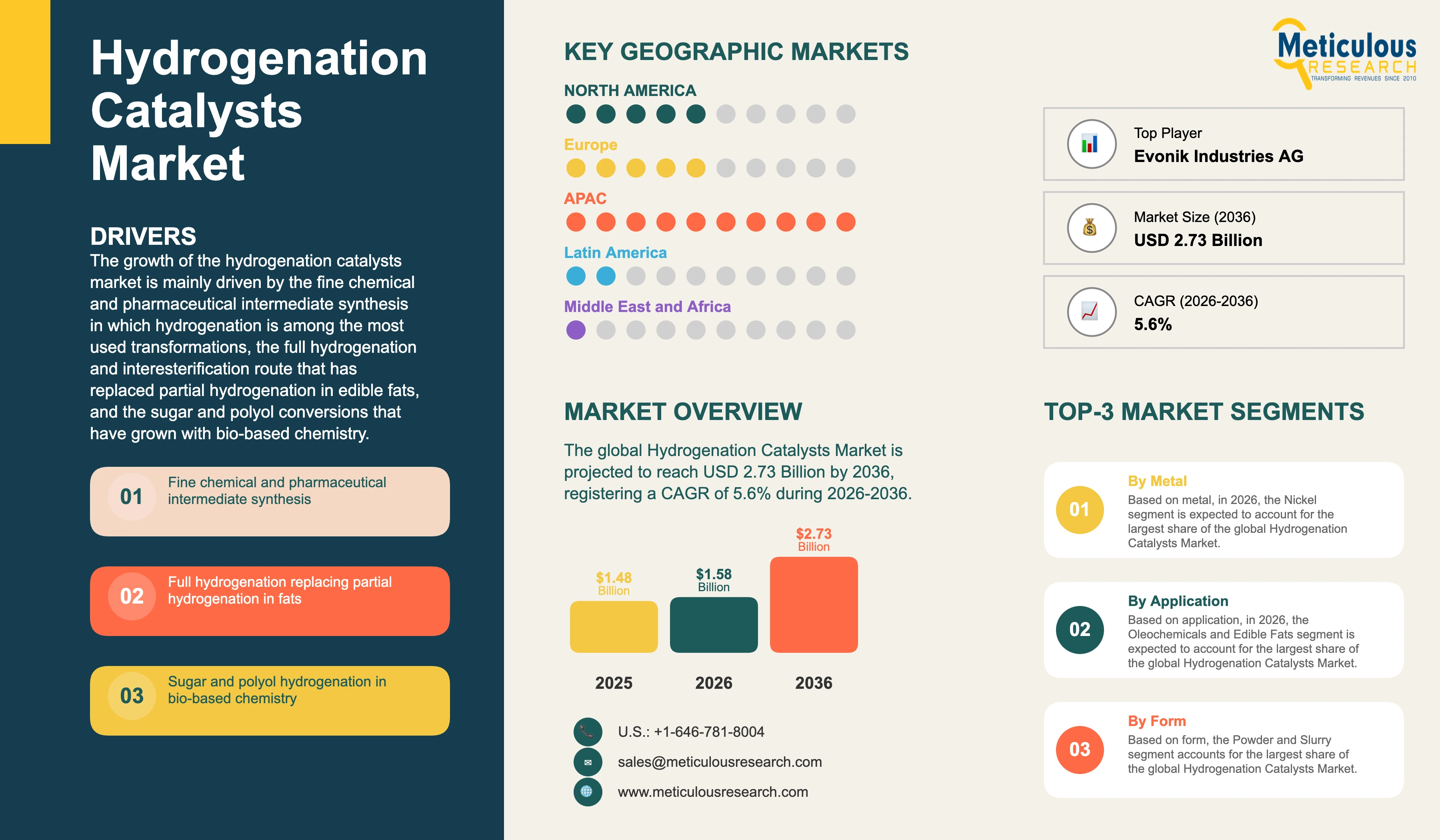
The global hydrogenation catalysts market was valued at USD 1.48 billion in 2025. This market is expected to reach USD 2.73 billion by 2036 from an estimated USD 1.58 billion in 2026, registering a CAGR of 5.6% during the forecast period (2026-2036).
- Published
- Nov 2026
- Pages
- 244
- Format
- PDF + Excel
- Report ID
- MRCHM - 1042805
- Base year
- 2025
- 2025 · BASELINE
- $1.48B
- 2036
- $2.73B
- CAGR 2026–2036
- 5.6%
2025 baseline · 2026–2036 forecast at 5.6% CAGR · hover a bar for the value
Key highlights
The global hydrogenation catalysts market is estimated at USD 1.58 billion in 2026 and is projected to reach USD 2.73 billion by 2036.
Market volume is estimated at 86.00 kilotons in 2026 and is projected to reach 115.58 kilotons by 2036 at a CAGR of 3.0%, measured as catalyst product as supplied.
The average selling price is estimated at USD 18.40 per kg in 2026 and is projected to reach USD 23.60 per kg by 2036 as precious metal grades take a larger share of a tonnage dominated by nickel.
Nickel is expected to account for the largest metal share in 2026, while palladium is projected to register the highest CAGR of 8.0%.
Oleochemicals and edible fats is expected to hold the largest application share in 2026, while fine chemicals and pharmaceutical intermediates is projected to grow fastest at a CAGR of 9.0%.
Asia-Pacific is expected to hold the largest regional share in 2026 and is also projected to grow fastest at a CAGR of 6.6%.
The World Health Organization trans fat fact sheet dated 24 January 2024 states that industrial trans fat is formed by adding hydrogen to vegetable oil, and that the resulting partially hydrogenated oil has trans fat concentrations averaging 25% to 45%.
That fact sheet gives two best-practice policy options, being a mandatory national limit of 2 g of industrially produced trans fat per 100 g of total fat in all foods, or a mandatory national ban on producing or using partially hydrogenated oils as an ingredient in all foods.
It states that almost half of the world population is covered by best-practice trans fat elimination policies, and attributes more than 278,000 deaths each year globally to industrially produced trans fat intake.
It also records a recommended limit of less than 1% of total energy from trans fat, being less than 2.2 g a day on a 2,000-calorie diet, and states that eliminating the cause would address 7% of cardiovascular disease globally.
That fact sheet gives no number of countries with best-practice policies, no target date for elimination or statement of whether one was met, and no regional breakdown of coverage, intake or deaths.
The regulatory elimination of partial hydrogenation has redirected rather than removed the largest nickel hydrogenation application, because the trans-fat-free replacement route is full hydrogenation followed by chemical interesterification.
Evonik markets MONCAT 2021 for that route, describing it as a ready-to-use activated nickel on silica catalyst embedded in hydrogenated vegetable oil and suitable for both full and partial hydrogenation of triglycerides.
The company describes its zero trans fatty acid approach as full hydrogenation followed by chemical interesterification using sodium methylate, with the powder form preferred for rapid interesterification under mild conditions and the lowest in-process oil losses.
Applications named for that route include margarines, cocoa butter alternatives, coating fats, bakery fats, vanaspati, ghee and other specialty fats, with fully hydrogenated palm and palm kernel oils forming stable beta prime crystals without extra processing.
That product page carries no date, no nickel content or loading, no trans fat content figures before or after processing, no selectivity, activity or filterability data, and no catalyst reuse or lifetime figures.
It also cites no regulation or trans fat limit as driving demand, saying only that the health effects of trans fatty acids have become better known.
This market excludes refinery hydroprocessing catalysts, ammonia synthesis catalysts, and methanol and Fischer-Tropsch synthesis catalysts, each of which is a separate duty on a separate basis.
Report summary
| Particulars | Details |
|---|---|
| Base Year | 2025 |
| Forecast Period | 2026-2036 |
| Market Size in 2025 | USD 1.48 billion |
| Market Size in 2026 | USD 1.58 billion |
| Market Size by 2036 | USD 2.73 billion |
| Value CAGR (2026-2036) | 5.6% |
| Format | PDF, Excel & Cloud Portal · 244 pages |
| Volume in 2026 | 86.00 kilotons |
| Volume by 2036 | 115.58 kilotons |
| Volume CAGR (2026-2036) | 3.0% |
| Volume Basis | Catalyst product as supplied |
| Average Selling Price in 2026 | USD 18.40 per kg |
| Average Selling Price by 2036 | USD 23.60 per kg |
| Price Direction | The average selling price rises across the forecast period as the palladium, platinum, ruthenium and rhodium grades take a larger share of a tonnage dominated by nickel, rather than through any change in the cost of an individual catalyst |
| Volume Basis Note | Activated nickel catalysts for edible oil are commonly supplied encapsulated in fat because the activated metal is pyrophoric and cannot be handled safely as a dry powder; Evonik describes MONCAT 2021 as an activated nickel on silica catalyst embedded in hydrogenated vegetable oil, so the mass supplied includes that matrix and a figure quoted on a nickel content basis would be far smaller than the one here |
| Value Basis Note | Value here includes the metal content, which differs from the convention applied to diesel oxidation catalysts and electrolyser catalyst coatings in this series; in those markets the precious metal is customer-supplied or passed through at metal cost, whereas a hydrogenation catalyst is bought outright with its metal content and the spent charge returned for refining, so the purchase price is what the user commits |
| Scope Exclusion Note | Refinery hydroprocessing catalysts are excluded and reserved to the hydrotreating catalysts report, ammonia synthesis catalysts are excluded and reserved to their own report, and methanol synthesis and Fischer-Tropsch catalysts are excluded as synthesis rather than substrate hydrogenation duties; those uses together exceed this market in tonnage, so a figure described as hydrogenation catalysts without those exclusions would be several times larger |
| Measurement Basis | Catalysts for the addition of hydrogen to organic substrates in chemical, fine chemical, pharmaceutical and oleochemical processing, including supported and sponge nickel, palladium, platinum, copper and copper chromite, and ruthenium and rhodium systems, by metal, application, form and geography |
| Relationship to Adjacent Markets | This market is distinct from the hydrotreating catalysts market, where cobalt molybdenum and nickel molybdenum catalysts remove sulphur and nitrogen from petroleum fractions, and from the ammonia synthesis catalysts market, where promoted iron and ruthenium combine nitrogen and hydrogen in a synthesis loop; none of the three is additive to another, and the sodium methylate used for the interesterification step that follows full hydrogenation is a basic chemical rather than a hydrogenation catalyst and is also excluded |
| Note on Trans Fat Policy | The World Health Organization trans fat fact sheet dated 24 January 2024 states that industrial trans fat is formed by adding hydrogen to vegetable oil and that partially hydrogenated oil has trans fat concentrations averaging 25% to 45%; it gives two best-practice policy options, a mandatory national limit of 2 g of industrially produced trans fat per 100 g of total fat in all foods or a mandatory national ban on producing or using partially hydrogenated oils as an ingredient in all foods, and states that almost half the world population is covered by best-practice policies, with more than 278,000 deaths a year attributed to industrially produced trans fat intake; it gives no number of countries, no target date or statement of whether one was met, and no regional breakdown |
| Note on the Redirected Application | A ban on producing or using partially hydrogenated oils removes by name the largest historical application of nickel hydrogenation catalyst, but the trans-fat-free replacement route is full hydrogenation followed by chemical interesterification, which consumes more hydrogen and drives the reaction to completion rather than stopping part way; Evonik markets MONCAT 2021 for that route and describes it as suitable for both full and partial hydrogenation of triglycerides, so the catalyst duty was redirected rather than eliminated and the oleochemical segment grows at 3.0% rather than contracting |
| Note on Supplier Disclosure | The Evonik product page reviewed for this report carries no date, no nickel content or loading, no trans fat content figures before or after processing, no quantitative selectivity, activity or filterability data and no catalyst reuse or lifetime figures, and cites no regulation or trans fat limit as driving demand, saying only that the health effects of trans fatty acids have become better known; no participant publishes hydrogenation catalyst revenue separately from its wider catalyst business, so the sizing here is built from application demand, substrate tonnages and dose rates |
| Largest Metal | Nickel |
| Fastest-Growing Metal | Ruthenium, rhodium and other metals (CAGR 15.0%) from the smallest base; palladium is fastest among the major metals at 8.0% |
| Largest Application | Oleochemicals and edible fats |
| Fastest-Growing Application | Fine chemicals and pharmaceutical intermediates (CAGR 9.0%) |
| Largest Form | Powder and slurry |
| Fastest-Growing Form | Fixed-bed shaped catalysts (CAGR 7.6%) |
| Largest Region | Asia-Pacific |
| Fastest-Growing Region | Asia-Pacific (CAGR 6.6%) |
| Segments Covered | Metal, Application, Form, and Geography |
| Geographies Covered | Asia-Pacific, Europe, North America, Latin America, and Middle East & Africa |
| Companies Profiled | 6 companies, including Evonik Industries AG, Clariant AG, BASF SE, Johnson Matthey Plc, Umicore SA, and Heraeus Precious Metals GmbH & Co. KG |
Report overview
Segments covered: metal, application, form.
In volume terms, this market is estimated at 86.00 kilotons in 2026 and is projected to reach 115.58 kilotons by 2036, registering a CAGR of 3.0% during the same period, measured as catalyst product as supplied. The average selling price is estimated at USD 18.40 per kg in 2026 and is projected to rise to USD 23.60 per kg by 2036 as the precious metal grades take a larger share of a tonnage dominated by nickel.
The growth of this market is mainly driven by the fine chemical and pharmaceutical intermediate synthesis in which hydrogenation is among the most used transformations, the full hydrogenation and interesterification route that has replaced partial hydrogenation in edible fats, the sugar and polyol conversions that have grown with bio-based chemistry, and the fixed-bed and continuous configurations being adopted in place of batch slurry operation. However, factors such as the regulatory elimination of partial hydrogenation in foods, the precious metal content that makes the higher-value grades expensive to hold, the activity loss and poisoning that shorten catalyst life in practice, and the maturity of the bulk chemical conversions that account for much of the tonnage are expected to restrain the growth of this market to some extent.
Nickel accounts for the largest metal share of this market, while palladium grows fastest. Asia-Pacific holds the largest regional share and is also the fastest-growing region.
Hydrogenation catalysts are the catalysts used to add hydrogen to organic substrates in chemical, fine chemical, pharmaceutical and oleochemical processing, including supported and sponge nickel, palladium on carbon and other palladium forms, platinum, copper and copper chromite, and the ruthenium and rhodium systems used in specialised reductions. Market sizing in this report is on both a value basis in USD and a volume basis in kilotons measured as catalyst product as supplied.
The as-supplied basis carries a complication specific to the edible fats grades and it is worth stating before any tonnage is read. Evonik describes MONCAT 2021 as an activated nickel on silica catalyst embedded in hydrogenated vegetable oil, and encapsulation of that kind is common across the edible oil grades because an activated nickel catalyst is pyrophoric and cannot be handled safely as a dry powder. The mass supplied therefore includes a fat matrix, and a figure quoted on a nickel content basis would be far smaller than the one here.
Value in this report includes the metal content, which differs from the convention used for automotive and electrolyser coatings in this series, and the difference is deliberate. In those markets the precious metal is customer-supplied or passed through at metal cost, whereas a hydrogenation catalyst is bought outright with its metal content and the spent charge is returned for refining, so the purchase price is what the user actually commits.
Three exclusions define the boundary and each is substantial. Refinery hydroprocessing catalysts are excluded and reserved to the hydrotreating catalysts report. Ammonia synthesis catalysts are excluded and reserved to their own report. Methanol synthesis and Fischer-Tropsch catalysts are excluded as synthesis rather than substrate hydrogenation duties. Together those uses exceed this market in tonnage, so a figure described as hydrogenation catalysts without those exclusions would be much larger.
The World Health Organization trans fat fact sheet dated 24 January 2024 states that industrial trans fat is formed by adding hydrogen to vegetable oil, turning the liquid into a solid, and that the resulting partially hydrogenated oil has trans fat concentrations averaging 25% to 45%. It attributes more than 278,000 deaths each year globally to industrially produced trans fat intake and recommends a limit of less than 1% of total energy, being under 2.2 g a day on a 2,000-calorie diet.
The two best-practice policy options set out there are the ones that matter to this market. The first is a mandatory national limit of 2 g of industrially produced trans fat per 100 g of total fat in all foods; the second is a mandatory national ban on producing or using partially hydrogenated oils as an ingredient in all foods. The fact sheet states that almost half of the world population is covered by best-practice policies of that kind.
A ban on producing or using partially hydrogenated oils removes, by name, the single largest historical application of nickel hydrogenation catalyst. Partial hydrogenation of edible oil was for decades the duty that consumed more hydrogenation catalyst tonnage than any other, and roughly half the world population now lives under policies that either prohibit it outright or cap the trans fat it produces at a level partial hydrogenation cannot meet.
What has actually happened to that demand is more interesting than the simple conclusion, and it is where the Evonik material is useful. The trans-fat-free replacement route is not a different technology but a different use of the same one: full hydrogenation followed by chemical interesterification. Partial hydrogenation creates trans fatty acids because it leaves double bonds partly converted, while full hydrogenation converts essentially all of them and produces no trans fat.
Full hydrogenation consumes more hydrogen and drives the reaction to completion rather than stopping part way, so the catalyst duty is not reduced by the switch. Evonik markets MONCAT 2021 for exactly that purpose, describing it as a ready-to-use activated nickel on silica catalyst embedded in hydrogenated vegetable oil and suitable for both full and partial hydrogenation of triglycerides, which is the same product serving both the old route and its replacement.
The interesterification step that follows uses a separate catalyst and is outside this market as measured. Evonik names sodium methylate for it, with the powder form preferred for rapid interesterification under mild conditions and the lowest in-process oil losses, and that is a basic chemical rather than a hydrogenation catalyst.
The conclusion for this market is therefore that regulation redirected the largest application rather than eliminating it. Oleochemicals and edible fats remain the largest application share and grow at 3.0%, slower than the market as a whole but not in decline, because the tonnage of oil being hardened has not fallen and the hardening is now taken further than before.
The commercial argument the supplier makes for that route is about oil sourcing rather than about health. Full hydrogenation and interesterification allow expensive oils to be replaced with cheaper alternatives such as canola, soybean and sunflower oil that can often be sourced locally, and allow products that do not occur in nature, with fully hydrogenated palm and palm kernel oils forming stable beta prime crystals without additional processing.
Notably, that supplier page cites no regulation at all as driving demand, saying only that the health effects of trans fatty acids have become better known. A catalyst producer selling into a route created by regulation describes the change as a shift in awareness, which is a gap between the regulatory record and the commercial literature worth recording rather than smoothing over.
It also carries no date, no nickel content or loading for the product, no trans fat figures before or after processing, no quantitative selectivity, activity or filterability data, and no catalyst reuse or lifetime figures, which is the level of disclosure available across this field and the reason the sizing here is built from application demand rather than from supplier reporting.
Fine chemicals and pharmaceutical intermediates is the fastest-growing application and the reason is the breadth of the transformation rather than any single product. Hydrogenation reduces nitro groups to amines, nitriles to amines, ketones and aldehydes to alcohols, and removes protecting groups, and it is among the most frequently used steps in pharmaceutical synthesis, which is why palladium grows fastest among the metals at 8.0%.
This market is distinct from the hydrotreating catalysts market, where cobalt molybdenum and nickel molybdenum catalysts remove sulphur and nitrogen from petroleum fractions on a refinery scale, and from the ammonia synthesis catalysts market, where promoted iron and ruthenium combine nitrogen and hydrogen in a synthesis loop. None of the three is additive to another.
A pharmaceutical route often requires one functional group reduced while others are left intact, which demands a catalyst selected for selectivity rather than activity and is where palladium, platinum and the modified precious metal systems are specified.
Fine chemicals and pharmaceutical intermediates grows at 9.0% and palladium at 8.0%, and the value per kilogram in these duties is many times that of an edible oil grade.
Replacing a batch slurry with a fixed bed removes the filtration step, the handling of a pyrophoric powder and the metal carry-over into the product, and allows continuous operation with tighter quality control.
Fixed-bed shaped catalysts are projected to grow at 7.6%, the fastest of the three forms, and the shaped product commands a higher price than the powder it replaces.
Ruthenium and rhodium systems address reductions that nickel and palladium handle poorly, including certain ring hydrogenations and selective carbonyl reductions in high-value synthesis.
The ruthenium, rhodium and other metals segment is projected to grow at 15.0%, the fastest of the metals, from the smallest base, and it is where the highest value per kilogram in this market sits.
These four opportunities divide between the two halves of the market and the division is clean. Asia-Pacific fats processing and the shift to fixed beds belong to the tonnage business; selective pharmaceutical hydrogenation and the ruthenium systems belong to the value business.
The regional opportunity is the largest in tonnage and the clearest in direction. Palm and palm kernel oil processing is concentrated in Asia-Pacific, and Evonik states that fully hydrogenated palm and palm kernel oils form stable beta prime crystals without extra processing, which makes the full hydrogenation route technically easier on exactly the feedstocks the region supplies.
The selective hydrogenation opportunity is the largest in value and the hardest to serve. Each pharmaceutical route presents a different combination of functional groups, so the catalyst is selected against one specific conversion rather than specified from a catalogue, and the supplier is competing on development work as much as on product.
The ruthenium and rhodium opportunity sits at the extreme of that logic. These metals address reductions the others handle poorly, they carry the highest value per kilogram in this market, and the segment grows at 15.0% from the smallest base, so it contributes materially to value while remaining negligible in tonnage.
A fifth route sits alongside them and is growing from a small base. Reductions of bio-based acids and esters to alcohols, and of furanics and other platform molecules, are hydrogenation duties created by the substitution of renewable feedstocks for petrochemical ones, and they need catalyst systems that tolerate the oxygen content and impurities that bio-based feeds carry.
Those duties sit between the two halves of this market in both tonnage and value, which makes them commercially awkward to serve and is part of why they remain underdeveloped relative to their potential.
Taken together, the five opportunities add value faster than tonnage, which is why value grows at 5.6% against 3.0% in volume across the forecast period.
A supplier able to serve both halves of this market is therefore unusually well placed, since the tonnage business funds the plant while the fine chemical business carries the margin.
Asia-Pacific is expected to account for the largest share in 2026, on the concentration of palm and palm kernel oil processing and specialty fat manufacture, the vanaspati and ghee production that consumes hardened fats, and expanding fine chemical manufacture. India is projected to grow at 8.0%, Indonesia at 7.4%, China at 6.4%, Malaysia at 6.0% and Japan at 2.6%.
Asia-Pacific is also projected to register the highest CAGR of 6.6% during the forecast period, holding both the largest share and the fastest growth.
Europe is projected to grow at a CAGR of 4.0%, with the Netherlands at 4.4% and Germany at 3.6%. It holds the catalyst manufacturers and a mature oleochemical and fine chemical industry, and it is where the reformulation away from partial hydrogenation was largely completed before the current period, so demand now follows oil tonnage and fine chemical activity rather than the transition itself.
The Middle East & Africa is projected to grow at a CAGR of 8.0%, the second fastest, from a small base and on edible fat processing where imported oils are hardened locally. Latin America is projected to grow at a CAGR of 5.6%, with Brazil at 5.6%, on soybean oil processing and sugar-derived polyol production.
Evonik Industries AG, Clariant AG, BASF SE, Johnson Matthey Plc and Umicore SA together accounted for an estimated 56.4% of this market in 2026. The 6 companies profiled in this report together accounted for an estimated 62.2%.
Report infographic
Market dynamics
11 factors across 4 forcesFine Chemical and Pharmaceutical Intermediate Synthesis
Hydrogenation reduces nitro groups and nitriles to amines, carbonyls to alcohols and removes protecting groups, which makes it among the most frequently used transformations in pharmaceutical and fine chemical synthesis rather than a single application.
Fine chemicals and pharmaceutical intermediates is projected to register the highest application CAGR of 9.0%, and palladium the highest metal CAGR of 8.0%, the two largely describing the same demand.
Full Hydrogenation Replacing Partial Hydrogenation in Edible Fats
The World Health Organization fact sheet of 24 January 2024 gives a mandatory ban on producing or using partially hydrogenated oils as one of its two best-practice policy options, and states that almost half the world population is covered by policies of that kind.
The replacement route is full hydrogenation followed by chemical interesterification, which drives the reaction to completion rather than stopping part way, so the catalyst duty is redirected rather than removed and Evonik markets the same MONCAT 2021 nickel catalyst for both.
Sugar and Polyol Hydrogenation in Bio-Based Chemistry
Converting sugars to sorbitol, mannitol and other polyols, and reducing bio-based acids and esters to alcohols, are hydrogenation duties that have grown with the substitution of bio-based feedstocks for petrochemical ones.
Sugar and polyol hydrogenation is projected to grow at 6.6%, and the duties involved favour the nickel and ruthenium systems rather than the palladium chemistries of fine chemical synthesis.
Fixed-Bed and Continuous Operation Replacing Batch Slurry
A shaped catalyst in a fixed bed avoids the filtration, handling and nickel carry-over that a slurry process requires, and allows continuous operation with more consistent product quality.
Fixed-bed shaped catalysts are projected to grow at 7.6% against 5.0% for powder and slurry grades and 4.4% for the fat-encapsulated ready-to-use forms, and they carry a higher value per kilogram.
These four drivers act on different halves of a market that is really two businesses sharing a name. The oleochemical and bulk chemical duties consume catalyst by the tonne at a low price per kilogram, while fine chemical and pharmaceutical synthesis consumes very little at a very high price, and a driver that moves one has almost no effect on the other.
The fats driver is the one most easily misread. It is not a growth driver in the ordinary sense, since the tonnage of oil being hardened has not risen; it is a driver because the route changed from stopping the reaction part way to taking it to completion, which consumes more hydrogen and keeps the catalyst duty intact where a naive reading of the regulation would have removed it.
The fine chemical driver is where the value growth actually comes from. Hydrogenation appears in a large proportion of pharmaceutical routes, each new molecule requires its own catalyst selection, and the catalyst cost is immaterial against the value of the product, so demand follows the number of processes rather than the tonnage of anything.
The form driver changes the purchase pattern rather than the quantity. A fixed bed is retained between campaigns while a slurry charge is filtered out and discarded with each batch, so a move to continuous operation lowers the frequency of purchase while raising the specification and the price of what is bought.
What none of the four rests on is growth in the underlying tonnage of fats or bulk chemicals, which moves with population and industrial output rather than with anything happening in catalysis. This market grows through its mix and its routes rather than through its substrates.
Each driver accordingly reaches only part of this market, and the headline growth rate is a weighted average of two businesses that share little beyond the chemistry.
Table of contents
11 chapters · 135 sections · 244 pages · click to expandSegmental analysis
| Segment | Largest share (2026) | Fastest growth (2026–2036) |
|---|---|---|
| By Metal | Nickel | Palladium |
| By Application | Oleochemicals and edible fats | Fine chemicals and pharmaceutical intermediates |
| By Form | Powder and slurry catalysts | Fixed-bed shaped catalysts |
By Metal
- Hydrogenation Catalysts Market Analysis by Metal
- The nickel segment is expected to account for the largest share of the global hydrogenation catalysts market.
- The large share of this segment is mainly due to the oleochemical and edible fat duties that consume catalyst in far greater tonnage than any other application, to nickel costing a small fraction of any precious metal on a mass basis so that it can be dosed accordingly, and to the activated nickel systems being well established across bulk chemical reductions as well.
- However, the palladium segment is projected to register the highest CAGR of 8.0% among the major metals during the forecast period.
- The rapid growth of this segment is attributed to its position in fine chemical and pharmaceutical synthesis, where selectivity rather than activity governs and a catalyst must reduce one functional group while leaving others intact, and to the value of those products supporting a metal cost the oleochemical duties could not.
- Platinum grows at 7.4% in duties where palladium is unsuitable.
- Copper and copper chromite serve ester and carbonyl reductions.
- The ruthenium, rhodium and other metals segment grows at 15.0% from the smallest base and carries the highest value per kilogram, addressing ring hydrogenations and selective reductions that the other metals handle poorly.
- Metal determines the selectivity, the poison tolerance and the cost, which range over three orders of magnitude across this axis.
- Nickel is expected to account for the largest share in 2026, on the oleochemical and edible fat duties that consume catalyst in far greater tonnage than any other application and on nickel costing a small fraction of any precious metal on a mass basis.
- Ruthenium, rhodium and other metals are projected to register the highest CAGR of 15.0% from the smallest base, while palladium is fastest among the major metals at 8.0% on its position in fine chemical and pharmaceutical synthesis.
By Application
- Hydrogenation Catalysts Market Analysis by Application
- The oleochemicals and edible fats segment is expected to account for the largest share of the global hydrogenation catalysts market.
- The large share of this segment is mainly due to the tonnage of oil hardened worldwide for margarines, bakery and coating fats, vanaspati, ghee and cocoa butter alternatives, and to the catalyst being consumed and filtered out rather than retained in a fixed bed.
- However, the fine chemicals and pharmaceutical intermediates segment is projected to register the highest CAGR of 9.0% during the forecast period.
- The rapid growth of this segment is attributed to hydrogenation being among the most frequently used transformations in pharmaceutical synthesis rather than a single step, and to each new route requiring its own catalyst selection for selectivity.
- Bulk and intermediate chemicals grows at 5.4% on long-established conversions such as aniline from nitrobenzene and fatty alcohols from esters, where demand tracks plant capacity.
- Sugar and polyol hydrogenation grows at 6.6% with bio-based chemistry.
- The oleochemical segment grows at 3.0%, the slowest, because the regulatory change to full hydrogenation redirected existing demand rather than creating new demand.
- Oleochemicals and edible fats is expected to hold the largest share in 2026, on the tonnage of oil hardened worldwide for margarines, bakery and coating fats, vanaspati, ghee and cocoa butter alternatives, and on the catalyst being consumed and filtered out rather than retained.
- Fine chemicals and pharmaceutical intermediates is projected to register the highest CAGR of 9.0% during the forecast period, hydrogenation being among the most frequently used transformations in pharmaceutical synthesis rather than a single step.
By Form
- Hydrogenation Catalysts Market Analysis by Form
- Powder and slurry catalysts account for the largest form share of this market and grow at 5.0%, being the form used in batch hydrogenation across both oleochemical and fine chemical duties, where the catalyst is dispersed in the reaction mass and filtered out afterwards.
- Fat-encapsulated and ready-to-use forms grow at 4.4%, the slowest, and exist because an activated nickel catalyst is pyrophoric and cannot be handled safely as a dry powder.
- Evonik describes MONCAT 2021 as nickel on silica embedded in hydrogenated vegetable oil for that reason, and the encapsulating matrix is part of the mass supplied, which is why the volume basis in this report is stated as product as supplied rather than as metal or active content.
- Fixed-bed shaped catalysts grow fastest at 7.6%, removing the filtration step, the handling of a pyrophoric powder and the metal carry-over into product that a slurry process accepts, and allowing continuous operation.
- This axis matters because it determines whether the catalyst is consumed with the batch or retained between campaigns, and therefore how often it is bought.
- The three axes answer different questions and the third is more consequential here than in most catalyst markets.
- Metal determines selectivity, poison tolerance and cost; application determines the substrate and the dose rate; and form determines whether the catalyst is consumed with the batch or retained between campaigns, which sets the frequency of purchase.
- The form axis also explains an oddity in the volume basis.
- The fat-encapsulated grades exist because activated nickel is pyrophoric, so the product includes a matrix that is not catalyst at all, and a tonnage comparison between an encapsulated nickel grade and a shaped fixed-bed catalyst is not a comparison of catalyst quantities.
- The metal axis spans a wider range of value than any other in this series.
- Nickel and ruthenium differ by orders of magnitude in price per kilogram, so a segment holding 6% of tonnage can contribute a share of value several times larger, and reading the metal split on volume alone would misdescribe the market entirely.
- The highest growth sits where selectivity is worth paying for.
- Fine chemicals and pharmaceutical intermediates grows fastest among applications at 9.0% and palladium fastest among the major metals at 8.0%, and those two largely describe the same demand from different directions.
- One axis is deliberately absent, and that is a split by reactor configuration beyond the form distinction already drawn.
- Trickle bed, stirred autoclave and loop reactor choices follow from the form of catalyst and the scale of the duty rather than determining them, so a split on configuration would restate the form axis in different words.
- The three axes used here divide the market without overlapping.
- The fastest-growing position in this market, read across all three axes, is a palladium or ruthenium catalyst supplied as a fixed-bed shaped product into a fine chemical or pharmaceutical conversion, and it is that combination rather than any one of its parts that is adding value fastest over the forecast period.
Geographic analysis
Asia-Pacific
Largest sharePalm and palm kernel oil processing, vanaspati and ghee manufacture and specialty fat production are concentrated in Asia-Pacific, and the full hydrogenation route suits palm and palm kernel oils particularly well. Evonik states that fully hydrogenated palm and palm kernel oils form stable beta prime crystals without extra processing, and Asia-Pacific holds the largest regional share and is projected to grow fastest at 6.6%, with India at 8.0% and Indonesia at 7.4%. In 2026, Asia-Pacific is expected to account for the largest share of the global hydrogenation catalysts market and is also projected to register the highest CAGR of 6.6% during the forecast period. The large share and rapid growth of this region are attributed to the concentration of palm and palm kernel oil processing and specialty fat manufacture there, to the vanaspati and ghee production that consumes hardened fats in large tonnage, and to the fine chemical and pharmaceutical intermediate manufacture expanding faster than in the mature regions. India is projected to register a CAGR of 8.0%, Indonesia a CAGR of 7.4%, China a CAGR of 6.4%, Malaysia a CAGR of 6.0% and Japan a CAGR of 2.6%. Asia-Pacific Oleochemical and Specialty Fat Processing Geographic Analysis
Europe
Europe is projected to grow at 4.0%, with the Netherlands at 4.4% and Germany at 3.6%. It holds the catalyst manufacturers and a mature oleochemical and fine chemical industry, and it is where the reformulation away from partial hydrogenation was largely completed before the current period.
North America
North America is projected to grow at 4.4%, with the United States at 4.4%, on pharmaceutical and fine chemical synthesis rather than on fats. In Europe and North America it is largely complete, so demand now follows oil tonnage and fine chemical activity; in much of Asia-Pacific, Latin America and Africa it is in progress or ahead, and the shift to full hydrogenation is itself a source of catalyst demand as processes are requalified and plants reconfigured. Country rates within each region spread widely and follow which industry dominates locally: India at 8.0% and Indonesia at 7.4% against Japan at 2.6% within Asia-Pacific, and the Netherlands at 4.4% against Germany at 3.6% within Europe. What separates the regions is therefore which half of this market they represent, and the two halves grow at materially different rates from materially different bases. Regional shares here therefore describe where substrates are processed rather than where catalysts are made, and the two are increasingly in different places.
Latin America
Latin America is projected to grow at 5.6%, with Brazil at 5.6%, on soybean oil processing and on sugar-derived polyol production. Latin America and the Middle East and Africa remain small in share but are the regions where the transition to full hydrogenation is least complete, which makes their growth rates a measure of reformulation activity as much as of underlying demand.
Middle East & Africa
Fastest growthThe Middle East & Africa is projected to grow at 8.0%, the second fastest, from a small base and on edible fat processing where imported oils are hardened locally for regional consumption. What differs between regions is whether the reformulation away from partial hydrogenation has already happened.
Competitive landscape
The global hydrogenation catalysts market is concentrated among a small number of catalyst manufacturers, and divided between the nickel producers who serve the oleochemical and bulk chemical duties and the precious metal houses who serve fine chemical and pharmaceutical synthesis. Competition is contested on selectivity in a specific conversion, on filterability and handling in slurry use, on metal recovery terms for the precious metal grades, and on application support, rather than on price per kilogram. Evonik Industries AG, Clariant AG, BASF SE, Johnson Matthey Plc and Umicore SA together accounted for an estimated 56.4% of this market in 2026, while the companies profiled in this report together accounted for an estimated 62.2%.
The two halves of this market are served by different capabilities and often by different parts of the same company. An activated nickel catalyst for edible oil is a bulk product sold on tonnage, filterability and handling safety, supplied in the fat-encapsulated form that Evonik describes for MONCAT 2021; a palladium catalyst for a pharmaceutical reduction is sold on selectivity in one conversion, on documentation and on metal recovery, in quantities that are trivial by comparison.
No participant publishes hydrogenation catalyst revenue separately from its wider catalyst business, and the product literature carries no loading, selectivity or lifetime figures in public form, the Evonik page reviewed for this report giving none of those and carrying no date. Shares here are built from application demand, substrate tonnages and dose rates. Some of the key players operating in the hydrogenation catalysts market are Evonik Industries AG (Germany), Clariant AG (Switzerland), BASF SE (Germany), Johnson Matthey Plc (U.K.), Umicore SA (Belgium), and Heraeus Precious Metals GmbH & Co. KG (Germany), among others.
Competition is therefore conducted differently in the two halves of this market, and few participants lead in both. A nickel catalyst for edible oil is won on tonnage economics, filterability and handling safety; a palladium catalyst for a pharmaceutical reduction is won on selectivity in one conversion and on the documentation behind it.
Metal recovery terms are the third competitive dimension and apply only to the precious metal half. A supplier that refines its own spent catalyst can offer terms that a catalyst maker without refining cannot, which is why the precious metal houses hold the positions they do in fine chemical supply.
- —
The World Health Organization trans fat fact sheet dated 24 January 2024 states that industrial trans fat is formed by adding hydrogen to vegetable oil, turning the liquid into a solid, and that the resulting partially hydrogenated oil has trans fat concentrations averaging 25% to 45%. It gives two best-practice policy options, being a mandatory national limit of 2 g of industrially produced trans fat per 100 g of total fat in all foods or a mandatory national ban on producing or using partially hydrogenated oils as an ingredient in all foods, and states that almost half the world population is covered by best-practice policies of that kind. It attributes more than 278,000 deaths each year globally to industrially produced trans fat intake, recommends a limit of less than 1% of total energy or under 2.2 g a day on a 2,000-calorie diet, and states that eliminating the cause would address 7% of cardiovascular disease globally, while giving no number of countries with best-practice policies, no target date for elimination or statement of whether one was met, and no regional breakdown. Separately, Evonik markets MONCAT 2021 for the trans-fat-free route, describing it as a ready-to-use activated nickel on silica catalyst embedded in hydrogenated vegetable oil and suitable for both full and partial hydrogenation of triglycerides, and describes its zero trans fatty acid approach as full hydrogenation followed by chemical interesterification using sodium methylate, with the powder form preferred for rapid interesterification under mild conditions and the lowest in-process oil losses. Applications named include margarines, cocoa butter alternatives, coating fats, bakery fats, vanaspati, ghee and other specialty fats, with fully hydrogenated palm and palm kernel oils forming stable beta prime crystals without extra processing, and the commercial argument given is that cheaper oils such as canola, soybean and sunflower can replace expensive ones and are often locally sourced. That page carries no date, no nickel content or loading, no trans fat content figures, no quantitative selectivity, activity or filterability data and no catalyst reuse or lifetime figures, and cites no regulation or trans fat limit as driving demand, saying only that the health effects of trans fatty acids have become better known.
- Evonik Industries AG
- Clariant AG
- BASF SE
- Johnson Matthey Plc
- Umicore SA
- Heraeus Precious Metals GmbH & Co. KG
Expert perspectives
Value grows at 5.6% against 3.0% in volume over the forecast period, and the average selling price rises from USD 18.40 per kg in 2026 to USD 23.60 per kg by 2036. The gap is the precious metal grades taking a larger share of a tonnage dominated by nickel, not a change in the cost of any one catalyst.
The scope exclusions do more work in this title than the inclusions. Refinery hydroprocessing is reserved to the hydrotreating catalysts report, ammonia synthesis to its own, and methanol and Fischer-Tropsch synthesis are excluded as synthesis rather than substrate hydrogenation duties. Those uses together exceed this market in tonnage, so a figure called hydrogenation catalysts without them would be several times larger.
The volume basis needs the same attention. Evonik describes MONCAT 2021 as activated nickel on silica embedded in hydrogenated vegetable oil, and encapsulation of that kind is common across edible oil grades because activated nickel is pyrophoric, so the mass supplied includes a fat matrix and a nickel-content figure would be far smaller. Value here includes the metal, unlike the automotive and electrolyser coating titles, because a hydrogenation catalyst is bought outright rather than coated with customer metal.
The most interesting finding in this title is that a regulation which appears to destroy the largest application in fact redirected it. The World Health Organization fact sheet of 24 January 2024 gives a ban on producing or using partially hydrogenated oils as one of two best-practice options and states that almost half the world population is covered by such policies, partially hydrogenated oil averaging 25% to 45% trans fat.
The replacement route, however, is full hydrogenation followed by chemical interesterification, which consumes more hydrogen and drives the reaction to completion rather than stopping part way. Evonik markets the same nickel on silica catalyst for both the partial and the full hydrogenation of triglycerides, so the duty moved rather than disappeared, and the oleochemical segment grows at 3.0% rather than contracting.
One gap in the commercial record is worth noting. That supplier page cites no regulation as driving demand, saying only that the health effects of trans fatty acids have become better known, and it carries no date, no nickel loading, no trans fat figures and no selectivity or lifetime data. Disclosure across this field is at that level, which is why the sizing here rests on application demand and dose rates rather than on supplier reporting.
Customer perspectives
The trans-fat-free replacement route is full hydrogenation followed by chemical interesterification, which drives the reaction to completion rather than stopping part way, so the catalyst duty was redirected rather than removed.
Evonik markets the same nickel on silica catalyst for both the partial and the full hydrogenation of triglycerides.
A pharmaceutical route often requires one functional group reduced while others are left intact, which demands a catalyst selected for selectivity rather than activity, and fine chemicals and pharmaceutical intermediates is projected to grow fastest at 9.0% with palladium fastest among the major metals at 8.0%.
An activated nickel catalyst is pyrophoric and cannot be handled safely as a dry powder, which is why Evonik describes MONCAT 2021 as nickel on silica embedded in hydrogenated vegetable oil, and why the volume basis in this report is product as supplied rather than metal content.
What these three accounts share is that none of them treats the catalyst as the main event. The fats technologist is describing a process change, the process chemist a selectivity requirement, and the operations manager a handling constraint, and in each case the catalyst is bought to satisfy a condition set elsewhere.
That also explains why this market should be read on its mix rather than its total. A figure for hydrogenation catalysts as a whole conceals a mature tonnage business and a fast-growing value business moving in different directions at once.
“We stopped partially hydrogenating years ago, and we use more hydrogen now than we did. Going all the way to saturation and then rearranging the fat is a longer process, not a shorter one.”
“We need one group reduced and three left alone. That is a selectivity problem, and it is why we pay for palladium rather than dosing nickel.”
“The catalyst arrives in fat because it would catch fire otherwise. We are buying the encapsulation as much as the nickel, and the filtration afterwards is most of the handling cost.”
Frequently asked questions
This market was valued at USD 1.40 billion in 2024 and USD 1.48 billion in 2025, and is estimated at USD 1.58 billion in 2026. In volume terms it is estimated at 86.00 kilotons in 2026, measured as catalyst product as supplied.
Cite this report
Meticulous Research. (2026). Hydrogenation Catalysts Market - Global Opportunity Analysis and Industry Forecast (2026-2036) (Report No. MRCHM - 1042805). Meticulous Market Research Pvt. Ltd. https://www.meticulousresearch.com/product/hydrogenation-catalysts-market-7488