Quaternary Ammonium Biocides Market (2026-2036)
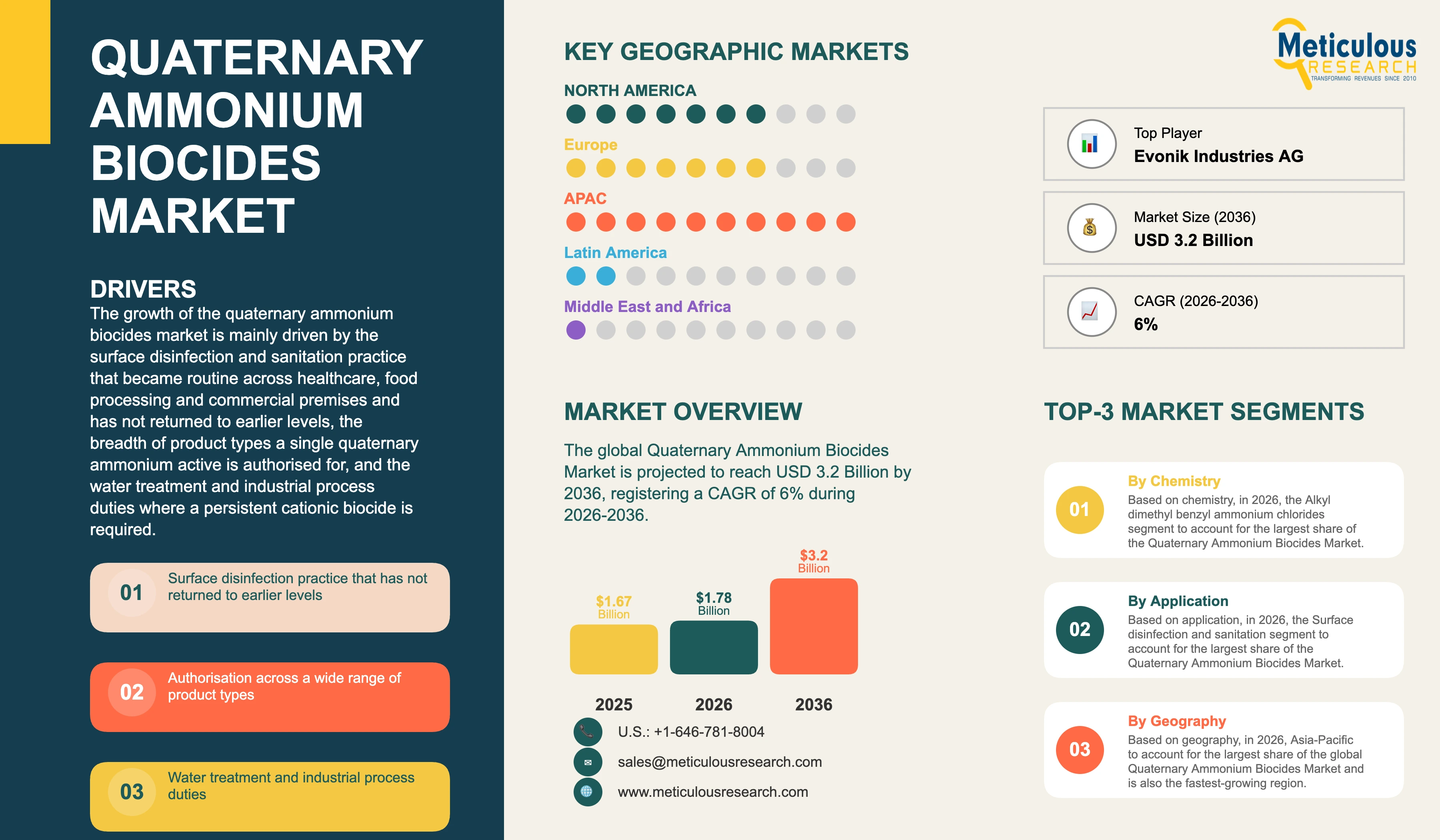
The global quaternary ammonium biocides market was valued at USD 1.67 billion in 2025. This market is expected to reach USD 3.20 billion by 2036 from an estimated USD 1.78 billion in 2026, registering a CAGR of 6.0% during the forecast period (2026-2036).
- Published
- Nov 2026
- Pages
- 252
- Format
- PDF + Excel
- Report ID
- MRCHM - 1042822
- Base year
- 2025
- 2025 · BASELINE
- $1.67B
- 2036
- $3.20B
- CAGR 2026–2036
- 6.0%
2025 baseline · 2026–2036 forecast at 6.0% CAGR · hover a bar for the value
Key highlights
The global quaternary ammonium biocides market is estimated at USD 1.78 billion in 2026 and is projected to reach USD 3.20 billion by 2036.
Market volume is estimated at 540.00 kilotons in 2026 and is projected to reach 830.03 kilotons by 2036 at a CAGR of 4.4%, measured as active substance on a 100% active basis.
Actives ship as solutions at commonly half or four fifths of their mass, so a tonnage quoted as supplied product would be substantially larger than the figures here.
The average selling price is estimated at USD 3.30 per kg in 2026 and is projected to reach USD 3.86 per kg by 2036 as polymeric and aromatic chemistries take a larger share.
Alkyl dimethyl benzyl ammonium chlorides are expected to account for the largest chemistry share in 2026, while polymeric quaternary ammonium compounds are projected to register the highest CAGR of 8.0%.
Surface disinfection and sanitation is expected to hold the largest application share in 2026, while water treatment and industrial process is projected to grow fastest at a CAGR of 7.8%.
Asia-Pacific is expected to hold the largest regional share in 2026 and is also projected to grow fastest at a CAGR of 7.4%.
Commission Implementing Decision (EU) 2024/2411 of 13 September 2024, published in the Official Journal on 16 September 2024, postponed the expiry date of the approval of didecyldimethylammonium chloride for product type 8 from 31 January 2025 to 31 July 2027.
That postponement follows a renewal application submitted on 28 July 2023 and a decision by the evaluating competent authority of Italy on 11 April 2024 that a full evaluation was necessary.
The Decision records that the approval was likely to expire before a renewal decision could be taken for reasons beyond the control of the applicant, and that the evaluation must be completed within 365 days of validation with a suspension of up to 180 days where further data is requested.
It also records that the European Chemicals Agency must submit an opinion within 270 days of receiving the recommendation of the evaluating authority.
That Decision does not renew the approval, decide the renewal outcome, state any risk or safety finding, give CAS or EC numbers, name the applicant or set out the conditions attaching to the approval.
A study published in npj Antimicrobials and Resistance on 8 January 2026 by authors at the Federal Institute for Materials Research and Testing in Berlin examined what benzalkonium chloride tolerance in Escherichia coli means for antibiotic selection.
That study found that subinhibitory ciprofloxacin selected for the tolerant strain at a minimal selective concentration of 0.0013 to 0.0022 micrograms per millilitre, about four-fold below the wildtype minimum inhibitory concentration of 0.01 micrograms per millilitre, while ampicillin, colistin and gentamicin did not consistently do so.
The same study found the tolerant strain was less likely than the wildtype to evolve resistance to ciprofloxacin and colistin, with ompF mutations found in all six wildtype populations against one of six tolerant populations at the highest exposure, an odds ratio of 15 with a confidence interval of 1.6 to 1422.7.
The authors state that tolerance can constrain evolutionary pathways toward antibiotic resistance, and that the study does not establish that tolerance generally selects for antibiotic resistance, does not test whether subinhibitory exposure to the biocide selects for antibiotic resistance, and does not address clinical, animal husbandry or wastewater relevance.
This market measures actives used for biocidal purposes and excludes the far larger tonnage of quaternary ammonium surfactants sold as fabric softeners, hair conditioners, phase transfer catalysts and asphalt emulsifiers.
Report summary
| Particulars | Details |
|---|---|
| Base Year | 2025 |
| Forecast Period | 2026-2036 |
| Market Size in 2025 | USD 1.67 billion |
| Market Size in 2026 | USD 1.78 billion |
| Market Size by 2036 | USD 3.20 billion |
| Value CAGR (2026-2036) | 6.0% |
| Format | PDF, Excel & Cloud Portal · 252 pages |
| Volume in 2026 | 540.00 kilotons |
| Volume by 2036 | 830.03 kilotons |
| Volume CAGR (2026-2036) | 4.4% |
| Volume Basis | Active substance on a 100% active basis |
| Average Selling Price in 2026 | USD 3.30 per kg |
| Average Selling Price by 2036 | USD 3.86 per kg |
| Price Direction | The average selling price rises across the forecast period as the polymeric and aromatic chemistries take a larger share of a mix dominated by the alkyl dimethyl benzyl ammonium chlorides, rather than through any change in the cost of producing an individual active |
| Volume Basis Note | Quaternary ammonium actives are supplied as aqueous or alcoholic solutions, commonly at half or four fifths of their mass and sometimes as blends of two or more chemistries, so a tonnage quoted as product as supplied would be substantially larger than the figures here without describing any more material; the 100% active basis follows the convention used for other biocidal actives and is necessary for comparison across them |
| Scope Exclusion Note | Quaternary ammonium compounds are produced in far greater tonnage for functions that are not biocidal, as fabric softeners and antistatic agents, hair conditioning ingredients, phase transfer catalysts and asphalt emulsifiers, and the dialkyl dimethyl chemistries in particular are dominated by the fabric care use; only actives supplied for biocidal purposes are counted here, and a figure capturing all quat production would be several times larger and would describe a different industry |
| Measurement Basis | Quaternary ammonium actives supplied for biocidal purposes, including alkyl dimethyl benzyl ammonium chlorides, dialkyl dimethyl ammonium chlorides, polymeric quaternary ammonium compounds and the aromatic quats, by chemistry, application, regulatory product type group and geography, measured as active substance on a 100% active basis and excluding non-biocidal quat uses and the formulated products into which the actives are supplied |
| Relationship to Adjacent Markets | This market is not additive to the markets for formulated products containing these actives; antimicrobial textile finishes and dry film preservatives are measured as formulated product on a mass basis in their own reports while the quaternary ammonium actives within them are counted here at active level, so adding the markets together would count the same chemistry twice on two different bases |
| Note on the Resistance Question | The study published in npj Antimicrobials and Resistance on 8 January 2026 found that subinhibitory ciprofloxacin selected for a benzalkonium chloride tolerant strain at a minimal selective concentration of 0.0013 to 0.0022 micrograms per millilitre against a wildtype minimum inhibitory concentration of 0.01, while ampicillin, colistin and gentamicin did not consistently do so, and also found the tolerant strain less likely than the wildtype to evolve resistance to ciprofloxacin and colistin; its authors state that it does not establish that tolerance generally selects for antibiotic resistance, does not test whether subinhibitory biocide exposure does so, and does not address clinical, animal husbandry or wastewater relevance |
| Note on Supplier Disclosure | No participant publishes revenue for quaternary ammonium biocides separately from its wider surfactant or microbial control business, and because a large part of quat production serves non-biocidal functions there is no production statistic that isolates the biocidal use, so the sizing here is built from application demand and authorisation coverage rather than from disclosed sales |
| Largest Chemistry | Alkyl dimethyl benzyl ammonium chlorides |
| Fastest-Growing Chemistry | Polymeric quaternary ammonium compounds (CAGR 8.0%) |
| Largest Application | Surface disinfection and sanitation |
| Fastest-Growing Application | Water treatment and industrial process (CAGR 7.8%) |
| Largest Region | Asia-Pacific |
| Fastest-Growing Region | Asia-Pacific (CAGR 7.4%) |
| Segments Covered | Chemistry, Application, Regulatory Product Type Group, and Geography |
| Geographies Covered | Asia-Pacific, North America, Europe, Latin America, and Middle East & Africa |
| Companies Profiled | 7 companies, including Evonik Industries AG, Arxada AG, Stepan Company, Nouryon Chemicals Holding B.V., LANXESS AG, Clariant AG, and Kao Corporation |
Report overview
Segments covered: chemistry, application, regulatory product type group.
In volume terms, this market is estimated at 540.00 kilotons in 2026 and is projected to reach 830.03 kilotons by 2036, registering a CAGR of 4.4% during the same period, measured as active substance on a 100% active basis. Quaternary ammonium actives are supplied as aqueous or alcoholic solutions, commonly at half or four fifths of their mass, so a tonnage quoted as supplied product would be substantially larger than the figures here. The average selling price is estimated at USD 3.30 per kg in 2026 and is projected to rise to USD 3.86 per kg by 2036 as polymeric and aromatic chemistries take a larger share.
The growth of this market is mainly driven by the surface disinfection and sanitation practice that became routine across healthcare, food processing and commercial premises and has not returned to earlier levels, the breadth of product types a single quaternary ammonium active is authorised for, the water treatment and industrial process duties where a persistent cationic biocide is required, and the agricultural and animal health programmes being built in the growing economies. However, factors such as the renewal burden now falling on the legacy actives, the published evidence on tolerance and its interaction with antibiotic selection, the effluent and surface water scrutiny that cationic surfactants attract, and the commodity pricing that leaves little margin for reformulation work are expected to restrain the growth of this market to some extent.
Alkyl dimethyl benzyl ammonium chlorides account for the largest chemistry share of this market, while polymeric quaternary ammonium compounds grow fastest from a smaller base. Asia-Pacific holds the largest regional share and is also the fastest-growing region.
Quaternary ammonium biocides are cationic surfactants carrying a permanently charged nitrogen centre that disrupt microbial membranes, and they are the largest class of biocidal active by volume. Market sizing in this report is on both a value basis in USD and a volume basis in kilotons measured as active substance on a 100% active basis, with average selling price derived from the two. The measurement basis covers alkyl dimethyl benzyl ammonium chlorides, dialkyl dimethyl ammonium chlorides, polymeric quaternary ammonium compounds and the aromatic quats, across disinfectant and preservative duties.
The exclusion that matters most in this title is larger than the market itself. Quaternary ammonium compounds are produced in far greater tonnage for functions that are not biocidal at all, as fabric softeners and antistatic agents, as hair conditioning ingredients, as phase transfer catalysts and as asphalt emulsifiers, and dialkyl dimethyl chemistries in particular are dominated by the fabric care use. Only actives supplied for biocidal purposes are counted here, and a figure that captured all quat production would be several times larger and would describe a different industry.
Measuring on a 100% active basis follows the convention used for other biocidal actives and is necessary for comparison. These substances are supplied as aqueous or alcoholic solutions, commonly at half or four fifths of their mass and sometimes as blends of two or more chemistries, so a tonnage quoted as product as supplied would be substantially larger than the figures in this report without describing any more material.
Commission Implementing Decision (EU) 2024/2411 of 13 September 2024, published in the Official Journal on 16 September 2024, postponed the expiry date of the approval of didecyldimethylammonium chloride for product type 8 from 31 January 2025 to 31 July 2027. The Decision records a renewal application submitted on 28 July 2023 and a decision by the evaluating competent authority of Italy on 11 April 2024 that a full evaluation was necessary, with that evaluation to be completed within 365 days of validation and a suspension of up to 180 days available where further data is requested.
The reason given for the postponement is the most informative part of it. The approval was likely to expire before a renewal decision could be taken for reasons beyond the control of the applicant, with the extension covering the evaluation, the opinion of the European Chemicals Agency, which must follow within 270 days of the recommendation of the evaluating authority, and the decision of the Commission. That is a procedural timetable, not a safety question, and the Decision states no risk or safety finding of any kind.
What that document describes is the renewal burden now falling on actives that were first listed under the earlier Directive and are treated as approved under the transitional provisions. A full evaluation with a data package, an agency opinion and a Commission decision is a multi-year undertaking for a substance sold at commodity prices, and the Decision records that the timetable alone was enough to outrun the approval it was meant to renew.
A study published in npj Antimicrobials and Resistance on 8 January 2026 by authors at the Federal Institute for Materials Research and Testing in Berlin addressed the question that hangs over this class, which is whether use of these biocides contributes to antibiotic resistance. Its findings are more equivocal than the usual framing and they deserve reporting as the authors state them rather than as the summary a reader might expect.
The study found that subinhibitory ciprofloxacin selected for a benzalkonium chloride tolerant strain of Escherichia coli over the wildtype, at a minimal selective concentration of 0.0013 to 0.0022 micrograms per millilitre, about four-fold below the wildtype minimum inhibitory concentration of 0.01 micrograms per millilitre. Ampicillin, colistin and gentamicin did not consistently select for the tolerant strain, and the tolerant strain showed only a modest increase in minimum inhibitory concentration to ciprofloxacin rather than resistance.
The finding that runs against expectation is the second one. The tolerant strain was less likely than the wildtype to evolve resistance to ciprofloxacin and colistin, with mutations in the outer membrane porin gene ompF found in all six wildtype populations against one of six tolerant populations at the highest exposure, an odds ratio of 15 with a confidence interval of 1.6 to 1422.7, and no significant difference in mutation rate between the strains. The authors conclude that tolerance can constrain evolutionary pathways toward antibiotic resistance.
The limits the authors place on that work are as important as the findings. The study does not establish that tolerance generally selects for antibiotic resistance, since only one of four antibiotics showed selection; it does not test whether subinhibitory exposure to the biocide itself selects for antibiotic resistance; it does not resolve the mechanism behind the epistasis it reports; and it does not address clinical, animal husbandry or wastewater relevance. Sample sizes were six populations per group under laboratory conditions with one principal tolerant strain.
The commercial reading of that is narrower than either side of the debate would prefer. The science does not supply a basis for restricting this class on resistance grounds, and it equally does not clear it, since the question the industry would most want answered, whether using these biocides selects for antibiotic resistance, was not what was tested. A supplier or a regulator citing this work in either direction would be going beyond what it says.
Surface disinfection and sanitation is the largest application and the reason is a change in practice rather than in chemistry. Cleaning and disinfection regimes across healthcare, food processing, transport and commercial premises were raised during the pandemic years and have not returned to earlier levels, and quaternary ammonium actives hold that duty because they are effective at low concentration, stable in formulation, compatible with surfaces and inexpensive.
The breadth of authorisation across product types is the structural advantage of this class and it explains the regulatory group segmentation used here. A single quaternary ammonium active may be approved across disinfectant and preservative product types covering human and veterinary hygiene, surfaces, food areas, drinking water, wood, slimicides and process waters, which gives a producer scale across uses that a narrower chemistry cannot reach.
That breadth is also what makes the renewal burden consequential. An active approved across many product types must be renewed for each of them, and the postponement recorded in 2024/2411 covers only product type 8, so the same substance faces the same exercise repeatedly on separate timetables, each requiring data and each capable of outrunning its own deadline.
Water treatment and industrial process duties are the fastest-growing application and are where the polymeric chemistries are concentrated. A polymeric quat carries multiple charged centres on a chain, which raises substantivity to surfaces and reduces foaming and the tendency to be deactivated by anionic materials, and those properties suit cooling circuits, process waters and oilfield systems where persistence is the requirement rather than a disadvantage.
This market is not additive to the markets for formulated products containing these actives. Antimicrobial textile finishes and dry film preservatives are measured as formulated product on a mass basis in their own reports, while the quaternary ammonium actives within them are counted here at active level, so adding the markets together would count the same chemistry twice on two different bases.
Where a narrower biocidal chemistry loses an authorisation or is withdrawn for lack of applicant support, the duty does not disappear, and a quaternary ammonium active already approved for that product type can take the work without a new approval being needed.
The breadth of authorisation across product types that makes the renewal burden heavy is the same property that makes this class the default replacement when a competing active leaves a use.
Quaternary ammonium actives are weaker against non-enveloped viruses and some spore formers, and their performance falls in hard water and in the presence of anionic surfactants, which formulated blends with a second active or a chelant are designed to address.
That moves part of the value from the active to the formulation and is where producers can hold a position in a market that otherwise prices on tonnage.
These four opportunities divide between taking new duties and defending old ones, and the second is the larger of the two in this market. Substitution into uses vacated by narrower chemistries requires no new approval, no new plant and no formulation development, because the quat is already authorised for the product type the departing active is leaving.
That is an unusual position for a commodity. The breadth of authorisation that makes the compliance burden heavy is the same property that makes this class the default replacement whenever a competing active is withdrawn for lack of applicant support, so the process that narrows the scope of the class in one place widens its volume in another.
The polymeric opportunity is where the chemistry genuinely advances rather than substitutes. Multiple charged centres on a chain hold the active on a surface against flow and against dilution, which is what a cooling circuit or an injection system needs and what a monomeric active cannot deliver without continuous feeding.
Blends address the two acknowledged weaknesses of the class, which are performance against non-enveloped viruses and some spore formers, and loss of activity in hard water and in the presence of anionic surfactants. Both are met by formulation rather than by a different quat, which moves value toward the producer able to supply a validated blend rather than a tonnage.
A fifth route sits alongside them and is the quietest of the five. Treated articles incorporating a quaternary ammonium active for material protection carry their own labelling and authorisation obligations, and the volume involved is small against the disinfectant uses but attaches to products with much longer development cycles and correspondingly more durable positions once specified.
The Asia-Pacific opportunity is also the one with the fewest obstacles in front of it, since the uses there are being written rather than defended and no renewal timetable stands between a supplier and the specification.
Asia-Pacific is expected to account for the largest share in 2026, on the scale of its chemical production, the institutional cleaning and food processing capacity being added, and the intensification of livestock production. India is projected to grow at 8.6%, China at 7.6% and Japan at 3.6%.
Asia-Pacific is also projected to register the highest CAGR of 7.4% during the forecast period, holding both the largest share and the fastest growth.
Europe is projected to grow at a CAGR of 4.6%, with the United Kingdom at 4.6%, France at 4.4% and Germany at 4.2%. It is the region where the renewal obligations falling on the legacy actives are most consequential and where the authorised scope of the class is contracting through withdrawal from the narrower product types rather than through restriction.
The Middle East & Africa is projected to grow at a CAGR of 7.0%, where oilfield process water and institutional hygiene are the operative requirements and warm conditions raise the microbial load. Latin America is projected to grow at a CAGR of 6.4%, with Brazil at 6.4%, on food processing and animal production.
Evonik Industries AG, Arxada AG, Stepan Company, Nouryon Chemicals Holding B.V. and LANXESS AG together accounted for an estimated 42.6% of this market in 2026. The 7 companies profiled in this report together accounted for an estimated 48.8%, a low figure reflecting how fragmented this market is.
Report infographic
Market dynamics
12 factors across 5 forcesSurface Disinfection Practice That Has Not Returned to Earlier Levels
Cleaning and disinfection regimes across healthcare, food processing, transport and commercial premises were raised during the pandemic years and have settled above where they began, which has made a step change in baseline demand rather than a temporary peak.
Quaternary ammonium actives hold that duty because they are effective at low concentration, stable in formulation, compatible with most surfaces and inexpensive, and surface disinfection and sanitation accounts for the largest application share throughout the period.
Authorisation Across a Wide Range of Product Types
A single quaternary ammonium active may be approved across disinfectant and preservative product types covering human and veterinary hygiene, surfaces, food areas, wood, slimicides and process waters, which gives a producer scale across uses that a narrower chemistry cannot reach.
Commission Implementing Decision (EU) 2024/2411 addresses didecyldimethylammonium chloride in product type 8 alone, which indicates how many separate authorisations a single substance in this class carries.
Water Treatment and Industrial Process Duties
Cooling circuits, process waters and oilfield systems require a biocide that persists on surfaces rather than one that degrades quickly, and a cationic active adsorbs to those surfaces and holds a residual effect between dosing.
Polymeric chemistries carrying multiple charged centres raise that substantivity further while reducing foaming and deactivation by anionic materials, and water treatment and industrial process is projected to register the highest application CAGR of 7.8%.
Agricultural and Animal Health Programmes in the Growing Economies
Livestock housing disinfection, hatchery hygiene, teat dips and footbaths are being formalised as production intensifies, and these are duties where a quaternary ammonium active is the established choice on cost and handling grounds.
Asia-Pacific holds the largest regional share and is also projected to register the highest CAGR at 7.4%, with India at 8.6% and China at 7.6%.
These four drivers sit on top of a volume base that is already the largest of any biocidal class, which changes how they should be read. A growth rate of a few per cent on this tonnage adds more material each year than the whole of several of the specialty biocide markets, so the drivers here are about the rate at which an established position expands rather than about whether a chemistry will be adopted.
The surface disinfection driver is the one that changed level rather than direction. Cleaning regimes across healthcare, food processing, transport and commercial premises were raised during the pandemic years and settled above where they began, so the demand that followed is a new baseline rather than a peak working its way out of the figures.
Breadth of authorisation is the driver that distinguishes this class from every alternative to it. A single active approved across human and veterinary hygiene, surfaces, food areas, wood, slimicides and process waters gives a producer volume across uses that a narrower chemistry cannot reach, and gives a formulator one supply chain for products that would otherwise need several.
The water treatment and agricultural drivers both rest on properties that have no substitute rather than on cost. A cationic active adsorbs to surfaces and holds a residual between dosing, which is what a cooling circuit requires and what a rapidly degrading oxidant cannot provide, and the handling and cost profile is what makes a footbath or a housing disinfection programme affordable at the scale livestock production needs.
What none of the four rests on is a performance claim against an alternative chemistry, and that is worth noting in a market this size. These actives are specified because they are adequate, authorised and cheap across a very wide range of duties, not because they outperform the oxidants, phenolics or aldehydes they sit alongside.
Table of contents
11 chapters · 138 sections · 252 pages · click to expandSegmental analysis
| Segment | Largest share (2026) | Fastest growth (2026–2036) |
|---|---|---|
| By Chemistry | Alkyl dimethyl benzyl ammonium chlorides | — |
| Other segments | — | Polymeric quaternary ammonium compounds |
By Chemistry
- Alkyl dimethyl benzyl ammonium chlorides are expected to account for the largest share in 2026, on their position in surface disinfection, the breadth of product types they are authorised for, their effectiveness at low concentration and the cost at which they are produced.
- Surface disinfection and sanitation is expected to hold the largest share in 2026, on cleaning regimes across healthcare, food processing, transport and commercial premises having settled above their earlier levels.
Other segments
- Polymeric quaternary ammonium compounds are projected to register the highest CAGR of 8.0% during the forecast period, on multiple charged centres raising substantivity while reducing foaming and deactivation by anionic materials.
- Water treatment and industrial process is projected to register the highest CAGR of 7.8% during the forecast period, on cooling circuits and process waters requiring a biocide that holds a residual between dosing.
Geographic analysis
Asia-Pacific
Largest shareInstitutional cleaning contracts, food processing capacity and livestock production are all expanding faster in Asia-Pacific than in the mature regions, and the specifications are being written for the first time rather than revised. Asia-Pacific is projected to register the highest regional CAGR at 7.4%, with India at 8.6%, China at 7.6% and Japan at 3.6%, and it also holds the largest regional share. In 2026, Asia-Pacific is expected to account for the largest share of the global quaternary ammonium biocides market and is also projected to register the highest CAGR of 7.4% during the forecast period. The large share and rapid growth of this region are attributed to the scale of its chemical production, the institutional cleaning contracts and food processing capacity being added, the intensification of livestock production and the hygiene programmes that accompany it, and specifications being written for the first time rather than revised. India is projected to register a CAGR of 8.6%, China a CAGR of 7.6% and Japan a CAGR of 3.6%. The divergence between Asia-Pacific and Europe is therefore not a demand story but a scope story: the same breadth of applicability that is being pared back by renewal economics in one region is still being established in the other. Asia-Pacific Industrial and Institutional Hygiene Geographic Analysis
North America
North America holds the second largest share and is projected to grow at 5.0%, with the United States at 5.0%, on institutional and healthcare disinfection volumes and on oilfield and process water demand.
Europe
Europe is projected to grow at 4.6%, where the renewal obligations falling on the legacy actives are most consequential and where the authorised scope of the class is contracting through withdrawal from narrower product types. Germany is projected to grow at 4.2%, France at 4.4% and the United Kingdom at 4.6%. In Europe the renewal obligation attaches to each product type and the economics favour defending the large uses only, so the scope contracts; in Asia-Pacific and the Middle East the uses are being established rather than defended, and the same breadth of applicability that creates the compliance burden in one region is a commercial advantage in the other. Country rates within each region spread more widely than the regional figures suggest, and they follow industrial and agricultural build-out rather than regulation: India at 8.6% and China at 7.6% against Japan at 3.6% within Asia-Pacific, and the United Kingdom at 4.6% against Germany at 4.2% within Europe.
Latin America
Latin America is projected to grow at 6.4%, with Brazil at 6.4%, on food processing and animal production.
Middle East & Africa
The Middle East & Africa is projected to grow at 7.0%, where oilfield process water and institutional hygiene are the operative requirements and where warm conditions raise the microbial load to be controlled. What differs between regions is whether the authorised scope of this class is widening or narrowing.
Competitive landscape
The global quaternary ammonium biocides market is fragmented, which is characteristic of a commodity-priced active produced at scale by surfactant and specialty chemical groups and sold both to formulators and to end users. Competition is contested on cost of production, on the breadth of product type authorisations held, on regional registration coverage and on formulation support, rather than on the chemistry itself, which is not differentiated. Evonik Industries AG, Arxada AG, Stepan Company, Nouryon Chemicals Holding B.V. and LANXESS AG together accounted for an estimated 42.6% of this market in 2026, while the companies profiled in this report together accounted for an estimated 48.8%.
The compliance position rather than the production position is what separates participants over the forecast period. Commission Implementing Decision (EU) 2024/2411 of 13 September 2024 postponed the expiry of the approval of didecyldimethylammonium chloride for product type 8 from 31 January 2025 to 31 July 2027, after a renewal application submitted on 28 July 2023 and a decision by the Italian evaluating authority on 11 April 2024 that a full evaluation was necessary. A producer able to carry that exercise across many product types retains uses that others will let lapse.
No participant publishes revenue for quaternary ammonium biocides separately from its wider surfactant or microbial control business, and because a large part of quat production serves non-biocidal functions there is no production statistic that isolates the biocidal use either. Shares here are built from application demand and authorisation coverage rather than from disclosed sales. Some of the key players operating in the quaternary ammonium biocides market are Evonik Industries AG (Germany), Arxada AG (Switzerland), Stepan Company (U.S.), Nouryon Chemicals Holding B.V. (Netherlands), LANXESS AG (Germany), Clariant AG (Switzerland), and Kao Corporation (Japan), among others.
Competition is therefore decided by what a participant can afford to keep approved rather than by what it can make. Production of these actives is well understood and widely held, so the asset that separates participants is a portfolio of live authorisations across product types and regions, and that asset is maintained by continuing expenditure rather than owned outright.
That favours scale in an unusual way. A producer with volume across many uses can spread a renewal dossier across all of them, while a producer holding one or two uses cannot, so each renewal round tends to consolidate the authorised positions even where no participant gains production share.
- —
Commission Implementing Decision (EU) 2024/2411 of 13 September 2024, published in the Official Journal on 16 September 2024, postponed the expiry date of the approval of didecyldimethylammonium chloride for product type 8 from 31 January 2025 to 31 July 2027. That followed a renewal application submitted on 28 July 2023 and a decision by the evaluating competent authority of Italy on 11 April 2024 that a full evaluation was necessary, with the evaluation to be completed within 365 days of validation, a suspension of up to 180 days available where further data is requested, and an opinion of the European Chemicals Agency to follow within 270 days of the recommendation. The Decision records that the approval was likely to expire before a renewal decision could be taken for reasons beyond the control of the applicant, and it states no risk or safety finding, gives no CAS or EC numbers and does not name the applicant. Separately, a study published in npj Antimicrobials and Resistance on 8 January 2026 by authors at the Federal Institute for Materials Research and Testing in Berlin found that subinhibitory ciprofloxacin selected for a benzalkonium chloride tolerant strain of Escherichia coli at a minimal selective concentration of 0.0013 to 0.0022 micrograms per millilitre against a wildtype minimum inhibitory concentration of 0.01, while ampicillin, colistin and gentamicin did not consistently do so, and that the tolerant strain was less likely than the wildtype to evolve resistance to ciprofloxacin and colistin, with ompF mutations in all six wildtype populations against one of six tolerant populations at the highest exposure. The authors state that the study does not establish that tolerance generally selects for antibiotic resistance, does not test whether subinhibitory biocide exposure does so, and does not address clinical, animal husbandry or wastewater relevance.
- Evonik Industries AG
- Arxada AG
- Stepan Company
- Nouryon Chemicals Holding B.V.
- LANXESS AG
- Clariant AG
- Kao Corporation
Expert perspectives
Value grows at 6.0% against 4.4% in volume over the forecast period, and the average selling price rises from USD 3.30 per kg in 2026 to USD 3.86 per kg by 2036. The gap is the polymeric and aromatic chemistries taking a larger share of a mix dominated by the benzyl chlorides, not a change in the cost of producing any one of them.
The scope boundary should be read before any figure here, because the excluded tonnage is larger than the market. Quaternary ammonium compounds are produced in far greater quantity as fabric softeners, hair conditioning ingredients, phase transfer catalysts and asphalt emulsifiers, and the dialkyl chemistries in particular are dominated by fabric care. Only actives supplied for biocidal purposes are counted, and on a 100% active basis rather than as the solutions in which they ship.
The structural issue in this market is a compliance timetable rather than a technical or commercial one. Commission Implementing Decision (EU) 2024/2411 of 13 September 2024 postponed the approval of didecyldimethylammonium chloride for product type 8 from 31 January 2025 to 31 July 2027 because the renewal could not be decided in time for reasons beyond the control of the applicant, and it states no safety finding at all.
The consequence is that the authorised scope of this class contracts through withdrawal rather than through restriction. Renewal attaches to each product type separately, and at a few dollars a kilogram a dossier cannot be justified for a narrow use, so producers defend the large uses and let the small ones lapse. The breadth of authorisation that is the commercial advantage of this class is also what makes its compliance cost repeat.
On the resistance question the published position is genuinely unsettled and should not be reported as though it were not. The study in npj Antimicrobials and Resistance of 8 January 2026 found subinhibitory ciprofloxacin selecting for a benzalkonium chloride tolerant strain at about four-fold below the wildtype minimum inhibitory concentration, and also found that strain less able than the wildtype to evolve resistance to ciprofloxacin and colistin.
Its authors state that it does not establish that tolerance generally selects for antibiotic resistance, does not test whether subinhibitory biocide exposure does so, and does not address clinical, animal husbandry or wastewater relevance, with six populations per group under laboratory conditions. Anyone citing it in either direction is going beyond it. This market is not additive to the formulated product markets that contain these actives, which are measured as product mass in their own reports.
Customer perspectives
These actives sell at a few dollars a kilogram on a 100% active basis while renewal attaches to each product type separately with a data package behind it, so the compliance position of a supplier rather than the chemistry is what the formulator is selecting.
That is why the authorised scope of this class contracts through withdrawal from narrow uses rather than through any restriction being imposed.
Cooling circuits and process waters require a biocide that adsorbs to surfaces and holds a residual between dosing rather than one that degrades quickly, which is where the polymeric chemistries carrying multiple charged centres are concentrated.
Commission Implementing Decision (EU) 2024/2411 records a renewal application submitted on 28 July 2023, a decision in April 2024 that a full evaluation was necessary, and an approval postponed from 31 January 2025 to 31 July 2027 for reasons beyond the control of the applicant.
What these three accounts share is that none of them is about the chemistry. The formulator is buying a compliance position, the water treatment manager is buying persistence on a surface, and the regulatory manager is describing a timetable, and the molecule itself is taken for granted by all three.
That is also why this market is more stable than its regulatory exposure suggests. The duties being performed do not go away when an authorisation lapses; they move to whichever approved active remains, and in most of these product types that is another quaternary ammonium compound.
“The actives cost very little and the registrations cost a great deal. We choose a supplier for the product types it can keep approved, not for the molecule.”
“We want something that stays on the surface between doses. Everything that degrades quickly has to be fed continuously, and that is a different cost structure.”
“The renewal was filed well before the deadline and the approval still had to be extended. That tells you what the timetable is really like.”
Frequently asked questions
This market was valued at USD 1.59 billion in 2024 and USD 1.67 billion in 2025, and is estimated at USD 1.78 billion in 2026. In volume terms it is estimated at 540.00 kilotons in 2026, measured as active substance on a 100% active basis.
This market is projected to reach USD 3.20 billion by 2036 in value and 830.03 kilotons in volume.
This market is projected to register a value CAGR of 6.0% and a volume CAGR of 4.4% during the forecast period 2026-2036. The average selling price is projected to move from USD 3.30 per kg in 2026 to USD 3.86 per kg by 2036 as the chemistry mix shifts.
Growth is driven by surface disinfection practice that has not returned to earlier levels, authorisation across a wide range of product types, water treatment and industrial process duties requiring a persistent cationic biocide, and agricultural and animal health programmes in the growing economies.
The renewal burden now falls on the legacy actives, with renewal attaching to each product type separately, and commodity pricing leaves little margin for compliance work. The published position on tolerance and antibiotic selection is unresolved, and cationic surfactants adsorb to solids and sludge, which attracts effluent and surface water scrutiny.
Opportunities include polymeric quats in process water and oilfield systems, Asia-Pacific industrial and institutional hygiene, substitution into uses vacated by narrower chemistries, and blends addressing the spectrum and deactivation limits.
Alkyl dimethyl benzyl ammonium chlorides are expected to account for the largest share in 2026, on their position in surface disinfection, the breadth of product types they are authorised for, their effectiveness at low concentration and the cost at which they are produced.
Polymeric quaternary ammonium compounds are projected to register the highest CAGR of 8.0% during the forecast period, on multiple charged centres raising substantivity while reducing foaming and deactivation by anionic materials.
Surface disinfection and sanitation is expected to hold the largest share in 2026, on cleaning regimes across healthcare, food processing, transport and commercial premises having settled above their earlier levels.
Water treatment and industrial process is projected to register the highest CAGR of 7.8% during the forecast period, on cooling circuits and process waters requiring a biocide that holds a residual between dosing.
Asia-Pacific is expected to account for the largest share in 2026, on the scale of its chemical production, the institutional cleaning and food processing capacity being added, and the intensification of livestock production. India is projected to grow at 8.6%, China at 7.6% and Japan at 3.6%.
Asia-Pacific is also projected to register the highest CAGR of 7.4% during the forecast period, holding both the largest share and the fastest growth.
Europe is projected to grow at a CAGR of 4.6%, with the United Kingdom at 4.6%, France at 4.4% and Germany at 4.2%. It is the region where the renewal obligations falling on the legacy actives are most consequential and where the authorised scope of the class is contracting through withdrawal from narrower product types.
The Middle East & Africa is projected to grow at a CAGR of 7.0%, where oilfield process water and institutional hygiene are the operative requirements. Latin America is projected to grow at a CAGR of 6.4%, with Brazil at 6.4%, on food processing and animal production.
Evonik Industries AG, Arxada AG, Stepan Company, Nouryon Chemicals Holding B.V. and LANXESS AG together accounted for an estimated 42.6% of this market in 2026. The 7 companies profiled in this report together accounted for an estimated 48.8%, reflecting how fragmented this market is.
Commission Implementing Decision (EU) 2024/2411 of 13 September 2024 postponed the expiry of the approval of didecyldimethylammonium chloride for product type 8 from 31 January 2025 to 31 July 2027, and states no risk or safety finding. Separately, a study published in npj Antimicrobials and Resistance on 8 January 2026 found that subinhibitory ciprofloxacin selected for a benzalkonium chloride tolerant E. coli strain, which was also less likely than the wildtype to evolve resistance to ciprofloxacin and colistin.
Cite this report
Meticulous Research. (2026). Quaternary Ammonium Biocides Market - Global Opportunity Analysis and Industry Forecast (2026-2036) (Report No. MRCHM - 1042822). Meticulous Market Research Pvt. Ltd. https://www.meticulousresearch.com/product/quaternary-ammonium-biocides-market-7505