Data Center Cooling Technologies Compared: Liquid, Immersion, Waterless and Heat Reuse
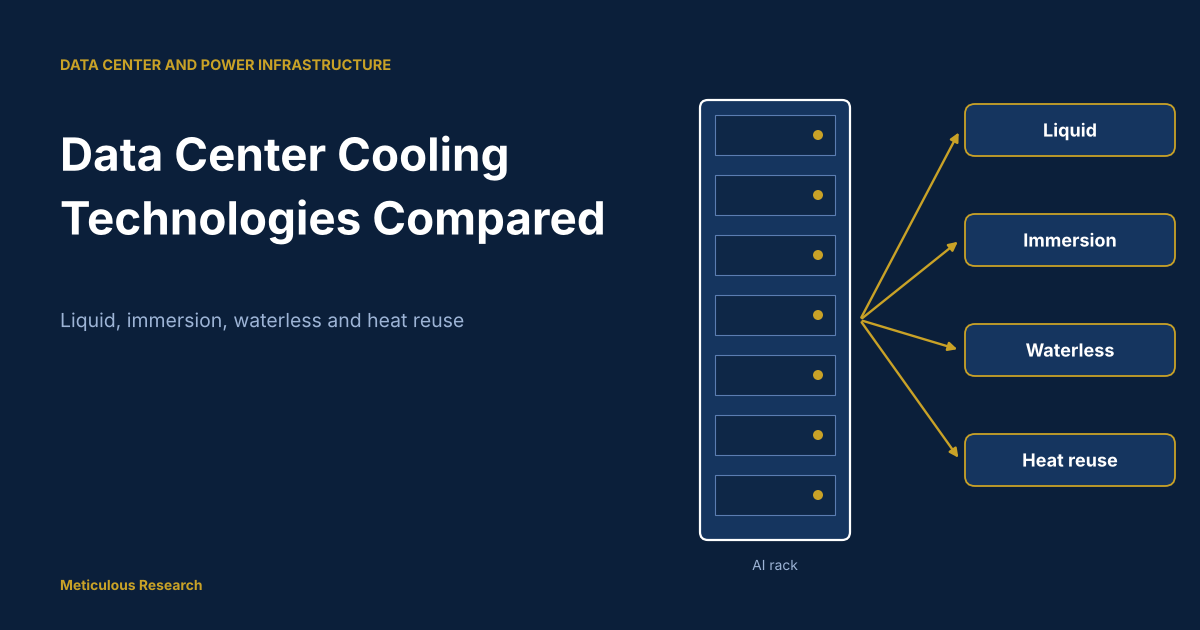
Air is still the largest way to cool a data center, but every faster growing segment in our research points to liquid. Liquid, immersion, waterless and heat reuse systems are not rivals. They are four answers to the same problem: AI racks now draw far more power than air can remove.
The Data Center Cooling Market is valued at USD 21.48 billion in 2026 and is projected to reach USD 79.64 billion by 2036, at a CAGR of 14.0%. Air based cooling is the largest technique, while liquid based cooling grows fastest.
This blog compares the four routes: what each does, where it fits, what it costs in water and fluids, and what the research says about how fast each is growing. It is the hub for our data center cooling coverage, and later spotlights link back here.
How Big Is Each Cooling Market?
The cooling stack is a set of linked markets. The largest is the overall cooling market, and the fastest growing sit underneath it:
- Data center cooling: USD 21.48 billion in 2026 to USD 79.64 billion by 2036, CAGR 14.0%.
- Waterless cooling systems: USD 5.3 billion in 2026 to USD 13.9 billion by 2036, CAGR 10.1%.
- Data center water and wastewater treatment equipment: USD 3.20 billion in 2026 to USD 10.1 billion by 2036, CAGR 12.1%.
- Data center heat reuse: USD 1.9 billion in 2026 to USD 8.4 billion by 2036, CAGR 16.0%.
- Immersion cooling fluids: USD 505.1 million in 2026 to USD 3.47 billion by 2036, CAGR 21.3%
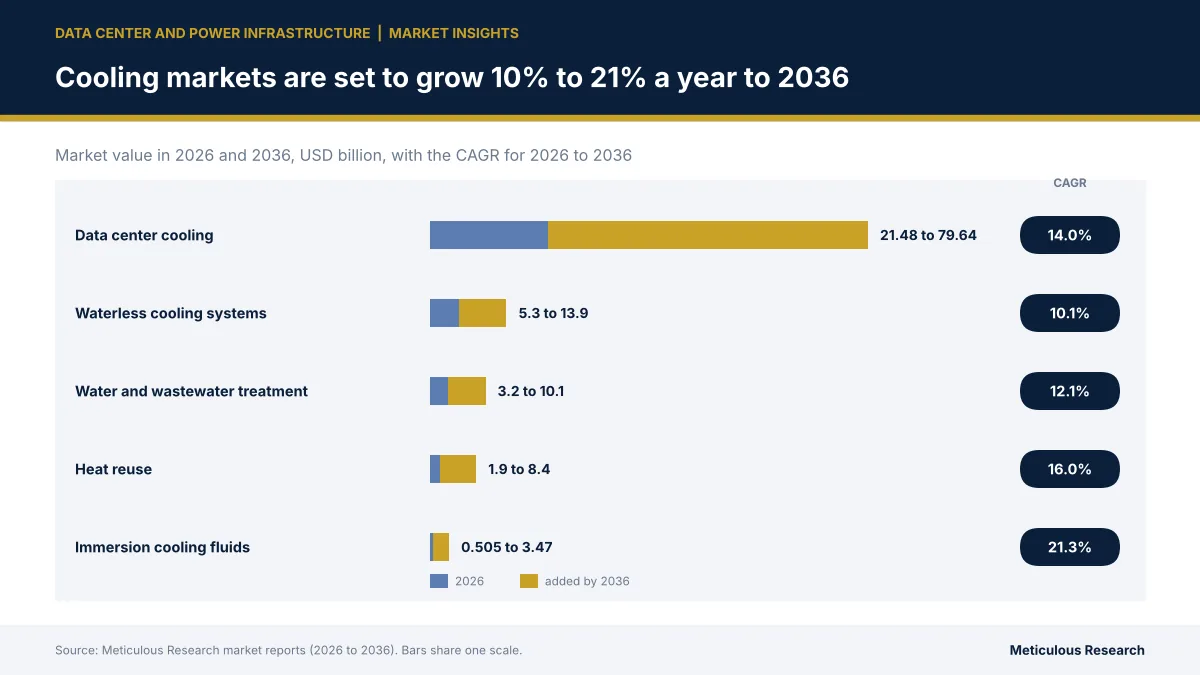
The pattern is that the smaller the base, the faster the growth. Fluids and heat reuse grow fastest, and both depend on liquid cooling spreading first.
The Liquid Cooling Data Center Market report is an earlier edition with a 2025 to 2032 horizon. It projects USD 15.9 billion by 2032, at a CAGR of 23.6%, with immersion the leading cooling method. Read it for the technology split, and use the newer reports for 2026 to 2036 sizing.
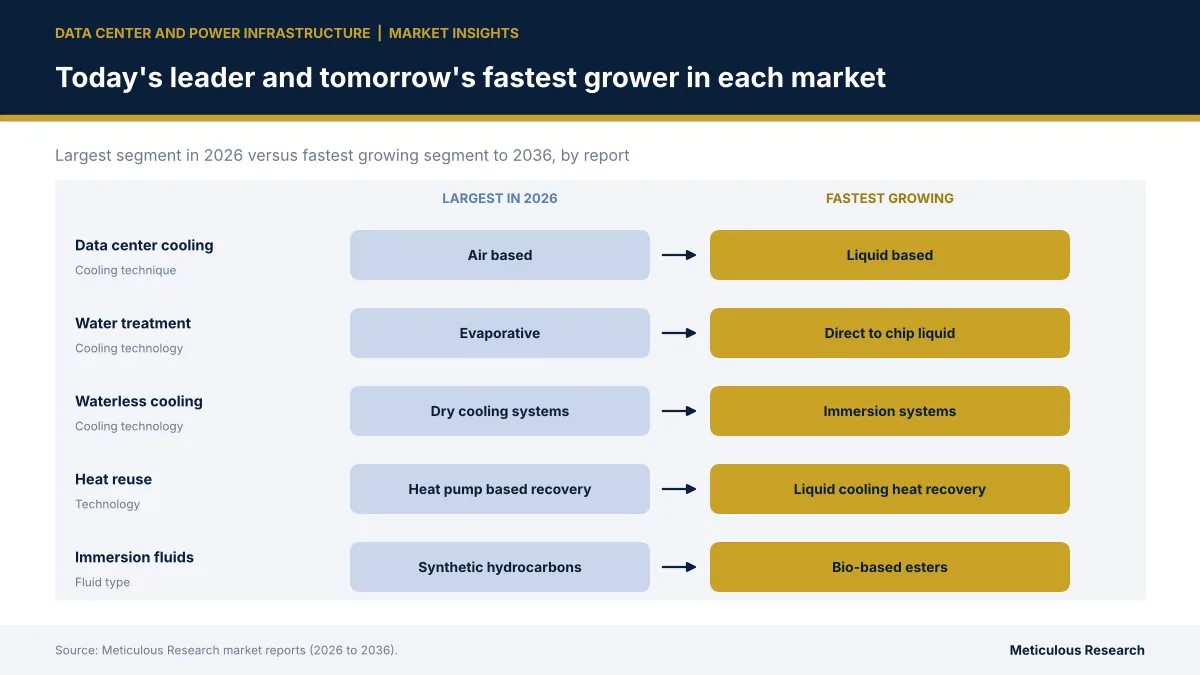
The segment leaders agree across the reports. Air based, evaporative and dry cooling lead today, while direct to chip liquid, immersion and liquid cooling heat recovery grow fastest. North America holds the largest share in the cooling, waterless, water treatment and fluids markets, while Asia-Pacific grows fastest in each. Heat reuse is the exception, where Europe leads on district heating networks and efficiency rules.
Liquid Cooling: The New Default for AI Racks
Liquid cooling carries heat away with a fluid loop instead of moving air. In direct to chip designs, cold plates sit on the processors and a coolant distribution unit moves the heat out of the rack. Rear door heat exchangers do the same job at the rack edge.
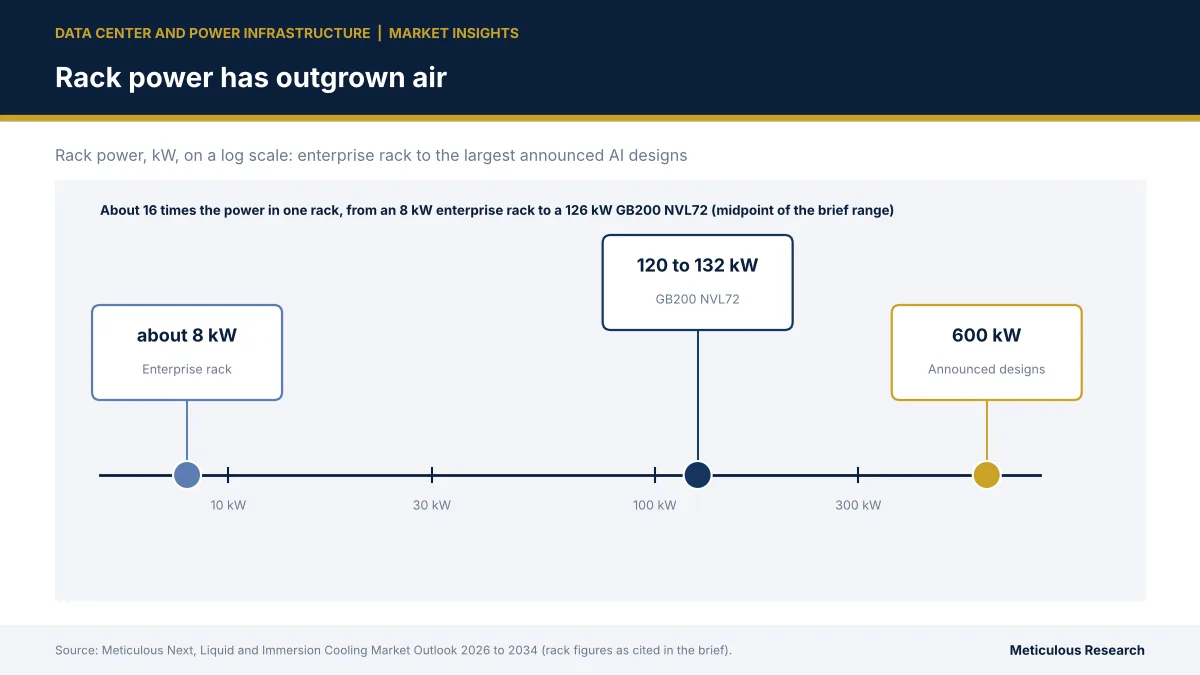
The case for it is density. An ASHRAE technical committee white paper says liquid cooling is becoming a requirement in some cases and recommends that any future data center be able to add it. NVIDIA describes its GB200 NVL72 as a rack scale, liquid cooled design. The Meticulous Next brief on liquid and immersion cooling puts a GB200 NVL72 rack at 120 to 132 kW, against about 8 kW for an enterprise rack.
The next generation raises the bar. At CES in January 2026, NVIDIA chief executive Jensen Huang said that at 45 degrees Celsius the data center does not need a chiller. That is a vendor statement, but it shows the direction: warm water loops and less mechanical cooling.
The supply side is already moving. Equinix has rolled out support for direct to chip liquid cooling at more than 100 sites. In our water treatment report, direct to chip liquid cooling is the fastest growing cooling technology, because every liquid loop needs treated water with controlled chemistry.
The conclusion is simple. Liquid is not replacing air everywhere, but for new AI halls it is the design that works, and the rest of the cooling stack is being rebuilt around it.
Immersion Cooling: Fluids Decide the Economics
Immersion cooling submerges servers in a dielectric fluid. In single phase systems the fluid stays liquid and is pumped through a heat exchanger. In two phase systems it boils at the chip and condenses again.
The Immersion Cooling Fluids Market is valued at USD 505.1 million in 2026 and is projected to reach USD 3.47 billion by 2036, at a CAGR of 21.3%. Single phase immersion and synthetic hydrocarbons are the largest segments in 2026, while two phase immersion and bio-based esters grow fastest. Data centers are the largest application, and electric vehicle batteries are the fastest growing.
The main risk is regulation of fluorinated fluids. 3M announced that it would exit all PFAS manufacturing by the end of 2025. In Europe, the universal PFAS restriction is still a proposal. An ECHA update from June 2026 says its scientific committee expects to give its final opinion by the end of 2026.
This is why PFAS free fluids matter. Fluorinated fluids have been widely used in two phase systems, so buyers who want two phase immersion need a clear view of which fluid they are choosing and how long it will be allowed. Single phase hydrocarbons and esters carry less of that risk.
Immersion also has a cost barrier. Our fluids report lists the high upfront capital cost of moving from air, fluid compatibility with hardware and warranty, and the complexity of fluid handling as the main restraints.
Waterless Cooling and the Water Question
Cooling is where data centers use most of their water, so water is now a design choice, not an afterthought. Evaporative cooling is the largest cooling technology in our Data Center Water and Wastewater Treatment Equipment Market report, which is valued at USD 3.20 billion in 2026 and projected to reach USD 10.1 billion by 2036, at a CAGR of 12.1%. Membrane treatment equipment is the largest equipment type, and water recycling and reuse grows fastest.
Waterless cooling removes the evaporation. The Waterless Cooling Systems Market is valued at USD 5.3 billion in 2026 and is projected to reach USD 13.9 billion by 2036, at a CAGR of 10.1%. Dry cooling systems are the largest technology and heat exchangers the largest component, while immersion cooling systems grow fastest.
Operators are already changing designs. Microsoft says its newer designs consume zero water for cooling by using a closed loop filled once at construction, and reports that its fleet average water usage effectiveness fell from 2.3 to 0.27 litres per kWh in 2025. Google takes a site by site view and says that where water risk is high it chooses air cooling or recycled water. All of these are company statements.
The trade off is energy. Microsoft notes that its zero water design raises energy use only nominally, and dry systems can need more electricity in hot climates. The right choice depends on local water cost, climate and grid carbon.
Water treatment does not disappear with waterless cooling. Closed liquid loops still need conditioned water, and sites that keep evaporative systems need recycling to cut withdrawals.
Heat Reuse: Turning a Cost Into a Revenue Line
Every kilowatt a data center uses ends up as heat. Heat reuse sends it to district heating, buildings or industry. The Data Center Heat Reuse Market is valued at USD 1.9 billion in 2026 and is projected to reach USD 8.4 billion by 2036, at a CAGR of 16.0%. Heat pump based heat recovery and heat pumps are the largest technology and component, Europe is the largest region, and liquid cooling heat recovery systems grow fastest.
Liquid cooling helps here. Liquid loops return heat at higher temperatures than air, which makes it easier to feed a heat network. That is why the fastest growing technology in the heat reuse report is tied to liquid cooling.
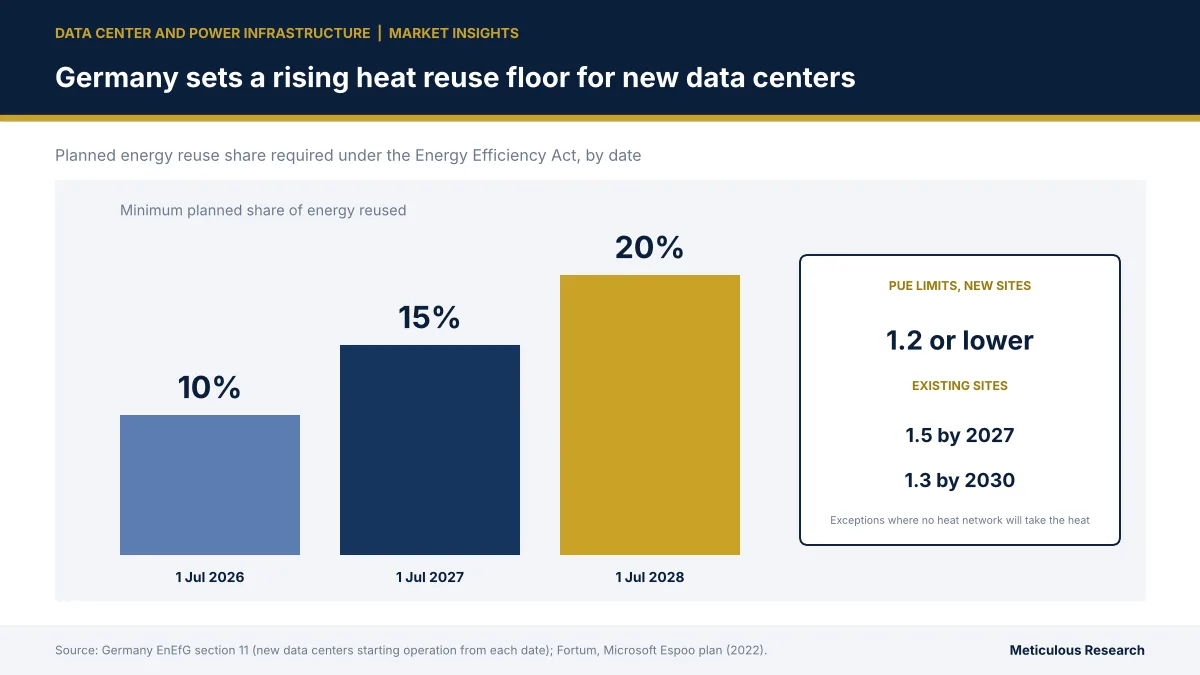
Regulation is pulling this forward in Europe. Germany requires new data centers starting operation from 1 July 2026 to reach a PUE of 1.2 or better, and to reuse a planned share of energy that begins at 10% and rises to 20% from 2028, with exceptions where no heat network will take the heat.
The working examples are in the Nordics. Microsoft and Fortum announced a plan in 2022 under which waste heat would cover about 60% of district heating in the Espoo area once the data center region is running. Meta has described a project in Odense to heat about 6,900 homes once complete. Both are company plans, so check operating status before citing them as running.
Heat reuse only works when a heat buyer is close. Siting next to a heat network is a strategic choice, which is why it fits new builds better than retrofits.
Cooling Technologies Compared
|
Technology |
Best fit |
Main advantage |
Main constraint |
Market view |
|---|---|---|---|---|
|
Air cooling |
Legacy and low density halls |
Proven, lowest upfront cost |
Cannot remove heat from AI racks |
Largest technique in 2026 |
|
Direct to chip liquid |
New AI halls, retrofits of dense rows |
Handles rack densities beyond air |
Needs coolant loops and water treatment |
Fastest growing cooling technology |
|
Immersion |
Very dense or edge sites |
Very high heat removal at the chip |
Fluid cost, compatibility, PFAS rules |
Fluids CAGR 21.3% to 2036 |
|
Waterless and dry |
Water scarce sites |
Cuts water withdrawal |
Higher electricity use in hot climates |
Dry cooling largest, CAGR 10.1% |
|
Heat reuse |
Sites near heat networks |
Sells or shares waste heat |
Needs a nearby heat buyer |
Heat pump recovery largest, CAGR 16.0% |
The choice is rarely one or the other. A new AI hall may use direct to chip liquid for the processors, dry coolers to reject heat without water, and a heat pump to feed a heat network. Start from three questions: how dense are the racks, how scarce is local water, and is there a buyer for the heat.
Outlook to 2034 and the Meticulous Next Brief
The Liquid and Immersion Cooling Market Outlook 2026 to 2034 brief, a 108 page Meticulous Next foresight brief, gives an indicative market of USD 6.5 to 8.5 billion in 2026 and USD 45 to 60 billion by 2034, at a CAGR of 27 to 29%. It expects liquid by default for AI in 2026 to 2028, warm water plant as the standard design in 2028 to 2031, and a settled thermal architecture by 2034, with mainstream inflection around 2029.
Capital is already moving. Trane completed its acquisition of LiquidStack in March 2026, and Ecolab closed its purchase of CoolIT in July 2026, a deal the brief puts at about USD 4.75 billion. Schneider took a 75% stake in Motivair in 2025. These are the integrated groups that will sell the full cooling stack.
To go deeper on each route, read the Data Center Cooling, Liquid Cooling Data Center, Waterless Cooling Systems, Data Center Water and Wastewater Treatment Equipment, Data Center Heat Reuse and Immersion Cooling Fluids market reports.
Frequently Asked Questions
What are the main data center cooling technologies? Air, direct to chip liquid, immersion, waterless or dry cooling, and heat reuse, which captures the heat the others reject.
How big is the data center cooling market? It is valued at USD 21.48 billion in 2026 and is projected to reach USD 79.64 billion by 2036, at a CAGR of 14.0%.
Which cooling technology is growing fastest? Liquid based cooling is the fastest growing cooling technique, and within it direct to chip liquid and immersion lead growth in our water and waterless reports.
Is immersion cooling affected by PFAS rules? Yes. 3M announced an exit from PFAS manufacturing by the end of 2025, and the EU restriction on PFAS is still under review. PFAS free fluids are the lower risk choice.
Can data centers cool without water? Yes. Closed loop and dry designs avoid evaporative water use, and Microsoft says its new designs consume zero water for cooling. The cost is usually more electricity in hot climates.
Where does heat reuse work best? Near district heating networks, which is why Europe is the largest region in the heat reuse report.
Sources
- Meticulous Research report pages: Data Center Cooling, Liquid Cooling Data Center, Waterless Cooling Systems, Data Center Water and Wastewater Treatment Equipment, Data Center Heat Reuse, Immersion Cooling Fluids, Liquid and Immersion Cooling Outlook 2026 to 2034
- ASHRAE TC 9.9, Emergence and Expansion of Liquid Cooling in Mainstream Data Centers
- NVIDIA, GB200 NVL72; Facilities Dive, No chillers needed for Vera Rubin
- Data Center Dynamics, Equinix direct to chip liquid cooling
- 3M, Exit from PFAS manufacturing; ECHA, update on the PFAS restriction, June 2026
- Microsoft, zero water cooling design and water intensity update, June 2026
- Google, water stewardship commitments
- Germany, Energy Efficiency Act section 11
- Fortum, Microsoft waste heat collaboration; Meta, Odense data center heat
Looking for full market sizing & granular dataset?
Access our comprehensive market forecast report SKU: MRSE - 1041726.
Related Market Intelligence Briefings
Recommended reading from the same research domain
METICULOUS INSIGHT
Used and Refurbished Data Center GPU Market 2026: Demand Drivers, Challenges and Opportunities
When a new AI accelerator is hard to get and the wait is long, a GPU that has already done a few years of work in someone else rack starts t...
METICULOUS INSIGHT
AI Data Center Power Demand: Why Grid Delays Are Pushing Operators Toward Microgrids, Batteries and Fuel Cells
A data center can be built in about two years. Getting a grid connection for it can take longer than that, sometimes much longer. That gap b...

METICULOUS INSIGHT
The Compliance Imperative: How the EU Cyber Resilience Act and NIS-2 Directive Are Reshaping Europe's OT/ICS Cybersecurity Market
For much of the past decade, cybersecurity in European industrial environments operated in a largely voluntary framework. Organizations adop...