Passive Radiative Cooling Materials and the Future of Buildings: Foresight, Key Signals and What Comes Next
Roofs, walls and windows absorb sunlight all day, and air conditioners then spend electricity removing the heat that the building envelope let in. Passive radiative cooling materials work on the other side of that equation. They reflect most sunlight and send heat out to the sky as infrared radiation, so a surface can stay cooler than the surrounding air without using any electricity.
The Passive Radiative Cooling Materials and the Future of Buildings brief from Meticulous Next sizes the opportunity at USD 1.5 to 2.5 billion in 2026 and USD 15 to 22 billion by 2036, an indicative CAGR of 24% to 27%. This foresight blog covers what the technology does, the signals worth tracking and the timeline the brief expects, so that manufacturers, building owners and utilities can judge when it matters for them.
How Passive Radiative Cooling Materials Work
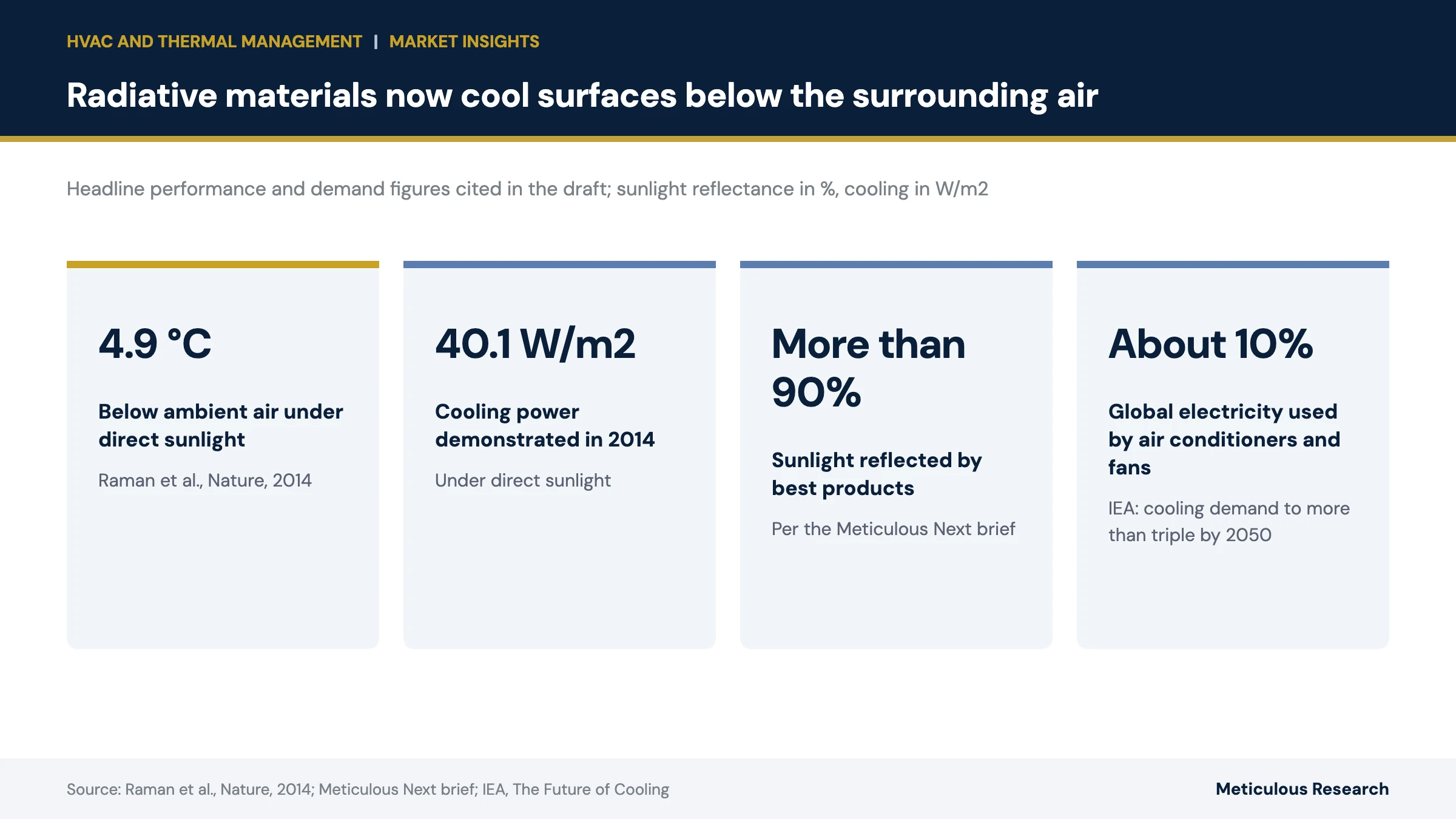
The Earth atmosphere is largely transparent to infrared radiation between 8 and 13 micrometres, so a surface that emits strongly in that range can release heat directly to space. A material that also reflects most sunlight can therefore end up cooler than the air around it. A 2014 study in Nature by Raman and colleagues showed this under direct sunlight, with a surface 4.9 degrees C below ambient air temperature and a cooling power of 40.1 W/m2. The brief notes that the best performing products now reflect more than 90% of sunlight.
The distinction between reflecting sunlight and radiating heat is central to the market. Conventional cool roofs reflect sunlight and stay cooler than a dark roof, while radiative materials are designed to go further and fall below air temperature. California sets this out clearly for roofs. The 2025 Energy Code, effective 1 January 2026, requires nonresidential low slope roofs to have an aged solar reflectance of at least 0.63 and a thermal emittance of at least 0.75, or a solar reflectance index of at least 75. That requirement rewards reflectance and emittance and does not ask for sub-ambient cooling, which is why the brief advises owners to specify radiative performance and not reflectance alone.
The need behind the technology is growing. The IEA has estimated that, without efficiency action, space cooling energy demand will more than triple by 2050, with air conditioners and fans already using about 10% of global electricity. Materials that lower the heat entering a building reduce the load that mechanical cooling has to remove, which is also the reason the brief tracks grid stress as a driver.
Key Signals in Passive Radiative Cooling Materials
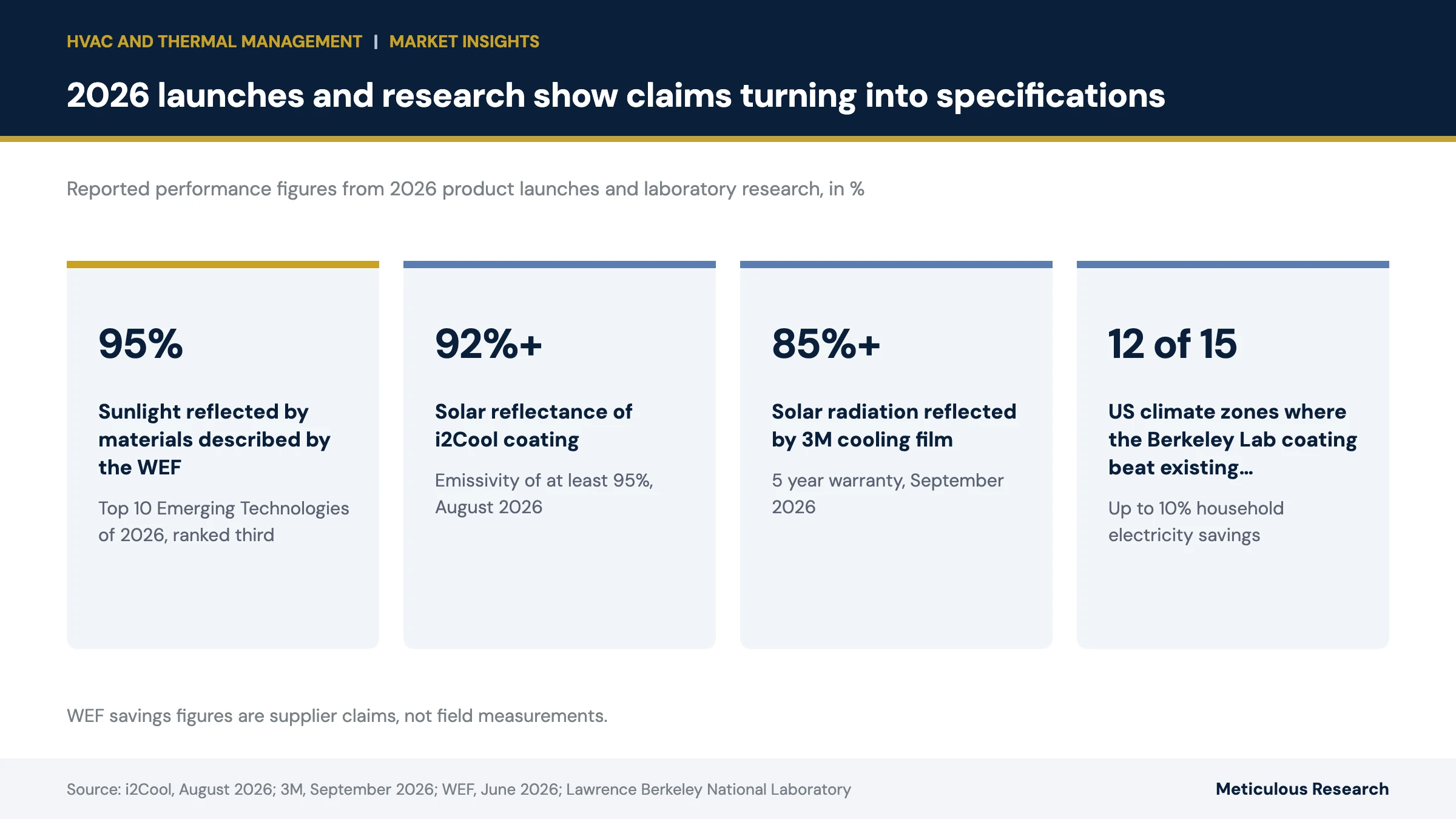
The brief grades the overall signal as high impact, with mainstream inflection around 2030, and the evidence in 2026 supports that reading. In June 2026 the World Economic Forum named passive radiative cooling materials the third of its Top 10 Emerging Technologies of 2026, which places the technology in front of building owners, utilities and policy makers well beyond the coatings industry. The Forum describes materials designed to reflect 95% of incoming sunlight, and it cites supplier reports of savings of up to 20% in grocery and retail stores, which are supplier claims and not field measurements.
Product launches show manufacturers moving from laboratory results to specified performance. In August 2026 i2Cool announced a corrosion protection coating with solar reflectance of at least 92% and emissivity of at least 95% in the 8 to 13 micrometre window, tested for 1,500 hours of xenon arc exposure with about 12% gloss loss. In September 2026 3M launched a cooling film for fleet and rail vehicle roofs that reflects over 85% of solar radiation and carries a 5 year warranty. Warranties of this kind are the signal the brief watches most closely, since durability is the barrier that most limits adoption.
Research continues to widen the field of use. A coating developed at Lawrence Berkeley National Laboratory switches its emittance with temperature, and the laboratory reports that it could save an average US household up to 10% of electricity and outperformed existing roof coatings in 12 of 15 US climate zones.
Standards and codes are the slower signals. The Cool Roof Rating Council works with ASTM methods for solar reflectance, emittance and laboratory soiling and weathering, and it is running a study comparing rapid ratings with naturally aged values, with analysis expected in late 2026 or early 2027. The brief expects test methods to extend to sub-ambient performance in the first phase and codes to reference radiative performance in the 2029 to 2032 phase, so the test methods have to come first.
The brief lists four indicators for investors and planners to track. These are the number of jurisdictions with mandates, sub-ambient launches with warranties, cost per square metre and the cool surface area deployed under programmes. Taken together, they show whether the market is moving along the base case or toward the accelerated or delayed cases.
Passive Radiative Cooling Timeline and Outlook to 2036
The brief expects adoption in three phases. Between 2026 and 2029, volume is driven by cool roof mandates, with California and China named as the lead jurisdictions and more US states, Indian states and Gulf cities expected to follow, while the first sub-ambient products launch with durability warranties. Between 2029 and 2032, sub-ambient materials reach commodity cost with colour and self-cleaning options, hot-climate building codes start to reference radiative performance and glazing scales on commercial buildings. Between 2032 and 2036, radiative performance becomes a standard specification for roofs, walls, glazing and outdoor surfaces in hot climates, and cities and utilities include cool surfaces in peak load planning.
The mainstream inflection point is placed around 2030 in the base case. An accelerated case, in which extreme heat and grid crises force rapid mandates and utility programmes, brings the inflection forward to about 2029 and takes the 2036 market to the top of the USD 15 to 22 billion range. A delayed case moves it to about 2032, if durability or soiling problems undermine warranties, or if low cost reflective products satisfy codes without any radiative performance, which would keep growth confined to conventional cool roofs.
The spread between the three cases is the most useful planning input in the brief. Suppliers that commit to warranted products before 2029 gain the most in the accelerated case, while those that wait for code references face the delayed case with less learning behind them.
Strategic Implications for Manufacturers, Owners and Utilities
Coatings and roofing manufacturers have the clearest decision, because the brief places margin in the sub-ambient tier and the winners in companies that own the distribution channel and can warrant products at scale. Launching a warranted radiative line before commodity pricing arrives secures shelf space and field performance data.
Chemical and materials suppliers gain by solving the three problems that limit adoption today, which are durability, colour and self-cleaning, at commodity cost. Pigments, polymers and films that deliver these properties sit upstream of every coating, membrane and glazing product in the market.
Building owners in hot climates should specify radiative performance and not reflectance alone, since many codes still reward reflectance only and would otherwise lock in a lower cooling outcome. Utilities and cities can treat cool surfaces as peak load and heat resilience infrastructure and fund programmes accordingly. Investors are directed toward channel owning manufacturers and enabling suppliers, with specialist start-ups expected to license their technology or be acquired by about 2029.
Related Cooling Report: Portable and Personal HVAC Cooling Devices
Radiative materials lower the heat entering a building, while personal cooling devices serve people directly where buildings cannot be cooled evenly. The Portable and Personal HVAC Cooling Devices Market report projects the market to reach USD 10.58 billion by 2035, at a CAGR of 5.2% from the 2025 base year. Asia-Pacific is the largest region with an expected 40% to 45% share in 2025, and demand is driven by energy efficient cooling, personal comfort preferences and urban heat island effects.
For the wider view of the sector, read our group blog, HVAC Components Market: Fans, Blowers, Coils, Compressors, Air Handling and Power Semiconductors.
Frequently Asked Questions
What are passive radiative cooling materials?
They are coatings, films, glazing and textiles that reflect most sunlight and emit heat in the 8 to 13 micrometre infrared window, so surfaces stay cooler than the surrounding air without electricity.
How big is the market for passive radiative cooling materials?
The Meticulous Next brief sizes the market at USD 1.5 to 2.5 billion in 2026 and USD 15 to 22 billion by 2036, an indicative CAGR of 24% to 27%.
When could passive radiative cooling become mainstream?
The brief places the mainstream inflection around 2030 in the base case, about 2029 in an accelerated case and about 2032 in a delayed case.
What limits adoption today?
Durability and soiling, climate dependence, colour and appearance limits, and building codes that reward reflectance alone.
Who is likely to win?
Channel owning coatings and roofing manufacturers with warranted products at scale, chemical and film suppliers that deliver durability and colour at commodity cost, and hot climate building owners, utilities and cities that deploy early.
Sources
- Meticulous Next, Passive Radiative Cooling Materials and the Future of Buildings
- Meticulous Research, Portable and Personal HVAC Cooling Devices Market
- Raman et al., Passive radiative cooling below ambient air temperature under direct sunlight, Nature, 2014
- World Economic Forum, Top 10 Emerging Technologies of 2026
- California Energy Commission, 2025 nonresidential cool roofs
- Cool Roof Rating Council, California Title 24
- Cool Roof Rating Council, 2025 AGM technical committee updates
- IEA, The Future of Cooling
- Lawrence Berkeley National Laboratory, temperature adaptive radiative coating
- i2Cool, i2Coating CorroCool launch, August 2026
- 3M, 3M Cooling Film announcement, September 2026
Looking for full market sizing & granular dataset?
Access our comprehensive market forecast report SKU: MREP - 1041529.
Related Market Intelligence Briefings
Recommended reading from the same research domain

METICULOUS INSIGHT
From Sea to Skincare: Harnessing the Potential of Algae in Cosmetics Products
In recent years, there has been a growing trend towards using natural and organic products in all aspects of our lives. This includes the be...

METICULOUS INSIGHT
Growing Deployment of Hydrogen Storage Facilities for Power Generation Supporting Market Growth
Hydrogen is used in power generation as a replacement for fossil fuels. It can potentially be a renewable energy source and produces no emis...
METICULOUS INSIGHT
Factors Affecting Vietnam Cartonboard Paper Market Growth
Vietnam is transitioning from a linear economy to a circular economy with an increased emphasis on waste management and sustainable economic...