Air Conditioner Market by Region: Asia-Pacific, Europe, North America and South-East Asia
The air conditioner market is growing in every major region, but the reasons differ. Asia-Pacific grows on rising incomes and household ownership. Europe grows on heat waves and a refrigerant rulebook that is rewriting product ranges. North America grows on replacement demand and efficiency standards. South-East Asia grows fastest, from a smaller base.
This blog compares the four regions using Meticulous Research syndicated reports, and adds primary data from the European Commission, the US EPA and the International Energy Agency (IEA) where policy and demand are concerned.
Global air conditioner market
According to the Meticulous Research report, Air Conditioners Market, the market is valued at USD 183.2 billion in 2025 and is projected to reach USD 276.7 billion by 2032, at a CAGR of 6.1% from 2025 to 2032. Unit volume is projected to reach 1,071.5 million units by 2032, at a CAGR of 7%.
Volume growing faster than value points to a mix shift toward lower-priced room units in emerging markets. Value growth then depends on efficiency and refrigerant upgrades.
Asia-Pacific holds the largest regional share of the global market. Split air conditioners, inverter technology and residential buyers lead their respective segments.
Global electricity demand is also at stake. The IEA estimates that air conditioners and fans account for about 10% of global electricity use, and that cooling demand would more than triple by 2050 without efficiency action. That report dates from 2018, so the figures are a long-run marker rather than a current reading. Regulators therefore treat cooling as a grid issue as much as an appliance issue.
Asia-Pacific air conditioner market
According to the Meticulous Research report, Asia-Pacific Air Conditioners Market, the region is projected to reach USD 122.06 billion by 2032, at a CAGR of 6.4% from 2025 to 2032. China holds the largest country share.
Split air conditioners, inverter air conditioners and the residential segment are the largest in their categories. Residential is also the fastest-growing end user. Household demand, not commercial building, is therefore the main driver in the region.
Manufacturers are building capacity close to demand. Daikin announced a joint venture in Thailand with NEXTY on 20 May 2026. Local production shortens supply chains and eases exposure to trade barriers.
Growth does not follow a straight line, because weather moves demand from year to year. The IEA Global Energy Review 2026 reports that cooling degree days fell by more than 6% globally in 2025, and that India saw electricity demand growth of only 1.4% after an early, intense monsoon. A cooler year slows replacement cycles, but it does not change the ownership trend.
Europe air conditioner market
According to the Meticulous Research report, Europe Air Conditioners Market, the region is projected to reach USD 46.8 billion by 2032, at a CAGR of 6.0% from 2025 to 2032. Italy holds the largest country share and France is the fastest-growing market.
Split systems, inverter technology and residential buyers lead. Heat waves are widening the customer base in countries that once treated air conditioning as optional. The IEA notes that European electricity demand rose 1% in 2025, with heat waves lifting cooling demand.
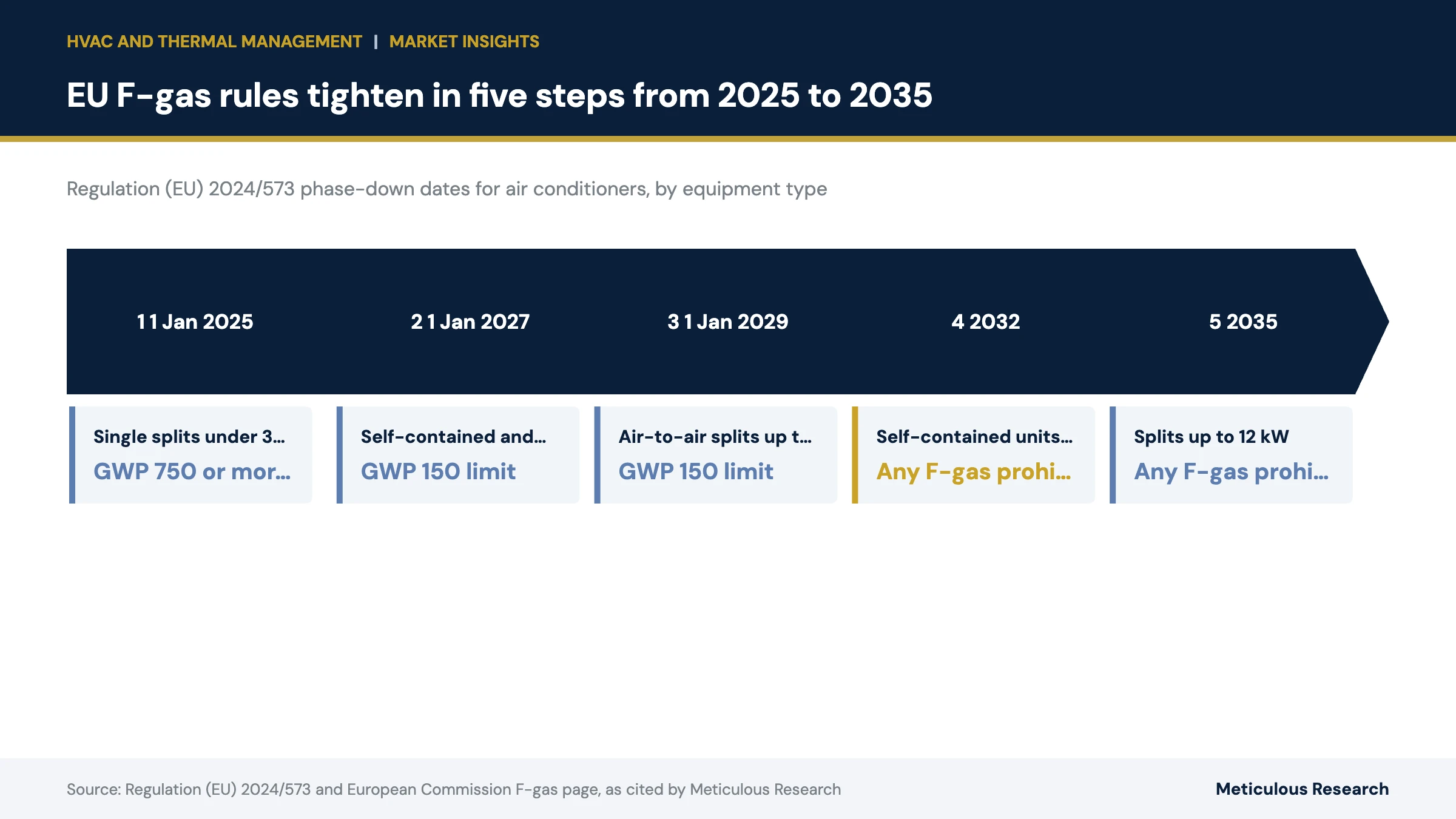
Regulation shapes the product range more than any other factor. Regulation (EU) 2024/573 on fluorinated greenhouse gases entered into force on 11 March 2024 and sets a staged phase-down for air conditioners. The European Commission lists the first step as 1 January 2025, when single split systems under 3 kg with a refrigerant GWP of 750 or more become prohibited. Self-contained units and air-to-water splits up to 12 kW face a GWP 150 limit from 1 January 2027, and air-to-air splits up to 12 kW from 1 January 2029. Any F-gas is prohibited in self-contained units up to 12 kW from 2032, and in splits up to 12 kW from 2035.
Brands that redesign early keep shelf space. The Commission names R-290 for room units and R-32 for splits among the alternatives, so the transition runs through new compressor, charge and safety designs. Daikin opened a heat pump plant in Poland on 21 May 2026, a sign that capacity is moving into the region.
North America air conditioner market
According to the Meticulous Research report, North America Air Conditioners Market, the region covers the US and Canada and is projected to reach USD 73.7 billion by 2036, at a CAGR of 6.31% from 2026 to 2036. This is the only regional report quoted here with a 2036 horizon, so its value should not be set directly against the 2032 figures for other regions.
Refrigerant rules set the pace of replacement. Under the US EPA Technology Transitions rule, 1 January 2025 is the compliance date for lower-GWP refrigerants in new residential air conditioning and heat pump systems. Older equipment made or imported before that date may be installed until 1 January 2026. That sell-through window has now closed, so the installed base turns over to the new refrigerants from here.
Data centres compete for the same electricity. The IEA reports that US electricity demand rose 2% in 2025, with data centres supplying about half of the increase. Cooling suppliers are following that demand. Daikin Applied tripled its modular manufacturing footprint on 14 October 2026 and committed USD 30 million to a training institute on 19 June 2026. Technician supply is therefore as important as product supply.
South-East Asia air conditioner market
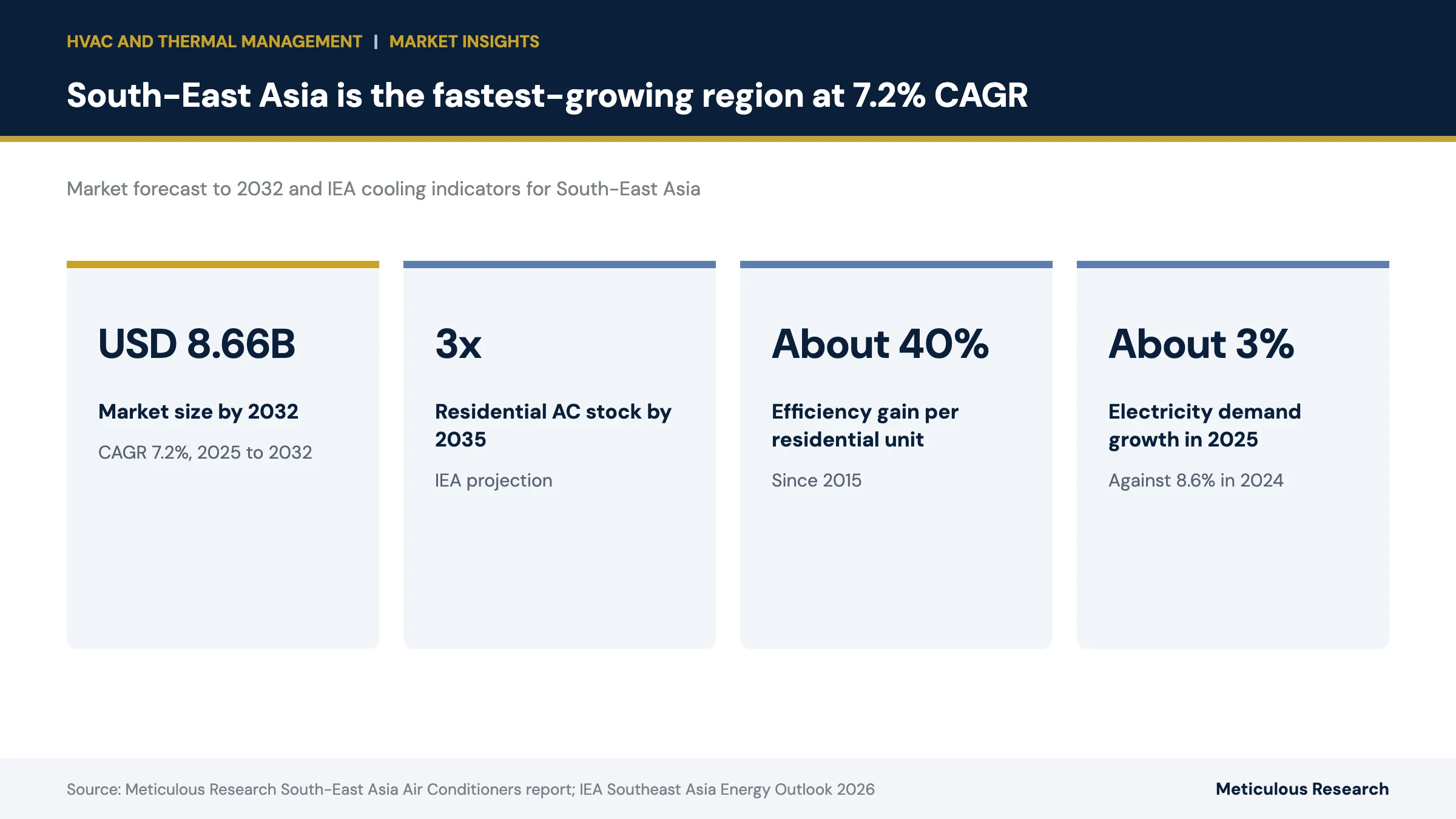
According to the Meticulous Research report, South-East Asia Air Conditioners Market, the region is projected to reach USD 8.66 billion by 2032, at a CAGR of 7.2% from 2025 to 2032. That is the fastest rate of the four regions. The report names Indonesia as the largest and fastest-growing country market.
The IEA Southeast Asia Energy Outlook 2026 shows why. Residential air conditioner stock is set to triple by 2035, and the average residential unit has become about 40% more efficient since 2015. Electricity demand is growing twice as fast as overall energy use. Efficient inverter units are therefore the commercial answer to a grid problem.
Demand is weather sensitive here as well. IEA data show South-East Asia electricity demand growth of about 3% in 2025, against 8.6% in 2024, because the weather was milder. One mild year slows sales, but it does not slow the build-out of households that are buying their first unit.
What the four regions have in common
Split air conditioners, inverter technology and residential buyers lead in all four regions. Product strategy is therefore more uniform than regional growth rates suggest. Suppliers that win on efficient inverter splits can compete everywhere, and the differences lie in refrigerant rules, channel structure and price points.
The market is led by Daikin, Mitsubishi Electric, Hitachi-Johnson Controls, Carrier, Whirlpool, Haier, LG, Voltas, Panasonic, Bosch, Samsung, Fujitsu, Blue Star, Toshiba, Gree and Midea, according to the Meticulous Research reports. Competition now extends beyond the room unit. Daikin signed an MOU with Delta Electronics on data centre cooling on 11 May 2026, which shows how air conditioning makers are moving toward adjacent thermal markets.
Three related Meticulous Next briefs cover the forces reshaping this market:
- Low-GWP Refrigerants and the Future of Cooling Chemistry sizes the refrigerant shift at USD 8 to 10 billion in 2026, rising to USD 17.38 to 21.72 billion by 2035, at an indicative CAGR of 9%. Every phase-down date above feeds this curve.
- Heat Pump Supply Chains and the Future of Residential Heating sizes the residential heat pump opportunity at USD 13 to 18 billion in 2026, rising to USD 28.23 to 39.09 billion by 2035, at a CAGR of 9%. Reversible air conditioners and heat pumps share compressors, controls and installers.
- Cooling-as-a-Service and the Future of Thermal Management Contracts sizes outcome-based cooling contracts at USD 3.0 to 4.5 billion in 2026, rising to USD 9.76 to 14.63 billion by 2035, at a CAGR of 14%. Commercial buyers are moving from owning equipment to buying cooling as a service.
A fourth brief, Passive Radiative Cooling Materials and the Future of Buildings, covers the technology that could trim air conditioning load from the building side, with a USD 15 to 22 billion outlook by 2036. The related blogs, Passive Radiative Cooling Materials and the Future of Buildings and Heat Pump Market Outlook 2026 to 2036, go deeper on each.
Frequently Asked Questions
What is the size of the global air conditioner market?
The Meticulous Research report values the global air conditioner market at USD 183.2 billion in 2025 and projects USD 276.7 billion by 2032, at a CAGR of 6.1%.
Which region is the largest air conditioner market?
Asia-Pacific holds the largest regional share. The Asia-Pacific report projects USD 122.06 billion by 2032, with China as the largest country market.
Which region is growing fastest?
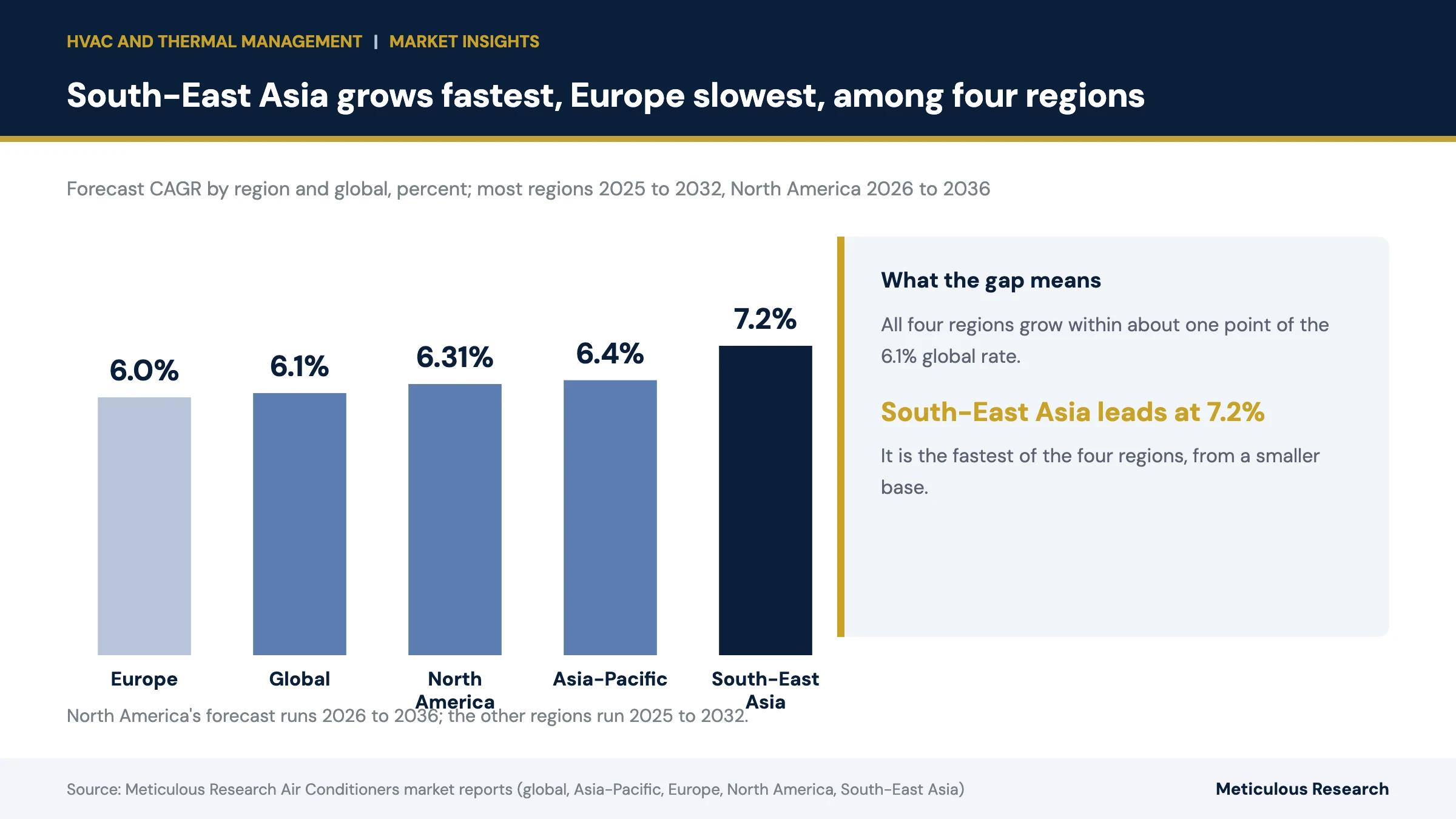
South-East Asia has the highest CAGR of the four regions at 7.2%, ahead of Asia-Pacific at 6.4%, North America at 6.31% and Europe at 6.0%. The North America forecast runs to 2036 and the others to 2032.
How do F-gas rules affect air conditioners in Europe?
Regulation (EU) 2024/573 phases down high-GWP refrigerants in stages from 2025. The next limits apply to self-contained units and air-to-water splits from 1 January 2027, and to air-to-air splits up to 12 kW from 1 January 2029.
Why is South-East Asia important for cooling demand?
The IEA expects residential air conditioner stock in South-East Asia to triple by 2035. Efficiency gains of about 40% since 2015 limit, but do not remove, the load on the grid.
Which segments lead the air conditioner market?
Split air conditioners, inverter air conditioners and the residential segment are the largest in all four regions.
Where can I find the full reports?
The reports are available from Meticulous Research: Air Conditioners Market, Asia-Pacific, Europe, North America and South-East Asia.
Sources
- Meticulous Research, Air Conditioners Market, Asia-Pacific, Europe, North America and South-East Asia report pages.
- Meticulous Research, Next briefs on Low-GWP Refrigerants, Residential Heat Pumps, Cooling-as-a-Service and Passive Radiative Cooling.
- European Union, Regulation (EU) 2024/573 on fluorinated greenhouse gases, and the European Commission F-gas page for the phase-down dates.
- US EPA, Technology Transitions regulatory actions.
- International Energy Agency, The Future of Cooling, Southeast Asia Energy Outlook 2026 and Global Energy Review 2026.
- Daikin Industries, press releases, May to October 2026.
Looking for full market sizing & granular datasets?
Access our comprehensive market forecast reports:
- Air Conditioners Market - Global Opportunity Analysis and Industry Forecast (2026-2036)MRSE - 104700
- Asia-Pacific Air Conditioners Market - Opportunity Analysis and Industry Forecast (2025-2032)MRSE - 104998
- Europe Air Conditioners Market - Opportunity Analysis and Industry Forecast (2025-2032)MRSE - 1041010
- North America Air Conditioners Market - Opportunity Analysis and Industry Forecast (2026-2036)MRSE - 104949
Related Market Intelligence Briefings
Recommended reading from the same research domain

METICULOUS INSIGHT
Increasing Use Of Anaerobic Digestion Systems In Sewage & Wastewater Treatment
The use of anaerobic digestion systems in sewage & wastewater treatment plants is growing rapidly due to the facilities’ need to e...

METICULOUS INSIGHT
Efforts to Mitigate the Environmental Impacts of Battery Disposal Supporting Second-life EV Batteries Market Growth
Improper battery disposal can have significant environmental impacts. Batteries contain various chemicals and metals that can be harmful to...

METICULOUS INSIGHT
Stringent Regulations for Public Safety and Product Quality Driving the Demand for NDT Services
Non-destructive Testing (NDT) is a quality control and quality assurance management tool. It is used to examine materials and components wit...