Liquid and Immersion Cooling Outlook 2026 to 2034: Key Signals, Technology Shifts and Strategic Implications

Liquid cooling has moved from a specialist option to the default design for rack-scale AI. According to the Meticulous Next brief, Liquid and Immersion Cooling Market Outlook 2026 to 2034, the market is valued at USD 6.5 to 8.5 billion in 2026 and is projected to reach USD 45 to 60 billion by 2034, at a CAGR of 27 to 29%. The brief presents this as an indicative trajectory rather than a segmented market model.
This blog reads the signals behind that range: rising rack power, warm water operation and a run of acquisitions that has pulled cooling into a few industrial groups. It then sets out what those signals mean for data center operators and suppliers, with related Meticulous reports and Next briefs linked where their numbers sit alongside.
Liquid and immersion cooling market outlook
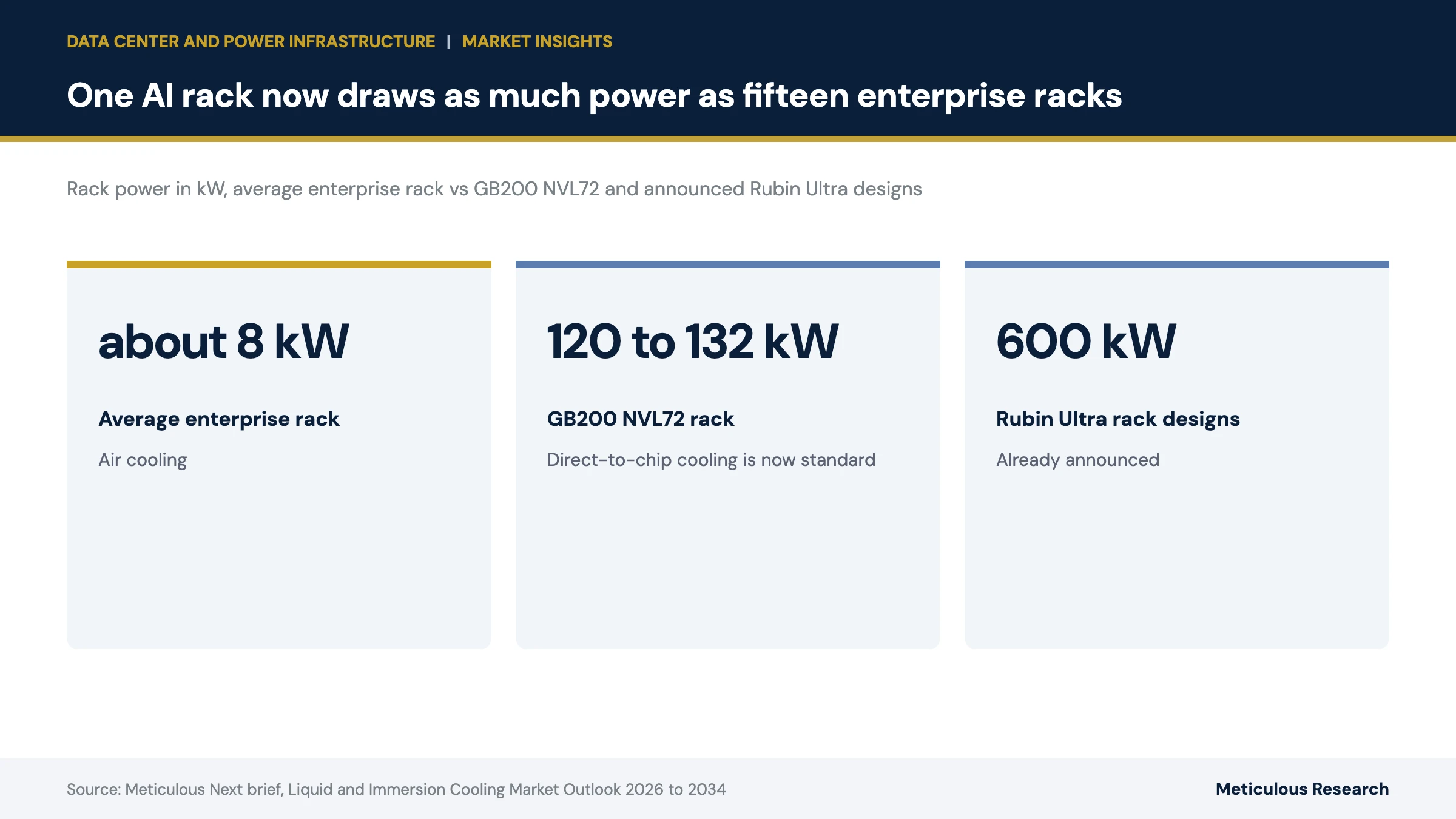
Rack power explains the growth rate. The brief puts a GB200 NVL72 rack at roughly 120 to 132 kW, against about 8 kW for an average enterprise rack, which means a single AI rack now draws as much power as fifteen enterprise racks. Air cannot remove that much heat from a rack footprint, so direct-to-chip cooling is now standard for rack-scale AI. Rubin Ultra designs with 600 kW racks have already been announced, and each step up in density widens the share of halls that must be built around liquid.
The brief sets out adoption in three phases. Between 2026 and 2028, liquid is the default for AI and warm-water, chiller-light plant spreads in temperate regions. From 2028 to 2031, warm-water plant becomes standard, 600 kW racks arrive and heat reuse scales. From 2031 to 2034, thermal architecture settles with liquid as the baseline for high-performance capacity.
Four restraints temper the range: the retrofit burden of bringing water to racks and managing leaks in buildings designed for air, supplier concentration after consolidation, the unresolved chiller debate for halls running only the latest platforms, and dependence on AI capital spending cycles. A slowdown in AI investment would therefore move the market toward the low end of the 2034 range.
Key signals and technology shifts
Warm water is the technology shift with the widest reach. At CES on 5 January 2026, NVIDIA chief executive Jensen Huang said the Vera Rubin rack is 100% liquid-cooled on the same 45°C water as Grace Blackwell, adding that "at 45 degrees Celsius, the data center doesn't need a chiller" (Facilities Dive). LiquidStack chief executive Joe Capes qualified the claim, saying chillers could still play a role in halls running only Vera Rubin because of the high temperatures of their secondary water loops. The brief records the same debate.
NVIDIA later set out the engineering behind the figure. Coolant enters the rack at up to 45°C and leaves at roughly 55°C, and in favourable climates dry coolers can replace chillers. The company cites about 2.6 million gallons of water per megawatt per year for conventional cooling tower systems, falling to near zero with dry coolers (NVIDIA blog). Warmer supply water therefore cuts water use as well as cooling energy, which links the liquid cooling story to the waterless systems market.
Immersion follows a different path. The brief finds it established mainly in high-density, edge and retrofit niches, while cold plates and coolant distribution units (CDUs) carry rack-scale AI. Megawatt-class CDUs, cold-plate supply chains in Taiwan and the US, and venture funding are the enablers it names. Immersion suppliers such as Submer, GRC, Iceotope, ZutaCore and LiquidStack compete in the niches, while cold-plate and CDU supply is consolidating into industrial groups.
Consolidation and strategic implications
Capital is moving as fast as technology. Schneider Electric agreed in October 2024 to buy a 75% controlling interest in Motivair for USD 850 million in cash (Silicon UK). Trane Technologies announced the purchase of LiquidStack on 10 February 2026 and completed it in March, describing the combined offer as cooling from the central plant to the chip (Business Wire). Ecolab completed its roughly USD 4.75 billion acquisition of CoolIT Systems in early July 2026, and reported that CoolIT sales had grown more than 100% year to date (DataCenterNews).
Supplier concentration is one of the four restraints the brief names, so operators now weigh integrated offers from groups that also supply plant, controls and service against specialists in immersion, fluids and components. Warm-water operation also opens the door to heat reuse, which the Meticulous research on data center heat reuse sizes as a separate and fast-growing opportunity.
The brief names six supplier groups: integrated cooling groups, cold-plate and CDU makers, immersion specialists, rack and server OEMs, plant and heat reuse suppliers, and operators, chip vendors and standards bodies. Its regulatory section points to US permitting and power constraints, the EU Energy Efficiency Directive with its heat reuse expectations, and the ASHRAE and Open Compute Project liquid specifications.
Related reports and Meticulous Next briefs
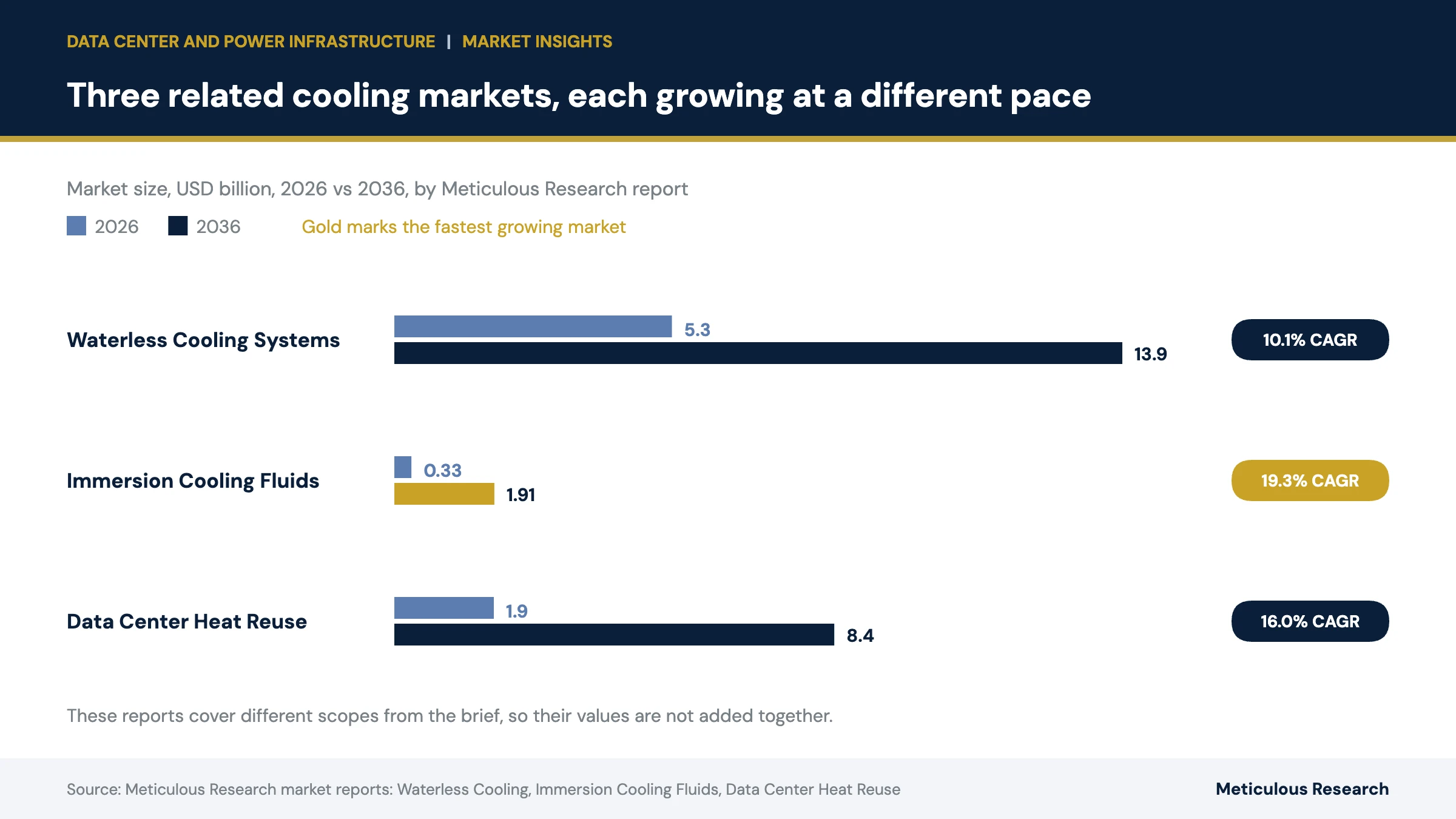
The Waterless Cooling Systems Market report values the market at USD 5.3 billion in 2026 and projects USD 13.9 billion by 2036, at a CAGR of 10.1%. Dry cooling systems are the largest cooling technology, immersion cooling systems are the fastest-growing, and Asia-Pacific is the fastest-growing region. Water scarcity and AI and hyperscale data center expansion are the two drivers it lists.
The Immersion Cooling Fluids Market report values the market at USD 326.0 million in 2026 and projects USD 1,909.9 million by 2036, at a CAGR of 19.3%. Single-phase immersion is the largest technology at 83.2% and two-phase immersion is the fastest-growing at 21.6%. Rising rack power density, data center electricity demand and hardware certification programmes are the drivers named.
The Data Center Heat Reuse Market report values the market at USD 1.9 billion in 2026 and projects USD 8.4 billion by 2036, at a CAGR of 16.0%. Europe holds the largest share and Asia-Pacific is the fastest-growing region. These reports cover different scopes from the brief, so their values are not added together.
Two Meticulous Next briefs cover the cooling and heat sides of the same build-out:
- Liquid and Immersion Cooling Market Outlook 2026 to 2034 sizes the market at USD 6.5 to 8.5 billion in 2026, rising to USD 45 to 60 billion by 2034, at a CAGR of 27 to 29%.
- Data Center Waste Heat and District Heating Outlook 2026 to 2034 sizes the market at USD 1.0 to 1.8 billion in 2026, rising to USD 4.3 to 7.74 billion by 2034, at a CAGR of 20%. It notes that the German Energy Efficiency Act sets a 10% waste heat reuse target for data centers commissioned from July 2026.
Frequently Asked Questions
How big is the liquid and immersion cooling market?
The Meticulous Next brief values the market at USD 6.5 to 8.5 billion in 2026 and projects USD 45 to 60 billion by 2034, at a CAGR of 27 to 29%. The range is an indicative trajectory, not a segmented model.
What is driving liquid and immersion cooling?
Rack density of 120 to 132 kW today and 600 kW announced, fanless and fully liquid-cooled platforms, consolidation and large capital deals, and scale deployments such as a 30 MW direct-to-chip site in Mumbai.
Do AI data centers still need chillers?
NVIDIA says Vera Rubin racks run on water of up to 45°C, which allows dry coolers in favourable climates. LiquidStack notes that chillers may still be needed for secondary loops, so the answer depends on climate and design.
Which companies are active in liquid and immersion cooling?
Integrated groups include Vertiv, Schneider Electric, Ecolab, Trane Technologies, nVent, Delta and LITEON. Immersion specialists include Submer, GRC, Iceotope, ZutaCore and LiquidStack, and cold-plate and CDU makers include Boyd, Cooler Master, Asetek and Chilldyne.
Where can I find the full brief?
The brief is available from Meticulous Research: Liquid and Immersion Cooling Market Outlook 2026 to 2034. Related reports cover Waterless Cooling Systems, Immersion Cooling Fluids and Data Center Heat Reuse.
Sources
- Meticulous Research, Next briefs: Liquid and Immersion Cooling Market Outlook 2026 to 2034 and Data Center Waste Heat and District Heating Outlook 2026 to 2034.
- Meticulous Research, Waterless Cooling Systems Market, Immersion Cooling Fluids Market and Data Center Heat Reuse Market report pages.
- Facilities Dive, No chillers needed for Vera Rubin server racks, NVIDIA CEO says, 9 January 2026.
- NVIDIA, Hotter Than a Hot Tub: The 45°C Breakthrough to Cool AI's Biggest Machines, 21 June 2026.
- Business Wire, Trane Technologies Completes Acquisition of LiquidStack, March 2026.
- DataCenterNews, Ecolab completes USD 4.75 billion CoolIT takeover, 3 July 2026.
- Silicon UK, Schneider Electric Bolsters Data Centre Credentials With Motivair Acquisition, October 2024.
Looking for full market sizing & granular datasets?
Access our comprehensive market forecast reports:
- Waterless Cooling Systems Market - Global Opportunity Analysis and Industry Forecast (2026-2036)MRSE - 1042110
- Immersion Cooling Fluids Market - Global Opportunity Analysis and Industry Forecast (2026-2036)MRCHM - 1041870
- Data Center Heat Reuse Market - Global Opportunity Analysis and Industry Forecast (2026-2036)MRSE - 1042112
Related Market Intelligence Briefings
Recommended reading from the same research domain

METICULOUS INSIGHT
Optical Network Equipment Market Outlook: Growth Drivers, Segments and Key Players
Optical network equipment market size and forecast According to the Meticulous Research report, Optical Network Equipment Market , the marke...
METICULOUS INSIGHT
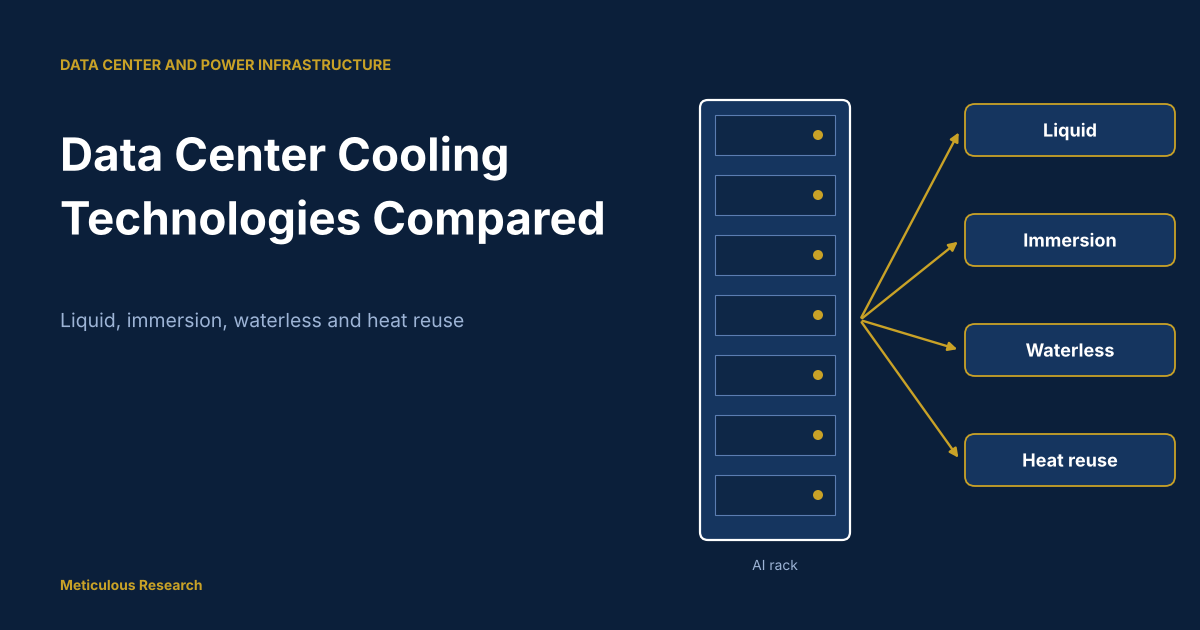
Data Center Cooling Technologies Compared: Liquid, Immersion, Waterless and Heat Reuse
Air is still the largest way to cool a data center, but every faster growing segment in our research points to liquid. Liquid, immersion, wa...

METICULOUS INSIGHT
Used and Refurbished Data Center GPU Market 2026: Demand Drivers, Challenges and Opportunities
When a new AI accelerator is hard to get and the wait is long, a GPU that has already done a few years of work in someone else rack starts t...