HVAC Power Semiconductors Market 2026: Segments, Regions and Where the Opportunity Sits
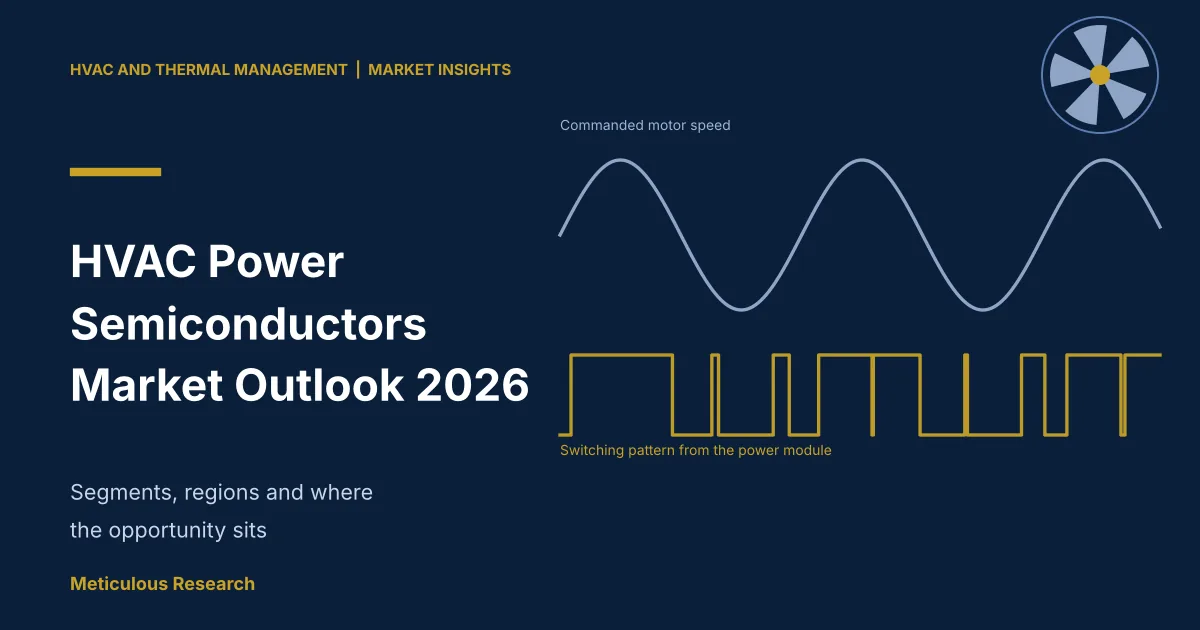
Inside every variable speed air conditioner and heat pump, a small power module decides how fast the compressor and the fan spin. That module is where most of the energy saving in modern HVAC is won, and it is why power semiconductors have become a market worth watching.
The HVAC Power Semiconductors Market is valued at USD 5.9 billion in 2026 and is projected to reach USD 12.8 billion by 2036, at a CAGR of 8.1%. It sits underneath much larger markets. The HVAC Plastic Fans and Blowers Market is valued at USD 6.28 billion in 2026, and the Air Handling Units Market is valued at USD 11.5 billion.
This blog looks at how the power semiconductor market breaks down by device, material, application and region, what is driving it and what could slow it down.
How Big Is the HVAC Power Semiconductors Market?
The market was USD 5.4 billion in 2025 and is expected to reach USD 5.9 billion in 2026. By 2036 it is projected at USD 12.8 billion, about 2.2 times the 2026 size. Growth is steady and tied to the replacement of fixed speed equipment with inverter driven systems.
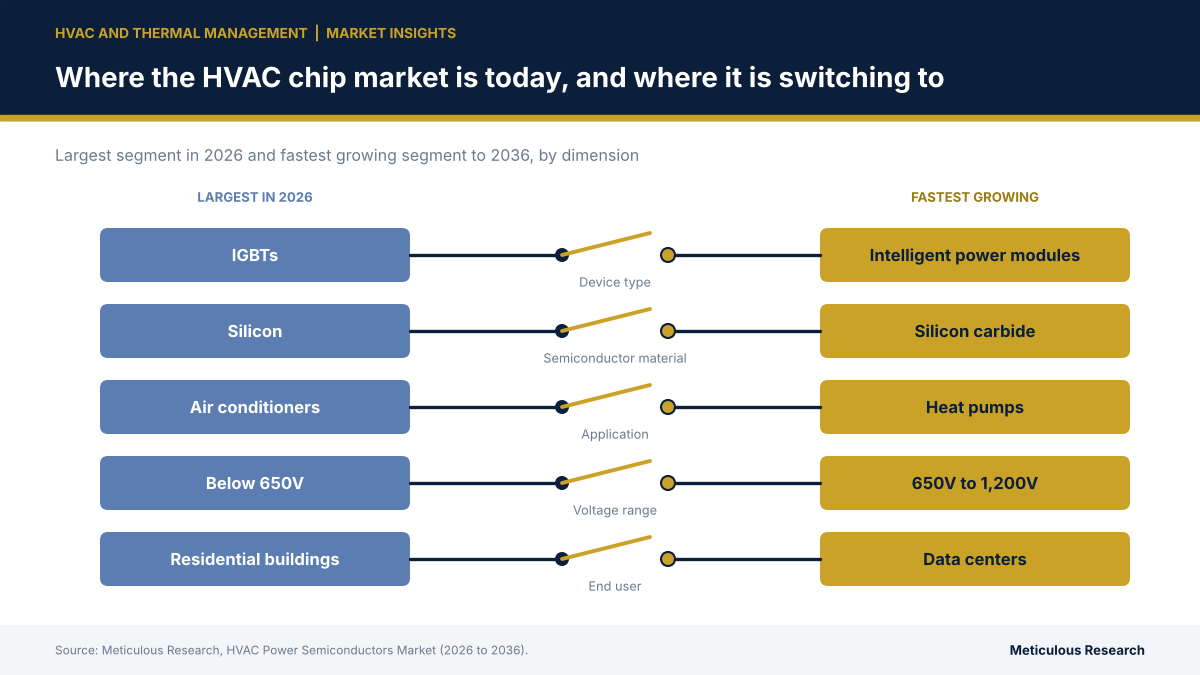
The segment leaders show where the demand sits today and where it is heading:
- Device type: IGBTs are the largest segment in 2026, while intelligent power modules grow fastest.
- Material: Silicon is the largest, while silicon carbide has the highest CAGR. Gallium nitride is also covered in the report.
- Application: Air conditioners lead, while heat pumps grow fastest.
- Voltage range: Low voltage devices below 650V lead, while the 650V to 1,200V range grows fastest.
- End user: Residential buildings lead, while data centers grow fastest.
Asia-Pacific holds the largest share in 2026, since it is where most room air conditioners are built. North America is the fastest growing region, which fits the shift to heat pumps and building electrification.
The pattern is clear. Today the market is silicon IGBTs inside residential air conditioners. Tomorrow it is intelligent modules and wide bandgap devices inside heat pumps and data center cooling.
What Is Driving Demand for HVAC Power Semiconductors?
Inverter drives need power modules. A variable speed system runs its compressor and fans through power switches and gate drivers. Infineon describes its CIPOS intelligent power modules for room air conditioners as covering the compressor, the power factor correction stage and the indoor and outdoor fans. Every inverter system sold adds content for IGBTs, MOSFETs and IPMs.
Efficiency rules keep tightening. US SEER2 and HSPF2 standards apply to units manufactured from 1 January 2023. India revised its BEE star ratings from 1 January 2026. Japan has set a Top Runner target for FY2027 of up to 34.7% better APF for wall mounted room air conditioners. China released a draft amendment of its room air conditioner standard in May 2026. Each step favours better motor control.
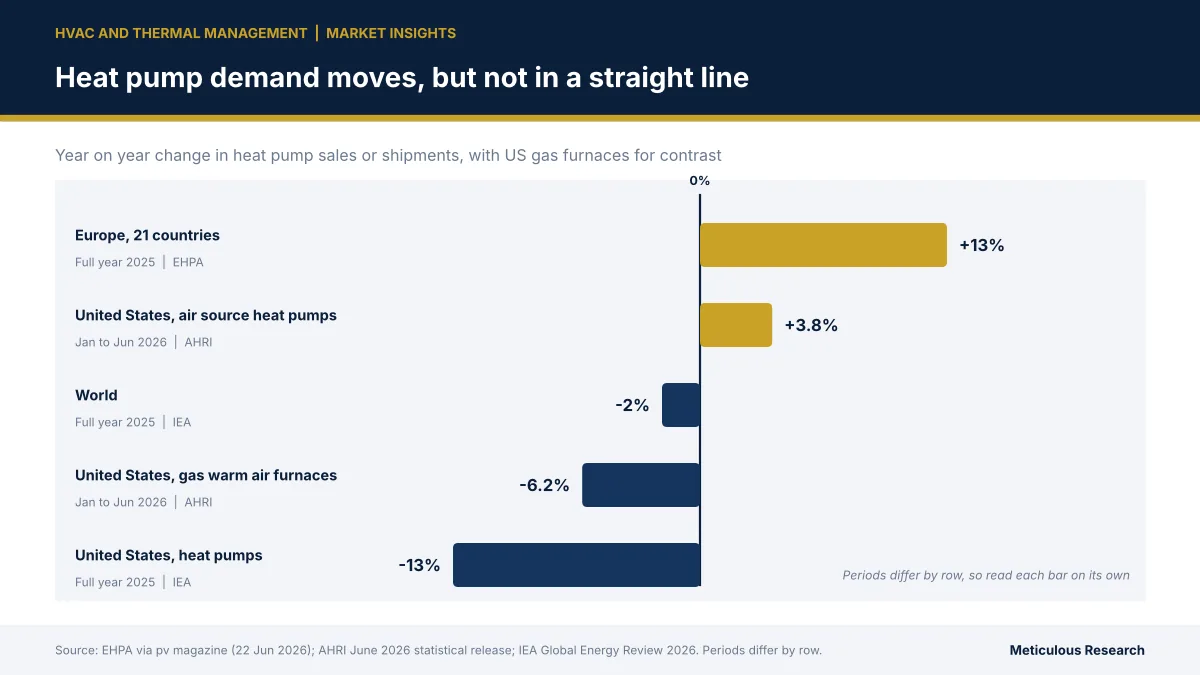
Heat pumps are growing, unevenly. The European Heat Pump Association reports 2.88 million units sold in 2025 in 21 European countries, up 13%. In the US, AHRI shows air source heat pump shipments up 3.8% in January to June 2026 while gas furnaces fell 6.2%. The IEA notes that global sales fell about 2% in 2025, with the US down about 13% on refrigerant shortages and a slow housing market. The direction is up, but the path is not smooth.
Data centers add a second pull. The IEA expects data center electricity use to reach about 945 TWh by 2030, more than double today. In the report, data centers are the fastest growing end user for HVAC power semiconductors.
Where the Opportunity Sits by Segment and Region
Intelligent power modules. Integration is the main product trend. In September 2026, ST introduced a 600V IGBT module in its SLLIMM Compact family that it says is more than 30% smaller than existing modules, aimed at air conditioners and heat pumps.
Silicon carbide and gallium nitride. Suppliers are pushing wide bandgap devices into compressor and fan drives. Mitsubishi Electric calculates a 41% energy reduction from a module that pairs silicon and silicon carbide chips, and Texas Instruments claims more than 99% inverter efficiency for its GaN module. These are calculations and vendor claims, not field results. Silicon is still the largest material segment in the report.
North America and heat pumps. North America is the fastest growing region in the report, and heat pumps are the fastest growing application. AHRI shipment data, with heat pumps up and gas furnaces down, fits that direction.
Data centers. Cooling fans and drives for data centers are a newer pool of demand. Infinitum has launched EC fan systems for data centers that it says save up to 25% against conventional fans, a company claim.
Asia-Pacific. It holds the largest share in 2026 and is where room air conditioners are made. The fans and blowers report cites China alone at over 130 million room air conditioners a year.
Challenges: Supply, Cost and Changing Rules
Supply is tight. ST reported Q3 2026 revenue of USD 3.757 billion on 29 October 2026, and its CEO said demand is well above supply. onsemi cited lead times of about 32 weeks, up from about 27, in its Q2 call. Much of the pull comes from AI data center power, which competes with HVAC for the same factories. Infineon's record Q3 FY2026 revenue of EUR 4.172 billion was driven by AI data center power.
Silicon carbide suppliers are fragile. Wolfspeed emerged from Chapter 11 on 29 September 2025 with debt cut by about 70%. For a buyer who wants to design in silicon carbide, supplier health matters.
Rules add cost and redesign. Since 1 January 2025, new US systems use mildly flammable A2L refrigerants and must have leak detection sensors wired to the control board. In India, manufacturers said the 2026 star rating change would raise air conditioner prices by 5 to 10%.
Demand is uneven. Heat pump sales fell about 2% globally in 2025 according to the IEA, and US sales fell about 13%. A power semiconductor maker that plans around a straight line will miss the dips.
How Power Semiconductors Connect to Fans, Blowers and Air Handling Units
The power module is the link between the electrical supply and every moving part in an HVAC system. Fans and blowers are the largest motor loads, so they are where drive efficiency counts most. The US Department of Energy puts fans at 13% of commercial primary energy use and 56% of commercial motor energy. In Europe, Regulation (EU) 2024/1834 replaces the earlier fan rules from 24 July 2026 with higher minimum efficiency.
To see the equipment side, read the HVAC Plastic Fans and Blowers Market report, which covers the fan and blower segment, and the Air Handling Units Market report, which covers the large building systems that use them. Together with the HVAC Power Semiconductors Market report, they trace the chain from chip to fan to building.
For the full picture across fans, blowers, coils, compressors, air handling and power semiconductors, read our group blog, HVAC Components Market: Fans, Blowers, Coils, Compressors, Air Handling and Power Semiconductors.
Frequently Asked Questions
How big is the HVAC power semiconductors market? The market is valued at USD 5.9 billion in 2026 and is projected to reach USD 12.8 billion by 2036, at a CAGR of 8.1%.
Which device type is the largest? IGBTs are the largest device type in 2026. Intelligent power modules are the fastest growing.
Which region is the largest and which is growing fastest? Asia-Pacific holds the largest share in 2026. North America is the fastest growing region.
Why do heat pumps matter for power semiconductors? Heat pumps use inverter driven compressors and fans, so each unit needs power modules. Heat pumps are the fastest growing application in the report.
Will silicon carbide replace silicon? Not soon. Silicon is still the largest material segment in 2026, while silicon carbide has the highest growth rate. Cost and supplier health decide how fast the shift happens.
What could slow the market? Tight chip supply, uneven heat pump demand and the cost of redesign for new refrigerant and efficiency rules.
Sources
- Meticulous Research: HVAC Power Semiconductors Market, HVAC Plastic Fans and Blowers Market, Air Handling Units Market
- Infineon, CIPOS Intelligent Power Modules selection guide
- US Department of Energy, SEER2 and HSPF2 standards FAQ and pump and fan technology characterization
- Business Today, BEE star ratings from January 2026
- ECCJ, Japan Top Runner room air conditioner target
- pv magazine, European heat pump sales 2025
- AHRI, June 2026 statistical release
- IEA, Global Energy Review 2026: heat pumps
- IIFIIR, AI set to drive doubling of electricity demand from data centres
- EE Journal, ST SLLIMM Compact modules
- Cooling Post, Mitsubishi power module cuts AC power usage
- Texas Instruments, GaN IPM announcement
- ACHR News, Infinitum EC fan systems and A2L refrigerants
- STMicroelectronics, Q3 2026 results
- Nasdaq, onsemi Q2 2026 call highlights
- Infineon, Q3 FY2026 results
- Latham and Watkins, Wolfspeed Chapter 11 emergence
- ILK Dresden, Regulation (EU) 2024/1834 on fans
Looking for full market sizing & granular dataset?
Access our comprehensive market forecast report SKU: MRSE - 1042115.
Related Market Intelligence Briefings
Recommended reading from the same research domain
METICULOUS INSIGHT
Heat Pump Market Outlook 2026 to 2036: Growth Drivers, Technologies and Where Demand Is Heading
Heat pumps are no longer a niche product. They already supply around 12% of the space heating needs of buildings worldwide, and the Internat...

METICULOUS INSIGHT
The AI Infrastructure Imperative: How Generative AI and Hyperscaler CapEx Are Reshaping Hyperscale Data Centers
There comes a point in the evolution of any infrastructure sector when the pace of investment stops resembling a cycle and begins to signal...

METICULOUS INSIGHT
Growing Demand For Automated Inspection Processes Supporting Market Growth
Several industries, including manufacturing, logistics, healthcare, and food processing, are harnessing the power of automation to streamlin...