Next Generation Sequencing Market 2026: Whole Genome, Long-Read, Benchtop and Southeast Asia
Sequencing used to be a research purchase. In 2026 it is turning into a clinical and public health purchase. Genomics England has enrolled 25,000 babies in the Generation Study, each screened for more than 200 rare conditions, with a target of 100,000. The All of Us programme in the United States now holds more than 535,000 whole genomes. PacBio has set a list price of USD 345 for a human genome on its SPRQ-Nx chemistry.
Numbers like these change who buys sequencers, who runs the samples and which step of the workflow becomes the bottleneck. They also explain why the next generation sequencing market no longer behaves like one market. Whole genome sequencing, long-read platforms, methylation assays, amplicon sequencing, automation and reference materials are growing at different speeds, for different reasons and in different regions.
This blog walks through those segments one by one. It starts with the market picture, moves through whole genome, long-read and benchtop sequencing, and then looks at what is pulling Southeast Asia into the conversation. Every section links to the Meticulous Research report that sizes it, so you can move from the argument to the numbers.
How Big Is the Next Generation Sequencing Market and Where Is It Growing Fastest?
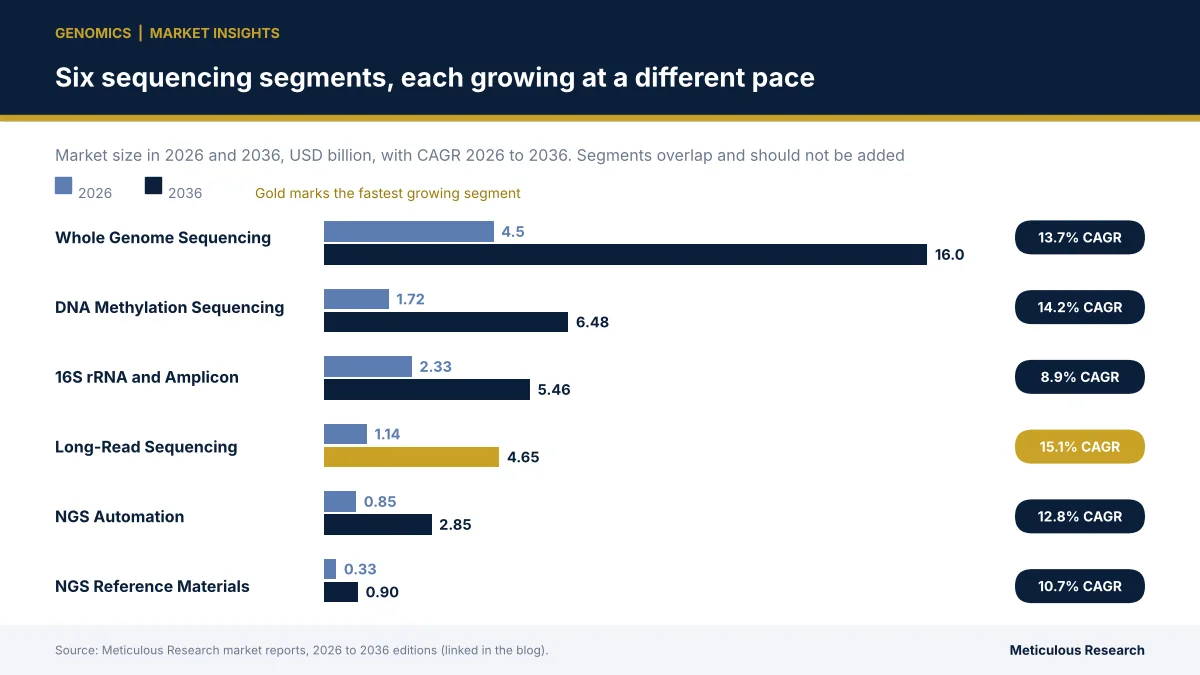
The largest segment by value is whole genome sequencing. The Whole Genome Sequencing Market is valued at USD 4.5 billion in 2026 and is projected to reach USD 16.0 billion by 2036, at a CAGR of 13.7%. North America holds the largest share in 2026 at 49.3%, while Asia-Pacific is the fastest growing region at a CAGR of 15.5%.
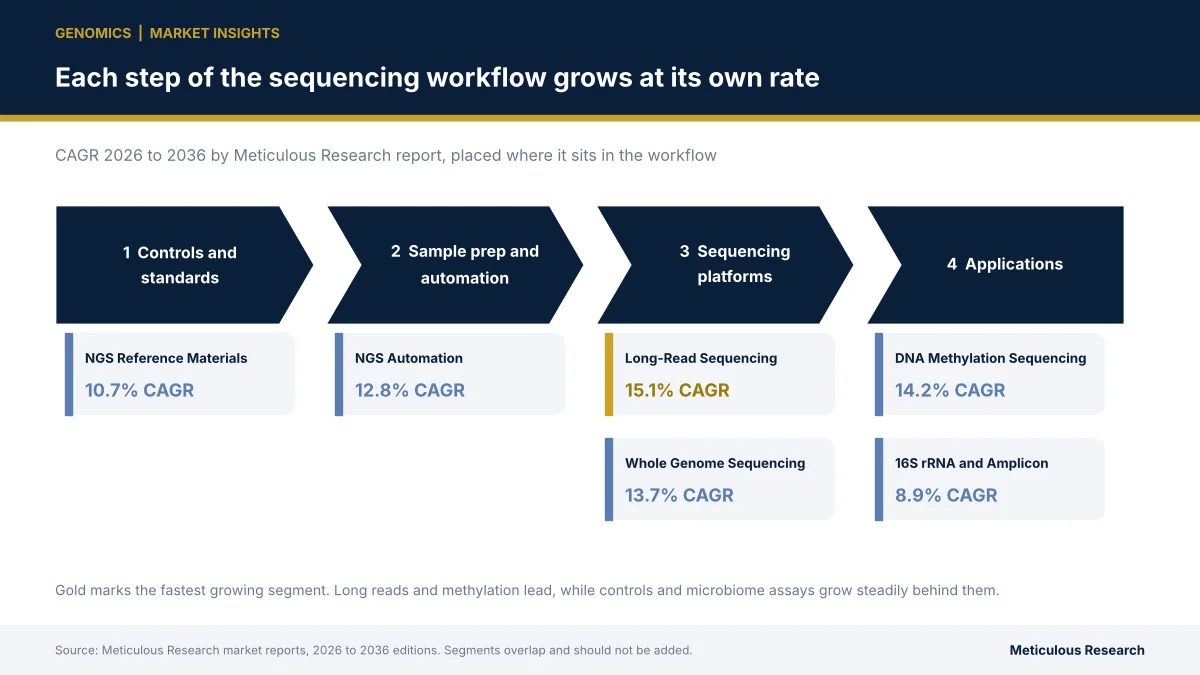
The fastest growing segment is long-read sequencing. The Long-Read Sequencing Market is valued at USD 1.14 billion in 2026 and is projected to reach USD 4.65 billion by 2036, at a CAGR of 15.1%. Close behind is methylation. The DNA Methylation Sequencing Market is valued at USD 1.72 billion in 2026 and is projected to reach USD 6.48 billion by 2036, at a CAGR of 14.2%. Both segments are growing faster than whole genome sequencing because they read information that short reads and standard chemistry leave out.
The layers that support the sequencing run grow at healthy double digit rates too. The 16S rRNA and Amplicon Sequencing Market is valued at USD 2.33 billion in 2026 and is projected to reach USD 5.46 billion by 2036, at a CAGR of 8.9%. The NGS Automation Market is valued at USD 855.1 million in 2026 and is projected to reach USD 2,853.3 million by 2036, at a CAGR of 12.8%. The NGS Reference Materials Market is valued at USD 327.3 million in 2026 and is projected to reach USD 904.1 million by 2036, at a CAGR of 10.7%.
The pattern is easy to read. Methods that add new information grow fastest, and every one of them pulls automation, controls and amplicon assays along with it. One caution on scope: these segments overlap. A single long-read run can serve whole genome and methylation work at the same time, so the figures should be read side by side and not added together.
Whole Genome Sequencing Is Moving From Research Projects Into Routine Care
The clearest sign is newborn screening. The Generation Study by Genomics England had enrolled 25,000 babies across more than 50 NHS sites by October 2025, and it screens for over 200 rare conditions. When a genome is read at birth, the buyer is no longer a research lab. It is a health system that has to sequence, interpret and store at volume.
Population programmes tell the same story at a larger scale. UK Biobank published whole genome sequencing of 490,640 participants in Nature in August 2025. In June 2026 the All of Us Research Program reported more than 535,000 whole genomes in its data release, including more than 14,500 long-read genomes. These programmes create the reference data that clinical labs later depend on. They also carry funding risk, since All of Us funding was reported at about USD 158 million in fiscal 2025, roughly 71% below fiscal 2023.
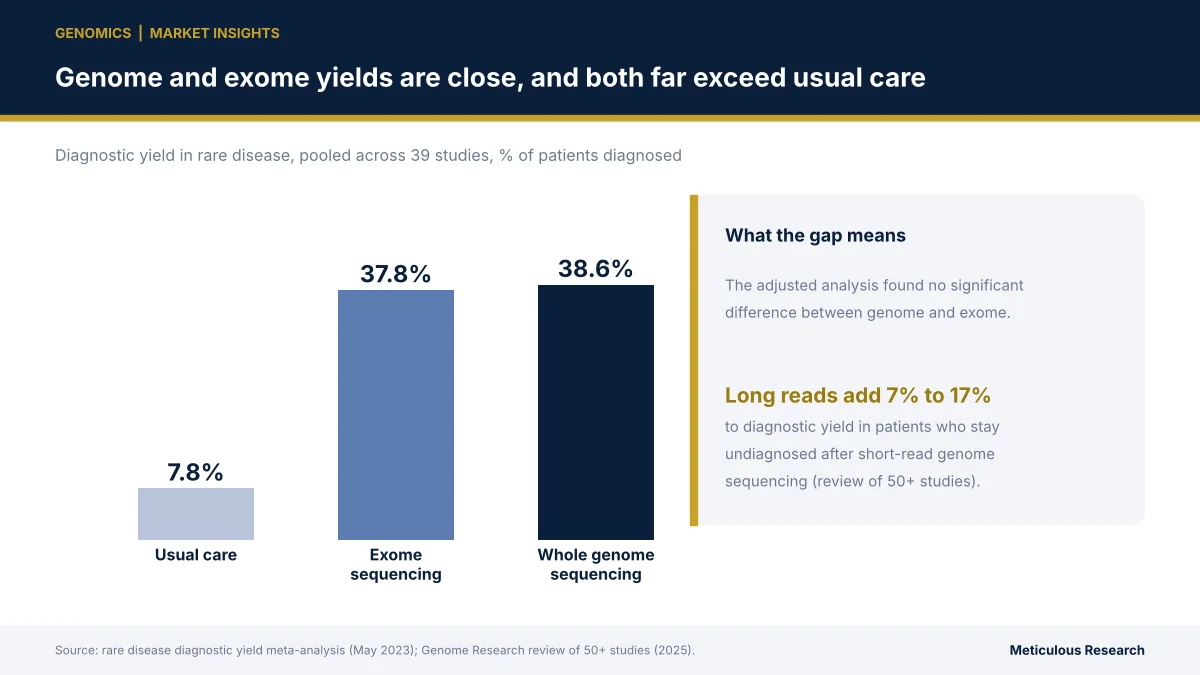
The clinical argument is worth stating carefully. A 2023 meta-analysis of 39 studies found a diagnostic yield of 38.6% for whole genome sequencing, 37.8% for exome sequencing and 7.8% for usual care. The big gap is between sequencing and usual care. The gap between genome and exome is small, and the adjusted analysis in the same paper did not show it to be significant. The case for the genome therefore rests on what it adds beyond yield, namely structural variants, non-coding regions and a dataset that can be reanalysed as knowledge improves.
Price is the other lever. PacBio lists a human genome on SPRQ-Nx at USD 345 per genome, and Ultima Genomics claims a 30X genome for as little as USD 80 on a reagent cost basis. The two figures are not like for like, since one is a long-read list price and the other is a company claim on reagents alone. Together they show how far the price of a genome has moved.
For suppliers, the lesson sits in the mix of the market. Consumables hold the largest offering share of the whole genome market in 2026 at 44.2%, which means every new genome sold keeps paying back in kits and reagents. The full segmentation by offering, technology, application and end user is in the Whole Genome Sequencing Market report.
Long-Read Sequencing and DNA Methylation Show What Short Reads Miss
Short reads are accurate and cheap, but they struggle with repeats, large structural changes and phase. Long reads address exactly those gaps. A review of more than 50 studies in Genome Research found that long-read sequencing adds 7% to 17% to diagnostic yield in patients who stay undiagnosed after short-read genome sequencing. The reference side is moving as well. The T2T-HG002 assembly covers 99.4% of the roughly 6 Gb diploid genome, and the updated benchmark adds 701.4 Mb of high-confidence autosomal sequence over the earlier version.
The commercial signal is more mixed, and that is useful to know. Oxford Nanopore reported H1 2026 revenue of GBP 116.7 million, up 10.5%, with clinical revenue up 35.4% to GBP 17.6 million, while research revenue grew only 5.4%. PacBio reported Q2 2026 revenue of USD 39.0 million against USD 39.8 million a year earlier, although Revio placements rose to 20 from 15. Research budgets are tight, and clinical demand is carrying the growth. This matches what the Long-Read Sequencing Market report shows, where clinical use is the fastest growing source of demand and nanopore sequencing holds the largest technology share in 2026.
Methylation follows the same logic. It is a layer of information that standard sequencing does not read, and it is the basis for several blood-based cancer tests. Chemistry is changing too. Illumina released its 5-Base DNA Prep in October 2025, which reads variants and methylation from the same sample, and the DNA Methylation Sequencing Market report points to enzymatic and chemical conversion as the fastest growing technology, ahead of the bisulfite methods that still hold the largest share.
The clinical evidence is still being settled, and it should be described that way. In the NHS-Galleri trial of 142,250 people, the primary endpoint, a reduction in stage III and IV cancers, was not met. GRAIL reports a 14% reduction in stage IV diagnoses across 12 prespecified cancers, and has since submitted a PMA to the FDA. On the other side, Guardant Shield was approved by the FDA in July 2024 as the first blood test for primary colorectal cancer screening, and Medicare set its price at USD 1,495 from April 2025. Methylation testing already has an approved route to patients. Multi-cancer screening is still working towards one.
Benchtop Sequencers and Automation Decide Where the Bottleneck Sits
Benchtop instruments are where sequencing reaches smaller labs. Illumina announced the MiSeq i100 and i100 Plus in October 2024 and began shipping them in 2025, with up to 25 million and 100 million reads, room temperature reagents and runs up to four times faster than the earlier MiSeq. On 29 June 2026, Roche launched AXELIOS 1, its sequencing by expansion system, for research use only. Roche describes reads of up to about 1,500 bases and a same day whole genome workflow, and has not published a price.
When instruments get faster and smaller, the cost and delay move upstream. A lab that can run a genome in a day still has to extract, quantify, prepare libraries and load plates by hand, and that is where a good share of the time and error sits. Automation vendors are filling that space. In March 2026, Takara Bio USA and Hamilton agreed to co-market automated library preparation kits on the Microlab STAR platform. This is our reading of the trend, since no source quantifies the split, but the direction is clear.
The NGS Automation Market report puts numbers on it. Workstations and robotic platforms hold 73.5% of the 2026 market. North America leads with a 44.0% share and Europe follows at 27.8%, while Asia-Pacific is the fastest growing region at a CAGR of 15.5%, with India the fastest growing country at 17.6%. Labs adding benchtop sequencers in new regions will need to budget for the workflow around the instrument, and not the instrument alone.
Southeast Asia Is Building Its Own Reference Genomes
Southeast Asia is a good example of how national programmes turn into demand for sequencers, kits and services. The programmes are at different stages, and they count progress in different ways, so the numbers below should not be compared directly.
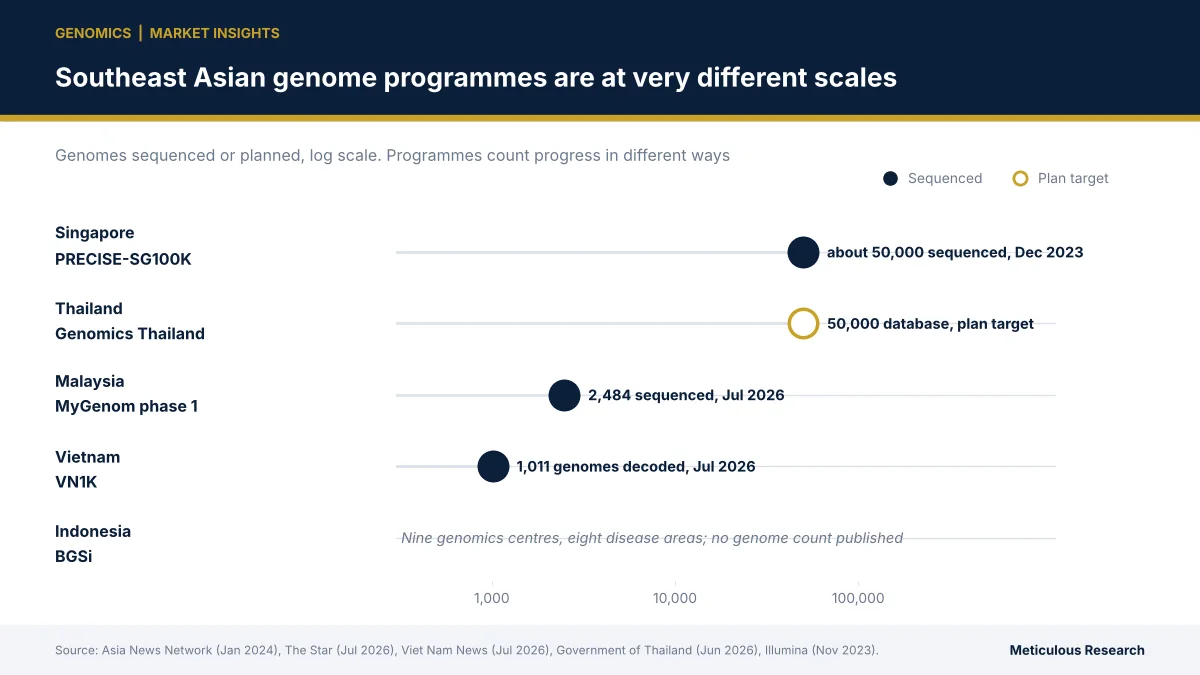
- Singapore: PRECISE-SG100K had sequenced about 50,000 genomes by December 2023, with around 80,000 people recruited. It is the most advanced programme in the region.
- Malaysia: The MyGenom project had recruited 5,029 people and sequenced 2,484 genomes in phase one, as reported in July 2026, ahead of its early goals.
- Vietnam: The VN1K study decoded 1,011 genomes from 53 of 63 provinces, found more than 42 million variants and reported about 8.5 million that are absent from international databases. It also produced a Vietnamese pangenome reference.
- Thailand: The Genomics Thailand plan aims at a 50,000 person genomic database, and breast cancer gene tests and severe drug allergy tests are being added to the universal healthcare scheme. The 50,000 figure is a plan target, not a count of completed genomes.
- Indonesia: The Biomedical and Genome Science Initiative set up nine genomics centres across eight disease areas, with a cancer arm at Dharmais targeting 3,000 germline tests.
The Vietnam result carries the main lesson. When 8.5 million of 42 million variants are missing from global databases, a local reference stops being an academic nicety and becomes a clinical need. Every programme that follows will need sequencers, library prep kits, controls and bioinformatics, and many of them will buy those from outside the region at first.
The Meticulous Research reports cover Asia-Pacific as a region and do not break out Southeast Asia separately, but the regional signal points the same way. Asia-Pacific is the fastest growing region in the Whole Genome Sequencing Market at 15.5%, and it is also projected to grow fastest in the DNA Methylation Sequencing Market, the 16S rRNA and Amplicon Sequencing Market and the NGS Reference Materials Market.
Reference Materials and 16S Amplicon Sequencing Keep Results Comparable
As sequencing moves into clinics, the question changes from "can we sequence it" to "can we show the result is right". That is the job of reference materials. The Genome in a Bottle consortium, hosted by NIST, released a new HG002 small variant and structural variant benchmark built on the T2T-HG002 assembly between November 2025 and May 2026, and it replaces the earlier v4.2.1 benchmark. It has also released tumour and normal benchmarks for the HG008 pancreatic cancer cell line. Labs now have a harder test to measure themselves against.
The commercial side is following. In June 2025, Revvity introduced its first IVD-labelled Mimix reference standards for monitoring NGS and droplet digital PCR assays, and the MDIC Somatic Reference Samples Initiative worked with Revvity on somatic cancer standards built on a Genome in a Bottle cell line. The NGS Reference Materials Market report shows oncology as the largest application in 2026, with liquid biopsy and molecular residual disease the fastest growing, and Asia-Pacific the fastest growing region.
Regulation shapes this demand. In the United States, a federal court vacated the FDA rule on laboratory developed tests on 31 March 2025, which leaves in-house NGS tests under CLIA oversight. In Europe, the IVDR transition periods, as extended, run from December 2027 to December 2029 depending on device class. Either way, a lab that runs its own assay needs controls it can document.
The same quality question applies to microbiome work. Sequencing the 16S rRNA gene is the standard way to profile bacterial communities, and moving from short reads to full-length 16S with long reads improves taxonomic resolution in human microbiome samples, according to a 2024 study. Oxford Nanopore launched its Microbial Amplicon Barcoding Kit 24 V14 in September 2025 for this kind of work. The 16S rRNA and Amplicon Sequencing Market report shows human targeted gene panels as the largest target type in 2026, while 16S rRNA and ITS marker gene sequencing is the fastest growing.
What This Means for Instrument Makers, Service Labs and Buyers
Instrument and consumable makers should plan around clinical demand. Long-read growth is coming from hospitals and clinical labs, while research revenue is soft. Illumina reported Q2 2026 revenue of USD 1.16 billion and raised its full year guidance to USD 4.60 billion to USD 4.64 billion, but it also said China reduced its growth by about 1.6 points. Illumina remains on China's unreliable entity list even after the sequencer export ban was lifted in November 2025, so supply chain and regional exposure are part of every plan.
Service labs and clinical labs should think about the whole workflow. Faster benchtop systems and cheaper genomes only help when library preparation, controls and bioinformatics keep up. Labs that automate early and document their assays against recognised reference materials will be better placed when accreditation and IVDR requirements tighten.
Buyers in emerging genomics markets should treat local reference data as a priority. The Vietnam result shows how much of a population can sit outside global databases. Programmes that budget for sequencing, controls and analysis together will deliver usable results sooner.
The market is also consolidating. On 22 October 2026, EQT announced an agreement to acquire Qiagen in a cash deal reported at about EUR 10.8 billion, with closing expected in mid 2027. Bloomberg reported a lower figure of EUR 9.6 billion before the announcement, so the headline value depends on whether net debt is counted. Either way, tools and diagnostics assets remain attractive.
If you are sizing an opportunity in any of these segments, the six reports below provide the segmentation, regional split and company profiles behind this blog:
- Whole Genome Sequencing Market, 2026 to 2036
- Long-Read Sequencing Market, 2026 to 2036
- DNA Methylation Sequencing Market, 2026 to 2036
- 16S rRNA and Amplicon Sequencing Market, 2026 to 2036
- NGS Automation Market, 2026 to 2036
- NGS Reference Materials Market, 2026 to 2036
Frequently Asked Questions
How large is the next generation sequencing market?
It is best read by segment, because the segments overlap. The largest is whole genome sequencing, valued at USD 4.5 billion in 2026 and projected to reach USD 16.0 billion by 2036, at a CAGR of 13.7%, according to the Whole Genome Sequencing Market report.
Which NGS segment is growing fastest?
Long-read sequencing, at a CAGR of 15.1% from 2026 to 2036, followed by DNA methylation sequencing at 14.2% and whole genome sequencing at 13.7%.
Is whole genome sequencing better than exome sequencing?
For diagnostic yield the gap is small. A 2023 meta-analysis of 39 studies found 38.6% for genome and 37.8% for exome, against 7.8% for usual care. The genome adds structural variants, non-coding regions and data that can be reanalysed later.
What is long-read sequencing used for?
It is used where short reads struggle: structural variants, repeat regions, phasing, isoform analysis and native methylation. A review of more than 50 studies found it adds 7% to 17% to diagnostic yield after a negative short-read genome.
Why do benchtop sequencers and automation matter together?
Smaller and faster instruments move sequencing into more labs, but sample extraction and library preparation still need hands-on time. Automation removes that step from the critical path, which is why workstations hold 73.5% of the 2026 NGS automation market.
Which Southeast Asian countries run national genome programmes?
Singapore (PRECISE-SG100K), Malaysia (MyGenom), Vietnam (VN1K), Thailand (Genomics Thailand) and Indonesia (the Biomedical and Genome Science Initiative) all run programmes, at different stages.
Why do clinical labs need NGS reference materials?
They let a lab show that an assay detects the variants it claims to detect, which accreditation and IVDR requirements ask for. See the NGS Reference Materials Market report for how this segment is sized.
Sources
- Genomics England, 25,000 babies join the Generation Study, 23 October 2025
- UK Biobank, Whole genome sequencing of 490,640 UK Biobank participants, Nature, 6 August 2025
- NIH, All of Us Research Program release, 30 June 2026
- Pharmacy Times, NIH expands All of Us dataset, July 2026
- Meta-analysis of diagnostic yield in rare disease, PMC10210272, May 2023
- PacBio, second quarter 2026 financial results, 5 August 2026
- GenomeWeb, Ultima Genomics upgrades sequencer
- Genome Research, long-read sequencing diagnostic yield review, 2025
- The Pathologist, A closer look at the complete genome, 20 August 2026
- Oxford Nanopore, interim results via Hargreaves Lansdown, 19 August 2026
- GEN, Illumina pilots mapped reads and multiomics at ASHG, 16 October 2025
- GRAIL, NHS-Galleri full results, 30 May 2026, and second quarter 2026 results, 5 August 2026
- Nasdaq, Guardant Shield ADLT status and Medicare approval, 2025
- Fierce Biotech, Illumina unveils benchtop DNA sequencer update, October 2024
- Roche, AXELIOS 1 launch, 29 June 2026
- Business Wire, Takara Bio USA and Hamilton partnership, March 2026
- Asia News Network, PRECISE-SG100K at the halfway mark, 29 January 2024
- The Star, MyGenom project beats early goals, 21 July 2026
- Viet Nam News, Preliminary results in decoding 1,000 Vietnamese genomes, 26 July 2026
- Government of Thailand, Genomics as a growth engine, 29 June 2026
- Illumina, Indonesia BGSi, 9 November 2023
- NIST, Genome in a Bottle
- The FDA Law Blog, Federal district court vacates FDA laboratory developed tests rule, April 2025
- RAPS, Commission proposes to extend IVDR transition, January 2024
- Frontiers, full-length 16S sequencing of human microbiome samples, 2024
- Illumina, Q2 2026 earnings release, 30 July 2026
- Fierce Biotech, Illumina working on a path through its China export troubles, January 2026
- GEN, EQT to acquire Qiagen, October 2026, and Bloomberg, EQT nears deal for Qiagen, 21 October 2026
- Meticulous Research, market reports linked in the text, 2026 to 2036 editions
Looking for full market sizing & granular dataset?
Access our comprehensive market forecast report SKU: MRHC - 1041386.
Related Market Intelligence Briefings
Recommended reading from the same research domain

METICULOUS INSIGHT
The Importance of Viral Vaccines
Viral vaccines are biologically engineered formulations designed to activate protective immune responses against harmful viruses. By simulat...

METICULOUS INSIGHT
Growing Need for Early Detection & Prevention of Neurological Diseases Driving Neurogenomics Research
Neurogenomics is the examination of how the gene contributes to the structure, function, and development of the nervous system. It involves...

METICULOUS INSIGHT
Driving Forces and Growth Opportunities in the U.S. Ambulatory EHR Market
The growth of the U.S. ambulatory EHR market is driven by the increasing government support for the adoption of EHR solutions, patients&rsqu...