DNA Methylation Sequencing Market (2026-2036)
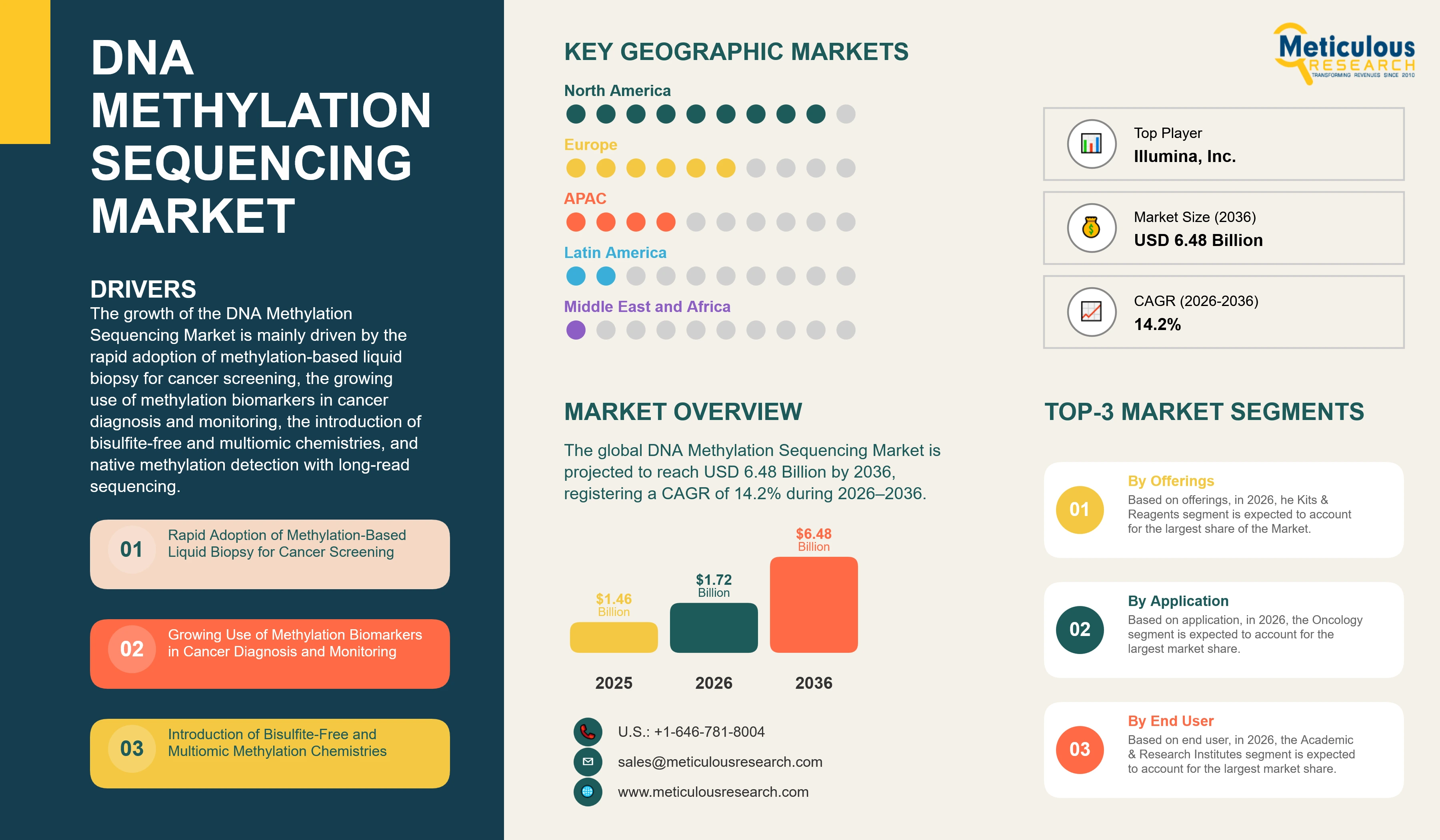
The global DNA Methylation Sequencing Market was valued at USD 1.46 billion in 2025. This market is expected to reach USD 6.48 billion by 2036 from an estimated USD 1.72 billion in 2026, registering a CAGR of 14.2% during the forecast period (2026-2036).
- Published
- Oct 2026
- Pages
- 367
- Format
- PDF + Excel
- Report ID
- MR-2343
- Base year
- 2025
- 2025 · BASELINE
- $1.46B
- 2036
- $6.48B
- CAGR 2026–2036
- 14.2%
2025 baseline · 2026–2036 forecast at 14.2% CAGR · hover a bar for the value
Key highlights
The global DNA Methylation Sequencing Market is projected to reach USD 6.48 billion by 2036, driven by methylation-based cancer screening, liquid biopsy, bisulfite-free chemistries, and multiomic sequencing.
North America is expected to account for the largest market share in 2026, while Asia-Pacific is projected to register the fastest growth during the forecast period. Guardant Health reported Q2 2026 Shield screening revenue of USD 53 million on about 66,000 tests, up from about 16,000 a year earlier, raised its 2026 Shield guidance to USD 218 million to USD 230 million on 270,000 to 285,000 tests, and is launching an FDA-approved, higher-throughput, methylation-only Shield workflow expected to reduce costs by about 15% by the end of 2026.
By offering, Kits & Reagents are expected to account for the largest market share in 2026, whereas Services are projected to witness the fastest growth through 2036. GRAIL, whose Galleri multi-cancer early detection test uses a targeted methylation-based sequencing platform, reported Q2 2026 Galleri revenue of USD 42.6 million, up 24%, on more than 61,000 tests, up 35%, has submitted a premarket approval (PMA) application to the U.S. Food and Drug Administration (FDA), and anticipates an FDA advisory committee meeting in fall 2026.
Methylation sequencing is moving beyond bisulfite. In October 2025, Illumina launched the 5-Base Solution, which uses proprietary conversion chemistry to detect DNA methylation at single-base resolution together with genomic variants from a single sample on NovaSeq and NextSeq 2000 systems, with custom DRAGEN algorithms and Illumina Connected Multiomics for analysis, following an early-access program with more than 50 testers.
By technology, Bisulfite Sequencing is expected to account for the largest market share in 2026, while Enzymatic & Chemical Conversion Sequencing is projected to grow the fastest. In February 2026, biomodal and Element Biosciences announced that the biomodal duet +modC (5-base) and duet evoC (6-base) multiomic solutions are compatible with Element AVITI and AVITI24 sequencers, validated at the University of Minnesota Genomics Center for cancer, aging, and neurodegenerative disease research.
Report summary
| Particulars | Details |
|---|---|
| Forecast Period | 2026-2036 |
| Base Year | 2025 |
| Estimated Year | 2026 |
| CAGR (Value) | 14.2% |
| Format | PDF, Excel & Cloud Portal · 367 pages |
| Market Size (Value) in 2026 | USD 1.72 Billion |
| Market Size (Value) in 2036 | USD 6.48 Billion |
| Segments Covered | By Offering: Kits & Reagents (Bisulfite Conversion Kits, Enzymatic & Chemical Conversion Kits, Library Preparation Kits, Target Enrichment Panels), Instruments, Software & Bioinformatics, Services (Clinical Testing Services, Research Sequencing Services). By Technology: Bisulfite Sequencing (Whole-Genome Bisulfite Sequencing, Reduced Representation Bisulfite Sequencing, Targeted Bisulfite Sequencing), Enzymatic & Chemical Conversion Sequencing, Long-Read Native Methylation Sequencing, Other Technologies. By Approach: Targeted, Whole-Genome, Reduced Representation. By Sample Type: Blood & Cell-Free DNA, Tissue, Other Samples. By Application: Oncology (Cancer Screening & Early Detection, Diagnosis & Monitoring, Cancer Research), Genetic & Rare Diseases, Neurological Disorders, Aging & Biological Age Research, Reproductive & Developmental Biology, Other Applications. By End User: Academic & Research Institutes, Diagnostic Laboratories, Pharmaceutical & Biotechnology Companies, Hospitals & Clinics, Other End Users. |
| Countries Covered | North America: U.S., Canada. Europe: U.K., Germany, France, Netherlands, Spain, Italy, Rest of Europe. Asia-Pacific: China, Japan, South Korea, Singapore, Australia, India, Rest of Asia-Pacific. Latin America: Brazil, Mexico, Rest of Latin America. Middle East & Africa: Saudi Arabia, UAE, Qatar, Rest of Middle East & Africa. |
| Key Companies | Illumina, Inc., Pacific Biosciences of California, Inc., Oxford Nanopore Technologies plc, New England Biolabs, Inc., Zymo Research Corporation, Agilent Technologies, Inc., QIAGEN N.V., Twist Bioscience Corporation, biomodal Limited, GRAIL, Inc., and Guardant Health, Inc. |
Report overview
Segments covered: offering, technology, approach, sample type, application, end user.
The growth of this market is mainly driven by the rapid adoption of methylation-based liquid biopsy tests for cancer screening and early detection, the growing use of DNA methylation as a biomarker for cancer diagnosis, monitoring, and tissue-of-origin identification, the introduction of bisulfite-free conversion chemistries and multiomic sequencing solutions, and the increasing ability of long-read sequencing platforms to detect methylation natively. In addition, the expansion of epigenetic research in aging, neurology, and rare diseases, the declining cost of sequencing, and the use of machine learning to interpret methylation patterns are further supporting the growth of this market.
The DNA Methylation Sequencing Market, also referred to as the methylation sequencing market, methyl-seq market, or epigenetic sequencing market, comprises the kits and reagents, instruments, software, and services used to map the methylation of cytosine bases across the genome or in targeted regions using sequencing. DNA methylation, most commonly 5-methylcytosine (5mC), is a chemical modification that regulates gene expression without changing the DNA sequence, and abnormal methylation patterns are associated with cancer, aging, neurological disorders, and developmental and rare diseases. The market includes bisulfite conversion kits used in whole-genome bisulfite sequencing (WGBS), reduced representation bisulfite sequencing (RRBS), and targeted bisulfite sequencing; enzymatic and chemical conversion kits, such as enzymatic methyl-seq (EM-seq), the Illumina 5-Base Solution, and biomodal duet solutions that can distinguish 5mC from 5-hydroxymethylcytosine (5hmC); library preparation and target enrichment panels; short-read and long-read sequencers used for methylation analysis; bioinformatics software; and research sequencing services and clinical methylation-based testing services. The market ecosystem extends from reagent and instrument manufacturers to software providers, research service providers, academic and clinical research institutions, pharmaceutical companies, and diagnostic laboratories.
The market is experiencing rapid growth as DNA methylation emerges as one of the most informative biomarkers for cancer detection. Cancer cells shed DNA into the bloodstream, and the methylation patterns of this cell-free DNA (cfDNA) can reveal both the presence of cancer and the tissue in which it originated. Methylation signals are more abundant and more tissue-specific than many genetic mutations, making them well suited to early detection, when tumor DNA in the blood is scarce. This has made methylation sequencing the foundation of several leading cancer screening tests and a central component of the liquid biopsy market.
Clinical cancer screening has become the most important growth driver for the market. GRAIL, whose Galleri multi-cancer early detection test uses a targeted methylation-based sequencing platform, reported Q2 2026 Galleri revenue of USD 42.6 million, up 24%, on more than 61,000 tests, up 35%, has submitted a premarket approval (PMA) application to the U.S. Food and Drug Administration (FDA), and anticipates an FDA advisory committee meeting in fall 2026. Results from the NHS-Galleri trial presented at the American Society of Clinical Oncology (ASCO) annual meeting in May 2026 showed that Galleri detected 937 cancers, about 40% at Stage I-II, and was associated with 22% and 26% reductions in Stage IV diagnoses in the second and third screening rounds for 12 prespecified aggressive cancers, while the PATHFINDER 2 study showed a 6.5-fold increase in cancers detected compared with standard recommended screenings. Guardant Health reported Q2 2026 Shield screening revenue of USD 53 million on about 66,000 tests, up from about 16,000 a year earlier, raised its 2026 Shield guidance to USD 218 million to USD 230 million on 270,000 to 285,000 tests, and is launching an FDA-approved, higher-throughput, methylation-only Shield workflow expected to reduce costs by about 15% by the end of 2026. Guardant Health also reports more than 700,000 epigenetic profiles in its data repository, and its Guardant360 Liquid CDx test integrates both genomic and epigenomic content. The growth of these tests is driving demand for high-throughput methylation sequencing, targeted methylation panels, and sequencing capacity in clinical laboratories.
Technology innovation is expanding the capabilities of methylation sequencing. Bisulfite conversion, the long-standing standard, damages DNA and reduces sequence complexity, which limits sensitivity and makes it difficult to analyze low-input samples such as cfDNA. Enzymatic conversion methods such as EM-seq, developed by New England Biolabs and used in the Twist EM-Seq v2 Methylation Detection System, are gentler on DNA and improve library quality. In October 2025, Illumina launched the 5-Base Solution, which uses proprietary conversion chemistry to detect DNA methylation at single-base resolution together with genomic variants from a single sample on NovaSeq and NextSeq 2000 systems, with custom DRAGEN algorithms and Illumina Connected Multiomics for analysis, following an early-access program with more than 50 testers. In February 2026, biomodal and Element Biosciences announced that the biomodal duet +modC (5-base) and duet evoC (6-base) multiomic solutions are compatible with Element AVITI and AVITI24 sequencers, validated at the University of Minnesota Genomics Center for cancer, aging, and neurodegenerative disease research. These solutions enable genetic and epigenetic information to be obtained from the same sample, supporting multiomic research and clinical applications.
Long-read sequencing platforms detect methylation directly from native DNA without conversion. PacBio began the global commercial rollout of its SPRQ-Nx chemistry in 2026, offering whole-genome sequencing at a list price of USD 345 per genome with enhanced methylation detection, while Oxford Nanopore Technologies reported 35% growth in clinical revenue in the first half of 2026. Native methylation detection allows phased, haplotype-resolved methylation analysis across repetitive and complex regions, supporting applications in rare disease, imprinting disorders, and cancer research.
Research applications are also expanding. DNA methylation is used to study gene regulation in cancer, immunology, neuroscience, and development, and methylation-based epigenetic clocks are widely used in aging research to estimate biological age. In addition, methylation sequencing is used in prenatal and reproductive research, rare disease diagnosis, and pharmaceutical biomarker development.
At the same time, the market faces challenges related to the cost of whole-genome methylation sequencing, the complexity of data analysis, and the regulatory and reimbursement requirements for clinical tests. GRAIL reported a net loss of USD 110.2 million in Q2 2026 as it invests in clinical evidence and regulatory approval, illustrating the investment required to bring methylation-based screening to market. As a result, providers that can reduce cost, improve sensitivity with low-input samples, and support clinical-grade workflows are expected to capture the largest share of growth over the forecast period.
Report infographic
Market dynamics
15 factors across 5 forcesRapid Adoption of Methylation-Based Liquid Biopsy for Cancer Screening
The rapid adoption of methylation-based liquid biopsy tests for cancer screening is a major factor driving the DNA Methylation Sequencing Market, as methylation patterns in cfDNA enable the detection of cancer and identification of its tissue of origin from a simple blood draw. GRAIL reported more than 117,000 Galleri tests in the first half of 2026, up 42%, and Guardant Health reported about 66,000 Shield tests in Q2 2026, up from about 16,000 a year earlier. Guardant expects 270,000 to 285,000 Shield tests in 2026.
Each test requires methylation sequencing, targeted enrichment, and bioinformatics analysis, making clinical screening a fast-growing source of demand for sequencing reagents, capacity, and services. As screening tests gain regulatory approvals, guideline inclusion, and reimbursement, demand for methylation sequencing is expected to grow strongly over the forecast period.
Growing Use of Methylation Biomarkers in Cancer Diagnosis and Monitoring
The growing use of methylation biomarkers in cancer diagnosis, monitoring, and treatment selection is significantly accelerating market growth. Methylation signals can identify tumor tissue of origin, detect minimal residual disease, monitor treatment response, and classify tumors, complementing genomic mutation analysis. Galleri identified the cancer signal origin more than 90% of the time in PATHFINDER 2, and Guardant360 Liquid CDx integrates genomic and epigenomic content. As oncologists seek more sensitive and informative liquid biopsy tests, the integration of methylation analysis into diagnostic and monitoring tests is expected to increase.
Introduction of Bisulfite-Free and Multiomic Methylation Chemistries
The introduction of bisulfite-free and multiomic methylation chemistries is expanding the use of methylation sequencing. Enzymatic and chemical conversion methods preserve DNA integrity, improve library quality, and allow genetic variants and methylation to be detected together. In October 2025, Illumina launched the 5-Base Solution, which uses proprietary conversion chemistry to detect DNA methylation at single-base resolution together with genomic variants from a single sample on NovaSeq and NextSeq 2000 systems, with custom DRAGEN algorithms and Illumina Connected Multiomics for analysis, following an early-access program with more than 50 testers. In February 2026, biomodal and Element Biosciences announced that the biomodal duet +modC (5-base) and duet evoC (6-base) multiomic solutions are compatible with Element AVITI and AVITI24 sequencers, validated at the University of Minnesota Genomics Center for cancer, aging, and neurodegenerative disease research. These technologies are making methylation analysis more accessible to laboratories already using short-read sequencers and are expected to drive adoption in research and clinical settings.
Native Methylation Detection with Long-Read Sequencing
The ability of long-read sequencing platforms to detect methylation directly from native DNA is creating new demand for methylation analysis. PacBio HiFi and Oxford Nanopore sequencing detect 5mC without conversion, enabling haplotype-resolved methylation analysis in difficult genomic regions. PacBio introduced SPRQ-Nx chemistry with enhanced methylation detection and a USD 345 list price per genome in 2026, making combined genetic and epigenetic analysis more affordable. As long-read sequencing is adopted in rare disease, population genomics, and cancer research, native methylation data are becoming a standard output, supporting the growth of the market.
Table of contents
14 chapters · 165 sections · 367 pages · click to expandSegmental analysis
| Segment | Largest share (2026) | Fastest growth (2026–2036) |
|---|---|---|
| By Offering | Kits & Reagents | Services |
| By Technology | Bisulfite Sequencing | Enzymatic & Chemical Conversion Sequencing |
| By Approach | Targeted Methylation Sequencing | Whole-Genome Methylation Sequencing |
| By Sample Type | Blood & Cell-Free DNA | Blood & Cell-Free DNA |
| By Application | Oncology | Oncology |
| By End User | Academic & Research Institutes | Diagnostic Laboratories |
By Offering
- DNA Methylation Sequencing Market Analysis by Offering
- Kits & reagents are further segmented into Bisulfite Conversion Kits, Enzymatic & Chemical Conversion Kits, Library Preparation Kits, and Target Enrichment Panels, while services are further segmented into Clinical Testing Services and Research Sequencing Services.
- The Kits & Reagents segment is expected to account for the largest share of the global DNA Methylation Sequencing Market.
- The large share of this segment is mainly due to the recurring use of conversion kits, library preparation kits, and enrichment panels in every methylation sequencing experiment and clinical test, and the broad adoption of methylation analysis across research and clinical laboratories.
- However, the Services segment is projected to register the highest CAGR during the forecast period.
- The rapid growth of this segment is attributed to the rapid scale-up of methylation-based clinical tests, including more than 61,000 Galleri tests and about 66,000 Shield tests in Q2 2026, and the increasing outsourcing of whole-genome and targeted methylation sequencing by research institutions and pharmaceutical companies.
- The Software & Bioinformatics segment is expected to record strong growth, supported by the need for specialized methylation analysis pipelines and machine learning classifiers, while the Instruments segment is expected to grow with the adoption of high-throughput short-read and long-read sequencers capable of methylation analysis.
By Technology
- DNA Methylation Sequencing Market Analysis by Technology
- Bisulfite sequencing is further segmented into Whole-Genome Bisulfite Sequencing, Reduced Representation Bisulfite Sequencing, and Targeted Bisulfite Sequencing.
- The Bisulfite Sequencing segment is expected to account for the largest market share, due to its long-established use as the reference method for methylation analysis, the wide availability of kits and analysis tools, and its use in many existing research and clinical workflows.
- However, the Enzymatic & Chemical Conversion Sequencing segment is projected to register the highest CAGR during the forecast period, owing to the advantages of these methods in preserving DNA integrity and improving library quality for low-input samples, and the launch of solutions such as the Illumina 5-Base Solution and the biomodal duet portfolio.
- The Long-Read Native Methylation Sequencing segment is also expected to record strong growth, supported by lower-cost long-read genomes with methylation detection, such as the PacBio SPRQ-Nx chemistry.
By Approach
- DNA Methylation Sequencing Market Analysis by Approach
- The Targeted Methylation Sequencing segment is expected to account for the largest market share, as clinical screening and diagnostic tests such as Galleri rely on targeted methylation panels to achieve deep coverage at clinically informative regions at an affordable cost.
- However, the Whole-Genome Methylation Sequencing segment is projected to register the highest CAGR during the forecast period, driven by declining sequencing costs, the availability of combined genetic and epigenetic whole-genome solutions, and native methylation detection in long-read whole-genome sequencing.
By Sample Type
- DNA Methylation Sequencing Market Analysis by Sample Type
- The Blood & Cell-Free DNA segment is expected to account for the largest market share and register the highest CAGR during the forecast period, due to the rapid growth of methylation-based liquid biopsy tests for cancer screening, diagnosis, and monitoring, and the use of blood samples in aging and population health research.
By Application
- DNA Methylation Sequencing Market Analysis by Application
- Oncology is further segmented into Cancer Screening & Early Detection, Diagnosis & Monitoring, and Cancer Research.
- The Oncology segment is expected to account for the largest market share, due to the central role of methylation in cancer biology and the rapid growth of methylation-based liquid biopsy tests.
- Within oncology, the Cancer Screening & Early Detection sub-segment is projected to register the highest CAGR during the forecast period, driven by the growth of Galleri and Shield volumes, the PMA submission for Galleri, and the development of multi-cancer detection.
- The Aging & Biological Age Research segment is also expected to record strong growth, supported by the use of methylation-based epigenetic clocks in research on aging and preventive health.
By End User
- DNA Methylation Sequencing Market Analysis by End User
- The Academic & Research Institutes segment is expected to account for the largest market share, as universities and research institutes conduct a large share of epigenetic research using whole-genome, reduced representation, and targeted methylation sequencing.
- However, the Diagnostic Laboratories segment is projected to register the highest CAGR during the forecast period, driven by the rapid growth of methylation-based screening and diagnostic testing in clinical laboratories.
Geographic analysis
North America
Largest shareIn 2026, North America is expected to account for the largest share of the global DNA Methylation Sequencing Market. The large share of this region is mainly attributed to the commercial availability of methylation-based cancer screening tests, the presence of leading test developers and technology providers, including GRAIL, Guardant Health, Illumina, PacBio, New England Biolabs, Zymo Research, and Twist Bioscience, and strong research funding. In the U.S., GRAIL performed more than 61,000 Galleri tests and Guardant Health about 66,000 Shield tests in Q2 2026, and the GRAIL PMA submission for Galleri, with an FDA advisory committee anticipated in fall 2026, could further expand the clinical use of methylation sequencing. Canada is expected to contribute to regional growth, supported by academic research and clinical genetics, including rare disease research using the Illumina 5-Base Solution.
Europe
Europe is expected to account for a significant share of the market, supported by strong academic research, large clinical trials, and the presence of technology providers such as Oxford Nanopore Technologies and biomodal in the U.K. and QIAGEN in Germany. The U.K. is an important market due to the NHS-Galleri trial, the largest randomized controlled trial of a multi-cancer early detection test, which has screened more than 140,000 participants. Oxford Nanopore reported 23% constant-currency growth in EMEAI in the first half of 2026. Germany, France, the Netherlands, Spain, and the Nordic countries are also expected to contribute, supported by epigenetic research and cancer research programs.
Asia-Pacific
Fastest growthAsia-Pacific is projected to register the highest CAGR during the forecast period. The growth of this region is driven by the large and aging population, the high burden of cancers such as liver, gastric, esophageal, colorectal, and lung cancer, expanding cancer screening programs, and growing investment in genomics and precision medicine. China is expected to account for the largest share within Asia-Pacific, supported by a strong genomics industry and the development of domestic methylation-based cancer detection tests, while Japan, South Korea, Singapore, Australia, and India are expected to see strong growth, supported by cancer research and clinical genomics programs. However, Oxford Nanopore reported a 16% revenue decline in China in the first half of 2026, reflecting trade and market access challenges for some international providers.
Latin America
Latin America and the Middle East & Africa are expected to account for smaller shares of the market. In Latin America, demand is supported by academic research and growing cancer diagnostics in Brazil and Mexico, while in the Middle East, national genomic medicine programs in Saudi Arabia, the UAE, and Qatar are expected to create demand for methylation sequencing.
Competitive landscape
The global DNA Methylation Sequencing Market is moderately consolidated, with leading sequencing platform providers and reagent suppliers accounting for a significant share of the research market, and a small number of clinical test developers leading the methylation-based screening and diagnostics segment. Market participants compete primarily on conversion efficiency and DNA preservation, sensitivity with low-input samples, cost per sample, the ability to combine genetic and epigenetic analysis, analysis software, clinical evidence, and regulatory approvals.
Leading companies are launching bisulfite-free and multiomic chemistries, reducing sequencing costs, developing targeted methylation panels, building clinical evidence, and pursuing regulatory approvals. Recent examples include the launch of the Illumina 5-Base Solution in October 2025, the compatibility of biomodal duet solutions with Element Biosciences sequencers in February 2026, the rollout of PacBio SPRQ-Nx chemistry with enhanced methylation detection in 2026, the presentation of NHS-Galleri and PATHFINDER 2 results at ASCO in May 2026, the GRAIL PMA submission for Galleri, and the launch of the methylation-only Shield workflow by Guardant Health in August 2026.
The report provides a comprehensive competitive assessment of the leading companies operating in the global DNA Methylation Sequencing Market. The key players profiled in the report include Illumina, Inc. (U.S.), Pacific Biosciences of California, Inc. (U.S.), Oxford Nanopore Technologies plc (U.K.), New England Biolabs, Inc. (U.S.), Zymo Research Corporation (U.S.), Agilent Technologies, Inc. (U.S.), QIAGEN N.V. (Netherlands), Twist Bioscience Corporation (U.S.), biomodal Limited (U.K.), GRAIL, Inc. (U.S.), and Guardant Health, Inc. (U.S.).
- Illumina, Inc.
- Pacific Biosciences of California, Inc.
- Oxford Nanopore Technologies plc
- New England Biolabs, Inc.
- Zymo Research Corporation
- Agilent Technologies, Inc.
- QIAGEN N.V.
- Twist Bioscience Corporation
- GRAIL, Inc.
- Guardant Health, Inc
Expert perspectives
The DNA Methylation Sequencing Market is entering a period in which clinical testing, rather than research alone, is becoming the main driver of growth. With more than 61,000 Galleri tests and about 66,000 Shield tests in a single quarter, a PMA application for Galleri under FDA review, and bisulfite-free chemistries now available on major short-read platforms, methylation sequencing is moving from a specialized research technique to a core technology for cancer detection. The binding constraint is shifting from the ability to measure methylation to the ability to demonstrate clinical benefit, secure regulatory approval and reimbursement, and reduce cost per test.
Three structural changes are expected to shape competitive positions through 2036. First, methylation-based screening is shifting volume from research to clinical laboratories, favoring providers that can support high-throughput, clinical-grade workflows. Second, the transition from bisulfite to enzymatic and chemical conversion, together with native methylation detection on long-read platforms, is enabling combined genetic and epigenetic analysis as a standard output. Third, the regulatory and clinical outcomes for multi-cancer early detection tests are expected to determine the size of the largest potential application.
For companies planning entry or expansion, the most defensible positions over the forecast period are likely to be found in low-input conversion chemistries, targeted methylation panels for liquid biopsy, methylation analysis software and machine learning classifiers, and high-throughput clinical laboratory services. For established providers, the principal risks are regulatory and reimbursement uncertainty for screening tests, sensitivity limits in early-stage cancer, and the cost of whole-genome methylation analysis.
Overall, the market is expected to grow strongly, with kits and reagents, bisulfite sequencing, targeted approaches, and oncology providing the core of demand and services, enzymatic and chemical conversion, whole-genome approaches, cancer screening, diagnostic laboratories, and Asia-Pacific providing the fastest growth.
Customer perspectives
Insights gathered during primary interviews with epigenetics researchers, clinical laboratory directors, and liquid biopsy developers operating in this market highlight where procurement priorities are shifting. The following perspectives reflect recurring themes raised across these discussions.
“This reflects the shift of methylation sequencing toward clinical scale.”
“This indicates the value of new conversion chemistries for research.”
“This points to the growing role of native methylation detection in clinical genetics.”
Frequently asked questions
The global DNA Methylation Sequencing Market is estimated at USD 1.72 billion in 2026.
Cite this report
Meticulous Research. (2026). DNA Methylation Sequencing Market - Global Opportunity Analysis And Industry Forecast (2026-2036) (Report No. MR-2343). Meticulous Market Research Pvt. Ltd. https://www.meticulousresearch.com/product/dna-methylation-sequencing-market-7026