16S rRNA and Amplicon Sequencing Market (2026-2036)
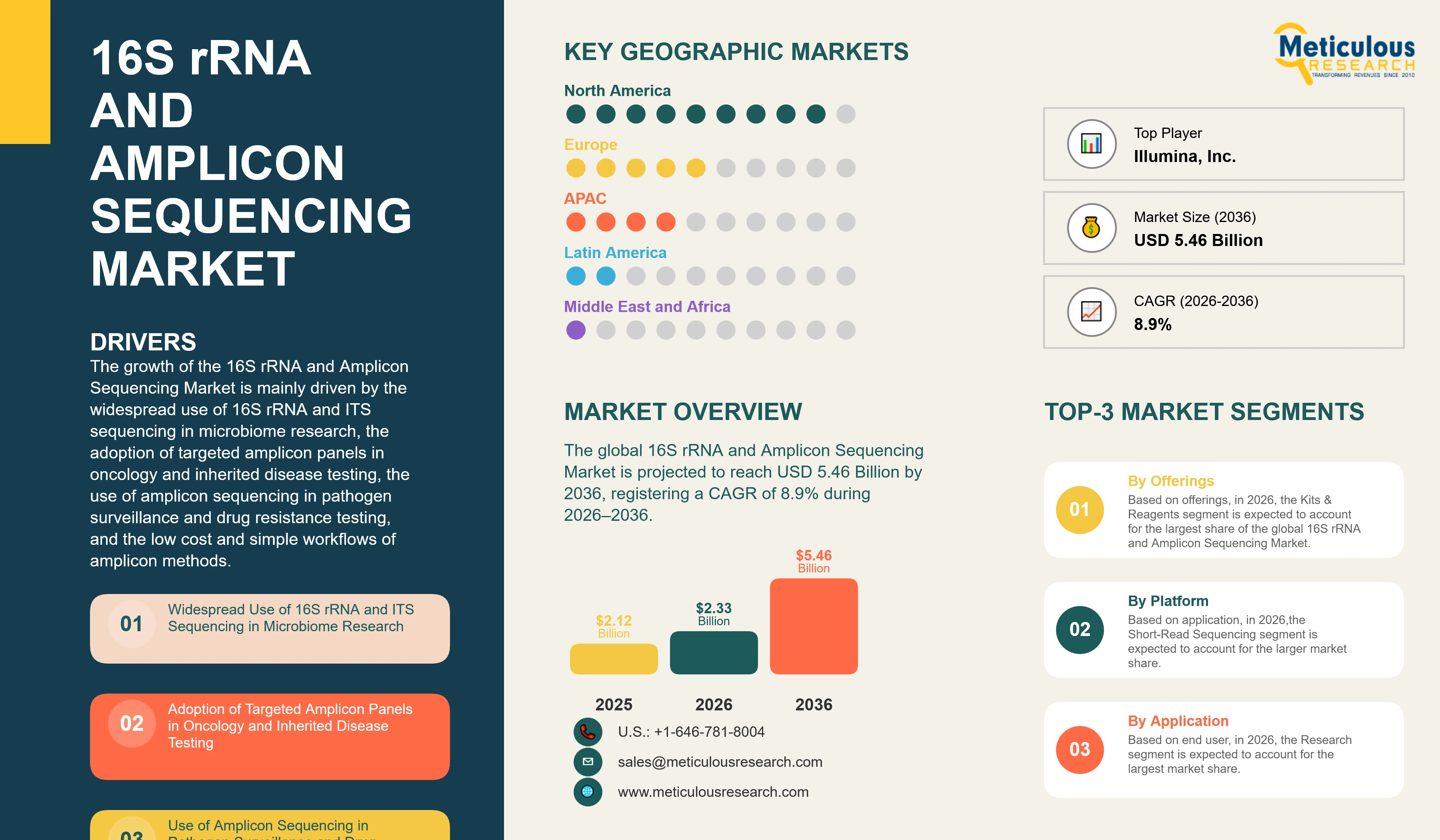
The global 16S rRNA and Amplicon Sequencing Market was valued at USD 2.12 billion in 2025. This market is expected to reach USD 5.46 billion by 2036 from an estimated USD 2.33 billion in 2026, registering a CAGR of 8.9% during the forecast period (2026-2036).
- Published
- Oct 2026
- Pages
- 313
- Format
- PDF + Excel
- Report ID
- MR-2337
- Base year
- 2025
- 2025 · BASELINE
- $2.12B
- 2036
- $5.46B
- CAGR 2026–2036
- 8.9%
2025 baseline · 2026–2036 forecast at 8.9% CAGR · hover a bar for the value
Key highlights
The global 16S rRNA and Amplicon Sequencing Market is projected to reach USD 5.46 billion by 2036, driven by microbiome research, targeted oncology panels, pathogen surveillance, and long-read full-length marker gene sequencing.
North America is expected to account for the largest market share in 2026, while Asia-Pacific is projected to register the fastest growth during the forecast period, supported by expanding microbiome and agricultural genomics research, clinical NGS adoption, and public health sequencing capacity in China, Japan, South Korea, and India.
Amplicon-based NGS is delivering rapid clinical results. In July 2025, Thermo Fisher Scientific received U.S. Food and Drug Administration (FDA) approval for the Oncomine Dx Express Test, a targeted amplicon-based NGS test that detects mutations across 46 genes on the Ion Torrent Genexus Dx Integrated Sequencer with results in as little as 24 hours, as a companion diagnostic for ZEGFROVY (sunvozertinib) in non-small cell lung cancer with EGFR exon 20 insertion mutations and for tumor profiling in solid tumors.
Long-read platforms are enabling full-length marker gene sequencing. In September 2025, Oxford Nanopore Technologies launched the Microbial Amplicon Barcoding Kit 24 V14 for full-length 16S rRNA gene and full-length ITS sequencing of bacteria, archaea, and fungi, with support for custom primers and a sequencing-ready library in about one hour after PCR, enabling same-day microbial profiling results.
By target type, Human Targeted Gene Panels are expected to account for the largest market share in 2026, whereas 16S rRNA & ITS Microbial Marker Gene Sequencing is projected to witness the fastest growth through 2036, supported by microbiome research, clinical gut microbiome testing, and full-length long-read sequencing.
Report summary
| Particulars | Details |
|---|---|
| Forecast Period | 2026-2036 |
| Base Year | 2025 |
| Estimated Year | 2026 |
| CAGR (Value) | 8.9% |
| Format | PDF, Excel & Cloud Portal · 313 pages |
| Market Size (Value) in 2026 | USD 2.33 Billion |
| Market Size (Value) in 2036 | USD 5.46 Billion |
| Segments Covered | By Offering: Kits & Reagents (Amplicon Panels & Primers, Library Preparation Kits, Other Reagents), Instruments, Software & Bioinformatics, Services. By Target Type: Human Targeted Gene Panels (Oncology Panels, Inherited Disease Panels, Pharmacogenomic Panels), 16S rRNA & ITS Microbial Marker Gene Sequencing, Pathogen Genome & Resistance Amplicon Sequencing, Plant & Animal Genotyping Amplicons, Other Targets. By Platform: Short-Read Sequencing, Long-Read Sequencing. By Application: Research, Clinical Diagnostics, Public Health & Infectious Disease Surveillance, Drug Discovery & Development, Agriculture, Food & Environmental Testing. By End User: Academic & Research Institutes, Hospitals & Clinical Laboratories, Pharmaceutical & Biotechnology Companies, Public Health Laboratories, Agricultural & Food Companies. |
| Countries Covered | North America: U.S., Canada. Europe: U.K., Germany, France, Netherlands, Italy, Spain, Rest of Europe. Asia-Pacific: China, Japan, South Korea, India, Australia, Rest of Asia-Pacific. Latin America: Brazil, Argentina, Mexico, Rest of Latin America. Middle East & Africa: South Africa, Saudi Arabia, UAE, Rest of Middle East & Africa. |
| Key Companies | Illumina, Inc., Thermo Fisher Scientific Inc., QIAGEN N.V., Danaher Corporation (Integrated DNA Technologies), Pacific Biosciences of California, Inc., Oxford Nanopore Technologies plc, Zymo Research Corporation, and Pillar Biosciences, Inc. |
Report overview
Segments covered: offering, target type, platform, application, end user.
The growth of this market is mainly driven by the widespread use of 16S rRNA and ITS amplicon sequencing in microbiome research, the adoption of targeted amplicon-based NGS panels for oncology and inherited disease testing, the use of amplicon sequencing for viral genome surveillance and drug resistance testing, and the low cost and simple workflows of amplicon methods compared with whole-genome approaches. In addition, the introduction of full-length 16S and ITS sequencing on long-read platforms, the approval of amplicon-based companion diagnostics with rapid turnaround, the use of amplicon sequencing for genotyping in agriculture and food testing, and the verification of gene editing in cell and gene therapy development are further supporting the growth of this market.
The 16S rRNA and Amplicon Sequencing Market, also referred to as the targeted amplicon sequencing market, amplicon-based NGS market, or marker gene sequencing market, comprises the kits and reagents, instruments, software, and services used to amplify and sequence specific regions of DNA or RNA. Amplicon sequencing uses PCR to enrich target regions before sequencing, providing a low-cost, sensitive, and simple approach for analyzing selected genes. The market includes 16S rRNA gene and internal transcribed spacer (ITS) sequencing for profiling bacterial and fungal communities; targeted human gene panels for oncology hotspot mutations, inherited disease, and pharmacogenomics; pathogen amplicon sequencing for viral genome surveillance and drug resistance; amplicon-based genotyping for plant and animal breeding and food testing; and the use of amplicon sequencing to verify gene editing. It includes amplicon panels, primers, library preparation kits, and reagents; short-read and long-read sequencers; analysis software; and sequencing services. The market ecosystem extends from reagent and panel developers and sequencing platform providers to service laboratories, clinical laboratories, academic and public health researchers, pharmaceutical and biotechnology companies, and agricultural and food companies.
The market is experiencing steady growth because amplicon sequencing offers an efficient balance of cost, sensitivity, and simplicity. By focusing sequencing on regions of interest, amplicon methods require less sequencing capacity than whole-genome or shotgun approaches, work with small amounts of input DNA, and can detect low-frequency variants. These advantages make amplicon sequencing well suited to large microbiome studies, routine clinical testing of tumor samples with limited tissue, rapid viral genome sequencing, and high-throughput genotyping.
Microbiome research is one of the largest applications of amplicon sequencing. 16S rRNA gene sequencing remains the most widely used method for profiling bacterial communities in human, animal, and environmental samples because of its low cost and established analysis methods, while ITS sequencing is used to profile fungi. Long-read sequencing is enabling full-length 16S and ITS sequencing, which improves taxonomic resolution to the species level. In September 2025, Oxford Nanopore Technologies launched the Microbial Amplicon Barcoding Kit 24 V14 for full-length 16S rRNA gene and full-length ITS sequencing of bacteria, archaea, and fungi, with support for custom primers and a sequencing-ready library in about one hour after PCR, enabling same-day microbial profiling results. PacBio offers Kinnex 16S kits for high-throughput full-length 16S sequencing, and Zymo Research provides full-length 16S library preparation kits and microbial community standards. At ASM Microbe 2026, Zymo Research highlighted microbial community standards, metagenomic reference materials, and benchmarked extraction and library preparation workflows, emphasizing the need to reduce lysis bias and improve the reproducibility of microbiome sequencing.
Targeted amplicon panels are widely used in clinical oncology. Amplicon-based NGS panels detect hotspot mutations, small insertions and deletions, and fusions in genes such as EGFR, KRAS, BRAF, and PIK3CA, guiding the selection of targeted therapies. In July 2025, Thermo Fisher Scientific received U.S. Food and Drug Administration (FDA) approval for the Oncomine Dx Express Test, a targeted amplicon-based NGS test that detects mutations across 46 genes on the Ion Torrent Genexus Dx Integrated Sequencer with results in as little as 24 hours, as a companion diagnostic for ZEGFROVY (sunvozertinib) in non-small cell lung cancer with EGFR exon 20 insertion mutations and for tumor profiling in solid tumors. Pillar Biosciences received FDA premarket approval for its oncoReveal Dx Lung and Colon Cancer Assay, an amplicon-based NGS test, and amplicon panels from Illumina, QIAGEN, and Integrated DNA Technologies are widely used in clinical and research laboratories. The ability of amplicon methods to work with small biopsy samples and deliver rapid results is particularly valuable for treatment decisions.
Amplicon sequencing is also central to pathogen genomics. Tiled amplicon approaches were the primary method used to sequence SARS-CoV-2 genomes during the COVID-19 pandemic and are now used for influenza, RSV, mpox, and other viruses, while targeted amplicon sequencing is used to detect drug resistance mutations in HIV and Mycobacterium tuberculosis. In agriculture and food testing, amplicon-based genotyping supports plant and animal breeding, and amplicon metabarcoding is used for food authenticity and environmental DNA monitoring.
At the same time, the market faces competition from shotgun metagenomic sequencing, hybrid capture panels, and whole-genome sequencing, which are becoming more affordable and provide broader information. Amplicon methods can also be affected by PCR bias, primer mismatches, and limited ability to detect copy number changes and novel fusions. As a result, providers that improve accuracy, resolution, and workflow speed, and that integrate amplicon sequencing with long-read and automated platforms, are expected to capture the largest share of growth over the forecast period.
Report infographic
Market dynamics
15 factors across 5 forcesWidespread Use of 16S rRNA and ITS Sequencing in Microbiome Research
The widespread use of 16S rRNA and ITS amplicon sequencing in microbiome research is a major factor driving the 16S rRNA and Amplicon Sequencing Market, as researchers investigate the role of microbial communities in human health, agriculture, and the environment. 16S sequencing is the most cost-effective method for profiling bacterial communities across large numbers of samples, making it the standard approach for cohort studies, clinical trials, and environmental surveys. The growing clinical use of microbiome testing is also creating demand, as reflected in the 78% growth in core testing volume to 22,418 tests reported by Microba Life Sciences in fiscal year 2026.
As microbiome research expands into new body sites, diseases, and environmental and agricultural applications, demand for 16S and ITS library preparation kits, sequencing, and analysis is expected to grow steadily over the forecast period.
Adoption of Targeted Amplicon Panels in Oncology and Inherited Disease Testing
The adoption of targeted amplicon-based NGS panels in oncology and inherited disease testing is significantly accelerating market growth. Amplicon panels detect clinically actionable mutations from small tissue and cytology samples with rapid turnaround, supporting treatment decisions in lung, colorectal, melanoma, and other cancers. In July 2025, Thermo Fisher Scientific received U.S. Food and Drug Administration (FDA) approval for the Oncomine Dx Express Test, a targeted amplicon-based NGS test that detects mutations across 46 genes on the Ion Torrent Genexus Dx Integrated Sequencer with results in as little as 24 hours, as a companion diagnostic for ZEGFROVY (sunvozertinib) in non-small cell lung cancer with EGFR exon 20 insertion mutations and for tumor profiling in solid tumors. FDA-approved amplicon-based tests such as the Pillar Biosciences oncoReveal Dx assay and the Thermo Fisher Scientific Oncomine Dx tests are enabling hospital laboratories to perform NGS testing in-house, supporting the decentralization of clinical NGS.
Use of Amplicon Sequencing in Pathogen Surveillance and Drug Resistance Testing
The use of amplicon sequencing in pathogen surveillance and drug resistance testing is an important driver of market growth. Tiled amplicon sequencing provides an efficient method for sequencing viral genomes directly from clinical and wastewater samples, and was used extensively for SARS-CoV-2 surveillance. Public health laboratories now apply similar approaches to influenza, RSV, mpox, and other pathogens, while targeted amplicon sequencing is used to detect drug resistance mutations in HIV and tuberculosis. As genomic surveillance becomes routine, demand for pathogen amplicon panels and sequencing is expected to remain steady.
Low Cost and Simple Workflows Compared with Whole-Genome Approaches
The low cost and simple workflows of amplicon sequencing compared with whole-genome and shotgun approaches support its use in high-volume and resource-limited settings. Amplicon methods require less sequencing capacity per sample, enable high levels of sample multiplexing, work with low-input and degraded samples, and can be performed with simple laboratory workflows. Oxford Nanopore Technologies reports that its Microbial Amplicon Barcoding Kit can produce a sequencing-ready library in about one hour after PCR. These characteristics make amplicon sequencing attractive for large studies, routine testing, and laboratories with limited resources.
Table of contents
13 chapters · 149 sections · 313 pages · click to expandSegmental analysis
| Segment | Largest share (2026) | Fastest growth (2026–2036) |
|---|---|---|
| By Offering | Kits & Reagents | Services |
| By Target Type | Human Targeted Gene Panels | 16S rRNA & ITS Microbial Marker Gene Sequencing |
| By Platform | Short-Read Sequencing | — |
| By Application | Research | Clinical Diagnostics |
| By End User | Academic & Research Institutes | Hospitals & Clinical Laboratories |
By Offering
- 16S rRNA and Amplicon Sequencing Market Analysis by Offering
- Kits & reagents are further segmented into Amplicon Panels & Primers, Library Preparation Kits, and Other Reagents.
- The Kits & Reagents segment is expected to account for the largest share of the global 16S rRNA and Amplicon Sequencing Market.
- The large share of this segment is mainly due to the recurring use of amplicon panels, primers, and library preparation kits in every amplicon sequencing experiment and clinical test, and the large installed base of short-read and long-read sequencers in research and clinical laboratories.
- However, the Services segment is projected to register the highest CAGR during the forecast period.
- The rapid growth of this segment is attributed to the outsourcing of large microbiome studies to sequencing service providers, the growth of clinical microbiome and oncology testing services, and the demand for gene editing verification services from cell and gene therapy developers.
- The Software & Bioinformatics segment is expected to record strong growth, supported by the need for standardized microbiome analysis pipelines and automated clinical reporting, while the Instruments segment is expected to grow with the adoption of integrated benchtop sequencers in hospital laboratories.
By Target Type
- 16S rRNA and Amplicon Sequencing Market Analysis by Target Type
- Human targeted gene panels are further segmented into Oncology Panels, Inherited Disease Panels, and Pharmacogenomic Panels.
- The Human Targeted Gene Panels segment is expected to account for the largest market share, due to the widespread use of amplicon-based oncology panels for treatment selection, the availability of FDA-approved amplicon-based companion diagnostics such as the Oncomine Dx Express Test and the oncoReveal Dx assay, and the use of amplicon panels in inherited disease and pharmacogenomic testing.
- However, the 16S rRNA & ITS Microbial Marker Gene Sequencing segment is projected to register the highest CAGR during the forecast period, owing to the expansion of microbiome research and clinical microbiome testing and the adoption of full-length long-read marker gene sequencing.
By Platform
- 16S rRNA and Amplicon Sequencing Market Analysis by Platform
- The Short-Read Sequencing segment is expected to account for the larger market share, due to the established use of short-read platforms for 16S variable region sequencing, clinical amplicon panels, and viral genome surveillance.
- However, the Long-Read Sequencing segment is projected to register the higher CAGR during the forecast period, driven by full-length 16S and ITS sequencing, rapid same-day workflows, and improving long-read accuracy and throughput.
By Application
- 16S rRNA and Amplicon Sequencing Market Analysis by Application
- The Research segment is expected to account for the largest market share, due to the extensive use of 16S and ITS sequencing in microbiome research and amplicon panels in genetic research.
- However, the Clinical Diagnostics segment is projected to register the highest CAGR during the forecast period, driven by the adoption of rapid in-house amplicon-based oncology testing, companion diagnostic approvals, and clinical microbiome testing.
- The Drug Discovery & Development segment is also expected to record strong growth, supported by gene editing verification and biomarker studies.
By End User
- 16S rRNA and Amplicon Sequencing Market Analysis by End User
- The Academic & Research Institutes segment is expected to account for the largest market share, as universities and research institutes perform a large share of microbiome and genetic research using amplicon methods.
- However, the Hospitals & Clinical Laboratories segment is projected to register the highest CAGR during the forecast period, driven by the decentralization of NGS testing to hospital laboratories and the growth of clinical microbiome testing.
Geographic analysis
North America
Largest shareIn 2026, North America is expected to account for the largest share of the global 16S rRNA and Amplicon Sequencing Market. The large share of this region is mainly attributed to strong research funding for microbiome and genomic research, the high adoption of clinical NGS, the availability of FDA-approved amplicon-based companion diagnostics, and the presence of leading companies, including Illumina, Thermo Fisher Scientific, Integrated DNA Technologies, PacBio, Zymo Research, and Pillar Biosciences. The FDA approval of the Oncomine Dx Express Test as a companion diagnostic and for tumor profiling in 2025 reflects the growth of rapid amplicon-based clinical testing in the U.S. Public health amplicon sequencing for viral surveillance also contributes to demand in the region. Canada is expected to contribute to regional growth, supported by microbiome research and public health genomics.
Europe
Europe is expected to account for a significant share of the market, supported by strong academic microbiome and genetic research, decentralized clinical NGS testing in hospital laboratories, and the presence of companies such as QIAGEN in Germany and Oxford Nanopore Technologies in the U.K. European hospital laboratories frequently use CE-IVD amplicon panels for oncology testing, and the EU In Vitro Diagnostic Regulation is increasing the importance of validated, regulated panels. The U.K., Germany, France, the Netherlands, Italy, and the Nordic countries are expected to account for the largest shares.
Asia-Pacific
Fastest growthAsia-Pacific is projected to register the highest CAGR during the forecast period. The growth of this region is driven by expanding microbiome research, growing adoption of clinical NGS in oncology, large agricultural genomics programs, and growing public health sequencing capacity. China is expected to account for the largest share within Asia-Pacific, supported by a large genomics services industry and agricultural genomics, while Japan, South Korea, India, and Australia, where Microba Life Sciences offers clinical gut microbiome testing, are expected to see strong growth.
Latin America
Latin America and the Middle East & Africa are expected to account for smaller shares of the market. In Latin America, demand is supported by agricultural genotyping in Brazil and Argentina and academic microbiome research, while in Africa, amplicon sequencing is used for pathogen surveillance and drug resistance testing, supported by international public health genomics initiatives, and Gulf countries are investing in clinical genomics.
Competitive landscape
The global 16S rRNA and Amplicon Sequencing Market is moderately consolidated, with a small number of sequencing platform providers and amplicon panel developers accounting for a significant share of the market, alongside specialized panel and reagent companies, microbiome workflow providers, bioinformatics companies, and sequencing service providers. Market participants compete primarily on panel content and accuracy, input requirements, workflow speed and simplicity, cost per sample, regulatory approvals, analysis software, and compatibility with sequencing platforms.
Leading companies are developing rapid and automated amplicon workflows, obtaining regulatory approvals for clinical panels, launching full-length 16S and ITS solutions for long-read platforms, and providing standards and analysis tools for microbiome studies. Recent examples include the FDA approval of the Thermo Fisher Scientific Oncomine Dx Express Test in July 2025, the launch of the Oxford Nanopore Technologies Microbial Amplicon Barcoding Kit in September 2025, and the presentation of microbiome standards and workflows by Zymo Research at ASM Microbe 2026.
The report provides a comprehensive competitive assessment of the leading companies operating in the global 16S rRNA and Amplicon Sequencing Market. The key players profiled in the report include Illumina, Inc. (U.S.), Thermo Fisher Scientific Inc. (U.S.), QIAGEN N.V. (Netherlands), Danaher Corporation (Integrated DNA Technologies) (U.S.), Pacific Biosciences of California, Inc. (U.S.), Oxford Nanopore Technologies plc (U.K.), Zymo Research Corporation (U.S.), and Pillar Biosciences, Inc. (U.S.).
- Illumina, Inc.
- Thermo Fisher Scientific Inc.
- QIAGEN N.V.
- Danaher Corporation (Integrated DNA Technologies)
- Pacific Biosciences of California, Inc.
- Oxford Nanopore Technologies plc
- Zymo Research Corporation
- Pillar Biosciences, Inc
Expert perspectives
The 16S rRNA and Amplicon Sequencing Market is entering a period in which amplicon methods must compete on resolution and speed rather than cost alone. As shotgun metagenomics, hybrid capture, and whole-genome sequencing become more affordable, amplicon sequencing is evolving through full-length long-read marker gene sequencing, rapid automated clinical panels delivering results in about 24 hours, and specialized applications such as gene editing verification and viral surveillance. The binding constraint is shifting from sequencing cost to the ability of amplicon methods to provide accurate, standardized, and actionable results quickly.
Three structural changes are expected to shape competitive positions through 2036. First, full-length 16S and ITS sequencing on long-read platforms is expected to raise the resolution of amplicon-based microbiome analysis, sustaining its role against shotgun metagenomics. Second, rapid in-house amplicon panels are expected to support the decentralization of clinical NGS testing. Third, competition from broader methods will push amplicon sequencing toward applications where speed, low input, and cost per sample matter most.
For companies planning entry or expansion, the most defensible positions over the forecast period are likely to be found in regulated rapid oncology amplicon panels, full-length long-read marker gene solutions, gene editing verification, and agricultural and food amplicon testing. For established providers, the principal risks are competition from broader sequencing methods, PCR bias and technical limitations, and the cost of maintaining panels for evolving targets.
Overall, the market is expected to grow steadily, with kits and reagents, human targeted panels, short-read platforms, research, and academic users providing the core of demand and services, 16S and ITS sequencing, long-read platforms, clinical diagnostics, hospital laboratories, and Asia-Pacific providing the fastest growth.
Customer perspectives
Insights gathered during primary interviews with microbiome researchers, molecular pathologists, and public health laboratory scientists operating in this market highlight where procurement priorities are shifting. The following perspectives reflect recurring themes raised across these discussions.
“This reflects the value of rapid in-house amplicon testing.”
“This indicates the role of full-length 16S in large studies.”
“This points to the importance of panel maintenance for pathogen surveillance.”
Frequently asked questions
The global 16S rRNA and Amplicon Sequencing Market is estimated at USD 2.33 billion in 2026.
Cite this report
Meticulous Research. (2026). 16S rRNA and Amplicon Sequencing Market - Global Opportunity Analysis And Industry Forecast (2026-2036) (Report No. MR-2337). Meticulous Market Research Pvt. Ltd. https://www.meticulousresearch.com/product/16s-rrna-amplicon-sequencing-market-7020