Long-Read Sequencing Market (2026-2036)
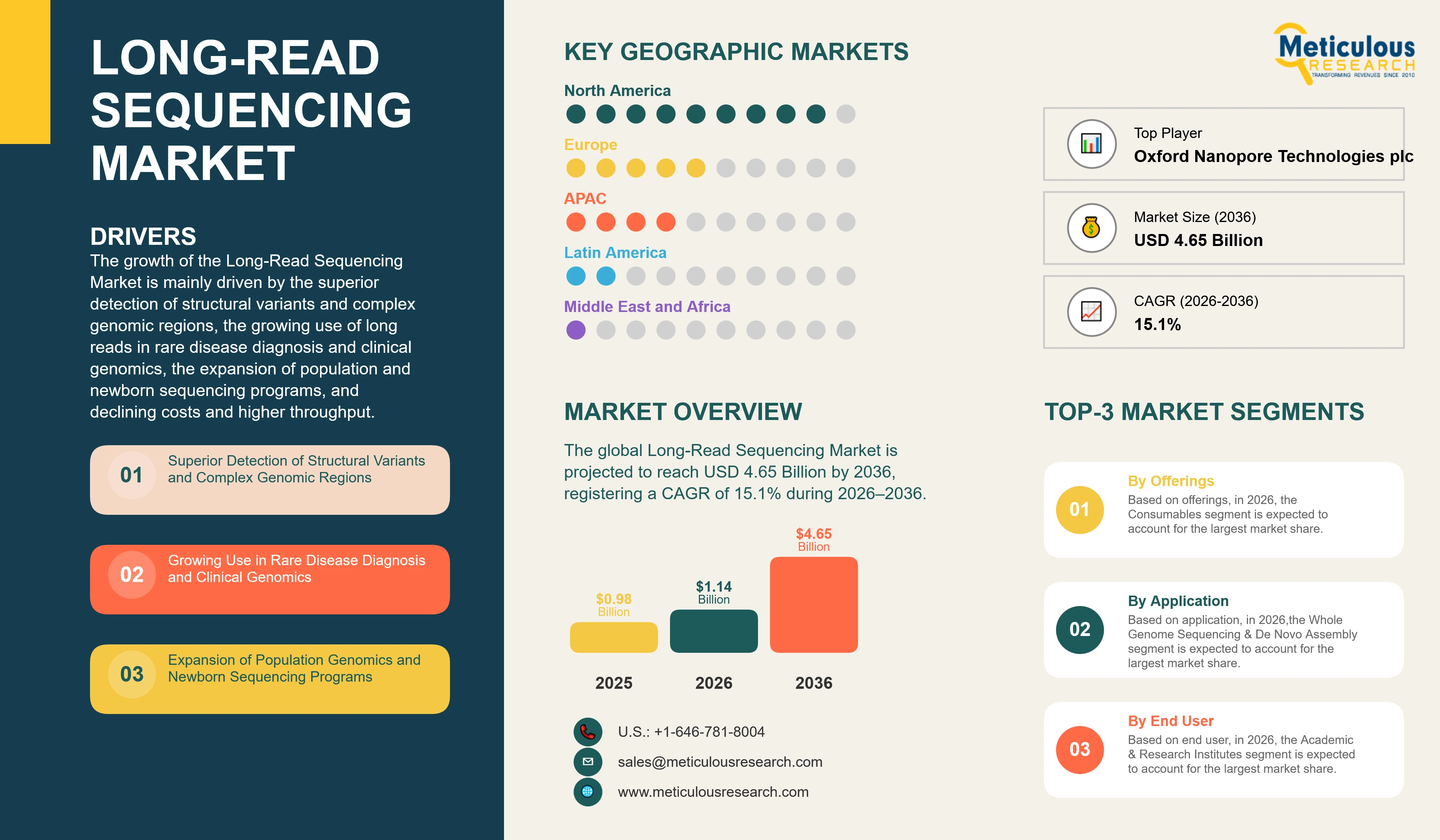
The global Long-Read Sequencing Market was valued at USD 0.98 billion in 2025. This market is expected to reach USD 4.65 billion by 2036 from an estimated USD 1.14 billion in 2026, registering a CAGR of 15.1% during the forecast period (2026-2036).
- Published
- Oct 2026
- Pages
- 327
- Format
- PDF + Excel
- Report ID
- MR-2335
- Base year
- 2025
- 2025 · BASELINE
- $980.0M
- 2036
- $4.65B
- CAGR 2026–2036
- 15.1%
2025 baseline · 2026–2036 forecast at 15.1% CAGR · hover a bar for the value
Key highlights
The global Long-Read Sequencing Market is projected to reach USD 4.65 billion by 2036, driven by structural variant detection, clinical genomics, population and newborn sequencing programs, and the declining cost of long-read platforms.
North America is expected to account for the largest market share in 2026, while Europe is projected to register the fastest growth during the forecast period. In September 2025, Genomics England awarded contracts worth about GBP 3.49 million for long-read whole genome sequencing of at least 2,000 samples across two long-read technologies, Oxford Nanopore and PacBio, for the Babies in Focus cohort within the Generation Study, which is assessing whole genome sequencing for newborn screening and rare condition diagnosis.
By technology, Nanopore Sequencing is expected to account for the largest market share in 2026 and to register the highest CAGR during the forecast period. Oxford Nanopore Technologies reported 2025 revenue of GBP 223.9 million, up 24.2% at constant currency, with clinical revenue up 59.9% to GBP 29.8 million, BioPharma revenue up 30.4% to GBP 18.1 million, Applied Industrial revenue up 27.2% to GBP 27.5 million, and PromethION revenue up 43.1% to GBP 110.6 million.
Clinical use is emerging as the fastest-growing source of demand. In H1 2026, Oxford Nanopore reported revenue of about GBP 116.5 million, up 10%, with clinical revenue up 35% and BioPharma revenue up 25%, while revenue in China declined 16% and in the Middle East 14%, and reaffirmed guidance for constant currency revenue growth of 21% to 25% in 2026.
New entrants are expanding the competitive landscape. In March 2026, MGI Tech acquired CycloneSEQ, whose G100-ER nanopore sequencing platform carries CE marking under the EU In Vitro Diagnostic Regulation (IVDR), while Illumina has commercialized its proximity mapped read technology, originally introduced as constellation, as the TruPath Genome solution for ultra-long phasing and detection of large structural rearrangements.
Report summary
| Particulars | Details |
|---|---|
| Forecast Period | 2026-2036 |
| Base Year | 2025 |
| Estimated Year | 2026 |
| CAGR (Value) | 15.1% |
| Format | PDF, Excel & Cloud Portal · 327 pages |
| Market Size (Value) in 2026 | USD 1.14 Billion |
| Market Size (Value) in 2036 | USD 4.65 Billion |
| Segments Covered | By Technology: Nanopore Sequencing, Single-Molecule Real-Time (SMRT) Sequencing, Synthetic & Mapped Long-Read Technologies. By Offering: Instruments, Consumables (Flow Cells & SMRT Cells, Sequencing Reagents, Library Preparation & Sample Extraction Kits), Services, Software & Bioinformatics. By Application: Whole Genome Sequencing & De Novo Assembly, Targeted Sequencing, Transcriptomics & Isoform Analysis, Epigenetics & Methylation Analysis, Metagenomics & Infectious Disease, Other Applications. By End User: Academic & Research Institutes, Hospitals & Clinical Laboratories, Pharmaceutical & Biotechnology Companies, Sequencing Service Providers, Applied & Public Health Laboratories. |
| Countries Covered | North America: U.S., Canada. Europe: U.K., Germany, France, Italy, Spain, Netherlands, Nordic Countries, Rest of Europe. Asia-Pacific: China, Japan, South Korea, Australia, India, Singapore, Rest of Asia-Pacific. Latin America: Brazil, Mexico, Rest of Latin America. Middle East & Africa: UAE, Saudi Arabia, Israel, Rest of Middle East & Africa. |
| Key Companies | Pacific Biosciences of California, Inc., Oxford Nanopore Technologies plc, Illumina, Inc., MGI Tech Co., Ltd., Qitan Technology Ltd., Novogene Co., Ltd., Azenta Life Sciences (GENEWIZ), Eurofins Scientific SE, Macrogen, Inc., and QIAGEN N.V. |
Report overview
Segments covered: technology, offering, application, end user.
The growth of this market is mainly driven by the ability of long-read sequencing to resolve structural variants, repeat expansions, and complex genomic regions that short-read sequencing cannot, the increasing use of long reads in rare disease diagnosis and clinical genomics, the expansion of population genomics and newborn sequencing programs, and the declining cost and rising throughput of long-read platforms. In addition, the growing adoption of full-length transcriptomics and native methylation analysis, the expansion of long-read sequencing into infectious disease, biopharmaceutical, and applied markets, the availability of benchtop and IVD-marked systems, and the entry of new technology providers are further supporting the growth of this market.
The Long-Read Sequencing Market, also referred to as the third-generation sequencing, single-molecule sequencing, or long-read DNA and RNA sequencing market, comprises the instruments, consumables, services, and software used to sequence DNA and RNA molecules thousands to millions of bases long in a single read. The market includes nanopore sequencing, which reads nucleic acids as they pass through protein nanopores; single-molecule real-time (SMRT) sequencing, including high-fidelity (HiFi) sequencing; and synthetic and mapped long-read technologies that reconstruct long-range genomic information on short-read platforms. It covers sequencing instruments, flow cells and SMRT Cells, sequencing reagents, library preparation and high-molecular-weight DNA extraction kits, target enrichment panels, sequencing services, and bioinformatics software. These technologies enable complete genome assembly, structural variant and repeat expansion detection, full-length transcript analysis, and direct detection of DNA and RNA modifications. The market ecosystem extends from sample preparation and reagent suppliers to platform manufacturers, sequencing service providers, bioinformatics providers, diagnostics partners, and academic, clinical, pharmaceutical, and applied end users.
The market is experiencing strong growth as researchers and clinicians increasingly recognize that a significant share of medically relevant genetic variation lies in regions that short-read sequencing cannot reliably resolve, including structural variants, segmental duplications, tandem repeats, and complex genes involved in repeat expansion disorders and drug metabolism. Long reads can span these regions in a single molecule, phase variants across entire genes and chromosomes, and detect methylation directly without chemical conversion, providing a more complete view of the genome than short reads alone. As a result, long-read sequencing is moving from a specialized research tool toward a mainstream complement to short-read sequencing in genomics laboratories, genome centers, and clinical programs.
The two established platform providers reflect the changing structure of demand. Oxford Nanopore Technologies reported 2025 revenue of GBP 223.9 million, up 24.2% at constant currency, with clinical revenue up 59.9% to GBP 29.8 million, BioPharma revenue up 30.4% to GBP 18.1 million, Applied Industrial revenue up 27.2% to GBP 27.5 million, and PromethION revenue up 43.1% to GBP 110.6 million. The company also registered its first in vitro diagnostic product, GridION Dx, with CE and UKCA marking, launched the AmPORE-TB assay for drug-resistant tuberculosis with bioMérieux, and formed a partnership with Cepheid for automated infectious disease sequencing, while guiding to constant currency revenue growth of 21% to 25% in 2026 and adjusted EBITDA breakeven in 2027. PacBio reported 2025 revenue of about USD 160.0 million, up 4%, with record consumables revenue of about USD 81.9 million, up from USD 70.3 million, and placements of 61 Revio and 140 Vega systems, and expects 2026 revenue of USD 155 million to USD 165 million. The record level of PacBio consumables revenue, alongside a decline in instrument revenue to about USD 53.8 million from USD 65.8 million, indicates that growth is increasingly driven by utilization of the installed base rather than by new capital purchases.
Clinical and population genomics programs are adding a new and more durable layer of demand to a market historically dominated by academic research. In September 2025, Genomics England awarded contracts worth about GBP 3.49 million for long-read whole genome sequencing of at least 2,000 samples across two long-read technologies, Oxford Nanopore and PacBio, for the Babies in Focus cohort within the Generation Study, which is assessing whole genome sequencing for newborn screening and rare condition diagnosis. Oxford Nanopore reported clinical revenue growth of 59.9% in 2025 and 35% in H1 2026, and PacBio cited meaningful traction across a range of clinical sequencing applications, with increasing real-world evidence expected to support growth in 2026 and beyond. Clinical laboratories are also offering long-read testing as a service, as reflected in Azenta Life Sciences becoming the first commercial provider to receive regulatory approval to offer a clinical long-read whole genome sequencing test in the U.S. in October 2024, performed on PacBio Revio systems in its CLIA-certified and CAP-accredited laboratory.
The competitive landscape is broadening as short-read and Chinese sequencing companies enter the long-read and long-range segment. In March 2026, MGI Tech acquired CycloneSEQ, which commercializes nanopore long-read sequencing on its G100-ER and G400-ER platforms, bringing long-read capability alongside its DNBSEQ short-read portfolio. Qitan Technology launched the QPinnacle2 high-throughput nanopore sequencer in 2025, with two chips producing 400 Gb each, completing a low-, medium-, and high-throughput portfolio alongside its QNome and QPursue systems. Illumina has commercialized its proximity mapped read technology as the TruPath Genome solution, which provides ultra-long phasing and improved detection of large structural rearrangements without traditional library preparation. These developments are increasing the choice of platforms available to laboratories and intensifying competition on cost, accuracy, and workflow simplicity.
At the same time, geopolitical factors are reshaping regional demand. Oxford Nanopore reported that its revenue declined 16% in China and 14% in the Middle East in H1 2026, while revenue excluding these markets grew 16% at constant currency and revenue in Europe, the Middle East, Africa, and India (EMEAI) grew 23% at constant currency. Chinese laboratories are increasingly adopting domestic long-read platforms such as CycloneSEQ and Qitan Technology systems, creating a more regionalized market in which international providers are focusing growth efforts on Europe, North America, and other regions.
Applications are also broadening well beyond human genomics. Long-read sequencing is used for microbial and viral genomics, infectious disease surveillance, metagenomics, plant and animal genomics, food safety, and biopharmaceutical quality control, including the verification of plasmids, viral vectors, mRNA constructs, and cell lines. Oxford Nanopore reported Applied Industrial revenue growth of 27.2% and BioPharma revenue growth of 30.4% in 2025, reflecting the expansion of long-read sequencing into regulated manufacturing and applied testing environments where complete and accurate sequence information is required.
Report infographic
Market dynamics
15 factors across 5 forcesSuperior Detection of Structural Variants and Complex Genomic Regions
The ability of long-read sequencing to resolve structural variants and complex genomic regions is a major factor driving the Long-Read Sequencing Market, as these variants are associated with many inherited diseases, cancers, and pharmacogenomic differences but are frequently missed by short-read sequencing, which reads only short fragments of DNA. Long reads can span entire repeats, rearrangements, and segmental duplications in a single molecule, enabling accurate detection of insertions, deletions, inversions, translocations, and repeat expansions, and the phasing of variants across entire genes. Complete, telomere-to-telomere human genome assemblies and pangenome references built with long-read data are also revealing variation in regions that were previously inaccessible, further increasing the value of long reads for both research and clinical interpretation.
The industry is placing increasing value on long-range genomic information, as reflected in the launch of the Illumina TruPath Genome solution, based on proximity mapped read technology, to improve the detection of large structural rearrangements on short-read platforms. As genomic studies and clinical tests increasingly require a complete view of the genome, demand for long-read instruments, consumables, and services is expected to grow steadily over the forecast period.
Increasing Use in Rare Disease Diagnosis and Clinical Genomics
The increasing use of long-read sequencing in rare disease diagnosis and clinical genomics is significantly accelerating market growth, as long reads can identify causal variants in patients who remain undiagnosed after short-read exome or genome testing, particularly repeat expansion disorders, complex structural variants, and methylation-based conditions. Oxford Nanopore reported clinical revenue growth of 59.9% to GBP 29.8 million in 2025 and 35% in H1 2026, and registered GridION Dx as its first IVD product with CE and UKCA marking, while the CycloneSEQ G100-ER platform also carries CE-IVDR marking. In July 2025, QIAGEN launched QIAseq xHYB Long Read Panels, which enable long-read sequencing of genomically complex regions, with fixed panels for hereditary cancer and HLA typing and support for repeat expansion and structural variant analysis.
The availability of IVD-marked platforms, clinical-grade enrichment panels, and accredited long-read testing services, such as the clinical long-read whole genome sequencing test offered by Azenta Life Sciences, is lowering the barriers to clinical adoption. As clinical evidence accumulates and reimbursement frameworks develop, hospitals and clinical laboratories are expected to become the fastest-growing users of long-read sequencing through 2036.
Expansion of Population Genomics and Newborn Sequencing Programs
National and large-scale genomics programs are increasingly incorporating long-read sequencing to build more complete reference datasets and to evaluate its clinical utility, providing large and sustained sample volumes for platform providers and service laboratories. In September 2025, Genomics England awarded contracts worth about GBP 3.49 million for long-read whole genome sequencing of at least 2,000 samples across two long-read technologies, Oxford Nanopore and PacBio, for the Babies in Focus cohort within the Generation Study, which is assessing whole genome sequencing for newborn screening and rare condition diagnosis. The two contracts were awarded to Cambridge University Technical Services Limited and Eurofins Genomics UK Limited, reflecting the role of service providers in delivering long-read sequencing at program scale.
Population programs in the Middle East and Asia have also used long-read platforms extensively, as reflected in the contribution of the Emirati Genome Program to PromethION utilization reported by Oxford Nanopore, and the PacBio, A*STAR, and Macrogen joint laboratory opened in Singapore in October 2024 supports the National Precision Medicine long-read sequencing program. These programs are establishing long-read sequencing as a standard tool in genomic medicine and are expected to generate the evidence needed to support broader clinical adoption.
Declining Costs and Rising Throughput of Long-Read Platforms
The declining cost and rising throughput of long-read platforms are broadening access to long-read sequencing beyond large genome centers to smaller research and clinical laboratories. PacBio placed 140 Vega benchtop systems in 2025, up from 7 in 2024, and is introducing its SPRQ-Nx chemistry, which it expects to lower costs and catalyze its next phase of growth. Oxford Nanopore reported PromethION revenue growth of 43.1% in 2025 and utilization growth of 25% for its larger devices, while Qitan Technology launched an 800 Gb nanopore sequencer in 2025.
Lower costs per genome, higher accuracy, and more compact systems are reducing the cost gap with short-read sequencing for many applications. As a result, long-read sequencing is expected to be adopted for a wider range of studies and clinical tests over the forecast period, supporting recurring demand for consumables and services.
Table of contents
12 chapters · 146 sections · 327 pages · click to expandSegmental analysis
| Segment | Largest share (2026) | Fastest growth (2026–2036) |
|---|---|---|
| By Technology | Nanopore Sequencing | Nanopore Sequencing |
| By Offering | Consumables | Services |
| By Application | Whole Genome Sequencing & De Novo Assembly | Transcriptomics & Isoform Analysis |
| By End User | Academic & Research Institutes | Hospitals & Clinical Laboratories |
By Technology
- Long-Read Sequencing Market Analysis by Technology
- The Nanopore Sequencing segment is expected to account for the largest share of the global Long-Read Sequencing Market.
- The large share of this segment is mainly due to the broad installed base and product range of Oxford Nanopore, which reported 2025 revenue of GBP 223.9 million, the ability of nanopore devices to scale from portable to high-throughput systems, and the entry of new nanopore platforms from CycloneSEQ and Qitan Technology.
- The Nanopore Sequencing segment is also projected to register the highest CAGR during the forecast period, driven by clinical adoption, IVD-marked products, infectious disease assays, and growth in applied and biopharmaceutical markets.
- The SMRT Sequencing segment is expected to account for a significant share of the market, supported by the high accuracy of HiFi reads and the expansion of the PacBio Revio and Vega installed base, while Synthetic & Mapped Long-Read Technologies are expected to grow from a small base following the commercial launch of the Illumina TruPath Genome solution, particularly among laboratories that already operate Illumina instruments.
By Offering
- Long-Read Sequencing Market Analysis by Offering
- Consumables are further segmented into Flow Cells & SMRT Cells, Sequencing Reagents, and Library Preparation & Sample Extraction Kits.
- The Consumables segment is expected to account for the largest market share, as consumables are purchased for every sequencing run and generate recurring revenue across the installed base, as reflected in the record consumables revenue reported by PacBio in Q4 2025.
- However, the Services segment is projected to register the highest CAGR during the forecast period, owing to the increasing outsourcing of long-read sequencing by research institutions, population programs, pharmaceutical companies, and clinical laboratories, as reflected in the Genomics England contracts awarded to Cambridge University Technical Services and Eurofins Genomics UK and the expansion of long-read capacity by service providers such as Novogene, which has added PacBio Revio systems to its laboratory in Munich, Germany.
By Application
- Long-Read Sequencing Market Analysis by Application
- The Whole Genome Sequencing & De Novo Assembly segment is expected to account for the largest market share, due to the widespread use of long reads for complete genome assembly, structural variant detection, and population and rare disease genomics, as reflected in the Genomics England long-read program.
- However, the Transcriptomics & Isoform Analysis segment is projected to register the highest CAGR during the forecast period, owing to the growing use of full-length transcript sequencing and its combination with single-cell and spatial methods.
- The Metagenomics & Infectious Disease segment is also expected to record strong growth, supported by assays such as AmPORE-TB and partnerships such as that between Oxford Nanopore and Cepheid.
By End User
- Long-Read Sequencing Market Analysis by End User
- The Academic & Research Institutes segment is expected to account for the largest market share, as research laboratories and genome centers have been the primary users of long-read sequencing for genome assembly, structural variation, and transcriptomics studies.
- However, the Hospitals & Clinical Laboratories segment is projected to register the highest CAGR during the forecast period, driven by rare disease, newborn, oncology, and infectious disease applications and the availability of IVD-marked platforms and accredited testing services, as reflected in the 59.9% growth in clinical revenue reported by Oxford Nanopore in 2025.
Geographic analysis
North America
Largest shareIn 2026, North America is expected to account for the largest share of the global Long-Read Sequencing Market. The large share of this region is mainly attributed to the concentration of genome centers, academic medical centers, clinical genomics laboratories, and pharmaceutical and biotechnology companies in the U.S., and the presence of leading companies such as PacBio, Illumina, and Azenta Life Sciences. PacBio, based in California, reported 2025 revenue of about USD 160.0 million, and Azenta became the first commercial provider to receive regulatory approval to offer a clinical long-read whole genome sequencing test in the U.S. U.S. pediatric genomic medicine institutes and clinical laboratories are also evaluating long-read and mapped-read technologies for rapid rare disease diagnosis. However, pressure on research funding has affected instrument purchases, and Oxford Nanopore reported that its Americas revenue growth of 12% at constant currency in H1 2026 was below expectations due to order timing, indicating that near-term growth in the region is likely to be led by consumables, services, and clinical applications.
Europe
Fastest growthEurope is projected to register the highest CAGR during the forecast period. In September 2025, Genomics England awarded contracts worth about GBP 3.49 million for long-read whole genome sequencing of at least 2,000 samples across two long-read technologies, Oxford Nanopore and PacBio, for the Babies in Focus cohort within the Generation Study, which is assessing whole genome sequencing for newborn screening and rare condition diagnosis. Oxford Nanopore, headquartered in the U.K., reported that its EMEAI revenue grew 23% at constant currency in H1 2026, and its GridION Dx is registered with CE and UKCA marking, while the CycloneSEQ G100-ER platform carries CE-IVDR marking. National genomics initiatives, public health systems, and strong research infrastructure in the U.K., Germany, France, the Netherlands, and the Nordic countries, together with the availability of IVD-marked platforms and the expansion of service capacity by providers such as Novogene and Eurofins Genomics, are expected to accelerate the adoption of long-read sequencing in rare disease, cancer, and infectious disease across the region.
Asia-Pacific
Asia-Pacific is expected to account for a significant share of the market, supported by large genomics research communities and national precision medicine programs. China is one of the largest sequencing markets, but Oxford Nanopore reported that its revenue in China declined 16% in H1 2026, as Chinese laboratories increasingly adopt domestic platforms such as CycloneSEQ, now part of MGI Tech, and Qitan Technology systems. Singapore is supporting long-read sequencing through the National Precision Medicine program and the PacBio, A*STAR, and Macrogen joint laboratory, while Japan, South Korea, Australia, and India are investing in genomics research and population sequencing, positioning the region for strong growth served by both international and domestic providers.
Middle East & Africa
The Middle East & Africa is expected to record growth, supported by national genome programs, such as the Emirati Genome Program, although Oxford Nanopore reported that its Middle East revenue declined 14% in H1 2026 amid geopolitical tensions.
Latin America
Latin America is expected to account for a smaller share of the market, with demand supported by academic research, public health genomics, and agricultural applications.
Competitive landscape
The global Long-Read Sequencing Market is highly consolidated, with two established platform providers, Oxford Nanopore and PacBio, accounting for most platform revenue, alongside new platform entrants from China, short-read sequencing companies offering long-range technologies, sequencing service providers, and suppliers of sample preparation, target enrichment, and bioinformatics products. Market participants compete primarily on read length and accuracy, throughput and cost per genome, ease of use, sample requirements, clinical and regulatory readiness, and the quality of data analysis tools.
Leading companies are investing in lower-cost chemistries, benchtop systems, IVD products and clinical assays, integrated long- and short-read portfolios, and partnerships with diagnostics companies, while service providers are expanding long-read capacity to meet growing outsourcing demand. Recent examples include the GridION Dx registration and the bioMérieux and Cepheid partnerships of Oxford Nanopore, the SPRQ-Nx chemistry and Vega placements of PacBio, the acquisition of CycloneSEQ by MGI Tech in March 2026, the launch of the Illumina TruPath Genome solution, and the QIAseq xHYB Long Read Panels launched by QIAGEN in July 2025.
The report provides a comprehensive competitive assessment of the leading companies operating in the global Long-Read Sequencing Market. The key players profiled in the report include Pacific Biosciences of California, Inc. (U.S.), Oxford Nanopore Technologies plc (U.K.), Illumina, Inc. (U.S.), MGI Tech Co., Ltd. (China), Qitan Technology Ltd. (China), Novogene Co., Ltd. (China), Azenta Life Sciences (GENEWIZ) (U.S.), Eurofins Scientific SE (Luxembourg), Macrogen, Inc. (South Korea), and QIAGEN N.V. (Netherlands).
- Pacific Biosciences of California, Inc.
- Oxford Nanopore Technologies plc
- Illumina, Inc.
- MGI Tech Co., Ltd.
- Qitan Technology Ltd.
- Novogene Co., Ltd.
- Azenta Life Sciences (GENEWIZ)
- Eurofins Scientific SE
- Macrogen, Inc.
- QIAGEN N.V
Expert perspectives
The Long-Read Sequencing Market is entering a period in which the source of demand, rather than the technology itself, is becoming the main variable determining supplier performance. With Oxford Nanopore reporting 59.9% clinical revenue growth in 2025, Genomics England sequencing newborn genomes on both major long-read technologies, and IVD-marked platforms now available in Europe, long reads are moving from discovery research into clinical and applied use. At the same time, the modest 4% revenue growth and declining instrument sales of PacBio show that the research capital market alone can no longer sustain growth, making the conversion of installed base into recurring clinical and applied volume the binding constraint for platform providers.
Three structural changes are expected to shape competitive positions through 2036. First, clinical adoption, supported by IVD-marked platforms, enrichment panels, and accredited testing services, is expected to become the main growth driver, favoring providers that can deliver validated end-to-end workflows rather than instruments alone. Second, the boundary between long-read and short-read sequencing is narrowing, as MGI Tech integrates nanopore sequencing with its short-read platforms and Illumina offers mapped-read technology, making hybrid workflows and data integration key competitive factors. Third, the market is regionalizing, as Chinese laboratories adopt domestic platforms and international providers concentrate on Europe, North America, and other regions.
For companies planning entry or expansion, the most defensible positions over the forecast period are likely to be found in clinical long-read workflows and IVD assays, full-length transcriptomics, native methylation analysis, biopharmaceutical quality control, and long-read sequencing services. For established providers, the principal risks are research funding pressure, competition from short-read and mapped-read approaches, price competition from new entrants, and geopolitical restrictions in China and the Middle East.
Overall, the market is expected to grow strongly, with consumables and research applications providing the base of demand and clinical genomics, services, transcriptomics, and applied markets providing the fastest growth. Providers that combine accurate, affordable platforms with clinical-grade workflows, software, and services are expected to strengthen their positions over the forecast period.
Customer perspectives
Insights gathered during primary interviews with genomics laboratory directors, clinical geneticists, and research scientists operating in this market highlight where procurement priorities are shifting. The following perspectives reflect recurring themes raised across these discussions.
“This reflects the growing clinical value of long reads and the importance of regulatory and reimbursement readiness.”
“This indicates that cost and capital constraints are shaping instrument purchasing decisions.”
“This points to the role of population programs in building the evidence base for long-read sequencing.”
Frequently asked questions
The global Long-Read Sequencing Market is estimated at USD 1.14 billion in 2026.
Cite this report
Meticulous Research. (2026). Long-Read Sequencing Market - Global Opportunity Analysis And Industry Forecast (2026-2036) (Report No. MR-2335). Meticulous Market Research Pvt. Ltd. https://www.meticulousresearch.com/product/long-read-sequencing-market-7018