Well Intervention Services Market (2026-2036)
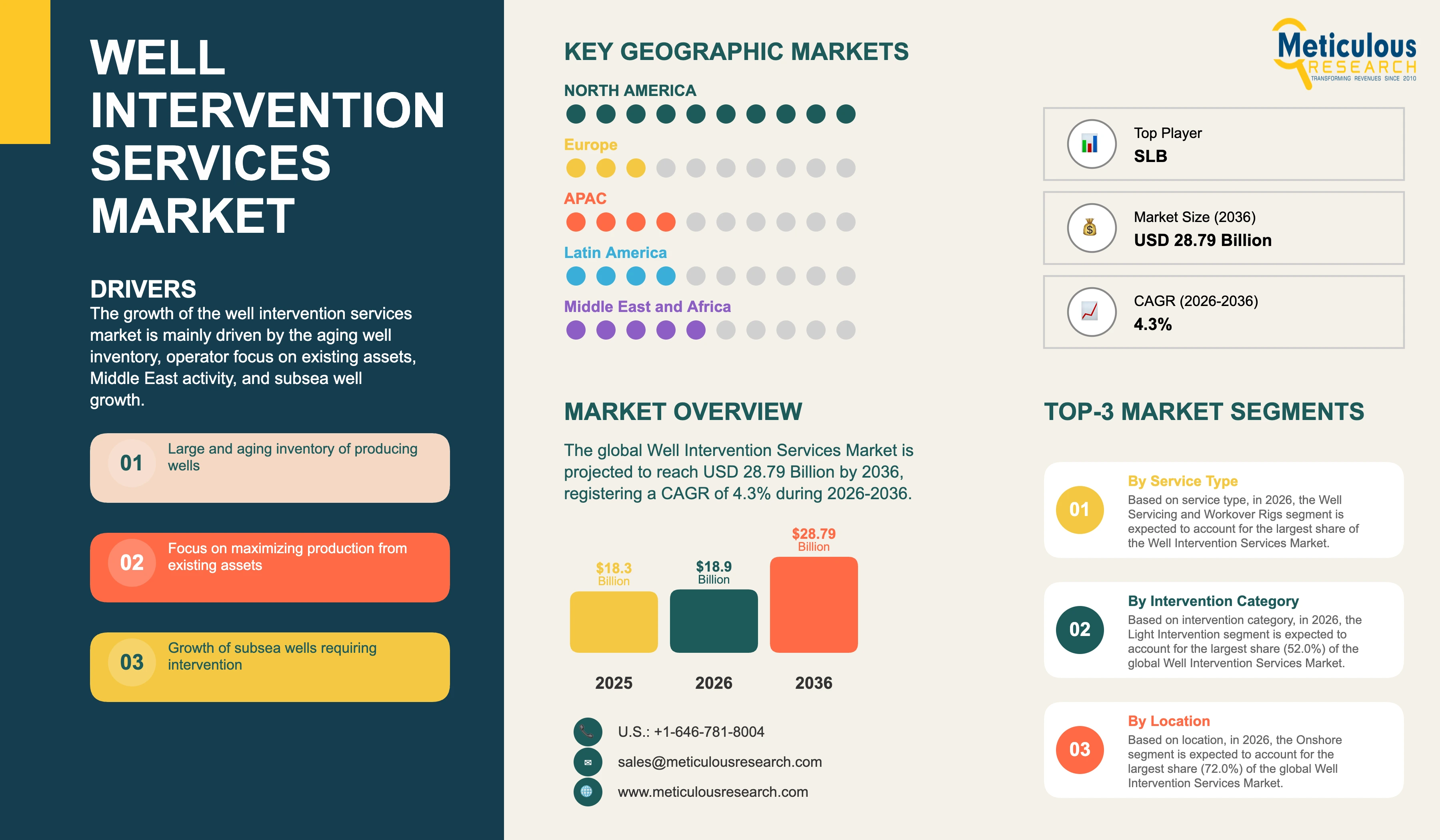
The global well intervention services market was valued at USD 18.30 billion in 2025. This market is expected to reach USD 28.79 billion by 2036 from an estimated USD 18.90 billion in 2026, registering a CAGR of 4.3% during the forecast period (2026-2036).
- Published
- Nov 2026
- Pages
- 274
- Format
- PDF + Excel
- Report ID
- MREP - 1042740
- Base year
- 2025
- 2024 · HISTORICAL
- $829.9M
- 2036
- $28.79B
- CAGR 2026–2036
- 4.3%
2024–2025 baseline · 2026–2036 forecast at 4.3% CAGR · hover a bar for the value
Key highlights
Ranger Energy Services completed the acquisition of American Well Services in the fourth quarter of 2025, adding 39 high-specification well service rigs and establishing Ranger as the largest well services provider in the U.S. Lower 48 with the largest fleet of active and available rigs. Ranger reported 2025 revenue of USD 546.9 million.
Ranger also launched its ECHO hybrid electric well service rig in 2025 and signed a contract for 15 new ECHO rigs with a Lower 48 operator, with all 15 expected to be operating by mid-2027.
Helix Energy Solutions reported 2025 well intervention segment revenue of USD 729.4 million, down from USD 829.9 million in 2024 because of weaker conditions in the U.K. North Sea and the Gulf of Mexico shelf, and guided 2026 total revenue of USD 1.2 billion to USD 1.4 billion. The company moved its Siem Helix 1 vessel onto three-year contracts with Petrobras and secured a multi-year plug and abandonment contract in the North Sea.
Expro reported 2025 revenue of USD 1, 607 million and a backlog of USD 2.5 billion at the end of 2025, and said that brownfield optimization and production enhancement work could support demand for its well intervention and production optimization services.
Island Offshore has provided light well intervention for Equinor on the Norwegian Continental Shelf with the Island Wellserver vessel since 2009, through TIOS, the former joint venture with TechnipFMC that also involves Altus and Oceaneering, showing the long-term nature of vessel-based intervention contracts.
SLB reported that activity increased across the Middle East in the fourth quarter of 2025, led by Saudi Arabia and with momentum in the UAE, driven by sustained gas development and increased oilfield intervention activity.
TechnipFMC has provided riserless light well intervention services to Equinor on the Norwegian Continental Shelf since 2006, enabling interventions from a monohull vessel without a riser or drilling rig, and holds a contract with Equinor for production enhancement, production data, and pre-plug and abandonment services.
By service type, well servicing and workover rigs account for the largest share of 32.0% in 2026, while vessel-based subsea intervention registers the highest CAGR.
By intervention category, light intervention accounts for the largest share in 2026 and also registers the highest CAGR.
By location, onshore accounts for the larger share of 72.0% in 2026, while offshore registers the higher CAGR.
By geography, North America accounts for the largest share of 40.0% in 2026, while Middle East & Africa registers the highest CAGR of 5.8%.
Report summary
| Particulars | Details |
|---|---|
| Base Year | 2025 |
| Estimated Year | 2026 |
| Forecast Period | 2026-2036 |
| Market Size in 2025 | USD 18.30 billion |
| Market Size in 2026 | USD 18.90 billion |
| Market Size by 2036 | USD 28.79 billion |
| CAGR (2026-2036) | 4.3% |
| Format | PDF, Excel & Cloud Portal · 274 pages |
| Largest Segment by Service Type (2026) | Well Servicing and Workover Rigs (32.0%) |
| Largest Segment by Location (2026) | Onshore (72.0%) |
| Largest Region (2026) | North America (40.0%) |
| Fastest-Growing Region | Middle East & Africa (CAGR 5.8%) |
| Companies Profiled | 12 companies and other companies |
| Segments Covered | Service Type, Intervention Category, Location, Geography |
| Countries Covered | U.S., Canada, Saudi Arabia, UAE, Kuwait, Oman, Qatar, Nigeria, Angola, Rest of Middle East & Africa, China, Indonesia, Malaysia, India, Australia, Rest of Asia-Pacific, Brazil, Mexico, Argentina, Colombia, Guyana, Rest of Latin America, Norway, U.K., Russia, Rest of Europe |
Report overview
Segments covered: service type, intervention category, location.
The growth of this market is mainly driven by the large and aging global inventory of producing wells, which require regular maintenance, repair, and production enhancement, the focus of operators and national oil companies on maximizing output from existing assets rather than new developments, rising intervention activity in the Middle East and other international markets, the growing number of subsea wells that require vessel-based intervention, and the adoption of new technologies such as hybrid-electric workover rigs, digital wireline tools, and riserless light well intervention. However, factors such as oil price volatility and reduced activity in U.S. land markets, pricing pressure in commoditized service lines, disruptions caused by the 2026 conflict in the Middle East, and the high cost and limited availability of intervention vessels are expected to restrain the growth of this market to some extent.
Well intervention refers to any operation carried out on an oil or gas well during or at the end of its productive life to maintain, restore, or increase production, gather data, or change the state of the well. Interventions range from simple slickline operations to replace valves or gauges, to wireline logging and perforating, to workovers that pull and replace tubing, pumps, and other completion equipment, to complex heavy interventions that require a rig or a specialized vessel. Every producing well requires interventions over its life, and the global inventory of more than one million producing oil and gas wells creates a large and recurring demand for intervention services. Well intervention is therefore one of the most stable segments of the oilfield services industry, as it depends on the existing well base rather than on new drilling.
This report covers global revenue from well intervention services, including wireline services, which comprise slickline, electric line, and cased-hole logging and perforating, well servicing and workover rigs, hydraulic workover and snubbing, matrix stimulation and production enhancement services such as acidizing and scale removal, fishing and remedial services, and vessel-based subsea intervention, including riserless light well intervention and riser-based intervention. Coiled tubing services, hydraulic fracturing, open-hole formation evaluation, permanent plug and abandonment campaigns, artificial lift equipment sales, and downhole tools sold as products are excluded from the scope of this report, as they are covered in separate studies.
Interventions are often classified as light, medium, or heavy, depending on the equipment needed and the complexity of the work. Light interventions, such as slickline and electric line operations, are performed through the existing completion without pulling tubing and can often be carried out without a rig. Medium interventions include coiled tubing and hydraulic workover operations that may require additional pressure control equipment. Heavy interventions involve pulling and replacing completion components using a workover rig, a drilling rig, or a heavy intervention vessel. Light interventions account for the largest number of operations, while heavy interventions are the most expensive per job.
In onshore markets, well servicing rigs are used to repair and maintain wells, including replacing rod pumps, electric submersible pumps, and tubing, which are among the most frequent interventions in mature oil fields. In the U.S. Lower 48, companies such as Ranger Energy Services operate large fleets of high-specification well service rigs, which have become more important as operators focus on maintaining production from existing shale and conventional wells. Wireline services are used for perforating, setting plugs, logging, and well integrity surveys. In the Middle East, national oil companies run large workover and wireline programs to sustain production capacity from their giant fields.
Offshore, interventions on platform wells are often performed with platform-based equipment or jack-up rigs, while interventions on subsea wells require specialized vessels or rigs. Riserless light well intervention vessels, such as those used by TechnipFMC for Equinor in Norway, can carry out wireline operations on subsea wells without a riser, which significantly reduces cost compared with using a drilling rig. Riser-based intervention vessels, such as Helix's Q4000 and Q7000, can perform heavier interventions and are used in the Gulf of Mexico, Brazil, West Africa, and other regions.
The market includes large integrated oilfield service companies, specialized intervention service providers, well servicing rig contractors, and vessel operators. Leading companies include SLB, Halliburton, Baker Hughes, Weatherford, Expro, Helix Energy Solutions, TechnipFMC, Oceaneering, Ranger Energy Services, Superior Energy Services, Archer, and China Oilfield Services. National oil companies in the Middle East, China, and other regions also operate large in-house workover and intervention fleets.
Over the forecast period, the market is expected to grow steadily, supported by the aging global well inventory, production enhancement in mature fields, Middle East activity, and offshore subsea interventions. Vessel-based subsea intervention is expected to be the fastest-growing service type, and the Middle East & Africa is expected to be the fastest-growing region, while North America remains the largest.
Report infographic
Market dynamics
20 factors across 5 forcesLarge and aging inventory of producing wells
The world has a very large and growing inventory of producing oil and gas wells, many of which are mature and require frequent maintenance and repair. As wells age, production declines, water and sand production increase, scale and corrosion develop, and artificial lift equipment wears out, all of which require interventions. In the U.S. alone, hundreds of thousands of producing oil and gas wells require periodic well servicing, and shale wells drilled in the past decade are now entering the stage where artificial lift repairs and remedial work are increasingly common.
Intervention spending is largely driven by the size of the installed well base rather than by new drilling, which makes it more stable than drilling and completion spending. Even when new drilling slows, existing wells continue to require maintenance and repair to sustain production. This stable demand base supports long-term growth in the well intervention services market. Shale wells, in particular, decline quickly and often require conversion from natural flow to gas lift, electric submersible pumps, or rod pumps within a few years, followed by regular pump repairs and replacements.
Ranger Energy Services has described its strategy as production-focused, emphasizing that well servicing demand is linked to maintaining output from existing wells rather than to new drilling. This was reflected in strong demand for its high-specification rigs in late 2025, even as completion-related wireline work declined.
Operator focus on maximizing production from existing assets
Operators and national oil companies are increasingly focused on maximizing production and recovery from existing fields, which are often lower-cost and lower-risk sources of supply than new developments. Baker Hughes has noted that upstream customers remain focused on maximizing output from existing assets, and Expro has said that brownfield optimization and production enhancement work support demand for its intervention services. Interventions such as reperforating, adding new zones, stimulation, water shutoff, and artificial lift optimization can significantly increase production at relatively low cost.
This focus has intensified with the need for supply security after disruptions to global oil and gas markets in 2026. Disruptions to supply from the Middle East in 2026 have highlighted the value of increasing production from existing fields, and many countries are seeking to sustain domestic production. Intervention services are among the fastest ways to add production, because they can be deployed quickly without new drilling. Operators increasingly use data analytics to screen their well inventories for intervention candidates, ranking wells by potential production gain and cost, which helps them direct spending toward the most profitable interventions.
Rising intervention activity in the Middle East and international markets
National oil companies in Saudi Arabia, the UAE, Kuwait, Oman, Qatar, and other countries operate very large fields with thousands of wells, and they have programs to sustain and expand production capacity. These programs require large volumes of workovers, wireline operations, stimulation, and other interventions. SLB reported increased activity across the Middle East in the fourth quarter of 2025, led by Saudi Arabia and the UAE, driven partly by increased oilfield intervention activity.
Latin America, Africa, and Asia also offer growth, supported by mature field redevelopment in Mexico, Colombia, Argentina, and Indonesia and offshore activity in Brazil, Guyana, and West Africa. Long-term contracts with national oil companies provide stable demand for intervention service providers. Many national oil companies also prefer integrated contracts that combine intervention, stimulation, and production optimization, which favors large service companies with broad portfolios.
Growth of subsea wells requiring vessel-based intervention
The number of subsea wells worldwide has grown significantly, particularly in Brazil, the Gulf of Mexico, Norway, West Africa, and Guyana. Subsea wells are more expensive to access than platform wells, and interventions have traditionally required drilling rigs, which are costly. As subsea wells age, their production declines, and operators need cost-effective intervention solutions to maintain output and recover more oil.
Riserless light well intervention vessels and riser-based intervention vessels allow operators to perform interventions at a fraction of the cost of a drilling rig. Helix has moved its Siem Helix 1 onto three-year contracts with Petrobras in Brazil, and TechnipFMC has provided riserless light well intervention to Equinor in Norway since 2006. The growing subsea well base is expected to drive strong growth in vessel-based intervention. Island Offshore has worked for Equinor with its Island Wellserver vessel since 2009, which shows the long-term demand for light well intervention in mature subsea regions.
Table of contents
11 chapters · 136 sections · 274 pages · click to expandSegmental analysis
| Segment | Largest share (2026) | Fastest growth (2026–2036) |
|---|---|---|
| By Service Type | Light intervention | Vessel-based subsea intervention |
By Service Type
- The light intervention segment is expected to account for the largest share of the well intervention services market, and it is also projected to register the highest CAGR during the forecast period.
Geographic analysis
North America
Largest shareIn 2026, North America is expected to account for the largest share of 40.0% of the global well intervention services market. The large share of this region is mainly due to the very large inventory of producing oil and gas wells in the U.S. and Canada, the maturing base of shale wells, which increasingly require artificial lift repairs and remedial work, the large fleets of well servicing rigs and wireline units operated by contractors, and offshore interventions in the Gulf of Mexico. Ranger, the largest well services provider in the Lower 48, and major integrated service companies have large North American operations. However, growth in the region is expected to be slower than the global average because of consolidation among operators, pricing pressure, and moderate drilling activity. Canada contributes through conventional and heavy oil well servicing.
Middle East & Africa
The Middle East & Africa is the second-largest market and is projected to register the highest CAGR of 5.8% during the forecast period. The rapid growth of this region is mainly due to large production capacity programs by national oil companies in Saudi Arabia, the UAE, Kuwait, Oman, and Qatar, which require large volumes of workovers, wireline, and stimulation, increased intervention activity reported by service companies, mature field redevelopment, and offshore activity in West Africa. Saudi Arabia and the UAE are expected to be the largest country markets in the region, followed by Kuwait and Oman, where mature fields require extensive workover, stimulation, and wireline programs every year. Short-term disruptions from the 2026 conflict may delay some activity, but the region is expected to be a major source of growth once conditions stabilize.
Asia-Pacific
Asia-Pacific is the third-largest market, supported by mature fields in China, Indonesia, Malaysia, and India and by offshore gas developments in Australia and Southeast Asia.
Latin America
Fastest growthLatin America is supported by mature field redevelopment in Mexico, Colombia, and Argentina and by offshore intervention in Brazil. Brazil is expected to be one of the fastest-growing country markets, driven by subsea interventions in its offshore fields.
Europe
Europe is supported by intervention and late-life work in the North Sea, where Norway is a leader in riserless intervention, but overall growth is limited by declining production in the U.K. Africa contributes through offshore interventions in Nigeria and Angola and mature onshore fields in North Africa.
Competitive landscape
The global well intervention services market is fragmented, with the top five players estimated to account for about 35% of the market in 2025. The market includes large integrated oilfield service companies, specialized intervention providers, well servicing rig contractors, vessel operators, and many regional companies.
SLB, Halliburton, Baker Hughes, and Weatherford offer broad portfolios of wireline, stimulation, fishing, and intervention services worldwide. Expro provides well intervention and integrity services, subsea well access, and well flow management, and reported 2025 revenue of USD 1,607 million. Helix Energy Solutions operates a fleet of riser-based and riserless well intervention vessels in the Gulf of Mexico, Brazil, and the North Sea, while TechnipFMC and Oceaneering provide riserless light well intervention services and equipment.
Ranger Energy Services is the largest well services provider in the U.S. Lower 48, and Superior Energy Services provides snubbing, hydraulic workover, and well services. Archer provides platform drilling, well services, and intervention in the North Sea and other regions, and China Oilfield Services provides well services in China and international markets. Companies compete on safety, reliability, technology, crew quality, equipment availability, and price. Key strategies include consolidating fleets through acquisitions, investing in hybrid-electric and automated equipment, developing through-tubing and digital technologies, expanding vessel-based intervention, and securing long-term contracts with national oil companies.
The competitive landscape is expected to evolve as consolidation continues in the U.S. and as international and offshore markets grow. Large integrated service companies have advantages in winning integrated contracts with national oil companies, while specialized providers compete through technology, flexibility, and focus. Regional and national service companies in the Middle East, China, Russia, and Latin America also hold significant shares in their home markets, often supported by local content requirements. Vessel-based intervention is a more concentrated segment, with a small number of operators owning most of the specialized fleet. Partnerships between vessel owners and service companies, such as those between Island Offshore, TechnipFMC, Altus, and Oceaneering in Norway, are common in this segment, combining vessels, well control equipment, and downhole services into a single offering for operators, which reduces interfaces and improves operational efficiency and safety.
Some of the key players operating in the well intervention services market are SLB, Halliburton Company, Baker Hughes Company, Weatherford International plc, Expro Group Holdings N.V., Helix Energy Solutions Group, Inc., TechnipFMC plc, Oceaneering International, Inc., Ranger Energy Services, Inc., Superior Energy Services, Inc., Archer Limited, and China Oilfield Services Limited, among others.
- —
Ranger acquired American Well Services and launched its ECHO hybrid rig, Helix moved the Siem Helix 1 onto three-year Petrobras contracts and secured a multi-year North Sea plug and abandonment contract, and SLB reported increased intervention activity in the Middle East in late 2025.
- SLB
- Halliburton
- Baker Hughes
- Weatherford
Expert perspectives
The well intervention services market is supported by a large and growing installed base of producing wells, which creates recurring demand regardless of new drilling. We expect steady growth over the forecast period, with the fastest growth in offshore and international markets.
Over the forecast period, the market is expected to grow at a CAGR of 4.3%, from USD 18.90 billion in 2026 to USD 28.79 billion in 2036. Growth will be supported by aging wells, production optimization, Middle East activity, and subsea intervention, while oil price volatility, U.S. land weakness, Middle East disruptions, and pricing pressure will moderate growth.
In terms of segments, well servicing and workover rigs remain the largest service type, while vessel-based subsea intervention grows fastest. Onshore remains the largest location, while offshore grows faster. North America remains the largest region, while the Middle East & Africa grows fastest at a CAGR of 5.8%.
For service providers, the key priorities are to differentiate through technology and safety, to invest in electrified and automated equipment, to expand in international and offshore markets, and to offer integrated production enhancement solutions. Consolidation is likely to continue in fragmented U.S. markets. Providers should also prepare for stricter emissions and safety requirements by modernizing their fleets. We expect operators to continue shifting toward light, rigless intervention methods wherever possible. In our view, the recovery of Middle East activity after the 2026 disruptions will be the most important factor for growth in the next few years.
Our estimates are based on the producing well inventory by region, typical intervention frequencies and costs by service type, the reported revenue of leading intervention service providers and vessel operators, and national oil company activity. We note that national oil companies perform a significant amount of intervention work with in-house resources, and we include the value of this work where it is contracted to service providers. We expect the offshore segment to gain share steadily as subsea well inventories grow and age. In the U.S., we expect well servicing demand to remain stable, supported by the maturing shale well base, even if drilling activity remains moderate. We also see opportunities for providers that combine intervention with digital production optimization and offer performance-based pricing. Vessel-based intervention will remain more cyclical than onshore well servicing, because it depends on a smaller number of large operators and project schedules, as Helix's 2025 results showed when weaker North Sea demand led to vessel stacking for part of the year.
Customer perspectives
Production Operations Manager - independent producer, U.S. Permian Basin
Our shale wells now need more artificial lift repairs and remedial work every year. We prefer contractors with modern, efficient rigs and consistent crews.
Well Intervention Lead - international oil company, Brazil
Using intervention vessels instead of drilling rigs lets us restore production from subsea wells at a much lower cost, and we plan to increase this work as our fields mature.
Workover Manager - national oil company, Middle East
We run large workover and wireline programs to sustain capacity, and we expect intervention activity to increase as conditions normalize.
Frequently asked questions
The global well intervention services market was valued at USD 18.30 billion in 2025, up from USD 18.00 billion in 2024, and is estimated at USD 18.90 billion in 2026. The market includes wireline, well servicing and workover rigs, hydraulic workover and snubbing, matrix stimulation, fishing, and vessel-based subsea intervention.
The global well intervention services market is expected to reach USD 28.79 billion by 2036, supported by the aging well inventory, production optimization, and offshore intervention.
The market is expected to register a CAGR of 4.3% from 2026 to 2036, with the fastest growth in vessel-based subsea intervention and in the Middle East & Africa.
The market excludes coiled tubing services, hydraulic fracturing, open-hole formation evaluation, permanent plug and abandonment campaigns, artificial lift equipment sales, and downhole tools sold as products, which are covered in separate studies.
Market growth is mainly driven by the large and aging inventory of producing wells, operator focus on maximizing production from existing assets, rising intervention activity in the Middle East and international markets, and the growth of subsea wells requiring vessel-based intervention.
Oil price volatility, reduced U.S. land activity, and geopolitical disruption in the Middle East restrain growth, while workforce shortages, safety requirements, and pricing pressure are key challenges.
Key opportunities include hybrid-electric and automated well service rigs, riserless light well intervention and vessel optimization, digital wireline and through-tubing technologies, and well integrity and late-life management.
Well servicing and workover rigs are expected to account for the largest share of 32.0% of the market in 2026, while vessel-based subsea intervention is projected to register the highest CAGR.
Offshore well intervention is projected to register the highest CAGR, driven by aging subsea wells and intervention vessels, while onshore accounts for the largest share of 72.0% in 2026.
North America is expected to account for the largest share of 40.0% of the market in 2026, mainly due to its very large inventory of producing wells and large well servicing fleets.
The Middle East & Africa is projected to register the highest CAGR of 5.8% during the forecast period, driven by national oil company capacity programs and intervention activity.
U.S. well services providers are consolidating and modernizing their fleets to improve efficiency and returns. Ranger acquired American Well Services in 2025, becoming the largest well services provider in the Lower 48, and signed a contract for 15 ECHO hybrid electric rigs.
The report profiles 12 companies, including SLB, Halliburton Company, Baker Hughes Company, Weatherford International plc, Expro Group Holdings N.V., Helix Energy Solutions Group, Inc., TechnipFMC plc, Oceaneering International, Inc., Ranger Energy Services, Inc., Superior Energy Services, Inc., Archer Limited, and China Oilfield Services Limited.
Ranger acquired American Well Services and launched its ECHO hybrid rig, Helix moved the Siem Helix 1 onto three-year Petrobras contracts and secured a multi-year North Sea plug and abandonment contract, and SLB reported increased intervention activity in the Middle East in late 2025.
In 2026, the light intervention segment is expected to account for the largest share of the well intervention services market, and it is also projected to register the highest CAGR during the forecast period.
Cite this report
Meticulous Research. (2026). Well Intervention Services Market - Global Opportunity Analysis and Industry Forecast (2026-2036) (Report No. MREP - 1042740). Meticulous Market Research Pvt. Ltd. https://www.meticulousresearch.com/product/well-intervention-services-market-7423