Steam Turbines Market (2026-2036)
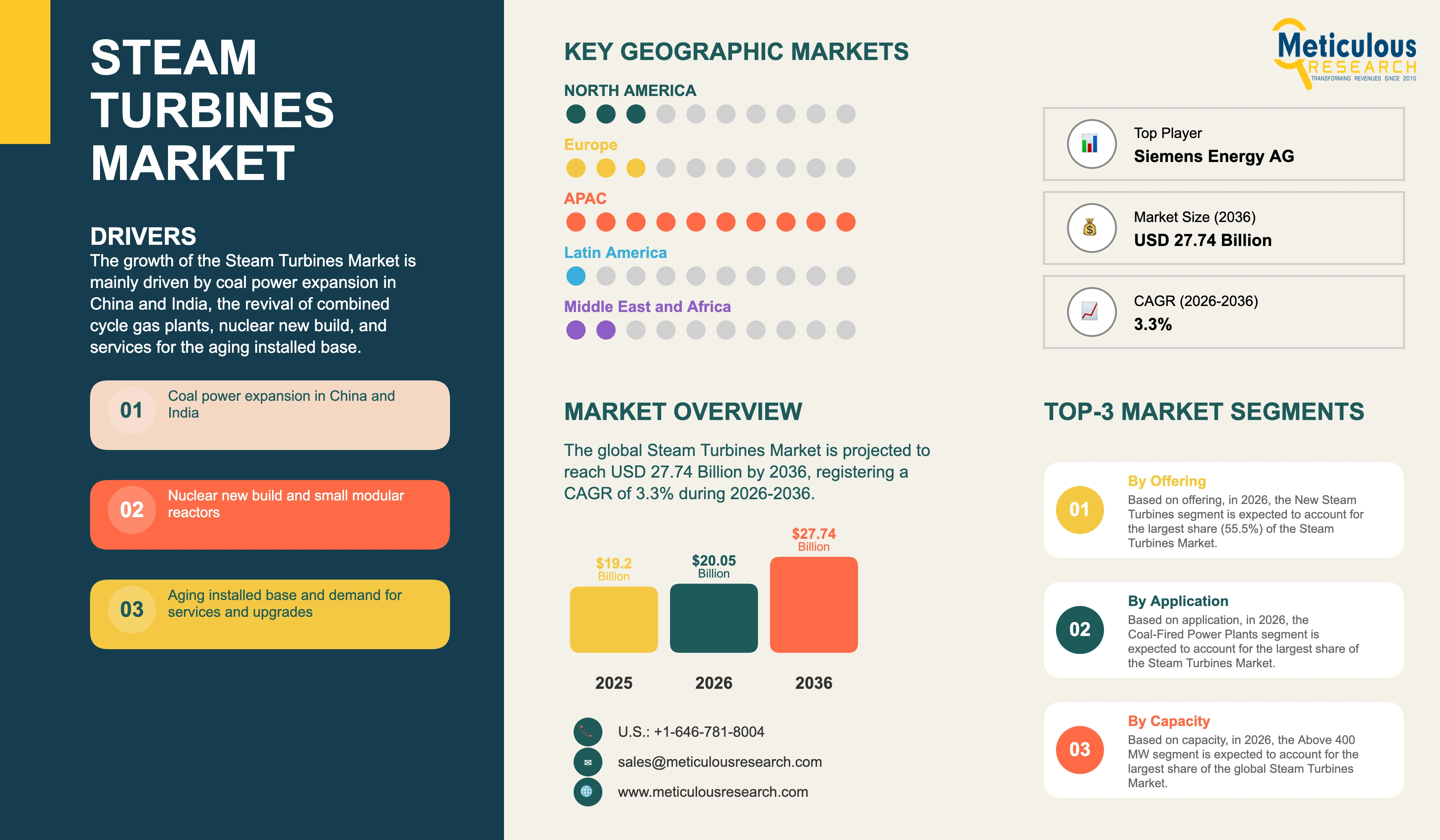
The global steam turbines market was valued at USD 19.20 billion in 2025. This market is expected to reach USD 27.74 billion by 2036 from an estimated USD 20.05 billion in 2026, registering a CAGR of 3.3% during the forecast period (2026-2036).
- Published
- Nov 2026
- Pages
- 260
- Format
- PDF + Excel
- Report ID
- MREP - 1042736
- Base year
- 2025
- 2025 · BASELINE
- $19.20B
- 2036
- $27.74B
- CAGR 2026–2036
- 3.3%
2025 baseline · 2026–2036 forecast at 3.3% CAGR · hover a bar for the value
Key highlights
According to the Centre for Research on Energy and Clean Air (CREA) and Global Energy Monitor (GEM), China commissioned 78 GW of new coal power capacity in 2025, the highest annual level in a decade, while new and reactivated coal project proposals reached a record 161 GW and about 291 GW of coal capacity remained permitted or under construction at the end of the year.
Global Energy Monitor reports that coal plant commissioning outside China and India was only 9.2 GW in 2025, which shows that demand for new coal-fired steam turbines is now concentrated in Asia, while the Indian government has set a target of adding at least 80 GW of new coal-based thermal capacity by fiscal year 2031-32.
The World Nuclear Industry Status Report 2026 counted 73 reactors under construction worldwide in mid-2026, the highest number since 1987, with China accounting for 37 units, and every one of these reactors requires a large turbine island with a steam turbine and generator.
In October 2025, Arabelle Solutions, part of EDF Group, was awarded the contract to supply two complete turbine islands for the 3.2 GW Sizewell C nuclear power plant in the U.K., each with an Arabelle steam turbine using a 75-inch last-stage blade, after earlier being selected to supply the steam turbine for the first BWRX-300 small modular reactor at Darlington in Canada.
In March 2026, Doosan Enerbility signed its first North American steam turbine contract to supply two 370 MW-class steam turbines and generators for a combined cycle plant serving a U.S. data center, while Siemens Energy and other OEMs are supplying steam turbine generator sets for gas-fired projects as large gas turbine delivery slots stretch into 2029 and 2030.
In India, JSW Energy placed orders with Toshiba JSW Power Systems for four 800 MW steam turbine generators for its 3,200 MW Salboni thermal project in 2026, and Bharat Heavy Electricals Limited (BHEL) reported thermal power orders of 14.6 GW in fiscal year 2025, its highest in a decade.
By offering, new steam turbines account for the larger share of 55.5% in 2026, while aftermarket services register the higher CAGR.
By capacity, above 400 MW accounts for the largest share in 2026, while 100 MW to 400 MW registers the highest CAGR.
By exhaust type, condensing accounts for the largest share in 2026, while extraction registers the highest CAGR.
By application, coal-fired power plants account for the largest share of 47.0% in 2026, while nuclear power plants register the highest CAGR.
By end user, utilities and independent power producers account for the largest share in 2026, while chemicals and fertilizers register the highest CAGR.
By geography, Asia-Pacific accounts for the largest share of 54.0% in 2026, while North America registers the highest CAGR of 4.8%.
Report summary
| Particulars | Details |
|---|---|
| Base Year | 2025 |
| Estimated Year | 2026 |
| Forecast Period | 2026-2036 |
| Market Size in 2025 | USD 19.20 billion |
| Market Size in 2026 | USD 20.05 billion |
| Market Size by 2036 | USD 27.74 billion |
| CAGR (2026-2036) | 3.3% |
| Format | PDF, Excel & Cloud Portal · 260 pages |
| Largest Segment by Offering (2026) | New Steam Turbines (55.5%) |
| Largest Segment by Application (2026) | Coal-Fired Power Plants (47.0%) |
| Largest Region (2026) | Asia-Pacific (54.0%) |
| Fastest-Growing Region | North America (CAGR 4.8%) |
| Companies Profiled | 17 companies and other companies |
| Segments Covered | Offering, Capacity, Exhaust Type, Application, End User, Geography |
| Countries Covered | U.S., Canada, Germany, U.K., France, Italy, Spain, Poland, Czech Republic, Netherlands, Nordic Countries, Rest of Europe, China, India, Japan, South Korea, Indonesia, Vietnam, Australia, Bangladesh, Thailand, Malaysia, Rest of Asia-Pacific, Brazil, Mexico, Argentina, Chile, Rest of Latin America, Saudi Arabia, U.A.E., Qatar, Egypt, Turkey, South Africa, Rest of Middle East & Africa |
Report overview
Segments covered: offering, capacity, exhaust type, application, end user.
The growth of this market is mainly driven by the continued construction of large coal-fired units in China and India to secure baseload supply, the strong revival of combined cycle gas power plants in the U.S. and the Middle East to serve data centers and rising electricity demand, the largest nuclear construction pipeline in more than three decades together with the first small modular reactor projects, the steady demand for service, repair, and efficiency upgrades from a very large installed base of aging turbines, and the use of steam turbines in biomass, waste-to-energy, and industrial combined heat and power plants. However, factors such as coal phase-out policies in Europe and North America, competition from wind, solar, and battery storage for new generating capacity, and long manufacturing lead times for large castings and forgings are expected to restrain the growth of this market to some extent.
Steam turbines are rotating machines that convert the thermal energy of high-pressure, high-temperature steam into mechanical energy, which is used to drive an electric generator or, in some industrial plants, a compressor or pump. They are the main power conversion equipment in coal-fired, nuclear, biomass, waste-to-energy, geothermal, and concentrated solar power plants, and they form the bottoming cycle of combined cycle gas power plants, where they use steam raised from gas turbine exhaust in a heat recovery steam generator. This report covers global revenue from new steam turbines and turbine-generator packages and from aftermarket services, including maintenance, repair, spare parts, and upgrades, across all capacity classes, exhaust types, applications, and end users.
Steam turbines still generate most of the world's electricity, since coal, nuclear, and the steam portion of combined cycle plants together supply well over half of global power output. The installed base of steam turbines is therefore very large, with several thousand gigawatts of capacity in operation across utility and industrial plants, and many of these machines are 25 to 50 years old. In addition, thermal plants are being asked to run more flexibly than they were designed for, which adds wear and increases the need for inspection, repair, and replacement parts. This installed base creates a large and stable market for inspections, overhauls, blade replacement, rotor repair, and efficiency upgrades, which accounts for a growing share of revenue for turbine manufacturers.
Demand for new steam turbines has shifted strongly toward Asia over the past decade, as new coal plant construction has nearly stopped in Europe and North America while China and India continue to build large supercritical and ultra-supercritical units. Chinese manufacturers, led by Shanghai Electric, Harbin Electric, and Dongfang Electric, supply most of the units built in China, while BHEL dominates large coal-fired orders in India. At the same time, new demand is coming from combined cycle gas plants in the U.S., the Middle East, and Southeast Asia, and from new nuclear reactors in China, India, Russia, Turkey, Egypt, the U.K., and other countries.
Technology has advanced steadily, with modern ultra-supercritical turbines operating at steam temperatures of around 600 to 620 degrees Celsius and achieving plant efficiencies above 45%, compared with less than 40% for older subcritical units. Large nuclear turbines with last-stage blades longer than 1.8 meters are now the largest rotating machines in the power industry, with single units rated at about 1,750 MW. In industrial markets, manufacturers offer standardized and modular turbines from a few hundred kilowatts to about 100 MW for cogeneration, waste heat recovery, and mechanical drive applications.
The business model in this market combines large one-time equipment contracts with long-term service relationships that last for decades. New turbines are usually sold as part of a turbine island or engineering, procurement, and construction contract, and they are often priced competitively, while manufacturers earn higher margins over the 30 to 60 year life of the machine from spare parts, outage services, and upgrades. Long-term service agreements are increasingly common for combined cycle plants, and manufacturers are adding digital monitoring and analytics services to their offerings.
The market is moderately concentrated in large turbines and fragmented in small industrial turbines. Leading companies include Siemens Energy, GE Vernova, Mitsubishi Heavy Industries, Shanghai Electric, Harbin Electric, Dongfang Electric, BHEL, Toshiba Energy Systems & Solutions, Doosan Enerbility, Arabelle Solutions, and Ansaldo Energia, while companies such as Triveni Turbine, Elliott Group, Everllence, Fuji Electric, Kawasaki Heavy Industries, and Hangzhou Steam Turbine compete in industrial segments.
Over the forecast period, the steam turbines market is expected to grow at a moderate pace, as the slowdown of new coal construction after the current Chinese and Indian build-out is offset by growth in nuclear, combined cycle, biomass, and waste-to-energy plants and by rising service demand from an aging fleet. The market is also expected to benefit from new uses of steam turbines, such as small modular reactors, flexible operation of thermal plants alongside renewables, carbon capture-ready plants, and thermal energy storage systems that use steam turbines to convert stored heat back into electricity.
We need large supercritical units to meet peak demand, and local manufacturing is very important for us. At the same time, our older units must keep running, so overhauls and upgrades are a big part of our budget.
The turbine island is one of the largest packages in the plant, and we chose a supplier with a proven design and a strong service team for the next sixty years. Repeating the same design across projects reduces our risk.
Asia-Pacific is expected to account for the largest share of 54.0% of the market in 2026, mainly due to large coal and nuclear construction programs in China and India and the strong position of Chinese manufacturers.
North America is projected to register the highest CAGR of 4.8% during the forecast period, driven by new combined cycle plants for data centers, small modular reactor projects, and services for existing plants.
The report profiles 17 companies, including Siemens Energy AG, GE Vernova Inc., Mitsubishi Heavy Industries, Ltd., Shanghai Electric Group Co., Ltd., Harbin Electric Corporation, Dongfang Electric Corporation, Bharat Heavy Electricals Limited, Toshiba Energy Systems & Solutions Corporation, Doosan Enerbility Co., Ltd., Arabelle Solutions (EDF Group), Ansaldo Energia S.p.A., Fuji Electric Co., Ltd., Elliott Group (Ebara Corporation), Everllence SE, Triveni Turbine Limited, Kawasaki Heavy Industries, Ltd., and Hangzhou Steam Turbine Power Group Co., Ltd.
Report infographic
Market dynamics
16 factors across 5 forcesCoal power expansion in China and India
The largest source of demand for new steam turbines today is the construction of large coal-fired power plants in China and India, where governments are adding baseload capacity to meet rising peak demand and to back up fast-growing wind and solar fleets. According to CREA and Global Energy Monitor, China commissioned 78 GW of new coal power capacity in 2025 and had about 291 GW permitted or under construction at the end of the year, which secures a pipeline of large steam turbine deliveries for Chinese manufacturers through the second half of the decade.
India has also returned to large-scale coal plant construction after several years of low orders. The Ministry of Power plans to add at least 80 GW of coal-based capacity by fiscal year 2031-32, and BHEL, which had received no thermal orders between 2019 and 2022, won 14.6 GW of thermal power orders in fiscal year 2025. Private developers such as JSW Energy and Adani Power are also placing orders for 800 MW supercritical units, which supports demand for large steam turbine generators from BHEL, Toshiba JSW, and other suppliers.
Most of the new coal units in both countries use supercritical or ultra-supercritical technology with unit sizes of 660 MW to 1,000 MW, which require large, high-value steam turbines with advanced materials. These projects also include long-term spare parts and service commitments, which add to the value captured by turbine suppliers. Although coal demand for new turbines is expected to decline after 2030, the units being built now will create service and upgrade demand for decades.
Revival of combined cycle gas power plants
Investment in combined cycle gas power plants has increased sharply, especially in the U.S., where electricity demand from data centers, manufacturing, and electrification is rising after a long period of flat demand. Large gas turbine manufacturers report record backlogs, with GE Vernova targeting a gas turbine backlog of about 100 GW by the end of 2026, and every large combined cycle block requires a steam turbine that typically provides about one-third of the plant's output.
Long lead times for large gas turbines are also creating demand for steam turbines that can be delivered faster, including steam turbine generator sets for gas-fired boiler plants and for conversions of existing coal plants. Doosan Enerbility's first North American steam turbine contract for a data center project in 2026 and Siemens Energy's steam turbine supply agreements with Babcock & Wilcox show how new suppliers and new project types are entering this market. Saudi Arabia, the U.A.E., Qatar, Vietnam, and other countries are also building large combined cycle plants as they move away from oil-fired generation and add capacity for growing demand.
Nuclear new build and small modular reactors
Nuclear power is entering a new construction cycle, supported by energy security concerns, decarbonization targets, and the need for firm low-carbon power for data centers and industry. The World Nuclear Industry Status Report 2026 counted 73 reactors under construction in mid-2026, the highest number since 1987, and countries including China, India, Russia, Turkey, Egypt, the U.K., France, Poland, and South Korea have programs for further reactors.
Nuclear steam turbines are among the largest and most valuable turbines built, with unit ratings of 1,000 MW to 1,750 MW, and each project also creates long-term service contracts. Arabelle Solutions' contracts for Hinkley Point C and Sizewell C in the U.K., Dongfang Electric and Harbin Electric deliveries for Hualong One and CAP1000 reactors in China, and Doosan Enerbility and Škoda supply for reactors in Korea and Europe show the scale of this opportunity. Small modular reactors, such as the GE Vernova Hitachi BWRX-300 at Darlington in Canada, add a new segment of medium-sized nuclear steam turbines.
Aging installed base and demand for services and upgrades
A large share of the global steam turbine fleet was installed between the 1970s and the early 2000s, and many units are now operating beyond their original design life. Utilities and industrial operators are extending the life of these machines rather than replacing them, which requires major overhauls, replacement of blades, diaphragms, and seals, rotor life assessments, and generator rewinds. Many plants are also being asked to operate more flexibly, with frequent start-ups and load changes to balance variable renewable generation, which increases wear and the need for inspection and repair.
Turbine manufacturers and independent service providers also offer efficiency upgrades, such as new high-efficiency blade paths and advanced seals, which can increase output and reduce fuel use and emissions. These upgrades are attractive because they cost much less than new plants and can be completed during planned outages, and they are a key reason why aftermarket services are the fastest-growing part of the steam turbines market.
Table of contents
13 chapters · 176 sections · 260 pages · click to expandSegmental analysis
| Segment | Largest share (2026) | Fastest growth (2026–2036) |
|---|---|---|
| Other segments | — | 100 MW |
| By Offering | Utilities and independent power producers | Chemicals and fertilizers |
Other segments
- The 100 MW to 400 MW segment is projected to register the highest CAGR during the forecast period, driven by combined cycle steam turbines and small modular reactor turbine islands.
By Offering
- The utilities and independent power producers segment is expected to account for the largest share of the steam turbines market, while the chemicals and fertilizers segment is projected to register the highest CAGR during the forecast period.
Geographic analysis
Asia-Pacific
Largest shareIn 2026, Asia-Pacific is expected to account for the largest share of 54.0% of the global steam turbines market. The large share of this region is mainly due to the very large coal power construction programs in China and India, China's leadership in nuclear power construction with 37 of the 73 reactors under construction worldwide in mid-2026, the strong position of Chinese manufacturers Shanghai Electric, Harbin Electric, and Dongfang Electric, and the large installed base of steam turbines in China, India, Japan, South Korea, and Southeast Asia. India's plan to add at least 80 GW of coal capacity by 2032 and its nuclear expansion program also support demand, while Indonesia, Vietnam, and Bangladesh continue to build thermal and combined cycle plants.
Europe
Europe is the second-largest market, supported by steam turbine services, nuclear projects, and biomass and waste-to-energy plants, although new coal construction has stopped. The U.K. is building Hinkley Point C and Sizewell C, France plans six EPR2 reactors, and Poland, the Czech Republic, Sweden, and the Netherlands are developing new nuclear programs. Germany, the Nordic countries, Italy, and Spain have large fleets of combined cycle, biomass, and waste-to-energy plants that need services and upgrades, and European manufacturers such as Siemens Energy, Ansaldo Energia, Doosan Škoda Power, and Arabelle Solutions supply both domestic and export markets.
North America
Fastest growthNorth America is projected to register the highest CAGR of 4.8% during the forecast period. The rapid growth of this region is mainly driven by the large number of new combined cycle gas plants being developed in the U.S. to serve data centers, manufacturing, and rising electricity demand, the first small modular reactor projects in Canada and the U.S., and strong demand for services and life extension at existing coal, gas, and nuclear plants. Some U.S. utilities are also delaying coal plant retirements and investing in existing turbines to maintain reliability.
Middle East & Africa
The Middle East & Africa is also expected to grow quickly, supported by large combined cycle projects in Saudi Arabia, the U.A.E., and Qatar, new nuclear plants in Egypt and Turkey, and waste-to-energy and concentrated solar power projects in the Gulf and North Africa.
Latin America
Latin America accounts for a smaller share of the market, with demand coming mainly from combined cycle plants in Mexico, Brazil, Argentina, and Chile, biomass cogeneration in Brazilian sugar mills, and services for existing thermal plants, while Colombia and Peru add smaller industrial demand.
Competitive landscape
The global steam turbines market is moderately concentrated, with the top five players estimated to account for about 50% of the market in 2025. The market includes large diversified power equipment manufacturers, Chinese state-owned power equipment groups, national champions in India, Japan, and Korea, nuclear turbine specialists, industrial turbine manufacturers, and independent service providers.
Siemens Energy, GE Vernova, and Mitsubishi Heavy Industries are global leaders in combined cycle steam turbines and services, with large installed bases and service networks worldwide. Shanghai Electric, Harbin Electric, and Dongfang Electric supply most of the large coal and nuclear turbines built in China and are expanding exports to Asia, the Middle East, and Africa. BHEL leads the Indian market for large coal-fired units, while Toshiba Energy Systems & Solutions, through Toshiba JSW Power Systems, also supplies large turbines in India. Doosan Enerbility, including Doosan Škoda Power, and Arabelle Solutions are important suppliers of nuclear and fossil turbines, and Ansaldo Energia serves Europe, the Middle East, and other export markets.
In the industrial segment, Triveni Turbine, Siemens Energy, Elliott Group, Everllence, Fuji Electric, Kawasaki Heavy Industries, and Hangzhou Steam Turbine compete in turbines for cogeneration, waste heat recovery, biomass, waste-to-energy, and mechanical drive applications, where standardized designs, delivery time, efficiency, and local service support are key buying factors.
Companies compete on efficiency, reliability, delivery time, price, project execution capability, local manufacturing and content, service network coverage, and the ability to offer complete turbine islands or power plant solutions. Key strategies include long-term service agreements, upgrades for existing fleets, partnerships with reactor and gas turbine suppliers, localization of manufacturing, investment in production capacity, and expansion of digital services.
The competitive structure has changed significantly over the past decade, as GE sold its nuclear steam turbine business to EDF, which now operates it as Arabelle Solutions, and as several Western manufacturers reduced their exposure to coal. Chinese manufacturers are expected to gain share in export markets, while Western, Japanese, and Korean suppliers focus on combined cycle, nuclear, industrial, and service segments where technology and service capability are more important than price.
Some of the key players operating in the steam turbines market are Siemens Energy AG, GE Vernova Inc., Mitsubishi Heavy Industries, Ltd., Shanghai Electric Group Co., Ltd., Harbin Electric Corporation, Dongfang Electric Corporation, Bharat Heavy Electricals Limited, Toshiba Energy Systems & Solutions Corporation, Doosan Enerbility Co., Ltd., Arabelle Solutions (EDF Group), Ansaldo Energia S.p.A., Fuji Electric Co., Ltd., Elliott Group (Ebara Corporation), Everllence SE, Triveni Turbine Limited, Kawasaki Heavy Industries, Ltd., and Hangzhou Steam Turbine Power Group Co., Ltd., among others.
- —
Arabelle Solutions won the turbine island contract for Sizewell C in 2025, Doosan Enerbility signed its first North American steam turbine contract for a data center project in 2026, JSW Energy ordered four 800 MW turbine generators from Toshiba JSW for its Salboni project, and China commissioned 78 GW of new coal capacity in 2025.
- Siemens Energy AG
- GE Vernova Inc.
- Mitsubishi Heavy Industries, Ltd.
- Shanghai Electric Group Co., Ltd.
- Harbin Electric Corporation
- Dongfang Electric Corporation
- Bharat Heavy Electricals Limited
- Toshiba Energy Systems & Solutions Corporation
- Doosan Enerbility Co., Ltd.
- Arabelle Solutions (EDF Group)
- Ansaldo Energia S.p.A
- Fuji Electric Co., Ltd.
- Elliott Group · Ebara Corporation
- Everllence SE
- Triveni Turbine Limited
- Kawasaki Heavy Industries, Ltd.
- Hangzhou Steam Turbine Power Group Co., Ltd.
Expert perspectives
The steam turbines market is in a period of transition, in which demand for new coal turbines remains strong in China and India for now, while nuclear, combined cycle, industrial, and service segments become more important for long-term growth. We see the market as a mature but resilient one, supported by the fact that steam turbines remain the main way of turning heat into electricity in thermal, nuclear, and many renewable power plants.
Over the forecast period, the market is expected to grow at a CAGR of 3.3%, from USD 20.05 billion in 2026 to USD 27.74 billion in 2036. Growth will be supported by nuclear construction, combined cycle plants for data centers and growing demand, waste-to-energy and biomass plants, and services for an aging installed base, while the slowdown of new coal construction after 2030 and competition from renewables will limit growth in new utility turbines.
New steam turbines remain the larger offering, while aftermarket services grow faster. Turbines above 400 MW remain the largest capacity class, while the 100 MW to 400 MW segment grows fastest with combined cycle and small modular reactor projects. Coal-fired power plants remain the largest application, while nuclear power plants grow fastest. Asia-Pacific remains the largest region, and North America is the fastest-growing region at a CAGR of 4.8%.
For manufacturers, the key priorities are to secure positions in nuclear and small modular reactor turbine islands, to build capacity for combined cycle steam turbines without overexposing themselves to a cyclical market, to grow service revenue through long-term agreements, upgrades, and digital monitoring, and to localize manufacturing and service in growth markets such as India, the Middle East, and Southeast Asia.
We expect services and nuclear to become the main sources of value in this market over time. In our view, manufacturers with large installed bases, strong engineering capability for large nuclear turbines, and flexible manufacturing will be best placed to benefit, while suppliers that depend mainly on new coal orders will face declining demand in the 2030s. The repurposing of coal plants with thermal storage or nuclear heat sources could also become an important niche, keeping existing turbines in service longer.
Government energy policy will remain a key factor for the steam turbines market over the forecast period. Decisions on new nuclear programs, coal plant approvals in China and India, gas power investment in the U.S., and carbon pricing in Europe will strongly influence demand, and manufacturers will need to stay flexible as these policies change, using services and industrial products to balance cycles in utility orders.
Customer perspectives
Head of Projects - independent power producer, U.S.
Our customers want power for their data centers as soon as possible, so delivery slots matter as much as price. We are looking at every supplier who can deliver a steam turbine on time, including companies that have never sold one in this country before.
Frequently asked questions
The global steam turbines market was valued at USD 19.20 billion in 2025, up from USD 18.35 billion in 2024, and is estimated at USD 20.05 billion in 2026. The market includes new steam turbines and turbine-generator packages and aftermarket services such as maintenance, repair, spare parts, and upgrades.
The global steam turbines market is expected to reach USD 27.74 billion by 2036, supported by nuclear construction, combined cycle gas plants, biomass and waste-to-energy plants, and services for the aging installed base.
The market is expected to register a CAGR of 3.3% from 2026 to 2036, as growth in nuclear, combined cycle, industrial, and service segments offsets a slowdown in new coal turbines after 2030.
Steam turbines convert heat from coal, nuclear, biomass, waste, geothermal, and solar thermal sources, as well as gas turbine exhaust in combined cycle plants, into electricity. Together these plants supply well over half of the world's electricity.
Market growth is mainly driven by coal power expansion in China and India, the revival of combined cycle gas power plants, nuclear new build and small modular reactors, and the aging installed base that needs services and upgrades.
Coal phase-out policies, competition from renewables, and long lead times restrain growth, while price competition and policy and investment uncertainty for thermal power are key challenges.
Key opportunities include small modular reactors and advanced nuclear, biomass, waste-to-energy, and industrial cogeneration, coal plant repurposing and thermal energy storage, and digital services and flexible operation upgrades.
New steam turbines are expected to account for the larger share of 55.5% of the market in 2026, while aftermarket services are projected to register the higher CAGR.
Coal-fired power plants are expected to account for the largest share of 47.0% of the market in 2026, while nuclear power plants are projected to register the highest CAGR.
The 100 MW to 400 MW segment is projected to register the highest CAGR during the forecast period, driven by combined cycle steam turbines and small modular reactor turbine islands.
Asia-Pacific is expected to account for the largest share of 54.0% of the market in 2026, mainly due to large coal and nuclear construction programs in China and India and the strong position of Chinese manufacturers.
North America is projected to register the highest CAGR of 4.8% during the forecast period, driven by new combined cycle plants for data centers, small modular reactor projects, and services for existing plants.
The report profiles 17 companies, including Siemens Energy AG, GE Vernova Inc., Mitsubishi Heavy Industries, Ltd., Shanghai Electric Group Co., Ltd., Harbin Electric Corporation, Dongfang Electric Corporation, Bharat Heavy Electricals Limited, Toshiba Energy Systems & Solutions Corporation, Doosan Enerbility Co., Ltd., Arabelle Solutions (EDF Group), Ansaldo Energia S.p.A., Fuji Electric Co., Ltd., Elliott Group (Ebara Corporation), Everllence SE, Triveni Turbine Limited, Kawasaki Heavy Industries, Ltd., and Hangzhou Steam Turbine Power Group Co., Ltd.
Arabelle Solutions won the turbine island contract for Sizewell C in 2025, Doosan Enerbility signed its first North American steam turbine contract for a data center project in 2026, JSW Energy ordered four 800 MW turbine generators from Toshiba JSW for its Salboni project, and China commissioned 78 GW of new coal capacity in 2025.
In 2026, the utilities and independent power producers segment is expected to account for the largest share of the steam turbines market, while the chemicals and fertilizers segment is projected to register the highest CAGR during the forecast period.
Cite this report
Meticulous Research. (2026). Steam Turbines Market - Global Opportunity Analysis and Industry Forecast (2026-2036) (Report No. MREP - 1042736). Meticulous Market Research Pvt. Ltd. https://www.meticulousresearch.com/product/steam-turbines-market-7419