Subsea Production Systems Market (2026-2036)
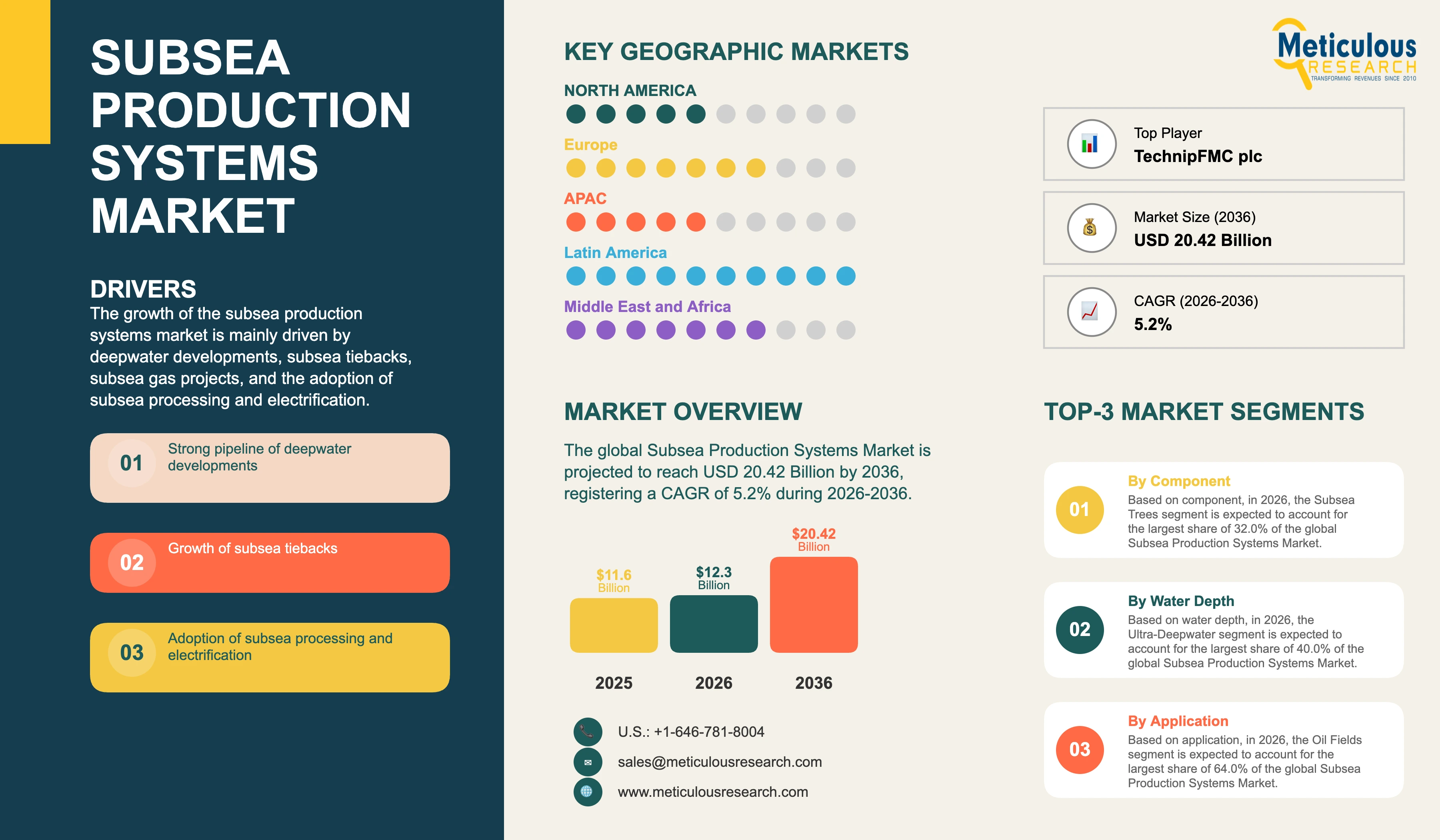
The global subsea production systems market was valued at USD 11.60 billion in 2025. This market is expected to reach USD 20.42 billion by 2036 from an estimated USD 12.30 billion in 2026, registering a CAGR of 5.2% during the forecast period (2026-2036).
- Published
- Nov 2026
- Pages
- 253
- Format
- PDF + Excel
- Report ID
- MREP - 1042737
- Base year
- 2025
- 2025 · BASELINE
- $11.60B
- 2036
- $20.42B
- CAGR 2026–2036
- 5.2%
2025 baseline · 2026–2036 forecast at 5.2% CAGR · hover a bar for the value
Key highlights
TechnipFMC reported 2025 revenue of USD 9.93 billion, up 9%, Subsea inbound orders of USD 10.1 billion, and a Subsea backlog of USD 15.9 billion. The company achieved its three-year goal of USD 30 billion in Subsea orders, said its Subsea opportunities list reached about USD 29 billion, the highest level ever recorded, and guided 2026 Subsea revenue of USD 9.4 billion.
TechnipFMC said that direct awards, Subsea Services, and integrated engineering, procurement, construction, and installation projects represented more than 80% of its 2025 Subsea inbound, and it delivered its 100th Subsea 2.0 configure-to-order tree in 2025.
SLB said it expects more than 500 subsea tree awards across 2026 and 2027, about 20% higher than the 2025 run rate, and aims to surpass USD 9 billion in cumulative OneSubsea bookings over the two years.
SLB OneSubsea was awarded an engineering, procurement, and construction contract by Equinor for the Fram Sør field offshore Norway, the first large-scale all-electric subsea production system, including four subsea templates and 12 all-electric subsea trees, and in February 2026 it was awarded a contract to upgrade the Gullfaks subsea compression system, the world's first multiphase subsea compression system.
OneSubsea is a joint venture backed by SLB, Aker Solutions, and Subsea7, with about 10,000 employees worldwide and headquarters in Oslo and Houston.
In October 2026, OneSubsea completed a joint industry project in Brazil with TotalEnergies, Equinor, BP, and Chevron to develop and qualify fully electric subsea production technologies for water depths of up to 3,000 meters.
TechnipFMC was awarded a substantial engineering, procurement, construction, and installation contract by Eni for the Coral North floating LNG development offshore Mozambique, reflecting rising subsea gas developments to supply LNG markets.
Innovex International delivered its first subsea wellhead products under a global alliance with OneSubsea in 2025 and completed its tenth XPak installation in Brazil's pre-salt fields, expanding the number of suppliers active in deepwater subsea wellheads.
By component, Subsea trees account for the largest share of 32.0% in 2026, while Subsea processing systems register the highest CAGR.
By water depth, ultra-deepwater accounts for the largest share in 2026 and also registers the highest CAGR.
By application, oil fields account for the larger share of 64.0% in 2026, while gas fields register the higher CAGR.
By geography, Latin America accounts for the largest share of 30.0% in 2026, while Middle East & Africa registers the highest CAGR of 6.6%.
Report summary
| Particulars | Details |
|---|---|
| Forecast Period | 2026-2036 |
| Base Year | 2025 |
| Estimated Year | 2026 |
| CAGR (Value) | 5.2% |
| Format | PDF, Excel & Cloud Portal · 253 pages |
| Market Size (Value) in 2025 | USD 11.60 billion |
| Market Size (Value) in 2026 | USD 12.30 billion |
| Market Size (Value) in 2036 | USD 20.42 billion |
| Largest Segment by Component (2026) | Subsea Trees (32.0%) |
| Largest Segment by Application (2026) | Oil Fields (64.0%) |
| Largest Region (2026) | Latin America (30.0%) |
| Fastest-Growing Region | Middle East & Africa (CAGR 6.6%) |
| Segments Covered | Component, Water Depth, Application, Geography |
| Countries Covered | Brazil, Guyana, Suriname, Mexico, Rest of Latin America, Norway, U.K., Netherlands, Rest of Europe, Nigeria, Angola, Mozambique, Egypt, Israel, Rest of Middle East & Africa, Australia, Malaysia, Indonesia, China, India, Rest of Asia-Pacific, U.S., Canada |
| Key Companies | 12 companies and other companies |
Report overview
Segments covered: component, water depth, application.
The growth of this market is mainly driven by a strong pipeline of deepwater and ultra-deepwater developments in Brazil, Guyana, Suriname, West Africa, the Eastern Mediterranean, and other regions, the growing use of subsea tiebacks to existing platforms and floating production units, which offer lower cost and faster time to first production, rising subsea gas developments to supply LNG and domestic gas markets, the adoption of subsea processing technologies such as boosting and compression that increase recovery and extend field life, the shift toward all-electric subsea systems that reduce emissions and simplify field architecture, and the growing installed base of subsea wells that require life-of-field services. However, factors such as high capital costs and long project lead times, oil price volatility that can delay final investment decisions, supply chain and capacity constraints, and geopolitical risks are expected to restrain the growth of this market to some extent.
Subsea production systems are the equipment installed on the seabed to control and produce oil and gas from offshore wells without the need for a platform directly above each well. A subsea production system typically includes subsea wellheads, which support the casing strings, subsea trees, also called subsea Christmas trees, which contain the valves that control flow from the well, manifolds and templates that gather production from multiple wells, connection systems that link equipment, subsea control systems that operate valves and monitor conditions, and in some cases subsea processing equipment such as pumps, compressors, and separators. Production is carried through flowlines and risers to a host platform, a floating production, storage, and offloading vessel, or directly to shore. Subsea production systems must operate for decades with minimal intervention, which requires high reliability, redundancy, and robust materials.
This report covers global revenue from subsea production systems, including subsea trees, subsea wellheads, manifolds, templates, and connection systems, subsea control systems, subsea processing systems, and services related to subsea production systems, such as installation and commissioning support, intervention, inspection, maintenance, and repair, workover systems, and life-of-field services. Subsea umbilicals, risers, and flowlines, offshore installation vessel services for these products, floating production units, fixed platforms, subsea drilling systems such as subsea blowout preventers, and surface wellheads are excluded from the scope of this report, as they are covered in separate studies.
Subsea production systems are used in a wide range of water depths, from shallow-water tiebacks in the North Sea and Southeast Asia to ultra-deepwater developments in Brazil's pre-salt fields, Guyana, the U.S. Gulf of Mexico, and West Africa, where water depths can exceed 2,000 to 3,000 meters. Subsea development allows operators to produce from fields that would be uneconomic to develop with fixed platforms, and subsea tiebacks to existing infrastructure can significantly reduce development cost and time. Subsea production also reduces the need for surface facilities, which lowers emissions and safety risks. In many deepwater developments, subsea production systems account for a significant share of total project capital expenditure, alongside floating production units and umbilicals, risers, and flowlines, which are covered in a separate study.
The market is driven by offshore project sanctions, and each major project can require dozens of subsea trees and associated equipment. TechnipFMC reported Subsea inbound orders of USD 10.1 billion in 2025 and a record Subsea opportunities list, while SLB expects more than 500 subsea tree awards across 2026 and 2027. Brazil, where Petrobras and international oil companies are developing large pre-salt fields, and Guyana, where production is expanding rapidly, are among the largest markets. Norway, the U.K., West Africa, the Eastern Mediterranean, Australia, and Southeast Asia are also important.
Technology is changing how subsea production systems are designed, delivered, and operated. Standardized, configure-to-order products, such as TechnipFMC's Subsea 2.0 platform, reduce lead times and costs. All-electric subsea systems, which replace hydraulic controls with electric actuators, eliminate the need for hydraulic fluid and allow longer tiebacks, as shown by Equinor's Fram Sør project. Subsea processing, including multiphase boosting and gas compression, increases recovery and extends field life, as shown by the Gullfaks subsea compression system.
The subsea production systems market is concentrated among a small number of large suppliers. Leading companies include TechnipFMC, SLB through its OneSubsea joint venture with Aker Solutions and Subsea7, and Baker Hughes, along with Innovex International, which supplies subsea wellheads and has an alliance with OneSubsea, and other suppliers of controls, connection systems, power, and services, such as Oceaneering, Proserv, Siemens Energy, ABB, Saipem, and Offshore Oil Engineering.
Over the forecast period, the market is expected to grow steadily, supported by deepwater developments, tiebacks, gas projects, subsea processing, and electrification. Subsea processing systems are expected to be the fastest-growing component, ultra-deepwater the fastest-growing water depth, and gas fields the fastest-growing application. Latin America is expected to remain the largest region, while the Middle East & Africa is expected to grow fastest.
Our pre-salt developments require large numbers of high-specification subsea trees and manifolds, and we value suppliers that can deliver on schedule and support the fields for decades.
This comment explains why subsea trees are the largest component and why Latin America is the largest region, led by Brazil's pre-salt fields.
All-electric systems let us tie back new wells over longer distances with lower emissions and minimal topside modifications.
This comment explains why subsea control systems and electrification are growing strongly, especially for tiebacks in Norway and other mature basins where host platforms have limited topside space and power available for new wells.
Our offshore gas project depends on subsea production systems and compression to deliver gas to our LNG facility over its full life.
This comment shows why gas fields and the Middle East & Africa are growing fastest and why subsea processing is important for gas developments.
Report infographic
Market dynamics
20 factors across 5 forcesStrong pipeline of deepwater and ultra-deepwater developments
The offshore industry has a large pipeline of deepwater and ultra-deepwater projects, supported by attractive project economics, low breakeven prices for many developments, and the need for new supply. Brazil's pre-salt fields, Guyana's Stabroek block, Suriname, the U.S. Gulf of Mexico, West Africa, the Eastern Mediterranean, and other regions have multiple projects in development or planning. TechnipFMC reported that its Subsea opportunities list reached about USD 29 billion at the end of 2025, the highest level ever recorded, and SLB expects more than 500 subsea tree awards across 2026 and 2027.
Deepwater projects typically use large numbers of subsea trees, manifolds, and control systems, which makes them the largest source of demand for subsea production systems. Many deepwater projects also have low emissions intensity per barrel and long production plateaus, which makes them attractive to operators.
The strong project pipeline provides visibility for subsea suppliers, and TechnipFMC raised its 2026 Subsea revenue guidance to USD 9.4 billion. Petrobras' strategic plan includes multiple new floating production units in the pre-salt Santos Basin, and ExxonMobil and its partners continue to sanction new developments in Guyana's Stabroek block, each requiring large subsea well networks. West African operators in Nigeria and Angola are also advancing new deepwater projects after several years of limited sanctions, supported by improved fiscal terms and new licensing rounds.
Growth of Subsea tiebacks
Subsea tiebacks connect new wells or small fields to existing platforms or floating production units, which allows operators to use spare processing capacity and avoid building new facilities. Tiebacks can be developed faster and at lower cost than standalone developments, and they are widely used in the North Sea, the Gulf of Mexico, Brazil, West Africa, and Southeast Asia. All-electric subsea systems and subsea processing are extending the distance over which tiebacks are feasible.
Equinor's Fram Sør project, a subsea tieback to the Troll C platform, uses 12 all-electric subsea trees and four templates, and is expected to have very low emissions because the host platform is powered from shore. Tiebacks are expected to account for a growing share of subsea projects over the forecast period. In mature basins such as the North Sea and the Gulf of Mexico, tiebacks are often the main way to develop smaller discoveries and extend the life of existing hosts. Longer tieback distances, enabled by subsea boosting and electrification, allow operators to develop fields that are farther from existing infrastructure.
Rising Subsea gas developments
Demand for natural gas to supply LNG export projects, domestic power generation, and industry is driving subsea gas developments in the Eastern Mediterranean, Mozambique, Australia, Southeast Asia, Norway, West Africa, and other regions. Subsea gas fields often use subsea trees, manifolds, and in some cases subsea compression to maintain production as reservoir pressure declines. TechnipFMC has been awarded a subsea contract by Eni for the Coral North floating LNG development offshore Mozambique.
Gas developments are expected to grow faster than oil developments over the forecast period, as countries seek to secure gas supplies and LNG demand grows. Gas fields often require subsea compression later in their life to maintain production, which creates additional demand for subsea processing equipment. Gas developments in the Eastern Mediterranean, including fields offshore Egypt, Israel, and Cyprus, are also expected to require subsea production systems.
Adoption of Subsea processing and electrification
Subsea processing technologies, such as multiphase boosting pumps, gas compression, and separation, increase recovery, extend field life, and reduce the need for topside equipment. The Gullfaks field in Norway hosts the world's first multiphase subsea compression system, installed in 2015, and in 2026 Equinor awarded OneSubsea a contract to upgrade it with next-generation compressor modules that will increase differential pressure and flow capacity.
All-electric subsea systems eliminate hydraulic fluid, reduce emissions, improve control and monitoring, and allow longer tiebacks. OneSubsea's completion of a joint industry project in Brazil with TotalEnergies, Equinor, BP, and Chevron to qualify fully electric subsea production technologies for water depths of up to 3,000 meters is expected to accelerate adoption in deepwater markets. Electric systems also reduce the size and cost of umbilicals, because hydraulic lines are no longer needed, and they provide better data from subsea equipment, which supports digital field management and predictive maintenance.
Table of contents
11 chapters · 132 sections · 253 pages · click to expandSegmental analysis
| Segment | Largest share (2026) | Fastest growth (2026–2036) |
|---|---|---|
| By Component | Subsea trees | Subsea processing systems |
| By Water Depth | Ultra-deepwater | Ultra-deepwater |
| By Application | Oil fields | Gas fields |
| Other segments | Ultra-deepwater | — |
By Component
- Subsea Production Systems Market Analysis by Component
- The subsea trees segment is expected to account for the largest share of 32.0% of the global subsea production systems market.
- The large share of this segment is mainly attributed to the need for a subsea tree on every subsea well, the high value of each tree, which includes valves, chokes, sensors, and controls rated for high pressures and deep water, and the large number of trees required for major deepwater developments in Brazil, Guyana, and other regions.
- SLB expects more than 500 subsea tree awards across 2026 and 2027, and TechnipFMC delivered its 100th Subsea 2.0 tree in 2025.
- Vertical and horizontal tree designs are used for different well and intervention requirements, and trees for high-pressure, high-temperature wells and ultra-deepwater command premium prices.
- All-electric trees, such as those supplied for Fram Sør, are expected to gain share over the forecast period.
- Tree demand in Brazil and Guyana alone is expected to account for a large share of global awards.
- However, the subsea processing systems segment is projected to register the highest CAGR during the forecast period.
- The rapid growth of this segment is primarily driven by the need to increase recovery and extend the life of maturing deepwater fields, the adoption of multiphase boosting and gas compression, upgrades of existing processing systems such as Gullfaks, and the potential for subsea separation to reduce topside requirements.
- Processing systems are typically supplied for larger fields with long production lives, and each installation can be worth hundreds of millions of dollars, which increases their contribution to market value.
- Boosting systems are the most widely installed type of subsea processing, while gas compression and separation are used on a smaller number of large fields.
- Brazil and Norway are expected to be the leading markets for subsea processing over the forecast period, followed by West Africa and the Gulf of Mexico.
- Meanwhile, the SPS services, manifolds, templates, and connection systems, Subsea control systems, and Subsea wellheads segments are expected to witness steady growth, supported by installation, intervention, maintenance, and life-of-field services for the growing installed base, manifolds and connection systems required for most subsea developments, electrification and replacement of aging control systems, and subsea wellheads supplied with every subsea well.
By Water Depth
- Subsea Production Systems Market Analysis by Water Depth
- The ultra-deepwater segment is expected to account for the largest share of 40.0% of the global subsea production systems market.
- The large share of this segment is mainly attributed to the large ultra-deepwater developments in Brazil's pre-salt fields, Guyana, the U.S. Gulf of Mexico, and West Africa, which require large numbers of high-specification subsea trees, manifolds, and control systems.
- Ultra-deepwater equipment is more expensive because of higher pressure and depth ratings.
- Brazil's pre-salt fields, which lie in water depths of around 2,000 meters or more, and Guyana's Stabroek developments are among the largest users of ultra-deepwater subsea equipment.
- The ultra-deepwater segment is also projected to register the highest CAGR during the forecast period.
- The rapid growth of this segment is primarily driven by new projects in Brazil, Guyana, Suriname, and West Africa, the qualification of all-electric technologies for depths of up to 3,000 meters, and the attractive economics of large ultra-deepwater reservoirs, which often have high flow rates and low breakeven prices.
- Equipment for these depths, often more than 1,500 meters, must withstand very high external pressures and often high reservoir pressures, which increases engineering requirements.
- Meanwhile, the deepwater and shallow water segments are expected to witness steady growth, supported by deepwater developments in West Africa, the Gulf of Mexico, and Norway, and numerous smaller tiebacks in the North Sea and Southeast Asia.
By Application
- Subsea Production Systems Market Analysis by Application
- The oil fields segment is expected to account for the largest share of 64.0% of the global subsea production systems market.
- The large share of this segment is mainly attributed to the large deepwater oil developments in Brazil, Guyana, the U.S. Gulf of Mexico, West Africa, and Norway, which account for most subsea tree awards.
- Oil projects often use floating production, storage, and offloading vessels with large subsea well networks.
- Oil developments in Brazil and Guyana alone account for a large share of global subsea tree demand, and new oil projects in West Africa and the Gulf of Mexico add to this demand.
- The oil segment is expected to grow steadily, supported by the deepwater project pipeline, although its share will decline as gas developments grow faster.
- However, the gas fields segment is projected to register the highest CAGR during the forecast period.
- The rapid growth of this segment is primarily driven by rising demand for natural gas and LNG, subsea gas developments in the Eastern Mediterranean, Mozambique, Australia, Southeast Asia, Norway, and West Africa, floating LNG projects such as Coral North, and the use of subsea compression to maintain gas production as reservoir pressure declines.
- Gas tiebacks in Norway and the U.K. and expanding gas production offshore Egypt and Israel add further demand for subsea gas systems.
Other segments
- The ultra-deepwater segment is expected to account for the largest share of the subsea production systems market, and it is also projected to register the highest CAGR during the forecast period.
Geographic analysis
Latin America
Largest shareIn 2026, Latin America is expected to account for the largest share of 30.0% of the global subsea production systems market. The large share of this region is mainly due to the very large deepwater and ultra-deepwater developments in Brazil's pre-salt fields, where Petrobras and international oil companies are developing multiple fields with floating production units and large subsea well networks, and the rapid growth of Guyana's offshore production. Petrobras is the world's largest operator of subsea wells, and its long-term contracts with suppliers provide a stable base of demand. Guyana's Stabroek block has added several floating production units in recent years, each supported by large numbers of subsea wells. Suriname is also emerging as a new deepwater market.
Europe
Europe and the Middle East & Africa are the next-largest markets, and Europe, led by Norway and the U.K., is a major market with many subsea tiebacks and advanced technologies such as subsea compression and all-electric systems, although growth is moderated by maturing basins. Norway is expected to remain one of the most technologically advanced markets, with early adoption of all-electric systems and subsea compression, and the U.K. North Sea is expected to see continued tiebacks despite declining production.
Middle East & Africa
Fastest growthThe Middle East & Africa is projected to register the highest CAGR of 6.6% during the forecast period. The rapid growth of this region is mainly due to deepwater oil and gas developments in West Africa, including Nigeria, Angola, and new frontier areas, gas developments in Mozambique, including floating LNG, Eastern Mediterranean gas fields, and offshore projects in the Middle East. These regions have significant undeveloped offshore resources and a growing number of project sanctions. Namibia's recent deepwater discoveries may also lead to subsea developments later in the forecast period. Nigeria and Angola remain the largest subsea markets in Africa.
Asia-Pacific
Asia-Pacific is supported by gas developments in Australia, Malaysia, Indonesia, and China, and North America is supported by deepwater developments and tiebacks in the U.S. Gulf of Mexico. Asia-Pacific includes large gas developments offshore Australia that supply LNG plants, as well as growing activity in Malaysia, Indonesia, and India.
North America
Canada's offshore Newfoundland fields also use subsea systems.
Competitive landscape
The global subsea production systems market is highly consolidated, with the top three players estimated to account for about 75% of the market in 2025. The market includes large subsea equipment and integrated project companies, subsea wellhead and component suppliers, and service providers.
TechnipFMC is the market leader, with its Subsea 2.0 configure-to-order products, integrated engineering, procurement, construction, and installation model, and strong position in Brazil, Guyana, Norway, and other markets. SLB's OneSubsea, a joint venture with Aker Solutions and Subsea7, is a leading supplier of subsea production systems, processing, and all-electric technology. Baker Hughes is also a major supplier of subsea trees, wellheads, and services. Innovex International supplies subsea wellheads and has a global alliance with OneSubsea, Oceaneering and Proserv supply controls, connection systems, and services, Siemens Energy and ABB supply subsea power and electrification systems, and Saipem and Offshore Oil Engineering provide subsea engineering and equipment.
Companies compete on technology, reliability, project execution, lead times, cost, and the ability to offer integrated solutions and long-term services. Key strategies include product standardization, integrated project delivery, alliances with operators and other suppliers, investment in electrification and processing technology, and growth of life-of-field services.
The competitive landscape is expected to remain concentrated, as high technical and qualification barriers limit new entrants. TechnipFMC and OneSubsea are expected to continue competing closely for major projects, with both emphasizing integrated delivery, standardized products, and early engagement with operators. Baker Hughes competes with a focus on trees, wellheads, and services. Chinese suppliers, such as Offshore Oil Engineering, are developing domestic subsea capabilities, mainly for projects in China. Alliances between suppliers and with operators are expected to become more important, as shown by long-term frame agreements and integrated project alliances. In addition, specialized suppliers of controls, power, and connection systems compete for subcontracts and service work, and some partner with the major integrators to deliver complete systems for operators. Service capabilities, including global service bases, spare parts inventories, and remote monitoring centers, are increasingly important differentiators, as the installed base grows and ages across all major regions. Pricing for subsea equipment has improved as demand has strengthened and suppliers have become more selective in the projects they pursue.
Some of the key players operating in the subsea production systems market are TechnipFMC plc, SLB (OneSubsea), Baker Hughes Company, Aker Solutions ASA, Subsea7 S.A., Innovex International, Inc., Oceaneering International, Inc., Proserv, Siemens Energy AG, ABB Ltd., Saipem S.p.A., and Offshore Oil Engineering Co., Ltd., among others.
- —
TechnipFMC reported record Subsea backlog and opportunities, OneSubsea won the Gullfaks compression upgrade in February 2026 and completed the Brazil All-Electric Joint Industry Project in October 2026, and Innovex delivered its first subsea wellheads under its OneSubsea alliance.
- TechnipFMC plc
- SLB (OneSubsea)
- Baker Hughes Company
- Aker Solutions ASA
- Subsea7 S.A.
- Innovex International, Inc.
- Oceaneering International, Inc.
- Proserv
- Siemens Energy AG
- ABB Ltd.
- Saipem S.p.A
- Offshore Oil Engineering Co., Ltd.
Expert perspectives
The subsea production systems market is in a strong cycle, supported by a large pipeline of deepwater projects, record subsea order levels, and new technologies. We expect steady growth over the forecast period, led by ultra-deepwater developments, gas projects, subsea processing, and electrification.
Over the forecast period, the market is expected to grow at a CAGR of 5.2%, from USD 12.30 billion in 2026 to USD 20.42 billion in 2036. Growth will be supported by deepwater developments, tiebacks, gas projects, processing, electrification, and services, while high costs, long lead times, oil price volatility, and supply chain constraints will moderate growth.
In terms of segments, subsea trees remain the largest component, while subsea processing systems grow fastest. Oil fields remain the largest application, while gas fields grow fastest. Latin America remains the largest region, while the Middle East & Africa grows fastest at a CAGR of 6.6%.
For suppliers, the key priorities are to expand capacity and standardize products, to commercialize all-electric and processing technologies, to deepen integrated delivery models and alliances, and to grow life-of-field services. Managing execution risk will remain essential, and suppliers must balance growth with disciplined project selection, as TechnipFMC has done by reducing its share of legacy projects to less than 10% of its Subsea backlog. We expect all-electric subsea systems to become standard for many new developments over the next decade. In our view, Brazil, Guyana, and West Africa will remain the most important markets for subsea production systems.
Our estimates are based on subsea tree awards and installations, the value of subsea production system equipment per project, the reported Subsea revenue and orders of leading suppliers, and the installed base for services. We have excluded umbilicals, risers, flowlines, and installation vessel services, which account for a large part of the subsea revenue of integrated suppliers. We expect order levels to remain strong in 2026 and 2027, supported by the record opportunities list, but we note that offshore investment can be cyclical. We see upside from faster adoption of subsea processing and electrification and downside from lower oil prices or project delays. We also expect services to account for a growing share of supplier revenue as the installed base ages and as operators seek to extend the life of existing fields with upgrades and processing retrofits, which typically carry attractive margins and strengthen customer relationships. In our view, suppliers with strong positions in Brazil, Guyana, and Norway will benefit most from the current cycle.
Customer perspectives
Buyers of subsea production systems include international oil companies, national oil companies, and independent offshore operators. Their decisions depend mainly on reliability, technology, lead times, cost, execution track record, and long-term service. Many buyers also value integrated delivery and early supplier involvement in field design, which can reduce costs and accelerate first production. Proven track records in similar water depths and reservoir conditions are often decisive, along with the supplier's ability to provide long-term service support and local content in countries such as Brazil and Nigeria.
Frequently asked questions
The global subsea production systems market was valued at USD 11.60 billion in 2025, up from USD 11.00 billion in 2024, and is estimated at USD 12.30 billion in 2026. The market includes subsea trees, wellheads, manifolds and templates, control systems, processing systems, and related services.
The global subsea production systems market is expected to reach USD 20.42 billion by 2036, supported by deepwater developments, tiebacks, gas projects, processing, and electrification.
The market is expected to register a CAGR of 5.2% from 2026 to 2036, with the fastest growth in subsea processing, subsea controls, ultra-deepwater, gas fields, and the Middle East & Africa.
TechnipFMC reported USD 10.1 billion of Subsea inbound orders in 2025 and a record Subsea opportunities list of about USD 29 billion, and SLB expects more than 500 subsea tree awards across 2026 and 2027, about 20% higher than the 2025 run rate.
Market growth is mainly driven by a strong pipeline of deepwater and ultra-deepwater developments, the growth of subsea tiebacks, rising subsea gas developments, and the adoption of subsea processing and electrification.
High capital costs, long lead times, and oil price volatility restrain growth, while technical complexity, reliability requirements, market concentration, and execution risk are key challenges.
Key opportunities include all-electric subsea production systems, subsea processing for recovery and life extension, integrated project delivery and direct awards, and life-of-field services for the installed base.
Subsea trees are expected to account for the largest share of 32.0% of the market in 2026, while subsea processing systems are projected to register the highest CAGR.
Gas fields are projected to register the highest CAGR, driven by LNG and gas demand, while oil fields account for the largest share of 64.0%.
Latin America is expected to account for the largest share of 30.0% of the market in 2026, mainly due to Brazil's pre-salt developments and Guyana's offshore growth.
The Middle East & Africa is projected to register the highest CAGR of 6.6% during the forecast period, driven by deepwater developments in West Africa, Mozambique gas, and Eastern Mediterranean projects.
Equinor's Fram Sør project, supplied by OneSubsea, is the first large-scale all-electric subsea production system, and OneSubsea completed a joint industry project in Brazil in 2026 to qualify electric technologies for water depths of up to 3,000 meters.
The report profiles 12 companies, including TechnipFMC plc, SLB (OneSubsea), Baker Hughes Company, Aker Solutions ASA, Subsea7 S.A., Innovex International, Inc., Oceaneering International, Inc., Proserv, Siemens Energy AG, ABB Ltd., Saipem S.p.A., and Offshore Oil Engineering Co., Ltd.
TechnipFMC reported record Subsea backlog and opportunities, OneSubsea won the Gullfaks compression upgrade in February 2026 and completed the Brazil All-Electric Joint Industry Project in October 2026, and Innovex delivered its first subsea wellheads under its OneSubsea alliance.
In 2026, the ultra-deepwater segment is expected to account for the largest share of the subsea production systems market, and it is also projected to register the highest CAGR during the forecast period.
Cite this report
Meticulous Research. (2026). Subsea Production Systems Market - Global Opportunity Analysis and Industry Forecast (2026-2036) (Report No. MREP - 1042737). Meticulous Market Research Pvt. Ltd. https://www.meticulousresearch.com/product/subsea-production-systems-market-7420