Subsea Umbilicals, Risers, and Flowlines (SURF) Market (2026-2036)
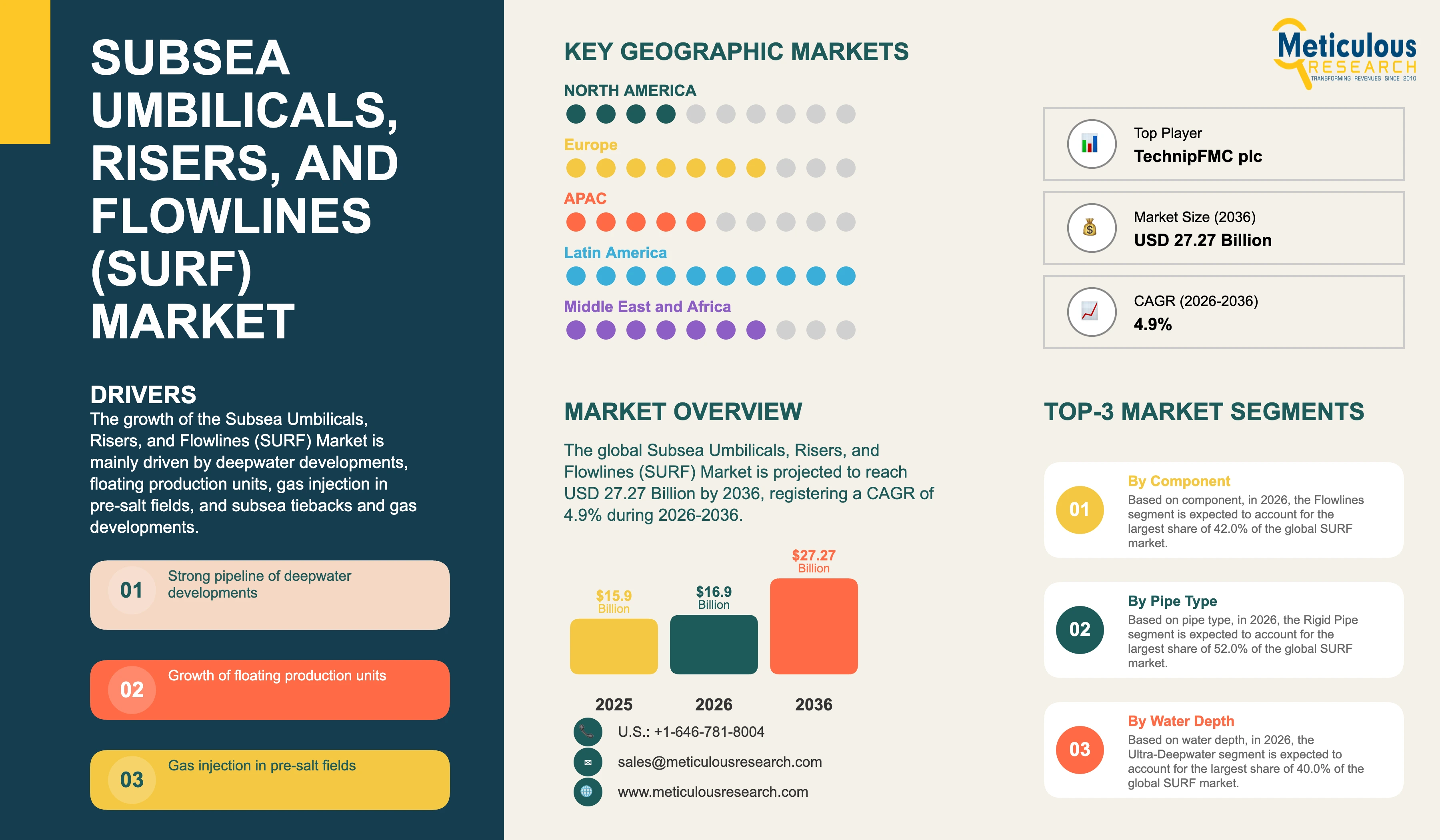
The global subsea umbilicals, risers, and flowlines market was valued at USD 15.90 billion in 2025. This market is expected to reach USD 27.27 billion by 2036 from an estimated USD 16.90 billion in 2026, registering a CAGR of 4.9% during the forecast period (2026-2036).
- Published
- Nov 2026
- Pages
- 248
- Format
- PDF + Excel
- Report ID
- MREP - 1042738
- Base year
- 2025
- 2025 · BASELINE
- $15.90B
- 2036
- $27.27B
- CAGR 2026–2036
- 4.9%
2025 baseline · 2026–2036 forecast at 4.9% CAGR · hover a bar for the value
Key highlights
Subsea7 reported 2025 revenue of USD 7.1 billion, up 4%, including USD 5.8 billion from its Subsea and Conventional business, order intake of USD 9.0 billion, and a record backlog of USD 13.8 billion at the end of 2025, of which USD 6.9 billion is expected to be executed in 2026. The company guided 2026 revenue of USD 7.0 billion to USD 7.4 billion.
Subsea7 and Saipem have proposed a merger of equals to create Saipem7, which would combine two of the largest subsea installation contractors, and the merger was awaiting regulatory clearance in 2026.
TechnipFMC reported 2025 Subsea inbound orders of USD 10.1 billion, with integrated engineering, procurement, construction, and installation projects the largest contributor, and a Subsea backlog of USD 15.9 billion.
TechnipFMC was awarded two Petrobras flexible pipe contracts in September 2025, including a substantial contract valued at USD 250 million to USD 500 million for flexible gas injection risers for pre-salt fields in the Santos Basin, and a further significant contract in October 2026 for flexible flowlines across multiple pre-salt fields, manufactured at its facility in Açu, Brazil.
SLB expects more than 500 subsea tree awards across 2026 and 2027, about 20% higher than the 2025 run rate, which indicates strong demand for the umbilicals, risers, and flowlines that connect subsea wells to host facilities.
Subsea7 reported that USD 4.3 billion of its year-end 2025 backlog is scheduled for execution in 2027, up 27% compared with the prior-year equivalent, which indicates that the current subsea and SURF upcycle is expected to extend beyond 2026.
In 2023, TechnipFMC was awarded a significant contract by Petrobras to design, engineer, and manufacture 14 kilometers of gas injection riser pipes for pre-salt fields, together with associated packing and storage services.
Global offshore rig activity declined from about 300 active rigs in 2024 to 251 in 2025 and stabilized around 250 rigs in the first five months of 2026, while subsea project backlogs reached record levels at leading contractors.
By component, flowlines account for the largest share of 42.0% in 2026, while risers register the highest CAGR.
By pipe type, rigid pipe accounts for the largest share of 52.0% in 2026, while thermoplastic composite pipe registers the highest CAGR.
By water depth, ultra-deepwater accounts for the largest share in 2026 and also registers the highest CAGR.
By geography, Latin America accounts for the largest share of 30.0% in 2026, while Middle East & Africa registers the highest CAGR of 6.2%.
Report summary
| Particulars | Details |
|---|---|
| Base Year | 2025 |
| Estimated Year | 2026 |
| Forecast Period | 2026-2036 |
| Market Size in 2025 | USD 15.90 billion |
| Market Size in 2026 | USD 16.90 billion |
| Market Size by 2036 | USD 27.27 billion |
| CAGR (2026-2036) | 4.9% |
| Format | PDF, Excel & Cloud Portal · 248 pages |
| Largest Segment by Component (2026) | Flowlines (42.0%) |
| Largest Segment by Pipe Type (2026) | Rigid Pipe (52.0%) |
| Largest Region (2026) | Latin America (30.0%) |
| Fastest-Growing Region | Middle East & Africa (CAGR 6.2%) |
| Companies Profiled | 12 companies and other companies |
| Segments Covered | Component, Pipe Type, Water Depth, Geography |
| Countries Covered | Brazil, Guyana, Suriname, Mexico, Rest of Latin America, Nigeria, Angola, Mozambique, Egypt, Israel, Saudi Arabia, UAE, Rest of Middle East & Africa, Norway, U.K., Netherlands, Rest of Europe, Australia, Malaysia, Indonesia, India, China, Rest of Asia-Pacific, U.S., Canada |
Report overview
Segments covered: component, pipe type, water depth.
The growth of this market is mainly driven by a strong pipeline of deepwater and ultra-deepwater developments in Brazil, Guyana, Suriname, West Africa, the Eastern Mediterranean, and other regions, the growing number of floating production, storage, and offloading vessels that require large networks of risers and flowlines, the use of subsea tiebacks to extend the life of existing infrastructure, rising subsea gas developments to supply LNG and domestic markets, gas injection and carbon dioxide reinjection requirements in Brazil's pre-salt fields, and the adoption of integrated engineering, procurement, construction, and installation contracting models. However, factors such as high capital costs and long project lead times, limited availability of specialized installation vessels, supply chain constraints for line pipe and flexible pipe, oil price volatility, and technical challenges such as stress corrosion cracking in high carbon dioxide environments are expected to restrain the growth of this market to some extent.
Subsea umbilicals, risers, and flowlines, commonly referred to as SURF, are the pipes and cables that connect subsea wells and production systems to host facilities such as floating production, storage, and offloading vessels, platforms, and onshore plants. Flowlines carry oil, gas, and water along the seabed between wells, manifolds, and risers, and they may also carry injection water or gas. Risers carry fluids vertically from the seabed to the floating or fixed host facility, and they must withstand dynamic loads from waves, currents, and vessel motion. Umbilicals carry hydraulic fluid, chemicals, electrical power, and communication signals from the host facility to subsea equipment, allowing operators to control and monitor subsea wells.
This report covers global revenue from subsea umbilicals, risers, and flowlines, including rigid flowlines and risers, flexible flowlines and risers, thermoplastic composite pipe, hybrid and other riser systems, steel tube and thermoplastic hose umbilicals, power and control umbilicals, and ancillary equipment such as buoyancy modules, end fittings, connectors, and riser support structures. Revenue includes the supply of these products and their engineering, fabrication, transportation, and installation offshore. Subsea production systems such as trees, manifolds, and control systems, large-diameter export trunklines, floating production units, offshore wind and power transmission cables, and decommissioning are excluded from the scope of this report, as they are covered in separate studies.
SURF systems are typically the largest single cost component in subsea developments after the host facility, and they represent a large share of the revenue of offshore installation contractors. Rigid steel pipe is widely used for flowlines and steel catenary risers, especially in large deepwater developments, and it is installed using reel-lay, S-lay, or J-lay vessels. Flexible pipe, made of layers of steel wires and polymer sheaths, is used for dynamic risers and flowlines in many developments, particularly in Brazil, where Petrobras is one of the largest users of flexible pipe in the world. Thermoplastic composite pipe is an emerging technology that offers corrosion resistance and lighter weight.
The SURF market is closely linked to offshore project sanctions, especially in deepwater and ultra-deepwater. Brazil's pre-salt developments, which use large numbers of flexible risers and flowlines connected to floating production units, and Guyana's Stabroek developments, which use rigid pipe-in-pipe flowlines and risers, are among the largest SURF markets. Norway, the U.K., West Africa, the Gulf of Mexico, Australia, Southeast Asia, and the Eastern Mediterranean are also important.
Contracting models in the SURF market are changing as operators seek lower costs, fewer interfaces, and shorter schedules. Integrated engineering, procurement, construction, and installation contracts that combine SURF with subsea production systems, such as TechnipFMC's iEPCI model and the OneSubsea and Subsea7 alliance, reduce interfaces and improve project economics. TechnipFMC reported that integrated projects were the largest contributor to its 2025 Subsea inbound orders. Installation contractors such as Subsea7 and Saipem, which have proposed to merge, operate fleets of specialized pipelay and construction vessels that are essential for SURF installation. The market includes integrated subsea contractors, installation contractors, and manufacturers of flexible pipe, umbilicals, line pipe, and thermoplastic composite pipe. Leading companies include TechnipFMC, Subsea7, Saipem, McDermott, Baker Hughes, Prysmian, Oceaneering, Aker Solutions, Tenaris, Strohm, Allseas, and Offshore Oil Engineering.
The SURF value chain begins with line pipe mills, which produce seamless and welded steel pipe for rigid flowlines and risers, and with manufacturers of flexible pipe, umbilicals, and composite pipe, which operate specialized plants in Brazil, Europe, the U.S., and Asia. Engineering firms design field layouts and riser systems, while spoolbases and fabrication yards weld, coat, and prepare pipe for installation. Installation contractors then lay, connect, and test the systems offshore using specialized vessels. Each step requires qualified materials and tight quality control, which creates high barriers to entry and favors experienced suppliers.
Over the forecast period, the market is expected to grow steadily, supported by deepwater developments, floating production units, tiebacks, gas projects, and integrated contracting. Risers are expected to be the fastest-growing component, thermoplastic composite pipe the fastest-growing pipe type, and ultra-deepwater the fastest-growing water depth. Latin America is expected to remain the largest region, while the Middle East & Africa is expected to grow fastest.
Report infographic
Market dynamics
16 factors across 5 forcesStrong pipeline of deepwater and ultra-deepwater developments
The offshore industry has a strong pipeline of deepwater and ultra-deepwater developments, supported by attractive project economics and the need for new oil and gas supply. Leading contractors reported record backlogs at the end of 2025, with Subsea7's backlog reaching USD 13.8 billion and TechnipFMC's Subsea backlog reaching USD 15.9 billion. TechnipFMC's Subsea opportunities list reached about USD 29 billion, the highest level ever recorded, and SLB expects more than 500 subsea tree awards across 2026 and 2027.
Each deepwater development requires extensive networks of flowlines, risers, and umbilicals to connect subsea wells to host facilities, and ultra-deepwater developments require longer and more robust systems. Brazil, Guyana, Suriname, West Africa, the Gulf of Mexico, and the Eastern Mediterranean are expected to drive demand over the forecast period.
Project sanctions in these regions are increasingly concentrated in large, long-life developments with low breakeven costs, which are more resilient to oil price changes than many onshore projects. This resilience supports a steady flow of SURF awards even when short-cycle activity slows, as seen in 2026 when onshore activity in several regions weakened while subsea backlogs remained at record levels. Subsea7 has said that its backlog provides high visibility on 2026 revenue, and that industry dynamics support the view of a sustained upcycle in offshore activity.
Growth of floating production units
Floating production, storage, and offloading vessels are the preferred host facilities for many deepwater developments, especially in Brazil, Guyana, and West Africa. Each floating production unit requires dynamic risers, flowlines, and umbilicals to connect it to subsea wells, and large units can require dozens of risers. Petrobras' plans for multiple new floating production units in the pre-salt Santos Basin and the continued expansion of Guyana's Stabroek developments create large demand for SURF systems. The dynamic environment of floating production units requires risers that can withstand repeated motion and fatigue, which increases engineering requirements and value. Flexible risers, steel lazy-wave risers, and hybrid riser towers are used depending on water depth, fluid properties, and environmental conditions.
Guyana illustrates the link between floating production units and SURF demand more clearly than any other offshore market. Each new floating production unit in the Stabroek block is connected to a large network of subsea wells through rigid flowlines and risers, and the steady sequence of developments sanctioned in the country has created one of the most consistent SURF markets in the world. Similar sequential development programs are under way in Brazil and are being planned in Suriname and West Africa.
Gas injection and carbon dioxide reinjection in pre-salt fields
Brazil's pre-salt fields contain high levels of carbon dioxide in the produced gas, and operators reinject gas and carbon dioxide into the reservoirs to maintain pressure, enhance recovery, and avoid emissions. This requires high-pressure gas injection risers and flowlines designed for corrosive conditions. TechnipFMC's substantial contract from Petrobras for flexible gas injection risers in the Santos Basin, valued at USD 250 million to USD 500 million, shows the scale of this demand. Gas injection requirements are expected to continue to drive demand for specialized risers and flowlines in Brazil, and similar reinjection approaches may be used in other fields with high carbon dioxide content.
Gas injection risers are among the most technically demanding SURF products because they must handle very high pressures and corrosive fluids while withstanding the dynamic loads of floating production units. Their high value per kilometer makes them an important contributor to market revenue, and the qualification required for these products limits the number of suppliers able to compete for such contracts.
Subsea tiebacks and gas developments
Subsea tiebacks connect new wells or small fields to existing hosts, which allows operators to use spare capacity and develop resources quickly and at lower cost. Tiebacks require flowlines and umbilicals, and longer tiebacks require more robust and often heated or insulated flowlines. Tiebacks are widely used in the North Sea, the Gulf of Mexico, West Africa, and Southeast Asia. Subsea gas developments, including those supplying floating LNG and onshore LNG plants in Mozambique, Australia, the Eastern Mediterranean, and West Africa, require large-diameter flowlines and umbilicals. Rising demand for gas is expected to support SURF demand in these regions.
Tiebacks are also attractive because they can be developed in two to three years, compared with five years or more for standalone developments. Operators in the North Sea and the Gulf of Mexico are using longer tiebacks of 30 kilometers or more, which require heated or insulated flowlines and longer umbilicals, increasing the value of each project.
Table of contents
11 chapters · 130 sections · 248 pages · click to expandSegmental analysis
| Segment | Largest share (2026) | Fastest growth (2026–2036) |
|---|---|---|
| By Component | Flowlines | Risers |
| By Pipe Type | Rigid pipe | Thermoplastic composite pipe |
| By Water Depth | Ultra-deepwater | Ultra-deepwater |
| Other segments | Ultra-deepwater | — |
By Component
- The flowlines segment is expected to account for the largest share of 42.0% of the global SURF market.
- The large share of this segment is mainly attributed to the extensive networks of flowlines needed to connect subsea wells, manifolds, and risers in deepwater and shallow-water developments, the long lengths of flowlines in tiebacks and large fields, and the use of insulated and pipe-in-pipe flowlines for flow assurance.
- Rigid and flexible flowlines are used in all major subsea regions.
- Flowlines include production flowlines, water and gas injection lines, service lines, and jumpers, and they may be single-wall, insulated, pipe-in-pipe, or electrically heated depending on fluid properties and flow assurance needs.
- Long tiebacks and large field layouts require many kilometers of flowlines, and their value is increased by coatings, insulation, and installation by reel-lay or S-lay vessels.
- However, the risers segment is projected to register the highest CAGR during the forecast period.
- The rapid growth of this segment is primarily driven by the growing number of floating production units in Brazil, Guyana, and West Africa, which require large numbers of dynamic risers, gas injection risers for pre-salt fields, and more complex riser systems for ultra-deepwater developments.
- TechnipFMC's Petrobras contracts for flexible gas injection risers show strong demand.
- Risers are among the highest-value SURF products per kilometer because they must resist fatigue from vessel motion, high internal pressure, and corrosive fluids over a design life of 25 years or more.
- In Brazil, operators use flexible risers and are qualifying new designs for high carbon dioxide service, while in Guyana and West Africa, steel risers are widely used with large floating production units.
- Meanwhile, the umbilicals and ancillary equipment segments are expected to witness steady growth, supported by the need for a custom umbilical on every subsea development to supply power, control, and chemicals, and demand for buoyancy modules, bend stiffeners, connectors, and riser support structures.
By Pipe Type
- The rigid pipe segment is expected to account for the largest share of 52.0% of the global SURF market.
- The large share of this segment is mainly attributed to the widespread use of rigid steel pipe for flowlines and steel catenary and lazy-wave risers in large deepwater developments in Guyana, the Gulf of Mexico, West Africa, and other regions, as well as in shallow-water and tieback developments.
- Rigid pipe is cost-effective for long flowlines and large diameters.
- Rigid pipe is supplied by line pipe manufacturers such as Tenaris and installed by contractors such as Subsea7, Saipem, TechnipFMC, McDermott, and Allseas.
- Pipe-in-pipe and electrically heated systems are used for flow assurance in long tiebacks, and corrosion-resistant alloy and clad pipe are used for corrosive fluids.
- However, the thermoplastic composite pipe segment is projected to register the highest CAGR during the forecast period.
- The rapid growth of this segment is primarily driven by its resistance to corrosion and stress corrosion cracking, light weight, ease of installation, and growing qualification for jumpers, flowlines, and risers, particularly in Brazil and the North Sea.
- Operators in Brazil are qualifying thermoplastic composite pipe for pre-salt service with high carbon dioxide content, which could open a large new market.
- Meanwhile, the flexible pipe and hybrid and other segments are expected to witness steady growth, supported by Brazil's pre-salt developments with floating production units that need dynamic risers and flowlines, and the use of hybrid riser towers and pipeline bundles where specific field conditions require them.
By Water Depth
- The ultra-deepwater segment is expected to account for the largest share of 40.0% of the global SURF market.
- The large share of this segment is mainly attributed to the large ultra-deepwater developments in Brazil's pre-salt fields, Guyana, the Gulf of Mexico, and West Africa, which require long and robust risers and flowlines rated for high pressures and water depths of 1,500 meters or more.
- Petrobras' pre-salt fields lie in water depths of about 2, 000 meters or more, and ExxonMobil's Guyana developments are in water depths of about 1,500 to 2,000 meters.
- The ultra-deepwater segment is also projected to register the highest CAGR during the forecast period.
- The rapid growth of this segment is primarily driven by new projects in Brazil, Guyana, Suriname, and West Africa, and by the attractive economics of large ultra-deepwater reservoirs.
- Ultra-deepwater projects require risers and flowlines designed for high external pressure, high internal pressure, and long suspended lengths, which increases engineering complexity and value.
- The Brazil All-Electric JIP qualified subsea systems for water depths of up to 3, 000 meters, which shows how technology is extending the depth range of subsea developments.
- Meanwhile, the deepwater and shallow water segments are expected to witness steady growth, supported by projects in West Africa, the Gulf of Mexico, Norway, Australia, and the Eastern Mediterranean, and tiebacks to existing platforms in the North Sea, Southeast Asia, India, and the Middle East.
Other segments
- The ultra-deepwater segment is expected to account for the largest share of the SURF market, and it is also projected to register the highest CAGR during the forecast period.
Geographic analysis
Latin America
Largest shareIn 2026, Latin America is expected to account for the largest share of 30.0% of the global SURF market. The large share of this region is mainly due to Brazil's pre-salt developments, which use large numbers of flexible risers and flowlines connected to floating production units, and Guyana's Stabroek developments, which use extensive rigid flowline and riser systems. Petrobras is one of the world's largest buyers of flexible pipe, and suppliers such as TechnipFMC manufacture locally in Brazil. In Latin America, Brazil remains the single largest country market, supported by Petrobras' plans for new floating production units and its large demand for flexible pipe, gas injection risers, and replacement lines in the pre-salt fields. Guyana's developments continue to add floating production units, and Suriname is expected to become a new market with its first deepwater developments.
Middle East & Africa
The Middle East & Africa is the second-largest market and is projected to register the highest CAGR of 6.2% during the forecast period. The rapid growth of this region is mainly due to deepwater oil and gas developments in West Africa, including Nigeria, Angola, and frontier areas, gas developments in Mozambique, including floating LNG, Eastern Mediterranean gas fields offshore Egypt and Israel, and offshore projects in the Middle East, including Saudi Arabia, the UAE, and Qatar. In the Middle East & Africa, Nigeria and Angola have restarted deepwater developments after a period of low investment, and projects in Côte d'Ivoire, Namibia, and other frontier countries are expected to add demand in the later years of the forecast period.
Europe
Europe is the third-largest market, led by Norway and the U.K., with many tiebacks and carbon storage projects, although growth is moderated by maturing basins. In Europe, Norway leads with many tiebacks, electrification projects, and carbon storage developments, while the U.K. market is moderated by its fiscal regime.
Asia-Pacific
In Asia-Pacific, gas developments in Australia, Malaysia, Indonesia, and India drive demand for flowlines and umbilicals.
North America
North America is supported by deepwater tiebacks and new developments in the U.S. Gulf of Mexico, where operators use subsea tiebacks to existing platforms to reduce costs, as well as by projects offshore Canada. Growth in North America is expected to be moderate because many new developments are tiebacks with shorter flowlines. Mexico offers further opportunities in deepwater areas of the Gulf of Mexico.
Competitive landscape
The global SURF market is consolidated, with the top five players estimated to account for about 60% of the market in 2025. The market includes integrated subsea contractors, installation contractors, and manufacturers of flexible pipe, umbilicals, line pipe, and composite pipe.
TechnipFMC is a leading integrated subsea company that manufactures flexible pipe and umbilicals and installs SURF systems as part of its iEPCI model. Subsea7 and Saipem, which have proposed to merge to form Saipem7, are leading installation contractors with large fleets of pipelay and construction vessels. McDermott and Allseas are also major offshore installation contractors, and Offshore Oil Engineering is a leading contractor in China. Baker Hughes and Prysmian manufacture flexible pipe, Oceaneering and Aker Solutions supply umbilicals, Tenaris supplies line pipe for rigid flowlines and risers, and Strohm is a leading supplier of thermoplastic composite pipe.
Subsea7 reported 2025 revenue of USD 7.1 billion and a record backlog of USD 13.8 billion, while TechnipFMC reported Subsea inbound orders of USD 10.1 billion and a Subsea backlog of USD 15.9 billion. These two companies, together with Saipem, McDermott, and Allseas, hold most of the global deepwater pipelay capacity. Regional contractors, such as Offshore Oil Engineering in China, compete strongly in their home markets and are expanding internationally in Asia-Pacific and the Middle East. Companies compete on engineering capability, vessel fleets, manufacturing capacity, technology, execution track record, and price. Key strategies include integrated contracting, alliances, consolidation, local manufacturing, and investment in new technologies such as thermoplastic composite pipe and power umbilicals.
Recent developments include the proposed merger of Subsea7 and Saipem, TechnipFMC's Petrobras flexible pipe contracts in September 2025 and October 2026, and continued growth in direct and integrated awards. Manufacturers of flexible pipe and umbilicals are investing in capacity and new designs for high carbon dioxide service, while composite pipe suppliers are expanding production lines as operators qualify their products for wider use. Competitive intensity is expected to remain moderate because of high barriers to entry, including vessel fleets, qualified products, and execution track records. Price remains important, but operators increasingly value schedule certainty and vessel availability. Long-term relationships and frame agreements with major operators are also an important competitive advantage.
Some of the key players operating in the SURF market are TechnipFMC plc, Subsea 7 S.A., Saipem S.p.A., McDermott International, Ltd., Baker Hughes Company, Prysmian S.p.A., Oceaneering International, Inc., Aker Solutions ASA, Tenaris S.A., Strohm B.V., Allseas Group S.A., and Offshore Oil Engineering Co., Ltd., among others.
- —
Subsea7 reported a record backlog and proposed a merger with Saipem, TechnipFMC won Petrobras flexible pipe contracts in 2025 and 2026, and SLB forecast more than 500 subsea tree awards across 2026 and 2027, about 20% above the 2025 run rate, which indicates continued demand for SURF systems.
- TechnipFMC plc
- Subsea 7 S.A.
- Saipem S.p.A
- McDermott International, Ltd.
- Baker Hughes Company
- Prysmian S.p.A
- Oceaneering International, Inc.
- Aker Solutions ASA
- Tenaris S.A.
- Strohm B.V.
- Allseas Group S.A.
- Offshore Oil Engineering Co., Ltd.
Expert perspectives
The SURF market is in a strong cycle, supported by record backlogs at leading contractors, a large pipeline of deepwater projects, and growing use of floating production units. We expect steady growth over the forecast period, led by ultra-deepwater developments, risers, and new pipe technologies.
Over the forecast period, the market is expected to grow at a CAGR of 4.9%, from USD 16.90 billion in 2026 to USD 27.27 billion in 2036. Growth will be supported by deepwater developments, floating production units, gas injection, tiebacks, and gas projects, while high costs, vessel constraints, oil price volatility, and technical challenges will moderate growth.
In terms of segments, flowlines remain the largest component, while risers grow fastest. Rigid pipe remains the largest pipe type, while thermoplastic composite pipe grows fastest. Latin America remains the largest region, while the Middle East & Africa grows fastest at a CAGR of 6.2%.
For contractors and manufacturers, the key priorities are to secure vessel capacity, expand manufacturing capacity, develop solutions for corrosive and ultra-deepwater conditions, and deepen integrated contracting and alliances.
We believe that the current cycle is different from previous cycles because contractors are focused on margins rather than volume, operators are favoring long-life, low-breakeven projects, and integrated contracting has reduced interfaces and project risk. These factors should make the market more resilient to oil price volatility than in the past, although a sharp and sustained fall in prices would still delay new project sanctions. We expect vessel availability to be a key constraint during the forecast period. In our view, Brazil, Guyana, and West Africa will remain the most important SURF markets.
We also see long-term opportunities in carbon storage pipelines, subsea electrification, and non-metallic pipe, which together could become a meaningful source of revenue by the end of the forecast period. However, we expect oil and gas developments to account for most of the market throughout the forecast period, and we expect the Saipem7 merger, if completed, to reshape competition in the installation segment. Our forecast assumes that offshore project sanctions remain broadly stable, that Brent oil prices remain in a range that supports deepwater investment, and that vessel capacity grows modestly through upgrades and new builds. A prolonged period of low oil prices or further geopolitical disruption, such as the 2026 Middle East conflict, could delay projects in some regions, while faster adoption of new technologies could add upside. We believe the balance of risks is broadly neutral over the forecast period.
Customer perspectives
Subsea Manager - international oil company, Brazil
Our pre-salt developments require large volumes of flexible risers and flowlines that can handle high carbon dioxide content, and we value suppliers with local manufacturing and proven designs.
Project Director - operator, West Africa
Our new deepwater project depends on securing installation vessel capacity early, so we prefer integrated contracts with contractors that can deliver both equipment and installation.
Engineering Manager - operator, North Sea
We are using thermoplastic composite pipe for jumpers and short flowlines because it resists corrosion and is quicker to install.
Frequently asked questions
The global subsea umbilicals, risers, and flowlines market was valued at USD 15.90 billion in 2025, up from USD 14.80 billion in 2024, and is estimated at USD 16.90 billion in 2026. The market includes the supply and installation of flowlines, risers, umbilicals, and ancillary equipment.
The global SURF market is expected to reach USD 27.27 billion by 2036, supported by deepwater developments, floating production units, gas injection, and tiebacks.
The market is expected to register a CAGR of 4.9% from 2026 to 2036, with the fastest growth in risers, thermoplastic composite pipe, ultra-deepwater, and the Middle East & Africa.
Subsea7 reported a record backlog of USD 13.8 billion at the end of 2025 and order intake of USD 9.0 billion, and TechnipFMC reported a Subsea backlog of USD 15.9 billion and Subsea inbound orders of USD 10.1 billion.
Market growth is mainly driven by a strong pipeline of deepwater developments, the growth of floating production units, gas injection and carbon dioxide reinjection in pre-salt fields, and subsea tiebacks and gas developments.
High capital costs, long lead times, and limited installation vessel availability restrain growth, while stress corrosion cracking, technical challenges, execution risk, and market concentration are key challenges.
Key opportunities include thermoplastic composite pipe, integrated contracting and alliances, electrification and power umbilicals, and carbon capture and storage pipelines.
Flowlines are expected to account for the largest share of 42.0% of the market in 2026, while risers are projected to register the highest CAGR.
Thermoplastic composite pipe is projected to register the highest CAGR from a small base, driven by corrosion resistance and ease of installation, while rigid pipe accounts for the largest share of 52.0%.
Latin America is expected to account for the largest share of 30.0% of the market in 2026, mainly due to Brazil's pre-salt developments and Guyana's offshore growth.
The Middle East & Africa is projected to register the highest CAGR of 6.2% during the forecast period, driven by deepwater developments in West Africa, Mozambique gas, and Eastern Mediterranean projects.
The proposed merger to create Saipem7 would combine two of the largest subsea installation contractors and their vessel fleets, which could affect competition and capacity in the SURF installation market. The merger was awaiting regulatory clearance in 2026.
The report profiles 12 companies, including TechnipFMC plc, Subsea 7 S.A., Saipem S.p.A., McDermott International, Ltd., Baker Hughes Company, Prysmian S.p.A., Oceaneering International, Inc., Aker Solutions ASA, Tenaris S.A., Strohm B.V., Allseas Group S.A., and Offshore Oil Engineering Co., Ltd.
Subsea7 reported a record backlog and proposed a merger with Saipem, TechnipFMC won Petrobras flexible pipe contracts in 2025 and 2026, and SLB forecast more than 500 subsea tree awards across 2026 and 2027, about 20% above the 2025 run rate, which indicates continued demand for SURF systems.
In 2026, the ultra-deepwater segment is expected to account for the largest share of the SURF market, and it is also projected to register the highest CAGR during the forecast period.
Cite this report
Meticulous Research. (2026). Subsea Umbilicals, Risers, and Flowlines (SURF) Market - Global Opportunity Analysis and Industry Forecast (2026-2036) (Report No. MREP - 1042738). Meticulous Market Research Pvt. Ltd. https://www.meticulousresearch.com/product/subsea-umbilicals-risers-flowlines-market-7421