Wellhead Equipment Market (2026-2036)
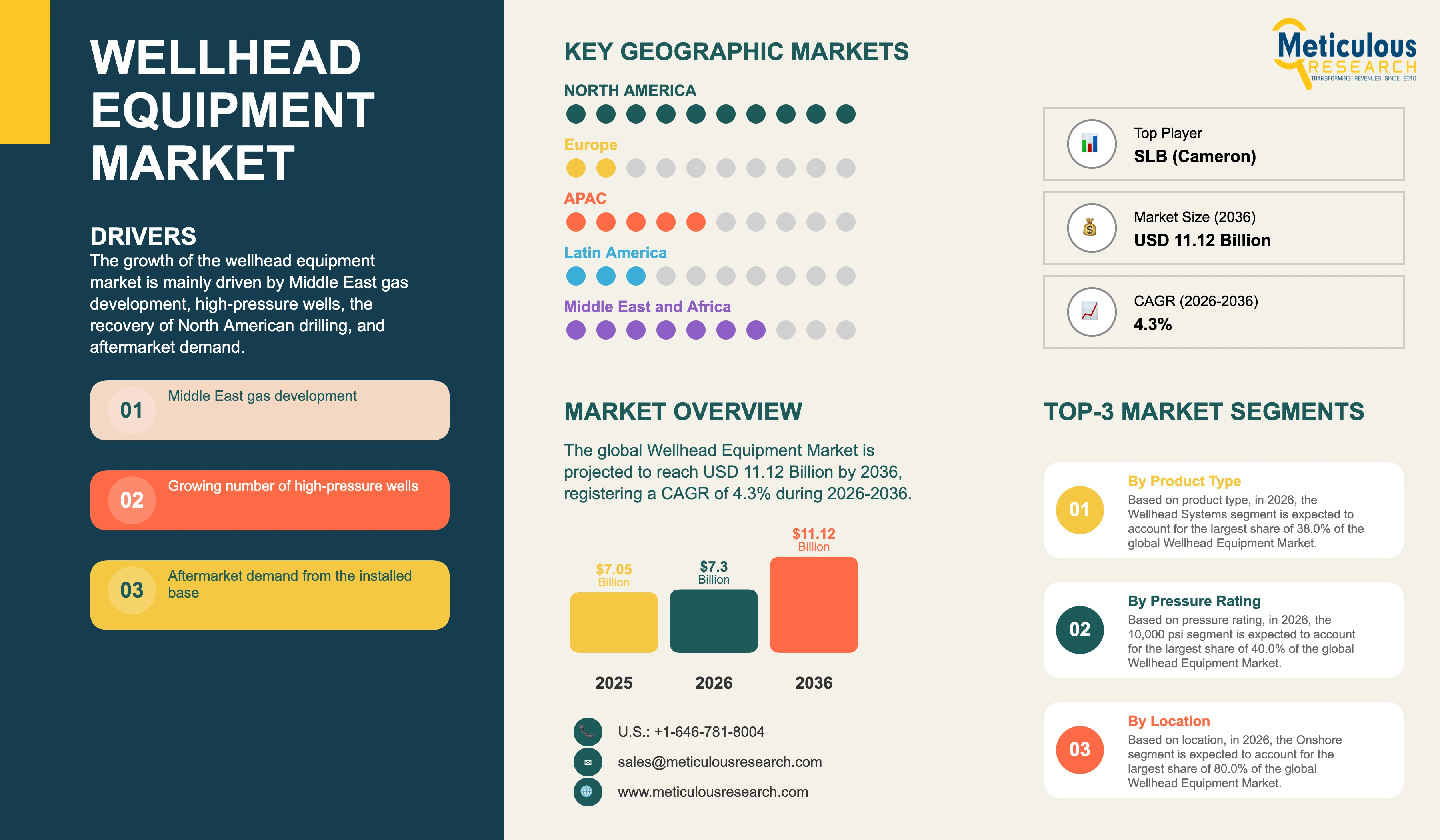
The global wellhead equipment market was valued at USD 7.05 billion in 2025. This market is expected to reach USD 11.12 billion by 2036 from an estimated USD 7.30 billion in 2026, registering a CAGR of 4.3% during the forecast period (2026-2036).
- Published
- Nov 2026
- Pages
- 248
- Format
- PDF + Excel
- Report ID
- MREP - 1042741
- Base year
- 2025
- 2024 · HISTORICAL
- $1.13B
- 2036
- $11.12B
- CAGR 2026–2036
- 4.3%
2024–2025 baseline · 2026–2036 forecast at 4.3% CAGR · hover a bar for the value
Key highlights
Cactus reported 2025 revenue of USD 1, 079.1 million, down from USD 1,129.8 million in 2024, and on January 1, 2026 closed its acquisition of a 65% controlling interest in Baker Hughes' Surface Pressure Control business, which now operates as Cactus International and significantly expands Cactus' international wellhead and pressure control footprint.
Cactus said that its fourth-quarter 2025 pressure control revenues exceeded expectations on strong sales of drilling equipment and higher rental revenues, but expected legacy pressure control sales to soften in early 2026 on lower products sold per rig and reduced customer rental activity.
TechnipFMC was awarded a 10-year framework agreement by ADNOC for wellheads, trees, and associated services, described as its largest-ever Surface Technologies contract with a value of more than USD 1 billion, under which it is expanding manufacturing, assembly, and testing in Abu Dhabi.
ADNOC previously awarded contracts worth nearly USD 6 billion for wellheads and related components, downhole completion equipment, and liner hangers and cementing accessories, with more than USD 1.8 billion of the equipment to be made in the UAE.
Aramco is seeking to expand sales gas production capacity by about 80% by 2030 compared with 2021 levels, driven largely by the Jafurah unconventional gas development, and in 2026 ADNOC approved the final investment decision for the SARB Deep Gas Development within the Ghasha concession.
SLB has reported increased activity across the Middle East, led by Saudi Arabia and with momentum in the UAE, driven by sustained gas development, while Aramco has awarded multi-year stimulation and completion contracts to Halliburton and SLB for its unconventional gas program, which requires large numbers of high-pressure wellheads and frac trees.
According to Baker Hughes, the U.S. rig count rose from 551 in March 2026 to 593 in August 2026, and the international rig count, which excludes North America, was 1,096 in July 2026.
By product type, wellhead systems account for the largest share of 38.0% in 2026, while aftermarket parts and services register the highest CAGR.
By pressure rating, 10, 000 psi accounts for the largest share in 2026, while 15,000 psi and above registers the highest CAGR.
By location, onshore accounts for the larger share of 80.0% in 2026, while offshore platforms register the higher CAGR.
By geography, North America accounts for the largest share of 38.0% in 2026, while Middle East & Africa registers the highest CAGR of 5.8%.
Report summary
| Particulars | Details |
|---|---|
| Base Year | 2025 |
| Estimated Year | 2026 |
| Forecast Period | 2026-2036 |
| Market Size in 2025 | USD 7.05 billion |
| Market Size in 2026 | USD 7.30 billion |
| Market Size by 2036 | USD 11.12 billion |
| CAGR (2026-2036) | 4.3% |
| Format | PDF, Excel & Cloud Portal · 248 pages |
| Largest Segment by Product Type (2026) | Wellhead Systems (38.0%) |
| Largest Segment by Location (2026) | Onshore (80.0%) |
| Largest Region (2026) | North America (38.0%) |
| Fastest-Growing Region | Middle East & Africa (CAGR 5.8%) |
| Companies Profiled | 12 companies and other companies |
| Segments Covered | Product Type, Pressure Rating, Location, Geography |
| Countries Covered | U.S., Canada, Saudi Arabia, UAE, Kuwait, Qatar, Oman, Iraq, Algeria, Rest of Middle East & Africa, China, India, Indonesia, Malaysia, Australia, Rest of Asia-Pacific, Argentina, Mexico, Brazil, Colombia, Rest of Latin America, Norway, U.K., Russia, Romania, Rest of Europe |
Report overview
Segments covered: product type, pressure rating, location.
The growth of this market is mainly driven by large drilling and gas development programs by national oil companies in the Middle East, including Saudi Arabia's plan to raise sales gas production capacity by about 80% by 2030 and the UAE's deep gas developments, the growing number of high-pressure and high-temperature wells that require higher-rated wellhead equipment, the recovery of drilling activity in North America in 2026, the expansion of unconventional development in Argentina and other international markets, aftermarket demand from the very large installed base of wellheads worldwide, and new applications in geothermal and carbon storage wells. However, factors such as capital discipline among U.S. shale producers, fewer wellhead products sold per rig as drilling becomes more efficient, tariffs and cost inflation, and geopolitical disruptions in the Middle East in 2026 are expected to restrain the growth of this market to some extent.
Wellhead equipment is installed at the surface of oil, gas, geothermal, and injection wells to support the casing and tubing strings, seal the annular spaces between them, and control the pressure and flow of fluids from the well. A typical surface wellhead system includes casing heads, casing spools, tubing heads, casing and tubing hangers, and seals. Above the wellhead, a production tree, also called a Christmas tree, consisting of valves, chokes, and fittings, controls the flow of oil and gas from the well during production. During hydraulic fracturing, temporary frac trees and frac stacks are installed to handle the very high pressures and flow rates of the fracturing operation. After the completion, the frac tree is removed and replaced with a production tree. Wellhead equipment must remain in service and maintain pressure integrity for the entire life of the well, which can exceed several decades.
This report covers global revenue from surface wellhead equipment for onshore wells and offshore platform wells, including wellhead systems, production trees and wellhead valves and chokes, frac trees and frac stacks sold or rented for well completion, and aftermarket parts and services such as installation, maintenance, repair, and remanufacturing. Subsea wellheads and subsea trees, blowout preventers and drilling pressure control equipment, high-pressure flow iron and manifolds used in fracturing spreads, pipelines and gathering equipment, and downhole completion equipment are excluded from the scope of this report, as they are covered in separate studies.
Wellhead equipment is designed and manufactured to industry standards such as API 6A, which specify pressure ratings, temperature classes, material classes, and product specification levels. Pressure ratings typically range from 2,000 psi to 20,000 psi or more, and the choice of rating depends on the expected reservoir pressure and the operations to be performed. High-pressure, high-temperature wells, sour gas wells containing hydrogen sulfide, and wells with corrosive fluids require higher-rated equipment and special materials, which increases the value of each wellhead. Product specification levels define the testing, documentation, and quality control required, with higher levels used for critical and high-risk wells.
Demand for wellhead equipment is closely linked to the number of wells drilled and completed, because every new well requires a wellhead and production tree. In North America, shale wells use standardized, quick-connect wellhead systems designed for fast installation on multiwell pads, and frac trees are often rented for the completion phase. Cactus, for example, has built a large business supplying pad-style wellheads and renting frac equipment to U.S. operators. In the Middle East and other international markets, wellheads are often purchased under long-term framework agreements with national oil companies, and local manufacturing and in-country value are increasingly important.
The market also includes substantial aftermarket demand from the very large installed base of wellheads around the world. Wellheads and trees must be maintained, repaired, and periodically remanufactured or replaced during the life of a well, and aging wells may require upgraded equipment to meet new safety or integrity requirements. Aftermarket parts and services provide a stable source of revenue for suppliers.
The wellhead equipment market includes large oilfield equipment companies, specialized wellhead manufacturers, and regional suppliers. Leading companies include SLB through its Cameron business, TechnipFMC, Cactus, Baker Hughes, which retains a minority interest in Cactus International, Weatherford, Caterpillar through SPM Oil & Gas, Stream-Flo Industries, Worldwide Oilfield Machine, Innovex International, Sentry Wellhead Systems, UZTEL, and Shanghai Shenkai Petroleum Equipment. Chinese manufacturers also supply a large share of wellheads in their domestic market and increasingly in export markets.
Over the forecast period, the market is expected to grow steadily, supported by Middle East gas development, high-pressure wells, international unconventional development, and aftermarket demand. Aftermarket parts and services are expected to be the fastest-growing product type, equipment rated at 15,000 psi and above is expected to grow fastest by pressure rating, and the Middle East & Africa is expected to be the fastest-growing region, while North America remains the largest.
Operators are drilling more high-pressure and high-temperature wells, including deep gas wells in the Middle East, the Haynesville in the U.S., and offshore developments, as well as sour gas wells that contain hydrogen sulfide. These wells require wellhead equipment rated for 15,000 psi or more, special corrosion-resistant materials, and higher product specification levels, which significantly increases the value of each wellhead and tree. Hydraulic fracturing also requires high-pressure frac trees and frac stacks capable of handling pressures of 10,000 to 15,000 psi or more and very high flow rates. As completion designs become more intense, the pressure and durability requirements for frac equipment increase. The shift toward higher-rated equipment is expected to support the value of the wellhead market even when the number of wells drilled grows slowly.
After a decline in 2025, North American drilling activity began to recover in 2026, with the U.S. rig count rising from 551 in March to 593 in August, according to Baker Hughes. Each new shale well requires a wellhead and production tree, and completions require frac trees, which are often rented. Multiwell pads with eight or more wells increase the number of wellheads installed at each location and favor suppliers with efficient pad systems and responsive field service teams that can support simultaneous operations. Rising gas-directed drilling for LNG exports and power generation is expected to support activity in gas basins such as the Haynesville, which typically require higher-pressure equipment.
Outside North America, unconventional development is expanding in Argentina's Vaca Muerta, Saudi Arabia's Jafurah field, the UAE, Oman, and China, which uses North American-style pad drilling, wellhead systems, and frac trees. These markets create new demand for wellhead equipment and for suppliers with unconventional experience. Argentina's Vaca Muerta has grown rapidly and is expected to continue increasing well counts, and China's shale gas development in the Sichuan Basin uses large numbers of high-pressure wellheads.
The global installed base of wellheads and production trees is very large, and these assets require ongoing maintenance, repair, and periodic replacement. As wells age, valves and seals wear out, corrosion develops, and operators may need to upgrade equipment to meet new safety or integrity requirements. Remanufacturing and repair of wellheads and trees provide a cost-effective alternative to new equipment.
Aftermarket demand is less sensitive to drilling activity than new equipment sales, which provides stability for suppliers. Suppliers with service centers close to their customers and with large installed bases are well positioned to capture this demand. Regulations on well integrity in the U.S., the North Sea, and other regions require operators to monitor and maintain wellhead barriers, which supports inspection, testing, and repair services. Idle and aging wells also require wellhead maintenance before abandonment.
Report infographic
Market dynamics
18 factors across 4 forcesCapital discipline and fewer products per rig
U.S. shale producers have consolidated and adopted strict capital discipline, which has limited drilling activity and increased their purchasing power. Drilling efficiency gains also mean that each rig drills more wells per year but operators are optimizing equipment use, and Cactus has indicated that its legacy pressure control sales were expected to soften in early 2026 on lower products sold per rig and reduced customer rental activity. Cactus' 2025 revenue declined compared with 2024, reflecting lower U.S. activity and these trends. Pricing pressure from large operators also limits margins for wellhead suppliers in North America. Oil price volatility can cause operators to adjust drilling programs quickly, which makes wellhead demand cyclical in short-cycle markets. Rental revenue from frac trees is particularly sensitive to completion activity, and reduced rental activity can affect supplier revenues quickly.
Tariffs and cost inflation
Wellhead equipment is made from forged steel and alloy components, and tariffs on steel and imported components have increased costs for manufacturers. Cactus has cited a challenging macro and tariff environment in 2025, and many suppliers have adjusted their supply chains to reduce exposure to tariffs. Cost inflation for materials, labor, and machining also affects margins. Suppliers that rely on imported forgings or components may face higher costs or need to relocate production, which can disrupt supply chains. Long lead times for large forgings and specialty alloys can also delay deliveries of high-pressure equipment.
Geopolitical disruptions in key markets
The 2026 conflict in the Middle East disrupted oil and gas operations in some countries, and SLB reported that its first-quarter 2026 revenue from the Middle East and Asia fell 10%, partly because of production constraints and security concerns in Iraq and disruptions to Qatar's gas exports. Such disruptions can delay drilling programs and wellhead deliveries in the region that is expected to drive most of the market's growth. Sanctions on Russia and other countries also restrict market access for international suppliers.
Table of contents
11 chapters · 136 sections · 248 pages · click to expandSegmental analysis
| Segment | Largest share (2026) | Fastest growth (2026–2036) |
|---|---|---|
| By Product Type | Wellhead systems | Aftermarket parts and services |
| By Pressure Rating | 10,000 psi | 15,000 psi and above |
| By Location | Onshore | Offshore platforms |
| Other segments | 10,000 psi | 15,000 psi and above |
By Product Type
- Wellhead Equipment Market Analysis by Product Type
- The wellhead systems segment is expected to account for the largest share of 38.0% of the global wellhead equipment market.
- The large share of this segment is mainly attributed to the need for a wellhead system, including casing heads, spools, hangers, and seals, in every new well, and the large number of wells drilled in North America, the Middle East, China, Russia, and Latin America.
- Wellhead systems for high-pressure and sour gas wells are particularly valuable, and long-term framework agreements with national oil companies provide stable demand.
- In North America, pad-style wellhead systems designed for fast installation have become standard for shale wells, and suppliers such as Cactus have built strong positions with these designs.
- In the Middle East, wellhead systems for deep gas and sour wells require special materials and higher pressure ratings, which increases their value.
- However, the aftermarket parts and services segment is projected to register the highest CAGR during the forecast period.
- The rapid growth of this segment is primarily driven by the very large installed base of wellheads and trees worldwide, aging wells that require maintenance, repair, and remanufacturing, the need to upgrade equipment to meet safety and integrity requirements, and the growth of service contracts with national oil companies.
- Aftermarket revenue is generally more stable than equipment sales, because existing wells require maintenance regardless of drilling activity.
- Suppliers with large installed bases, such as SLB, TechnipFMC, and Cactus International, are well positioned to capture this growth, and regional service companies also compete for maintenance and repair work.
- Remanufactured equipment is increasingly accepted by operators as a cost-effective alternative to new equipment, and it also supports sustainability goals by reducing material use.
- Meanwhile, the production trees and wellhead valves and frac trees and frac stacks segments are expected to witness steady growth, supported by the need for production trees on every producing well, the replacement and upgrading of valves and chokes on existing wells, rented frac trees in North America, and growing unconventional activity in Argentina and Saudi Arabia.
By Pressure Rating
- Wellhead Equipment Market Analysis by Pressure Rating
- The 10,000 psi segment is expected to account for the largest share of 40.0% of the global wellhead equipment market.
- The large share of this segment is mainly attributed to the widespread use of 10, 000 psi equipment in unconventional wells in North America and other regions, many conventional oil and gas wells, and frac trees used in hydraulic fracturing.
- This rating provides a balance of capability and cost for a wide range of applications.
- Many North American operators standardize on 10, 000 psi wellheads and frac trees for their shale wells, which supports large volumes in this segment.
- The segment is expected to grow in line with the overall market, supported by unconventional development in North America, Argentina, and the Middle East.
- However, the 15,000 psi and above segment is projected to register the highest CAGR during the forecast period.
- The rapid growth of this segment is primarily driven by deep gas development in the Middle East, high-pressure gas in the Haynesville, high-pressure, high-temperature offshore wells, and more intense completion designs that require higher-rated frac equipment.
- Equipment rated at 15, 000 psi and above often requires special materials and extensive testing, which significantly increases its value per unit.
- Deep gas projects in Saudi Arabia and the UAE, including the SARB Deep Gas Development, are expected to be major sources of demand.
- Meanwhile, the up to 5,000 psi segment is expected to witness steady growth, supported by shallow and conventional wells, mature fields, onshore conventional fields in the Middle East, Russia, China, and Latin America, and aftermarket replacement applications.
By Location
- Wellhead Equipment Market Analysis by Location
- The onshore segment is expected to account for the largest share of 80.0% of the global wellhead equipment market.
- The large share of this segment is mainly attributed to the very large number of onshore wells drilled in North America, the Middle East, China, Russia, and Latin America, including unconventional wells that require wellheads, production trees, and frac trees.
- Onshore drilling programs by national oil companies in Saudi Arabia, the UAE, and Kuwait also account for a large share of demand.
- Onshore wellheads are generally less expensive than offshore platform wellheads, but the very large number of onshore wells makes this the dominant segment.
- Growth in onshore demand is expected to be driven by Middle East gas programs, international unconventional development, and the recovery of North American activity.
- However, the offshore platforms segment is projected to register the highest CAGR during the forecast period.
- The rapid growth of this segment is primarily driven by offshore developments in the Middle East, including the UAE's offshore gas projects, platform developments in Southeast Asia, the North Sea, and West Africa, and the higher value of offshore platform wellheads, which often require higher pressure ratings and stricter specifications.
- Offshore platform developments in the Arabian Gulf, including ADNOC's offshore gas projects and Saudi Aramco's offshore fields, are expected to be major sources of demand.
- Offshore wellheads must meet strict safety and reliability requirements and are often supplied with long-term service agreements.
Other segments
- The 10,000 psi segment is expected to account for the largest share of the wellhead equipment market, while the 15,000 psi and above segment is projected to register the highest CAGR during the forecast period.
Geographic analysis
Middle East & Africa
Largest shareNational oil companies in the Middle East are investing heavily in drilling to sustain oil production capacity and to expand gas production. Aramco aims to increase sales gas production capacity by about 80% by 2030 compared with 2021 levels, driven largely by the Jafurah unconventional gas development, and ADNOC is developing deep and sour gas resources, including the SARB Deep Gas Development within the Ghasha concession. These programs require large numbers of wellheads and production trees, many of them rated for high pressures and sour service. National oil companies in the Gulf region typically purchase wellheads and trees under long-term framework agreements. TechnipFMC's 10-year agreement with ADNOC for wellheads, trees, and associated services, valued at more than USD 1 billion, and ADNOC's earlier awards of nearly USD 6 billion for wellheads, downhole completion equipment, and liner hangers show the scale of these programs. Local manufacturing, assembly, and testing are often required, which shapes how suppliers serve the region. Kuwait, Qatar, Oman, and Iraq also have large drilling programs that require wellhead equipment, and the Middle East is expected to account for a growing share of global wellhead demand over the forecast period. Aramco has also awarded multi-year stimulation and completion contracts to Halliburton and SLB for its unconventional gas program, indicating a large and sustained well program that will require wellheads, production trees, and frac trees. The Middle East & Africa is the second-largest market and is projected to register the highest CAGR of 5.8% during the forecast period. The rapid growth of this region is mainly due to large drilling and gas development programs in Saudi Arabia, the UAE, Kuwait, Qatar, Oman, and Iraq, the growing number of high-pressure and sour gas wells, long-term framework agreements for wellheads and trees, and local manufacturing requirements that encourage suppliers to invest in the region. Saudi Arabia and the UAE are expected to be the largest country markets in the region, followed by Kuwait, Qatar, and Oman. Africa contributes through drilling in Algeria, Nigeria, Egypt, and other countries, where demand is supported by gas development for domestic use and exports. Short-term disruptions from the 2026 conflict may delay some activity, but the long-term programs of national oil companies are expected to drive strong growth. Middle East gas development and national oil company programs Geographic Analysis
North America
In 2026, North America is expected to account for the largest share of 38.0% of the global wellhead equipment market. The large share of this region is mainly due to the large number of shale wells drilled and completed in the U.S. and Canada, the use of pad-style wellhead systems and rented frac trees, and the presence of leading wellhead suppliers such as Cactus, SLB's Cameron business, and TechnipFMC. Rising gas-directed drilling for LNG exports is expected to support demand for higher-pressure equipment. However, growth in the region is expected to be slower than the global average because of capital discipline among shale producers and fewer products sold per rig. Canada also has a significant wellhead market, supported by the Montney and other plays.
Asia-Pacific
Asia-Pacific is the third-largest market, supported by China's large domestic market, served mainly by Chinese manufacturers, and by drilling in India, Indonesia, Malaysia, and Australia. China is a major market for domestically manufactured wellheads, and Chinese suppliers increasingly export to Asia, Africa, and Latin America.
Latin America
Fastest growthLatin America is supported by Argentina's Vaca Muerta, Mexico, Colombia, and offshore platform developments. Argentina is expected to be one of the fastest-growing country markets, supported by Vaca Muerta development.
Europe
Europe, including Russia, is supported by the North Sea and Russian drilling, although sanctions limit international participation in Russia.
Competitive landscape
The global wellhead equipment market is moderately consolidated, with the top five players estimated to account for about 50% of the market in 2025. The market includes large oilfield equipment companies, specialized wellhead manufacturers, and regional and Chinese suppliers.
SLB through its Cameron business and TechnipFMC are among the largest global suppliers of surface wellheads and trees, with strong positions in North America and the Middle East. Cactus is a leading supplier of pad-style wellheads and frac equipment in the U.S. and has expanded internationally through its acquisition of a controlling interest in Baker Hughes' Surface Pressure Control business, now Cactus International, in which Baker Hughes retains a minority interest. Weatherford, Caterpillar through SPM Oil & Gas, Stream-Flo Industries, Worldwide Oilfield Machine, Innovex International, Sentry Wellhead Systems, UZTEL, and Shanghai Shenkai Petroleum Equipment supply wellheads, trees, valves, and related equipment in various regions. Companies compete on product quality, reliability, certifications, pressure and material capabilities, price, delivery time, local presence, and aftermarket service. Key strategies include consolidating through acquisitions, expanding local manufacturing in the Middle East, developing high-pressure and digital products, and growing aftermarket services.
The competitive landscape is expected to evolve as Cactus integrates Cactus International and competes more directly with SLB and TechnipFMC in international markets. Local manufacturing requirements in the Middle East favor suppliers with in-country facilities, while Chinese manufacturers compete on price in Asia, Africa, and Latin America. Long-term framework agreements with national oil companies are critical for market share in the Middle East, and their renewal cycles create periodic opportunities for competitors. In North America, competition is intense, with suppliers competing on pad-style designs, rental fleets, and service responsiveness. Aftermarket services are an increasingly important area of competition, as suppliers seek recurring revenue from their installed bases. Pricing discipline in North America is expected to improve gradually as consolidation reduces the number of competitors. TechnipFMC's long-term agreement with ADNOC illustrates the value of strong national oil company relationships and in-country manufacturing capabilities. Smaller suppliers often focus on niche products, regional markets, or specific customers where they can compete on responsiveness and price.
Some of the key players operating in the wellhead equipment market are SLB (Cameron), TechnipFMC plc, Cactus, Inc., Baker Hughes Company, Weatherford International plc, Caterpillar Inc. (SPM Oil & Gas), Stream-Flo Industries Ltd., Worldwide Oilfield Machine, Inc., Innovex International, Inc., Sentry Wellhead Systems, LLC, UZTEL S.A., and Shanghai Shenkai Petroleum & Chemical Equipment Co., Ltd., among others.
- —
Cactus formed Cactus International by acquiring a majority of Baker Hughes' Surface Pressure Control business in 2026, ADNOC approved the SARB Deep Gas Development, Aramco continued to expand its unconventional gas program, and the U.S. rig count recovered in 2026.
- SLB · Cameron
- TechnipFMC plc
- Cactus, Inc.
- Baker Hughes Company
- Weatherford International plc
- Caterpillar Inc. (SPM Oil & Gas)
- Stream-Flo Industries Ltd.
- Worldwide Oilfield Machine, Inc.
- Innovex International, Inc.
- Sentry Wellhead Systems, LLC
- UZTEL S.A.
Expert perspectives
The wellhead equipment market is closely linked to the number of wells drilled and completed, but its value is increasingly driven by pressure ratings, materials, and aftermarket services. We expect steady growth over the forecast period, led by the Middle East and high-pressure gas wells.
Over the forecast period, the market is expected to grow at a CAGR of 4.3%, from USD 7.30 billion in 2026 to USD 11.12 billion in 2036. Growth will be supported by Middle East gas programs, high-pressure wells, North American recovery, international unconventional development, and aftermarket demand, while capital discipline, fewer products per rig, tariffs, and geopolitical disruptions will moderate growth.
In terms of segments, wellhead systems remain the largest product type, while aftermarket parts and services grow fastest. Equipment rated at 10,000 psi remains the largest pressure rating, while 15,000 psi and above grows fastest. North America remains the largest region, while the Middle East & Africa grows fastest at a CAGR of 5.8%.
For suppliers, the key priorities are to expand local manufacturing and service in the Middle East, to develop high-pressure and sour service products, to grow aftermarket services, and to add digital and automation capabilities. Consolidation is likely to continue, as shown by Cactus' acquisition of Baker Hughes' Surface Pressure Control business. We expect the value of wellhead equipment per well to rise as wells become deeper and higher-pressure. In our view, Middle East gas development is the most important growth driver for the next decade.
Our estimates are based on the number of wells drilled and completed by region, wellhead and tree value per well by pressure rating and location, frac tree rental activity, the reported revenue of leading wellhead suppliers, and the size of the installed base for aftermarket services. We note that 2025 spending declined compared with 2024 because of lower North American activity, and we expect a recovery from 2026 supported by rising U.S. rig counts and Middle East gas programs. We also expect higher pressure ratings and aftermarket services to account for a growing share of market value. Upside risks include faster growth in offshore platform developments and geothermal drilling, while downside risks include lower oil prices and prolonged disruptions in the Middle East. We believe that suppliers with strong positions in both North America and the Middle East will outperform the overall market over the forecast period, while suppliers concentrated in mature markets face slower growth and greater pricing pressure from large customers.
Customer perspectives
Drilling Manager - independent producer, U.S. Permian Basin
We use pad-style wellheads and rented frac trees on all our multiwell pads. Fast installation and reliable service are essential to keep our completion schedules on track.
Procurement Director - national oil company, Middle East
Our deep gas wells require high-pressure, sour service wellheads, and we expect suppliers to manufacture and service equipment locally under long-term agreements.
Production Superintendent - international oil company, Latin America
Many of our wells are decades old, so we rely on suppliers for wellhead maintenance, repair, and upgrades to keep them safe and productive.
Frequently asked questions
The global wellhead equipment market was valued at USD 7.05 billion in 2025, down from USD 7.25 billion in 2024 because of lower North American activity, and is estimated at USD 7.30 billion in 2026. The market includes surface wellhead systems, production trees and valves, frac trees and frac stacks, and aftermarket parts and services.
The global wellhead equipment market is expected to reach USD 11.12 billion by 2036, supported by Middle East gas development, high-pressure wells, and aftermarket demand.
The market is expected to register a CAGR of 4.3% from 2026 to 2036, with the fastest growth in aftermarket services, high-pressure equipment, and the Middle East & Africa.
The market excludes subsea wellheads and trees, blowout preventers and drilling pressure control equipment, flow iron and fracturing manifolds, pipelines and gathering equipment, and downhole completion equipment.
Market growth is mainly driven by Middle East gas development and national oil company programs, the growing number of high-pressure and high-temperature wells, the recovery of North American drilling and unconventional growth abroad, and aftermarket demand from the installed base.
Capital discipline, fewer products per rig, tariffs, and cost inflation restrain growth, while safety and certification requirements, low-cost competition, and geopolitical disruptions are key challenges.
Key opportunities include local manufacturing and in-country value in the Middle East, high-pressure and sour service equipment, digital wellheads and remote monitoring, and geothermal and carbon storage wells.
Wellhead systems are expected to account for the largest share of 38.0% of the market in 2026, while aftermarket parts and services are projected to register the highest CAGR.
Equipment rated at 15,000 psi and above is projected to register the highest CAGR, driven by deep gas and high-pressure wells, while 10,000 psi equipment accounts for the largest share of 40.0%.
North America is expected to account for the largest share of 38.0% of the market in 2026, mainly due to the large number of shale wells and the use of pad-style wellheads and rented frac trees.
The Middle East & Africa is projected to register the highest CAGR of 5.8% during the forecast period, driven by large gas development programs and local manufacturing requirements.
Cactus closed its acquisition of a 65% controlling interest in Baker Hughes' Surface Pressure Control business on January 1, 2026, forming Cactus International and expanding its international wellhead business.
The report profiles 12 companies, including SLB (Cameron), TechnipFMC plc, Cactus, Inc., Baker Hughes Company, Weatherford International plc, Caterpillar Inc. (SPM Oil & Gas), Stream-Flo Industries Ltd., Worldwide Oilfield Machine, Inc., Innovex International, Inc., Sentry Wellhead Systems, LLC, UZTEL S.A., and Shanghai Shenkai Petroleum & Chemical Equipment Co., Ltd.
Cactus formed Cactus International by acquiring a majority of Baker Hughes' Surface Pressure Control business in 2026, ADNOC approved the SARB Deep Gas Development, Aramco continued to expand its unconventional gas program, and the U.S. rig count recovered in 2026.
In 2026, the 10,000 psi segment is expected to account for the largest share of the wellhead equipment market, while the 15,000 psi and above segment is projected to register the highest CAGR during the forecast period.
Cite this report
Meticulous Research. (2026). Wellhead Equipment Market - Global Opportunity Analysis and Industry Forecast (2026-2036) (Report No. MREP - 1042741). Meticulous Market Research Pvt. Ltd. https://www.meticulousresearch.com/product/wellhead-equipment-market-7424