Small-Scale LNG Market (2026-2036)
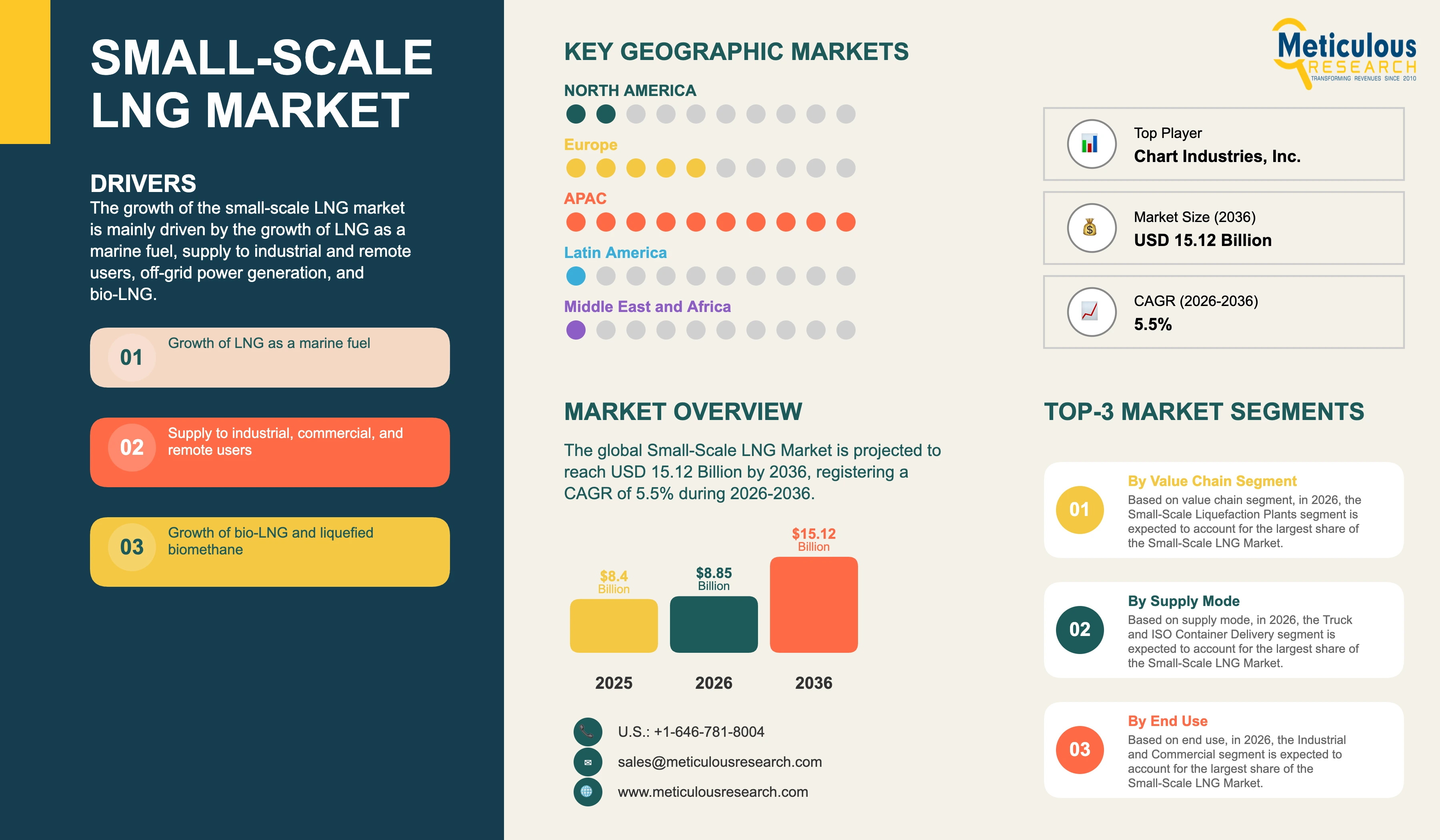
The global small-scale LNG market was valued at USD 8.40 billion in 2025. This market is expected to reach USD 15.12 billion by 2036 from an estimated USD 8.85 billion in 2026, registering a CAGR of 5.5% during the forecast period (2026-2036).
- Published
- Nov 2026
- Pages
- 265
- Format
- PDF + Excel
- Report ID
- MREP - 1042735
- Base year
- 2025
- 2025 · BASELINE
- $8.40B
- 2036
- $15.12B
- CAGR 2026–2036
- 5.5%
2025 baseline · 2026–2036 forecast at 5.5% CAGR · hover a bar for the value
Key highlights
According to SEA-LNG's 2026 Mid-Year Market Review, 73 LNG dual-fuel vessels were ordered between January and June 2026, accounting for nearly 90% of all alternatively fuelled vessel orders tracked by DNV. There are now 67 LNG bunker vessels in operation globally, with another 42 on order.
Global LNG bunker volumes averaged about 770, 000 cubic meters per month between January and May 2026, up about 13% from the same period in 2025, according to Kpler data cited by SEA-LNG. LNG bunkering is now offered in 222 ports worldwide, with 62 more ports planning to offer it.
Singapore recorded a 48% increase in LNG bunkering in the first quarter of 2026 compared with the same period in 2025, reaching 150,000 tonnes, and the Port of Rotterdam recorded a more than six-fold increase in bio-LNG blend bunkering in 2025 compared with 2024.
China's natural gas heavy-duty truck sales reached a record 198, 700 units in 2025, up 12%, but their share of total heavy-duty truck sales fell to 24.83% from 29.58% in 2024 as electric trucks gained ground, and electric trucks passed 50% of China's heavy-truck sales in September 2026.
Since SEA-LNG was founded, LNG-fuelled ships have grown from 81 to over 1,550 in operation and on order, and LNG bunker vessels have grown from 9 to 109 in operation and on order, showing the rapid build-out of small-scale marine LNG infrastructure.
China accounted for almost a quarter of global LNG bunker volumes in 2025, and Chinese marine fuel suppliers such as Sinopec Fuel Oil Sales and China Marine Bunker (PetroChina) are expanding LNG bunkering services in Chinese ports.
Liquefied biomethane is growing rapidly in small-scale LNG supply chains, especially in marine fuel markets. Gasum reported that biomethane grew from 0.8% to 12.3% of its maritime gas volumes between 2024 and 2025, and Titan Clean Fuels reported bio-LNG rising from 6.5% to 19.1% of its total delivered volume over the same period.
By value chain segment, small-scale liquefaction plants account for the largest share of 26.0% in 2026, while LNG bunkering infrastructure registers the highest CAGR.
By supply mode, truck and ISO container delivery accounts for the largest share in 2026, while marine delivery (small LNG carriers and bunker vessels) registers the highest CAGR.
By end use, industrial and commercial accounts for the largest share of 28.0% in 2026, while marine fuel registers the highest CAGR.
By geography, Asia-Pacific accounts for the largest share of 52.0% in 2026, while Latin America registers the highest CAGR of 7.7%.
Report summary
| Particulars | Details |
|---|---|
| Base Year | 2025 |
| Estimated Year | 2026 |
| Forecast Period | 2026-2036 |
| Market Size in 2025 | USD 8.40 billion |
| Market Size in 2026 | USD 8.85 billion |
| Market Size by 2036 | USD 15.12 billion |
| CAGR (2026-2036) | 5.5% |
| Format | PDF, Excel & Cloud Portal · 265 pages |
| Largest Segment by Value Chain Segment (2026) | Small-Scale Liquefaction Plants (26.0%) |
| Largest Segment by End Use (2026) | Industrial and Commercial (28.0%) |
| Largest Region (2026) | Asia-Pacific (52.0%) |
| Fastest-Growing Region | Latin America (CAGR 7.7%) |
| Companies Profiled | 12 companies and other companies |
| Segments Covered | Value Chain Segment, Supply Mode, End Use, Geography |
| Countries Covered | China, Singapore, Japan, South Korea, Indonesia, Philippines, Australia, India, Rest of Asia-Pacific, Netherlands, Belgium, Norway, Finland, Sweden, Spain, Germany, U.K., Rest of Europe, U.S., Canada, Brazil, Mexico, Argentina, Chile, Caribbean, Rest of Latin America, UAE, South Africa, Rest of Middle East & Africa |
Report overview
Segments covered: value chain segment, supply mode, end use.
The growth of this market is mainly driven by the rapid expansion of LNG as a marine fuel, supported by International Maritime Organization emissions rules, the EU Emissions Trading System, and FuelEU Maritime, which has led to a large orderbook of LNG-fuelled ships and LNG bunker vessels, the supply of LNG to industrial and commercial users and remote communities that are not connected to gas pipelines, the use of LNG for off-grid power generation and mining in emerging markets, the growth of bio-LNG and liquefied biomethane, which can use the same small-scale infrastructure, and the expansion of small-scale import terminals and satellite regasification facilities in island nations and emerging markets. However, factors such as the rapid shift from LNG to battery-electric heavy trucks in China, which is reducing demand for LNG fueling stations, the higher unit cost of small-scale supply chains compared with pipeline gas, LNG price volatility, and regulatory uncertainty about methane emissions are expected to restrain the growth of this market to some extent.
Small-scale LNG refers to the production, transport, storage, and use of LNG in smaller volumes than conventional large-scale LNG trade. It includes small liquefaction plants that produce LNG from pipeline gas, stranded gas, or biogas, small import and satellite terminals that receive LNG by small ships, trucks, or containers, LNG bunkering infrastructure that supplies LNG as fuel to ships, road tankers and ISO containers that transport LNG to customers, LNG fueling stations for trucks, and off-grid supply systems that deliver LNG to industrial sites, mines, power plants, and communities without pipeline access.
This report covers global revenue from small-scale LNG infrastructure and equipment, including small-scale liquefaction plants with capacities below about 0.3 Mtpa, small-scale import and satellite terminals, LNG bunkering infrastructure, including bunker vessels and bunkering terminals, LNG road and container transport equipment, LNG fueling stations, and off-grid and remote supply systems. Large-scale and mid-scale liquefaction plants, large onshore regasification terminals, floating storage and regasification units, and LNG-fuelled ships themselves are excluded from the scope of this report, as they are covered in separate studies. Revenue is measured as annual investment in equipment and infrastructure.
Small-scale LNG allows natural gas to reach users that cannot be economically served by pipelines, such as ships, heavy trucks, remote industries, islands, and mines. It also provides a pathway for bio-LNG and synthetic methane, which can be distributed through the same infrastructure as fossil LNG. In many regions, small-scale LNG competes with diesel, heavy fuel oil, and liquefied petroleum gas, and its competitiveness depends heavily on the price difference between LNG and these fuels. Small-scale LNG can also improve energy security by allowing regions to receive gas from multiple sources and to store fuel locally, which is valuable for remote communities and industries that depend on reliable energy supply.
China has the world's largest small-scale LNG market, with hundreds of small liquefaction plants, a very large fleet of LNG road tankers, thousands of LNG fueling stations, and a growing network of satellite regasification stations that supply towns and industrial users. China's LNG heavy-duty truck market grew rapidly in recent years, with natural gas heavy truck sales reaching a record 198,700 units in 2025, but electric trucks are now taking a growing share of the market. China also has extensive peak-shaving and emergency LNG storage that supports gas supply during winter, and many of its import terminals act as hubs for small-scale distribution by truck and small ship.
Europe is a leader in LNG bunkering and small-scale import terminals, with major bunkering hubs in Rotterdam, Antwerp-Bruges, and other ports, small-scale terminals in the Nordic and Baltic countries, and a fast-growing bio-LNG market. Singapore, China, and other Asian ports are also expanding LNG bunkering, and the U.S. has a growing small-scale LNG sector that supplies bunkering, industrial users, and exports to the Caribbean and Central America. In Latin America, virtual pipelines that deliver LNG by truck to industrial users and remote communities are growing in Brazil, Argentina, Mexico, and other countries.
The market includes manufacturers of small-scale liquefaction plants, cryogenic tanks, trailers, ISO containers, pumps, vaporizers, and fueling equipment, shipbuilders that build LNG bunker vessels and small LNG carriers, and companies that develop and operate small-scale LNG supply chains. Leading companies include Chart Industries, Wärtsilä, Linde, Air Products, CIMC Enric, Houpu Clean Energy, Galileo Technologies, Nikkiso, Gasum, Titan Clean Fuels, Stabilis Solutions, and Kawasaki Heavy Industries. Many smaller regional companies also build tanks, trailers, and regasification skids, and LNG suppliers and utilities often develop and operate small-scale supply chains themselves.
Over the forecast period, the small-scale LNG market is expected to grow steadily, driven mainly by marine fuel and bunkering, industrial and off-grid supply, and bio-LNG, while LNG demand for road transport in China is expected to decline as electric trucks gain share. LNG bunkering infrastructure is expected to be the fastest-growing segment, and Europe and Latin America are expected to grow faster than Asia-Pacific.
Industrial and commercial users are expected to account for the largest share of 28.0% of the market in 2026, while marine fuel is projected to register the highest CAGR.
Asia-Pacific is expected to account for the largest share of 52.0% of the market in 2026, mainly due to China's very large small-scale LNG market, including liquefaction plants, road tankers, fueling stations, and satellite stations.
Latin America is projected to register the highest CAGR of 7.7% during the forecast period, driven by virtual pipelines, island power supply, and bunkering.
The report profiles 12 companies, including Chart Industries, Inc., Wärtsilä Corporation, Linde plc, Air Products and Chemicals, Inc., CIMC Enric Holdings Limited, Houpu Clean Energy Group Co., Ltd., Galileo Technologies S.A., Nikkiso Co., Ltd., Gasum Oy, Titan Clean Fuels, Stabilis Solutions, Inc., and Kawasaki Heavy Industries, Ltd.
Report infographic
Market dynamics
16 factors across 5 forcesGrowth of LNG as a marine fuel
LNG has become the leading alternative marine fuel, as shipowners seek to comply with International Maritime Organization emissions rules, the EU Emissions Trading System for shipping, and FuelEU Maritime, which sets limits on the greenhouse gas intensity of energy used on ships calling at EU ports. According to SEA-LNG, 73 LNG dual-fuel vessels were ordered in the first half of 2026, accounting for nearly 90% of all alternatively fuelled vessel orders, and the LNG order book is dominated by container ships and pure car and truck carriers.
The growing fleet of LNG-fuelled ships requires bunkering infrastructure, including bunker vessels, bunkering terminals, and truck-to-ship and shore-to-ship facilities. There are now 67 LNG bunker vessels in operation and 42 on order, and LNG bunkering is offered in 222 ports, with 62 more ports planning to offer it. Global LNG bunker volumes averaged about 770,000 cubic meters per month between January and May 2026, up about 13% year-on-year, and Singapore recorded a 48% increase in LNG bunkering in the first quarter of 2026.
LNG bunkering also provides a pathway for bio-LNG and synthetic methane, which can be used in the same engines and supplied through the same infrastructure, helping shipowners reduce emissions further over time. Since SEA-LNG was founded, LNG-fuelled ships have grown from 81 to more than 1,550 in operation and on order, which shows the scale of the shift toward LNG as a marine fuel. China accounted for almost a quarter of global LNG bunker volumes in 2025, and Chinese suppliers are expanding bunkering services in major ports such as Shanghai and Shenzhen.
Supply to industrial, commercial, and remote users
Small-scale LNG allows industrial and commercial users that are not connected to gas pipelines to switch from diesel, heavy fuel oil, or liquefied petroleum gas to natural gas, which can reduce fuel costs and emissions. Industries such as ceramics, glass, food processing, textiles, chemicals, and mining use LNG delivered by truck or container and regasified at satellite stations on site.
In China, satellite regasification stations supply many towns and industrial parks that are not yet connected to the gas grid, and in Europe, the Nordic countries, Spain, and other countries have extensive truck-based LNG supply to industry. In the U.S., small-scale LNG supplies industrial users, remote facilities, and peak shaving needs, and it is exported to Caribbean and Central American markets. Stabilis Solutions, for example, supplies LNG to industrial, mining, oilfield, and marine customers in North America. For many industrial users, switching to LNG also reduces sulfur and particulate emissions, which helps them meet local air quality rules.
Off-grid power generation and mining
Many remote regions, islands, and mining operations rely on diesel or heavy fuel oil for power generation, which is expensive and polluting. Small-scale LNG can provide a cheaper and cleaner alternative, and it can be combined with solar and wind power in hybrid systems. Projects in the Caribbean, Central America, Brazil, Southeast Asia, Africa, and Australia use small-scale LNG to supply power plants and mines.
Island nations in the Caribbean and Pacific and archipelagic countries such as Indonesia and the Philippines are developing small-scale LNG supply chains to replace diesel generation, often using small LNG carriers and floating or onshore satellite terminals. Mining companies in Latin America, Africa, and Australia are also using LNG to replace diesel at remote sites, often in combination with solar power. These projects typically require reliable delivery logistics, on-site storage, and regasification and power generation equipment.
Growth of bio-LNG and liquefied biomethane
Bio-LNG, or liquefied biomethane, is produced from biogas and can be used in the same engines, vehicles, and ships as fossil LNG, which makes it an attractive pathway for decarbonization. Bio-LNG production is growing rapidly in Europe, supported by EU renewable energy and transport policies, and the Port of Rotterdam recorded a more than six-fold increase in bio-LNG blend bunkering in 2025.
Bio-LNG requires small-scale liquefaction plants at biogas production sites, as well as distribution infrastructure, which creates new demand for small-scale LNG equipment. Gasum reported that biomethane grew from 0.8% to 12.3% of its maritime gas volumes between 2024 and 2025, and Titan Clean Fuels reported bio-LNG rising from 6.5% to 19.1% of its total delivered volume. The number of operational biogas plants in Europe continues to rise, and many new plants are being designed to produce bio-LNG for transport and marine fuel markets.
Table of contents
11 chapters · 136 sections · 265 pages · click to expandSegmental analysis
| Segment | Largest share (2026) | Fastest growth (2026–2036) |
|---|---|---|
| By Value Chain Segment | Small-scale liquefaction plants | LNG bunkering infrastructure |
| By Supply Mode | Truck and ISO container delivery | Marine delivery (small LNG carriers and bunker vessels) |
| By End Use | Industrial and commercial | Marine fuel |
| Other segments | Truck and ISO container delivery | Marine delivery (small LNG carriers and bunker vessels) |
By Value Chain Segment
- Small-Scale LNG Market Analysis by Value Chain Segment
- The small-scale liquefaction plants segment is expected to account for the largest share of 26.0% of the global small-scale LNG market.
- The large share of this segment is mainly attributed to the large number of small liquefaction plants in China that produce LNG for trucks, industry, and satellite stations, small-scale liquefaction in North America for bunkering, industrial supply, and exports to the Caribbean, peak-shaving plants operated by utilities, and the growing number of bio-LNG plants in Europe.
- Small-scale liquefaction plants require compressors, cold boxes, heat exchangers, refrigeration systems, and storage tanks, which makes them the highest-value part of the small-scale value chain.
- Peak-shaving plants in North America and Europe, which liquefy gas during periods of low demand and store it for use during cold weather, are another important application.
- In addition, small-scale liquefaction plants built near shale gas fields and pipeline hubs in the U.S. supply LNG for bunkering in Florida, the Gulf Coast, and other ports, as well as for exports to Caribbean islands.
- However, the LNG bunkering infrastructure segment is projected to register the highest CAGR during the forecast period.
- The rapid growth of this segment is primarily driven by the growing fleet of LNG-fuelled ships, the large orderbook of LNG dual-fuel vessels, the 42 LNG bunker vessels on order, the expansion of bunkering to new ports, and the growth of bio-LNG bunkering.
- Major bunkering hubs such as Singapore, Rotterdam, and Antwerp-Bruges are adding bunker vessels, storage, and loading facilities to serve the growing number of LNG-fuelled ships.
- Meanwhile, the small-scale import and satellite terminals, LNG road and container transport equipment, LNG fueling stations, and off-grid and remote supply systems segments are expected to witness steady growth, supported by island power projects and virtual pipelines, the adoption of LNG by island nations and emerging markets, and truck-based distribution in China, Europe, and the Americas, although LNG fueling stations are expected to grow slowly as electric trucks gain share in China.
- Small-scale liquefaction plants are expected to account for the largest share of 26.0% of the market in 2026, while LNG bunkering infrastructure is projected to register the highest CAGR.
By Supply Mode
- Small-Scale LNG Market Analysis by Supply Mode
- The truck and ISO container delivery segment is expected to account for the largest share of the global small-scale LNG market.
- The large share of this segment is mainly attributed to the dominant role of road tankers and ISO containers in delivering LNG from small liquefaction plants and import terminals to industrial users, satellite regasification stations, fueling stations, and remote power plants, especially in China, Europe, and North America.
- Truck delivery is flexible, requires little fixed infrastructure, and can serve many small customers spread over large areas.
- China operates one of the world's largest fleets of LNG road tankers, and many Chinese import terminals have large truck loading facilities that supply inland markets.
- ISO containers are also widely used to move LNG by road, rail, and sea to remote sites and island markets, and they allow LNG to be delivered without dedicated receiving terminals.
- However, the marine delivery (small LNG carriers and bunker vessels) segment is projected to register the highest CAGR during the forecast period.
- The rapid growth of this segment is primarily driven by the growth of LNG bunkering, which requires bunker vessels to deliver LNG to ships in port, the 42 LNG bunker vessels on order, the use of small LNG carriers to supply island and archipelagic nations, and the development of coastal small-scale LNG distribution in Southeast Asia, the Caribbean, and Northern Europe.
- Meanwhile, the on-site and pipeline-connected supply segment is expected to witness steady growth, supported by bio-LNG plants and peak-shaving facilities connected directly to users or gas networks.
By End Use
- Small-Scale LNG Market Analysis by End Use
- The industrial and commercial segment is expected to account for the largest share of 28.0% of the global small-scale LNG market.
- The large share of this segment is mainly attributed to the widespread use of small-scale LNG to supply industrial users that are not connected to gas pipelines in China, Europe, North America, and Latin America, including ceramics, glass, food processing, textiles, chemicals, and other industries.
- Satellite regasification stations and truck deliveries allow these users to switch from oil products to gas.
- Industrial demand is generally more stable than transport demand, because many industrial processes require continuous fuel supply and cannot easily switch to electricity.
- However, the marine fuel segment is projected to register the highest CAGR during the forecast period.
- The rapid growth of this segment is primarily driven by the growing fleet of LNG-fuelled ships, International Maritime Organization and EU emissions rules, the expansion of bunkering infrastructure, and the growth of bio-LNG bunkering.
- Container lines, cruise operators, and car carrier owners have ordered large numbers of LNG dual-fuel vessels, which will need regular bunkering in Asia, Europe, and North America.
- Meanwhile, off-grid power generation and residential and peak-shaving applications are expected to witness steady growth, supported by island and mining power projects, LNG supply to towns without pipelines, and peak-shaving storage for utilities, while heavy-duty road transport is expected to grow slowly as electric trucks gain share in China.
Other segments
- The truck and ISO container delivery segment is expected to account for the largest share of the small-scale LNG market, while the marine delivery (small LNG carriers and bunker vessels) segment is projected to register the highest CAGR during the forecast period.
Geographic analysis
Asia-Pacific
Largest shareIn 2026, Asia-Pacific is expected to account for the largest share of 52.0% of the global small-scale LNG market. The large share of this region is mainly due to China's very large small-scale LNG market, which includes hundreds of small liquefaction plants, a large fleet of LNG road tankers, thousands of LNG fueling stations, and many satellite regasification stations, as well as growing LNG bunkering in Singapore and Chinese ports and small-scale LNG distribution in Indonesia, the Philippines, and other island nations. China accounted for almost a quarter of global LNG bunker volumes in 2025. However, growth in the region is expected to be slower than in other regions because of the decline in LNG truck demand in China. China's natural gas heavy truck sales reached a record 198,700 units in 2025, but their share of heavy truck sales fell to 24.83% as electric trucks gained ground, and electric trucks passed 50% of sales in September 2026.
Europe
Europe is the second-largest market, supported by major LNG bunkering hubs in Rotterdam, Antwerp-Bruges, and other ports, small-scale import terminals in the Nordic and Baltic countries, truck-based LNG supply to industry, and a fast-growing bio-LNG market. Europe is expected to grow faster than Asia-Pacific, driven by bunkering and bio-LNG. LNG bunker sales at the Port of Antwerp-Bruges reached a record of about 235,000 tonnes in 2025, up from about 68,000 tonnes in 2024, and the port sold about 241,000 tonnes in the first nine months of 2026 alone, showing the rapid growth of bunkering in the region. European biomethane production capacity reached 8.2 billion cubic meters per year by mid-2026, up 17% year-on-year, according to SEA-LNG, which supports the supply of bio-LNG.
Latin America
Fastest growthLatin America is projected to register the highest CAGR of 7.7% during the forecast period, although from a small base. The rapid growth of this region is mainly due to the use of small-scale LNG and virtual pipelines to supply industrial users, mines, and power plants in Brazil, Argentina, Chile, Colombia, Mexico, and Central America, LNG supply to Caribbean islands for power generation, and the development of LNG bunkering in Panama and other ports. Brazil's growing gas market and Argentina's Vaca Muerta gas production are expected to support small-scale LNG supply to industries and remote areas across the region.
North America
North America accounts for a significant share of the market, with small-scale LNG used for bunkering, industrial supply, peak shaving, and exports to the Caribbean and Central America.
Middle East & Africa
The Middle East & Africa accounts for a small share, but bunkering hubs in the Middle East and off-grid power projects in Africa are expected to support growth. Ports in the UAE and other Gulf countries are developing LNG bunkering to serve ships on major trade routes.
Competitive landscape
The global small-scale LNG market is fragmented, with the top five players estimated to account for about 20% of the market in 2025. The market includes manufacturers of small-scale liquefaction plants, cryogenic tanks, trailers, ISO containers, pumps, vaporizers, and fueling equipment, shipbuilders, and companies that develop and operate small-scale LNG supply chains.
Chart Industries is a leading supplier of small-scale liquefaction systems, cryogenic tanks, trailers, and fueling equipment, while Wärtsilä supplies small-scale liquefaction, bio-LNG, and LNG fuel gas systems. Linde and Air Products supply liquefaction technology and equipment, Galileo Technologies supplies modular liquefaction systems, and Nikkiso supplies cryogenic pumps and vaporizers. These companies supply equipment to small-scale LNG projects worldwide and often provide long-term service and maintenance.
CIMC Enric and Houpu Clean Energy are leading Chinese suppliers of LNG storage tanks, trailers, ISO containers, and fueling equipment. Gasum, Titan Clean Fuels, and Stabilis Solutions develop and operate small-scale LNG and bio-LNG supply chains, and Kawasaki Heavy Industries builds small LNG carriers and bunker vessels. Many other shipyards in China, South Korea, Japan, and Europe also build LNG bunker vessels, and engine manufacturers supply LNG fuel gas systems for ships. Marine fuel suppliers such as Shell, TotalEnergies, and Chinese suppliers operate bunker vessels in major ports, although they are buyers rather than manufacturers of most equipment.
Companies compete on technology, cost, reliability, safety, project experience, and the ability to offer integrated solutions. Key strategies include developing modular and containerized systems, building bunker vessels and bunkering terminals, expanding into bunkering and bio-LNG, offering integrated supply chain solutions, and expanding into emerging markets.
The competitive landscape is expected to evolve as bunkering and bio-LNG grow and as China's LNG truck market declines. Suppliers with strong positions in bunkering, bio-LNG, and off-grid supply will be best positioned. Chinese suppliers are expected to expand in export markets as domestic truck demand declines. Mergers, acquisitions, and partnerships between equipment suppliers and supply chain operators are also expected, as companies seek to offer complete solutions. Price competition from Chinese equipment suppliers is also increasing in emerging markets, which puts pressure on Western suppliers to reduce costs and differentiate through technology and service.
Some of the key players operating in the small-scale LNG market are Chart Industries, Inc., Wärtsilä Corporation, Linde plc, Air Products and Chemicals, Inc., CIMC Enric Holdings Limited, Houpu Clean Energy Group Co., Ltd., Galileo Technologies S.A., Nikkiso Co., Ltd., Gasum Oy, Titan Clean Fuels, Stabilis Solutions, Inc., and Kawasaki Heavy Industries, Ltd., among others.
- —
SEA-LNG reported 73 LNG dual-fuel vessel orders and 42 bunker vessels on order in the first half of 2026, Singapore's LNG bunkering rose 48% in the first quarter of 2026, Rotterdam's bio-LNG bunkering grew more than six-fold in 2025, and electric trucks overtook LNG trucks in China.
- Chart Industries, Inc.
- Wärtsilä Corporation
- Linde plc
- Air Products and Chemicals, Inc.
- CIMC Enric Holdings Limited
- Houpu Clean Energy Group Co., Ltd.
- Galileo Technologies S.A.
- Nikkiso Co., Ltd.
- Gasum Oy
- Titan Clean Fuels
- Stabilis Solutions, Inc.
- Kawasaki Heavy Industries, Ltd.
Expert perspectives
The small-scale LNG market is undergoing a shift in its main growth drivers, from road transport in China toward marine fuel, industrial and off-grid supply, and bio-LNG. We expect steady growth overall, but with significant differences between segments and regions. Our estimates are based on the installed base and capital spending across liquefaction, terminals, bunkering, transport equipment, fueling stations, and off-grid systems, as well as orderbook data for LNG bunker vessels and LNG-fuelled ships.
Over the forecast period, the market is expected to grow at a CAGR of 5.5%, from USD 8.85 billion in 2026 to USD 15.12 billion in 2036. Growth will be supported by LNG bunkering, industrial and off-grid supply, and bio-LNG, while the shift to electric trucks in China, higher unit costs, price volatility, and methane regulations will moderate growth.
In terms of segments, small-scale liquefaction plants remain the largest value chain segment, while LNG bunkering infrastructure grows fastest. Industrial and commercial users remain the largest end use, while marine fuel grows fastest. Asia-Pacific remains the largest region, while Latin America grows fastest at a CAGR of 7.7%.
For suppliers, the key priorities are to expand in bunkering and bio-LNG, to develop modular and containerized solutions for off-grid and emerging markets, and to adapt to the declining LNG truck market in China. Integrated supply chain solutions that combine liquefaction, transport, and regasification will be increasingly valuable. Suppliers should also prepare for stricter methane emission rules by offering low-emission equipment. Equipment that minimizes boil-off gas losses and venting will be increasingly important to customers and regulators.
We expect LNG bunkering to be the most important growth driver over the next decade, supported by the large orderbook of LNG-fuelled ships. In our view, the outcome of IMO discussions on greenhouse gas pricing and fuel standards will be a key factor for long-term bunkering demand. Regional rules such as FuelEU Maritime already support LNG and bio-LNG bunkering in Europe, and they give suppliers greater confidence to invest.
We also expect bio-LNG to play an increasingly important role in small-scale LNG, particularly in Europe, as it allows users to reduce emissions using existing infrastructure. In our view, suppliers that can offer both fossil and bio-LNG solutions will have a competitive advantage. We also expect Latin America, which is projected to be the fastest-growing region, the Middle East, and Africa to become more important markets for small-scale LNG suppliers, as these regions develop bunkering hubs and off-grid supply, and as they monetize stranded gas resources through small-scale liquefaction.
Customer perspectives
Buyers of small-scale LNG infrastructure and equipment include LNG suppliers, bunkering companies, port authorities, industrial users, utilities, power developers, mining companies, and fueling station operators. Their decisions depend mainly on cost, reliability, safety, flexibility, and the ability to supply bio-LNG and other renewable fuels. Many buyers also value suppliers that can provide integrated solutions, financing support, and long-term service, particularly in emerging markets.
This comment explains why LNG bunkering infrastructure is the fastest-growing value chain segment and why marine fuel is the fastest-growing end use.
This comment explains why Asia-Pacific accounts for 52.0% of the market and why industrial and commercial users account for 28.0% of the market.
This comment shows why off-grid supply systems and Latin America are growing quickly in the forecast period. It also shows why marine delivery is growing as island markets adopt LNG.
“Demand for LNG bunkering is growing as more LNG-fuelled ships enter service. We are adding bunker vessels and expanding to new ports, and bio-LNG is becoming an important part of our offering.”
“Our small-scale LNG business supplies many industrial users and towns without pipeline gas. LNG truck demand is slowing as electric trucks grow, so we are focusing on industrial customers.”
“Switching our power plants from diesel to small-scale LNG has reduced our fuel costs and emissions. Reliable supply and flexible logistics are essential for island markets.”
Frequently asked questions
The global small-scale LNG market was valued at USD 8.40 billion in 2025, up from USD 8.00 billion in 2024, and is estimated at USD 8.85 billion in 2026. The market includes small-scale liquefaction, satellite terminals, bunkering infrastructure, transport equipment, fueling stations, and off-grid supply systems.
The global small-scale LNG market is expected to reach USD 15.12 billion by 2036, supported by LNG bunkering, industrial and off-grid supply, and bio-LNG.
The market is expected to register a CAGR of 5.5% from 2026 to 2036, with strong growth in bunkering offset partly by declining LNG truck demand in China.
Global LNG bunker volumes averaged about 770,000 cubic meters per month between January and May 2026, up about 13% year-on-year, and there are 67 LNG bunker vessels in operation and 42 on order, according to SEA-LNG.
Market growth is mainly driven by the growth of LNG as a marine fuel, supply to industrial, commercial, and remote users, off-grid power generation and mining, and the growth of bio-LNG.
The shift from LNG to electric heavy trucks in China, higher unit costs, and price volatility restrain growth, while methane emissions, regulatory uncertainty, and fragmented markets are key challenges.
Key opportunities include the expansion of bunkering infrastructure in new ports, small-scale LNG for island and archipelagic nations, bio-LNG production plants, and virtual pipelines and modular liquefaction.
Small-scale liquefaction plants are expected to account for the largest share of 26.0% of the market in 2026, while LNG bunkering infrastructure is projected to register the highest CAGR.
Industrial and commercial users are expected to account for the largest share of 28.0% of the market in 2026, while marine fuel is projected to register the highest CAGR.
China's natural gas heavy truck sales reached a record 198,700 units in 2025, but their share of heavy truck sales fell to 24.83% as electric trucks gained ground, and electric trucks passed 50% of sales in September 2026.
Asia-Pacific is expected to account for the largest share of 52.0% of the market in 2026, mainly due to China's very large small-scale LNG market, including liquefaction plants, road tankers, fueling stations, and satellite stations.
Latin America is projected to register the highest CAGR of 7.7% during the forecast period, driven by virtual pipelines, island power supply, and bunkering.
The report profiles 12 companies, including Chart Industries, Inc., Wärtsilä Corporation, Linde plc, Air Products and Chemicals, Inc., CIMC Enric Holdings Limited, Houpu Clean Energy Group Co., Ltd., Galileo Technologies S.A., Nikkiso Co., Ltd., Gasum Oy, Titan Clean Fuels, Stabilis Solutions, Inc., and Kawasaki Heavy Industries, Ltd.
SEA-LNG reported 73 LNG dual-fuel vessel orders and 42 bunker vessels on order in the first half of 2026, Singapore's LNG bunkering rose 48% in the first quarter of 2026, Rotterdam's bio-LNG bunkering grew more than six-fold in 2025, and electric trucks overtook LNG trucks in China.
In 2026, the truck and ISO container delivery segment is expected to account for the largest share of the small-scale LNG market, while the marine delivery (small LNG carriers and bunker vessels) segment is projected to register the highest CAGR during the forecast period.
Cite this report
Meticulous Research. (2026). Small-Scale LNG Market - Global Opportunity Analysis and Industry Forecast (2026-2036) (Report No. MREP - 1042735). Meticulous Market Research Pvt. Ltd. https://www.meticulousresearch.com/product/small-scale-lng-market-7418