Tank Storage Terminals Market (2026-2036)
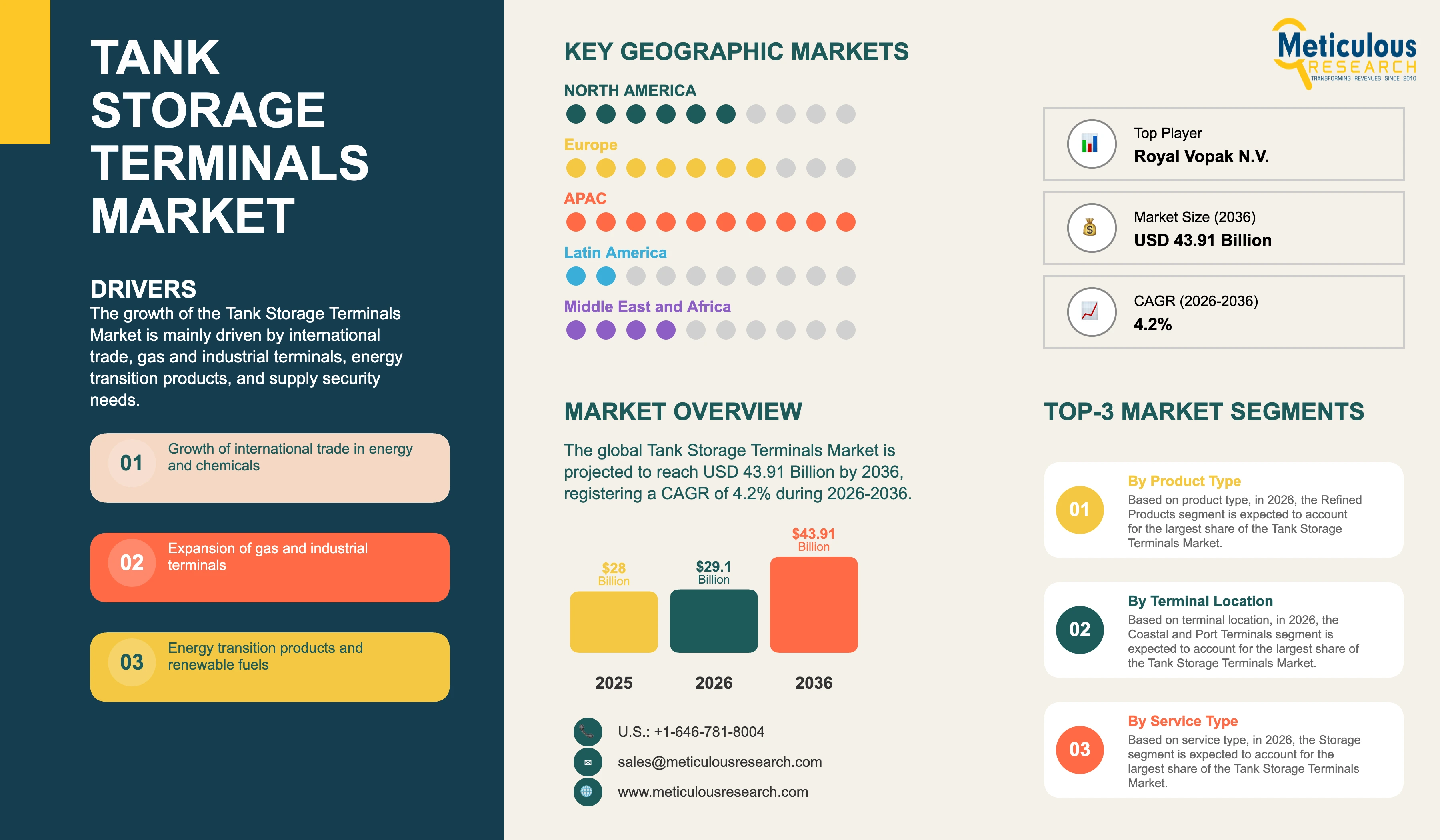
The global tank storage terminals market was valued at USD 28.00 billion in 2025. This market is expected to reach USD 43.91 billion by 2036 from an estimated USD 29.10 billion in 2026, registering a CAGR of 4.2% during the forecast period (2026-2036).
- Published
- Nov 2026
- Pages
- 281
- Format
- PDF + Excel
- Report ID
- MREP - 1042739
- Base year
- 2025
- 2025 · BASELINE
- $28.00B
- 2036
- $43.91B
- CAGR 2026–2036
- 4.2%
2025 baseline · 2026–2036 forecast at 4.2% CAGR · hover a bar for the value
Key highlights
Royal Vopak, the world's leading independent tank storage company, reported record 2025 proportional EBITDA of EUR 1,184 million and proportional revenues of EUR 1,916 million, with storage capacity of 35.5 million cubic meters at the end of 2025 and a proportional occupancy rate of 91.4%, compared with 92.5% in 2024.
Vopak reported that about 80% of its revenue is generated through storage fees structured as long-term take-or-pay contracts, and it guided 2026 proportional EBITDA of EUR 1.15 billion to EUR 1.2 billion and announced a shareholder distribution program of about EUR 1.7 billion through 2030.
Vopak signed a joint venture agreement with OQ to develop and operate energy storage and terminal infrastructure at Duqm in Oman, and it is commissioning new capacity for biofuel feedstocks in Malaysia, low-carbon fuels and feedstocks at Alemoa in Brazil, and ethane storage and handling in Thailand.
Kinder Morgan reported liquids leasable terminal capacity of 78.7 million barrels at the end of 2025, with liquids lease capacity utilization of 93% and tank utilization of 99% at its Houston Ship Channel and Carteret, New Jersey hubs, and its terminals segment earnings increased in the fourth quarter of 2025.
Vopak's storage capacity of 35.5 million cubic meters includes its share of joint ventures, while its proportional capacity was 20.4 million cubic meters at the end of 2025.
Vopak's industrial terminals delivered 15% EBITDA growth in 2025, while oil storage EBITDA rose modestly, which reflects the shift of growth toward gas, industrial, and energy transition infrastructure.
Kinder Morgan reported that its Jones Act tanker fleet, which supports its terminals business, was fully leased through 2026 and 97% leased through 2027, which reflects strong demand for U.S. liquids logistics.
Vopak expects its investments in gas, industrial, and energy transition infrastructure to grow from about EUR 1.9 billion in 2025 to about EUR 4 billion by 2030, which shows the scale of investment in new terminal capacity.
By product type, refined products account for the largest share of 38.0% in 2026, while liquefied gases register the highest CAGR.
By terminal location, coastal and port terminals account for the larger share in 2026 and also register the higher CAGR.
By service type, storage accounts for the largest share of 74.0% in 2026, while blending and other value-added services register the highest CAGR.
By geography, Asia-Pacific accounts for the largest share of 34.0% in 2026, while Middle East & Africa registers the highest CAGR of 5.5%.
Report summary
| Particulars | Details |
|---|---|
| Forecast Period | 2026-2036 |
| Base Year | 2025 |
| Estimated Year | 2026 |
| CAGR (Value) | 4.2% |
| Format | PDF, Excel & Cloud Portal · 281 pages |
| Market Size (Value) in 2025 | USD 28.00 billion |
| Market Size (Value) in 2026 | USD 29.10 billion |
| Market Size (Value) in 2036 | USD 43.91 billion |
| Segments Covered | Product Type, Terminal Location, Service Type, Geography |
| Countries Covered | Singapore, China, India, South Korea, Japan, Rest of Asia-Pacific, Netherlands, Belgium, Germany, U.K., Spain, Rest of Europe, U.S., Canada, UAE, Saudi Arabia, Oman, South Africa, Nigeria, Rest of Middle East & Africa, Brazil, Mexico, Rest of Latin America |
| Key Companies | 12 companies and other companies |
| Largest Segment by Product Type (2026) | Refined Products (38.0%) |
| Largest Segment by Service Type (2026) | Storage (74.0%) |
| Largest Region (2026) | Asia-Pacific (34.0%) |
| Fastest-Growing Region | Middle East & Africa (CAGR 5.5%) |
Report overview
Segments covered: product type, terminal location, service type.
The growth of this market is mainly driven by growing international trade in crude oil, refined products, chemicals, and liquefied gases, shifting refinery locations and longer trade routes that increase the need for storage at import and export hubs, the growth of liquefied petroleum gas, ammonia, liquefied natural gas, and other gas terminals, rising demand for storage of biofuels, sustainable aviation fuel, and renewable feedstocks, the need for strategic and commercial storage to manage supply security in a period of geopolitical disruption, and the expansion of chemical and industrial terminals in Asia-Pacific and the Middle East. However, factors such as the long-term decline in oil product demand in some regions, the high capital cost and long development times of new terminals, stricter environmental and safety regulations, and competition from integrated oil companies' captive storage are expected to restrain the growth of this market to some extent.
Tank storage terminals are facilities that store and handle bulk liquids and liquefied gases, such as crude oil, gasoline, diesel, jet fuel, fuel oil, chemicals, liquefied petroleum gas, ammonia, liquefied natural gas, biofuels, and vegetable oils. They are located at ports, along pipelines, near refineries and chemical plants, and at inland distribution points, and they play a critical role in global energy and chemical supply chains by enabling trade, balancing supply and demand, supporting refinery and chemical plant operations, and providing strategic reserves. Terminals typically provide storage, receipt and delivery by ship, barge, pipeline, rail, and truck, blending, heating, and other services.
This report covers global revenue from tank storage terminal services provided on a commercial basis by independent terminal operators, midstream companies, and other operators that offer storage to third parties, including storage fees, throughput and handling fees, and fees for blending and other value-added services. It covers terminals for refined products, crude oil, chemicals, liquefied gases, and biofuels, vegetable oils, and other liquids, located at coastal and port locations and inland. Captive storage operated by refineries and chemical plants solely for their own use, government strategic petroleum reserves operated without commercial storage contracts, the construction of storage tanks, and liquefied natural gas regasification services at dedicated import terminals are excluded from the scope of this report.
Independent terminal operators, such as Vopak, Advario, VTTI, Evos, Odfjell Terminals, Koole Terminals, and LBC Tank Terminals, provide storage to oil traders, oil majors, refiners, chemical companies, and governments, and they earn revenue mainly through storage fees under contracts that range from short-term to long-term. Vopak reported that about 80% of its revenue is generated through storage fees structured as long-term take-or-pay contracts. In North America, midstream companies such as Kinder Morgan, Sunoco, Buckeye Partners, and Zenith Energy operate large terminal networks connected to pipelines, refineries, and export facilities.
The largest storage hubs are located at major trading and refining centers, such as the Amsterdam-Rotterdam-Antwerp region in Europe, Singapore and the surrounding region in Asia, Fujairah in the UAE, the U.S. Gulf Coast, particularly Houston, and New York Harbor. These hubs provide storage for traders and refiners, blending of fuels to meet regional specifications, and supply of marine fuels to ships. Chemical and industrial terminals are often located within or near chemical parks, where they provide dedicated storage and pipeline connections to chemical plants.
The tank storage terminals market is changing in important ways as the energy transition progresses. Demand for storage of traditional oil products is expected to grow slowly or decline in some regions, while demand for storage of liquefied gases, chemicals, biofuels, sustainable aviation fuel, renewable feedstocks, ammonia, and, in the future, hydrogen carriers and carbon dioxide is expected to grow. Leading operators are reallocating capital from oil storage to gas, industrial, and energy transition infrastructure. Vopak's industrial terminals delivered 15% EBITDA growth in 2025, while oil storage EBITDA rose modestly.
Geopolitical disruptions in recent years have also highlighted the strategic importance of storage capacity. Changes in trade flows after sanctions on Russian oil, disruptions to shipping routes, and the 2026 regional conflict in the Gulf have increased the value of storage for supply security and trading flexibility, and governments are reviewing strategic storage requirements. Many countries are also required to hold minimum stocks of crude oil and refined products under national rules and international commitments, and some governments contract commercial terminals to hold these stocks, which creates long-term demand for storage.
Over the forecast period, the market is expected to grow steadily, supported by trade growth, new gas and chemical terminals, energy transition products, and supply security needs. Refined products are expected to remain the largest product type, while liquefied gases grow fastest. Coastal and port terminals are expected to remain the largest and fastest-growing location type, and storage the largest service type, while blending and other value-added services grow fastest. Asia-Pacific is expected to remain the largest region, while the Middle East & Africa is expected to grow fastest.
We need dedicated storage connected by pipeline to our plant, and we prefer long-term contracts with operators that have strong safety records.
This comment explains why industrial terminals and long-term contracts are growing.
Storage at major hubs gives us flexibility to manage cargoes and blend products for different markets.
This comment explains why refined products and coastal terminals remain the largest segments.
We are contracting converted tanks for renewable feedstocks and sustainable aviation fuel near our production sites.
This comment explains why biofuels and blending services are growing.
Across all customer groups, safety, reliability, and connectivity to pipelines, ports, and production facilities are critical selection criteria. Traders value flexibility and short-term availability, while industrial customers value dedicated capacity and long-term security of supply. Governments and national oil companies focus on security, capacity, and long-term contracts for strategic stocks. Renewable fuel producers and blenders focus on access to blending capacity, product segregation, and certification of sustainable products, which require careful handling and documentation. Many customers also consider the environmental performance of terminals, including vapor emission controls and energy use, when selecting storage partners. Customers also value terminal operators that can support them in multiple locations, which favors global operators with networks of terminals in key hubs.
Report infographic
Market dynamics
16 factors across 5 forcesGrowth of international trade in energy and chemicals
International trade in crude oil, refined products, chemicals, and liquefied gases continues to grow, driven by rising demand in Asia, the Middle East, and Africa, new refining capacity in the Middle East and Asia, and growing exports from the U.S. Trade requires storage at both export and import locations to accumulate cargoes, manage shipping schedules, and balance supply and demand. As trade volumes grow and trade routes become longer, demand for storage at major hubs increases.
New refineries in the Middle East, India, China, Africa, and other regions are changing global product flows, as refined products are exported over longer distances to Europe, Africa, and other markets. These changes increase demand for storage at both refinery export terminals and import hubs, as well as for blending and handling services to meet regional fuel specifications.
U.S. exports of crude oil, refined products, liquefied petroleum gas, and petrochemicals have grown significantly over the past decade, which has driven investment in export terminals on the Gulf Coast. Kinder Morgan reported tank utilization of 99% at its Houston Ship Channel hub at the end of 2025.
Expansion of gas and industrial terminals
Demand for storage of liquefied petroleum gas, ethane, ammonia, liquefied natural gas, and chemicals is growing, driven by the expansion of petrochemical production in Asia and the Middle East, growing liquefied petroleum gas consumption in India, China, and Southeast Asia, and the development of liquefied natural gas markets. These terminals typically involve long-term contracts with industrial customers and higher capital investment, which provides stable revenue for operators.
Vopak is commissioning ethane storage and handling capacity in Thailand and investing in liquefied petroleum gas and ammonia terminals, and it expects its investments in gas, industrial, and energy transition infrastructure to grow from about EUR 1.9 billion in 2025 to about EUR 4 billion by 2030. Chemical terminals in chemical parks in Europe, Asia, and the U.S. also provide stable demand, although global chemical markets have faced pressure in recent years. Industrial terminals are typically integrated with customers' production facilities through pipelines, and they often operate under long-term contracts of 10 years or more, which provides very stable revenue. These terminals also have high switching costs for customers, which supports contract renewals.
Energy transition products and renewable fuels
The growth of biofuels, sustainable aviation fuel, hydrotreated vegetable oil, and renewable feedstocks such as used cooking oil and animal fats is creating demand for new and converted storage capacity. Regulations such as the European Union's renewable energy and aviation fuel mandates are increasing the use of renewable fuels, which require storage at production sites, blending hubs, and airports. Vopak is commissioning 272,000 cubic meters of biofuel feedstock storage in Malaysia and expanding capacity for low-carbon fuels and feedstocks at Alemoa in Brazil.
In the longer term, the development of hydrogen carriers, such as ammonia and liquid organic hydrogen carriers, and carbon dioxide storage and transport for carbon capture projects is expected to create demand for new types of terminals. Terminal operators are converting existing oil storage to new products where possible, which supports the use of existing infrastructure. The share of revenue from energy transition products is still small, but it is expected to grow over the forecast period as mandates for renewable fuels increase and new low-carbon supply chains develop. Sustainable aviation fuel is a particularly important opportunity, as aviation fuel mandates in Europe and other regions require increasing shares of sustainable aviation fuel to be blended into jet fuel, which requires storage and blending capacity at production sites, import terminals, and airports.
Supply security and geopolitical disruptions
Geopolitical events, such as sanctions on Russian oil, disruptions to shipping through the Red Sea and the Strait of Hormuz, and the 2026 regional conflict in the Gulf, have increased the importance of storage for supply security and trading flexibility. Governments and companies are holding more inventory and diversifying supply sources, which requires additional storage capacity at import hubs and strategic locations.
Market volatility also increases the value of storage for traders, who use storage to take advantage of price differences over time and between regions. When markets are in contango, with future prices higher than spot prices, demand for storage increases, as traders store products to sell later at higher prices.
Storage at hubs close to major shipping routes is particularly valuable when routes are disrupted, as cargoes may need to be diverted, held, or reblended for different markets. Terminal operators in Singapore, Fujairah, the Amsterdam-Rotterdam-Antwerp region, and the U.S. Gulf Coast have benefited from these shifts, which have supported high occupancy rates.
Table of contents
11 chapters · 127 sections · 281 pages · click to expandSegmental analysis
| Segment | Largest share (2026) | Fastest growth (2026–2036) |
|---|---|---|
| By Product Type | Refined products | Liquefied gases |
| By Terminal Location | Coastal and port terminals | Coastal and port terminals |
| By Service Type | Storage | Blending and other value-added services |
By Product Type
- Tank Storage Terminals Market Analysis by Product Type
- The refined products segment is expected to account for the largest share of 38.0% of the global tank storage terminals market.
- The large share of this segment is mainly attributed to the large volumes of gasoline, diesel, jet fuel, fuel oil, and other refined products traded and distributed globally, the need for storage at major trading and blending hubs such as the Amsterdam-Rotterdam-Antwerp region, Singapore, Fujairah, and the U.S. Gulf Coast, and the extensive network of inland distribution terminals.
- Refined products terminals serve a wide range of customers, including traders that use storage to manage cargoes and blend products, refiners that need storage for exports and imports, and fuel distributors that supply retail and commercial customers.
- Demand is expected to grow slowly in mature markets but remain strong at major trading hubs and in growing markets in Asia, the Middle East, and Africa, where new refineries and rising fuel consumption require additional storage.
- However, the liquefied gases segment is projected to register the highest CAGR during the forecast period.
- The rapid growth of this segment is primarily driven by growing liquefied petroleum gas and ethane demand in Asia, the development of ammonia terminals, and growth in liquefied natural gas storage, as well as long-term contracts with industrial customers.
- Liquefied gas terminals require pressurized or refrigerated storage, specialized safety systems, and marine facilities, and they typically involve higher capital investment and longer contracts than oil terminals.
- Liquefied petroleum gas import terminals in India, China, and Southeast Asia, ethane terminals supporting petrochemical plants, and ammonia terminals for fertilizer and future energy trade are among the main growth areas.
- Meanwhile, the crude oil, chemicals, and biofuels, vegetable oils, and other segments are expected to witness steady growth, supported by storage at crude export and import terminals and trading hubs, long-term contracts at industrial chemical terminals, and renewable fuel mandates that increase trade in biofuels and renewable feedstocks.
By Terminal Location
- Tank Storage Terminals Market Analysis by Terminal Location
- The coastal and port terminals segment is expected to account for the largest share of 72.0% of the global tank storage terminals market.
- The large share of this segment is mainly attributed to the importance of port terminals for international trade, the large size of major storage hubs, and the higher value of services provided at port terminals, such as ship loading, blending, and marine fuel supply.
- Major port hubs, such as Rotterdam, Antwerp, Singapore, Fujairah, and Houston, offer deep water access for large tankers, extensive pipeline connections to refineries and chemical plants, and access to large trading communities, which makes them highly attractive to customers and allows operators to maintain high occupancy.
- The coastal and port terminals segment is also projected to register the highest CAGR during the forecast period.
- The rapid growth of this segment is primarily driven by trade growth, new import terminals in Asia and Africa, and new gas and energy transition terminals at ports.
- New port terminals are being developed in Asia, the Middle East, and Africa to support growing imports and exports, and existing port terminals are adding capacity for liquefied gases and energy transition products.
- Meanwhile, the inland terminals segment is expected to witness steady growth, supported by the distribution of fuels and chemicals by pipeline, rail, and truck to regional markets.
- The coastal and port terminals segment is expected to account for the larger share of the tank storage terminals market, and it is also projected to register the higher CAGR during the forecast period.
By Service Type
- Tank Storage Terminals Market Analysis by Service Type
- The storage segment is expected to account for the largest share of 74.0% of the global tank storage terminals market.
- The large share of this segment is mainly attributed to the fact that storage fees, often under long-term take-or-pay contracts, account for most terminal revenue.
- Storage revenue depends on capacity, occupancy, and storage rates, which vary by product, location, and contract length.
- Long-term take-or-pay contracts, under which customers pay for capacity whether or not they use it, provide stable revenue, while short-term contracts allow operators to benefit from strong markets but expose them to downturns.
- However, the blending and other value-added services segment is projected to register the highest CAGR during the forecast period.
- The rapid growth of this segment is primarily driven by the need to blend fuels with renewable components and to meet changing regional specifications.
- Value-added services include blending, heating, additive injection, nitrogen blanketing, drumming, and product testing, and they allow operators to differentiate their services and earn higher margins.
- The growing use of biofuels, sustainable aviation fuel, and other renewable components in fuels is increasing demand for blending services at terminals in Europe, North America, and Asia.
- Meanwhile, the throughput and handling segment is expected to witness steady growth, supported by the movement of products through terminals by ship, barge, rail, truck, and pipeline, which increases with trade activity and the expansion of export terminals.
Geographic analysis
Asia-Pacific
Largest shareIn 2026, Asia-Pacific is expected to account for the largest share of 34.0% of the global tank storage terminals market. The large share of this region is mainly due to the major trading and storage hub in Singapore, large and growing storage capacity in China, India, South Korea, and Japan, growing imports of crude oil, liquefied petroleum gas, and chemicals, and petrochemical expansion. Within Asia-Pacific, Singapore is the region's leading trading and storage hub, while China has the largest total storage capacity, supported by its large refining and petrochemical industries and its growing imports of crude oil, liquefied petroleum gas, and chemicals. India is a fast-growing market, supported by new refineries, rising fuel demand, and growing imports of liquefied petroleum gas. South Korea and Japan have large storage capacity for crude oil, refined products, and chemicals, including government stockpiles.
Europe
Europe is the second-largest market, supported by the Amsterdam-Rotterdam-Antwerp hub and energy transition terminals. In Europe, the Amsterdam-Rotterdam-Antwerp region is the largest storage hub, serving traders, refiners, and chemical companies across Northwest Europe, and it is a leading location for energy transition terminals, including biofuels, ammonia, and carbon dioxide.
North America
North America is the third-largest market, supported by the U.S. Gulf Coast and New York Harbor. In North America, the U.S. Gulf Coast is the largest storage and export hub, with Houston serving as a major center for crude oil, refined products, liquefied petroleum gas, and chemicals, while New York Harbor is a key hub for refined products on the East Coast. Mexico is expanding its import terminals, and Brazil also relies on imported diesel.
Middle East & Africa
Fastest growthThe Middle East & Africa is projected to register the highest CAGR of 5.5% during the forecast period. The rapid growth of this region is mainly due to new refineries and petrochemical plants in the Middle East, the Fujairah storage hub, new terminal investments such as Vopak's joint venture with OQ at Duqm, and growing import storage needs in Africa. In the Middle East, Fujairah is one of the world's largest storage hubs for refined products and fuel oil, and new terminals in Saudi Arabia, Oman, and other countries are expected to add capacity.
Latin America
Latin America is a smaller market, supported by fuel import terminals in Brazil and Mexico, where growing fuel demand and limited refining capacity require import storage, as well as by renewable fuel storage in Brazil.
Competitive landscape
The global tank storage terminals market is fragmented, with the top five players estimated to account for about 25% of the market in 2025. The market includes independent terminal operators, midstream companies, and terminals owned by oil and chemical companies that offer third-party storage.
Royal Vopak is the world's leading independent tank storage company, with 35.5 million cubic meters of storage capacity and record 2025 proportional EBITDA of EUR 1,184 million. Advario, VTTI, Evos, Odfjell Terminals, Koole Terminals, LBC Tank Terminals, and Horizon Terminals are other leading independent operators. In North America, Kinder Morgan, with 78.7 million barrels of liquids leasable capacity, Sunoco, Buckeye Partners, and Zenith Energy operate large terminal networks. Terminal companies compete mainly on location, connectivity, service quality, safety performance, and price. Key strategies include investment in gas, industrial, and energy transition terminals, conversion of existing storage, acquisitions, and long-term contracts.
Location is the most important competitive factor, as terminals at major hubs with deep water access and pipeline connections are difficult to replicate and command premium rates. Barriers to entry are high because of the scarcity of suitable waterfront land, the long permitting process, and the high capital cost of new terminals. Infrastructure investors, private equity funds, and strategic buyers have been active in acquiring terminal portfolios, attracted by their stable, contracted cash flows. Recent developments include Vopak's record 2025 results and its joint venture with OQ at Duqm, new commissioning of biofuel feedstock, low-carbon fuel, and ethane capacity, and continued high utilization at Kinder Morgan's Gulf Coast and New York Harbor terminals. We expect operators to continue shifting their portfolios toward gas, industrial, and energy transition terminals while optimizing their oil storage assets. Regional operators, including terminals owned by national oil companies and local companies, play an important role in many markets, particularly in Asia, the Middle East, and Latin America, where they often have strong relationships with domestic customers and governments. Competition is generally local, as customers choose terminals based on location and connectivity, and price competition is strongest where several terminals serve the same hub. At major hubs, such as the Amsterdam-Rotterdam-Antwerp region and Singapore, several large operators compete for the same customers.
Some of the key players operating in the tank storage terminals market are Royal Vopak N.V., Kinder Morgan, Inc., Advario, VTTI B.V., Evos, Sunoco LP, Buckeye Partners, L.P., Zenith Energy, Odfjell Terminals, Koole Terminals, LBC Tank Terminals, and Horizon Terminals Limited, among others.
- —
Vopak reported record 2025 results, signed a joint venture with OQ at Duqm, and is commissioning new biofuel feedstock, low-carbon fuel, and ethane capacity, while Kinder Morgan reported high utilization at its Gulf Coast and New York Harbor terminals.
- Kinder Morgan
- Sunoco
- Buckeye Partners
- Zenith Energy
Expert perspectives
The tank storage terminals market is stable and resilient, supported by long-term contracts, high occupancy, and the essential role of storage in energy and chemical supply chains. We expect steady growth over the forecast period, with a gradual shift from oil products to gas, chemicals, and energy transition products.
Over the forecast period, the market is expected to grow at a CAGR of 4.2%, from USD 29.10 billion in 2026 to USD 43.91 billion in 2036. Growth will be supported by trade growth, gas and industrial terminals, energy transition products, and supply security, while declining oil product demand in mature markets, high capital costs, and regulations will moderate growth.
In terms of segments, refined products remain the largest product type, while liquefied gases grow fastest. Coastal and port terminals remain the largest and fastest-growing location type, and storage remains the largest service type, while blending and other value-added services grow fastest. Asia-Pacific remains the largest region, while the Middle East & Africa grows fastest at a CAGR of 5.5%.
For terminal operators, the key priorities are to reposition portfolios toward growth segments, secure long-term contracts, maintain high safety standards, and invest in digitalization. We believe that operators with strategic hub locations and diversified product portfolios will outperform.
We expect occupancy rates to remain high at major hubs, supported by trade growth, geopolitical disruptions, and supply security needs, while some smaller inland terminals focused on oil products in mature markets face pressure. Our forecast assumes that global oil demand remains broadly stable through the early 2030s before gradually declining, that trade in liquefied gases and chemicals continues to grow, and that renewable fuel mandates continue to expand. A faster decline in oil demand or a sharp slowdown in chemical markets could slow growth, while faster growth in ammonia, hydrogen carriers, and carbon dioxide terminals could add upside. In our view, operators that combine strategic hub locations, long-term industrial contracts, and investment in energy transition products will deliver the most resilient growth. We also expect digitalization to become an important differentiator, as customers increasingly expect real-time inventory visibility and efficient scheduling.
Finally, we see safety performance and environmental compliance as non-negotiable for terminal operators, as incidents can lead to the loss of customers, fines, and restrictions on operations. Operators that maintain strong safety records and invest in emission reduction will be better positioned to win long-term contracts and secure permits for new projects. Safety will remain a key differentiator. We expect steady consolidation across the industry as well.
Customer perspectives
Customers of tank storage terminals include oil traders, oil majors, refiners, chemical companies, gas companies, biofuel producers, and governments. Their decisions depend mainly on location, connectivity, safety, flexibility, service quality, and price.
Frequently asked questions
The global tank storage terminals market was valued at USD 28.00 billion in 2025, up from USD 27.00 billion in 2024, and is estimated at USD 29.10 billion in 2026. The market is measured as revenue from commercial storage, throughput and handling, and value-added services at bulk liquid and liquefied gas terminals.
The global tank storage terminals market is expected to reach USD 43.91 billion by 2036, supported by trade growth, gas and industrial terminals, energy transition products, and supply security needs.
The market is expected to register a CAGR of 4.2% from 2026 to 2036, with the fastest growth in liquefied gases, coastal and port terminals, blending and other value-added services, and the Middle East & Africa.
Vopak reported record proportional EBITDA of EUR 1,184 million and a proportional occupancy rate of 91.4%, while Kinder Morgan reported liquids lease capacity utilization of 93% and tank utilization of 99% at its Houston Ship Channel and Carteret hubs.
Market growth is mainly driven by the growth of international trade in energy and chemicals, the expansion of gas and industrial terminals, energy transition products and renewable fuels, and supply security needs.
The long-term decline in oil product demand in mature markets and high capital costs and regulations restrain growth, while safety and environmental risks and uncertainty over the pace of the energy transition are key challenges.
Key opportunities include ammonia, hydrogen carrier, and carbon dioxide terminals, conversion of existing oil storage, growth in Asia-Pacific, the Middle East, and Africa, and digitalization of terminal operations.
Refined products are expected to account for the largest share of 38.0% of the market in 2026, while liquefied gases are projected to register the highest CAGR.
Blending and other value-added services are projected to register the highest CAGR, while storage accounts for the largest share of 74.0%.
Asia-Pacific is expected to account for the largest share of 34.0% of the market in 2026, mainly due to Singapore and large storage capacity in China, India, South Korea, and Japan.
The Middle East & Africa is projected to register the highest CAGR of 5.5% during the forecast period, driven by new refineries, petrochemical plants, and terminal investments.
Leading operators are shifting investment from oil storage to gas, industrial, and energy transition infrastructure, converting tanks for renewable fuels and feedstocks, and developing ammonia and carbon dioxide terminals.
The report profiles 12 companies, including Royal Vopak N.V., Kinder Morgan, Inc., Advario, VTTI B.V., Evos, Sunoco LP, Buckeye Partners, L.P., Zenith Energy, Odfjell Terminals, Koole Terminals, LBC Tank Terminals, and Horizon Terminals Limited.
Vopak reported record 2025 results, signed a joint venture with OQ at Duqm, and is commissioning new biofuel feedstock, low-carbon fuel, and ethane capacity, while Kinder Morgan reported high utilization at its Gulf Coast and New York Harbor terminals.
In 2026, the coastal and port terminals segment is expected to account for the larger share of the tank storage terminals market, and it is also projected to register the higher CAGR during the forecast period.
Cite this report
Meticulous Research. (2026). Tank Storage Terminals Market - Global Opportunity Analysis and Industry Forecast (2026-2036) (Report No. MREP - 1042739). Meticulous Market Research Pvt. Ltd. https://www.meticulousresearch.com/product/tank-storage-terminals-market-7422