Polyethylene Furanoate Market (2026-2036)
The global polyethylene furanoate market was valued at USD 2.5 million in 2025. This market is expected to reach USD 81.3 million by 2036 from an estimated USD 3.6 million in 2026, registering a CAGR of 36.6% during the forecast period (2026-2036).
- Published
- Nov 2026
- Pages
- 254
- Format
- PDF + Excel
- Report ID
- MRCHM - 1042819
- Base year
- 2025
- 2025 · BASELINE
- $2.5M
- 2036
- $81.3M
- CAGR 2026–2036
- 36.6%
2025 baseline · 2026–2036 forecast at 36.6% CAGR · hover a bar for the value
Key highlights
The global polyethylene furanoate market is estimated at USD 3.6 million in 2026 and is projected to reach USD 81.3 million by 2036.
Market volume is estimated at 620.00 tonnes in 2026 and is projected to reach 31, 261.45 tonnes by 2036 at a CAGR of 48.0%, measured as polymer supplied.
The average selling price is estimated at USD 5.80 per kg in 2026 and is projected to reach USD 2.60 per kg by 2036 as pilot quantities give way to licensed production.
Pilot and sample volumes are expected to account for the largest supply basis share in 2026, while licensed third-party production is projected to register the highest CAGR of 62.0%.
Rigid bottles and containers are expected to be the largest application in 2026, while films and flexible packaging are projected to grow fastest at a CAGR of 54.0%.
Food and beverage is expected to be the largest end-use industry in 2026, while personal care and home care are projected to register the highest CAGR of 52.0%.
Europe is expected to hold the largest regional share in 2026, while North America is projected to register the highest CAGR of 42.0%.
Avantium N.V. announced a joint development agreement with Amcor Rigid Packaging USA, LLC on 11 February 2025 to explore the use of its polymer, branded releaf, in rigid containers for food, beverage, pharmaceutical, medical, home and personal care products.
Separately under that announcement Amcor committed to a multi-year capacity reservation for the polymer from a future industrial-scale facility that would operate under a technology licence from Avantium, giving it preferred access to volumes produced by the future licensee network.
The release describes the polymer as 100% plant-based, recyclable in existing polyethylene terephthalate recycling streams and included in the Association of Plastic Recyclers Critical Guidance Protocol, with superior barrier properties extending shelf life, higher mechanical strength reducing material use, and a lower processing temperature cutting energy use.
That release did not state the financial value or pricing of either agreement, the reserved volumes or tonnage, the contract term beyond multi-year, whether the reservation is binding and on what conditions, or the location, size or start date of the future licensed facility.
It also did not identify any future licensee, state whether Amcor holds exclusivity beyond preferred access, establish any supply or purchase commitment, or quantify the carbon footprint claim.
Avantium N.V. announced on 12 November 2026 that it had produced the first furandicarboxylic acid at its Delfzijl plant, described as the world first commercial-scale facility for the monomer.
That announcement also recorded a capacity reservation with Will & Co B.V. for monomer from future licensed production capacity directed at coatings, adhesives, sealants and elastomer markets rather than at this polymer.
Avantium N.V. had reported on 23 January 2026 that construction-related quality issues in certain titanium welds posing a safety risk had delayed the Delfzijl start-up and added EUR 7 million of capital expenditure.
No industrial-scale polyethylene furanoate facility is in operation, so supply in 2026 consists of pilot, sample and development quantities.
This market measures the polymer and is not additive to the furandicarboxylic acid market, which measures the monomer that is its principal input.
Report summary
| Particulars | Details |
|---|---|
| Base Year | 2025 |
| Forecast Period | 2026-2036 |
| Market Size in 2025 | USD 2.5 million |
| Market Size in 2026 | USD 3.6 million |
| Market Size by 2036 | USD 81.3 million |
| Value CAGR (2026-2036) | 36.6% |
| Format | PDF, Excel & Cloud Portal · 254 pages |
| Volume in 2026 | 620.00 tonnes |
| Volume by 2036 | 31,261.45 tonnes |
| Volume CAGR (2026-2036) | 48.0% |
| Volume Basis | Polymer supplied |
| Average Selling Price in 2026 | USD 5.80 per kg |
| Average Selling Price by 2036 | USD 2.60 per kg |
| Price Direction | Average selling price falls sharply across the forecast period as pilot, sample and development quantities give way to production from licensed capacity |
| Market Maturity Note | This market is pre-commercial in 2026. No industrial-scale polyethylene furanoate facility is in operation, the commercial model is a technology licence rather than owner-operated capacity, and the agreements signed to date are reservations against a future licensee network whose members are not identified and whose facilities have no stated location, size or start date |
| Note on Agreement Terms | The capacity reservation announced with a major rigid packaging converter on 11 February 2025 states no financial value or pricing, no reserved volume or tonnage, no term beyond multi-year, no exclusivity beyond preferred access, and no supply or purchase commitment, and the release does not say whether the reservation is binding or on what conditions |
| Scope Definition Note | The boundary is set at the polymer rather than at its monomer, because roughly seven tenths of the mass of the finished polyester comes from the acid and because monomer is also directed at coatings, adhesives, sealants and elastomer applications that never become this polymer; a monomer tonnage read as polymer availability would overstate this market |
| Measurement Basis | Polyethylene furanoate resin from pilot, owner-operated and licensed capacity, by supply basis, application, end-use industry and geography, and excluding furandicarboxylic acid and monoethylene glycol sold as such, bio-based polyethylene terephthalate, other furan polymers, blends in which this polyester is a minor component, and the bottles, films and trays into which the resin is converted |
| Relationship to Adjacent Markets | This market is not additive to the furandicarboxylic acid market, which measures the monomer that is its principal input, nor to the bio-based polyethylene terephthalate market, which measures a polyester made from terephthalic acid in which the aromatic ring is benzene rather than furan; reading the three figures together as one bio-based polyester total would double-count the monomer and merge two different polymers |
| Largest Supply Basis | Pilot and sample volumes |
| Fastest-Growing Supply Basis | Licensed third-party production (CAGR 62.0%) |
| Largest Application | Rigid bottles and containers |
| Fastest-Growing Application | Films and flexible packaging (CAGR 54.0%) |
| Largest End-Use Industry | Food and beverage |
| Fastest-Growing End-Use Industry | Personal care and home care (CAGR 52.0%) |
| Largest Region | Europe |
| Fastest-Growing Region | North America (CAGR 42.0%) |
| Segments Covered | Supply Basis, Application, End-Use Industry, and Geography |
| Geographies Covered | Europe, North America, Asia-Pacific, Latin America, and Middle East & Africa |
| Companies Profiled | 4 companies, including Avantium N.V., Amcor plc, Klöckner Pentaplast Group, and Sukano AG |
| Note on Profiled Share | Avantium N.V. accounted for an estimated 96.4% of supply in 2026 as the only producer of the polymer, and the profiled-company share is the same figure because the other profiled companies hold capacity reservations and development agreements rather than production; competition in the conventional sense does not yet exist in this market |
Report overview
Segments covered: supply basis, application, end-use industry.
In volume terms, this market is estimated at 620.00 tonnes in 2026 and is projected to reach 31,261.45 tonnes by 2036, registering a CAGR of 48.0% during the same period, measured as polymer supplied. The average selling price is estimated at USD 5.80 per kg in 2026 and is projected to fall to USD 2.60 per kg by 2036 as pilot and development quantities give way to production from licensed capacity.
The growth of this market is mainly driven by the first commercial-scale furandicarboxylic acid production now achieved, the barrier and mechanical properties that allow lighter packaging with longer shelf life, the capacity reservation agreements signed by major packaging converters against future licensed capacity, and the recyclability of the polymer in existing polyethylene terephthalate streams. However, factors such as the absence of any industrial-scale polymer facility, the dependence on a monomer whose own plant has only just started, the diversion of early monomer supply toward coatings and adhesives markets, and the absence of binding volume commitments in the agreements signed to date are expected to restrain the growth of this market to some extent.
Pilot and sample volumes account for the largest share of this market because no industrial-scale polymer facility is in operation. Licensed third-party production grows fastest because the commercial model for this polymer is a technology licence rather than owner-operated capacity, and the reservations signed by converters are against that future licensee network.
Polyethylene furanoate is a plant-based polyester made by polycondensing furandicarboxylic acid with monoethylene glycol, and it is positioned as a renewable alternative to polyethylene terephthalate in packaging where barrier performance and mechanical strength matter. Market sizing in this report is on both a value basis in USD and a volume basis in tonnes measured as polymer supplied, with average selling price derived from the two. The measurement basis covers resin from pilot, owner-operated and licensed capacity, and it excludes furandicarboxylic acid and monoethylene glycol sold as such, bio-based polyethylene terephthalate, other furan polymers, polymer blends in which this polyester is a minor component, and the bottles, films and trays into which the resin is converted.
Separating the polymer from the monomer is essential to reading either market, since the monomer is the principal input and is also directed at applications that never become this polyester. Roughly seven tenths of the mass of the finished polymer comes from the acid, so a monomer tonnage read as polymer availability would overstate this market, and a monomer producer selling into coatings reduces what is available here without any change in its own output.
Avantium N.V. announced a joint development agreement with Amcor Rigid Packaging USA, LLC on 11 February 2025 to explore the use of the polymer, branded releaf, in rigid containers for food, beverage, pharmaceutical, medical, home and personal care products, and recorded separately that Amcor had committed to a multi-year capacity reservation for the polymer from a future industrial-scale facility operating under a technology licence from Avantium, giving it preferred access to volumes produced by the future licensee network. The release describes the material as 100% plant-based, recyclable in existing polyethylene terephthalate recycling streams and included in the Association of Plastic Recyclers Critical Guidance Protocol, with superior barrier properties, higher mechanical strength and a lower processing temperature.
The structure of that arrangement describes the market more accurately than any volume figure could. What a major global packaging converter has signed is a reservation against capacity that does not yet exist, at a facility whose location, size and start date are unstated, to be operated by a licensee who is not identified, on terms whose binding character the release does not establish. The release also gives no value, no pricing, no tonnage, no term beyond multi-year, no exclusivity beyond preferred access, and no supply or purchase commitment.
Avantium N.V. announced on 12 November 2026 that it had produced the first furandicarboxylic acid at its Delfzijl plant, described as the world first commercial-scale facility for the monomer, having reported on 23 January 2026 that construction-related quality issues in certain titanium welds posing a safety risk had delayed the start-up and added EUR 7 million of capital expenditure. The same November announcement recorded a capacity reservation with Will & Co B.V. for monomer from future licensed capacity directed at coatings, adhesives, sealants and elastomer markets.
That last point is the most important single fact for this market and it cuts against it. The first commercial agreement announced after the monomer plant started directs that monomer at coatings and adhesives rather than at this polyester, which means the molecule this polymer depends on is being competed for by applications that reach revenue sooner and need no new polymer capacity. A reader following the monomer story as a proxy for this market would draw the wrong conclusion.
The property case for the polymer is genuinely strong and it is what sustains converter interest through the delays. Higher gas barrier means a smaller package can hold a product for the same shelf life, higher mechanical strength means less material per container, a lower processing temperature means less energy on the converting line, and inclusion in the Association of Plastic Recyclers Critical Guidance Protocol addresses the objection that a new polymer disrupts existing recycling.
Compatibility with existing polyethylene terephthalate recycling is the feature that distinguishes this polyester from most new packaging polymers. A material that contaminates an established recycling stream faces opposition from recyclers and brand owners irrespective of its own credentials, so recognition under a recycling protocol removes a barrier that has defeated other candidates. The claim is the company own, with the protocol reference the only external support the release cites.
Rigid bottles and containers are the largest application and the reason is where the property advantage is worth most. A carbonated or oxygen-sensitive beverage in a small container is the hardest case for polyethylene terephthalate, because the surface-to-volume ratio works against shelf life, so a higher barrier polymer earns its premium there before it does in a large bottle. Rigid bottles and containers accordingly account for the largest application share.
Films and flexible packaging grow fastest because the barrier argument scales further in thin structures. A film has to deliver its barrier across a few tens of microns, which is where a polymer with intrinsically lower gas permeability replaces a multi-layer construction or a coating, simplifying the structure and improving its recyclability at the same time. Films and flexible packaging consequently register the highest application CAGR at 54.0%.
The absence of polymer capacity is the fact that governs every figure here. No industrial-scale facility for this polyester is in operation, the commercial model is a technology licence rather than owner-operated production, and the agreements signed to date are reservations against that future network. Supply in 2026 therefore consists of pilot, sample and development quantities, and the growth rates describe a polymer reaching first production rather than a market taking share.
This market is not additive to the furandicarboxylic acid market, which measures the monomer rather than the polymer, and it is not additive to the bio-based polyethylene terephthalate market, which measures a different polyester made from terephthalic acid in which the aromatic ring is benzene rather than furan. Reading those three figures together as one bio-based polyester total would double-count the monomer and merge two polymers with different properties and different production routes.
Europe is expected to account for the largest share in 2026, on the technology owner and its monomer facility being located there, the Delfzijl plant having produced the first commercial-scale monomer in November 2026, and the packaging recyclability requirements that favour monomaterial structures. The Netherlands is projected to grow at 34.0%, Germany at 35.0% and France at 33.0%.
North America is projected to register the highest CAGR of 42.0% during the forecast period, with the United States at 42.4%.
Europe holds the largest share, with Germany growing at 35.0% and the Netherlands at 34.0%, on the technology owner and monomer facility located there, the packaging recyclability requirements that favour monomaterial structures, and the converters and brand owners engaged in development work.
The Middle East & Africa is projected to grow at a CAGR of 12.0%, where no development activity has been announced. Latin America is projected to grow at a CAGR of 30.0% from a negligible base.
Avantium N.V. accounted for an estimated 96.4% of supply in 2026 as the only producer of the polymer, and the 4 companies profiled in this report together accounted for the same figure, because the other profiled companies hold capacity reservations and development agreements rather than production. Competition in the conventional sense does not yet exist in this market.
What comes next: Polyethylene Furanoate and the Bio-Based Bottle Polymer, a Meticulous Next™ foresight brief.
Report infographic
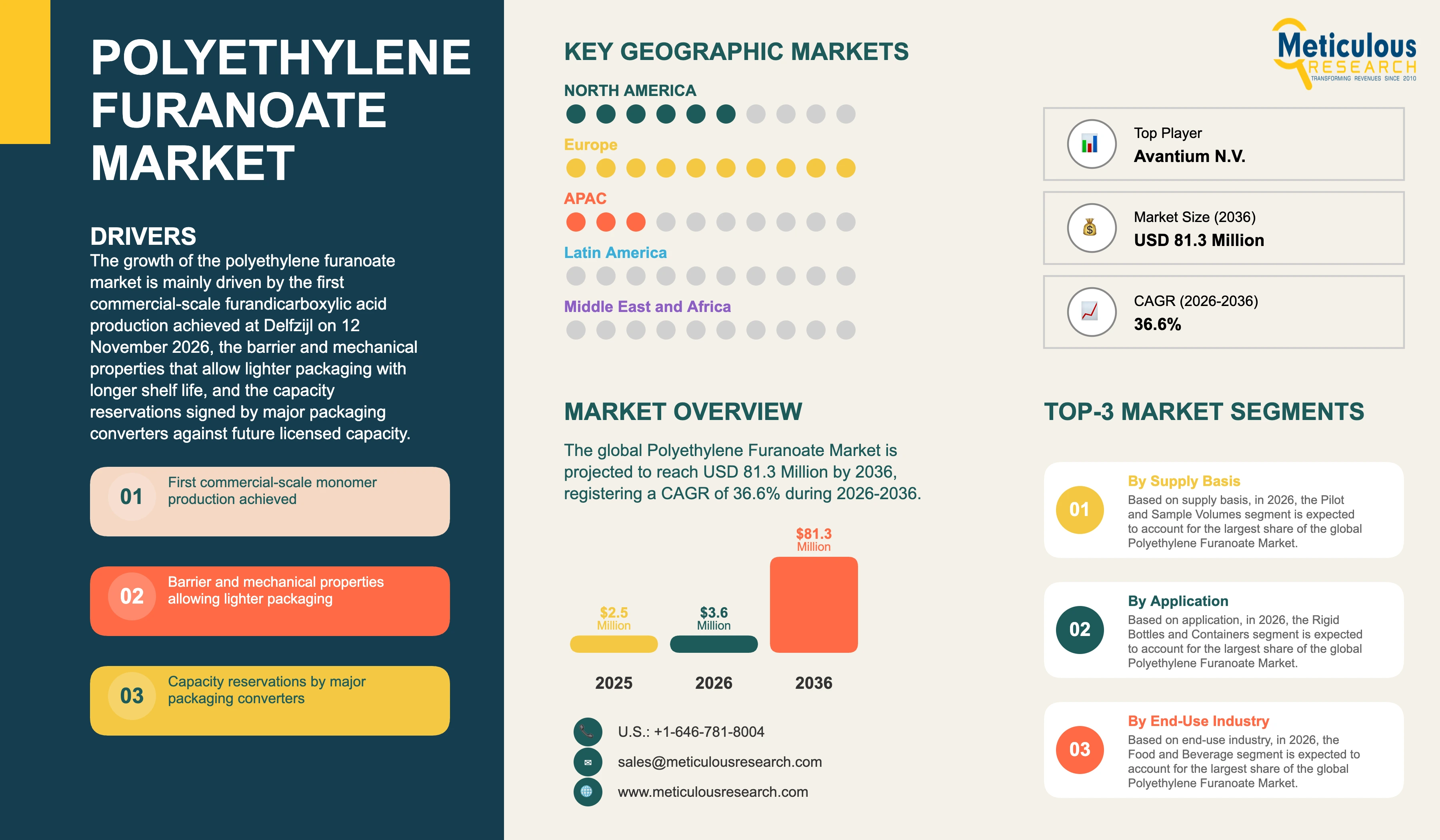
Market dynamics
15 factors across 5 forcesFirst Commercial-Scale Monomer Production Achieved
Avantium N.V. announced on 12 November 2026 that it had produced the first furandicarboxylic acid at its Delfzijl plant, described as the world first commercial-scale facility for the monomer, after reporting on 23 January 2026 that quality issues in certain titanium welds had delayed the start-up and added EUR 7 million of capital expenditure.
Monomer availability at commercial scale is the precondition for any polymer production, so the start-up removes the constraint that had held this market at laboratory and pilot volumes rather than improving an existing position.
A commercial-scale monomer plant also establishes a reference cost for the acid, which a prospective licensee needs before it can model the economics of a polymer line, and no pilot facility can supply that.
Reaching first production also converts a technology claim into an operating record, which is what a brand owner asks for before it will commit a packaging programme.
Barrier and Mechanical Properties Allowing Lighter Packaging
Higher gas barrier means a smaller package can hold a product for the same shelf life, higher mechanical strength means less material per container, and a lower processing temperature means less energy on the converting line, all described in the Avantium release of 11 February 2025 alongside a claim of 100% plant-based content.
Those are converting economics rather than sustainability arguments, which matters because a converter can justify them on cost per package even before any renewable content premium is considered.
A smaller container holding the same product for the same period also uses less resin in absolute terms, so the material advantage compounds with the lightweighting rather than merely adding to it.
A lower processing temperature additionally reduces the energy a converter uses per container, which is a cost saving on an existing line rather than a benefit that accrues to someone else in the chain.
Capacity Reservations by Major Packaging Converters
Amcor Rigid Packaging USA, LLC committed to a multi-year capacity reservation for the polymer from a future industrial-scale facility operating under a technology licence from Avantium, giving it preferred access to volumes from the future licensee network, alongside a joint development agreement covering rigid containers across food, beverage, pharmaceutical, medical, home and personal care.
Reservations of that kind from established converters give a prospective licensee a demand signal ahead of investment, which is how a licensing model is supposed to build capacity.
The joint development agreement accompanying that reservation spans food, beverage, pharmaceutical, medical, home and personal care containers, which is an unusually broad scope for a first programme and indicates the converter is testing the material across its portfolio rather than in one format.
Interest of this kind from a converter with global rigid packaging operations also validates the material commercially in a way laboratory results cannot.
Recyclability in Existing Polyethylene Terephthalate Streams
The polymer is described as recyclable in existing polyethylene terephthalate recycling streams and included in the Association of Plastic Recyclers Critical Guidance Protocol, which addresses the objection that a new packaging polymer disrupts an established recovery system.
That objection has defeated other candidate materials irrespective of their own credentials, so recognition under a recycling protocol removes a barrier rather than adding an advantage.
Compatibility also means a brand can introduce the material without negotiating a separate collection or sorting arrangement, which removes a cost and a delay that a wholly new polymer would carry.
Inclusion in a recognised recycling protocol also gives a brand owner an external reference to cite rather than relying on a supplier claim, which shortens an internal approval.
All four drivers rest on evidence published in 2025 and 2026 rather than on projection, which is unusual for a polymer at this stage and is the reason the forecast here is built on them.
Table of contents
11 chapters · 126 sections · 254 pages · click to expandSegmental analysis
| Segment | Largest share (2026) | Fastest growth (2026–2036) |
|---|---|---|
| By Supply Basis | Pilot and sample volumes | Licensed third-party production |
| By Application | Rigid bottles and containers | Films and flexible packaging |
| By End-Use Industry | Food and beverage | Personal care and home care |
| Other segments | Rigid bottles and containers | Films and flexible packaging |
By Supply Basis
- Polyethylene Furanoate Market Analysis by Supply Basis
- The pilot and sample volumes segment is expected to account for the largest share of the global polyethylene furanoate market.
- The large share of this segment is mainly due to no industrial-scale polymer facility being in operation, the development agreements under way requiring material for trials and demonstrator packaging, and the first commercial-scale monomer production having been achieved only in November 2026.
- However, the licensed third-party production segment is projected to register the highest CAGR of 62.0% during the forecast period, from a negligible base.
- The rapid growth of this segment is attributed to the commercial model being a technology licence rather than owner-operated capacity, and to the reservations signed by converters being against that future licensee network.
- Direct sales from owner-operated capacity occupy the middle position, drawing on the monomer facility described as central to selling the acid and the polymer directly.
- This axis measures how the material reaches a customer rather than any property of it, and it is included because the route to supply is the principal uncertainty in this market, with the location, size, start date and identity of every prospective licensee facility unstated in the announcements made to date.
- Supply basis also determines what a buyer can rely on.
- Material from a pilot line is available for development but cannot support a commercial launch, material from owner-operated capacity is limited by one plant, and material from a licensee network does not exist until a licensee builds, so the axis measures commercial availability rather than a production method.
- That is why it is the first segmentation in this report rather than a technical footnote.
- No licensee has been identified in any announcement to date, so the fastest-growing segment on this axis currently has no named participant.
- Pilot and sample volumes are expected to account for the largest share in 2026, since no industrial-scale polymer facility is in operation and development agreements require material for trials and demonstrator packaging.
- Licensed third-party production is projected to register the highest CAGR of 62.0% during the forecast period, from a negligible base.
By Application
- Polyethylene Furanoate Market Analysis by Application
- The rigid bottles and containers segment is expected to account for the largest share of the global polyethylene furanoate market.
- The large share of this segment is mainly due to small-format carbonated and oxygen-sensitive beverages being the hardest case for polyethylene terephthalate on shelf life, the joint development agreement with Amcor covering rigid containers across several end-uses, and the suitability of the polymer to existing stretch blow moulding.
- However, the films and flexible packaging segment is projected to register the highest CAGR of 54.0% during the forecast period.
- The rapid growth of this segment is attributed to a polymer with intrinsically lower gas permeability being able to replace a multi-layer construction or a coating in a thin structure, simplifying the laminate and improving its recyclability together.
- Fibres and textiles draw on the same polyester chemistry that supports polyethylene terephthalate fibre, with thermal properties that differ enough to require separate process development.
- Thermoformed trays use the barrier in a rigid format at lower cost per unit than bottles.
- Application determines how much of the property advantage is monetised, since a barrier worth a premium in a small bottle is worth less in a large one and more in a thin film.
- Application also determines how quickly a qualification can be completed, since a film structure can be trialled and changed within a season while a bottle requires preform tooling, filling line trials and shelf life studies that run for a year or more.
- The faster-qualifying applications are therefore where early licensed volume is most likely to land.
- Fibre applications would draw on the largest polyester end market of all, but require separate process development because the thermal properties differ from polyethylene terephthalate.
By End-Use Industry
- Polyethylene Furanoate Market Analysis by End-Use Industry
- The food and beverage segment is expected to account for the largest share of the global polyethylene furanoate market.
- The large share of this segment is mainly due to shelf life being the property the polymer improves most directly, the scale of beverage and food packaging relative to other end-uses, and the inclusion of food and beverage containers in the development agreement announced in February 2025.
- However, the personal care and home care segment is projected to register the highest CAGR of 52.0% during the forecast period.
- The rapid growth of this segment is attributed to higher value per package tolerating a material premium more readily, and to frequent redesign as part of brand refreshes giving a new polymer repeated opportunities to be specified.
- Pharmaceutical and medical packaging values barrier and extractables performance highly but qualifies materials slowly and against tighter requirements.
- Industrial and other uses remain small.
- End-use industry determines the qualification burden and the tolerance for a premium, which at this stage of development matters more than the size of the end market, since a material available only in development quantities can serve a demanding buyer sooner than a high-volume one.
- End-use industry also sets how much of the barrier advantage is paid for.
- A pharmaceutical pack values barrier highly but buys small volumes under tight qualification, a beverage buys large volumes at thin margins, and personal care sits between the two with higher value per unit and shorter design cycles, so the revenue available per tonne varies widely across this axis.
- Qualification burden rather than market size therefore determines the order in which end-uses open, which is characteristic of a material in first production.
- That sequencing also explains why the segmentation in this report leads with supply basis: until capacity exists, availability rather than application preference determines where the material goes.
- Supply basis is accordingly the axis a reader should weigh most heavily in this report.
Other segments
- Rigid bottles and containers are expected to account for the largest share in 2026, since small-format carbonated and oxygen-sensitive beverages are the hardest case for polyethylene terephthalate on shelf life.
- Films and flexible packaging are projected to register the highest CAGR of 54.0% during the forecast period.
- Food and beverage is expected to hold the largest share in 2026, since shelf life is the property the polymer improves most directly and the sector is the largest consumer of packaging.
- Personal care and home care are projected to register the highest CAGR of 52.0% during the forecast period.
Geographic analysis
Europe
Largest shareIn 2026, Europe is expected to account for the largest share of the global polyethylene furanoate market. The large share of this region is mainly due to the technology owner and its monomer facility being located there, the Delfzijl plant having produced the first commercial-scale furandicarboxylic acid in November 2026, the packaging recyclability requirements that favour monomaterial structures, and the converters and brand owners engaged in development work. The Netherlands is projected to register a CAGR of 34.0%, Germany a CAGR of 35.0% and France a CAGR of 33.0% during the forecast period.
North America
Fastest growthHowever, North America is projected to register the highest CAGR of 42.0% during the forecast period. The rapid growth of this region is attributed to the capacity reservation and joint development agreement with Amcor Rigid Packaging USA, LLC, the scale of the rigid packaging converting industry located there, the recognition of the polymer under the Association of Plastic Recyclers Critical Guidance Protocol, and the brand owners setting renewable content targets. The United States is projected to register a CAGR of 42.4%.
Asia-Pacific
Asia-Pacific is projected to grow at 38.0%, with Japan and China both at 38.0%, on the polyester manufacturing capability concentrated in the region and the prospect of licensed capacity being built there, though no licensee has been identified. Asia-Pacific holds the largest polyester converting base of any region, so a licence awarded there would change the regional picture faster than its current development activity implies. No licensee has been named in any region, so every regional figure here rests on development activity rather than on announced capacity.
Latin America
Latin America is projected to grow at 30.0% from a negligible base.
Middle East & Africa
The Middle East & Africa is projected to grow at 12.0%, where no development activity has been announced. Where this polymer gets made will be decided by which licensees commit rather than by where demand or feedstock sits, which is unusual and specific to a licensing model. Sugar feedstock and polyester converting capability both exist in several regions, so neither constrains the outcome; the binding variable is which companies take a licence and finance a plant, and the announcements made to date name none of them. Regional outcomes in this market therefore remain open rather than determined, and the shares here describe where development activity is concentrated rather than where production will sit.
Competitive landscape
The global polyethylene furanoate market has one producer and a set of converters holding reservations against capacity that does not yet exist. Avantium N.V. owns the technology, operates the pilot facility and the newly started monomer plant, and accounted for an estimated 96.4% of supply in 2026, with the balance from development and demonstrator quantities produced by prospective partners. The companies profiled in this report together accounted for the same figure, because the other profiled companies hold capacity reservations and development agreements rather than production.
Competition in the conventional sense does not yet exist in this market, and the position is stated on that basis rather than divided into shares that would imply otherwise. What determines the outcome is whether licensees commit capital, and the announcements to date identify no licensee, state no facility location, size or start date, and establish no binding volume obligation. Producers of bio-based polyethylene terephthalate are excluded, since that polyester uses terephthalic acid and is a separate material rather than a grade of this one.
Development agreements and capacity reservations rather than capacity or supply accounted for all significant activity through 2026. Avantium N.V. announced the joint development agreement and multi-year capacity reservation with Amcor Rigid Packaging USA, LLC on 11 February 2025, produced the first furandicarboxylic acid at Delfzijl on 12 November 2026 at what it described as the world first commercial-scale facility for the monomer, and recorded alongside that a capacity reservation with Will & Co B.V. for monomer directed at coatings, adhesives, sealants and elastomer markets rather than at this polymer. Some of the key players operating in the polyethylene furanoate market are Avantium N.V. (Netherlands), Amcor plc (Switzerland), Klöckner Pentaplast Group (Germany), and Sukano AG (Switzerland), among others.
A licensing model also means the set of producers in this market in 2036 may include companies that have no involvement in it today, which is a different kind of uncertainty from the one a conventional polymer market presents.
Until a licensee is named and a facility is sanctioned, the useful way to track this market is through monomer allocation and licence awards rather than through demand indicators, because demand interest is already established and supply is not.
- —
Avantium N.V. announced a joint development agreement with Amcor Rigid Packaging USA, LLC on 11 February 2025 to explore the use of its polymer, branded releaf, in rigid containers for food, beverage, pharmaceutical, medical, home and personal care products, and recorded separately that Amcor had committed to a multi-year capacity reservation for the polymer from a future industrial-scale facility operating under a technology licence, giving it preferred access to volumes from the future licensee network; that release described the polymer as 100% plant-based, recyclable in existing polyethylene terephthalate streams and included in the Association of Plastic Recyclers Critical Guidance Protocol, with superior barrier properties, higher mechanical strength and a lower processing temperature, while stating no financial value or pricing, no reserved volume or tonnage, no term beyond multi-year, no exclusivity beyond preferred access, no supply or purchase commitment, and no location, size or start date for the future licensed facility. Avantium N.V. announced on 12 November 2026 that it had produced the first furandicarboxylic acid at its Delfzijl plant, described as the world first commercial-scale facility for the monomer, and recorded alongside it a capacity reservation with Will & Co B.V. for monomer from future licensed capacity directed at coatings, adhesives, sealants and elastomer markets rather than at this polymer, having reported on 23 January 2026 that construction-related quality issues in certain titanium welds posing a safety risk had delayed the start-up and added EUR 7 million of capital expenditure.
- Avantium N.V.
- Amcor plc
- Klöckner Pentaplast Group
- Sukano AG
Expert perspectives
Volume grows at 48.0% against 36.6% in value over the forecast period, and the average selling price falls from USD 5.80 per kg in 2026 to USD 2.60 per kg by 2036. Price falling steeply while volume multiplies from a base measured in hundreds of tonnes is the signature of a polymer reaching first production rather than of a market competing for share.
The clearest way to read this market is through the instruments its participants use. A global packaging converter signed a multi-year capacity reservation on 11 February 2025 for polymer from a future industrial-scale facility operating under a licence, giving it preferred access to a licensee network. No licensee is named, no facility location, size or start date is given, no volume or term is stated, and the release does not say whether the reservation binds anyone.
That is not a criticism of the parties; it is the only instrument available when no capacity exists. But it means the demand signal a prospective licensee is asked to underwrite is softer than the announcements suggest, and it is why the supply basis axis in this report measures how material reaches a customer rather than treating supply as given.
The monomer achievement is real and it was hard won. Avantium N.V. produced the first furandicarboxylic acid at Delfzijl on 12 November 2026, at what it described as the world first commercial-scale facility for the acid, after reporting in January 2026 that construction-related quality issues in certain titanium welds posing a safety risk had delayed start-up and added EUR 7 million of capital expenditure.
The uncomfortable detail is what that monomer is being committed to. The reservation announced alongside the first production covers acid for coatings, adhesives, sealants and elastomers, which use it in existing resin chemistry at smaller volume and higher value and need no new polymer plant. The molecule this polyester depends on is being drawn toward the markets that pay first.
The property case remains the reason to watch this market. Higher barrier, higher mechanical strength, lower processing temperature and recognition under the Association of Plastic Recyclers Critical Guidance Protocol together address both the performance and the recycling objections that have defeated other new packaging polymers. This market is not additive to the furandicarboxylic acid market, which measures its principal input.
The profiled companies are therefore best read as the participants shaping this market rather than as competitors dividing it.
Customer perspectives
Recognition in an established recycling protocol removes the objection that a new polymer disrupts existing recovery, while the absence of any industrial-scale facility prevents a converter from committing production capacity to the material.
A reservation against future licensed capacity is the instrument available in that position, rather than a supply agreement.
Preferred access to a future licensee network is a different commitment from a supply agreement, and the distinction matters to a converter planning line capacity.
The surface-to-volume ratio of a small container works against shelf life in polyethylene terephthalate, so a higher barrier polymer realises most of its value in small formats rather than across the bottle range.
New packaging is also introduced in small formats first, where the volume at risk is lower and the design cycle shorter.
A monomaterial film satisfies packaging recyclability requirements that a laminate cannot, so replacing a multi-layer structure delivers a regulatory benefit alongside the barrier performance.
Laminate recyclability requirements are tightening specifically, which gives the substitution a regulatory driver rather than only a technical one.
That design cycle is short enough for the material to be adopted without a special programme.
“The barrier and the strength numbers are attractive and the recycling position is the part that makes it discussable internally. What we cannot do is commit a line to a resin that has no plant behind it yet.”
“Where it would earn its money for us is the small formats, because that is where shelf life is hardest in the incumbent material. A two-litre bottle does not need it.”
“If one polymer gives us the barrier we currently build with three layers, the recyclability argument writes itself. That is worth more to us than the barrier on its own.”
Frequently asked questions
This market was valued at USD 1.8 million in 2024 and USD 2.5 million in 2025, and is estimated at USD 3.6 million in 2026. In volume terms it is estimated at 620.00 tonnes in 2026 as polymer supplied, consisting of pilot, sample and development quantities.
This market is projected to reach USD 81.3 million by 2036 in value and 31,261.45 tonnes in volume.
This market is projected to register a value CAGR of 36.6% and a volume CAGR of 48.0% during the forecast period 2026-2036. The average selling price is projected to move from USD 5.80 per kg in 2026 to USD 2.60 per kg by 2036 as licensed production replaces pilot volumes.
Growth is driven by the first commercial-scale furandicarboxylic acid production achieved at Delfzijl on 12 November 2026, the barrier and mechanical properties that allow lighter packaging with longer shelf life, the capacity reservations signed by major packaging converters including the multi-year commitment announced with Amcor on 11 February 2025, and recyclability in existing polyethylene terephthalate streams.
No industrial-scale polymer facility is in operation and the commercial model is a technology licence with no licensee identified. The monomer plant has only just started, early monomer volumes are being directed at coatings, adhesives, sealants and elastomers, and the agreements signed state no binding volume commitments.
Small-format bottles are where the barrier advantage is worth most. A monomaterial film can replace a multi-layer structure and improve recyclability, licensed production converts reservations into capacity financed by third parties, and personal care and home care packaging tolerates a material premium.
Pilot and sample volumes are expected to account for the largest share in 2026, since no industrial-scale polymer facility is in operation and development agreements require material for trials and demonstrator packaging.
Licensed third-party production is projected to register the highest CAGR of 62.0% during the forecast period, from a negligible base.
Rigid bottles and containers are expected to account for the largest share in 2026, since small-format carbonated and oxygen-sensitive beverages are the hardest case for polyethylene terephthalate on shelf life.
Films and flexible packaging are projected to register the highest CAGR of 54.0% during the forecast period.
Food and beverage is expected to hold the largest share in 2026, since shelf life is the property the polymer improves most directly and the sector is the largest consumer of packaging.
Personal care and home care are projected to register the highest CAGR of 52.0% during the forecast period.
Europe is expected to account for the largest share in 2026, as the technology owner and its monomer facility are located there and packaging recyclability requirements favour monomaterial structures. The Netherlands is projected to grow at 34.0%, Germany at 35.0% and France at 33.0%.
North America is projected to register the highest CAGR of 42.0% during the forecast period, with the United States at 42.4%.
Europe holds the largest share, with Germany growing at 35.0% and the Netherlands at 34.0%, on the technology owner and monomer facility located there, the packaging recyclability requirements that favour monomaterial structures, and the converters and brand owners engaged in development work.
The Middle East & Africa is projected to grow at a CAGR of 12.0%, where no development activity has been announced. Latin America is projected to grow at a CAGR of 30.0% from a negligible base.
Avantium N.V. accounted for an estimated 96.4% of supply in 2026 as the only producer of the polymer, and the 4 companies profiled together accounted for the same figure, because the others hold capacity reservations and development agreements rather than production. Competition in the conventional sense does not yet exist in this market.
Avantium N.V. announced a joint development agreement and a multi-year capacity reservation with Amcor Rigid Packaging USA, LLC on 11 February 2025. On 12 November 2026 it produced the first furandicarboxylic acid at its Delfzijl plant and recorded a capacity reservation with Will & Co B.V. for monomer directed at coatings, adhesives, sealants and elastomers.
Cite this report
Meticulous Research. (2026). Polyethylene Furanoate Market - Global Opportunity Analysis and Industry Forecast (2026-2036) (Report No. MRCHM - 1042819). Meticulous Market Research Pvt. Ltd. https://www.meticulousresearch.com/product/polyethylene-furanoate-market-7502