Zinc Pyrithione Market (2026-2036)
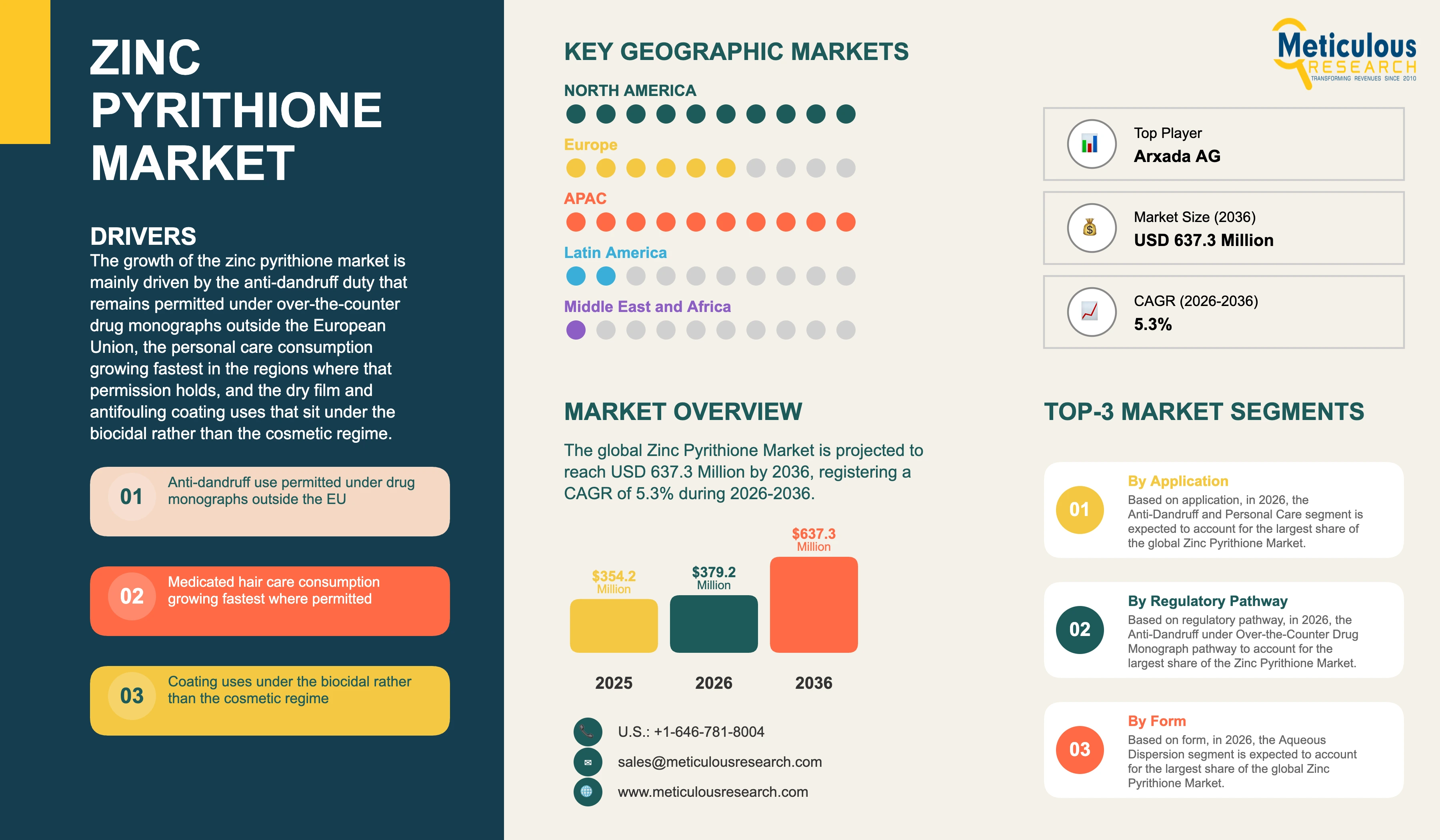
The global zinc pyrithione market was valued at USD 354.2 million in 2025. This market is expected to reach USD 637.3 million by 2036 from an estimated USD 379.2 million in 2026, registering a CAGR of 5.3% during the forecast period (2026-2036).
- Published
- Nov 2026
- Pages
- 268
- Format
- PDF + Excel
- Report ID
- MRCHM - 1042833
- Base year
- 2025
- 2025 · BASELINE
- $354.2M
- 2036
- $637.3M
- CAGR 2026–2036
- 5.3%
2025 baseline · 2026–2036 forecast at 5.3% CAGR · hover a bar for the value
Key highlights
The global zinc pyrithione market is estimated at USD 379.2 million in 2026 and is projected to reach USD 637.3 million by 2036.
Market volume is estimated at 24.00 kilotons in 2026 and is projected to reach 36.21 kilotons by 2036 at a CAGR of 4.2%, measured as active substance on a 100% active basis.
The average selling price is estimated at USD 15.80 per kg in 2026 and is projected to reach USD 17.60 per kg by 2036 as the industrial and coatings uses take a larger share.
Anti-dandruff and personal care is expected to account for the largest application share in 2026, while antifouling coatings are projected to register the highest CAGR of 6.6%.
North America is expected to hold the largest regional share in 2026, while Asia-Pacific is projected to register the highest CAGR of 7.4%.
Europe is projected to grow at 2.4%, markedly the slowest of the regions, as a direct consequence of the cosmetics prohibition.
Commission Regulation (EU) 2021/1902 of 29 October 2021, published in the Official Journal of 3 November 2021 and applying from 1 March 2022, added pyrithione zinc to Annex II as prohibited entry 1670, with CAS 13463-41-7 and EC 236-671-3.
That Regulation deleted Annex III entry 101, which had allowed non-preservative use in leave-on hair products up to 0.1%, and Annex V entry 8, which had allowed preservative use up to 1% in rinse-off hair products and up to 0.5% in other rinse-off non-oral-hygiene products.
The prohibition rests on classification as toxic for reproduction category 1B, applying from the same date as the underlying classification under Delegated Regulation (EU) 2020/1182.
Recital 8 of that Regulation records that the Scientific Committee on Consumer Safety found zinc pyrithione can be considered safe as an anti-dandruff ingredient in rinse-off hair products up to a maximum concentration of 1%, in its opinion of 3 to 4 March 2020, SCCS/1614/19.
The substance was nonetheless prohibited because the Commission concluded it had not been established that no suitable alternative substances were available, so the exception condition on alternatives was not met.
An exception request for rinse-off anti-dandruff hair use up to 1% had been submitted on 11 April 2019 and was not granted, and the Regulation sets no transitional period for products already on the market beyond the 1 March 2022 application date.
Commission Implementing Regulation (EU) 2025/937 of 21 May 2025, approving DBNPA for product type 6, records in recital 11 that zinc pyrithione was among around fifty alternatives examined for paper-production uses and found unsuitable.
The reasons given there for rejecting examined alternatives were suitability only for long-term preservation, technical compatibility problems, or hazard issues, without attributing a specific reason to zinc pyrithione.
This market measures zinc pyrithione only and excludes sodium pyrithione and copper pyrithione, which are distinct substances with their own regulatory positions, the latter being the pyrithione more commonly used in antifouling coatings.
Report summary
| Particulars | Details |
|---|---|
| Base Year | 2025 |
| Forecast Period | 2026-2036 |
| Market Size in 2025 | USD 354.2 million |
| Market Size in 2026 | USD 379.2 million |
| Market Size by 2036 | USD 637.3 million |
| Value CAGR (2026-2036) | 5.3% |
| Format | PDF, Excel & Cloud Portal · 268 pages |
| Volume in 2026 | 24.00 kilotons |
| Volume by 2036 | 36.21 kilotons |
| Volume CAGR (2026-2036) | 4.2% |
| Volume Basis | Active substance on a 100% active basis |
| Average Selling Price in 2026 | USD 15.80 per kg |
| Average Selling Price by 2036 | USD 17.60 per kg |
| Price Direction | The average selling price rises across the forecast period as the industrial and coatings uses take a larger share of a mix led by personal care, rather than through any change in the cost of producing the active |
| Volume Basis Note | Zinc pyrithione is supplied principally as an aqueous dispersion at around half its mass and as a dry powder, so a tonnage quoted as product as supplied would be substantially larger than the figures here without describing any more active material; the 100% active basis matches the convention applied to the isothiazolinone and quaternary ammonium actives in this series |
| Scope Exclusion Note | Sodium pyrithione and copper pyrithione are excluded as distinct substances with their own regulatory positions; copper pyrithione rather than the zinc complex is the pyrithione more commonly specified in antifouling coatings, so the antifouling share recorded here is smaller than a reader thinking of pyrithione antifoulants generally would expect; zinc oxide and other zinc compounds are also outside the scope |
| Regulatory Basis Note | Commission Regulation (EU) 2021/1902 of 29 October 2021 added pyrithione zinc to Annex II as prohibited entry 1670 from 1 March 2022 on the basis of classification as toxic for reproduction category 1B, deleting Annex III entry 101 and Annex V entry 8; recital 8 records that the Scientific Committee on Consumer Safety found the substance can be considered safe as an anti-dandruff ingredient in rinse-off hair products up to 1% in its opinion of 3 to 4 March 2020, SCCS/1614/19, and the exception failed because the Commission concluded it had not been established that no suitable alternative substances were available, so the prohibition rests on the alternatives limb of the test rather than on an adverse safety finding |
| Measurement Basis | Zinc pyrithione supplied as an active substance for antifungal and antibacterial duties, by application, regulatory pathway, form and geography, measured as active substance on a 100% active basis and excluding sodium and copper pyrithione, other zinc compounds, and the formulated products into which the active is supplied |
| Relationship to Adjacent Markets | This market is not additive to the dry film preservatives market, which measures formulated preservative on a product mass basis while the zinc pyrithione within those formulations is counted here at active level; the same relationship holds with the antimicrobial textile finishes market |
| Note on Supplier Disclosure | No participant publishes revenue for zinc pyrithione separately from its wider microbial control or life science business, so neither sales nor volumes can be read from supplier disclosure and the sizing here is built from application demand and pathway coverage; a material share is held by producers in China and India whose corporate particulars could not be verified to the standard applied to the profiled companies, and they are not named individually rather than being listed on an unverified basis |
| Largest Application | Anti-dandruff and personal care |
| Fastest-Growing Application | Antifouling coatings (CAGR 6.6%) |
| Largest Regulatory Pathway | Anti-dandruff under over-the-counter drug monograph |
| Fastest-Growing Regulatory Pathway | Biocidal product type uses (CAGR 6.6%) |
| Largest Region | North America |
| Fastest-Growing Region | Asia-Pacific (CAGR 7.4%) |
| Slowest-Growing Region | Europe (CAGR 2.4%), as a direct consequence of the cosmetics prohibition applying from 1 March 2022 |
| Segments Covered | Application, Regulatory Pathway, Form, and Geography |
| Geographies Covered | North America, Asia-Pacific, Europe, Latin America, and Middle East & Africa |
| Companies Profiled | 4 companies, being Arxada AG, Kolon Life Science, Inc., LANXESS AG, and Clariant AG |
Report overview
Segments covered: application, regulatory pathway, form.
The growth of this market is mainly driven by the anti-dandruff duty that remains permitted under over-the-counter drug monographs outside the European Union, the personal care consumption growing fastest in the regions where that permission holds, the dry film and antifouling coating uses that sit under the biocidal rather than the cosmetic regime, and the industrial water and metalworking applications where a zinc complex is established. However, factors such as the European cosmetics prohibition that removed the largest single use in that region, the reproductive toxicity classification underlying it, the alternatives test that the substance failed despite a favourable safety opinion, and the substitution pressure in coatings are expected to restrain the growth of this market to some extent.
Zinc pyrithione is a zinc complex of 2-mercaptopyridine-N-oxide used as an antifungal and antibacterial active, principally in anti-dandruff hair products and as a preservative in coatings, metalworking fluids and polymers. Market sizing in this report is on both a value basis in USD and a volume basis in kilotons measured as active substance on a 100% active basis, with average selling price derived from the two. The substance carries CAS 13463-41-7 and EC 236-671-3.
The measurement basis matters because the material is almost never handled neat. Zinc pyrithione is supplied principally as an aqueous dispersion at around half its mass and as a dry powder, so a tonnage quoted as product as supplied would be substantially larger than the figures here without describing any more active material. The 100% active convention also allows comparison with the other biocidal actives in this series.
Sodium pyrithione and copper pyrithione are excluded, and that exclusion is more consequential than it sounds. They are distinct substances with their own regulatory positions, and copper pyrithione rather than the zinc complex is the pyrithione more commonly specified in antifouling coatings, so the antifouling share recorded here is smaller than a reader thinking of pyrithione antifoulants generally would expect. Zinc oxide and other zinc compounds are also outside the scope.
Commission Regulation (EU) 2021/1902 of 29 October 2021, published in the Official Journal of 3 November 2021 and applying from 1 March 2022, is the single most important document affecting this market. It added pyrithione zinc to Annex II as prohibited entry 1670 on the basis of classification as toxic for reproduction category 1B, applying from the same date as the underlying classification under Delegated Regulation (EU) 2020/1182.
What that Regulation removed is the detail worth having. It deleted Annex III entry 101, which had allowed non-preservative use in leave-on hair products up to 0.1%, and Annex V entry 8, which had allowed preservative use up to 1% in rinse-off hair products and up to 0.5% in other rinse-off non-oral-hygiene products. It also replaced Annex III entry 24 for water-soluble zinc salts so that the entry now excludes zinc pyrithione.
The reasoning behind the prohibition is the most instructive part of it, because the substance was not found unsafe. Recital 8 records that the Scientific Committee on Consumer Safety found zinc pyrithione can be considered safe as an anti-dandruff ingredient in rinse-off hair products up to a maximum concentration of 1%, in its opinion of 3 to 4 March 2020, SCCS/1614/19. The Commission nonetheless concluded that it had not been established that no suitable alternative substances were available.
That distinction decides how the European position should be read. An exception for a classified substance requires both safety and the absence of suitable alternatives, and here the first condition was met and the second was not. An exception request for rinse-off anti-dandruff use up to 1% had been submitted on 11 April 2019 and was not granted, the Regulation contains no analysis of alternatives, and it sets no transitional period beyond the 1 March 2022 application date.
A substance prohibited on the availability of alternatives rather than on its own hazard profile occupies an unusual commercial position. The scientific case for the use was accepted and is on the record, which means the European restriction is in principle reversible if the alternatives position changes, whereas a prohibition resting on an adverse safety finding would not be. No participant should plan on that, but it is a materially different situation from the one the Annex II listing suggests.
Outside the European Union the anti-dandruff use continues under over-the-counter drug monographs and equivalent national frameworks, and that divergence is the structural feature of this market. The largest single use of the substance is prohibited in one major region and permitted in the others, so the geography of demand is now set by regulatory status rather than by population or hair care consumption.
That is why Europe is projected to grow at 2.4% against 7.4% in Asia-Pacific and 5.0% in North America. European volume now rests on the biocidal product type uses in coatings, metalworking fluids and polymers rather than on personal care, and those uses were a minority of regional demand before the prohibition took effect.
North America holds the largest regional share because the anti-dandruff duty is both permitted there and concentrated in a small number of very large shampoo brands. Asia-Pacific grows fastest because the same duty is permitted and the consumption of medicated hair care is rising from a lower base, with India projected at 9.0% and China at 7.6%.
The coatings uses sit under the biocidal regime rather than the cosmetic one and are therefore unaffected by the 2021 prohibition. Dry film preservation protects a cured coating against fungal and algal growth on the surface, which is a different duty from in-can preservation, and zinc pyrithione holds a position there on the strength of its performance against the organisms that discolour exterior paint.
Commission Implementing Regulation (EU) 2025/937 of 21 May 2025, which approved DBNPA for product type 6, records in recital 11 that zinc pyrithione was among around fifty alternatives examined for paper-production uses and found unsuitable. The reasons given there for rejecting examined alternatives were suitability only for long-term preservation, technical compatibility problems, or hazard issues, and the Regulation does not attribute a specific reason to zinc pyrithione, so none is attributed here either.
That appearance is nonetheless informative about where this substance does and does not compete. Zinc pyrithione is a durable, surface-active antifungal suited to protecting a film or a formulation over months, which is what makes it effective in dry film preservation and ineffective for the short-term in-can duty that the paper and slurry applications require.
This market is not additive to the dry film preservatives market, which measures formulated preservative on a product mass basis while the zinc pyrithione within those formulations is counted here at active level. The same relationship holds with the antimicrobial textile finishes market, and the convention used here matches the one applied to the isothiazolinone and quaternary ammonium actives.
A cured exterior coating fails visually on fungal and algal growth long before it fails mechanically, and the duty requires an active that remains effective in the film over years rather than one that protects a wet formulation in the can.
Zinc pyrithione is durable and surface-active, which suits that requirement, and the coatings uses sit under the biocidal product type framework rather than the cosmetic regime that was closed in Europe in 2022.
Resistance to settlement on immersed surfaces is a duty where organic boosters are specified alongside copper chemistry, and the pyrithiones hold a position in that role.
Antifouling coatings are projected to register the highest application CAGR of 6.6%, though the share recorded here is limited by the exclusion of copper pyrithione, which is the pyrithione more commonly specified in that duty.
Supplying the active already dispersed in a polymer carrier removes the handling problem that a fine powder presents to a converter and places the dispersion work with the party able to validate it.
Masterbatch and compounded supply grows at 6.6% against 5.2% for aqueous dispersion and 5.0% for powder, and plastics and textiles grow at 7.0% among applications.
These four opportunities fall into two groups that will not move together. Asia-Pacific hair care expands the use that already dominates the market, while the coating, antifouling and compounded supply routes build weight in the pathway that European regulation left untouched.
The second group matters disproportionately to any participant with European exposure. A supplier whose volume was concentrated in personal care lost that position in the region outright in March 2022, and the only route back to European growth runs through the biocidal product type uses, which is why that pathway grows at 6.6% against 2.6% for the cosmetic one.
The dry film opportunity is also the one where the technical case is strongest rather than merely permitted. A cured exterior coating fails visually on fungal and algal growth years before it fails mechanically, and the requirement is for an active still working in the film after that time, which is the property this substance has and the short-acting alternatives do not.
The compounded supply opportunity changes who can buy rather than what the active does. A converter without dispersion capability cannot use a powder at a fraction of a per cent addition, so supplying the active already distributed through a polymer carrier opens customers that the existing forms exclude.
A fifth route sits alongside them and carries the least regulatory exposure of any use in this market. Metalworking fluids and industrial water systems need antifungal control across long service intervals in closed systems where consumer exposure does not arise, and that duty grows with manufacturing activity rather than with any formulation trend or ingredient policy.
Those uses are small in share and valuable in character, because they are the part of the market least likely to be disturbed by the classification pressure now working on the consumer-facing applications, and they are also a meaningful part of what European volume now consists of.
Each of the five therefore sits in a different relationship to the regulatory position, and a participant assessing this market needs to know which pathway an opportunity belongs to before weighing it at all.
The anti-dandruff pathway under over-the-counter drug monographs is expected to hold the largest share in 2026, since the use is regulated as a therapeutic active rather than as a cosmetic ingredient and the European cosmetics prohibition did not reach it.
The biocidal product type pathway is projected to register the highest CAGR of 6.6% during the forecast period, covering the coatings, metalworking fluid and polymer uses that were unaffected by the 2021 Regulation, against 2.6% for the cosmetic pathway.
North America is expected to account for the largest share in 2026, on the anti-dandruff use remaining permitted under the over-the-counter drug framework and the concentration of that duty in large shampoo brands manufactured in the region. The United States is projected to grow at 5.0%.
Asia-Pacific is projected to register the highest CAGR of 7.4% during the forecast period, with India at 9.0%, China at 7.6% and Japan at 3.4%.
Europe is projected to grow at a CAGR of 2.4%, markedly the slowest of the regions, with the United Kingdom at 2.2% and Germany and France at 2.0%. Commission Regulation (EU) 2021/1902 prohibited the substance in cosmetics from 1 March 2022, so regional volume now rests on the coatings, metalworking fluid and polymer uses under the biocidal framework, which were a minority of demand before that date.
The Middle East & Africa is projected to grow at a CAGR of 5.0%. Latin America is projected to grow at a CAGR of 5.6%, with Brazil at 5.6%, on medicated hair care and on exterior coatings in humid climates.
Arxada AG, Kolon Life Science, Inc., LANXESS AG and Clariant AG together accounted for an estimated 54.6% of this market in 2026, which is also the share held by the 4 companies profiled in this report. A material further share is held by producers in China and India whose corporate particulars could not be verified to the standard applied to the profiled companies.
Report infographic
Market dynamics
11 factors across 4 forcesAnti-Dandruff Use Permitted Under Drug Monographs Outside the European Union
The anti-dandruff duty continues under over-the-counter drug monographs and equivalent national frameworks in the regions outside the European Union, where the substance is regulated as a therapeutic active rather than as a cosmetic ingredient.
That pathway accounts for the largest share of demand, and it is unaffected by the European cosmetics prohibition because it rests on a different legal basis with a different test applied to it.
Medicated Hair Care Consumption Growing Fastest Where the Use Is Permitted
Consumption of medicated and functional hair care is rising faster in the regions where the anti-dandruff use remains available than in the mature markets, and from a lower base.
Asia-Pacific is projected to register the highest regional CAGR at 7.4%, with India at 9.0% and China at 7.6%, against North America holding the largest share.
Coating Uses Under the Biocidal Rather Than the Cosmetic Regime
Dry film preservation protects a cured coating against the fungal and algal growth that discolours exterior paint, and antifouling coatings resist settlement on immersed surfaces, both of which fall under the biocidal product type framework and were unaffected by the 2021 cosmetics prohibition.
Antifouling coatings are projected to register the highest application CAGR of 6.6%, and the biocidal product type pathway grows at 6.6% against the cosmetic pathway at 2.6%.
Industrial Water and Metalworking Applications
Metalworking fluids and industrial water systems require antifungal control over extended service intervals, which suits a durable active that persists in a formulation rather than one that is consumed quickly.
Those uses also sit under the biocidal framework, and they are the applications on which European volume now principally rests following the removal of the personal care use.
What holds these four drivers together is that none of them depends on the European position, and that is the practical reason this market continues to grow at all after losing its largest regional use in a single category. The anti-dandruff duty rests on drug monographs, the coating duties on the biocidal framework, and the industrial duties on neither.
The first driver is the one most often misunderstood. The anti-dandruff use was not preserved in the other regions by an exemption or a transitional arrangement; it sits under a different body of law entirely, in which the substance is assessed as a therapeutic active against a therapeutic test rather than as a cosmetic ingredient against the cosmetic one. Nothing about the European decision reaches that assessment.
The growth in medicated hair care is where the volume actually comes from. Consumption per head in the regions where the use remains available is well below the mature markets and rising, and the product categories involved are mass-market rather than premium, so the demand being added is in tonnage rather than in value per kilogram.
The coating and industrial drivers matter more than their share suggests, because they are what remains of European demand. Dry film preservation, antifouling and metalworking fluid duties were a minority of regional consumption before March 2022 and are now substantially all of it, which is why Europe grows at 2.4% rather than contracting.
None of the four rests on a cost advantage or on superior performance against the alternative anti-dandruff actives. The substance is specified because it is established, effective and permitted where it is permitted, and the competitive question in each region is whether the use is lawful rather than whether the active is the best available.
Read together, the four describe a substance whose demand now follows the map of where it may lawfully be used, and whose growth rate is the weighted average of several quite different legal positions.
Table of contents
11 chapters · 131 sections · 268 pages · click to expandSegmental analysis
| Segment | Largest share (2026) | Fastest growth (2026–2036) |
|---|---|---|
| By Application | Anti-dandruff and personal care | Antifouling coatings |
| By Regulatory Pathway | Anti-dandruff pathway under over-the-counter drug monographs | Biocidal product type pathway |
| By Form | Aqueous dispersion | Masterbatch and compounded supply |
By Application
- Zinc Pyrithione Market Analysis by Application
- The anti-dandruff and personal care segment is expected to account for the largest share of the global zinc pyrithione market.
- The large share of this segment is mainly due to the duty remaining permitted under over-the-counter drug monographs and equivalent national frameworks outside the European Union, to its concentration in a small number of very large shampoo brands, and to the established efficacy of the active against the organism associated with dandruff.
- However, the antifouling coatings segment is projected to register the highest CAGR of 6.6% during the forecast period.
- The rapid growth of this segment is attributed to the specification of organic boosters alongside copper chemistry in resisting settlement on immersed surfaces, and to that duty sitting under the biocidal product type framework rather than the cosmetic regime closed in Europe in 2022.
- Dry film preservation protects a cured coating against the fungal and algal growth that discolours exterior paint, which is a different duty from in-can preservation and the one this active suits best.
- Metalworking fluids and industrial water require antifungal control over extended service intervals.
- Plastics and textiles grow at 7.0%.
- Application determines which regulatory framework the use falls under, and in this market that matters more than the technical requirement.
- Anti-dandruff and personal care is expected to account for the largest share in 2026, on the duty remaining permitted under drug monographs outside the European Union and its concentration in a small number of very large shampoo brands.
- Antifouling coatings are projected to register the highest CAGR of 6.6% during the forecast period, though the share recorded is limited by the exclusion of copper pyrithione.
By Regulatory Pathway
- Zinc Pyrithione Market Analysis by Regulatory Pathway
- The anti-dandruff pathway under over-the-counter drug monographs accounts for the largest share of this market and grows at 5.0%, because the use is regulated as a therapeutic active with its own test rather than as a cosmetic ingredient, and the European cosmetics prohibition did not reach it.
- The biocidal product type pathway grows fastest at 6.6% and covers the coatings, metalworking fluid and polymer uses, which were unaffected by the 2021 Regulation.
- The cosmetic preservative and other cosmetic pathway grows most slowly at 2.6%, having lost Annex III entry 101 for leave-on hair use up to 0.1% and Annex V entry 8 for preservative use up to 1% in rinse-off hair products.
- This axis is included because it is the one that actually divides the market.
- Two identical tonnes of the same substance face entirely different legal positions according to the framework the use falls under, and the 2022 prohibition closed one pathway in one region while leaving the others intact, which no application or regional split on its own would reveal.
By Form
- Aqueous dispersion accounts for the largest form share of this market, because the active is supplied at around half its mass in a stabilised dispersion that can be dosed directly into a shampoo base, a waterborne coating or a metalworking fluid without the handling difficulties a fine powder presents.
- Powder grows most slowly at 5.0% and is used where water cannot be introduced into the formulation or where the customer has its own dispersion capability.
- Masterbatch and compounded supply grows fastest at 6.6%, serving the polymer and textile uses where the active must be distributed through a solid matrix.
- Form determines who carries the dispersion work rather than what the active does.
- The three axes answer different questions and the second is the one that explains this market.
- Application says which duty is being performed, form says who carries the dispersion work, and regulatory pathway says under which body of law the use sits, which in this case determines whether the use exists in a given region at all.
- That second axis would be a refinement in most markets and is the organising fact here.
- Two identical tonnes of the same substance performing a similar antifungal duty face entirely different legal positions according to whether the use is assessed as a therapeutic active, a cosmetic ingredient or a biocidal product, and only one of those three pathways was closed in Europe in 2022.
- The highest growth sits in the pathway that regulation left alone.
- Antifouling coatings grow fastest among applications at 6.6% and the biocidal product type pathway grows at the same rate, while the cosmetic pathway grows at 2.6% and carries the whole of the European loss within it.
- One axis is deliberately absent, and that is a split by particle size or dispersion grade.
- The anti-dandruff grades are specified to a particle size distribution that affects deposition on the scalp, but producers publish no grade-level volumes and the distinction does not change the regulatory position or the duty performed, so a split on it would divide the market on a property that is real but undisclosed.
- The three axes used here divide it on properties that decide outcomes.
- Reading the axes together also explains the gap between the two growth rates.
- Volume grows at 4.2% while value grows at 5.3%, and the difference comes from the mix moving toward the coatings, antifouling and compounded uses, which carry higher unit prices than the mass-market personal care grades that still dominate the tonnage.
- The regional and pathway axes also interact rather than varying independently.
- Europe grows at 2.4% not because European demand for antifungal protection has fallen but because one of the three pathways was closed there, so the regional figure is really a pathway figure seen from a different direction.
- The fastest-growing position in this market, read across all three axes, is a compounded or dispersed grade sold into a coating or polymer duty under the biocidal product type pathway, and it is that combination rather than any one of its parts that is adding value fastest over the forecast period.
Geographic analysis
Asia-Pacific
Fastest growthThe anti-dandruff use is permitted across Asia-Pacific under national drug and cosmetic frameworks, and consumption of medicated hair care is rising there faster than in any other region and from a lower base per head. Asia-Pacific is projected to register the highest regional CAGR at 7.4%, with India at 9.0%, China at 7.6% and Japan at 3.4%. However, Asia-Pacific is projected to register the highest CAGR of 7.4% during the forecast period. The rapid growth of this region is attributed to the anti-dandruff use being permitted under national drug and cosmetic frameworks, to medicated hair care consumption rising from a lower base per head than in the mature markets, and to the regional production of both the active and the finished products. India is projected to register a CAGR of 9.0%, China a CAGR of 7.6% and Japan a CAGR of 3.4%. Asia-Pacific Medicated Hair Care Geographic Analysis
North America
Largest shareIn 2026, North America is expected to account for the largest share of the global zinc pyrithione market. The large share of this region is mainly due to the anti-dandruff use remaining permitted under the over-the-counter drug framework, the concentration of that duty in a small number of very large shampoo brands manufactured in the region, and the coatings and metalworking uses that sit alongside it. The United States is projected to register a CAGR of 5.0% during the forecast period.
Europe
Europe is projected to grow at 2.4%, markedly the slowest of the regions and for a single identifiable reason. Commission Regulation (EU) 2021/1902 prohibited the substance in cosmetics from 1 March 2022, so regional volume now rests on the coatings, metalworking fluid and polymer uses under the biocidal framework, which were a minority of demand before that date. Germany and France are projected to grow at 2.0% and the United Kingdom at 2.2%.
Latin America
Latin America is projected to grow at 5.6%, with Brazil at 5.6%, on medicated hair care and on exterior coatings in humid climates.
Middle East & Africa
The Middle East & Africa is projected to grow at 5.0%. What separates the regions here is not demand but permission: the same product in the same category is lawful in one place and prohibited in another, and a supplier building a forecast from population or hair care spending would misread this market entirely. Country rates within each region spread widely and follow permission rather than demand: India at 9.0% and China at 7.6% against Japan at 3.4% within Asia-Pacific, and Germany and France at 2.0% against the United Kingdom at 2.2% within Europe. A supplier serving all three pathways therefore maintains three separate regulatory positions for one substance, and the European decision of 2021 removed one of them in one region without affecting the other two anywhere. The regional pattern here is therefore a regulatory map rather than a demand map, and a forecast built from population, hair care spending or coatings consumption would misstate every region in it.
Competitive landscape
The global zinc pyrithione market is concentrated among a small number of producers, with the anti-dandruff grade requiring pharmaceutical-standard documentation that narrows the field further than the chemistry alone would. Competition is contested on grade qualification with the large shampoo brands, on the regulatory documentation supporting each pathway and region, and on dispersion quality, rather than on the cost of the active. Arxada AG, Kolon Life Science, Inc., LANXESS AG and Clariant AG together accounted for an estimated 54.6% of this market in 2026, which is also the share held by the companies profiled in this report.
A material further share is held by producers in China and India whose corporate particulars could not be verified to the standard applied to the profiled companies, and they are therefore not named individually rather than being listed on an unverified basis. That unprofiled share is concentrated in the industrial grades rather than in the anti-dandruff grade, where qualification with the brand owners is the barrier.
No participant publishes revenue for zinc pyrithione separately from its wider microbial control or life science business, so neither sales nor volumes can be read from supplier disclosure, and shares here are built from application demand and pathway coverage. Some of the key players operating in the zinc pyrithione market are Arxada AG (Switzerland), Kolon Life Science, Inc. (South Korea), LANXESS AG (Germany), and Clariant AG (Switzerland), among others.
Competition in this market therefore turns on grade qualification rather than on cost of production. The anti-dandruff grade is supplied into products regulated as therapeutic, which requires documentation and consistency of a different order from the industrial grades, and that requirement rather than the chemistry is what keeps the field small.
It also explains why the unprofiled share sits where it does. Producers outside the four profiled companies compete principally in the coatings, metalworking and polymer grades, where the qualification burden is lighter, rather than in the anti-dandruff grade where the brand owners set the standard and change suppliers rarely.
A supplier serving all three pathways maintains three separate regulatory positions for one substance, and the European decision of 2021 removed one of them in one region while leaving the other two intact everywhere, which is why participants with industrial breadth weathered it better than those concentrated in personal care.
- —
Commission Regulation (EU) 2021/1902 of 29 October 2021, published in the Official Journal of 3 November 2021 and applying from 1 March 2022, added pyrithione zinc to Annex II as prohibited entry 1670 with CAS 13463-41-7 and EC 236-671-3, on the basis of classification as toxic for reproduction category 1B under Delegated Regulation (EU) 2020/1182. It deleted Annex III entry 101, which had allowed non-preservative use in leave-on hair products up to 0.1%, and Annex V entry 8, which had allowed preservative use up to 1% in rinse-off hair products and up to 0.5% in other rinse-off non-oral-hygiene products, and it replaced Annex III entry 24 for water-soluble zinc salts so that the entry excludes zinc pyrithione. Recital 8 records that the Scientific Committee on Consumer Safety found zinc pyrithione can be considered safe as an anti-dandruff ingredient in rinse-off hair products up to a maximum concentration of 1%, in its opinion of 3 to 4 March 2020, SCCS/1614/19, and the substance was nonetheless prohibited because the Commission concluded that it had not been established that no suitable alternative substances were available. An exception request for rinse-off anti-dandruff hair use up to 1% had been submitted on 11 April 2019 and was not granted, the Regulation contains no analysis of alternatives, and it sets no transitional period for products already on the market beyond the 1 March 2022 application date. Separately, Commission Implementing Regulation (EU) 2025/937 of 21 May 2025, which approved DBNPA for product type 6, records in recital 11 that zinc pyrithione was among around fifty alternatives examined for paper-production uses and found unsuitable, the reasons given for rejecting examined alternatives being suitability only for long-term preservation, technical compatibility problems, or hazard issues, with no specific reason attributed to zinc pyrithione.
- 4 companies
- Kolon Life Science, Inc.
- LANXESS AG
- Clariant AG
Expert perspectives
Value grows at 5.3% against 4.2% in volume over the forecast period, and the average selling price rises from USD 15.80 per kg in 2026 to USD 17.60 per kg by 2036. The gap is the industrial and coatings uses taking a larger share of a mix led by personal care, not a change in the cost of producing the active.
One document governs this market and it is worth reading closely rather than summarising. Commission Regulation (EU) 2021/1902 of 29 October 2021 added pyrithione zinc to Annex II as prohibited entry 1670 from 1 March 2022, deleting Annex III entry 101 for leave-on hair use up to 0.1% and Annex V entry 8 for preservative use up to 1% in rinse-off hair products and 0.5% in other rinse-off non-oral-hygiene products, with no transitional period beyond the application date.
The ground for that prohibition is not what it appears. Recital 8 records that the Scientific Committee on Consumer Safety found the substance can be considered safe as an anti-dandruff ingredient in rinse-off hair products up to 1%, in its opinion of 3 to 4 March 2020, SCCS/1614/19. The exception failed on the second limb of the test, the Commission concluding that it had not been established that no suitable alternative substances were available.
That matters commercially in two directions. A participant cannot answer the restriction with safety data, because the safety case was accepted and is on the record; and the restriction rests on a comparative judgement about alternatives rather than on a finding about the substance, which is a different kind of position from an adverse hazard conclusion. No one should plan on it changing, but it is not the same thing as a substance found unsafe.
The practical consequence is that demand geography now follows permission rather than consumption. Europe is projected to grow at 2.4% against 7.4% in Asia-Pacific and 5.0% in North America, where the anti-dandruff duty continues under drug monographs and equivalent national frameworks, and European volume rests on coatings, metalworking and polymer uses that were a minority of regional demand before 2022.
Where this active does not compete is as clear as where it does. Commission Implementing Regulation (EU) 2025/937 of 21 May 2025 records zinc pyrithione among around fifty alternatives examined for paper-production uses and found unsuitable, without attributing a reason to it specifically. The substance suits durable protection of a film or formulation rather than short-term in-can duties. This market excludes sodium and copper pyrithione and is not additive to the formulated preservative markets that contain it.
Customer perspectives
Recital 8 of Commission Regulation (EU) 2021/1902 records a favourable Scientific Committee on Consumer Safety opinion for the anti-dandruff use up to 1%, while the exception failed because it had not been established that no suitable alternative substances were available.
A participant therefore cannot answer the European position with safety data, and depends instead on an alternatives assessment it does not control.
The largest single use of this substance is prohibited in one major region and permitted in the others, so demand geography follows the legal position rather than population or hair care spending, with Europe projected to grow at 2.4% against 7.4% in Asia-Pacific.
Dry film preservation protects a cured coating against fungal and algal growth, which is a different duty from in-can preservation, and the durability that suits this active to the first is why it was found unsuitable among the alternatives examined for short-term in-can uses in 2025.
What these three accounts share is that none of them concerns whether the substance works. The regulatory director is describing a test that was not about safety, the category manager a cost created by a regional divergence, and the coatings manager a durability requirement that distinguishes this active from the short-acting alternatives.
“The committee said it was safe at one per cent. It was prohibited anyway, because nobody could show there was no alternative. Those are two completely different arguments and only one of them was ours to win.”
“We reformulated for Europe and kept the original everywhere else. Two formulations for the same product is a cost we carry indefinitely.”
“Our problem is the wall going green three years after it is painted. That needs something that is still working in the film, which is not the same as something that keeps the tin fresh.”
Frequently asked questions
This market was valued at USD 335.2 million in 2024 and USD 354.2 million in 2025, and is estimated at USD 379.2 million in 2026. In volume terms it is estimated at 24.00 kilotons in 2026, measured as active substance on a 100% active basis.
This market is projected to reach USD 637.3 million by 2036 in value and 36.21 kilotons in volume.
This market is projected to register a value CAGR of 5.3% and a volume CAGR of 4.2% during the forecast period 2026-2036. The average selling price is projected to move from USD 15.80 per kg in 2026 to USD 17.60 per kg by 2036 as the use mix shifts.
Growth is driven by the anti-dandruff use remaining permitted under over-the-counter drug monographs outside the European Union, medicated hair care consumption growing fastest where that permission holds, the coating uses that sit under the biocidal rather than the cosmetic regime, and the industrial water and metalworking applications.
Commission Regulation (EU) 2021/1902 prohibited the substance in European cosmetics from 1 March 2022 with no transitional period, based on the toxic for reproduction category 1B classification. The prohibition was reached on the alternatives test rather than on safety, and substitution pressure continues in the permitted uses.
Asia-Pacific medicated hair care, projected to grow at 7.4%, dry film preservation in exterior coatings, antifouling coatings (the fastest-growing application at 6.6%), and compounded and masterbatch supply into polymers and textiles, growing at 6.6% against 5.0% for powder.
Anti-dandruff and personal care is expected to account for the largest share in 2026, on the duty remaining permitted under drug monographs outside the European Union and its concentration in a small number of very large shampoo brands.
Antifouling coatings are projected to register the highest CAGR of 6.6% during the forecast period, though the share recorded is limited by the exclusion of copper pyrithione.
The anti-dandruff pathway under over-the-counter drug monographs is expected to hold the largest share in 2026, since the use is regulated as a therapeutic active rather than as a cosmetic ingredient and the European cosmetics prohibition did not reach it.
The biocidal product type pathway is projected to register the highest CAGR of 6.6% during the forecast period, covering the coatings, metalworking fluid and polymer uses that were unaffected by the 2021 Regulation, against 2.6% for the cosmetic pathway.
North America is expected to account for the largest share in 2026, on the anti-dandruff use remaining permitted under the over-the-counter drug framework and the concentration of that duty in large shampoo brands manufactured in the region. The United States is projected to grow at 5.0%.
Asia-Pacific is projected to register the highest CAGR of 7.4% during the forecast period, with India at 9.0%, China at 7.6% and Japan at 3.4%.
Europe is projected to grow at a CAGR of 2.4%, markedly the slowest of the regions, with the United Kingdom at 2.2% and Germany and France at 2.0%. Regional volume now rests on the coatings, metalworking fluid and polymer uses under the biocidal framework, following the cosmetics prohibition from 1 March 2022.
The Middle East & Africa is projected to grow at a CAGR of 5.0%. Latin America is projected to grow at a CAGR of 5.6%, with Brazil at 5.6%, on medicated hair care and on exterior coatings in humid climates.
Arxada AG, Kolon Life Science, Inc., LANXESS AG and Clariant AG together accounted for an estimated 54.6% of this market in 2026, which is also the share held by the 4 companies profiled in this report. A material further share is held by producers in China and India whose corporate particulars could not be verified.
Commission Regulation (EU) 2021/1902, applying from 1 March 2022, added pyrithione zinc to Annex II as prohibited entry 1670 on the basis of classification as toxic for reproduction category 1B, even though the SCCS found it safe in rinse-off anti-dandruff products up to 1%, because it had not been established that no suitable alternatives were available. Separately, Commission Implementing Regulation (EU) 2025/937 of 21 May 2025 records zinc pyrithione among around fifty alternatives examined for paper-production uses and found unsuitable.
Cite this report
Meticulous Research. (2026). Zinc Pyrithione Market - Global Opportunity Analysis and Industry Forecast (2026-2036) (Report No. MRCHM - 1042833). Meticulous Market Research Pvt. Ltd. https://www.meticulousresearch.com/product/zinc-pyrithione-market-7516