Automotive Anti-Corrosion Coatings Market (2026-2036)
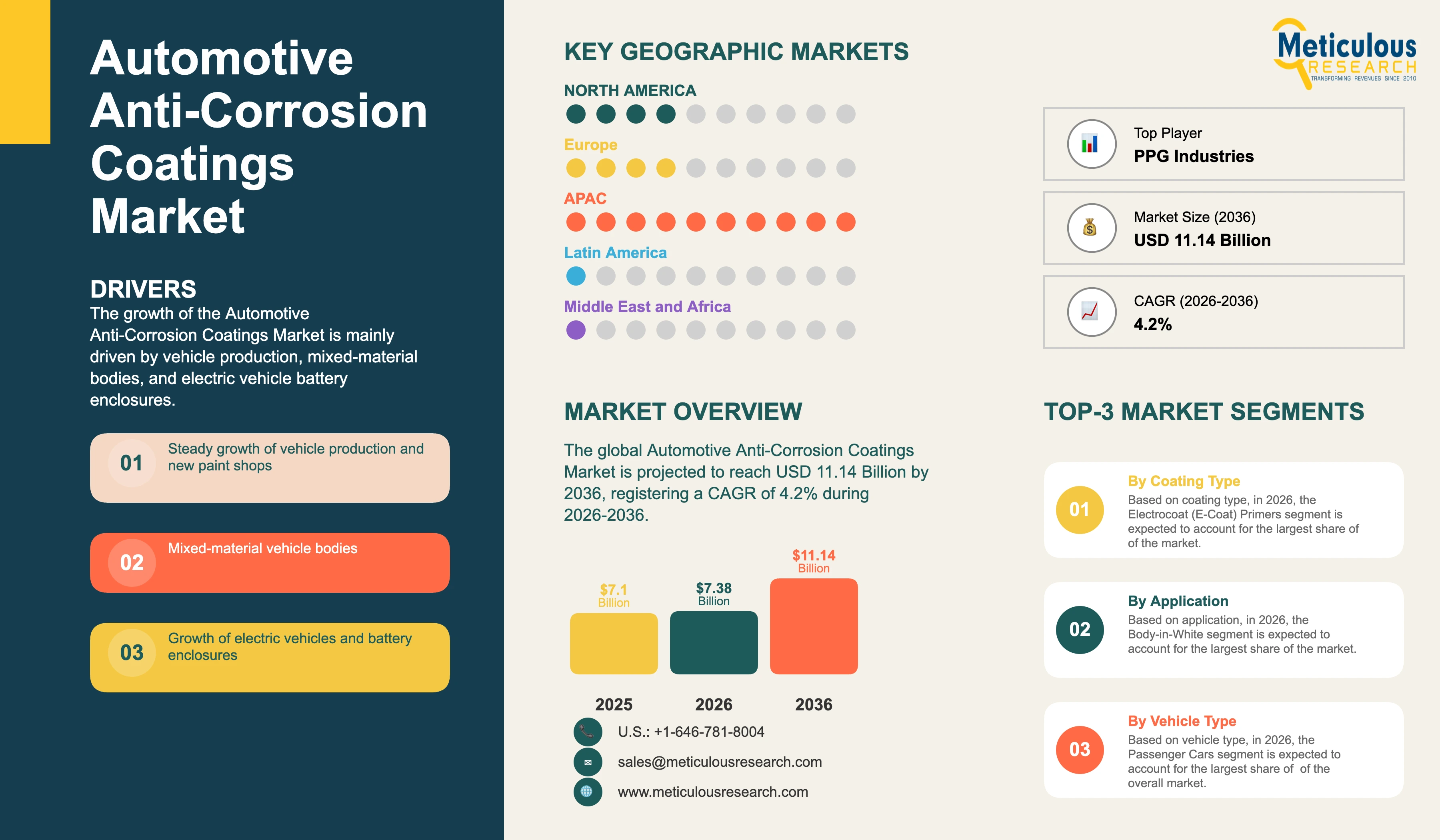
The global automotive anti-corrosion coatings market was valued at USD 7.10 billion in 2025. This market is expected to reach USD 11.14 billion by 2036 from an estimated USD 7.38 billion in 2026, registering a CAGR of 4.2% during the forecast period (2026-2036).
- Published
- Nov 2026
- Pages
- 265
- Format
- PDF + Excel
- Report ID
- MRCHM - 1042890
- Base year
- 2025
- 2025 · BASELINE
- $7.10B
- 2036
- $11.14B
- CAGR 2026–2036
- 4.2%
2025 baseline · 2026–2036 forecast at 4.2% CAGR · hover a bar for the value
Key highlights
BASF and Carlyle completed their coatings transaction on June 30, 2026, at an enterprise value of EUR 7.7 billion, according to BASF. BASF now holds a 40% stake in Surventis, formerly BASF Coatings, which comprises the automotive OEM coatings, automotive refinish coatings, and surface treatment businesses, including the e-coat and pretreatment technologies used on vehicle bodies worldwide.
AkzoNobel and Axalta received conditional approval from the European Commission on November 6, 2026, for their all-stock merger of equals, according to AkzoNobel and Axalta. The companies agreed to sell AkzoNobel's European vehicle refinish business as a remedy, and the transaction is expected to close in early 2027. The merger, announced in November 2025, will create a coatings company with an enterprise value of about USD 25 billion, combining Axalta's mobility coatings, including e-coat, with AkzoNobel's industrial and powder coatings.
PPG's Enviro-Prime EPIC low-temperature cure e-coat primer was named Innovative Coating of the Year at the 2026 Ringier Technology Innovation Awards in Shanghai, according to PPG. Low-cure e-coats reduce the oven energy needed in paint shops and allow mixed-material bodies with heat-sensitive parts to be coated in one process. PPG also offers its POWERCRON e-coat range for automotive and industrial uses.
PPG offers pretreatment and e-coat for corrosion protection of electric vehicle battery packs, along with dielectric, thermal management, and fire protection coatings, according to PPG. Surventis supplied thin-film pretreatment and e-coat for the full aluminum body of the NIO ES8, according to BASF, which shows how anti-corrosion coatings are adapting to aluminum-intensive electric vehicles.
Global electric car sales topped 20 million units in 2025, according to the IEA. Each electric vehicle carries a large battery enclosure and electric drive parts that need corrosion protection, often combined with electrical insulation, which adds coating value per vehicle compared with many conventional vehicles.
Leading suppliers include PPG Industries, Axalta, Surventis, Nippon Paint, Kansai Paint, KCC Corporation, Henkel, NOF Metal Coatings, and Dörken. Battery enclosures and EV components is the fastest-growing application, and powder and other coatings is the fastest-growing coating type, supported by coatings for battery housings and electric drive parts.
By coating type, electrocoat (e-coat) primers account for the largest share of 48.0% in 2026, while powder and other coatings register the highest CAGR.
By application, body-in-white accounts for the largest share in 2026, while battery enclosures and EV components register the highest CAGR.
By propulsion type, internal combustion engine vehicles account for the largest share in 2026, while battery electric vehicles register the highest CAGR.
By vehicle type, passenger cars account for the larger share of 78.0% in 2026, while commercial vehicles register the higher CAGR.
By geography, Asia-Pacific accounts for the largest share of 50.0% in 2026, while Asia-Pacific registers the highest CAGR of 5.1%.
Report summary
| Particulars | Details |
|---|---|
| Base Year | 2025 |
| Estimated Year | 2026 |
| Forecast Period | 2026-2036 |
| Market Size in 2025 | USD 7.10 billion |
| Market Size in 2026 | USD 7.38 billion |
| Market Size by 2036 | USD 11.14 billion |
| CAGR (2026-2036) | 4.2% |
| Format | PDF, Excel & Cloud Portal · 265 pages |
| Largest Segment by Coating Type (2026) | Electrocoat (E-Coat) Primers (48.0%) |
| Largest Segment by Vehicle Type (2026) | Passenger Cars (78.0%) |
| Largest Region (2026) | Asia-Pacific (50.0%) |
| Fastest-Growing Region | Asia-Pacific (CAGR 5.1%) |
| Companies Profiled | 9 companies and other companies |
| Segments Covered | Coating Type, Application, Propulsion Type, Vehicle Type, Geography |
| Countries Covered | U.S., Canada, Mexico, Germany, France, U.K., Spain, Italy, Sweden, Czech Republic, Poland, Slovakia, Hungary, Romania, Rest of Europe, China, Japan, South Korea, India, Thailand, Indonesia, Malaysia, Vietnam, Taiwan, Australia, Rest of Asia-Pacific, Brazil, Argentina, Chile, Colombia, Rest of Latin America, Turkey, Morocco, South Africa, Saudi Arabia, UAE, Israel, Rest of Middle East & Africa |
Report overview
Segments covered: coating type, application, propulsion type, vehicle type.
Automotive anti-corrosion coatings protect vehicle bodies, chassis parts, fasteners, and, increasingly, electric vehicle battery enclosures from rust and other forms of corrosion caused by water, road salt, stone chips, and humidity. They include pretreatment coatings that prepare bare metal surfaces, electrocoat (e-coat) primers that are applied to the whole car body by dipping it in a paint bath and passing an electric current, underbody coatings and cavity waxes that protect hidden and exposed areas, zinc flake coatings for bolts and small steel parts, and powder and other coatings used on chassis components and battery housings.
The growth of this market is mainly driven by steady growth of global vehicle production, especially in Asia-Pacific, the long corrosion warranties offered by vehicle makers, which require strong multi-layer protection, the growing use of mixed-material car bodies that combine steel, aluminum, and magnesium, which increases the risk of corrosion between different metals, the fast growth of electric vehicles, whose large battery enclosures and electric drive parts need corrosion protection and electrical insulation, and the growing use of high-strength steel fasteners that need zinc flake coatings instead of electroplating. In addition, low-temperature cure e-coats and thin-film pretreatments that save energy in paint shops support the replacement of older coating systems. However, strong price pressure from vehicle makers, volatile raw material prices, and stricter rules on chemicals used in coatings are expected to restrain the growth of this market to some extent.
Corrosion protection is one of the most important functions of the coating system on a vehicle. A modern car body passes through several protection steps before it is painted. First, the welded body is cleaned and treated with a pretreatment, traditionally zinc phosphate and increasingly thin-film zirconium or silane-based products, which improves paint adhesion and slows corrosion. The body is then dipped in an e-coat bath, where an electric current deposits an even primer layer on all surfaces, including inside closed sections that sprays cannot reach. After the e-coat is cured in an oven, sealers, underbody coatings, and cavity waxes are added to protect seams, wheel arches, and hollow sections from water and stone chips.
This report covers the global automotive anti-corrosion coatings market, including electrocoat primers, pretreatment coatings, underbody and cavity protection coatings, zinc flake coatings, and powder and other coatings used to protect body-in-white, chassis and underbody parts, fasteners and components, and battery enclosures and EV components, for internal combustion engine vehicles, battery electric vehicles, and hybrid vehicles, and for passenger cars and commercial vehicles. The market is valued at the selling price of these coatings supplied to vehicle makers and parts makers for original equipment use. The market is analyzed by coating type, application, propulsion type, vehicle type, and geography. Primers, basecoats, and clearcoats applied mainly for appearance, refinish coatings, and aftermarket rustproofing products are not included.
The level of corrosion protection on vehicles has improved greatly over the past decades. Many vehicle makers now offer body corrosion warranties of 10 to 12 years in Europe, and vehicles are expected to last longer as average vehicle age rises in most markets. These expectations are met through a combination of galvanized steel, careful body design that avoids water traps, and multi-layer coating systems. Coating suppliers test their products in long salt spray and cyclic corrosion tests, and vehicle makers set their own detailed standards for each coating layer, which makes qualification of new coatings a long process.
The materials used in vehicle bodies are also changing, which makes corrosion protection more complex. Vehicle makers increasingly use aluminum for closures and structures, large aluminum castings for front and rear body sections, and in some cases magnesium parts, alongside steel. When different metals touch in the presence of water, the less noble metal corrodes faster, which is known as galvanic corrosion. Pretreatments and e-coats must therefore work on several metals at once, and joining methods, sealants, and coatings must be designed together to separate the metals. This has pushed suppliers to develop thin-film pretreatments and e-coats that protect steel and aluminum equally well in one paint shop process.
The market is led by large automotive coating companies that supply complete paint shop systems to vehicle makers. PPG Industries, Axalta, Surventis, Nippon Paint, Kansai Paint, and KCC Corporation supply e-coat primers and often pretreatments, together with topcoats, and many of them operate on-site service teams in customer paint shops. Henkel supplies pretreatments, sealants, and underbody and cavity protection products, while NOF Metal Coatings and Dörken supply zinc flake coatings used on fasteners and small steel parts. The industry is consolidating: BASF sold a controlling stake in its coatings business to Carlyle, creating Surventis, and AkzoNobel and Axalta are merging, which will change the competitive structure of the market.
The growth of electric vehicles is creating several new uses for anti-corrosion coatings beyond the vehicle body. Battery enclosures, which are usually made of aluminum or steel and sit under the vehicle floor, must be protected against water, road salt, and stone chips for the life of the vehicle, as any corrosion that lets water into the battery is a serious safety risk. Many battery enclosures are e-coated or powder coated, and some also need coatings that insulate electrically or slow the spread of fire. Electric drive housings, busbars, and other high-voltage parts also need corrosion protection and, in some cases, electrical insulation, which adds new coating applications that did not exist in conventional vehicles.
In 2026, electrocoat primers account for the largest share of the market by coating type, while powder and other coatings are the fastest-growing coating type. Body-in-white accounts for the largest share by application, while battery enclosures and EV components is the fastest-growing application. Internal combustion engine vehicles account for the largest share by propulsion type, while battery electric vehicles are the fastest-growing propulsion type. Passenger cars account for the largest share by vehicle type, while commercial vehicles are the fastest-growing vehicle type. Asia-Pacific accounts for the largest share of the market and is also the fastest-growing region.
Market growth over the forecast period will depend on vehicle production, the share of electric vehicles, the materials used in vehicle bodies and battery enclosures, new paint shop construction in Asia-Pacific and other growing regions, the adoption of low-cure e-coats and thin-film pretreatments, and price trends for raw materials, such as epoxy resins, zinc, and solvents. Strong price pressure from vehicle makers will limit value growth in mature body coatings, while battery enclosures, fasteners, and new paint shops will add growth. Overall, the market is expected to grow steadily, slightly faster than vehicle production, through 2036.
Passenger cars are expected to account for the largest share of 78.0% of the market in 2026, while commercial vehicles are projected to register the higher CAGR, driven by e-coated chassis frames and longer life requirements.
Asia-Pacific is expected to account for the largest share of 50.0% of the market in 2026, mainly due to China's large vehicle production, leadership in electric vehicles, and many new paint shops in the region.
Asia-Pacific is also projected to register the highest CAGR of 5.1% during the forecast period, driven by electric vehicle production in China, new plants in India, and Southeast Asian production hubs.
The report profiles 9 companies, including PPG Industries, Axalta, Surventis, Nippon Paint, Kansai Paint, KCC Corporation, Henkel, NOF Metal Coatings, and Dörken.
E-coat is a primer applied by dipping the whole car body in a paint bath and passing an electric current, which deposits an even layer on all surfaces, including hidden cavities. It is the main corrosion protection layer on almost every vehicle body.
Electric vehicles have large battery enclosures under the floor and many high-voltage parts that must be protected against water, road salt, and stone chips for the life of the vehicle, often with coatings that also insulate electrically.
Report infographic
Market dynamics
17 factors across 5 forcesSteady growth of vehicle production and new paint shops
Every new vehicle body must be pretreated, e-coated, and sealed, so demand for anti-corrosion coatings is closely linked to vehicle production. Global vehicle production is expected to grow steadily over the forecast period, led by China, India, and Southeast Asia, while production in Europe and North America is expected to grow more slowly. New vehicle plants, especially those built by Chinese electric vehicle makers in Southeast Asia, Europe, Latin America, Turkey, and the Middle East, require new paint shops, which creates demand for the first fill of e-coat tanks and long-term supply contracts for coatings.
Coating suppliers usually win long-term contracts when a new paint shop is built, as switching e-coat suppliers in an existing paint shop is costly and risky. As a result, new plant construction is an important source of growth for suppliers with strong relationships with vehicle makers that are expanding abroad. Asia-Pacific is the largest and fastest-growing region in this market, supported by vehicle production growth and new plants in China, India, Indonesia, Thailand, and Vietnam, and by the growth of commercial vehicle production in the region.
Long corrosion warranties and longer vehicle lifetimes
Vehicle makers offer long corrosion warranties to show the quality of their vehicles, often 10 to 12 years against body perforation in Europe and similar terms in other markets, and consumers expect vehicles to stay free of rust for much longer than in the past. At the same time, vehicles are being kept longer, and average vehicle age is rising in most major markets. Meeting these expectations requires multi-layer protection with high-quality pretreatment, e-coat, sealers, underbody coatings, and cavity waxes that work together for the full life of the vehicle.
Commercial vehicles, such as trucks, buses, and vans, face even harsher conditions, as they drive longer distances, often in winter conditions with road salt, and must last for many years. Truck chassis frames, axles, and body parts are increasingly e-coated and powder coated to meet longer life requirements. These needs support steady demand for high-performance anti-corrosion coatings, and commercial vehicles are the fastest-growing vehicle type in this market, supported by stricter durability expectations from fleet operators.
Mixed-material vehicle bodies
Vehicle makers increasingly use aluminum, high-strength steel, and magnesium together in vehicle bodies to reduce weight and improve energy efficiency and electric driving range. Large aluminum castings, used for front and rear body structures in many new electric vehicles, are joined to steel and aluminum sheet parts. When different metals are joined, galvanic corrosion can occur at the joints, especially in the presence of road salt. Pretreatments and e-coats must therefore protect several metals at once, and sealants and coatings must separate metals at joints.
Thin-film pretreatments based on zirconium and silane chemistry, such as Surventis's Oxsilan, are replacing zinc phosphate in many paint shops because they work on steel and aluminum and produce less sludge and waste. Surventis supplied thin-film pretreatment and e-coat for the full aluminum body of the NIO ES8, according to BASF. The move to mixed-material bodies increases the technical requirements and value of pretreatments and e-coats and creates opportunities for suppliers with strong multi-metal technology.
Growth of electric vehicles and battery enclosures
Global electric car sales topped 20 million units in 2025, according to the IEA, and electric vehicles are expected to account for a growing share of new vehicle sales over the forecast period. Each electric vehicle has a large battery enclosure under the floor, which is exposed to water, road salt, and stone chips and must remain sealed for the life of the vehicle. Battery enclosures are usually made of aluminum or steel and are protected with e-coat, powder coatings, or other coatings, often combined with underbody protection against stone chips.
Electric vehicles also use coatings on electric drive housings, battery cooling plates, busbars, and other high-voltage parts that need corrosion protection and, in some cases, electrical insulation. PPG offers pretreatment and e-coat for corrosion protection of battery packs together with dielectric and fire protection coatings, according to PPG. Battery enclosures and EV components is the fastest-growing application in this market, and battery electric vehicles are the fastest-growing propulsion type, supported by these new coating needs.
Shift to zinc flake coatings for high-strength fasteners
Vehicles use thousands of bolts, nuts, clips, and small steel parts, many of which must resist corrosion for the life of the vehicle. High-strength steel fasteners, which are increasingly used to save weight, can suffer from hydrogen embrittlement when they are electroplated with zinc, which can cause sudden failure. Zinc flake coatings, which are applied as a thin layer of zinc and aluminum flakes in a binder and cured without electroplating, avoid this risk and provide strong corrosion protection with a thin layer. As a result, vehicle makers increasingly specify zinc flake coatings for high-strength fasteners, chassis parts, and brake components. Rules restricting hexavalent chromium, which was once widely used in fastener coatings, have also pushed the industry toward zinc flake systems. Suppliers such as NOF Metal Coatings, with its GEOMET coatings, and Dörken, with its DELTA-MKS systems, supply zinc flake coatings to fastener makers and parts makers worldwide through networks of licensed coating applicators. Zinc flake coatings are a fast-growing coating type in this market, supported by the wider use of high-strength steel, the growth of electric vehicles with many new fastening points in battery packs and electric drives, and the long corrosion warranties offered by vehicle makers.
Table of contents
12 chapters · 183 sections · 265 pages · click to expandSegmental analysis
| Segment | Largest share (2026) | Fastest growth (2026–2036) |
|---|---|---|
| By Coating Type | Electrocoat (e-coat) primers | Powder and other coatings |
| By Application | Body-in-white | Battery enclosures and EV components |
| By Propulsion Type | Internal combustion engine vehicles | Battery electric vehicles |
| By Vehicle Type | Passenger cars | Rapid growth of this |
| Other segments | Body-in-white | Battery enclosures and EV components |
By Coating Type
- Automotive Anti-Corrosion Coatings Market Analysis by Coating Type
- The electrocoat (e-coat) primers segment is expected to account for the largest share of 48.0% of the global automotive anti-corrosion coatings market.
- The large share of this segment is mainly due to the use of e-coat on almost every passenger car and light commercial vehicle body produced worldwide, its ability to coat all surfaces evenly, including hidden cavities and closed sections that sprays cannot reach, its high material efficiency and automated application, the growing use of e-coat on chassis frames, battery enclosures, and components, and the long-term supply contracts that come with each paint shop.
- PPG Industries, Axalta, Surventis, Nippon Paint, and Kansai Paint are among the leading suppliers of automotive e-coat primers.
- However, the powder and other coatings segment is projected to register the highest CAGR during the forecast period.
- The rapid growth of this segment is driven by the use of powder coatings on electric vehicle battery enclosures, electric drive housings, and chassis components, the absence of solvents in powder coatings, which helps vehicle makers and parts makers meet emission rules, the use of dielectric and fire-resistant coatings on battery parts, and the growth of electric buses and trucks.
- Zinc flake coatings are also growing quickly, supported by the wider use of high-strength steel fasteners.
By Application
- Automotive Anti-Corrosion Coatings Market Analysis by Application
- The body-in-white segment is expected to account for the largest share of the global automotive anti-corrosion coatings market.
- The large share of this segment is mainly due to the large surface area of vehicle bodies, the use of several protection layers on every body, including pretreatment, e-coat, and sealers, long body corrosion warranties offered by vehicle makers, the growing use of mixed-material bodies that need more advanced pretreatments and e-coats, and the construction of new paint shops in Asia-Pacific and other growing regions.
- PPG Industries, Axalta, Surventis, and Nippon Paint are among the leading suppliers of body-in-white anti-corrosion coatings.
- However, the battery enclosures and EV components segment is projected to register the highest CAGR during the forecast period.
- The rapid growth of this segment is driven by the fast growth of electric vehicle production, which topped 20 million units in 2025 according to the IEA, the need to protect battery enclosures against water, road salt, and stone chips for the full life of the vehicle, the growing use of coating systems that combine corrosion protection with electrical insulation and fire protection, and the coating of electric drive housings, cooling plates, and high-voltage parts.
- Fasteners and components are also growing, supported by zinc flake coatings.
By Propulsion Type
- Automotive Anti-Corrosion Coatings Market Analysis by Propulsion Type
- The internal combustion engine vehicles segment is expected to account for the largest share of the global automotive anti-corrosion coatings market.
- The large share of this segment is mainly due to the large share of internal combustion engine vehicles in global vehicle production, the use of pretreatment, e-coat, underbody coatings, and cavity waxes on every vehicle body, the use of corrosion-resistant coatings on exhaust systems, fuel tanks, and engine and transmission parts, and the large production volumes of these vehicles in North America, India, Latin America, and the Middle East and Africa.
- PPG Industries, Axalta, and Henkel supply anti-corrosion coatings across many of these vehicle platforms.
- However, the battery electric vehicles segment is projected to register the highest CAGR during the forecast period.
- The rapid growth of this segment is driven by the fast growth of electric vehicle sales, the large battery enclosures and electric drive parts in each electric vehicle that need corrosion protection, the greater use of aluminum bodies and large castings in electric vehicles, which require multi-metal pretreatments and e-coats, and the growing use of coatings that combine corrosion protection with insulation.
- Hybrid vehicles are also growing as vehicle makers expand their hybrid ranges.
By Vehicle Type
- Automotive Anti-Corrosion Coatings Market Analysis by Vehicle Type
- The passenger cars segment is expected to account for the largest share of 78.0% of the global automotive anti-corrosion coatings market.
- The large share of this segment is mainly due to the very large number of passenger cars produced each year, the use of complete pretreatment, e-coat, sealer, and underbody coating systems on every passenger car body, long corrosion warranties offered on passenger cars, and the fast growth of electric passenger cars with battery enclosures that need protection.
- PPG Industries, Axalta, Surventis, and Nippon Paint supply coatings across many passenger car platforms.
- However, the commercial vehicles segment is projected to register the higher CAGR during the forecast period.
- The rapid growth of this segment is driven by the growing use of e-coat and powder coatings on truck chassis frames, axles, and body parts to meet longer life requirements, fleet operators' focus on reducing maintenance costs in harsh conditions with road salt, the growth of electric buses and trucks with large battery housings, and growing truck and bus production in Asia-Pacific and other emerging regions.
Other segments
- The body-in-white segment is expected to account for the largest share of the automotive anti-corrosion coatings market, while the battery enclosures and EV components segment is projected to register the highest CAGR during the forecast period.
- The internal combustion engine vehicles segment is expected to account for the largest share of the automotive anti-corrosion coatings market, while the battery electric vehicles segment is projected to register the highest CAGR during the forecast period.
Geographic analysis
Asia-Pacific
Largest shareIn 2026, Asia-Pacific is expected to account for the largest share of 50.0% of the global automotive anti-corrosion coatings market. The large share of this region is mainly due to China's position as the largest vehicle producer in the world, China's leadership in electric vehicle production, which adds battery enclosure coatings, the large vehicle production of Japan, South Korea, India, and Thailand, the construction of many new paint shops by Chinese and other vehicle makers, and the presence of leading coating suppliers, such as Nippon Paint, Kansai Paint, and KCC Corporation, along with large plants of PPG Industries, Axalta, and Surventis. China is the largest market in the region, followed by Japan, India, and South Korea. Asia-Pacific is also projected to register the highest CAGR of 5.1% during the forecast period. The rapid growth of this region is mainly driven by continued growth of electric vehicle production in China, rising vehicle production and new plants in India, the growth of Southeast Asian countries, such as Indonesia, Thailand, and Vietnam, as production hubs, including for Chinese electric vehicle makers, and the growth of commercial vehicle production in the region. India is expected to be one of the fastest-growing countries, supported by new plants built by domestic and foreign vehicle makers and by rising quality and durability expectations from consumers.
Europe
Europe accounts for a significant share of the market, supported by long corrosion warranties offered by European vehicle makers, the use of road salt in winter in many countries, the early adoption of thin-film pretreatments and low-cure e-coats, the growing use of aluminum and mixed-material bodies in premium and electric vehicles, and strict environmental rules that push suppliers to develop cleaner coatings. Germany is the largest market in the region, followed by France, Spain, and the Czech Republic. Eastern European countries, such as Hungary, Poland, Slovakia, and Romania, are attracting new vehicle and battery plants, including plants built by Chinese vehicle makers, which adds demand for new paint shops and battery enclosure coatings. Turkey and Morocco are important export bases for vehicles supplied to Europe, and their paint shops follow European corrosion standards.
North America
North America accounts for a significant share of the market, supported by the large production of pickup trucks and SUVs with large bodies and steel frames, the heavy use of road salt in winter in the northern U.S. and Canada, which requires strong underbody and chassis protection, the large heavy truck market, and the presence of leading suppliers, such as PPG Industries and Axalta. The U.S. is the largest market in the region, followed by Mexico and Canada. Mexico is also an important production base for vehicles and parts exported to the U.S. market.
Latin America
Latin America and the Middle East and Africa account for smaller shares but are growing as new vehicle plants are built in Brazil, Turkey, Morocco, and Saudi Arabia, with Brazil the largest market in Latin America.
Competitive landscape
The global automotive anti-corrosion coatings market includes large automotive coating companies that supply complete paint shop systems, including pretreatment, e-coat, and topcoats, specialty chemical companies that supply pretreatments, sealants, underbody coatings, and cavity waxes, and specialized suppliers of zinc flake coatings for fasteners and components. The market is concentrated in body coatings, where a small number of global suppliers hold most e-coat contracts with vehicle makers, while the component coatings segment includes many regional suppliers and licensed coating applicators.
PPG Industries, which reported net sales of USD 15.9 billion in 2025 according to PPG, is a leading supplier of automotive e-coat and pretreatment, with its POWERCRON and Enviro-Prime e-coat ranges. Axalta supplies e-coat and other mobility coatings and is merging with AkzoNobel. Surventis, formerly BASF Coatings, supplies CathoGuard e-coats and Oxsilan thin-film pretreatments. Nippon Paint, Kansai Paint, and KCC Corporation are leading suppliers in Asia-Pacific, Henkel supplies Bonderite pretreatments and Teroson sealing and underbody protection products, NOF Metal Coatings supplies GEOMET zinc flake coatings, and Dörken supplies DELTA-MKS zinc flake systems.
Companies in this market compete mainly on corrosion performance, compatibility with mixed metals, energy efficiency in the paint shop, environmental compliance, price, technical service, global supply capability, and long-term relationships with vehicle makers. Key strategies in this market include launching low-cure e-coats and thin-film pretreatments, developing complete coating systems for battery packs, expanding production and service capabilities in Asia-Pacific and other growing regions, following vehicle makers to new plants abroad, and consolidating through mergers and acquisitions to gain scale.
Recent competitive activity in this market has mainly focused on consolidation and new technologies. BASF and Carlyle completed their coatings transaction on June 30, 2026, creating Surventis, according to BASF. AkzoNobel and Axalta received conditional European Commission approval for their merger in November 2026, according to the companies, with closing expected in early 2027. PPG's Enviro-Prime EPIC low-cure e-coat received the Innovative Coating of the Year award at the 2026 Ringier Technology Innovation Awards, according to PPG, and PPG showcased its battery pack coating systems at The Battery Show Europe 2026.
We expect competition to increase over the forecast period as consolidated coating companies use their scale to win global contracts, as Chinese and Korean suppliers grow with domestic vehicle makers at home and abroad, and as battery enclosures attract new competitors from the powder and specialty coatings industries. Suppliers with strong multi-metal pretreatment and e-coat technology, battery coating systems, energy-saving products, and global service networks are expected to strengthen their positions.
Some of the key players operating in the automotive anti-corrosion coatings market are PPG Industries, Inc., Axalta Coating Systems Ltd., Surventis (formerly BASF Coatings), Nippon Paint Holdings Co., Ltd., Kansai Paint Co., Ltd., KCC Corporation, Henkel AG & Co. KGaA, NOF Metal Coatings Group, and Ewald Dörken AG, among others.
- —
BASF and Carlyle completed their coatings transaction in June 2026, creating Surventis, AkzoNobel and Axalta received conditional EU approval for their merger in November 2026, and PPG's low-cure e-coat won a 2026 innovation award.
- PPG Industries, Inc.
- Axalta Coating Systems Ltd.
- Surventis (formerly BASF Coatings)
- Nippon Paint Holdings Co., Ltd.
- Kansai Paint Co., Ltd.
- KCC Corporation
- Henkel AG & Co. KGaA
- NOF Metal Coatings Group
- Ewald Dörken AG
Expert perspectives
Automotive anti-corrosion coatings are a mature but essential market that protects the long-term value of every vehicle. While e-coat and pretreatment for vehicle bodies remain the core of the market, the move to mixed-material bodies, electric vehicles, and energy-saving paint shops is changing the technology and creating new applications, especially for battery enclosures and electric drive parts.
Over the forecast period, the market is expected to grow at a CAGR of 4.2%, from USD 7.38 billion in 2026 to USD 11.14 billion in 2036. Growth will be driven by steady vehicle production growth and new paint shops, long corrosion warranties and longer vehicle lifetimes, mixed-material vehicle bodies, the growth of electric vehicles and battery enclosures, and the shift to zinc flake coatings for high-strength fasteners. Price pressure from vehicle makers and volatile raw material and energy costs will limit growth to some extent.
Among the market segments, electrocoat primers are the largest coating type, while powder and other coatings grow fastest. Body-in-white is the largest application, while battery enclosures and EV components grows fastest. Internal combustion engine vehicles are the largest propulsion type, while battery electric vehicles grow fastest. Passenger cars are the largest vehicle type, while commercial vehicles grow fastest. Asia-Pacific is the largest region and is also the fastest-growing region, led by China and India.
In our view, battery enclosures will be the most important new battleground for anti-corrosion coating suppliers. Battery enclosures need corrosion protection, stone chip resistance, sealing, electrical insulation, and in some cases fire protection, and vehicle makers want suppliers that can deliver all of these as one system. Suppliers that work with vehicle and battery makers from the design stage and offer complete coating systems will gain the most value from electrification.
We also see consolidation among the largest coating suppliers reshaping the competitive structure of this market. The creation of Surventis and the merger of AkzoNobel and Axalta will change the balance among the leading suppliers and may give vehicle makers fewer choices for global contracts. At the same time, Chinese and Korean suppliers are growing quickly with domestic vehicle makers, which may increase competition in Asia-Pacific and in new production hubs abroad, where they often follow Chinese vehicle makers into new plants.
Overall, we believe that the automotive anti-corrosion coatings market will grow steadily over the forecast period, with powder and other coatings, battery enclosures and EV components, battery electric vehicles, commercial vehicles, and Asia-Pacific providing the fastest growth. Companies with strong multi-metal technology, energy-saving products, complete battery coating systems, and global service networks will be best positioned to capture this growth.
Customer perspectives
This comment explains why battery enclosures and EV components is the fastest-growing application and why Asia-Pacific is the fastest-growing region, led by electric vehicle makers in China.
This comment explains the shift to thin-film pretreatments and low-cure e-coats, while electrocoat primers account for 48.0% of the market, supported by their use on almost every vehicle body.
This comment explains why commercial vehicles are the fastest-growing vehicle type, while passenger cars account for 78.0% of the market, supported by their much larger production volumes.
“Our battery enclosures have to stay sealed and rust-free for the life of the car. We now coat them with the same care as the body, using e-coat and extra underbody protection.”
“With aluminum castings, steel sheet, and magnesium in one body, the pretreatment and e-coat must protect every metal at once. Low-cure e-coat also helps us cut oven energy use.”
“Road salt used to eat through our truck chassis within a few winters on northern routes. Trucks with e-coated frames and better underbody protection now last much longer and cost far less to maintain.”
Frequently asked questions
The global automotive anti-corrosion coatings market was valued at USD 7.10 billion in 2025, up from USD 6.85 billion in 2024, and is estimated at USD 7.38 billion in 2026. The market includes e-coat primers, pretreatments, underbody and cavity protection coatings, zinc flake coatings, and powder and other coatings.
The global automotive anti-corrosion coatings market is expected to reach USD 11.14 billion by 2036, driven by vehicle production and new paint shops, long corrosion warranties, mixed-material bodies, and electric vehicle battery enclosures.
The market is expected to register a CAGR of 4.2% from 2026 to 2036, with the fastest growth in powder and other coatings, battery enclosures and EV components, battery electric vehicles, commercial vehicles, and Asia-Pacific.
Market growth is mainly driven by steady vehicle production growth and new paint shops, long corrosion warranties and longer vehicle lifetimes, mixed-material vehicle bodies, the growth of electric vehicles and battery enclosures, and the shift to zinc flake coatings for high-strength fasteners.
Strong price pressure from vehicle makers and volatile raw material and energy costs restrain growth, while stricter rules on chemicals used in coatings and protecting mixed materials and new body designs are key challenges.
Key growth opportunities include coatings for electric vehicle battery enclosures and components, low-cure e-coats and energy-saving paint shop technologies, new paint shops in emerging production hubs, and higher protection for commercial vehicles and components.
Electrocoat (e-coat) primers are expected to account for the largest share of 48.0% of the market in 2026, while powder and other coatings are projected to register the highest CAGR, driven by battery enclosures and electric drive parts.
In 2026, the body-in-white segment is expected to account for the largest share of the automotive anti-corrosion coatings market, while the battery enclosures and EV components segment is projected to register the highest CAGR during the forecast period.
In 2026, the internal combustion engine vehicles segment is expected to account for the largest share of the automotive anti-corrosion coatings market, while the battery electric vehicles segment is projected to register the highest CAGR during the forecast period.
Passenger cars are expected to account for the largest share of 78.0% of the market in 2026, while commercial vehicles are projected to register the higher CAGR, driven by e-coated chassis frames and longer life requirements.
Asia-Pacific is expected to account for the largest share of 50.0% of the market in 2026, mainly due to China's large vehicle production, leadership in electric vehicles, and many new paint shops in the region.
Asia-Pacific is also projected to register the highest CAGR of 5.1% during the forecast period, driven by electric vehicle production in China, new plants in India, and Southeast Asian production hubs.
The report profiles 9 companies, including PPG Industries, Axalta, Surventis, Nippon Paint, Kansai Paint, KCC Corporation, Henkel, NOF Metal Coatings, and Dörken.
BASF and Carlyle completed their coatings transaction in June 2026, creating Surventis, AkzoNobel and Axalta received conditional EU approval for their merger in November 2026, and PPG's low-cure e-coat won a 2026 innovation award.
E-coat is a primer applied by dipping the whole car body in a paint bath and passing an electric current, which deposits an even layer on all surfaces, including hidden cavities. It is the main corrosion protection layer on almost every vehicle body.
Electric vehicles have large battery enclosures under the floor and many high-voltage parts that must be protected against water, road salt, and stone chips for the life of the vehicle, often with coatings that also insulate electrically.
Cite this report
Meticulous Research. (2026). Automotive Anti-Corrosion Coatings Market - Global Opportunity Analysis and Industry Forecast (2026-2036) (Report No. MRCHM - 1042890). Meticulous Market Research Pvt. Ltd. https://www.meticulousresearch.com/product/automotive-anti-corrosion-coatings-market-7573