Automotive Natural Fiber Composites Market (2026-2036)
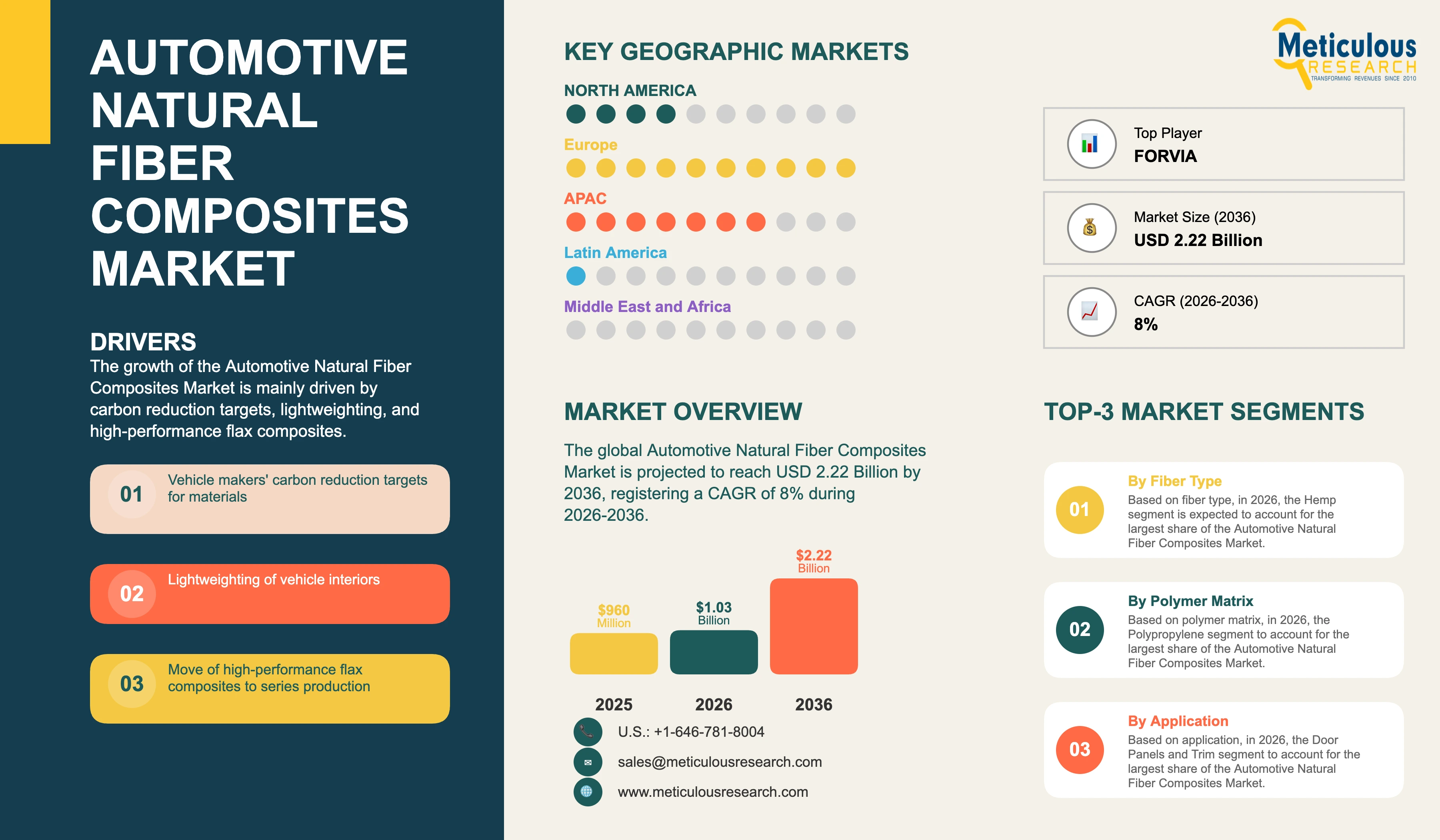
The global automotive natural fiber composites market was valued at USD 960.0 million in 2025. This market is expected to reach USD 2.22 billion by 2036 from an estimated USD 1.03 billion in 2026, registering a CAGR of 8.0% during the forecast period (2026-2036).
- Published
- Nov 2026
- Pages
- 267
- Format
- PDF + Excel
- Report ID
- MRCHM - 1042892
- Base year
- 2025
- 2025 · BASELINE
- $960.0M
- 2036
- $2.22B
- CAGR 2026–2036
- 8.0%
2025 baseline · 2026–2036 forecast at 8.0% CAGR · hover a bar for the value
Key highlights
The BMW Group announced in June 2025 that natural fiber composites are ready for series production of future models, following their use in BMW M Motorsport racing cars, according to the BMW Group. Bcomp and the BMW Group won first prize at the JEC Composites Innovation Awards 2026 for bringing natural fiber composites into BMW series production, including visible exterior parts, such as roofs made with Bcomp's ampliTex flax fabric in place of carbon fiber composites, according to Bcomp.
The Polestar 5 uses Bcomp's ampliTex and powerRibs technologies in its front seatbacks and tailgate structure, combining them with natural fiber polypropylene, according to Polestar and Bcomp. The tailgate application extends natural fiber composites beyond the interior into a structural exterior part.
Bcomp's ampliTex flax composite is used in the doors of the Volvo EX30, and Bcomp announced a collaboration with Kia in April 2025 to bring flax-based composite materials to entry-level vehicles, according to Bcomp. Bcomp raised USD 40 million in a Series C funding round to scale automotive production, according to the company.
FORVIA's NAFILean biocomposite combines 20% hemp fibers with polypropylene to create a fully recyclable material that reduces the weight and carbon footprint of car interiors, according to FORVIA. Its NAFILean-R version, which uses recycled polypropylene, reduces cradle-to-gate CO2 emissions by up to 90% compared with traditional materials, according to FORVIA.
Toyota Boshoku has used kenaf, a fast-growing plant from the hibiscus family, in door trims and other interior parts for many years, including in Lexus and Toyota models, and developed a kenaf-reinforced polyurethane foam door trim with Covestro that is 30% lighter than conventional materials, according to Covestro.
Leading suppliers include FORVIA, Toyota Boshoku, Bcomp, Yanfeng, Grupo Antolin, Polyvlies Franz Beyer, FlexForm Technologies, and Ecotechnilin. Flax is the fastest-growing fiber type, and exterior and semi-structural parts is the fastest-growing application, as high-performance flax composites move from motorsport into series production. Polyvlies Franz Beyer and Ecotechnilin produce natural fiber nonwoven mats in Europe for interior parts makers.
By fiber type, hemp accounts for the largest share of 26.0% in 2026, while flax registers the highest CAGR.
By polymer matrix, polypropylene accounts for the largest share in 2026, while bio-based and other polymers register the highest CAGR.
By application, door panels and trim accounts for the largest share in 2026, while exterior and semi-structural parts register the highest CAGR.
By vehicle type, passenger cars account for the larger share of 92.0% in 2026 and also register the higher CAGR.
By geography, Europe accounts for the largest share of 46.0% in 2026, while Asia-Pacific registers the highest CAGR of 10.3%.
Report summary
| Particulars | Details |
|---|---|
| Forecast Period | 2026-2036 |
| Base Year | 2025 |
| Estimated Year | 2026 |
| CAGR (Value) | 8.0% |
| Format | PDF, Excel & Cloud Portal · 267 pages |
| Market Size (Value) in 2025 | USD 960.0 million |
| Market Size (Value) in 2026 | USD 1.03 billion |
| Market Size (Value) in 2036 | USD 2.22 billion |
| Largest Segment by Fiber Type (2026) | Hemp (26.0%) |
| Largest Segment by Vehicle Type (2026) | Passenger Cars (92.0%) |
| Largest Region (2026) | Europe (46.0%) |
| Fastest-Growing Region | Asia-Pacific (CAGR 10.3%) |
| Segments Covered | Fiber Type, Polymer Matrix, Application, Vehicle Type, Geography |
| Countries Covered | U.S., Canada, Mexico, Germany, France, U.K., Spain, Italy, Sweden, Czech Republic, Poland, Slovakia, Hungary, Belgium, Netherlands, Rest of Europe, China, Japan, South Korea, India, Thailand, Indonesia, Malaysia, Vietnam, Taiwan, Australia, Rest of Asia-Pacific, Brazil, Argentina, Chile, Colombia, Rest of Latin America, Turkey, Morocco, South Africa, Saudi Arabia, UAE, Israel, Rest of Middle East & Africa |
| Key Companies | 8 companies and other companies |
Report overview
Segments covered: fiber type, polymer matrix, application, vehicle type.
Automotive natural fiber composites are materials made by combining plant fibers, such as hemp, flax, kenaf, jute, and wood fibers, with plastics, such as polypropylene, polyurethane, and bio-based polymers. They are used mainly in vehicle interiors for door panel carriers, package trays, trunk liners, seat backs, and instrument panel parts, and increasingly in visible interior surfaces and exterior and semi-structural parts, such as roofs, spoilers, and tailgate structures, where high-performance woven flax composites can replace carbon fiber and glass fiber composites.
The growth of this market is mainly driven by vehicle makers' targets to reduce the carbon footprint of materials, the lower weight of natural fiber composites compared with glass-fiber-reinforced and talc-filled plastics, the growing use of visible natural fiber surfaces as a design feature in electric vehicles, the move of high-performance flax composites from motorsport into series production vehicles, and the EU's push for circular and renewable materials in vehicles. In addition, the combination of natural fibers with recycled polypropylene helps vehicle makers meet recycled content and renewable material targets at the same time. However, variable fiber quality, odor and moisture sensitivity, limited supply chains outside Europe, and higher costs for high-performance flax composites are expected to restrain the growth of this market to some extent.
Natural fibers have been used in vehicles for decades, from coconut fibers in seat cushions to wood fibers in interior panels. Modern automotive natural fiber composites became common in the 1990s and 2000s, when European vehicle makers began to use mats of hemp, flax, kenaf, and jute fibers mixed with polypropylene fibers, which are heated and pressed into door panel carriers, package trays, and other interior parts. These materials are lighter than glass-fiber-reinforced and wood-flour-filled plastics, use renewable raw materials, and break without sharp splinters in a crash, which makes them well suited to interior parts.
This report covers the global automotive natural fiber composites market, including composites reinforced with hemp, flax, kenaf, jute, and wood and other natural fibers, with polypropylene, polyurethane and thermoset resins, and bio-based and other polymer matrices, used in door panels and trim, package trays and trunk liners, seat backs, instrument panels and consoles, exterior and semi-structural parts, and other applications, in passenger cars and commercial vehicles. The market is valued at the selling price of natural fiber composite materials, such as nonwoven mats, compounds, woven fabrics, and prepregs, supplied to parts makers and vehicle makers. The market is analyzed by fiber type, polymer matrix, application, vehicle type, and geography. Finished interior parts, natural leather, and natural fiber textiles used only for decoration are not included.
Natural fiber composites used in vehicles fall into two main types, which differ in performance, price, and the parts they are used in. The first and largest type is nonwoven natural fiber mats and natural fiber polypropylene compounds, which are used in hidden or covered interior parts, such as door panel carriers, package trays, and trunk liners. These materials are produced in large volumes and compete mainly on cost and weight with glass-fiber-reinforced and talc-filled polypropylene. FORVIA's NAFILean, which combines hemp fibers with polypropylene for injection molding, is an example of a natural fiber compound used in high-volume interior parts.
The second and fastest-growing type is high-performance woven and grid-reinforced flax composites, such as Bcomp's ampliTex fabrics and powerRibs reinforcement grids, which are used in visible interior surfaces and in exterior and semi-structural parts. These materials developed in motorsport, where BMW M Motorsport, McLaren, Porsche, and others used them to replace carbon fiber composites in body parts and seats. They are now entering series production, with visible flax composite parts in BMW M models, seatbacks and tailgate structures in the Polestar 5, and door panels in the Volvo EX30, according to the companies.
Europe has long been the center of the automotive natural fiber composites industry, from fiber growing to parts production. Flax and hemp are grown mainly in France, Belgium, the Netherlands, and other European countries, and European vehicle makers, especially German vehicle makers, have long used natural fiber composites in interiors. FORVIA, Grupo Antolin, Polyvlies Franz Beyer, Ecotechnilin, and Bcomp are based in Europe. In Asia-Pacific, Toyota Boshoku has long used kenaf from Southeast Asia, and jute is widely available in India and Bangladesh, while in North America, FlexForm Technologies supplies natural fiber mats to vehicle parts makers.
Sustainability is the main reason for the renewed interest in natural fiber composites. As electric vehicles reduce emissions during driving, the carbon footprint of materials becomes a larger share of each vehicle's total emissions, and vehicle makers are looking for lower-carbon alternatives to glass fiber, carbon fiber, and virgin plastics. Natural fibers absorb carbon dioxide as they grow and need less energy to produce than glass or carbon fibers. FORVIA states that its NAFILean-R material, which uses recycled polypropylene, reduces cradle-to-gate CO2 emissions by up to 90% compared with traditional materials, according to FORVIA.
In 2026, hemp accounts for the largest share of the market by fiber type, while flax is the fastest-growing fiber type. Polypropylene accounts for the largest share by polymer matrix, while bio-based and other polymers are the fastest-growing polymer matrix. Door panels and trim account for the largest share by application, while exterior and semi-structural parts is the fastest-growing application. Passenger cars account for the largest share by vehicle type and are also the fastest-growing vehicle type. Europe accounts for the largest share of the market, while Asia-Pacific is the fastest-growing region.
Market growth over the forecast period will depend on vehicle makers' carbon reduction targets, the adoption of visible and exterior natural fiber composites in series production, the development of supply chains for flax and hemp outside Europe, the cost of natural fiber composites compared with glass fiber and recycled plastics, and the performance of natural fiber composites in demanding applications. Price pressure in high-volume interior parts will limit value growth in that segment, while high-performance flax composites will add more value per vehicle. Overall, the market is expected to grow faster than vehicle production through 2036.
Passenger cars are expected to account for the largest share of 92.0% of the market in 2026 and are also projected to register the higher CAGR, driven by visible and exterior natural fiber composites in electric and premium cars.
Europe is expected to account for the largest share of 46.0% of the market in 2026, mainly due to the long use of natural fiber composites by European vehicle makers and the availability of European flax and hemp.
Asia-Pacific is projected to register the highest CAGR of 10.3% during the forecast period, driven by large vehicle production, local kenaf and jute fibers, and growing interest in sustainable materials.
The report profiles 8 companies, including FORVIA, Toyota Boshoku, Bcomp, Yanfeng, Grupo Antolin, Polyvlies Franz Beyer, FlexForm Technologies, and Ecotechnilin.
Natural fiber composites are lighter than glass-fiber-reinforced plastics, have a lower carbon footprint, use renewable raw materials, and break without sharp splinters, and visible flax surfaces help vehicle makers show their sustainability efforts.
High-performance flax composites can replace carbon fiber in some exterior and semi-structural parts, such as roofs and tailgate structures, with a lower carbon footprint and cost, as shown in BMW M models and the Polestar 5.
Report infographic
Market dynamics
17 factors across 5 forcesVehicle makers' carbon reduction targets for materials
Most large vehicle makers have set targets to reduce carbon emissions across their supply chains, including emissions from producing materials. As electric vehicles reduce emissions during driving, the share of a vehicle's total carbon footprint that comes from materials grows, and interior and body materials become an important focus for reduction. Natural fiber composites typically have a lower carbon footprint than glass-fiber-reinforced and carbon-fiber-reinforced plastics, because plant fibers absorb carbon dioxide as they grow and need much less energy to produce than glass or carbon fibers.
FORVIA's NAFILean-R, which combines hemp fibers with recycled polypropylene, reduces cradle-to-gate CO2 emissions by up to 90% compared with traditional materials, according to FORVIA. The BMW Group highlighted reduced CO2 emissions in production as a key benefit of using natural fiber composites in series production models, according to the BMW Group. As vehicle makers set stricter material carbon targets, demand for natural fiber composites is expected to grow in both hidden and visible parts.
Lightweighting of vehicle interiors
Natural fibers have a low density, about half that of glass fiber, which allows natural fiber composites to be lighter than glass-fiber-reinforced and talc-filled plastics with similar stiffness. Lighter interior parts help vehicle makers reduce vehicle weight, which improves fuel efficiency in conventional vehicles and driving range in electric vehicles. Toyota Boshoku and Covestro developed a kenaf-reinforced polyurethane foam door trim that is 30% lighter than conventional material, according to Covestro, and natural fiber polypropylene compounds are lighter than many talc-filled grades.
Natural fiber composites also break without sharp splinters in a crash, which is an advantage for interior parts near occupants. These properties have made natural fiber composites a standard material for door panel carriers, package trays, and trunk liners in many European vehicles. As vehicle makers continue to reduce weight, especially in electric vehicles with heavy batteries, demand for lightweight natural fiber composites in interiors is expected to grow steadily.
Visible natural fiber surfaces as a design feature
Vehicle makers, especially makers of electric and premium vehicles, increasingly use visible natural fiber surfaces as a design feature to show their commitment to sustainability. Woven flax fabrics, such as Bcomp's ampliTex, can be left visible on door panels, dashboards, seatbacks, and exterior parts, with weave patterns and colors chosen to match the brand's design. Bcomp created a bespoke color and weave pattern for the BMW Group to create a distinctive natural fiber identity, according to Bcomp.
Visible natural fiber surfaces have appeared in vehicles such as the Volvo EX30, the Polestar 5, and concept vehicles from Kia and Cupra, according to Bcomp and the vehicle makers. These applications use higher-value woven flax composites, which increases the value of natural fiber composites per vehicle. Flax is the fastest-growing fiber type in this market, supported by the growth of visible and high-performance applications.
Move of high-performance flax composites from motorsport to series production
High-performance flax composites were developed and tested in motorsport, where teams used them to replace carbon fiber composites in body panels, seats, and other parts. BMW M Motorsport first introduced Bcomp's renewable reinforcements in 2019 through its Formula E program, according to Bcomp, and McLaren used Bcomp's materials in a Formula One seat in 2021. This motorsport experience showed that flax composites can deliver good stiffness, impact behavior, and vibration damping with a much lower carbon footprint than carbon fiber.
The BMW Group announced in June 2025 that natural fiber composites are ready for series production, including exterior parts, such as roofs that replace carbon fiber composites, according to the BMW Group and Bcomp. Bcomp and the BMW Group won first prize at the JEC Composites Innovation Awards 2026 for this work, according to Bcomp. The move into series production opens a much larger market for high-performance flax composites, and exterior and semi-structural parts is the fastest-growing application in this market.
Circular and renewable material policies
The EU is pushing vehicle makers to use more circular and renewable materials. The EU's End-of-Life Vehicles Regulation, which entered into force in August 2026, sets mandatory targets for recycled plastic content in new vehicles and includes design requirements to improve recyclability, while EU bioeconomy and circular economy policies encourage the use of renewable raw materials. Natural fiber composites based on polypropylene can be recycled with other polypropylene parts, and combining natural fibers with recycled polypropylene, as in FORVIA's NAFILean-R, helps vehicle makers increase both recycled and renewable content in the same part. Vehicle makers also face growing pressure from investors and customers to report and reduce the environmental impact of their products, which includes the use of renewable materials. In addition, European flax and hemp growers, supported by agricultural and bioeconomy programs, are working with composite makers to expand fiber supply for the automotive industry. These policies and initiatives support the use of natural fiber composites in Europe and, through global vehicle platforms, in other regions over the forecast period, especially where vehicle makers apply the same material standards worldwide.
Table of contents
12 chapters · 174 sections · 267 pages · click to expandSegmental analysis
| Segment | Largest share (2026) | Fastest growth (2026–2036) |
|---|---|---|
| By Fiber Type | Hemp | Flax |
| By Polymer Matrix | Polypropylene | Bio-based and other polymers |
| By Application | Door panels and trim | Exterior and semi-structural parts |
| By Vehicle Type | Passenger cars | Rapid growth of this |
| Other segments | Door panels and trim | Exterior and semi-structural parts |
By Fiber Type
- The hemp segment is expected to account for the largest share of 26.0% of the global automotive natural fiber composites market.
- The large share of this segment is mainly due to the wide use of hemp fibers in nonwoven mats and natural fiber polypropylene compounds for door panel carriers, package trays, and other interior parts, the established hemp supply chain in France and other European countries, the good stiffness and low weight of hemp fibers, and the use of hemp in high-volume materials, such as FORVIA's NAFILean, which combines hemp fibers with polypropylene.
- FORVIA, Grupo Antolin, and Polyvlies Franz Beyer are among the leading suppliers of hemp-based automotive composites.
- However, the flax segment is projected to register the highest CAGR during the forecast period.
- The rapid growth of this segment is driven by the move of high-performance flax composites from motorsport into series production vehicles, the growing use of visible woven flax surfaces as a design feature in electric and premium vehicles, the replacement of carbon fiber and glass fiber composites in exterior and semi-structural parts, such as roofs and tailgate structures, and new series production programs, such as those of the BMW Group, Polestar, and Volvo with Bcomp's ampliTex and powerRibs technologies.
By Polymer Matrix
- The polypropylene segment is expected to account for the largest share of the global automotive natural fiber composites market.
- The large share of this segment is mainly due to the wide use of natural fiber polypropylene mats and compounds in door panel carriers, package trays, trunk liners, and other interior parts, the low cost and easy processing of polypropylene, the ability to recycle natural fiber polypropylene composites with other polypropylene parts, and the growing use of recycled polypropylene as the matrix.
- FORVIA, Toyota Boshoku, and FlexForm Technologies are among the leading suppliers of natural fiber polypropylene composites.
- However, the bio-based and other polymers segment is projected to register the highest CAGR during the forecast period.
- The rapid growth of this segment is driven by vehicle makers' interest in fully bio-based composites that combine natural fibers with bio-based polymers, such as polylactic acid and bio-based polyurethane, the use of bio-based epoxy and other resins in high-performance flax composites, and growing material carbon footprint targets.
- Polyurethane and thermoset resins are also used in some door trims and semi-structural parts.
- The polypropylene segment is expected to account for the largest share of the automotive natural fiber composites market, while the bio-based and other polymers segment is projected to register the highest CAGR during the forecast period.
By Application
- The door panels and trim segment is expected to account for the largest share of the global automotive natural fiber composites market.
- The large share of this segment is mainly due to the long-established use of natural fiber composites in door panel carriers, especially in European vehicles, the large surface area of door panels, the low weight and splinter-free crash behavior of natural fiber composites, which suit parts close to occupants, and the growing use of visible natural fiber surfaces on door panels in electric vehicles, such as the Volvo EX30.
- FORVIA, Toyota Boshoku, Yanfeng, and Grupo Antolin are among the leading suppliers of natural fiber door panels and trim.
- However, the exterior and semi-structural parts segment is projected to register the highest CAGR during the forecast period.
- The rapid growth of this segment is driven by the move of high-performance flax composites into series production exterior parts, such as roofs in BMW M models and the tailgate structure of the Polestar 5, the replacement of carbon fiber and glass fiber composites in body and semi-structural parts, vehicle makers' carbon targets, and the much higher value of these parts compared with interior carriers.
- Seat backs are also growing quickly, supported by flax composites in seat structures.
By Vehicle Type
- The passenger cars segment is expected to account for the largest share of 92.0% of the global automotive natural fiber composites market.
- The large share of this segment is mainly due to the very large number of passenger cars produced each year, the long-established use of natural fiber composites in passenger car interiors, especially in European vehicles, the focus of vehicle makers' sustainability and design efforts on passenger cars, and the use of high-performance flax composites in premium and electric passenger cars.
- FORVIA, Toyota Boshoku, and Bcomp supply natural fiber composites used across many passenger car platforms.
- The passenger cars segment is also projected to register the higher CAGR during the forecast period.
- The rapid growth of this segment is driven by the growing use of visible and exterior natural fiber composites in electric and premium passenger cars, vehicle makers' carbon reduction targets for materials, the EU's push for circular and renewable materials, and the spread of natural fiber composites to entry-level passenger cars, such as through Bcomp's collaboration with Kia.
- Commercial vehicles also use natural fiber composites in interiors but at a slower pace.
Other segments
- The door panels and trim segment is expected to account for the largest share of the automotive natural fiber composites market, while the exterior and semi-structural parts segment is projected to register the highest CAGR during the forecast period.
Geographic analysis
Europe
Largest shareIn 2026, Europe is expected to account for the largest share of 46.0% of the global automotive natural fiber composites market. The large share of this region is mainly due to the long history of natural fiber composite use by European vehicle makers, especially German vehicle makers, the availability of flax and hemp grown in France, Belgium, the Netherlands, and other European countries, strong vehicle maker carbon and circularity targets, EU circular economy and bioeconomy policies, and the presence of leading suppliers, such as FORVIA, Grupo Antolin, Polyvlies Franz Beyer, Ecotechnilin, and Bcomp. Germany is the largest market in the region, followed by France, Sweden, and Spain.
Asia-Pacific
Fastest growthHowever, Asia-Pacific is projected to register the highest CAGR of 10.3% during the forecast period. The rapid growth of this region is mainly driven by the large and growing vehicle production of China, India, and Southeast Asia, the availability of kenaf and jute fibers in Southeast Asia, India, and Bangladesh, Toyota Boshoku's long use of kenaf in Toyota and Lexus vehicles, the growing interest of Chinese, Korean, and Japanese vehicle makers in sustainable materials, including through Bcomp's collaboration with Kia, and the need for Asian vehicle makers that export to Europe to meet European expectations. China and Japan are the largest markets in the region, followed by South Korea and India. India also has a large jute industry, which could supply natural fibers to vehicle interior parts makers as vehicle production in the country grows.
North America
North America accounts for a significant share of the market, supported by the use of natural fiber composites in interiors of vehicles produced by European, Japanese, and U.S. vehicle makers, the presence of natural fiber mat suppliers, such as FlexForm Technologies, and the growing hemp industry in the U.S. and Canada, which could provide a local fiber supply. The U.S. is the largest market in the region, followed by Mexico and Canada. Growth is expected to be supported by vehicle makers' carbon targets, although the lack of binding recycled and renewable material rules limits growth compared with Europe. Canada's hemp industry and U.S. hemp farming, which grew after hemp cultivation was legalized, could provide local fiber supply for natural fiber mats used by parts makers in the region. Mexico is part of the North American production network, while Turkey and Morocco are important production hubs for vehicles supplied to Europe, where European material standards apply.
Latin America
Latin America and the Middle East and Africa account for smaller shares of the market. Brazil has long used natural fibers, such as coconut and sisal fibers, in vehicle interiors and has abundant natural fiber resources, which supports local production of natural fiber composites for vehicles built in the country.
Middle East & Africa
South Africa also produces vehicles for export to Europe, which supports the use of natural fiber composites in some interior parts. Morocco's growing vehicle production also creates demand for interior parts made to European standards.
Competitive landscape
The global automotive natural fiber composites market includes large automotive interior suppliers that produce natural fiber composite parts and in some cases their own materials, specialized natural fiber mat and compound producers, and suppliers of high-performance natural fiber reinforcements. The market is fragmented, with many regional suppliers of natural fiber mats and compounds, a few large interior suppliers that use natural fiber composites at high volume, and a small number of specialists in high-performance flax composites.
FORVIA is a leading supplier of natural fiber composites through its NAFILean range, which combines hemp fibers with polypropylene for interior parts, according to FORVIA. Toyota Boshoku uses kenaf in door trims and other interior parts for Toyota and Lexus vehicles. Bcomp supplies ampliTex flax fabrics and powerRibs reinforcement grids for visible, exterior, and semi-structural parts. Yanfeng and Grupo Antolin produce interior parts using natural fiber composites, Polyvlies Franz Beyer and Ecotechnilin produce natural fiber nonwoven mats in Europe, and FlexForm Technologies produces natural fiber mats in North America.
Companies in this market compete mainly on weight, mechanical performance, appearance, odor and emission performance, carbon footprint, cost, supply security, processing support, and relationships with vehicle makers. Key strategies in this market include developing high-performance and visible natural fiber composites, combining natural fibers with recycled and bio-based polymers, developing injection-moldable compounds, publishing life cycle data, securing fiber supply through partnerships with growers, and working with vehicle makers from the design stage.
Recent competitive activity in this market has mainly focused on series production of high-performance flax composites. Bcomp and the BMW Group won first prize at the JEC Composites Innovation Awards 2026 for bringing natural fiber composites into BMW series production, according to Bcomp. The Polestar 5 uses Bcomp's ampliTex and powerRibs technologies in its front seatbacks and tailgate structure, and Bcomp raised USD 40 million in a Series C funding round to scale automotive production, according to the companies. FORVIA has expanded its NAFILean range with NAFILean-R based on recycled polypropylene, according to FORVIA.
We expect competition to increase over the forecast period as more interior suppliers and material producers develop natural fiber composites, as high-performance flax composites attract new entrants, and as Asian suppliers develop kenaf, jute, and other natural fiber composites. Suppliers with secure fiber supply, high-performance and visible products, recycled and bio-based polymer options, verified carbon footprint data, and close relationships with vehicle makers are expected to strengthen their positions.
Some of the key players operating in the automotive natural fiber composites market are FORVIA SE, Toyota Boshoku Corporation, Bcomp Ltd., Yanfeng International Automotive Technology Co., Ltd., Grupo Antolin-Irausa, S.A., Polyvlies Franz Beyer GmbH, FlexForm Technologies, and Ecotechnilin, among others.
- —
Bcomp and the BMW Group won a JEC Composites Innovation Award in 2026 for natural fiber composites in series production, and the Polestar 5 uses Bcomp's flax technologies in its seatbacks and tailgate structure.
- FORVIA SE
- Toyota Boshoku Corporation
- Bcomp Ltd.
- Yanfeng International Automotive Technology Co., Ltd.
- Grupo Antolin-Irausa, S.A.
- Polyvlies Franz Beyer GmbH
- FlexForm Technologies
- Ecotechnilin
Expert perspectives
Automotive natural fiber composites are entering a new phase of growth after a long period of steady but quiet use in hidden parts. After decades of use mainly in hidden interior parts, natural fiber composites are now moving into visible, exterior, and semi-structural parts in series production vehicles, led by high-performance flax composites. At the same time, vehicle makers' carbon targets and EU circular economy policies are renewing interest in natural fiber composites for high-volume interior parts.
Over the forecast period, the market is expected to grow at a CAGR of 8.0%, from USD 1.03 billion in 2026 to USD 2.22 billion in 2036. Growth will be driven by vehicle makers' carbon reduction targets for materials, lightweighting of vehicle interiors, visible natural fiber surfaces as a design feature, the move of high-performance flax composites from motorsport to series production, and circular and renewable material policies. Variable fiber quality and supply and the higher cost of high-performance composites will limit growth to some extent.
Among the market segments, hemp is the largest fiber type, while flax grows fastest. Polypropylene is the largest polymer matrix, while bio-based and other polymers grow fastest. Door panels and trim is the largest application, while exterior and semi-structural parts grows fastest. Passenger cars are the largest vehicle type and also grow fastest. Europe is the largest region, while Asia-Pacific is the fastest-growing region.
In our view, the BMW Group's adoption of flax composites in series production exterior parts is a turning point for this market. It shows that natural fiber composites can replace carbon fiber in visible, demanding parts at production scale, and it is likely to encourage other premium and electric vehicle makers to follow. High-performance flax composites sell at much higher prices than nonwoven mats, so even modest adoption can add significant value to the market over the forecast period.
We also see the supply of high-quality fibers as the main long-term constraint on growth in this market. Flax and hemp supply chains are concentrated in Europe and depend on harvests, and building new supply chains in other regions takes time. Suppliers that secure fiber supply through partnerships with growers and processors, and that develop composites based on locally available fibers, such as kenaf and jute in Asia, will be best placed to grow.
Overall, we believe that the automotive natural fiber composites market will grow steadily over the forecast period, with flax, bio-based polymers, exterior and semi-structural parts, passenger cars, and Asia-Pacific providing the fastest growth. Companies with secure fiber supply, high-performance and visible products, recycled and bio-based polymer options, and close relationships with vehicle makers will be best positioned to capture this growth.
Customer perspectives
Customers in the automotive natural fiber composites market are mainly interior parts makers, which buy natural fiber mats, compounds, and fabrics to produce door panels, package trays, seat backs, and other parts, and vehicle makers, which specify materials and increasingly work directly with high-performance natural fiber suppliers for visible and exterior parts. They focus on weight, stiffness, impact behavior, appearance, odor and emissions, moisture resistance, carbon footprint, recyclability, cost, and supply security. Premium and electric vehicle makers place growing value on visible natural fiber surfaces that express sustainability, while high-volume parts makers focus strongly on cost and consistent quality. Customers also want suppliers that can support them with design guidance and processing trials when they introduce natural fiber composites into new parts.
This comment explains why exterior and semi-structural parts is the fastest-growing application and why flax is the fastest-growing fiber type, as high-performance flax composites enter series production.
This comment explains why hemp accounts for 26.0% of the market, supported by its wide use in high-volume interior parts, and why fiber supply is a key concern.
This comment explains why Asia-Pacific is the fastest-growing region, while passenger cars account for 92.0% of the market and are also the fastest-growing vehicle type.
“Flax composites gave us a roof that looks great and cuts carbon compared with carbon fiber. Customers can see the natural fiber, which makes our sustainability story real.”
“Hemp-polypropylene door carriers are lighter and lower in carbon than talc-filled parts, but we need steady fiber quality and supply every season.”
“Since we have used kenaf in door trims for many years, the material is proven for us. Now we are looking at natural fiber parts for more models, including vehicles we export to Europe.”
Frequently asked questions
The global automotive natural fiber composites market was valued at USD 960.0 million in 2025, up from USD 900.0 million in 2024, and is estimated at USD 1.03 billion in 2026. The market includes hemp, flax, kenaf, jute, and wood fiber composites for vehicle interiors and exteriors.
The global automotive natural fiber composites market is expected to reach USD 2.22 billion by 2036, driven by vehicle makers' carbon targets, lightweighting, visible natural fiber surfaces, and high-performance flax composites.
The market is expected to register a CAGR of 8.0% from 2026 to 2036, with the fastest growth in flax, bio-based polymers, exterior and semi-structural parts, passenger cars, and Asia-Pacific.
Market growth is mainly driven by vehicle makers' carbon reduction targets for materials, lightweighting of vehicle interiors, visible natural fiber surfaces as a design feature, the move of high-performance flax composites from motorsport to series production, and circular and renewable material policies.
Variable fiber quality and supply and the higher cost of high-performance natural fiber composites restrain growth, while moisture sensitivity, odor, and durability and recycling and end-of-life treatment are key challenges.
Key growth opportunities include replacing carbon fiber and glass fiber in exterior and semi-structural parts, natural fibers combined with recycled polymers, growth in Asia-Pacific, and new processing technologies for high-volume production.
Hemp is expected to account for the largest share of 26.0% of the market in 2026, while flax is projected to register the highest CAGR, driven by high-performance flax composites in visible and exterior parts.
In 2026, the polypropylene segment is expected to account for the largest share of the automotive natural fiber composites market, while the bio-based and other polymers segment is projected to register the highest CAGR during the forecast period.
In 2026, the door panels and trim segment is expected to account for the largest share of the automotive natural fiber composites market, while the exterior and semi-structural parts segment is projected to register the highest CAGR during the forecast period.
Passenger cars are expected to account for the largest share of 92.0% of the market in 2026 and are also projected to register the higher CAGR, driven by visible and exterior natural fiber composites in electric and premium cars.
Europe is expected to account for the largest share of 46.0% of the market in 2026, mainly due to the long use of natural fiber composites by European vehicle makers and the availability of European flax and hemp.
Asia-Pacific is projected to register the highest CAGR of 10.3% during the forecast period, driven by large vehicle production, local kenaf and jute fibers, and growing interest in sustainable materials.
The report profiles 8 companies, including FORVIA, Toyota Boshoku, Bcomp, Yanfeng, Grupo Antolin, Polyvlies Franz Beyer, FlexForm Technologies, and Ecotechnilin.
Bcomp and the BMW Group won a JEC Composites Innovation Award in 2026 for natural fiber composites in series production, and the Polestar 5 uses Bcomp's flax technologies in its seatbacks and tailgate structure.
Natural fiber composites are lighter than glass-fiber-reinforced plastics, have a lower carbon footprint, use renewable raw materials, and break without sharp splinters, and visible flax surfaces help vehicle makers show their sustainability efforts.
High-performance flax composites can replace carbon fiber in some exterior and semi-structural parts, such as roofs and tailgate structures, with a lower carbon footprint and cost, as shown in BMW M models and the Polestar 5.
Cite this report
Meticulous Research. (2026). Automotive Natural Fiber Composites Market - Global Opportunity Analysis and Industry Forecast (2026-2036) (Report No. MRCHM - 1042892). Meticulous Market Research Pvt. Ltd. https://www.meticulousresearch.com/product/automotive-natural-fiber-composites-market-7575