Bio Based Polyethylene Market (2026-2036)
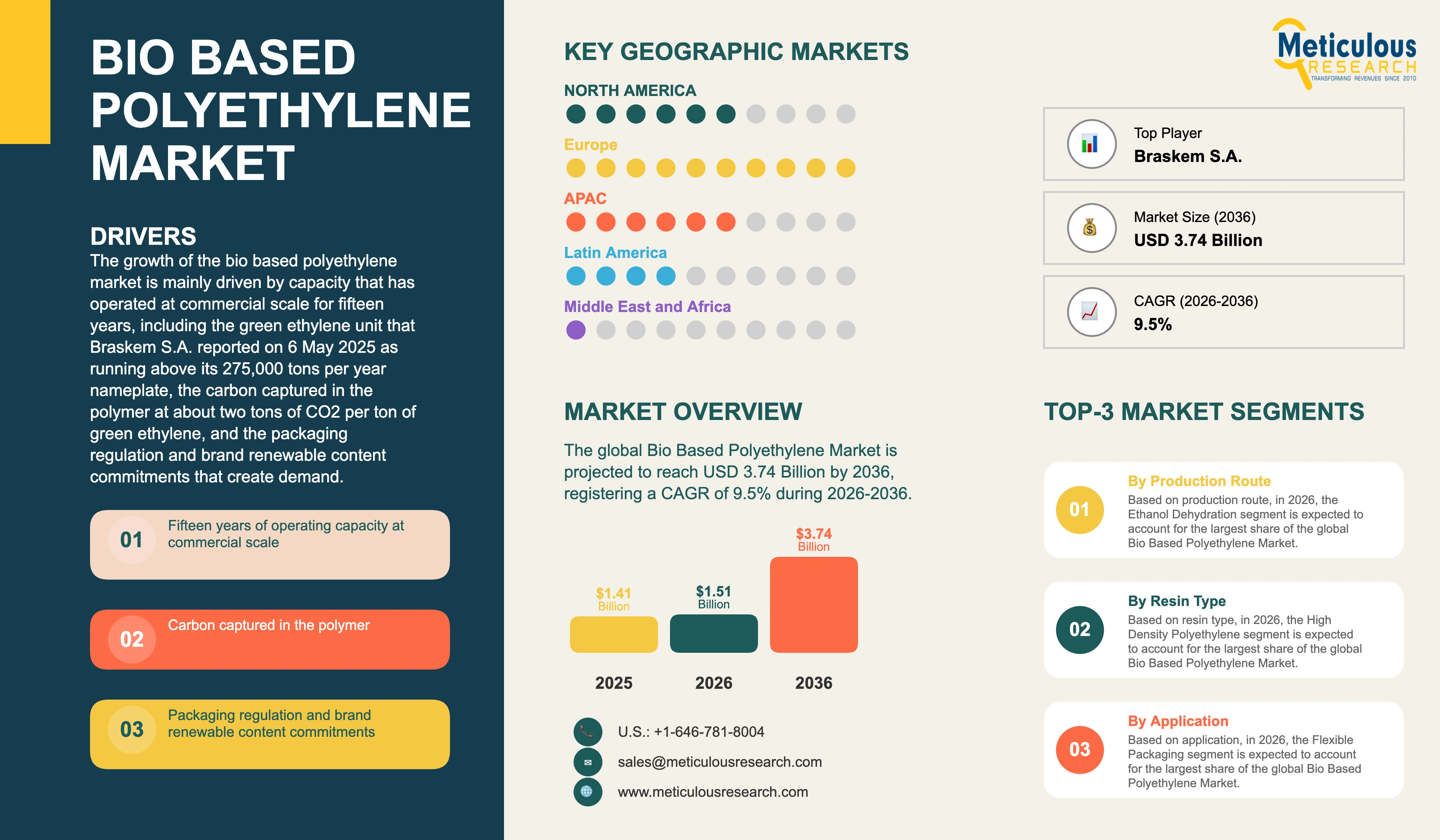
The global bio based polyethylene market was valued at USD 1.41 billion in 2025. This market is expected to reach USD 3.74 billion by 2036 from an estimated USD 1.51 billion in 2026, registering a CAGR of 9.5% during the forecast period (2026-2036).
- Published
- Nov 2026
- Pages
- 249
- Format
- PDF + Excel
- Report ID
- MRCHM - 1042682
- Base year
- 2025
- 2025 · BASELINE
- $1.41B
- 2036
- $3.74B
- CAGR 2026–2036
- 9.5%
2025 baseline · 2026–2036 forecast at 9.5% CAGR · hover a bar for the value
Key highlights
The global bio based polyethylene market is estimated at USD 1.51 billion in 2026 and is projected to reach USD 3.74 billion by 2036.
Market volume is estimated at 520.00 kilotons in 2026 and is projected to reach 1, 558.16 kilotons by 2036 at a CAGR of 11.6%, measured as bio-based polyethylene resin supplied.
The average selling price is estimated at USD 2.90 per kg in 2026 and is projected to reach USD 2.40 per kg by 2036 as the premium over fossil polyethylene narrows.
Ethanol dehydration to green ethylene is expected to account for the largest production route share in 2026, while mass-balance bio-attributed material is projected to register the highest CAGR of 16.6%.
High density polyethylene is expected to hold the largest resin type share in 2026, while linear low density polyethylene is projected to grow fastest at a CAGR of 11.0%.
Flexible packaging is expected to be the largest application in 2026, while personal care and cosmetics packaging is projected to register the highest CAGR of 14.0%.
Europe is expected to hold the largest regional share in 2026, while Asia-Pacific is projected to register the highest CAGR of 13.0%.
Braskem S.A. reported on 6 May 2025 that its green ethylene unit at Triunfo in Rio Grande do Sul, Brazil, was operating at rates above nameplate capacity following its expansion.
The nameplate capacity of the unit is stated at 275, 000 tons per year.
The original capacity at start-up in 2010 was 200, 000 tons per year, and the expansion represented a 37% increase completed in 2023.
The release marks fifteen years of the I am green bio-based product line.
Each ton of green ethylene captures about two tons of CO2, measured across the production chain up to the gate of Braskem S.A.
The added capacity is expected to capture about 159, 000 tons of CO2 per year, which the company equates to the annual emissions of 12,000 United States citizens.
Green ethylene is the raw material for the I am green bio-based polyethylene supplied to industry and brand owners.
The release does not state the investment amount, the operating rate as a percentage, the feedstock, the bio-based content percentage or any certification.
This market is a fraction of the total polyethylene market rather than an addition to it, and is not additive to the recycled polyethylene market with which it competes for renewable content budgets.
Report summary
| Particulars | Details |
|---|---|
| Base Year | 2025 |
| Forecast Period | 2026-2036 |
| Market Size in 2025 | USD 1.41 billion |
| Market Size in 2026 | USD 1.51 billion |
| Market Size by 2036 | USD 3.74 billion |
| Value CAGR (2026-2036) | 9.5% |
| Format | PDF, Excel & Cloud Portal · 249 pages |
| Volume in 2026 | 520.00 kilotons |
| Volume by 2036 | 1,558.16 kilotons |
| Volume CAGR (2026-2036) | 11.6% |
| Volume Basis | Bio-based polyethylene resin supplied, on a product-mass basis |
| Average Selling Price in 2026 | USD 2.90 per kg |
| Average Selling Price by 2036 | USD 2.40 per kg |
| Price Direction | Average selling price declines across the forecast period as additional capacity and mass-balance supply narrow the premium over fossil polyethylene, rather than through any change in the resin itself |
| Measurement Basis | High density, low density and linear low density polyethylene and ethylene vinyl acetate carrying certified renewable content, from ethanol dehydration and mass-balance attribution, and excluding fossil polyethylene without a certified claim, mechanically and chemically recycled polyethylene, bio-based polypropylene and other polyolefins, bio-ethanol and green ethylene sold as such, biodegradable and compostable polymers including polylactic acid and polyhydroxyalkanoates, and converted films, containers and finished articles |
| Relationship to Adjacent Markets | This market is a fraction of the total polyethylene market rather than an addition to it, since every tonne counted here substitutes for fossil resin, and it is not additive to the recycled polyethylene market with which it competes for the same renewable and circular content budgets, nor to the bio-ethanol and green ethylene markets upstream or the converted article markets downstream |
| Largest Production Route | Ethanol dehydration to green ethylene |
| Fastest-Growing Production Route | Mass-balance bio-attributed (CAGR 16.6%) |
| Largest Resin Type | High density polyethylene |
| Fastest-Growing Resin Type | Linear low density polyethylene (CAGR 11.0%) |
| Largest Application | Flexible packaging |
| Fastest-Growing Application | Personal care and cosmetics packaging (CAGR 14.0%) |
| Largest Region | Europe |
| Fastest-Growing Region | Asia-Pacific (CAGR 13.0%) |
| Segments Covered | Production Route, Resin Type, Application, and Geography |
| Geographies Covered | Europe, Asia-Pacific, North America, Latin America, and Middle East & Africa |
| Companies Profiled | 11 companies, including Braskem S.A., Saudi Basic Industries Corporation, Borealis AG, LyondellBasell Industries N.V., Dow Inc., and SCG Chemicals Public Company Limited |
Report overview
Segments covered: production route, resin type, application.
The growth of this market is mainly driven by the operating capacity that has been producing at commercial scale for fifteen years, including the green ethylene unit in Triunfo that Braskem S.A. reported on 6 May 2025 as running above its 275,000 tons per year nameplate, the carbon capture that the route delivers at about two tons of CO2 per ton of green ethylene, the packaging regulation and brand commitments that create demand for renewable content, and the chemical identity of the resin with fossil polyethylene that allows substitution without requalification. However, factors such as the dependence of physically bio-based supply on a single production complex, the price premium over fossil polyethylene, the competition for the same renewable content budgets from recycled polyethylene, and the ethanol feedstock exposure to fuel and food markets are expected to restrain the growth of this market to some extent.
Bio based polyethylene is polyethylene carrying certified renewable carbon, whether polymerised from ethylene made by dehydrating bio-ethanol or supplied from a conventional cracker under a certified mass-balance allocation of renewable feedstock. Market sizing in this report is on both a value basis in USD and a volume basis in kilotons measured as bio-based polyethylene resin supplied on a product-mass basis, with average selling price derived from the two. The measurement basis covers high density, low density and linear low density polyethylene and ethylene vinyl acetate carrying certified renewable content, and it excludes fossil polyethylene without a certified claim, mechanically and chemically recycled polyethylene, bio-based polypropylene and other polyolefins, bio-ethanol and green ethylene where sold as such, biodegradable and compostable polymers including polylactic acid and polyhydroxyalkanoates, and converted films, containers and finished articles.
Separating this market from recycled polyethylene matters because the two compete for the same money rather than complementing one another. A brand with a commitment on renewable or circular content can satisfy it with bio-based resin, with recycled resin or with a combination, and the choice turns on availability, price and what the specific commitment permits. Adding the two markets together would describe a budget rather than a product, and reading growth in one without the other would miss the substitution occurring between them.
Braskem S.A. reported on 6 May 2025, marking fifteen years of the I am green bio-based line, that its green ethylene unit at Triunfo in Rio Grande do Sul was operating at rates above its nameplate capacity of 275,000 tons per year following an expansion representing a 37% increase completed in 2023, against an original capacity of 200,000 tons per year at start-up in 2010. The company states that each ton of green ethylene captures about two tons of CO2 measured across the production chain up to its gate, and that the added capacity is expected to capture about 159,000 tons of CO2 a year, which it equates to the annual emissions of 12,000 United States citizens.
Fifteen years of commercial operation is what distinguishes this market from most bio-based chemical markets, including the bio-based acrylic acid that reached prototype production only in 2025. A unit that started in 2010, has been expanded once and is now running above nameplate is a producing asset rather than a demonstration, and the resin from it has been specified into commercial packaging for more than a decade. The release does not state the investment amount, the operating rate as a percentage, the feedstock, the bio-based content percentage or any certification, so the operational facts are what it establishes.
Carbon capture rather than emissions reduction is how the route is described, and the distinction matters to a buyer. About two tons of CO2 per ton of green ethylene is a figure for carbon taken up by the growing feedstock and retained in the polymer, measured to the producer gate, not a comparison against the emissions of a fossil cracker on a full life-cycle basis. The polymer holds that carbon for as long as the article survives and releases it on incineration, so the claim is about where the carbon came from rather than about permanent sequestration. Buyers increasingly ask for the boundary as well as the figure.
Supply concentration is the most important structural feature of the physically bio-based part of this market. A single complex in southern Brazil accounts for the great majority of polyethylene in which renewable carbon is physically present, so a planned maintenance turnaround, a drought affecting ethanol supply or a logistics disruption at a Brazilian port affects global availability in a way no other polyolefin grade experiences. Brand owners who have specified the resin into packaging carry that exposure. It is the principal reason mass-balance supply has been adopted alongside rather than instead of it.
Mass balance resolves the volume problem and raises a different question. A cracker fed with a certified quantity of renewable feedstock allocates that content across its outputs under a certification scheme, so the resin delivered is physically identical to fossil polyethylene while carrying a verified attribution, and it can be supplied from existing assets in Europe, Asia and North America without new investment. Buyers who require renewable carbon physically present in the polymer cannot use it, and a radiocarbon test on the resin would not detect it. Mass-balance material consequently registers the highest production route CAGR at 16.6%.
Chemical identity with fossil polyethylene is what makes substitution straightforward and also what caps the price. A converter can run bio-based resin on existing extrusion and blow moulding equipment without reformulating, requalifying a film structure or changing a mould, which removes the technical barrier that slows most bio-based substitutions. The resin offers no performance advantage, so the premium rests entirely on the renewable claim, and a brand decides whether that claim is worth the difference against recycled content or against no claim at all.
Packaging regulation and brand commitments rather than cost drive demand, which makes this market responsive to policy and corporate strategy rather than to resin economics. European packaging rules tightening requirements on material content, together with public commitments by consumer goods, personal care and food companies, create a requirement that a converter then satisfies through its resin purchasing. Europe therefore holds the largest regional share while producing almost none of the physically bio-based material it consumes.
Personal care and cosmetics packaging is where the premium is most easily absorbed, which is why it grows fastest at 14.0%. A bottle or jar is a small fraction of the cost of a finished cosmetic and the pack is the part of the product a consumer handles, so a renewable claim carries directly to the buyer and the resin premium disappears into the retail price. Flexible packaging remains the largest application because it is the largest use of polyethylene generally. The two facts together describe how substitution spreads through this market.
This market is a fraction of the polyethylene market rather than an addition to it. Every tonne counted here is a tonne of polyethylene that would otherwise have been supplied as fossil resin, so growth comes by substitution within a total set by packaging and converting demand. It is also not additive to the recycled polyethylene market, to the bio-ethanol or green ethylene markets upstream, or to the converted film and container markets downstream.
Europe is expected to account for the largest share in 2026, on packaging rules tightening material content requirements and on the renewable content commitments of the brands headquartered there. Germany is projected to grow at 9.6%, France at 9.0% and the United Kingdom at 8.4%.
Asia-Pacific is projected to register the highest CAGR of 13.0% during the forecast period, with China at 14.0%, South Korea at 13.0% and Japan at 12.0%.
Europe holds the largest regional share and is projected to grow at a CAGR of 8.9%, on packaging rules tightening requirements on material content, the renewable content commitments of the consumer goods, personal care and food companies headquartered there, and the established recognition of mass-balance certification schemes, while producing almost none of the physically bio-based resin it consumes.
The Middle East & Africa is projected to grow at a CAGR of 8.0% on mass-balance supply from regional petrochemical capacity. Latin America is projected to grow at a CAGR of 6.6%, with Brazil at 6.6%, where the physically bio-based capacity is located but where much of the output is exported rather than consumed.
Braskem S.A., Saudi Basic Industries Corporation, Borealis AG, LyondellBasell Industries N.V. and Dow Inc. together accounted for an estimated 68.4% of this market in 2026. The 11 companies profiled in this report together accounted for an estimated 88.2%.
Report infographic
Market dynamics
15 factors across 5 forcesFifteen Years of Operating Capacity at Commercial Scale
Braskem S.A. reported on 6 May 2025 that its green ethylene unit at Triunfo was running above its nameplate capacity of 275,000 tons per year following a 37% expansion completed in 2023, against 200,000 tons per year at start-up in 2010. A producing asset with that record removes the technology and reliability questions that hold back most bio-based materials, and the resin has been specified into commercial packaging for more than a decade. The driver is credibility built through operation rather than through announcement.
Operating above nameplate also tells a buyer something a capacity figure does not. It indicates demand in excess of the design rate and a unit whose debottlenecking potential has been realised, which means further physically bio-based volume requires new investment rather than better utilisation.
Operating above nameplate also tells a buyer something a capacity figure does not, since it indicates demand in excess of the design rate and a unit whose debottlenecking potential has been realised.
Carbon Captured in the Polymer
Braskem S.A. states that each ton of green ethylene captures about two tons of CO2 measured across the production chain up to its gate, and that the capacity added in 2023 is expected to capture about 159,000 tons of CO2 a year, equated to the annual emissions of 12,000 United States citizens. A figure of that form lets a brand account for renewable content and for carbon in the same purchase. The driver works through corporate carbon accounting rather than through product performance, which is why it acts on brand owners rather than on converters.
The figure also lets a brand report renewable content and captured carbon from one purchase, which is efficient in corporate reporting terms and is part of why the resin is specified at brand level rather than at converter level.
Packaging Regulation and Brand Renewable Content Commitments
European packaging rules tightening requirements on material content, together with public commitments by consumer goods, personal care and food companies on renewable and circular content, create a requirement that converters satisfy through resin purchasing rather than through design. Demand in this market is therefore created by policy and corporate strategy rather than by resin economics. It also means the buyer making the decision is often the brand rather than the converter placing the order, which changes how the material is sold.
The brand making the decision is often several steps removed from the resin order, and it specifies the material through its converter, so the selling effort and the purchase order sit in different places.
Chemical Identity Allowing Substitution Without Requalification
A converter can run bio-based polyethylene on existing extrusion, blow moulding and film lines without reformulating, requalifying a structure or changing a mould, because the polymer is identical to the fossil resin it replaces, which makes adoption a procurement decision rather than a development project. Substitution can therefore proceed at the speed of contract renewal. It also means the resin competes only on its certified claim, since it offers no technical advantage whatever.
It also means the resin competes only on its certified claim, since it offers no technical advantage, so the commercial work is about certification, availability and contract terms rather than about specification.
A fourth driver is the fifteen-year specification history itself. Packaging qualified on this resin a decade ago is still running, which gives a converter evidence of long-term processability and shelf-life performance that no newer bio-based polymer can offer, and removes the technical objection that usually accompanies a material change.
A fourth opportunity lies in grades beyond the commodity slate. Ethylene vinyl acetate and specialty grades carrying renewable content reach adhesives, footwear and photovoltaic encapsulation customers who hold their own content targets and are less price-sensitive than packaging converters, and those applications are not yet served at scale by either route.
Table of contents
11 chapters · 134 sections · 249 pages · click to expandSegmental analysis
| Segment | Largest share (2026) | Fastest growth (2026–2036) |
|---|---|---|
| By Production Route | Ethanol dehydration | Mass-balance bio-attributed |
| By Resin Type | High density polyethylene | Linear low density polyethylene |
| By Application | Flexible packaging | Personal care and cosmetics packaging |
| Other segments | High density polyethylene | Linear low density polyethylene |
By Production Route
- Bio Based Polyethylene Market Analysis by Production Route
- The ethanol dehydration segment is expected to account for the largest share of the global bio based polyethylene market.
- The large share of this segment is mainly due to operation at commercial scale since 2010, a stated green ethylene nameplate of 275,000 tons per year running above that rate, and the physical presence of renewable carbon in the resin, which is the only basis on which some brand claims can be made.
- However, the mass-balance bio-attributed segment is projected to register the highest CAGR of 16.6% during the forecast period.
- The rapid growth of this segment is attributed to supply from existing crackers in Europe, Asia and North America without new investment, the second source it provides where a physical bio-based claim offers none, and the volumes that brand commitments imply, which physically bio-based capacity cannot approach this decade.
- Other routes, including polyethylene from renewable feedstock processed through alternative cracker configurations, serve a small share.
- Route determines what claim a buyer can make rather than what the resin does, since the polymer is identical in every case, and a radiocarbon test distinguishes ethanol-derived material from mass-balance material while detecting no difference in performance.
- The two routes are therefore not substitutes for one another commercially even though they are chemically indistinguishable in the finished article.
- Ethanol dehydration to green ethylene is expected to account for the largest share in 2026, on operation at commercial scale since 2010 and the physical presence of renewable carbon in the resin.
- Mass-balance bio-attributed material is projected to register the highest CAGR of 16.6% during the forecast period.
By Resin Type
- Bio Based Polyethylene Market Analysis by Resin Type
- The high density polyethylene segment is expected to account for the largest share of the global bio based polyethylene market.
- The large share of this segment is mainly due to its use in bottles, closures, caps and rigid containers where brand owners have concentrated their renewable content commitments, the grades the existing green ethylene capacity was configured to supply, and the straightforward substitution into existing blow moulding operations.
- Route also determines what a buyer can say rather than what a buyer receives.
- A brand claiming renewable content present in its packaging needs ethanol-derived resin, while a brand reporting an allocated percentage can use either, so the two routes serve different claims from an identical product.
- However, the linear low density polyethylene segment is projected to register the highest CAGR of 11.0% during the forecast period.
- The rapid growth of this segment is attributed to its use in the flexible films that dominate polyethylene consumption by volume, the thinner structures that film producers are moving toward, and the suitability of mass-balance supply to film volumes that physically bio-based capacity cannot serve.
- Low density polyethylene supplies film, coating and laminate applications where clarity and sealing behaviour matter, and ethylene vinyl acetate serves adhesives, footwear, photovoltaic encapsulation and foamed products where a renewable claim reaches a different set of customers.
- Resin type in this market follows the grade slate of the available capacity as much as end-use demand, which is why the mix here does not match the mix of polyethylene generally.
By Application
- Bio Based Polyethylene Market Analysis by Application
- The flexible packaging segment is expected to account for the largest share of the global bio based polyethylene market.
- The large share of this segment is mainly due to flexible packaging being the largest use of polyethylene generally, the renewable content commitments of the food and consumer goods brands that specify it, and the ability to substitute resin without changing film structures or converting equipment.
- Resin type also determines which production route can serve the demand, since the grade slate of the single physically bio-based complex does not cover every specification, and buyers requiring a grade outside it have to accept mass-balance material whatever claim they would prefer to make.
- However, the personal care and cosmetics packaging segment is projected to register the highest CAGR of 14.0% during the forecast period.
- The rapid growth of this segment is attributed to a bottle or jar being a small fraction of finished cosmetic cost so that the resin premium disappears into the retail price, the pack being the part of the product a consumer handles so that the claim reaches the buyer directly, and the specific renewable content commitments brands in the category hold.
- Rigid packaging and containers take bio-based resin into food, household and industrial containers where the claim appears on the pack.
- Automotive and consumer goods applications use it in components and housings where a manufacturer carries its own renewable content target.
- Agriculture and other applications cover films, pipe and industrial uses where price sensitivity is highest and adoption consequently slowest.
- Application mix therefore reflects where a premium can be recovered rather than where polyethylene is consumed.
- The applications also differ in how quickly they can adopt.
- A bottle or jar changes resin without altering the mould, while a multi-layer film structure may need its seal and barrier performance reconfirmed even with an identical polymer, so conversion speed varies with the complexity of the article rather than with the resin.
- Grade coverage is a further segment consideration.
- The physically bio-based complex produces a defined slate, so a buyer needing a specification outside it accepts mass-balance material whatever claim it would prefer, and the resin type mix in this market reflects what that single plant makes as much as what converters would choose.
- That constraint eases only as new capacity is built.
- Application mix also differs by region in a way the segment totals conceal, with European demand concentrated in packaging against regulatory requirements while Asian demand is spread across packaging, consumer goods and industrial uses serving export brands, so a regional growth rate describes a different basket of applications in each case.
Other segments
- High density polyethylene is expected to hold the largest share in 2026, on its use in bottles, closures and rigid containers where brand owners have concentrated their renewable content commitments.
- Linear low density polyethylene is projected to register the highest CAGR of 11.0% during the forecast period.
- Flexible packaging is expected to account for the largest share in 2026, on being the largest use of polyethylene generally and on the renewable content commitments of the food and consumer goods brands that specify it.
- Personal care and cosmetics packaging is projected to register the highest CAGR of 14.0% during the forecast period.
Geographic analysis
Europe
Largest shareIn 2026, Europe is expected to account for the largest share of the global bio based polyethylene market. The large share of this region is mainly due to packaging rules tightening requirements on material content, the renewable content commitments of the consumer goods, personal care and food companies headquartered there, the established recognition of mass-balance certification schemes, and the converting base that supplies those brands. Germany is projected to register a CAGR of 9.6%, France a CAGR of 9.0% and the United Kingdom a CAGR of 8.4% during the forecast period.
Asia-Pacific
Fastest growthHowever, Asia-Pacific is projected to register the highest CAGR of 13.0% during the forecast period. The rapid growth of this region is attributed to the cracker capacity able to supply mass-balance material without new investment, the converting industry serving global brand owners, the renewable content requirements those brands apply to packaging sourced in the region, and the growth of domestic consumer goods demand. China is projected to register a CAGR of 14.0%, South Korea a CAGR of 13.0% and Japan a CAGR of 12.0%.
North America
North America is projected to grow at 9.4%, with the United States at 9.6%, on brand commitments and on cracker capacity able to supply mass-balance grades.
Latin America
Latin America is projected to grow at 6.6%, with Brazil at 6.6%, where the physically bio-based capacity is located but where much of the output is exported rather than consumed.
Middle East & Africa
The Middle East & Africa is projected to grow at 8.0% on mass-balance supply from regional petrochemical capacity. Regional capacity to supply mass-balance grades is therefore the variable that determines how fast a region can grow, because it can be established by qualifying renewable feedstock at an existing cracker rather than by building a plant. Production and consumption are separated in this market more sharply than in most polymers. The physically bio-based resin is made at a single complex in southern Brazil and consumed mainly in Europe, North America and Asia, while mass-balance material is produced wherever a cracker can be fed certified renewable feedstock. Regional share therefore describes where brand commitments are held rather than where renewable carbon enters the chain, and the shipping distance involved is itself part of the footprint conversation. Shipping distance is itself part of the footprint conversation, since resin made in southern Brazil and consumed in Europe or Asia carries transport emissions that a mass-balance grade produced regionally does not, and buyers comparing the two routes increasingly include that difference.
Competitive landscape
The global bio based polyethylene market is characterised by the presence of one producer of physically bio-based resin at commercial scale and a larger group of petrochemical companies offering mass-balance bio-attributed grades from existing crackers. Competition is contested on the route and certification a producer can offer rather than on resin performance, because the polymer is identical to fossil polyethylene and the two routes support different claims. Braskem S.A., Saudi Basic Industries Corporation, Borealis AG, LyondellBasell Industries N.V. and Dow Inc. together accounted for an estimated 68.4% of this market in 2026, while the companies profiled in this report together accounted for an estimated 88.2%, a concentration that reflects the small number of producers able to certify renewable content at scale.
Braskem S.A. reported on 6 May 2025, marking fifteen years of the I am green bio-based line, that its green ethylene unit at Triunfo was operating above its nameplate capacity of 275,000 tons per year following a 37% expansion completed in 2023, against 200,000 tons per year at start-up in 2010, with each ton of green ethylene capturing about two tons of CO2 to the company gate and the added capacity expected to capture about 159,000 tons of CO2 a year. Extension of mass-balance certification across polyolefin portfolios, qualification of renewable feedstock at existing crackers, and combined bio-based and recycled content offers accounted for most competitive activity through 2026.
Route position rather than cost separates the competitors, because a buyer requiring renewable carbon physically present in the polymer has one supplier while a buyer accepting attribution has many. Braskem S.A. competes from the only commercial-scale ethanol dehydration capacity, Saudi Basic Industries Corporation, Borealis AG, LyondellBasell Industries N.V., Dow Inc., TotalEnergies SE, Repsol S.A., INEOS AG, Mitsui Chemicals, Inc. and Sumitomo Chemical Company, Limited from mass-balance grades supplied out of existing crackers, and SCG Chemicals Public Company Limited from green ethylene development in Asia. Some of the key players operating in the bio based polyethylene market are Braskem S.A. (Brazil), Saudi Basic Industries Corporation (Saudi Arabia), Borealis AG (Austria), LyondellBasell Industries N.V. (Netherlands), Dow Inc. (U.S.), TotalEnergies SE (France), Repsol S.A. (Spain), INEOS AG (Switzerland), Mitsui Chemicals, Inc. (Japan), Sumitomo Chemical Company, Limited (Japan), and SCG Chemicals Public Company Limited (Thailand), among others.
- —
Braskem S.A. reported on 6 May 2025, marking fifteen years of the I am green bio-based product line, that its green ethylene unit at Triunfo in Rio Grande do Sul, Brazil, was operating at rates above nameplate capacity following its expansion. The nameplate capacity of the unit is stated at 275,000 tons per year, against an original capacity of 200,000 tons per year at start-up in 2010, with the expansion representing a 37% increase completed in 2023. The company states that each ton of green ethylene captures about two tons of CO2 measured across the production chain up to its gate, and that the added capacity is expected to capture about 159,000 tons of CO2 per year, which it equates to the annual emissions of 12,000 United States citizens. Green ethylene is the raw material for the I am green bio-based polyethylene supplied to industry and brand owners. The release does not state the investment amount, the operating rate as a percentage, the feedstock, the bio-based content percentage or any certification.
- Braskem S.A.
- Saudi Basic Industries Corporation
- Borealis AG
- LyondellBasell Industries N.V.
- Dow Inc.
- SCG Chemicals Public Company Limited
Expert perspectives
Volume grows at 11.6% against 9.5% in value over the forecast period, and the average selling price falls from USD 2.90 per kg in 2026 to USD 2.40 per kg by 2036 as additional capacity and mass-balance supply narrow the premium over fossil polyethylene. The gap between the two rates is the premium compressing rather than the market weakening.
This is a producing market rather than an emerging one, which separates it from most bio-based polymer reports. A unit that started in 2010, was expanded by 37% in 2023 and now runs above a 275,000 tons per year nameplate has answered the technology and reliability questions, and the resin has been specified into commercial packaging for more than a decade. Running above nameplate also means further physically bio-based volume requires new investment rather than better utilisation.
The carbon figure needs reading carefully rather than discounting. About two tons of CO2 captured per ton of green ethylene, measured to the producer gate, describes carbon taken up by the feedstock and held in the polymer; it is not a full life-cycle comparison against a fossil cracker, and the carbon returns on incineration. Buyers reporting under corporate accounting standards are increasingly asking for the boundary alongside the number, which is the right question.
Single-source exposure is the risk brand owners underweight. The great majority of polyethylene with renewable carbon physically present comes from one complex in southern Brazil, so a turnaround, a drought affecting ethanol or a port disruption moves global availability, and dual sourcing for a physical claim does not exist. That is the reason mass balance has been adopted alongside it rather than as a cheaper alternative, and why it grows at 16.6%.
The competitor to watch is recycled polyethylene rather than another bio-based producer. Brand commitments are usually written on renewable or circular content rather than on a material, recyclate is generally cheaper and is supported directly by packaging rules that set recycled content targets, so a change in those rules or in recyclate availability moves demand here without any change in cost position.
Where the premium can be recovered decides the application mix, not where polyethylene is used. Flexible packaging is the largest segment because it is the largest use of the polymer, while personal care and cosmetics packaging grows fastest at 14.0% because the pack is a small fraction of finished cost and the part the consumer handles. This market is also a fraction of the polyethylene market rather than an addition to it, and not additive to recycled polyethylene.
Customer perspectives
Where the pack is a small share of finished product cost and is handled directly by the consumer, the resin premium is absorbed into the retail price and the renewable claim reaches the buyer, which is why adoption concentrates in those applications.
The premium is consequently recovered at the point of sale to the consumer rather than anywhere in the supply chain, which is why adoption tracks the visibility of the pack rather than the cost of the resin.
Because commitments are written on combined renewable and circular content rather than on a single material, bio-based and recycled polyethylene compete for the same spend, and demand moves between them with price and availability.
A supplier able to offer both materials against one target therefore holds a stronger position than one offering either alone, since it can balance the mix as availability and relative price move through the year.
The resin substitutes into existing converting equipment without requalification, so availability rather than processability constrains adoption, and physically bio-based supply comes from a single production complex.
Taken together the three perspectives describe a material that is easy to use, hard to obtain in its physical form, and bought against a budget it shares with recycled resin.
“The bottle is a rounding error in our cost of goods and it is the thing the customer picks up. That combination is why we can justify the resin premium here and cannot justify it on a secondary film.”
“Our target is renewable and circular content as one number, so bio-based and recycled resin compete for the same budget inside our own business. Whichever is available at a price we can defend is what we buy that quarter.”
“Running it is not the issue, it drops straight into our lines. Getting it is the issue, because for the physical version there is effectively one plant in the world and we are told what we can have.”
Frequently asked questions
This market was valued at USD 1.33 billion in 2024 and USD 1.41 billion in 2025, and is estimated at USD 1.51 billion in 2026. In volume terms it is estimated at 520.00 kilotons in 2026 as bio-based polyethylene resin supplied.
This market is projected to reach USD 3.74 billion by 2036 in value and 1,558.16 kilotons in volume.
This market is projected to register a value CAGR of 9.5% and a volume CAGR of 11.6% during the forecast period 2026-2036. The average selling price is projected to move from USD 2.90 per kg in 2026 to USD 2.40 per kg by 2036 as the premium over fossil polyethylene narrows.
Growth is driven by capacity that has operated at commercial scale for fifteen years, including the green ethylene unit that Braskem S.A. reported on 6 May 2025 as running above its 275,000 tons per year nameplate, the carbon captured in the polymer, packaging regulation and brand renewable content commitments, and the chemical identity with fossil resin that allows substitution without requalification.
Physically bio-based supply depends on a single production complex, and the resin carries a premium over fossil polyethylene without any performance advantage. Recycled polyethylene competes for the same renewable and circular content budgets, and ethanol feedstock cost is set by fuel and food markets.
Mass balance supplies volumes from existing crackers without new investment, and personal care and cosmetics packaging absorbs the premium readily. New green ethylene capacity outside Brazil would remove the single-point exposure, and combined bio-based and recycled content offers meet commitments that neither material satisfies alone.
Ethanol dehydration to green ethylene is expected to account for the largest share in 2026, on operation at commercial scale since 2010 and the physical presence of renewable carbon in the resin.
Mass-balance bio-attributed material is projected to register the highest CAGR of 16.6% during the forecast period.
High density polyethylene is expected to hold the largest share in 2026, on its use in bottles, closures and rigid containers where brand owners have concentrated their renewable content commitments.
Linear low density polyethylene is projected to register the highest CAGR of 11.0% during the forecast period.
Flexible packaging is expected to account for the largest share in 2026, on being the largest use of polyethylene generally and on the renewable content commitments of the food and consumer goods brands that specify it.
Personal care and cosmetics packaging is projected to register the highest CAGR of 14.0% during the forecast period.
Europe is expected to account for the largest share in 2026, on packaging rules tightening material content requirements and the renewable content commitments of the brands headquartered there. Germany is projected to grow at 9.6%, France at 9.0% and the United Kingdom at 8.4%.
Asia-Pacific is projected to register the highest CAGR of 13.0% during the forecast period, with China at 14.0%, South Korea at 13.0% and Japan at 12.0%.
Europe holds the largest regional share and is projected to grow at a CAGR of 8.9%, on tightening packaging rules, brand renewable content commitments and recognition of mass-balance certification schemes. It produces almost none of the physically bio-based resin it consumes.
The Middle East & Africa is projected to grow at a CAGR of 8.0% on mass-balance supply from regional petrochemical capacity. Latin America is projected to grow at a CAGR of 6.6%, with Brazil at 6.6%, where the physically bio-based capacity is located but much of the output is exported.
Braskem S.A., Saudi Basic Industries Corporation, Borealis AG, LyondellBasell Industries N.V. and Dow Inc. together accounted for an estimated 68.4% of this market in 2026. The 11 companies profiled in this report together accounted for an estimated 88.2%.
Braskem S.A. reported on 6 May 2025 that its green ethylene unit at Triunfo in Rio Grande do Sul, Brazil, was operating above its nameplate capacity of 275,000 tons per year following a 37% expansion completed in 2023. The company states that each ton of green ethylene captures about two tons of CO2 up to its gate, with the added capacity expected to capture about 159,000 tons of CO2 per year.
Cite this report
Meticulous Research. (2026). Bio Based Polyethylene Market - Global Opportunity Analysis and Industry Forecast (2026-2036) (Report No. MRCHM - 1042682). Meticulous Market Research Pvt. Ltd. https://www.meticulousresearch.com/product/bio-based-polyethylene-market-7365