Furandicarboxylic Acid Market (2026-2036)
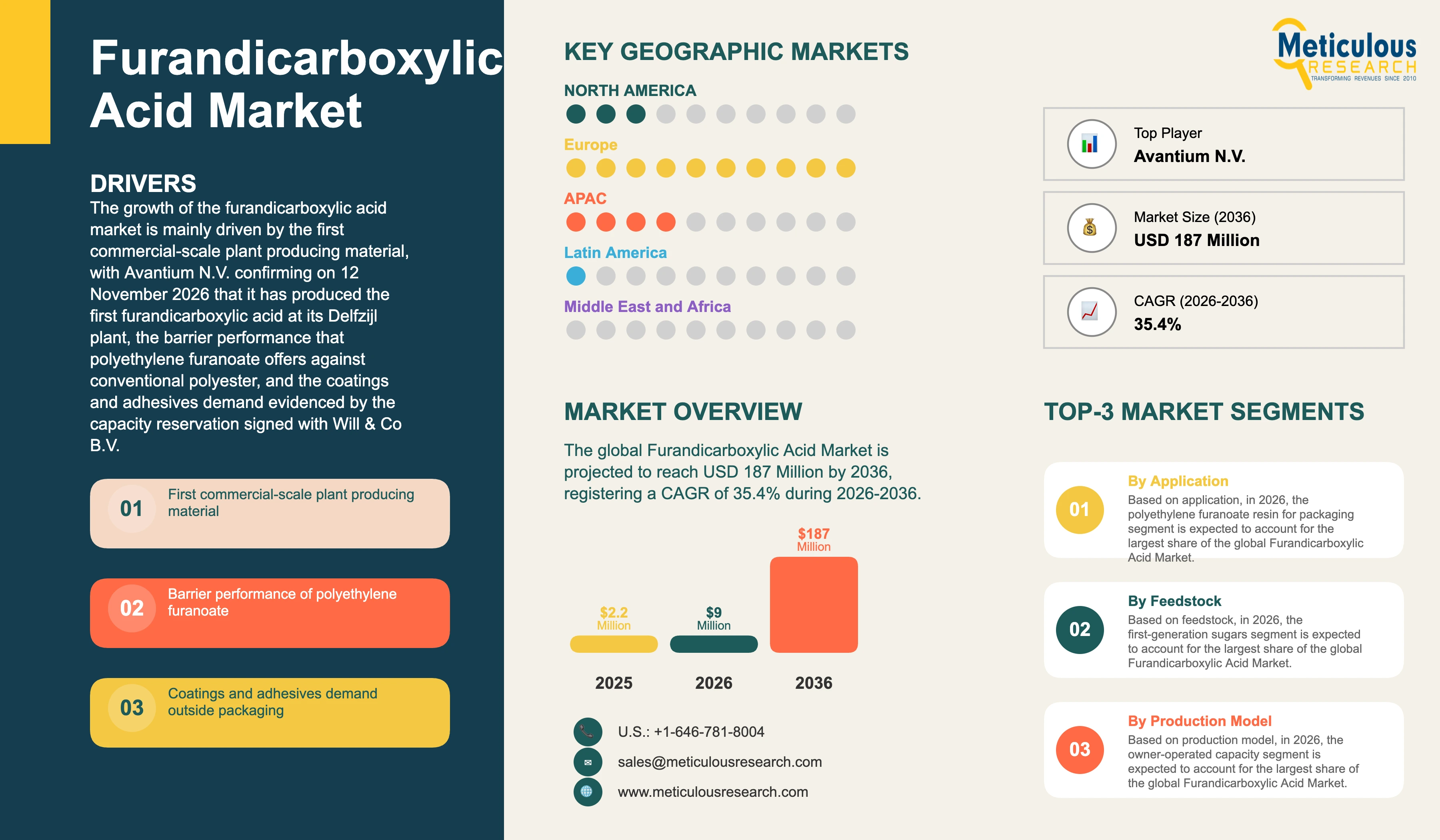
The global furandicarboxylic acid market was valued at USD 2.2 million in 2025. This market is expected to reach USD 187.0 million by 2036 from an estimated USD 9.0 million in 2026, registering a CAGR of 35.4% during the forecast period (2026-2036).
- Published
- Nov 2026
- Pages
- 264
- Format
- PDF + Excel
- Report ID
- MRCHM - 1042688
- Base year
- 2025
- 2025 · BASELINE
- $2.2M
- 2036
- $187.0M
- CAGR 2026–2036
- 35.4%
2025 baseline · 2026–2036 forecast at 35.4% CAGR · hover a bar for the value
Key highlights
The global furandicarboxylic acid market is estimated at USD 9.0 million in 2026 and is projected to reach USD 187.0 million by 2036.
Market volume is estimated at 1, 250.00 tonnes in 2026 and is projected to reach 55,009.13 tonnes by 2036 at a CAGR of 46.0%, measured as acid supplied including acid equivalent of the dimethyl ester.
The average selling price is estimated at USD 7.20 per kg in 2026 and is projected to reach USD 3.40 per kg by 2036 as output moves beyond pilot quantities.
Polyethylene furanoate resin for packaging is expected to account for the largest application share in 2026, while coatings, adhesives, sealants and elastomers are projected to register the highest CAGR of 44.0%.
First-generation sugars are expected to hold the largest feedstock share in 2026, while second-generation lignocellulosic sugars are projected to grow fastest at a CAGR of 44.0%.
Owner-operated capacity is expected to be the largest production model in 2026, while licensed third-party capacity is projected to register the highest CAGR of 51.0%.
Europe is expected to hold the largest regional share in 2026, while Asia-Pacific is projected to register the highest CAGR of 40.0%.
Avantium N.V. stated on 23 January 2026 that utilities and the sugar dehydration unit at its Delfzijl flagship plant were operational, with work focused on starting up the oxidation and purification units.
Start-up was expected to be completed by mid-2026, with product sales under existing offtake agreements expected to begin in the second half of 2026, the previous timeline having become unachievable.
The delay was caused by construction-related quality issues found in certain titanium welds in the piping during commissioning, which posed a safety risk for start-up and operations.
Inspections showed more remediation was needed than first expected, and the weld remediation adds EUR 7 million in capital expenditure.
The company stated it was reviewing contractual and legal options to seek compensation for the added costs and delays.
The YXY Technology of Avantium N.V. catalytically converts plant-based sugars into furandicarboxylic acid, and was demonstrated at pilot scale at Geleen in the Netherlands.
Furandicarboxylic acid is described as the key building block for polyethylene furanoate, sold under the releaf brand, an EU registered trademark of the company.
On 12 November 2026 Avantium N.V. and Will & Co B.V., a distributor of specialty bio-based chemicals, signed a capacity reservation for furandicarboxylic acid from future licensed production capacity.
Will & Co B.V. seeks future access for the coatings, adhesives, sealants and elastomers markets, building on a collaboration announced in February 2026.
The final agreement is subject to a deal between Will & Co B.V. and each relevant licensee, and the release states no capacity, term, value, territory, pricing or binding purchase obligation.
The release states that furandicarboxylic acid can be used in alkyd resins, surfactants and polyester polyols, with potential uses in paints, adhesives, flooring, roofing, tubing, automotive components and construction materials.
The company newsroom records a fully committed and underwritten rights offering of EUR 55 million announced on 27 October 2026 and completed on 11 November 2026.
This market measures furandicarboxylic acid and is not additive to the polyethylene furanoate resin market downstream of it.
Report summary
| Particulars | Details |
|---|---|
| Base Year | 2025 |
| Forecast Period | 2026-2036 |
| Market Size in 2025 | USD 2.2 million |
| Market Size in 2026 | USD 9.0 million |
| Market Size by 2036 | USD 187.0 million |
| Value CAGR (2026-2036) | 35.4% |
| Format | PDF, Excel & Cloud Portal · 264 pages |
| Volume in 2026 | 1,250.00 tonnes |
| Volume by 2036 | 55,009.13 tonnes |
| Volume CAGR (2026-2036) | 46.0% |
| Volume Basis | Furandicarboxylic acid supplied, including the acid equivalent where the material is delivered as its dimethyl ester |
| Average Selling Price in 2026 | USD 7.20 per kg |
| Average Selling Price by 2036 | USD 3.40 per kg |
| Commercialisation Status | First furandicarboxylic acid was produced at the Delfzijl flagship plant, described by the company as the world first commercial-scale facility for the chemical, with start-up expected to complete by mid-2026 and product sales under existing offtake agreements expected in the second half of 2026; the 2026 market size reflects start-up and early commercial quantities |
| Disclosure Note | No plant capacity, total project cost, original start-up date, offtake counterparty, volume or price is stated in the company releases relied on, and the capacity reservation of 12 November 2026 states no tonnage, term, value, territory or binding purchase obligation |
| Measurement Basis | Furandicarboxylic acid by application, feedstock and production model, including acid equivalent of the dimethyl ester, and excluding hydroxymethylfurfural and other furan intermediates sold as such, levulinic acid and other platform chemicals, the sugar and lignocellulosic feedstocks, polyethylene furanoate and other polymers made from the acid, and the converted bottles, films, coatings and adhesives downstream |
| Relationship to Adjacent Markets | This market measures the acid and is not additive to the polyethylene furanoate resin market downstream of it, nor to the bio-based polyethylene terephthalate market with which the polymer competes, since polyethylene furanoate is a new polymer rather than a renewable version of polyester |
| Largest Application | Polyethylene furanoate resin for packaging |
| Fastest-Growing Application | Coatings, adhesives, sealants and elastomers (CAGR 44.0%) |
| Largest Feedstock | First-generation sugars |
| Fastest-Growing Feedstock | Second-generation lignocellulosic sugars (CAGR 44.0%) |
| Largest Production Model | Owner-operated capacity |
| Fastest-Growing Production Model | Licensed third-party capacity (CAGR 51.0%) |
| Largest Region | Europe |
| Fastest-Growing Region | Asia-Pacific (CAGR 40.0%) |
| Segments Covered | Application, Feedstock, Production Model, and Geography |
| Geographies Covered | Europe, Asia-Pacific, North America, Latin America, and Middle East & Africa |
| Companies Profiled | 5 companies, including Avantium N.V., Origin Materials, Inc., Archer-Daniels-Midland Company, Toyobo Co., Ltd., and Will & Co B.V. |
Report overview
Segments covered: application, feedstock, production model.
In volume terms, this market is estimated at 1,250.00 tonnes in 2026 and is projected to reach 55,009.13 tonnes by 2036, registering a CAGR of 46.0% during the same period, measured as furandicarboxylic acid supplied, including the acid equivalent where the material is delivered as its dimethyl ester. The average selling price is estimated at USD 7.20 per kg in 2026 and is projected to decline to USD 3.40 per kg by 2036 as output moves from pilot quantities to commercial production and licensed capacity is added.
The growth of this market is mainly driven by the first commercial-scale plant producing material, with Avantium N.V. confirming on 12 November 2026 that it has produced the first furandicarboxylic acid at its Delfzijl plant and describing it as the world first commercial-scale facility for the chemical, the barrier performance that polyethylene furanoate offers against conventional polyester in packaging, the coatings and adhesives demand evidenced by the capacity reservation signed with Will & Co B.V., and the licensing model that would add capacity without the licensor funding it. However, factors such as the start-up delay caused by construction quality issues in titanium welds that added EUR 7 million of capital expenditure, the absence of any stated plant capacity, the dependence of the growth case on licensed plants that have not been announced, and the price premium over conventional polyester monomers are expected to restrain the growth of this market to some extent.
Polyethylene furanoate resin for packaging accounts for the largest share of this market because it is the application the technology was developed to serve and the one carrying existing offtake agreements. Coatings, adhesives, sealants and elastomers grow faster because those formulations can use furandicarboxylic acid in alkyd resins, surfactants and polyester polyols without requiring a new polymer to be qualified and recycled.
Furandicarboxylic acid is a furan-based diacid made from plant sugars, and it is the monomer that replaces terephthalic acid in a polyester to give polyethylene furanoate. Market sizing in this report is on both a value basis in USD and a volume basis in tonnes measured as acid supplied, including the acid equivalent where material is delivered as the dimethyl ester, with average selling price derived from the two. The measurement basis covers the acid by application, feedstock and production model, and it excludes hydroxymethylfurfural and other furan intermediates where sold as such, levulinic acid and other platform chemicals, the sugars and lignocellulosic feedstocks, polyethylene furanoate and other polymers made from the acid, and the converted bottles, films, coatings and adhesives further downstream.
Stating the basis to include dimethyl ester equivalent matters because the furan diacid has been developed commercially in both forms, and the ester carries a different molecular mass for the same furan content. A tonnage figure mixing the two would describe neither the furan supplied nor the material shipped. Treating the acid as the common denominator follows the way the chemical is discussed and licensed, and it keeps the measure comparable across routes.
Avantium N.V. stated on 23 January 2026 that utilities and the sugar dehydration unit at its Delfzijl flagship plant were operational, with work focused on starting up the oxidation and purification units, start-up expected to be completed by mid-2026 and product sales under existing offtake agreements expected in the second half of 2026, the previous timeline having become unachievable. The delay was caused by construction-related quality issues found in certain titanium welds in the piping during commissioning, which posed a safety risk and required more remediation than first expected, adding EUR 7 million in capital expenditure, with the company reviewing contractual and legal options to seek compensation.
The nature of that delay is worth separating from the technology it interrupted. Defective titanium welds are a construction quality failure rather than a process or chemistry problem, which means the schedule slipped for reasons that say nothing about whether the route works, and the company pursuing compensation indicates it regards the fault as its contractor rather than its design. For a reader assessing the viability of the chemistry, a weld remediation programme is a different signal from a yield shortfall or a catalyst failure would be.
On 12 November 2026 the company confirmed that it has produced the first furandicarboxylic acid at Delfzijl, describing the plant as the world first commercial-scale facility for the chemical, and announced a capacity reservation with Will & Co B.V., a distributor of specialty bio-based chemicals, for material from future licensed production capacity for the coatings, adhesives, sealants and elastomers markets, building on a collaboration announced in February 2026. The release states that the acid can be used in alkyd resins, surfactants and polyester polyols, with potential uses in paints, adhesives, flooring, roofing, tubing, automotive components and construction materials.
That reservation is easy to overread and should be understood precisely. It covers capacity at plants operated by licensees rather than at Delfzijl, the final agreement depends on a separate deal between the distributor and each licensee, and no tonnage, term, value, territory, price or binding purchase obligation is stated. What it establishes is commercial interest in applications outside packaging before the first plant has completed start-up, which is genuinely informative, and that the growth case for this market rests on licensed plants that have not yet been announced.
No plant capacity figure appears in either release, and that absence shapes how this market can be assessed. Neither the January start-up update nor the November reservation states the Delfzijl capacity, the total project cost or the original start-up date, so the quantity of material that will be available in the second half of 2026 is not disclosed. A forecast for this market is therefore built on the commercial structure and the stated timeline rather than on a nameplate figure, and the 2026 market size reflects start-up and early commercial quantities.
The commercial logic of polyethylene furanoate rests on barrier performance rather than on renewable content alone. A furan ring in the polymer backbone restricts gas diffusion more than a benzene ring does, which gives a bottle or film better oxygen and carbon dioxide barrier than conventional polyester at the same wall thickness, allowing lighter packs, longer shelf life or the removal of a barrier layer. That is a performance argument a brand can monetise, which distinguishes the material from bio-based drop-ins that compete only on origin.
The same furan ring creates the obstacle that has slowed adoption. Polyethylene furanoate is a new polymer rather than a renewable version of an existing one, so it does not enter the polyester recycling stream, requires its own collection and sorting arrangements at scale, and must be qualified afresh in every converting process and food contact application. A brand adopting it is taking on a material introduction rather than a substitution, which is a far slower decision than the bio-based polyethylene terephthalate alternative requires.
Coatings and adhesives avoid most of that burden, which is why they grow fastest. Alkyd resins, surfactants and polyester polyols are formulated products rather than recycled articles, so a new diacid can be introduced on performance and renewable content without a collection system, a food contact dossier or a sorting infrastructure. The applications named in the November release, including paints, adhesives, flooring, roofing, tubing, automotive components and construction materials, are all of that kind. Coatings, adhesives, sealants and elastomers consequently register the highest application CAGR at 44.0%.
Licensing rather than ownership is the model on which the capacity case depends, and the November reservation makes that explicit by covering future licensed production. A licensor adds capacity without funding it, which matters for a company that raised EUR 55 million in a rights offering announced on 27 October 2026 and completed on 11 November 2026, but it also means the volume in this market depends on third parties taking investment decisions that have not been announced. Licensed third-party capacity consequently registers the highest production model CAGR at 51.0% from a base of effectively nothing.
Feedstock flexibility is a longer-term question that the current position does not settle. The technology converts plant-based sugars, which today means first-generation sugar from food crops, while second-generation lignocellulosic sugars would remove the food competition argument that a renewable packaging claim eventually attracts. The company describes its broader focus as sustainable carbon feedstocks, meaning carbon from biomass or from carbon dioxide in the air. Second-generation sugars consequently register the highest feedstock CAGR at 44.0%.
Europe is expected to account for the largest share in 2026, on the only commercial-scale plant being located at Delfzijl in the Netherlands with the pilot plant at Geleen, and on the packaging regulation and brand owners established in the region. Germany is projected to grow at 34.0%, France at 33.0% and the Netherlands at 32.0%.
Asia-Pacific is projected to register the highest CAGR of 40.0% during the forecast period, with China at 42.0%, South Korea at 39.0% and Japan at 38.0%.
Europe holds the largest regional share and is projected to grow at a CAGR of 33.2%, on the only commercial-scale plant and the pilot plant being located there, the packaging regulation that favours renewable and recyclable materials, the brand owners and converters established in the region, and the coatings and adhesives formulators that signed early commercial interest.
The Middle East & Africa is projected to grow at a CAGR of 30.0% from a negligible base. Latin America is projected to grow at a CAGR of 34.0%, with Brazil at 34.0%, on sugar feedstock that would suit a licensed plant rather than on current capacity.
Avantium N.V., Origin Materials, Inc., Archer-Daniels-Midland Company, Toyobo Co., Ltd. and Will & Co B.V. together accounted for an estimated 96.2% of this market in 2026, which is also the share of the 5 companies profiled in this report, since the field of participants above pilot scale is this narrow.
Report infographic
Market dynamics
15 factors across 5 forcesFirst Commercial-Scale Plant Producing Material
Avantium N.V. confirmed on 12 November 2026 that it has produced the first furandicarboxylic acid at its Delfzijl plant, describing it as the world first commercial-scale facility for the chemical, having stated on 23 January 2026 that utilities and the sugar dehydration unit were operational with start-up expected complete by mid-2026 and product sales under existing offtake agreements expected in the second half of 2026. Material existing at commercial scale converts a licensing proposition into a demonstrable one. The driver acts on credibility rather than on volume, which remains small.
Material existing at commercial scale converts a licensing proposition into a demonstrable one, which matters more in this market than the tonnage produced does.
A producing plant also changes what a prospective licensee is being asked to believe, since it can be shown an operating unit rather than a pilot result, and that is the difference between a technology under evaluation and one being licensed.
A producing plant also changes what a prospective licensee is being asked to believe, since it can be shown an operating unit rather than a pilot result, and that is the difference between a technology under evaluation and one being licensed.
Barrier Performance of Polyethylene Furanoate
A furan ring in the polymer backbone restricts gas diffusion more than a benzene ring, giving better oxygen and carbon dioxide barrier than conventional polyester at the same wall thickness, which allows lighter packs, longer shelf life or the removal of a separate barrier layer. That is a performance benefit a brand can monetise rather than a renewable claim alone. It distinguishes the material from bio-based drop-in monomers that compete only on origin and must therefore be cheaper to win.
It distinguishes the material from bio-based drop-in monomers that compete only on origin and must therefore be cheaper to win, which is a far weaker commercial position.
Coatings and Adhesives Demand Outside Packaging
Avantium N.V. and Will & Co B.V. signed a capacity reservation on 12 November 2026 for material from future licensed capacity for the coatings, adhesives, sealants and elastomers markets, with the acid stated to be usable in alkyd resins, surfactants and polyester polyols and potential uses listed in paints, adhesives, flooring, roofing, tubing, automotive components and construction materials. These are formulated products rather than recycled articles, so adoption requires no collection system or food contact dossier. Coatings, adhesives, sealants and elastomers register the highest application CAGR at 44.0%.
These are formulated products rather than recycled articles, so adoption requires no collection system or food contact dossier, which is why interest appeared there before packaging sales had begun.
Licensing Model Adding Capacity Without Licensor Funding
The November reservation covers material from future licensed production capacity rather than from the flagship plant, with the licensor intending to introduce the distributor to prospective licensees and facilitate capacity discussions, which is a model that adds supply without the technology owner funding the plants. For a company that completed a EUR 55 million rights offering in November 2026, that distinction matters to how quickly capacity can grow. Licensed third-party capacity registers the highest production model CAGR at 51.0%.
For a company that completed a EUR 55 million rights offering in November 2026, that distinction matters to how quickly capacity can grow and to how much of the growth it must fund itself.
A fifth driver is the breadth of application interest relative to the supply available. The November release names alkyd resins, surfactants and polyester polyols as uses and lists paints, adhesives, flooring, roofing, tubing, automotive components and construction materials as potential applications, which means demand in this market is limited by material availability rather than by the number of applications seeking it.
Table of contents
11 chapters · 123 sections · 264 pages · click to expandSegmental analysis
| Segment | Largest share (2026) | Fastest growth (2026–2036) |
|---|---|---|
| By Application | Polyethylene furanoate resin for packaging | Coatings, adhesives, sealants and elastomers |
| Other segments | — | Second-generation lignocellulosic sugars |
By Application
- Polyethylene furanoate resin for packaging is expected to account for the largest share in 2026, on being the application the technology was developed to serve and the one carrying existing offtake agreements.
- Coatings, adhesives, sealants and elastomers are projected to register the highest CAGR of 44.0% during the forecast period.
- First-generation sugars are expected to hold the largest share in 2026, since the technology converts plant-based sugars and first-generation sugar is the form available at consistent quality and scale.
- Owner-operated capacity is expected to account for the largest share in 2026, since the Delfzijl flagship plant is the only commercial-scale facility and is operated by the technology owner.
Other segments
- Second-generation lignocellulosic sugars are projected to register the highest CAGR of 44.0% during the forecast period.
- Licensed third-party capacity is projected to register the highest CAGR of 51.0% during the forecast period, from a base of effectively nothing and with no licensee plant yet announced.
Geographic analysis
Europe
Largest shareIn 2026, Europe is expected to account for the largest share of the global furandicarboxylic acid market. The large share of this region is mainly due to the only commercial-scale plant being located at Delfzijl in the Netherlands with the pilot plant at Geleen, the packaging regulation that favours renewable and recyclable materials, the brand owners and converters established in the region, and the coatings and adhesives formulators that signed early commercial interest. The Netherlands is projected to register a CAGR of 32.0%, Germany a CAGR of 34.0% and France a CAGR of 33.0% during the forecast period.
Asia-Pacific
Fastest growthHowever, Asia-Pacific is projected to register the highest CAGR of 40.0% during the forecast period. The rapid growth of this region is attributed to the polyester and packaging converting base located there, the sugar feedstock availability that a licensed plant would draw on, the coatings and adhesives manufacturing serving regional and export demand, and the prospect of licensed capacity being built close to both feedstock and conversion. China is projected to register a CAGR of 42.0%, South Korea a CAGR of 39.0% and Japan a CAGR of 38.0%.
North America
North America is projected to grow at 37.0%, with the United States at 37.4%, on brand owner interest, the furan and biomass conversion technology developers based there, and sugar feedstock availability.
Latin America
Latin America is projected to grow at 34.0%, with Brazil at 34.0%, on sugar feedstock that would suit a licensed plant.
Middle East & Africa
The Middle East & Africa is projected to grow at 30.0% from a negligible base. Regional outcomes therefore depend on where licensees emerge rather than on where demand grows, and the sugar feedstock and converting bases that would attract a licensed plant sit largely outside the region holding the current share. Regional share in this market currently describes where one plant and its early customers sit rather than any distribution of capacity, so the figures should be read as a starting position rather than a structure. A single licensed plant announced in Asia-Pacific or North America would change the regional picture more than any shift in demand could, which is unusual and follows directly from there being one commercial facility in the world. A further segment consideration is that the three axes are not independent in this market. A licensee choosing second-generation feedstock will site its plant near residue supply and is most likely to sell into regional coatings and adhesives formulators rather than into an international packaging programme, so feedstock, production model and application tend to move together in any given project rather than combining freely.
Competitive landscape
The global furandicarboxylic acid market is characterised by one technology owner operating the only commercial-scale plant, a small number of companies developing alternative routes to furan diacids and their esters, and distributors and polymer companies positioning for future supply. Competition is contested on route economics and on securing licensees and application partners rather than on price, because commercial sales had not begun when the capacity reservation of 12 November 2026 was signed. Avantium N.V., Origin Materials, Inc., Archer-Daniels-Midland Company, Toyobo Co., Ltd. and Will & Co B.V. together accounted for an estimated 96.2% of this market in 2026, which is also the share of the companies profiled in this report, since the field of participants above pilot scale is this narrow.
Avantium N.V. stated on 23 January 2026 that utilities and the sugar dehydration unit at Delfzijl were operational with start-up expected complete by mid-2026 and sales in the second half of the year, after construction-related titanium weld quality issues added EUR 7 million in capital expenditure, and confirmed on 12 November 2026 that first furandicarboxylic acid had been produced and that a capacity reservation had been signed with Will & Co B.V. for future licensed capacity in the coatings, adhesives, sealants and elastomers markets. A fully committed and underwritten rights offering of EUR 55 million was announced on 27 October 2026 and completed on 11 November 2026. Completion of start-up, pursuit of licensees and development of applications outside packaging accounted for most competitive activity through 2026.
Position in this market rests on controlling a route to the molecule rather than on capacity, because almost no capacity exists. Avantium N.V. competes from the only commercial-scale plant and the YXY Technology licensing position, Origin Materials, Inc. from a chloromethylfurfural route to furan chemicals, Archer-Daniels-Midland Company from furan diester development and sugar feedstock integration, Toyobo Co., Ltd. from polyethylene furanoate polymer and film development, and Will & Co B.V. from distribution into the coatings and adhesives formulators that would use the acid. Some of the key players operating in the furandicarboxylic acid market are Avantium N.V. (Netherlands), Origin Materials, Inc. (U.S.), Archer-Daniels-Midland Company (U.S.), Toyobo Co., Ltd. (Japan), and Will & Co B.V. (Netherlands), among others.
- —
Avantium N.V. stated on 23 January 2026 that utilities and the sugar dehydration unit at its Delfzijl flagship plant in the Netherlands were operational, with work focused on starting up the oxidation and purification units, start-up expected to be completed by mid-2026 and product sales under existing offtake agreements expected to begin in the second half of 2026, the previous timeline having become unachievable. The delay was caused by construction-related quality issues found in certain titanium welds in the piping during commissioning, which posed a safety risk for start-up and operations, with inspections showing more remediation was needed than first expected and the remediation adding EUR 7 million in capital expenditure, and the company reviewing contractual and legal options to seek compensation for the added costs and delays. The YXY Technology catalytically converts plant-based sugars into furandicarboxylic acid and was demonstrated at pilot scale at Geleen, and the acid is described as the key building block for polyethylene furanoate sold under the releaf brand. On 12 November 2026 the company and Will & Co B.V., a distributor of specialty bio-based chemicals, signed a capacity reservation for furandicarboxylic acid from future licensed production capacity for the coatings, adhesives, sealants and elastomers markets, building on a collaboration announced in February 2026, with the final agreement subject to a deal between the distributor and each relevant licensee and no capacity, term, value, territory, pricing or binding purchase obligation stated. That release confirmed that first furandicarboxylic acid had been produced at Delfzijl, described as the world first commercial-scale facility for the chemical, and stated that the acid can be used in alkyd resins, surfactants and polyester polyols with potential uses in paints, adhesives, flooring, roofing, tubing, automotive components and construction materials. The company newsroom records a fully committed and underwritten rights offering of EUR 55 million announced on 27 October 2026 and completed on 11 November 2026.
- Avantium N.V.
- Origin Materials, Inc.
- Archer-Daniels-Midland Company
- Toyobo Co., Ltd.
- Will & Co B.V
Expert perspectives
Volume grows at 46.0% against 35.4% in value over the forecast period, and the average selling price falls from USD 7.20 per kg in 2026 to USD 3.40 per kg by 2036 as output moves from pilot quantities to commercial production. The 2026 figure of USD 9.0 million is very small, and percentage growth and absolute quantity are separate facts in a market where commercial sales were expected to begin only in the second half of that year.
The most useful thing to understand about the delay is what caused it. Construction-related quality issues in certain titanium welds, found during commissioning and requiring more remediation than first expected at EUR 7 million of additional capital expenditure, is a fabrication failure rather than a process or chemistry failure, and the company reviewing contractual and legal options indicates it regards the fault as its contractor rather than its design. That is a materially different signal from a yield shortfall.
First material having been produced is the fact that changes the licensing proposition. Confirmation on 12 November 2026 that furandicarboxylic acid has been made at what the company describes as the world first commercial-scale facility means a prospective licensee can be shown an operating unit rather than a pilot result, which is the difference between a technology under evaluation and one being licensed.
The capacity reservation should not be read as contracted demand. It covers future licensed production rather than Delfzijl, depends on a separate agreement between the distributor and each licensee, and states no tonnage, term, value, territory, price or binding obligation. What it does establish is commercial pull from coatings and adhesives before packaging sales have begun, which is informative about where this market will actually develop first.
The reason those applications move first is qualification burden rather than chemistry. Polyethylene furanoate is a new polymer, not a renewable version of an existing one, so it sits outside the polyester recycling stream and needs its own collection, sorting and food contact qualification, while alkyd resins, surfactants and polyester polyols need only formulation trials. Coatings, adhesives, sealants and elastomers therefore grow at 44.0% while packaging holds the larger share.
The risk to this forecast is concentrated in one place. Licensed third-party capacity grows at 51.0% from effectively nothing, no licensee plant has been announced, and no plant capacity figure appears in either release, so the volume case depends on investment decisions by third parties that have not been taken. This market measures the acid and is not additive to the polyethylene furanoate resin market downstream of it.
Customer perspectives
Formulated products require formulation trials rather than collection systems, sorting infrastructure or food contact dossiers, which is why coatings and adhesives can adopt the acid well ahead of packaging applications.
Formulators can also absorb a higher monomer price than a packaging converter, because a diacid is a smaller share of a coating or adhesive cost than of a bottle resin, which compounds the qualification advantage.
The barrier performance of the polymer is commercially attractive, but because it is a new polymer rather than a drop-in it falls outside the existing polyester recycling stream, which turns adoption into a value chain negotiation rather than a material substitution.
A brand in that position is also weighing a benefit it captures immediately against an infrastructure problem that persists, which is why packaging interest has not converted into volume at the pace the barrier case alone would suggest.
Commercial arrangements in this market are reservations contingent on later agreements with licensees rather than binding offtake, so announced interest reflects confidence in the applications rather than contracted volume.
Taken together the three perspectives describe a market where the technology has been demonstrated, the easier applications are being pursued first, and the volume case waits on licensee investment decisions.
“For an alkyd or a polyol we run formulation trials and we are done. We are not waiting for a recycling stream or a food contact opinion, which is why we can look at this material years before a bottle producer can.”
“The barrier number is genuinely attractive and would let us lighten the pack. The problem is that it is a different polymer, so it does not go back into our bottle stream, and that is a conversation with every recycler in every market we sell in.”
“We reserved capacity because we believe in the applications, not because we have a price or a tonnage. Those come when a licensee actually builds, and that is the piece everyone is waiting for.”
Frequently asked questions
This market was valued at USD 0.8 million in 2024 and USD 2.2 million in 2025, and is estimated at USD 9.0 million in 2026. In volume terms it is estimated at 1,250.00 tonnes in 2026 as acid supplied.
This market is projected to reach USD 187.0 million by 2036 in value and 55,009.13 tonnes in volume.
This market is projected to register a value CAGR of 35.4% and a volume CAGR of 46.0% during the forecast period 2026-2036. The average selling price is projected to move from USD 7.20 per kg in 2026 to USD 3.40 per kg by 2036.
Growth is driven by the first commercial-scale plant producing material, the barrier performance of polyethylene furanoate against conventional polyester, the coatings and adhesives demand evidenced by the capacity reservation with Will & Co B.V., and the licensing model that adds capacity without the licensor funding it.
Construction-related titanium weld quality issues delayed start-up and added EUR 7 million in capital expenditure, and no plant capacity or available volume is stated. Polyethylene furanoate is a new polymer rather than a drop-in, and the growth case depends on licensed plants that have not been announced.
Coatings, adhesives, sealants and elastomers require only formulation trials rather than recycling infrastructure, and licensed capacity expands supply without licensor capital. Second-generation and alternative carbon feedstocks address the food competition question, and barrier layer elimination makes a pack easier to recycle as a single polymer.
Polyethylene furanoate resin for packaging is expected to account for the largest share in 2026, on being the application the technology was developed to serve and the one carrying existing offtake agreements.
Coatings, adhesives, sealants and elastomers are projected to register the highest CAGR of 44.0% during the forecast period.
First-generation sugars are expected to hold the largest share in 2026, since the technology converts plant-based sugars and first-generation sugar is the form available at consistent quality and scale.
Second-generation lignocellulosic sugars are projected to register the highest CAGR of 44.0% during the forecast period.
Owner-operated capacity is expected to account for the largest share in 2026, since the Delfzijl flagship plant is the only commercial-scale facility and is operated by the technology owner.
Licensed third-party capacity is projected to register the highest CAGR of 51.0% during the forecast period, from a base of effectively nothing and with no licensee plant yet announced.
Europe is expected to account for the largest share in 2026, on the only commercial-scale plant being located at Delfzijl in the Netherlands with the pilot plant at Geleen, and on the packaging regulation and brand owners established in the region. Germany is projected to grow at 34.0%, France at 33.0% and the Netherlands at 32.0%.
Asia-Pacific is projected to register the highest CAGR of 40.0% during the forecast period, with China at 42.0%, South Korea at 39.0% and Japan at 38.0%.
Europe holds the largest regional share and is projected to grow at a CAGR of 33.2%, on the only commercial-scale plant and the pilot plant being located there, the packaging regulation that favours renewable and recyclable materials, and the brand owners, converters and formulators in the region.
The Middle East & Africa is projected to grow at a CAGR of 30.0% from a negligible base. Latin America is projected to grow at a CAGR of 34.0%, with Brazil at 34.0%, on sugar feedstock that would suit a licensed plant rather than on current capacity.
Avantium N.V., Origin Materials, Inc., Archer-Daniels-Midland Company, Toyobo Co., Ltd. and Will & Co B.V. together accounted for an estimated 96.2% of this market in 2026, which is also the share of the 5 companies profiled in this report.
Avantium N.V. stated on 23 January 2026 that utilities and the sugar dehydration unit at Delfzijl were operational, with titanium weld issues adding EUR 7 million in capital expenditure. On 12 November 2026 it confirmed first furandicarboxylic acid had been produced and signed a capacity reservation with Will & Co B.V. for future licensed capacity, after a EUR 55 million rights offering completed on 11 November 2026.
Cite this report
Meticulous Research. (2026). Furandicarboxylic Acid Market - Global Opportunity Analysis and Industry Forecast (2026-2036) (Report No. MRCHM - 1042688). Meticulous Market Research Pvt. Ltd. https://www.meticulousresearch.com/product/furandicarboxylic-acid-market-7371