Three Way Catalyst Washcoats Market (2026-2036)
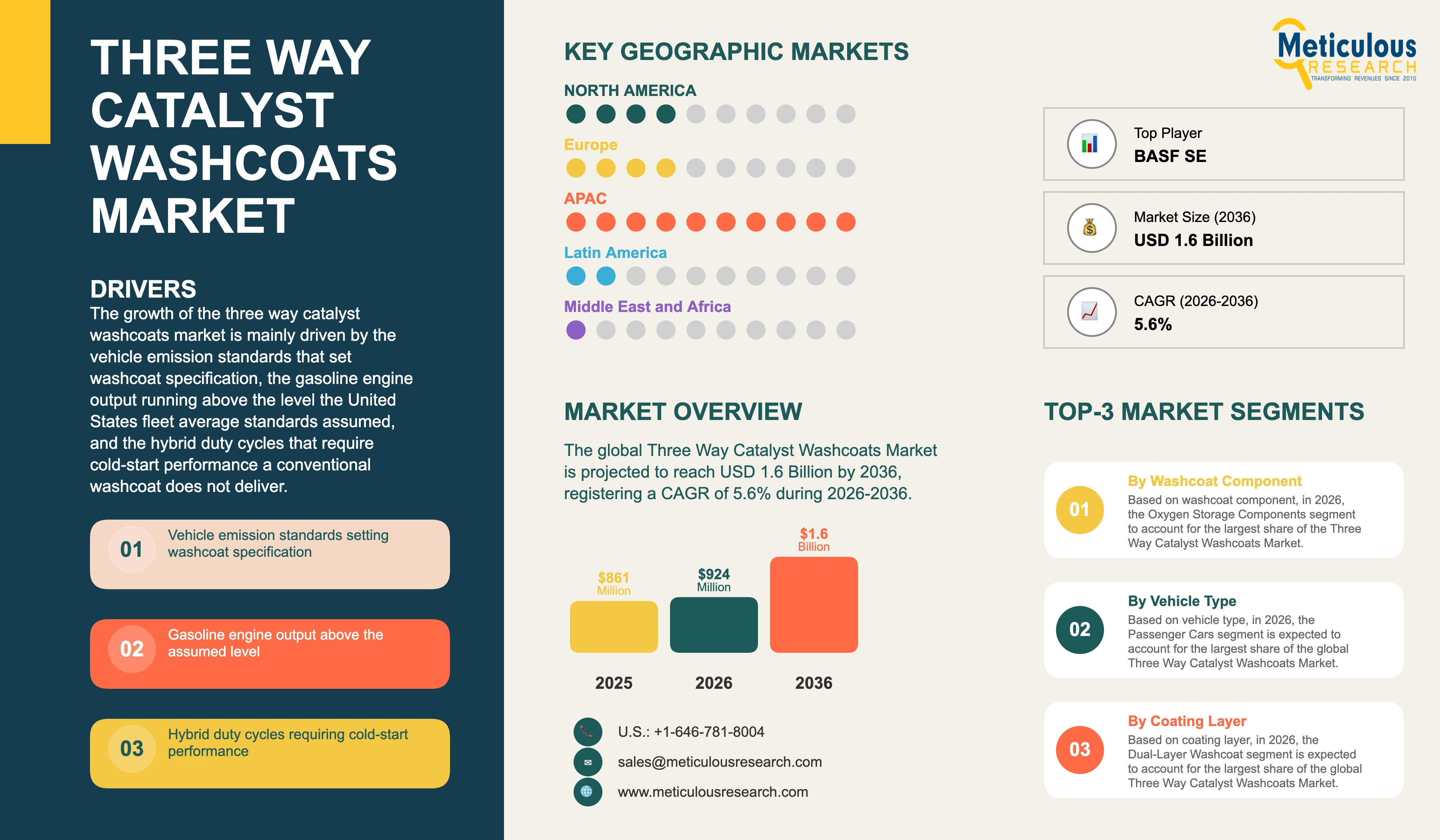
The global three way catalyst washcoats market was valued at USD 861.0 million in 2025. This market is expected to reach USD 1.60 billion by 2036 from an estimated USD 924.0 million in 2026, registering a CAGR of 5.6% during the forecast period (2026-2036).
- Published
- Nov 2026
- Pages
- 265
- Format
- PDF + Excel
- Report ID
- MRCHM - 1042832
- Base year
- 2025
- 2025 · BASELINE
- $861.0M
- 2036
- $1.60B
- CAGR 2026–2036
- 5.6%
2025 baseline · 2026–2036 forecast at 5.6% CAGR · hover a bar for the value
Key highlights
The global three way catalyst washcoats market is estimated at USD 924.0 million in 2026 and is projected to reach USD 1.60 billion by 2036.
Market volume is estimated at 42.00 kilotons in 2026 and is projected to reach 54.29 kilotons by 2036 at a CAGR of 2.6%, measured as washcoat as applied on a dry mass basis.
The measurement covers the coating only and excludes the platinum group metals and the bare substrate, on the same basis used for the diesel oxidation catalysts market.
The average selling price is estimated at USD 22.00 per kg in 2026 and is projected to reach USD 29.40 per kg by 2036 as cold-start trap and zoned layers take a larger share of the coating.
Oxygen storage components are expected to account for the largest washcoat component share in 2026, while zeolites and hydrocarbon trap materials are projected to register the highest CAGR of 10.0%.
Passenger cars are expected to hold the largest vehicle type share in 2026, while hybrid electric vehicles are projected to grow fastest at a CAGR of 9.4%.
Dual-layer washcoat is expected to hold the largest coating layer share in 2026, while the cold-start hydrocarbon trap layer is projected to grow fastest at a CAGR of 11.0%.
Asia-Pacific is expected to hold the largest regional share in 2026, while the Middle East & Africa is projected to grow fastest at a CAGR of 7.4%.
The United States Environmental Protection Agency proposed on 14 May 2026, in document EPA 420-F-26-009, a two-year delay to the Tier 4 criteria pollutant standards for light-duty and medium-duty vehicles, moving the start to model year 2029.
Manufacturers would continue to comply with the Tier 3 standards for model years 2027 and 2028, so the washcoat requirement is deferred rather than withdrawn.
Tier 4 was set in April 2024 and currently reaches full implementation by model year 2032, and the agency estimates the deferral saves over USD 1.7 billion and hundreds of dollars per vehicle.
The stated rationale is low consumer appetite for electric vehicles and manufacturer shifts away from them, with a USD 4 billion internal combustion investment by General Motors, a USD 19.5 billion electric vehicle write-down by Ford and a USD 26.5 billion charge by Stellantis.
Each gasoline engine built in place of a battery electric vehicle carries at least one coated monolith and commonly two, so the grounds cited for deferring the standard are themselves grounds for higher unit demand in this market.
A Part 2 reconsideration is planned, which leaves the model year 2029 specification unsettled for formulators developing against it.
Cerium oxide at 99.5% minimum rose 41% to USD 1.71 per kilogram in 2025 from USD 1.21 in 2024, according to the United States Geological Survey, while lanthanum oxide held at USD 1.00 and mischmetal at USD 5.62.
Cerium is the active element in the oxygen storage component and cannot be substituted, so the increase passes into the coating rather than being absorbed by reformulation.
Catalysts were the estimated leading domestic end use of rare earths in the United States, against magnets as the leading global end use, which places this market inside the rare earth chain rather than beside it.
China tightened rare earth export controls in April 2025 and expanded them in October 2025 before suspending the October list for one year in November 2025, and cerium and lanthanum appear on neither list, so this market carries a price exposure without the licensing exposure that constrains the magnet supply chain.
Report summary
| Particulars | Details |
|---|---|
| Base Year | 2025 |
| Forecast Period | 2026-2036 |
| Market Size in 2025 | USD 861.0 million |
| Market Size in 2026 | USD 924.0 million |
| Market Size by 2036 | USD 1.60 billion |
| Value CAGR (2026-2036) | 5.6% |
| Format | PDF, Excel & Cloud Portal · 265 pages |
| Volume in 2026 | 42.00 kilotons |
| Volume by 2036 | 54.29 kilotons |
| Volume CAGR (2026-2036) | 2.6% |
| Volume Basis | Washcoat as applied on a dry mass basis, excluding the platinum group metals and the bare substrate |
| Average Selling Price in 2026 | USD 22.00 per kg |
| Average Selling Price by 2036 | USD 29.40 per kg |
| Price Direction | The average selling price rises across the forecast period as cold-start trap and zoned layers take a larger share of the coating and as the cerium price raises the cost of the oxygen storage component, so the increase reflects a change in the coating rather than in the price of any individual material |
| Scope Exclusion Note | Platinum, palladium and rhodium are excluded because they are commonly supplied by the vehicle manufacturer or passed through at cost, and the cordierite or metallic substrate is excluded because it is bought as a separate component; gasoline particulate filter coatings, ammonia slip catalysts, canning and converter assembly, and all diesel washcoats are also outside the measurement |
| Measurement Basis | Coatings applied to monolith substrates for stoichiometric gasoline engines, covering ceria-zirconia oxygen storage components, alumina and stabilised alumina supports, promoters and stabilisers, zeolites and hydrocarbon trap materials, and binders and rheology additives, by washcoat component, vehicle type, coating layer and geography |
| Relationship to Adjacent Markets | This market is distinct from the diesel oxidation catalysts title in this series, which serves lean diesel engines on separate vehicles, and from the selective catalytic reduction catalysts title, which addresses a separate duty on the same aftertreatment system; the washcoat and platinum group metal recovered from a spent autocatalyst are counted in the spent catalyst recycling market as recovery revenue, so this market is not additive to any of them |
| Note on the Emission Standard | The United States Environmental Protection Agency proposed on 14 May 2026, in document EPA 420-F-26-009, a two-year delay to the Tier 4 criteria pollutant standards for light-duty and medium-duty vehicles, moving the start to model year 2029; manufacturers would continue to comply with Tier 3 for model years 2027 and 2028, which deliver reductions of up to 80 percent, with emissions controls remaining fully in effect through the transition, so the coating requirement is deferred rather than withdrawn |
| Note on the Phase-In | Tier 4 was set in April 2024 and currently phases in from model year 2027 to full implementation by model year 2032; the agency estimates the deferral saves over USD 1.7 billion and hundreds of dollars per vehicle, which measures coating content and warranty exposure rather than administrative burden, and a Part 2 reconsideration is planned that may change the standards, implementation dates, phase-in schedules and test procedures |
| Note on the Stated Rationale | The agency cites low consumer appetite for electric vehicles and manufacturer shifts away from them, listing a USD 4 billion internal combustion investment by General Motors, a USD 19.5 billion electric vehicle write-down by Ford, a USD 26.5 billion charge by Stellantis, a 30% cut in electric vehicle spending by Honda and a halt to electric vehicle production in Alabama by Hyundai; each gasoline engine built in place of a battery electric vehicle carries at least one coated monolith and commonly two, so the specification per vehicle is held while the number of vehicles requiring a coating rises |
| Note on Washcoat Rare Earths | The United States Geological Survey Mineral Commodity Summaries rare earths chapter of February 2026 reports cerium oxide at 99.5% minimum rising 41% to USD 1.71 per kilogram in 2025 from USD 1.21 in 2024, while lanthanum oxide held at USD 1.00 against USD 0.97 and mischmetal at 65% cerium and 35% lanthanum stood at USD 5.62 against USD 5.45; cerium is the active element in the oxygen storage component and the function depends on it cycling between two oxidation states, so the increase passes into the delivered cost of the coating |
| Note on Export Controls | China tightened export controls in April 2025 on alloys, compounds, metals and oxides of samarium, gadolinium, terbium, dysprosium, lutetium, scandium and yttrium, expanded them in October 2025 to europium, holmium, erbium, thulium and ytterbium, then suspended the October controls for one year in November 2025 while the April controls remained in effect; cerium and lanthanum appear on neither list, so this market carries a cerium price exposure without the licensing exposure that constrains the magnet supply chain |
| Note on Rare Earth Supply | China produced an estimated 270,000 tons of rare-earth oxide equivalent of a world total of 390,000 tons in 2025; United States net import reliance for compounds and metals stood at an estimated 67% against 53% in 2024, with China including Hong Kong accounting for 71% of import sources over 2021 to 2024, Malaysia 13%, Japan 5% and Estonia 5%, and catalysts were the estimated leading domestic end use of rare earths in the United States |
| Note on Market Structure | The coating is formulated and applied by automotive catalyst houses that sell a coated part to an engine manufacturer, while the oxygen storage components, stabilised aluminas and zeolites are bought from specialist materials producers including Solvay SA, Sasol Limited and Daiichi Kigenso Kagaku Kogyo Co., Ltd.; this report measures the washcoat as applied so the share belongs to the coaters, and Chinese coaters serving domestic vehicle production hold a further part described in this report rather than listed |
| Largest Washcoat Component | Oxygen storage components, ceria-zirconia |
| Fastest-Growing Washcoat Component | Zeolites and hydrocarbon trap materials (CAGR 10.0%) |
| Largest Vehicle Type | Passenger cars |
| Fastest-Growing Vehicle Type | Hybrid electric vehicles (CAGR 9.4%) |
| Largest Coating Layer | Dual-layer washcoat |
| Fastest-Growing Coating Layer | Cold-start hydrocarbon trap layer (CAGR 11.0%) |
| Largest Region | Asia-Pacific |
| Fastest-Growing Region | Middle East & Africa (CAGR 7.4%) |
| Slowest-Growing Region | Europe (CAGR 3.4%) |
| Segments Covered | Washcoat Component, Vehicle Type, Coating Layer, and Geography |
| Geographies Covered | Asia-Pacific, North America, Europe, Latin America, and Middle East & Africa |
| Companies Profiled | 4 companies, including BASF SE, Umicore N.V., Johnson Matthey Plc, and Cataler Corporation |
Report overview
Segments covered: washcoat component, vehicle type, coating layer.
In volume terms, this market is estimated at 42.00 kilotons in 2026 and is projected to reach 54.29 kilotons by 2036, registering a CAGR of 2.6% during the same period, measured as washcoat as applied on a dry mass basis, excluding the platinum group metals and the bare substrate. The average selling price is estimated at USD 22.00 per kg in 2026 and is projected to rise to USD 29.40 per kg by 2036. Value therefore grows at more than twice the rate of tonnage, and the difference is the coating itself becoming more elaborate rather than more of it being applied.
The growth of this market is mainly driven by the vehicle emission standards that set washcoat specification, the gasoline engine output running above the level the United States fleet average standards assumed, the hybrid duty cycles that require cold-start performance a conventional washcoat does not deliver, and the cerium price that has raised the cost of the oxygen storage component. However, factors such as the two-year delay proposed to the United States Tier 4 criteria pollutant standards, the European gasoline engine output that is not expanding, the uncertainty over what the reconsidered standards will require, and the continuing electrification that removes the engine altogether are expected to restrain the growth of this market to some extent.
Oxygen storage components account for the largest washcoat component share of this market, while zeolites and hydrocarbon trap materials grow fastest from a smaller base. Asia-Pacific holds the largest regional share, while the Middle East & Africa is the fastest-growing region.
Three way catalyst washcoats are the coatings applied to a monolith substrate that allow a stoichiometric gasoline engine to oxidise carbon monoxide and hydrocarbons and reduce nitrogen oxides at the same time. Market sizing in this report is on both a value basis in USD and a volume basis in kilotons measured as washcoat as applied on a dry mass basis, with average selling price derived from the two.
Platinum, palladium and rhodium are excluded because they are commonly supplied by the vehicle manufacturer or passed through at cost, and the cordierite or metallic substrate is excluded because it is bought as a separate component. Including either would measure the converter rather than the coating, and the metal alone would dominate the result. The same basis is applied in the diesel oxidation catalysts title in this series, which keeps the two markets comparable.
What that leaves is the formulation that performs the chemistry. The ceria-zirconia oxygen storage component buffers the air-fuel excursions a gasoline engine runs through, the stabilised alumina carries the metal dispersion, the barium and alkaline earth promoters resist thermal ageing, the zeolites trap hydrocarbons before the catalyst lights off, and the binders hold the layer to the channel wall. Each of those performs a function the others cannot, which is why the component mix rather than the coating weight determines what a washcoat is worth.
Regulatory direction in the largest gasoline market has reversed within the forecast period. The United States Environmental Protection Agency proposed on 14 May 2026, in document EPA 420-F-26-009, to delay the Tier 4 criteria pollutant standards for light-duty and medium-duty vehicles by two years to model year 2029, describing the existing standards as unattainable.
Manufacturers would continue to comply with the Tier 3 standards for model years 2027 and 2028, which deliver reductions of up to 80 percent, with emissions controls remaining fully in effect through the transition. Tier 4 was set in April 2024 and currently phases in from model year 2027 to full implementation by model year 2032. The requirement is therefore deferred rather than withdrawn, and the washcoat remains a condition of certification throughout.
What the deferral removes is the increase in content a tighter limit would have required. A catalyst has to hold its conversion over a certified life while oxygen storage capacity is lost to sintering, so the loading specified at the start is sized against the end of that period. A tighter limit over a longer useful life calls for more oxygen storage material, more promoter and in many cases an additional layer, and the agency estimate of over USD 1.7 billion and hundreds of dollars per vehicle is a measure of that content rather than of administrative burden.
The grounds the agency gives for the deferral work in the opposite direction on demand. It cites low consumer appetite for electric vehicles and manufacturer shifts away from them, listing a USD 4 billion internal combustion investment by General Motors, a USD 19.5 billion electric vehicle write-down by Ford, a USD 26.5 billion charge by Stellantis, a 30% cut in electric vehicle spending by Honda and a halt to electric vehicle production in Alabama by Hyundai.
Those are capital commitments already in the accounts rather than statements of intent, and each gasoline engine built in place of a battery electric vehicle carries at least one coated monolith and commonly two. The specification per vehicle is therefore held at the Tier 3 level for two further model years while the number of vehicles needing a coating rises above the level the fleet average standards were calculated on, which is why volume in this market is forecast at 2.6% while value grows at 5.6%.
A Part 2 reconsideration is planned that may change the standards themselves, the implementation dates, the phase-in schedules and the test procedures. A formulator developing a coating for model year 2029 is therefore working toward a requirement whose level and measurement method are both still open, which lengthens development cycles and holds incumbent formulations in place while the position settles.
Material cost has moved independently of regulation over the same period. The United States Geological Survey Mineral Commodity Summaries rare earths chapter of February 2026 reports cerium oxide at 99.5% minimum rising 41% to USD 1.71 per kilogram in 2025 from USD 1.21 in 2024, while lanthanum oxide at 99.5% minimum held at USD 1.00 against USD 0.97 and mischmetal at 65% cerium and 35% lanthanum stood at USD 5.62 against USD 5.45.
That the movement was confined to cerium matters because cerium is the one element in the washcoat that cannot be replaced. The oxygen storage function depends on it cycling between two oxidation states as the air-fuel ratio swings, and no other constituent performs it, so a 41% increase in the oxide price passes into the delivered cost of the coating and contributes directly to the average selling price rising from USD 22.00 per kg in 2026 to USD 29.40 per kg by 2036.
China tightened export controls in April 2025 on alloys, compounds, metals and oxides of samarium, gadolinium, terbium, dysprosium, lutetium, scandium and yttrium, expanded them in October 2025 to europium, holmium, erbium, thulium and ytterbium, then suspended the October controls for one year in November 2025 while the April controls remained in effect. Cerium and lanthanum appear on neither list, which leaves a washcoat formulator carrying a price exposure without the licensing exposure that constrains the magnet supply chain.
Demand within the coating is shifting toward the part of the duty cycle that remains unresolved. An engine that stops and restarts repeatedly spends more of its operating time below light-off temperature, and conversion requires the washcoat to be above that temperature, so hydrocarbons passing through in the interval after a restart are not converted however active the formulation is once warm.
Trapping those hydrocarbons on a zeolite until the catalyst becomes active is the only route to reducing them, and the requirement scales with restart frequency rather than with engine displacement. Conversion once the catalyst is hot has been achieved to a level where further improvement yields little on a test cycle, so design attention and material content have moved to the seconds before light-off, which is why zeolites and hydrocarbon trap materials are forecast at 10.0% and the cold-start hydrocarbon trap layer at 11.0% against 4.4% for the alumina supports that carry most of the mass.
This market is distinct from the diesel oxidation catalysts title in this series, which serves lean diesel engines on separate vehicles, and from the selective catalytic reduction catalysts title, which addresses a separate duty on the same aftertreatment system. Gasoline particulate filter coatings and ammonia slip catalysts are excluded, as are canning and converter assembly and all diesel washcoats.
The washcoat and platinum group metal recovered from a spent autocatalyst are counted in the spent catalyst recycling market in this series as recovery revenue, so this market is not additive to that one, and the platinum group metal excluded from the value measured here is excluded there by design as well.
Asia-Pacific is expected to account for the largest share in 2026, on the gasoline vehicle output concentrated there, on two and three wheeler volumes no other region matches, and on the coating capacity located alongside that production. India is projected to grow at 8.6%, China at 6.0%, South Korea at 3.6% and Japan at 2.4%.
The Middle East & Africa is projected to register the highest CAGR of 7.4% during the forecast period, with Saudi Arabia at 7.4%, on vehicle assembly being established locally and on a fleet that remains almost entirely gasoline fuelled.
Europe is projected to grow at a CAGR of 3.4%, the slowest region, with the Czech Republic at 4.0%, Spain at 3.4% and Germany at 2.6%, on gasoline engine production that is static or declining, since washcoat is consumed per engine built rather than per vehicle on the road.
The Middle East & Africa is projected to grow at a CAGR of 7.4%, the fastest region, with Saudi Arabia at 7.4%. Latin America is projected to grow at a CAGR of 6.0%, with Mexico at 6.6% on vehicle assembly for export and Brazil at 6.0% on a fleet running gasoline and ethanol blends that require the same three way chemistry.
BASF SE, Umicore N.V., Johnson Matthey Plc and Cataler Corporation are the 4 companies profiled in this report, and together they accounted for an estimated 52.4% of this market in 2026. Chinese coaters serving domestic vehicle production hold a further part, and the upstream suppliers of oxygen storage components, stabilised aluminas and zeolites earn their revenue selling into the coaters rather than holding share in this market.
Report infographic
Market dynamics
15 factors across 5 forcesVehicle Emission Standards Setting Washcoat Specification
A three way catalyst is a condition of certification for every stoichiometric gasoline engine sold into a regulated market, and the standard decides how much oxygen storage capacity, how much promoter and how many layers the washcoat must carry to hold conversion over the certified life.
What the standard governs is durability rather than initial conversion, because oxygen storage capacity is lost to sintering across a service life and the loading specified at the start has to be sized against the end of that period. The United States proposal of 14 May 2026 holds manufacturers at the Tier 3 standards for model years 2027 and 2028, with emissions controls remaining fully in effect, so the coating remains required while its specification is held.
That combination keeps the installed requirement intact without adding to it, which supports the volume forecast of 2.6% while leaving the value growth in this market to come from formulation changes made for reasons other than the limit.
Gasoline Engine Output Above the Assumed Level
The agency gives as its rationale low consumer appetite for electric vehicles and manufacturer shifts away from them, listing a USD 4 billion internal combustion investment by General Motors, a USD 19.5 billion electric vehicle write-down by Ford, a USD 26.5 billion charge by Stellantis, a 30% cut in electric vehicle spending by Honda and a halt to electric vehicle production in Alabama by Hyundai.
Those are capital commitments already in the accounts rather than statements of intent, and each gasoline engine built instead of a battery electric vehicle requires a three way catalyst and therefore a washcoat. Washcoat is consumed when an engine is manufactured rather than across the years it is driven, so a decision taken now about model year output reaches this market immediately.
The conditions cited as grounds for deferring the standard are accordingly the same conditions that raise the number of units this market serves, and that is what holds the volume forecast positive through a period in which the limit itself is unchanged.
Hybrid Duty Cycles Requiring Cold-Start Performance
An engine that stops and restarts repeatedly spends more of its operating time below light-off temperature than one that runs continuously once warm, and conversion requires the washcoat to be above that temperature. Hydrocarbons passing through in the interval after a restart are therefore not converted however active the formulation is once warm.
Recovering that loss means trapping the hydrocarbons until the catalyst becomes active, and the requirement scales with restart frequency rather than with engine displacement, so a hybrid carries a more demanding coating requirement despite its smaller engine. Hybrid electric vehicles are forecast at 9.4%, the cold-start hydrocarbon trap layer at 11.0% and zeolites and hydrocarbon trap materials at 10.0%, all well ahead of the market as a whole.
Those three rates together are the clearest measure of how electrification is reaching this market, raising the value of the coating applied to each engine well before it begins to reduce the number of engines coated.
Cerium Price Raising Formulation Cost
Cerium oxide at 99.5% minimum rose to USD 1.71 per kilogram in 2025 from USD 1.21 in 2024, an increase of 41%, while lanthanum oxide held at USD 1.00 and mischmetal at USD 5.62, so the movement was confined to cerium rather than general to the light rare earths.
Cerium cannot be designed out of the oxygen storage component, since the function depends on it cycling between two oxidation states as the air-fuel ratio swings and no other constituent performs it. The increase therefore passes into the delivered cost of the coating, and it is part of why the average selling price is forecast to rise from USD 22.00 per kg in 2026 to USD 29.40 per kg by 2036 while tonnage grows at only 2.6%.
Table of contents
11 chapters · 132 sections · 265 pages · click to expandSegmental analysis
| Segment | Largest share (2026) | Fastest growth (2026–2036) |
|---|---|---|
| By Washcoat Component | Oxygen storage components | Zeolites and hydrocarbon trap materials |
| By Vehicle Type | Passenger cars | Hybrid electric vehicles |
| By Coating Layer | Dual-layer washcoat | Cold-start hydrocarbon trap layer |
| Other segments | Passenger cars | Hybrid electric vehicles |
By Washcoat Component
- Three Way Catalyst Washcoats Market Analysis by Washcoat Component
- The oxygen storage components segment is expected to account for the largest share of the global three way catalyst washcoats market.
- The large share of this segment is mainly due to ceria-zirconia being the single largest constituent of a modern washcoat by mass, to its function of buffering the air-fuel excursions a stoichiometric engine runs through being irreplaceable within the three way chemistry, and to cerium oxide having risen 41% in price during 2025 while the other washcoat rare earths did not.
- However, the zeolites and hydrocarbon trap materials segment is projected to register the highest CAGR of 10.0% during the forecast period.
- The rapid growth of this segment is attributed to the remaining hydrocarbon emission on a test cycle sitting in the interval before the catalyst lights off, and to engine stop-start frequency rising with hybridisation, which makes adsorbing and later releasing those hydrocarbons the only route to further reduction.
- Alumina and stabilised alumina supports grow at 4.4%, the slowest component, because they carry much of the mass at low unit value and the quantity required follows substrate volume rather than specification.
- Promoters and stabilisers grow at 5.6% on thermal durability over a certified life, with lanthanum oxide holding at USD 1.00 per kilogram, and binders and rheology additives grow at 5.4%, their quantity set by the number of layers applied.
- The ordering across this axis follows function rather than quantity, which is why the largest segment by mass is not the fastest by growth.
- Oxygen storage and alumina together account for most of the coating weight and both are mature, while the zeolite and promoter content is small and is where each specification change lands, and that is what lifts the average selling price in this market without any individual material becoming more expensive.
- Rare earth supply reaches this axis through the oxygen storage segment alone.
- China produced an estimated 270, 000 tons of rare-earth oxide equivalent of a world total of 390,000 tons in 2025 and United States net import reliance for compounds and metals stood at an estimated 67% against 53% in 2024, with China including Hong Kong accounting for 71% of import sources over 2021 to 2024.
- Because cerium cannot be substituted within the three way chemistry, that concentration sets a cost floor under the largest component segment that no change to the emission limit relieves.
- Oxygen storage components are expected to account for the largest share in 2026, on ceria-zirconia being the single largest constituent of a modern washcoat by mass and its air-fuel buffering function being irreplaceable within the three way chemistry.
- Zeolites and hydrocarbon trap materials are projected to register the highest CAGR of 10.0% during the forecast period, on the remaining hydrocarbon emission sitting in the interval before light-off and on engine stop-start frequency rising with hybridisation.
By Vehicle Type
- Three Way Catalyst Washcoats Market Analysis by Vehicle Type
- The passenger cars segment is expected to account for the largest share of the global three way catalyst washcoats market.
- The large share of this segment is mainly due to the number of stoichiometric gasoline passenger cars built annually exceeding every other application, to each requiring at least one and commonly two coated monoliths, and to the certification requirement applying without exception in every regulated market.
- However, the hybrid electric vehicles segment is projected to register the highest CAGR of 9.4% during the forecast period.
- The rapid growth of this segment is attributed to a hybrid carrying a gasoline engine whose coating requirement is more demanding rather than less, because the engine runs intermittently and spends more of its operating time below light-off temperature.
- Light commercial vehicles grow at 5.0% and are the application least exposed to electrification in the near term.
- Two and three wheelers grow at 6.6% on unit volumes concentrated in Asia-Pacific at small washcoat quantities each, and medium-duty and other gasoline engines at 7.4%, those engines sitting inside the scope of the proposal of 14 May 2026 alongside light-duty vehicles.
- This axis separates on duty cycle rather than on vehicle size, which is why a hybrid grows fastest while carrying a smaller engine than the passenger cars holding the largest share.
- For a coater the consequence is that the mix of platforms qualified matters more to revenue than the total number of engines coated.
- Hybridisation extends the requirement across this axis rather than narrowing it.
- A hybrid retains a gasoline engine that must meet the same tailpipe limit while starting from cold far more often, so the engine is smaller and runs less yet raises the demands on the coating applied to it.
- Electrification is therefore reaching this market as a change in specification well before it arrives as a loss of volume, which is what keeps the vehicle type axis growing while engine displacement falls.
- Washcoat is consumed when an engine is manufactured rather than across the years it is driven, so this axis tracks assembly rather than the installed fleet.
- A hybrid counts once when its engine is built, in the same way a conventional passenger car does, and the difference between the two is the content of the coating rather than the number of coatings applied.
By Coating Layer
- Three Way Catalyst Washcoats Market Analysis by Coating Layer
- Dual-layer washcoat accounts for the largest coating layer share of this market and grows at 4.7%, because separating the palladium-rich oxidation function from the rhodium-containing reduction function into two layers is the established architecture for meeting a stoichiometric standard at acceptable metal loading.
- The cold-start hydrocarbon trap layer grows fastest at 11.0%, from the smallest base in this axis, and because it is an additional layer rather than a replacement for the others its growth adds washcoat mass per part.
- Triple-layer and zoned washcoat grows at 9.0%, placing different formulations along the length and through the thickness of a monolith to raise conversion for a given quantity of metal.
- Single-layer washcoat grows at 2.6%, the slowest segment in this report, surviving in two and three wheelers and small engines where cost rather than conversion decides the specification.
- The chemistry of three way catalysis has been settled for some years while the architecture has not, which is why this axis rather than the component axis shows where specification change is going.
- A single washcoat became two, then three with zoning, and now four where a cold-start trap is added, and each addition raises washcoat mass per part at an unchanged emission limit, which is the mechanism behind value in this market growing at more than twice the rate of tonnage.
- For a coater the consequence is that architecture rather than chemistry now carries the premium.
- A zoned or trap-layer coating is priced above a dual-layer one on the same substrate, and because the addition is physical rather than a reformulation it is visible in both the tonnage and the value this market records.
Other segments
- Passenger cars are expected to hold the largest share in 2026, on the number of stoichiometric gasoline passenger cars built annually exceeding every other application and on each requiring at least one and commonly two coated monoliths.
- Hybrid electric vehicles are projected to register the highest CAGR of 9.4% during the forecast period, because a hybrid carries a gasoline engine whose coating requirement is more demanding rather than less, running intermittently and spending more of its operating time below light-off temperature.
- Dual-layer washcoat is expected to hold the largest share in 2026, since separating the palladium-rich oxidation function from the rhodium-containing reduction function is the established architecture for meeting a stoichiometric standard at acceptable metal loading.
- The cold-start hydrocarbon trap layer is projected to register the highest CAGR of 11.0% during the forecast period, from the smallest base in this axis, and because it is an additional layer rather than a replacement its growth adds washcoat mass per part.
Geographic analysis
Asia-Pacific
Largest shareIn 2026, Asia-Pacific is expected to account for the largest share of the global three way catalyst washcoats market. The large share of this region is mainly due to the gasoline vehicle output concentrated there, to the two and three wheeler volumes that no other region matches, and to the catalyst coating capacity located alongside that production. China is projected to register a CAGR of 6.0%, India a CAGR of 8.6%, South Korea a CAGR of 3.6% and Japan a CAGR of 2.4%. That spread reflects where assembly is still being added. India at 8.6% is the fastest major country rate in this report, on passenger car and two wheeler output still expanding against a gasoline-weighted fleet, while Japan at 2.4% is the slowest, carrying established coating capability against engine production that is no longer growing.
Middle East & Africa
Fastest growthHowever, the Middle East & Africa is projected to register the highest CAGR of 7.4% during the forecast period, with Saudi Arabia at 7.4%. The rapid growth of this region is attributed to vehicle assembly being established locally and to a fleet that remains almost entirely gasoline fuelled, so coatings are being applied to output that is being added rather than replaced on an existing base.
North America
North America is projected to grow at 5.4%, with the United States at 5.4%, and the region carries both halves of the regulatory position described above. The Tier 4 deferral holds the coating specification while the electric vehicle retreat the agency cites raises gasoline engine output, so the region contributes unit growth without the content growth a tightening limit would have delivered. Medium-duty gasoline engines sit inside the scope of the proposal of 14 May 2026 and are forecast at 7.4%.
Europe
Europe is projected to grow at 3.4%, the slowest region, with the Czech Republic at 4.0%, Spain at 3.4% and Germany at 2.6%, on gasoline engine production that is static or declining. Germany is the slowest country rate in this report on that basis, and the regional contribution is accordingly shifting from tonnage toward content per part as electrification advances faster there than in the markets the United States proposal describes.
Latin America
Latin America is projected to grow at 6.0%, with Mexico at 6.6% on vehicle assembly for export markets whose standards it must meet, and Brazil at 6.0% on a fleet running gasoline and ethanol blends that require the same three way chemistry. Neither country is materially exposed to the electrification that is reducing European engine output, which is what keeps both rates above the market average. The regional pattern turns on whether a jurisdiction is adding gasoline engine assembly or holding it flat, because the coating follows the engine rather than the standard. Regions adding assembly convert a regulatory requirement into unit volume, while regions holding it flat convert it only into content per part.
Competitive landscape
The global three way catalyst washcoats market is supplied by a small number of automotive catalyst houses that formulate and apply the coating and sell a coated part to an engine manufacturer, because a coating is qualified with the engine family it is developed for and cannot be transferred between platforms without requalification. The four companies profiled together accounted for an estimated 52.4% of this market in 2026.
Upstream of those coaters, Solvay SA supplies rare earth based oxygen storage components, Sasol Limited supplies stabilised aluminas and a small group of producers including Daiichi Kigenso Kagaku Kogyo Co., Ltd. supplies zirconium and cerium based materials. That revenue is earned selling into the coaters rather than into the vehicle manufacturer, so those positions sit outside the share measured here while setting much of its cost base.
Competition between the coaters is contested on conversion achieved per gram of platinum group metal and on durability over the certified life, since the metal is commonly supplied or passed through at cost and the coater is paid for the formulation that uses less of it. Price per kilogram of coating is accordingly a secondary consideration, and a zoned or trap-layer architecture that reduces metal loading can command a premium while lowering the total cost of the converter.
Replacing a coating on a certified engine family means requalifying the engine against its emission standard, which gives the incumbent a durable position. A challenger displaces it on a measurable conversion or durability advantage rather than on a quotation, and because the qualification decision is taken once per platform and then held for its life, share in this market moves slowly and in steps rather than continuously.
Chinese coaters supply a further part of this market serving domestic vehicle production on the same platform-by-platform basis, and those positions are described in this report rather than listed because available disclosure does not support attributing a share to individual producers. Some of the key players operating in the three way catalyst washcoats market are BASF SE (Germany), Umicore N.V. (Belgium), Johnson Matthey Plc (U.K.), and Cataler Corporation (Japan), among others.
Because share moves in steps tied to platform launches, the period to 2029 is more likely to consolidate existing positions than to redistribute them, and the reconsidered standard taking effect is the point at which the next round of qualifications, and therefore the next opportunity for share to move, arrives.
- —
The United States Environmental Protection Agency proposed on 14 May 2026, in document EPA 420-F-26-009, a two-year delay to the Tier 4 criteria pollutant standards for light-duty and medium-duty vehicles, moving the start to model year 2029 and holding manufacturers at Tier 3 for model years 2027 and 2028, with the deferral estimated to save over USD 1.7 billion and hundreds of dollars per vehicle. Tier 4 was set in April 2024 and currently phases in to full implementation by model year 2032, and a Part 2 reconsideration is planned that may change the standards, implementation dates, phase-in schedules and test procedures. The stated rationale is low consumer appetite for electric vehicles and manufacturer shifts away from them, including a USD 4 billion internal combustion investment by General Motors, a USD 19.5 billion write-down by Ford and a USD 26.5 billion charge by Stellantis. Separately, the United States Geological Survey reported in February 2026 that cerium oxide rose 41% to USD 1.71 per kilogram in 2025 while lanthanum oxide held at USD 1.00, and that China tightened rare earth export controls in April 2025 and expanded them in October 2025 before suspending the October list for one year in November 2025, with cerium and lanthanum on neither list.
- BASF SE
- Umicore N.V.
- Johnson Matthey Plc
- Cataler Corporation
Expert perspectives
Value grows at 5.6% against 2.6% in volume over the forecast period, and the average selling price rises from USD 22.00 per kg in 2026 to USD 29.40 per kg by 2036. That gap is the coating becoming more elaborate rather than more of it being applied, and reading the two series together is the only way to size this market correctly.
The measurement basis has to be read with them. Platinum, palladium and rhodium are excluded because they are commonly supplied by the vehicle manufacturer or passed through at cost, and the substrate because it is bought separately, which keeps this title on the same basis as the diesel oxidation catalysts title in this series. Including the metal would measure the converter and the metal would dominate the result.
The driver named for this title is being deferred in its largest gasoline market. The United States Environmental Protection Agency proposed on 14 May 2026 to move the Tier 4 criteria pollutant standards to model year 2029, holding manufacturers at Tier 3 for model years 2027 and 2028, with a Part 2 to reconsider the standards, dates, phase-in and test procedures.
The grounds given for that deferral point the other way on demand. Low consumer appetite for electric vehicles and manufacturer retreat from them, evidenced by a USD 4 billion internal combustion investment by General Motors, a USD 19.5 billion write-down by Ford and a USD 26.5 billion charge by Stellantis, mean more gasoline engines are being built than the fleet average standards assumed. Each needs a coating, so the specification is held while the unit count rises.
The value growth therefore rests on cold-start trap layers at 11.0% and zoned architectures at 9.0% rather than on any tightening of the limit, with cerium oxide up 41% to USD 1.71 per kilogram adding cost that cannot be engineered out. Neither cerium nor lanthanum appears on the Chinese export control lists of April or October 2025, so the exposure is to price rather than to availability.
For a participant, the practical consequence is that the next two model years reward platform qualification over formulation advance, while the years after the reconsidered standard takes effect reward the opposite. The sizing in this report is built from gasoline engine assembly and coating loading per part on that basis.
Customer perspectives
The proposal of 14 May 2026 moves the Tier 4 criteria pollutant standards to model year 2029, with a Part 2 planned that may change the standards, implementation dates, phase-in schedules and test procedures. Tier 4 was set in April 2024 and currently reaches full implementation by model year 2032, so the coating specified for the end of that period is the one a formulator is working toward.
The cold-start hydrocarbon trap layer is forecast at 11.0% and zeolites and hydrocarbon trap materials at 10.0%, against 4.4% for alumina supports, as engine stop-start frequency rises with hybridisation. Timing the release of trapped hydrocarbons to coincide with the catalyst becoming active is a formulation problem in pore structure and layer placement rather than a question of adding precious metal, which is why the value accrues to the coater.
Cerium oxide at 99.5% minimum rose to USD 1.71 per kilogram in 2025 from USD 1.21 in 2024, while lanthanum oxide held at USD 1.00 and mischmetal barely moved, so the increase was confined to cerium. Cerium and lanthanum appear on neither the April nor the October 2025 Chinese export control list, which leaves this market exposed to price rather than to supply interruption.
“Tier 3 for two more years means the coating we have is the coating we keep. What we cannot plan for is what model year 2029 will actually ask us to meet.”
“The hot conversion has been solved for years. Everything we are paid for now happens in the first twenty seconds, and that is a trap layer problem.”
“Ceria went up forty percent in a year. At least it is not on a licence list, which is more than the magnet people can say.”
Frequently asked questions
This market was valued at USD 820.1 million in 2024 and USD 861.0 million in 2025, and is estimated at USD 924.0 million in 2026. In volume terms it is estimated at 42.00 kilotons in 2026, measured as washcoat as applied on a dry mass basis.
This market is projected to reach USD 1.60 billion by 2036 in value and 54.29 kilotons in volume.
This market is projected to register a value CAGR of 5.6% and a volume CAGR of 2.6% during the forecast period 2026-2036. The average selling price is projected to move from USD 22.00 per kg in 2026 to USD 29.40 per kg by 2036.
Growth is driven by the vehicle emission standards that set washcoat specification, the gasoline engine output running above the level the fleet average standards assumed, the hybrid duty cycles requiring cold-start performance, and the cerium price that has raised the cost of the oxygen storage component.
The United States has proposed delaying the Tier 4 criteria pollutant standards by two years to model year 2029, deferring content worth over USD 1.7 billion. European gasoline engine output is not expanding, at a CAGR of 3.4%. A Part 2 reconsideration leaves the model year 2029 specification unsettled, and cerium oxide rose 41% in 2025 in a material that cannot be substituted.
Cold-start hydrocarbon trap layers at a CAGR of 11.0%, zoned and triple-layer architectures at 9.0%, hybrid electric vehicle formulations at 9.4%, and thermal durability and rare earth stabilisation, with promoters at 5.6% on lanthanum that is flat in price and on neither export control list.
Oxygen storage components are expected to account for the largest share in 2026, on ceria-zirconia being the single largest constituent of a modern washcoat by mass and its air-fuel buffering function being irreplaceable within the three way chemistry.
Zeolites and hydrocarbon trap materials are projected to register the highest CAGR of 10.0% during the forecast period, on the remaining hydrocarbon emission sitting in the interval before light-off and on engine stop-start frequency rising with hybridisation.
Passenger cars are expected to hold the largest share in 2026, on the number of stoichiometric gasoline passenger cars built annually exceeding every other application and on each requiring at least one and commonly two coated monoliths.
Hybrid electric vehicles are projected to register the highest CAGR of 9.4% during the forecast period, because a hybrid carries a gasoline engine whose coating requirement is more demanding rather than less, running intermittently and spending more of its operating time below light-off temperature.
Dual-layer washcoat is expected to hold the largest share in 2026, since separating the palladium-rich oxidation function from the rhodium-containing reduction function is the established architecture for meeting a stoichiometric standard at acceptable metal loading.
The cold-start hydrocarbon trap layer is projected to register the highest CAGR of 11.0% during the forecast period, from the smallest base in this axis, and because it is an additional layer rather than a replacement its growth adds washcoat mass per part.
Asia-Pacific is expected to account for the largest share in 2026, on the gasoline vehicle output concentrated there, on two and three wheeler volumes no other region matches, and on the coating capacity located alongside that production. India is projected to grow at 8.6%, China at 6.0%, South Korea at 3.6% and Japan at 2.4%.
The Middle East & Africa is projected to register the highest CAGR of 7.4% during the forecast period, with Saudi Arabia at 7.4%, on vehicle assembly being established locally and on a fleet that remains almost entirely gasoline fuelled.
Europe is projected to grow at a CAGR of 3.4%, the slowest region, with the Czech Republic at 4.0%, Spain at 3.4% and Germany at 2.6%, on gasoline engine production that is static or declining, since washcoat is consumed per engine built rather than per vehicle on the road.
The Middle East & Africa is projected to grow at a CAGR of 7.4%, the fastest region, with Saudi Arabia at 7.4%. Latin America is projected to grow at a CAGR of 6.0%, with Mexico at 6.6% on vehicle assembly for export and Brazil at 6.0% on a fleet running gasoline and ethanol blends that require the same three way chemistry.
BASF SE, Umicore N.V., Johnson Matthey Plc and Cataler Corporation are the 4 companies profiled in this report, and together they accounted for an estimated 52.4% of this market in 2026. Chinese coaters serving domestic vehicle production hold a further part, and upstream suppliers earn their revenue selling into the coaters rather than holding share in this market.
The United States Environmental Protection Agency proposed on 14 May 2026, in document EPA 420-F-26-009, a two-year delay to the Tier 4 criteria pollutant standards, moving the start to model year 2029 and holding manufacturers at Tier 3 for model years 2027 and 2028. Separately, the United States Geological Survey reported in February 2026 that cerium oxide rose 41% to USD 1.71 per kilogram in 2025 while lanthanum oxide held at USD 1.00, with cerium and lanthanum on neither Chinese export control list.
Cite this report
Meticulous Research. (2026). Three Way Catalyst Washcoats Market - Global Opportunity Analysis and Industry Forecast (2026-2036) (Report No. MRCHM - 1042832). Meticulous Market Research Pvt. Ltd. https://www.meticulousresearch.com/product/three-way-catalyst-washcoats-market-7515