Bio Based Polyethylene Terephthalate Market (2026-2036)
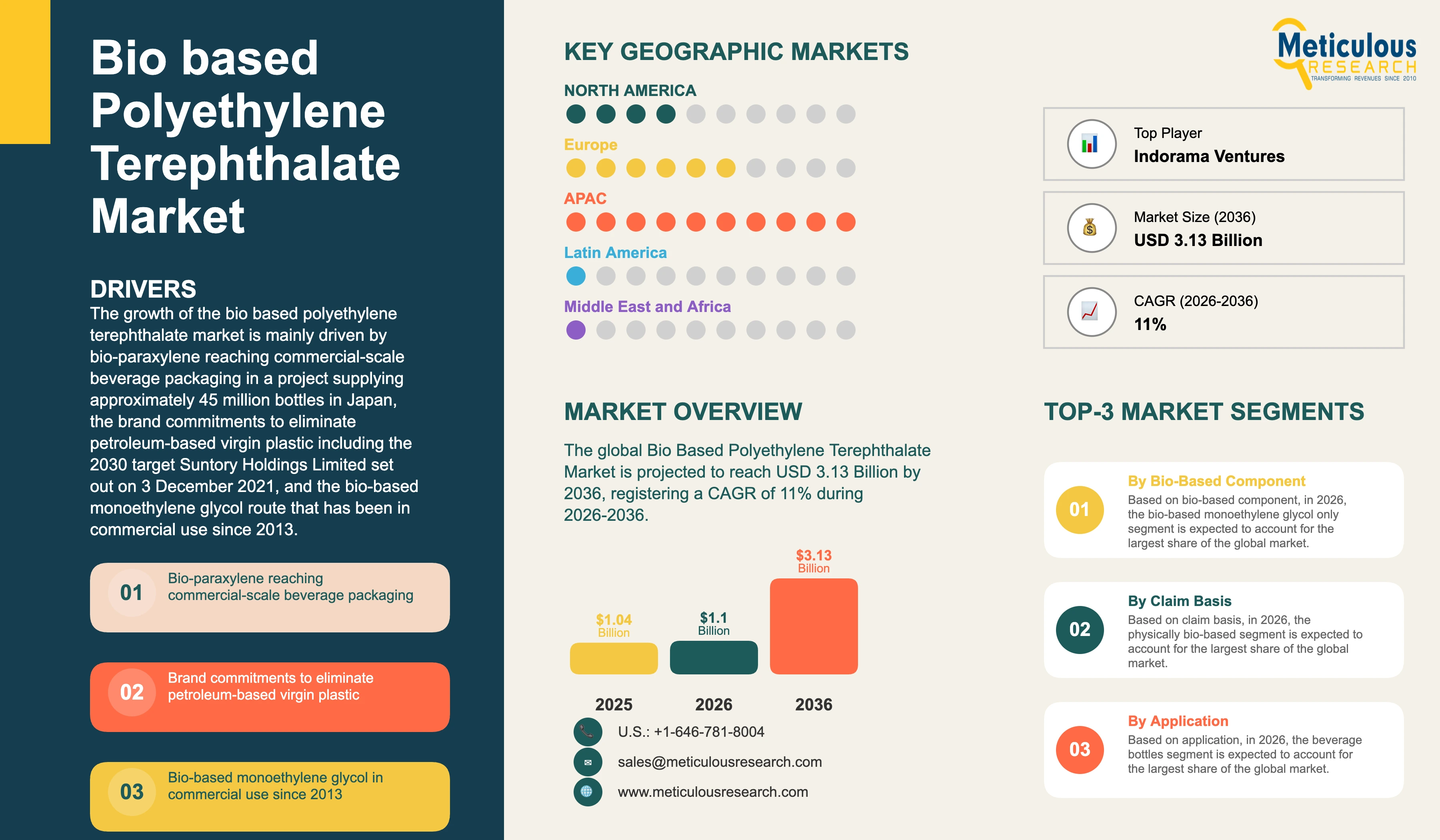
The global bio based polyethylene terephthalate market was valued at USD 1.04 billion in 2025. This market is expected to reach USD 3.13 billion by 2036 from an estimated USD 1.10 billion in 2026, registering a CAGR of 11.0% during the forecast period (2026-2036).
- Published
- Nov 2026
- Pages
- 250
- Format
- PDF + Excel
- Report ID
- MRCHM - 1042683
- Base year
- 2025
- 2025 · BASELINE
- $1.04B
- 2036
- $3.13B
- CAGR 2026–2036
- 11.0%
2025 baseline · 2026–2036 forecast at 11.0% CAGR · hover a bar for the value
Key highlights
The global bio based polyethylene terephthalate market is estimated at USD 1.10 billion in 2026 and is projected to reach USD 3.13 billion by 2036.
Market volume is estimated at 760.00 kilotons in 2026 and is projected to reach 2, 446.09 kilotons by 2036 at a CAGR of 12.4%, measured as bio-based PET resin supplied.
The average selling price is estimated at USD 1.45 per kg in 2026 and is projected to reach USD 1.28 per kg by 2036 as the premium over fossil resin narrows.
Resin with bio-based monoethylene glycol alone is expected to account for the largest bio-based component share in 2026, while resin with both bio-based monoethylene glycol and bio-based terephthalic acid is projected to register the highest CAGR of 32.0%.
Physically bio-based material is expected to hold the largest claim basis share in 2026, while mass-balance bio-attributed material is projected to grow fastest at a CAGR of 16.0%.
Beverage bottles are expected to be the largest application in 2026, while textiles and fibre is projected to register the highest CAGR of 15.0%.
Asia-Pacific is expected to hold the largest regional share in 2026, while Europe is projected to register the highest CAGR of 13.2%.
Suntory Holdings Limited stated in its release of 3 December 2021 that PET is made from two raw materials, 70% terephthalic acid and 30% monoethylene glycol.
The company announced prototype PET bottles made from 100% plant-based materials, produced for Orangina in Europe and Suntory Tennensui in Japan.
The plant-based paraxylene for those prototypes was supplied by Anellotech, Inc. and made from wood chips before conversion to plant-based terephthalic acid.
The Anellotech Bio-TCat process converts biomass directly to benzene, toluene and xylene in a single thermal catalytic step, with IFPEN and Axens named as its research, engineering and licensing partners for a first commercial plant.
The bio-based monoethylene glycol used is made from molasses and has been used in Suntory Tennensui in Japan since 2013.
Suntory Holdings Limited stated a goal of using 100% sustainable PET bottles globally by 2030, eliminating petroleum-based virgin plastic from its PET supply, and a net-zero greenhouse gas ambition across its value chain by 2050.
The 2021 release gives no bottle sizes, no volumes and no commercialisation date beyond an intention to commercialise as soon as possible.
A later commercial-scale bio-PET bottle project involves Suntory, ENEOS Corporation, Mitsubishi Corporation, Iwatani Corporation and Neste Corporation.
That project uses ISCC+ certified bio-paraxylene produced from used cooking oil under a mass-balance approach, in which the bio-based characteristic is allocated to a share of output in proportion to the bio-material used.
It covers approximately 45 million PET bottles in 280 ml and 285 ml sizes for selected Suntory beverages in Japan, described as the world first bio-PET bottle at commercial scale.
The bio-based content percentage, the production site and the identity of the bio-paraxylene producer are not stated for that project.
This market is a fraction of the total PET market rather than an addition to it, and is not additive to the recycled PET market with which it competes for the same packaging commitments.
Report summary
| Particulars | Details |
|---|---|
| Base Year | 2025 |
| Forecast Period | 2026-2036 |
| Market Size in 2025 | USD 1.04 billion |
| Market Size in 2026 | USD 1.10 billion |
| Market Size by 2036 | USD 3.13 billion |
| Value CAGR (2026-2036) | 11.0% |
| Format | PDF, Excel & Cloud Portal · 250 pages |
| Volume in 2026 | 760.00 kilotons |
| Volume by 2036 | 2,446.09 kilotons |
| Volume CAGR (2026-2036) | 12.4% |
| Volume Basis | Bio-based PET resin supplied, on a product-mass basis rather than on the mass of bio-based carbon contained |
| Average Selling Price in 2026 | USD 1.45 per kg |
| Average Selling Price by 2036 | USD 1.28 per kg |
| Monomer Mass Split | PET is made from two raw materials, 70% terephthalic acid and 30% monoethylene glycol, which fixes the renewable content achievable from each monomer route |
| Price Direction | Average selling price declines across the forecast period as bio-based monoethylene glycol capacity expands and mass-balance supply narrows the premium over fossil resin, rather than through any change in the resin itself |
| Measurement Basis | Bottle, fibre, film and sheet grade PET carrying certified renewable content in one or both monomers, from bio-based monoethylene glycol, bio-based terephthalic acid and mass-balance attribution, and excluding fossil PET without a certified claim, mechanically and chemically recycled PET, bio-based monoethylene glycol, terephthalic acid and paraxylene sold as such, polyethylene furanoate and other furan-based polyesters, biodegradable polyesters including polylactic acid, and converted bottles, preforms, films and fibres |
| Relationship to Adjacent Markets | This market is a fraction of the total PET market rather than an addition to it, since every tonne counted here substitutes for fossil resin, and it is not additive to the recycled PET market with which it competes for the same packaging commitments, nor to the monomer markets upstream or the converted article markets downstream |
| Largest Bio-Based Component | Bio-based monoethylene glycol only |
| Fastest-Growing Bio-Based Component | Bio-based monoethylene glycol with bio-based terephthalic acid (CAGR 32.0%) |
| Largest Claim Basis | Physically bio-based |
| Fastest-Growing Claim Basis | Mass-balance bio-attributed (CAGR 16.0%) |
| Largest Application | Beverage bottles |
| Fastest-Growing Application | Textiles and fibre (CAGR 15.0%) |
| Largest Region | Asia-Pacific |
| Fastest-Growing Region | Europe (CAGR 13.2%) |
| Segments Covered | Bio-Based Component, Claim Basis, Application, and Geography |
| Geographies Covered | Asia-Pacific, Europe, North America, Latin America, and Middle East & Africa |
| Companies Profiled | 11 companies, including Indorama Ventures Public Company Limited, Far Eastern New Century Corporation, Alpek, S.A.B. de C.V., ENEOS Corporation, Neste Corporation, and Origin Materials, Inc. |
Report overview
Segments covered: bio-based component, claim basis, application.
In volume terms, this market is estimated at 760.00 kilotons in 2026 and is projected to reach 2,446.09 kilotons by 2036, registering a CAGR of 12.4% during the same period, measured as bio-based polyethylene terephthalate resin supplied on a product-mass basis rather than on the mass of bio-based carbon it contains. The average selling price is estimated at USD 1.45 per kg in 2026 and is projected to decline to USD 1.28 per kg by 2036 as bio-based monoethylene glycol capacity expands and as mass-balance supply narrows the premium over fossil resin.
The growth of this market is mainly driven by the commercial-scale bio-paraxylene supply that reached beverage packaging, including the approximately 45 million bottles of ISCC+ certified material supplied for Suntory beverages in Japan, the brand commitments to eliminate petroleum-based virgin plastic that Suntory Holdings Limited set out on 3 December 2021 with a target of 100% sustainable PET bottles globally by 2030, the bio-based monoethylene glycol route that has been in commercial use since 2013, and the chemical identity of the resin with fossil PET that allows substitution without requalification. However, factors such as the 70% of PET mass that is terephthalic acid and remains predominantly fossil, the limited bio-paraxylene capacity available at commercial scale, the competition from recycled PET for the same packaging commitments, and the price premium over fossil resin are expected to restrain the growth of this market to some extent.
Resin containing bio-based monoethylene glycol alone accounts for the largest share of this market because that route has been commercially available since 2013 and delivers the whole of the glycol portion of the polymer. Resin containing both bio-based monoethylene glycol and bio-based terephthalic acid grows fastest because it is the only route to a content level above the glycol share, which is what brand commitments beyond partial substitution require.
Bio based polyethylene terephthalate is PET carrying certified renewable carbon in one or both of its monomers, whether from bio-based monoethylene glycol, bio-based terephthalic acid or a mass-balance allocation of renewable feedstock. Market sizing in this report is on both a value basis in USD and a volume basis in kilotons measured as bio-based PET resin supplied on a product-mass basis, with average selling price derived from the two. The measurement basis covers bottle, fibre, film and sheet grades carrying certified renewable content, and it excludes fossil PET without a certified claim, mechanically and chemically recycled PET, bio-based monoethylene glycol, terephthalic acid and paraxylene where sold as such, polyethylene furanoate and other furan-based polyesters, biodegradable polyesters including polylactic acid, and converted bottles, preforms, films and fibres.
Excluding polyethylene furanoate matters because it is frequently discussed alongside bio-PET and is a different polymer. It is made from furandicarboxylic acid rather than terephthalic acid, has different barrier and thermal properties, requires its own recycling stream and cannot be processed as PET. A brand choosing between the two is choosing between substituting a monomer in a familiar polymer and adopting a new one, which are not comparable decisions.
Suntory Holdings Limited stated in its release of 3 December 2021 that PET is made from two raw materials, 70% terephthalic acid and 30% monoethylene glycol, and announced prototype bottles made from 100% plant-based materials for Orangina in Europe and Suntory Tennensui in Japan. The plant-based paraxylene was supplied by Anellotech, Inc. from wood chips, using a Bio-TCat process that converts biomass directly to benzene, toluene and xylene in a single thermal catalytic step, with IFPEN and Axens named as its research, engineering and licensing partners for a first commercial plant. The bio-based monoethylene glycol is made from molasses and has been used in Suntory Tennensui since 2013.
That 70 to 30 split is the single most important number in this market. Because monoethylene glycol is only 30% of PET by mass and bio-based glycol has been commercially available since 2013, a bottle described as plant-based has usually meant about 30% renewable content, and every percentage point beyond that requires bio-based terephthalic acid, which means bio-based paraxylene. The glycol problem was solved more than a decade ago and the paraxylene problem was not, which is why this market has sat at roughly a third bio-based for years while the headlines have described fully plant-based bottles.
A later project takes a different route to the same objective. Suntory, ENEOS Corporation, Mitsubishi Corporation, Iwatani Corporation and Neste Corporation are supplying approximately 45 million PET bottles in 280 ml and 285 ml sizes for selected Suntory beverages in Japan, described as the world first bio-PET bottle at commercial scale, using ISCC+ certified bio-paraxylene produced from used cooking oil under a mass-balance approach in which the bio-based characteristic is allocated to a share of output in proportion to the bio-material used. The bio-based content percentage, the production site and the identity of the bio-paraxylene producer are not stated.
The contrast between the two projects describes the choice facing this market. The 2021 prototypes used paraxylene physically derived from wood, which supports a claim about what is in the bottle but required a first commercial plant that had not been built. The later project uses mass-balance paraxylene from used cooking oil, which can be supplied through existing aromatics assets and reached 45 million bottles rather than a prototype run. One route proves the chemistry and the other delivers the volume, and they support different claims from an identical polymer.
Used cooking oil as a feedstock also changes the sustainability argument in a way a buyer should understand. It is a residue rather than a crop, so it carries no land use or food competition question, but its supply is finite and it is contested by renewable diesel and aviation fuel producers whose policy support and willingness to pay exceed those of packaging. A packaging buyer competing for that feedstock is therefore bidding against the fuel sector rather than against other polymer producers.
Chemical identity with fossil PET is what makes substitution practical and also what caps the premium. A converter can run bio-based resin on existing injection, stretch blow moulding and spinning equipment without reformulating, requalifying a preform or changing a mould, and the bottle goes into the same recycling stream. The resin offers no performance advantage, so the premium rests entirely on the certified claim, and a brand weighs that claim against recycled content rather than against fossil resin.
Recycled PET is the competitor that matters, not another bio-based producer. Packaging rules in Europe and elsewhere set recycled content targets specifically, collection and sorting infrastructure is expanding, and recycled resin carries a circularity argument that bio-based material does not, so a brand with a sustainable packaging commitment generally reaches for recyclate first. Bio-based PET therefore competes for the residual part of a commitment that recyclate cannot fill, which is why its growth depends on recyclate availability as much as on its own capacity.
Textiles are the application most likely to be underestimated. Polyester fibre consumes more PET than packaging does, apparel and footwear brands hold renewable content commitments of their own, and a fibre customer is less constrained by food contact approval and bottle-to-bottle recycling requirements than a beverage customer. The same resin chemistry serves both. Textiles and fibre consequently registers the highest application CAGR at 15.0% during the forecast period.
This market is a fraction of the PET market rather than an addition to it. Every tonne counted here is a tonne of PET that would otherwise have been supplied as fossil resin, so growth comes by substitution within a total set by packaging and fibre demand. It is also not additive to the recycled PET market, to the bio-based monoethylene glycol, terephthalic acid and paraxylene markets upstream, or to the converted bottle, film and fibre markets downstream.
Asia-Pacific is expected to account for the largest share in 2026, on the concentration of PET and polyester fibre capacity across the region and the commercial-scale bio-PET bottle project in Japan. India is projected to grow at 12.4%, Japan at 11.6% and China at 10.6%.
Europe is projected to register the highest CAGR of 13.2% during the forecast period, with Germany at 13.6%, France at 13.0% and the United Kingdom at 12.4%.
Europe is the fastest-growing region at a CAGR of 13.2%, on packaging rules tightening requirements on material content, the renewable content commitments of the beverage, food and personal care companies headquartered there, the established recognition of mass-balance certification schemes, and the renewable feedstock processing capacity available in the region.
The Middle East & Africa is projected to grow at a CAGR of 8.0% on mass-balance supply from regional aromatics capacity. Latin America is projected to grow at a CAGR of 9.0%, with Brazil at 9.0%, on sugar-based feedstock availability rather than on resin capacity.
Indorama Ventures Public Company Limited, Far Eastern New Century Corporation, Alpek, S.A.B. de C.V., Reliance Industries Limited and Saudi Basic Industries Corporation together accounted for an estimated 56.8% of this market in 2026. The 11 companies profiled in this report together accounted for an estimated 74.2%.
Resin with both bio-based monoethylene glycol and bio-based terephthalic acid is projected to register the highest CAGR of 32.0% during the forecast period.
Report infographic
Market dynamics
15 factors across 5 forcesBio-Paraxylene Reaching Commercial-Scale Beverage Packaging
A project involving Suntory, ENEOS Corporation, Mitsubishi Corporation, Iwatani Corporation and Neste Corporation is supplying approximately 45 million PET bottles in 280 ml and 285 ml sizes for selected Suntory beverages in Japan using ISCC+ certified bio-paraxylene from used cooking oil, described as the world first bio-PET bottle at commercial scale. Reaching the paraxylene side of the molecule at that volume addresses the 70% of PET mass that had remained fossil. The driver acts on achievable content level rather than on total tonnage.
Supplying the acid side at volume is what raises the achievable content level, since no quantity of bio-based glycol can take a bottle beyond the glycol share of the molecule.
The route also demonstrates that bio-paraxylene can be delivered through existing aromatics assets rather than requiring a dedicated plant, which shortens the path from a brand commitment to resin a converter can actually buy.
Reaching commercial volume through existing assets rather than a dedicated plant also shortens the path from a stated commitment to resin a converter can buy, which is what distinguishes this project from the prototypes that preceded it.
Brand Commitments to Eliminate Petroleum-Based Virgin Plastic
Suntory Holdings Limited stated on 3 December 2021 a goal of using 100% sustainable PET bottles globally by 2030, eliminating petroleum-based virgin plastic from its PET supply, alongside a net-zero greenhouse gas ambition across its value chain by 2050. Commitments of that form create a requirement that a converter satisfies through resin purchasing rather than through pack design. Demand in this market is therefore set by brand strategy and packaging regulation rather than by resin economics, and the buyer is often the brand rather than the converter placing the order.
The brand making the decision is usually several steps removed from the resin order and specifies the material through its converter, so the selling effort and the purchase order sit in different places.
Bio-Based Monoethylene Glycol in Commercial Use Since 2013
The bio-based monoethylene glycol used by Suntory Holdings Limited is made from molasses and has been used in Suntory Tennensui in Japan since 2013, which gives the glycol route more than a decade of commercial packaging history and removes the technology and reliability questions that attach to newer bio-based materials. Because glycol is 30% of PET by mass, that route alone supports a substantial renewable content claim. It is the reason the largest part of this market exists at all rather than remaining a development activity.
More than a decade of commercial packaging history on the glycol route also removes the shelf-life and processability objections that usually accompany a material change, which is why that part of the market needed no further proving.
Chemical Identity Allowing Substitution Without Requalification
A converter can run bio-based PET on existing injection, stretch blow moulding and spinning equipment without reformulating, requalifying a preform or changing a mould, and the finished bottle enters the same recycling stream as fossil PET, because the polymer is identical. Adoption is therefore a procurement decision rather than a development project and can proceed at the speed of contract renewal. It also means the resin competes only on its certified claim, since it offers no technical advantage.
It also means the resin competes only on its certified claim, so the commercial work is about monomer access, certification and contract terms rather than about specification.
A fourth driver is the recycling compatibility of the resin. Because bio-based PET is chemically identical to fossil PET it enters the same bottle-to-bottle stream without contaminating it, which means a brand can pursue a renewable content claim and a recyclability claim at once rather than trading one against the other, and that is not true of the alternative bio-based polyesters.
Table of contents
11 chapters · 132 sections · 250 pages · click to expandSegmental analysis
| Segment | Largest share (2026) | Fastest growth (2026–2036) |
|---|---|---|
| By Bio-Based Component | Resin with bio-based monoethylene glycol alone | — |
| Other segments | — | Mass-balance bio-attributed material |
By Bio-Based Component
- Resin with bio-based monoethylene glycol alone is expected to account for the largest share in 2026, on that route having been in commercial packaging use since 2013 and on the 30% glycol share of PET mass supporting a renewable content claim on its own.
- Physically bio-based material is expected to hold the largest share in 2026, since bio-based monoethylene glycol is physically incorporated into the polymer and brands making claims about pack composition prefer renewable carbon verifiable in the product.
- Beverage bottles are expected to account for the largest share in 2026, on the renewable content commitments of the beverage brands that drove development of the material and the visibility of the pack to the consumer.
Other segments
- Mass-balance bio-attributed material is projected to register the highest CAGR of 16.0% during the forecast period.
- Textiles and fibre is projected to register the highest CAGR of 15.0% during the forecast period.
Geographic analysis
Asia-Pacific
Largest shareIn 2026, Asia-Pacific is expected to account for the largest share of the global bio based polyethylene terephthalate market. The large share of this region is mainly due to the concentration of PET and polyester fibre capacity across China, India, Thailand and Taiwan, the commercial-scale bio-PET bottle project supplying approximately 45 million bottles for Suntory beverages in Japan, and the bio-based monoethylene glycol capacity in the region. India is projected to register a CAGR of 12.4%, Japan a CAGR of 11.6% and China a CAGR of 10.6% during the forecast period.
Europe
Fastest growthHowever, Europe is projected to register the highest CAGR of 13.2% during the forecast period. The rapid growth of this region is attributed to packaging rules tightening requirements on material content, the renewable content commitments of the beverage, food and personal care companies headquartered there, the established recognition of mass-balance certification schemes, and the renewable feedstock processing capacity available in the region. Germany is projected to register a CAGR of 13.6%, France a CAGR of 13.0% and the United Kingdom a CAGR of 12.4%.
North America
North America is projected to grow at 10.0%, with the United States at 10.2%, on brand commitments and on bio-paraxylene technology development based there, though with recycled content targets absorbing much of the available sustainable packaging budget.
Latin America
Latin America is projected to grow at 9.0%, with Brazil at 9.0%, on sugar-based feedstock availability.
Middle East & Africa
The Middle East & Africa is projected to grow at 8.0% on mass-balance supply from regional aromatics capacity. Regional capacity to certify monomer supply is therefore the variable that determines how fast a region grows, since resin polymerisation capacity is already in place almost everywhere PET is consumed. Feedstock, monomer and resin production are distributed differently in this market, and the claim travels with the certificate rather than with the material. Bio-based glycol and certified paraxylene are produced where molasses, sugar or renewable feedstock processing capacity exists, resin is polymerised where PET capacity exists, and the brand commitment that creates the demand usually sits in Europe, North America or Japan. Regional share therefore describes where the resin is supplied rather than where renewable carbon enters the chain. That separation also means a regional growth rate describes where brand commitments are held rather than where capacity sits, and the certificate travels where the material does not. Application mix also differs by region in a way the segment totals conceal. European demand is concentrated in packaging against regulatory requirements, Asian demand spreads across packaging and polyester fibre serving export brands, and North American demand sits largely in beverage programmes where recycled content targets absorb much of the available budget, so a regional growth rate describes a different basket of applications in each case.
Competitive landscape
The global bio based polyethylene terephthalate market is characterised by the presence of large PET producers polymerising certified monomers into resin, aromatics and refining companies supplying certified paraxylene, trading houses structuring the certified supply chains, and technology companies developing routes to physically bio-based paraxylene. Competition is contested on the monomer basis and certification a producer can offer rather than on resin performance, because the polymer is identical to fossil PET and the routes support different claims. Indorama Ventures Public Company Limited, Far Eastern New Century Corporation, Alpek, S.A.B. de C.V., Reliance Industries Limited and Saudi Basic Industries Corporation together accounted for an estimated 56.8% of this market in 2026, while the companies profiled in this report together accounted for an estimated 74.2%.
Suntory Holdings Limited announced on 3 December 2021 prototype PET bottles made from 100% plant-based materials for Orangina in Europe and Suntory Tennensui in Japan, with plant-based paraxylene from Anellotech, Inc. made from wood chips using a Bio-TCat process and bio-based monoethylene glycol from molasses in use since 2013, stating that PET is 70% terephthalic acid and 30% monoethylene glycol and setting a goal of 100% sustainable PET bottles globally by 2030. A later project with ENEOS Corporation, Mitsubishi Corporation, Iwatani Corporation and Neste Corporation supplies approximately 45 million bottles in Japan using ISCC+ certified bio-paraxylene from used cooking oil under a mass-balance approach. Certification of paraxylene supply, qualification of residue feedstocks and combined bio-based and recycled content offers accounted for most competitive activity through 2026.
Monomer access rather than polymerisation capability separates the competitors, because any PET producer can polymerise certified monomers while very few can obtain certified paraxylene at volume. Indorama Ventures Public Company Limited, Far Eastern New Century Corporation, Alpek, S.A.B. de C.V., Reliance Industries Limited and Saudi Basic Industries Corporation compete from PET and polyester capacity, ENEOS Corporation and Neste Corporation from aromatics and renewable feedstock processing, Mitsubishi Corporation and Iwatani Corporation from certified supply chain structuring, and Origin Materials, Inc. and Anellotech, Inc. from routes to physically bio-based paraxylene under development. Some of the key players operating in the bio based polyethylene terephthalate market are Indorama Ventures Public Company Limited (Thailand), Far Eastern New Century Corporation (Taiwan), Alpek, S.A.B. de C.V. (Mexico), Reliance Industries Limited (India), Saudi Basic Industries Corporation (Saudi Arabia), ENEOS Corporation (Japan), Neste Corporation (Finland), Mitsubishi Corporation (Japan), Iwatani Corporation (Japan), Origin Materials, Inc. (U.S.), and Anellotech, Inc. (U.S.), among others.
- —
Suntory Holdings Limited announced on 3 December 2021 prototype PET bottles made from 100% plant-based materials, produced for Orangina in Europe and Suntory Tennensui in Japan, with plant-based paraxylene supplied by Anellotech, Inc. from wood chips using a Bio-TCat process that converts biomass directly to benzene, toluene and xylene in a single thermal catalytic step, and IFPEN and Axens named as research, engineering and licensing partners for a first commercial plant. The bio-based monoethylene glycol used is made from molasses and has been used in Suntory Tennensui in Japan since 2013. The company stated that PET is made from two raw materials, 70% terephthalic acid and 30% monoethylene glycol, and set out a goal of using 100% sustainable PET bottles globally by 2030, eliminating petroleum-based virgin plastic from its PET supply, alongside a net-zero greenhouse gas ambition across its value chain by 2050, with no bottle sizes, volumes or commercialisation date given beyond an intention to commercialise as soon as possible. A later commercial-scale project involving Suntory, ENEOS Corporation, Mitsubishi Corporation, Iwatani Corporation and Neste Corporation supplies approximately 45 million PET bottles in 280 ml and 285 ml sizes for selected Suntory beverages in Japan, using ISCC+ certified bio-paraxylene produced from used cooking oil under a mass-balance approach in which the bio-based characteristic is allocated to a share of output in proportion to the bio-material used, and described as the world first bio-PET bottle at commercial scale, with the bio-based content percentage, the production site and the identity of the bio-paraxylene producer not stated.
- Indorama Ventures Public Company Limited
- Far Eastern New Century Corporation
- Alpek
- S.A.B. de C.V
- ENEOS Corporation
- Neste Corporation
- Origin Materials, Inc
Expert perspectives
Volume grows at 12.4% against 11.0% in value over the forecast period, and the average selling price falls from USD 1.45 per kg in 2026 to USD 1.28 per kg by 2036 as bio-based glycol capacity expands and mass-balance supply narrows the premium over fossil resin. The gap between the two rates is the premium compressing rather than the market weakening.
The number that governs this market is 70 to 30. Terephthalic acid is 70% of PET by mass and monoethylene glycol 30%, bio-based glycol has been in commercial packaging since 2013 and bio-based paraxylene has not reached comparable scale, so a bottle described as plant-based has usually meant about a third renewable content. The glycol problem was solved more than a decade ago and the paraxylene problem was not.
The two Suntory projects show the trade-off plainly. The 2021 prototypes used paraxylene physically derived from wood chips, which supports a claim about pack composition but depended on a commercial plant that had not been built, while the later project uses ISCC+ mass-balance paraxylene from used cooking oil through existing assets and reached approximately 45 million bottles. One route proves the chemistry, the other delivers the volume, and they support different claims from an identical polymer.
Used cooking oil solves one problem and introduces another. As a residue it carries no land use or food competition question, which a molasses or sugar feedstock eventually attracts, but it is contested by renewable diesel and aviation fuel producers whose policy support and willingness to pay exceed those of packaging. A packaging buyer is therefore bidding against the fuel sector for its feedstock.
Recycled PET rather than another bio-based producer is the competitor to watch. Packaging rules set recycled content targets specifically, recyclate carries a circularity argument that bio-based material does not, and collection capacity is expanding, so bio-based resin competes for the residual part of a commitment that recyclate cannot fill. Demand here moves with recyclate availability as much as with its own capacity.
Textiles are the part of this market most likely to be underestimated, which is why they grow at 15.0%. Polyester fibre consumes more PET than packaging does, apparel and footwear brands carry their own commitments, and a fibre customer faces neither food contact approval nor bottle-to-bottle recycling constraints. This market is also a fraction of the PET market rather than an addition to it, and not additive to recycled PET or to the monomer markets upstream.
Customer perspectives
Because monoethylene glycol is only 30% of PET by mass, renewable content above roughly a third requires bio-based terephthalic acid, which makes paraxylene availability rather than purchasing the constraint on higher content claims.
The honest answer of about a third also sets the terms of every conversation in this market, because a commitment written as a high percentage cannot be met from the glycol route however much resin is available.
Fibre applications face neither food contact approval nor bottle-to-bottle recycling requirements, so they accept a wider range of content levels and resin sources than beverage packaging, which is why textiles grow fastest.
Fibre customers also buy on a multi-year yarn contract rather than on an annual packaging tender, which gives a resin producer the volume visibility that beverage supply does not.
The resin substitutes into existing converting equipment and recycling streams without requalification, so adoption turns on whether a brand allocates its sustainable packaging budget to renewable or recycled content.
Taken together the three perspectives describe a resin that is trivial to process, limited in how much renewable content it can carry, and bought from a budget it shares with recycled material.
“When we say plant-based, the first question we get is what percentage, and the honest answer for most of the market is about thirty. Getting beyond that means solving the acid side, and that is not a procurement conversation, it is a chemistry one.”
“We are not bound by food contact rules or bottle-to-bottle collection, so we can take content levels and resin sources a beverage brand cannot. For fibre this material is far easier to adopt than people assume.”
“It runs on our existing moulds and goes into the same recycling stream, so processing is not the question. The question is whether our customer wants renewable content or recycled content this year, because the budget is the same one.”
Frequently asked questions
This market was valued at USD 976.5 million in 2024 and USD 1.04 billion in 2025, and is estimated at USD 1.10 billion in 2026. In volume terms it is estimated at 760.00 kilotons in 2026 as bio-based PET resin supplied.
This market is projected to reach USD 3.13 billion by 2036 in value and 2,446.09 kilotons in volume.
This market is projected to register a value CAGR of 11.0% and a volume CAGR of 12.4% during the forecast period 2026-2036. The average selling price is projected to move from USD 1.45 per kg in 2026 to USD 1.28 per kg by 2036 as the premium over fossil resin narrows.
Growth is driven by bio-paraxylene reaching commercial-scale beverage packaging in a project supplying approximately 45 million bottles for Suntory beverages in Japan, and by brand commitments to eliminate petroleum-based virgin plastic, including Suntory's 2030 target. The bio-based monoethylene glycol route in commercial use since 2013 and the chemical identity with fossil PET that allows substitution without requalification also contribute.
Terephthalic acid is 70% of PET by mass and remains predominantly fossil, so most material carries renewable content of around the glycol share, and bio-paraxylene capacity at commercial scale is limited. Recycled PET competes for the same packaging commitments, and residue feedstocks are contested by renewable diesel and aviation fuel producers that can pay more.
Mass balance delivers bio-paraxylene through existing aromatics assets without new investment, and textiles and fibre consume more PET than packaging and face fewer constraints. Residue feedstocks such as used cooking oil avoid land use questions, and combined bio-based and recycled content offers meet commitments that neither material satisfies alone.
Resin with bio-based monoethylene glycol alone is expected to account for the largest share in 2026, on that route having been in commercial packaging use since 2013 and on the 30% glycol share of PET mass supporting a renewable content claim on its own.
Resin with both bio-based monoethylene glycol and bio-based terephthalic acid is projected to register the highest CAGR of 32.0% during the forecast period.
Physically bio-based material is expected to hold the largest share in 2026, since bio-based monoethylene glycol is physically incorporated into the polymer and brands making claims about pack composition prefer renewable carbon verifiable in the product.
Mass-balance bio-attributed material is projected to register the highest CAGR of 16.0% during the forecast period.
Beverage bottles are expected to account for the largest share in 2026, on the renewable content commitments of the beverage brands that drove development of the material and the visibility of the pack to the consumer.
Textiles and fibre is projected to register the highest CAGR of 15.0% during the forecast period.
Asia-Pacific is expected to account for the largest share in 2026, on the concentration of PET and polyester fibre capacity across the region and the commercial-scale bio-PET bottle project in Japan. India is projected to grow at 12.4%, Japan at 11.6% and China at 10.6%.
Europe is projected to register the highest CAGR of 13.2% during the forecast period, with Germany at 13.6%, France at 13.0% and the United Kingdom at 12.4%.
Europe is the fastest-growing region at a CAGR of 13.2%, on packaging rules tightening requirements on material content, the renewable content commitments of the beverage, food and personal care companies headquartered there, the established recognition of mass-balance certification schemes, and the renewable feedstock processing capacity available in the region.
The Middle East & Africa is projected to grow at a CAGR of 8.0% on mass-balance supply from regional aromatics capacity. Latin America is projected to grow at a CAGR of 9.0%, with Brazil at 9.0%, on sugar-based feedstock availability rather than on resin capacity.
Indorama Ventures Public Company Limited, Far Eastern New Century Corporation, Alpek, S.A.B. de C.V., Reliance Industries Limited and Saudi Basic Industries Corporation together accounted for an estimated 56.8% of this market in 2026. The 11 companies profiled in this report together accounted for an estimated 74.2%.
Suntory Holdings Limited announced on 3 December 2021 prototype PET bottles made from 100% plant-based materials for Orangina in Europe and Suntory Tennensui in Japan, with plant-based paraxylene supplied by Anellotech, Inc. from wood chips. A later commercial-scale project involving Suntory, ENEOS Corporation, Mitsubishi Corporation, Iwatani Corporation and Neste Corporation supplies approximately 45 million PET bottles in Japan using ISCC+ certified bio-paraxylene from used cooking oil under a mass-balance approach.
Cite this report
Meticulous Research. (2026). Bio Based Polyethylene Terephthalate Market - Global Opportunity Analysis and Industry Forecast (2026-2036) (Report No. MRCHM - 1042683). Meticulous Market Research Pvt. Ltd. https://www.meticulousresearch.com/product/bio-based-polyethylene-terephthalate-market-7366