Depolymerisation Catalysts Market (2026-2036)
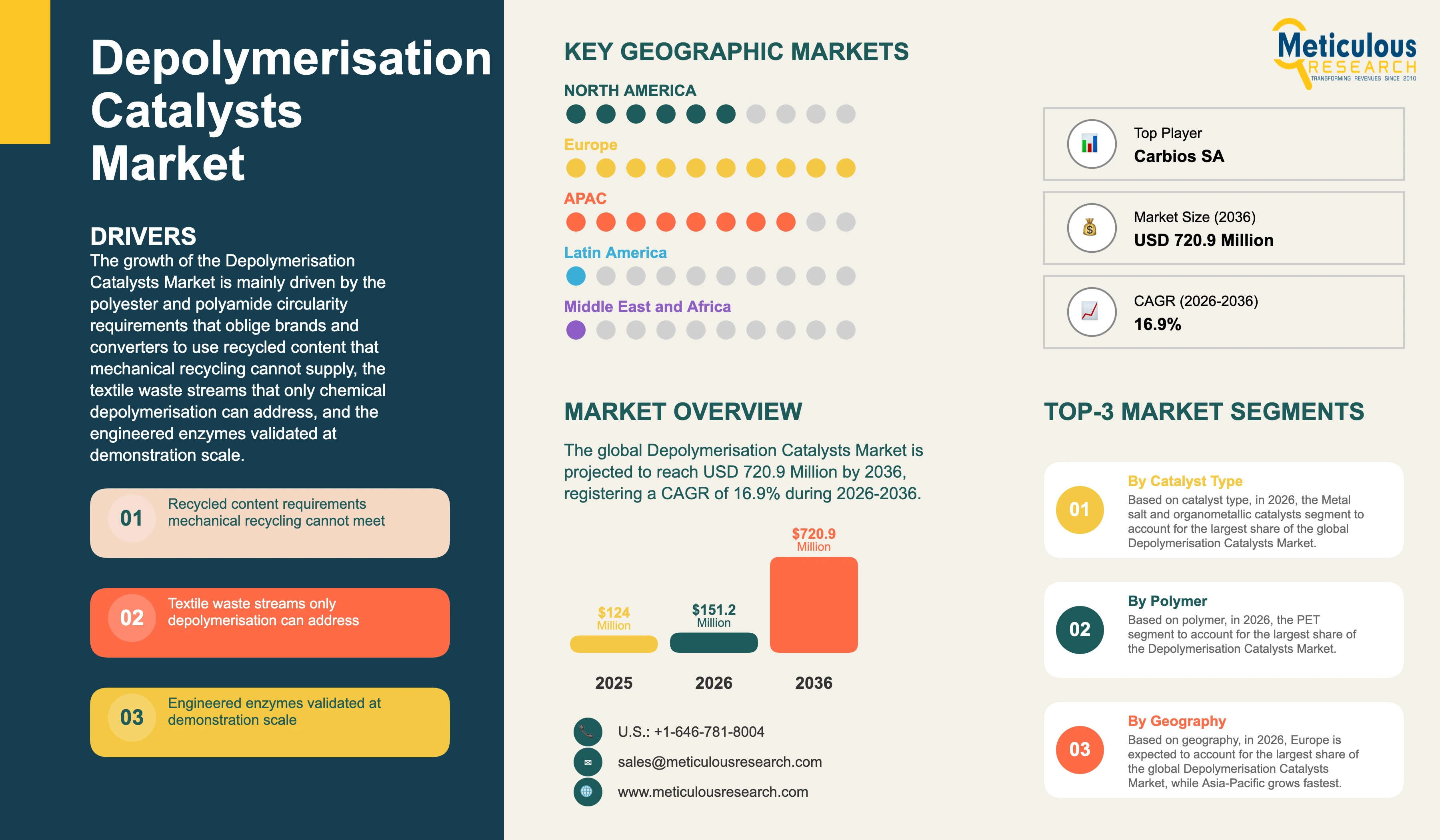
The global depolymerisation catalysts market was valued at USD 124.0 million in 2025. This market is expected to reach USD 720.9 million by 2036 from an estimated USD 151.2 million in 2026, registering a CAGR of 16.9% during the forecast period (2026-2036).
- Published
- Nov 2026
- Pages
- 256
- Format
- PDF + Excel
- Report ID
- MRCHM - 1042800
- Base year
- 2025
- 2025 · BASELINE
- $124.0M
- 2036
- $720.9M
- CAGR 2026–2036
- 16.9%
2025 baseline · 2026–2036 forecast at 16.9% CAGR · hover a bar for the value
Key highlights
The global depolymerisation catalysts market is estimated at USD 151.2 million in 2026 and is projected to reach USD 720.9 million by 2036.
Market volume is estimated at 3.60 kilotons in 2026 and is projected to reach 13.35 kilotons by 2036 at a CAGR of 14.0%, measured as catalyst and enzyme supplied on a product mass basis.
The average selling price blends chemistries whose prices differ by orders of magnitude, so it measures the mix rather than the price of any single catalyst.
Metal salt and organometallic catalysts are expected to account for the largest catalyst type share in 2026, while engineered enzymes are projected to register the highest CAGR of 24.0%.
PET is expected to hold the largest polymer share in 2026, while polyurethane is projected to grow fastest at a CAGR of 20.0%.
Europe is expected to hold the largest regional share in 2026, while Asia-Pacific is projected to register the highest CAGR of 18.0%.
Carbios announced on 21 July 2026 that it had reached a milestone of 100 batches at its Clermont-Ferrand demonstration plant, covering packaging and textile waste processed since commissioning.
That release reports more than 95% conversion achieved within 24 hours on complex textile waste streams, with monomers described as equivalent to virgin quality and results described as consistent and reproducible.
On the strength of that validation the company extended its licensing offering from packaging to the global textile market, development of which it says began in 2025.
That release gives no plant capacity or throughput, no monomer purity figures, no cycle time per batch, no named licensees or customers, no licensing terms and no timeline for first textile licences.
Carbios reported on 24 September 2026 that construction of its Longlaville plant remains to be resumed, listing the resumption of construction among its forward priorities.
That report states that credit committees of a majority of the project lenders have approved it, while export credit agencies Bpifrance Assurance Export and EIFO and equity partners were still conducting due diligence, and describes the financing process as necessarily extensive without giving a closing date.
A commercial agreement with a major player in the beverage industry was being finalised and was expected to raise pre-sales to 60% of nominal capacity, though the report does not state whether it had been signed.
For the first half of 2026 the company reported operating revenues of EUR 2.593 million against EUR 2.143 million a year earlier, operating expenses down 19% to EUR 14.352 million, an operating loss of EUR 11.8 million and a net loss of EUR 9.4 million against EUR 11.9 million.
Group cash stood at EUR 48 million at 30 June 2026, which the company says covers operating expenses beyond the next 12 months, with group cash consumption of EUR 11 million in the half against EUR 18 million a year earlier.
A strategic partnership with Wankai New Materials was signed on 2 December 2025 and the joint venture Kaibio Biotechnology Co. Ltd. was established to build a licensed industrial facility, with qualification tests confirming local feedstock compatibility.
The most advanced enzymatic depolymerisation technology in this field is therefore technically validated and not yet built at commercial scale, which is the central condition of this market.
Report summary
| Particulars | Details |
|---|---|
| Base Year | 2025 |
| Forecast Period | 2026-2036 |
| Market Size in 2025 | USD 124.0 million |
| Market Size in 2026 | USD 151.2 million |
| Market Size by 2036 | USD 720.9 million |
| Value CAGR (2026-2036) | 16.9% |
| Format | PDF, Excel & Cloud Portal · 256 pages |
| Volume in 2026 | 3.60 kilotons |
| Volume by 2036 | 13.35 kilotons |
| Volume CAGR (2026-2036) | 14.0% |
| Volume Basis | Catalyst and enzyme supplied on a product mass basis |
| Average Selling Price in 2026 | USD 42.00 per kg |
| Average Selling Price by 2036 | USD 54.00 per kg |
| Price Direction | The blended average selling price rises across the forecast period as engineered enzymes take a larger share of a market led by metal salt chemistries, rather than through any change in the price of an individual catalyst |
| Average Selling Price Note | A metal salt catalyst and an engineered enzyme differ in price per kilogram by orders of magnitude and are dosed at very different loadings, and the enzyme is consumed while a chemical catalyst is loaded and partly recovered; the blended figure therefore tracks the composition of the market and must not be read as the price of a catalyst |
| Scope Exclusion Note | Stoichiometric reagents are excluded, since the ethylene glycol in glycolysis, the methanol in methanolysis and the caustic in alkaline hydrolysis are consumed in proportion to the polymer treated and dominate the bill of materials in a way the catalyst does not; pyrolysis and catalytic cracking of polyolefins are also excluded, because they yield a hydrocarbon oil rather than a monomer and the catalysts involved belong with refining catalysts |
| Measurement Basis | Catalysts and biocatalysts used to break condensation polymers back into their monomers, including metal salt and organometallic catalysts, engineered enzymes, solid acid and base catalysts and ionic liquid and organocatalytic systems, by catalyst type, polymer, plant status and geography |
| Relationship to Adjacent Markets | This market is not additive to the virgin monomer markets its output competes with, since a tonne of recycled terephthalic acid or caprolactam displaces a tonne of virgin material rather than adding to demand for it; the polyolefin pyrolysis and cracking catalysts excluded here are counted in no title in this series |
| Note on Market Structure | The catalyst or enzyme is in most cases supplied by or under licence from the owner of the depolymerisation process rather than bought from a catalyst producer, so a share in this market reflects a position in process technology rather than in catalyst manufacture, and catalyst demand follows licensing success |
| Note on Technical Validation | Carbios announced on 21 July 2026 a milestone of 100 batches at its Clermont-Ferrand demonstration plant covering packaging and textile waste, reporting more than 95% conversion within 24 hours on complex textile waste streams with monomers described as equivalent to virgin quality and results described as consistent and reproducible, and extended its licensing offering to the global textile market on that basis; that release gives no plant capacity or throughput, no monomer purity figures, no cycle time per batch, no named licensees and no timeline for first textile licences |
| Note on Commercial Deployment | Carbios reported on 24 September 2026 that construction of its Longlaville plant remains to be resumed, with credit committees of a majority of project lenders having approved while export credit agencies Bpifrance Assurance Export and EIFO and equity partners continued due diligence, the financing process described as necessarily extensive with no closing date, and a commercial agreement with a major beverage industry player being finalised and expected to raise pre-sales to 60% of nominal capacity but not confirmed as signed; neither nominal capacity in tonnes nor the capital cost of the plant is stated, so the pre-sales figure cannot be converted into a volume |
| Largest Catalyst Type | Metal salt and organometallic catalysts |
| Fastest-Growing Catalyst Type | Engineered enzymes (CAGR 24.0%) |
| Largest Polymer | PET |
| Fastest-Growing Polymer | Polyurethane (CAGR 20.0%) |
| Largest Plant Status | Commercial plants |
| Fastest-Growing Plant Status | Demonstration and pilot plants (CAGR 19.4%) |
| Largest Region | Europe |
| Fastest-Growing Region | Asia-Pacific (CAGR 18.0%) |
| Segments Covered | Catalyst Type, Polymer, Plant Status, and Geography |
| Geographies Covered | Europe, Asia-Pacific, North America, Latin America, and Middle East & Africa |
| Companies Profiled | 6 companies, including Carbios SA, Eastman Chemical Company, Loop Industries, Inc., Aquafil S.p.A., BASF SE, and Samsara Eco Pty Ltd |
Report overview
Segments covered: catalyst type, polymer, plant status.
The growth of this market is mainly driven by the polyester and polyamide circularity requirements that oblige brands and converters to use recycled content that mechanical recycling cannot supply, the textile waste streams that only chemical depolymerisation can address at all, the engineered enzymes that have now been validated at demonstration scale on complex feedstocks, and the licensed plant projects being developed in the regions with the largest polyester consumption. However, factors such as the project financing that has paused the most advanced plant in the field, the absence of commercial-scale operating history for most routes, the stoichiometric reagent and energy costs that dominate operating economics rather than the catalyst, and the competition from mechanical recycling in the cleaner waste streams are expected to restrain the growth of this market to some extent.
Depolymerisation catalysts are the catalysts and biocatalysts used to break condensation polymers back into their monomers so that those monomers can be repolymerised, covering metal salt and organometallic catalysts for glycolysis and methanolysis, engineered enzymes for enzymatic hydrolysis, solid acid and base catalysts, and ionic liquid and organocatalytic systems. Market sizing in this report is on both a value basis in USD and a volume basis in kilotons measured as catalyst and enzyme supplied on a product mass basis.
The average selling price derived from those two bases needs reading with care, more than in any other title in this series. A metal salt catalyst and an engineered enzyme differ in price per kilogram by orders of magnitude and are dosed at very different loadings, and the enzyme is consumed while a chemical catalyst is partly recovered. The blended figure therefore tracks the composition of the market and should not be read as the price of a catalyst.
Two exclusions matter. Stoichiometric reagents are not counted: the ethylene glycol in glycolysis, the methanol in methanolysis and the caustic in alkaline hydrolysis are consumed in proportion to the polymer treated and are reagents rather than catalysts, and they dominate the bill of materials in a way the catalyst does not. Pyrolysis and catalytic cracking of polyolefins are also excluded, because they yield a hydrocarbon oil rather than a monomer and the catalysts involved belong with refining catalysts.
Carbios announced on 21 July 2026 that it had reached a milestone of 100 batches at its Clermont-Ferrand demonstration plant, covering packaging and textile waste processed since commissioning. The release reports more than 95% conversion achieved within 24 hours on complex textile waste streams, with monomers described as equivalent to virgin quality and results described as consistent and reproducible, and on that basis the company extended its licensing offering from packaging to the global textile market.
That is a substantive technical statement and it is worth separating from what it does not say. The release gives no plant capacity or throughput, no monomer purity figures, no cycle time per batch, no named licensees or customers, no licensing terms and no timeline for first textile licences, and the 24 hour figure refers to conversion rather than to a complete production cycle.
The same company reported on 24 September 2026 that construction of its Longlaville plant remains to be resumed, listing the resumption of construction among its forward priorities. Credit committees of a majority of the project lenders have approved it, while the export credit agencies Bpifrance Assurance Export and EIFO and equity partners were still conducting due diligence, and the company describes the financing process as necessarily extensive without giving a closing date.
Read together, those two documents describe the condition of this market more precisely than any forecast could. The most advanced enzymatic depolymerisation technology in the field has produced 100 batches, converts more than 95% of complex textile waste within 24 hours, and has been extended to a second market on the strength of that record, while the plant intended to run it commercially is awaiting financing. Technical validation and commercial deployment are several years apart.
The financial detail behind that gap is published and should be read alongside it. For the first half of 2026 the company reported operating revenues of EUR 2.593 million against EUR 2.143 million a year earlier, operating expenses down 19% to EUR 14.352 million, an operating loss of EUR 11.8 million and a net loss of EUR 9.4 million against EUR 11.9 million, with group cash of EUR 48 million at 30 June 2026 covering operating expenses beyond the next 12 months.
Group cash consumption fell to EUR 11 million in the half from EUR 18 million, and consumption at the parent company fell to EUR 4.2 million from EUR 33.4 million, the latter reflecting a partial repayment of EUR 8 million on a shareholder loan from the project subsidiary. Those figures describe a business conserving cash while a project financing is completed rather than one spending into construction.
The commercial progress reported alongside it is real and incomplete in a specific way. A commercial agreement with a major player in the beverage industry was being finalised and was expected to raise pre-sales to 60% of nominal capacity, but the report does not state whether it had been signed, and it gives neither the nominal capacity in tonnes nor the capital cost of the plant, so the pre-sales figure cannot be converted into a volume.
The licensing route is progressing on a separate track from the owned plant and is where the catalyst demand in this market will first appear at scale. A strategic partnership with Wankai New Materials was signed on 2 December 2025 and the joint venture Kaibio Biotechnology Co. Ltd. established to build a licensed industrial facility, with qualification tests confirming that locally available feedstocks and waste streams are compatible with the process.
That arrangement also indicates where the volume will be. Polyester consumption and polyester waste are concentrated in Asia-Pacific, so a licensed facility built there addresses feedstock and offtake in the same place, and Asia-Pacific is projected to register the highest regional CAGR at 18.0% while Europe holds the largest share on the strength of its technology developers and its recycled content requirements.
Textile waste is the stream that makes this market necessary rather than merely useful. Mechanical recycling requires a clean, sorted, largely single-polymer input and degrades the polymer each cycle, while post-consumer textiles are blended, dyed, finished and contaminated, which is why the validation of a process on complex textile waste matters more commercially than a further improvement on bottle flake would.
Within the chemistries, the division that matters is between catalysts that are loaded and partly recovered and enzymes that are consumed. A metal salt catalyst contributes a small and falling cost per tonne of polymer treated as recovery improves, while an engineered enzyme is a recurring input whose cost per tonne is a direct function of its activity and stability, which is why enzyme cost reduction is pursued as hard as enzyme performance.
That distinction is also why engineered enzymes grow fastest at 24.0% while metal salt and organometallic catalysts hold the largest share. The enzymatic route addresses feedstocks the chemical routes handle poorly and consumes its catalyst, so each tonne of enzymatic capacity generates far more catalyst demand than an equivalent tonne of glycolysis capacity does.
This market is not additive to the virgin monomer markets that its output competes with, since a tonne of recycled terephthalic acid or caprolactam displaces a tonne of virgin material rather than adding to demand for it. It is also distinct from the other catalyst titles in this series, and the polyolefin pyrolysis and cracking catalysts excluded here are counted in neither.
Europe is expected to account for the largest share in 2026, on recycled content requirements, the concentration of technology developers and demonstration plants, and the waste collection infrastructure. France is projected to grow at 18.4%, the Netherlands at 17.6% and Germany at 17.0%.
Asia-Pacific is projected to register the highest CAGR of 18.0% during the forecast period, with India at 20.0%, China at 19.0% and Japan at 14.0%, on polyester production, consumption and waste being concentrated there.
Europe holds the largest share, with France growing at 18.4%, the Netherlands at 17.6%, Germany at 17.0% and Italy at 16.0%. It has the regulatory requirement and the collection infrastructure but a smaller polyester industry to feed the monomer back into, which is why the technology was developed there while the first licensed commercial capacity is being developed in Asia-Pacific.
The Middle East & Africa is projected to grow at a CAGR of 11.0% and Latin America at a CAGR of 14.0%, both from very small bases and both dependent on waste collection developing before any plant can be fed.
Carbios SA, Eastman Chemical Company, Loop Industries, Inc., Aquafil S.p.A. and BASF SE together accounted for an estimated 44.6% of this market in 2026. The 6 companies profiled in this report together accounted for an estimated 50.2%. The catalyst or enzyme is in most cases supplied by or under licence from the owner of the process, so a share here reflects a position in process technology rather than in catalyst manufacture.
Report infographic
Market dynamics
15 factors across 5 forcesRecycled Content Requirements That Mechanical Recycling Cannot Meet
Brands and converters are obliged to incorporate recycled content at levels and in applications that mechanical recycling cannot supply, because mechanical processing requires a clean single-polymer input and degrades the polymer with each cycle.
Chemical depolymerisation returns the material to monomer and so to virgin-equivalent quality, which is what allows recycled content in applications where mechanically recycled material is not acceptable.
Textile Waste Streams That Only Depolymerisation Can Address
Post-consumer textiles are blended, dyed, finished and contaminated, which excludes them from mechanical recycling almost entirely and leaves depolymerisation as the only route back to fibre-grade material.
Carbios reported on 21 July 2026 more than 95% conversion within 24 hours on complex textile waste streams across 100 batches at its demonstration plant, and extended its licensing offering from packaging to the global textile market on that basis.
Engineered Enzymes Validated at Demonstration Scale
An engineered enzyme operates at moderate temperature and selectively attacks the polyester bond, which allows it to work on mixed and contaminated feedstocks that a thermal or strongly chemical route struggles with.
The 100 batch record reported in July 2026 covers packaging and textile waste processed since commissioning, with results described as consistent and reproducible, and engineered enzymes are projected to register the highest catalyst type CAGR of 24.0%.
Licensed Plant Projects in the Largest Polyester Markets
Polyester consumption and polyester waste are concentrated in the same regions, so a licensed facility built there addresses feedstock supply and monomer offtake in one location.
Carbios signed a strategic partnership with Wankai New Materials on 2 December 2025 and established the joint venture Kaibio Biotechnology Co. Ltd. to build a licensed industrial facility, with qualification tests confirming local feedstock compatibility, and Asia-Pacific is projected to grow fastest at 18.0%.
These four drivers are not independent arguments but one chain, and it runs from obligation through feedstock to technology. A recycled content requirement creates demand for material of a quality mechanical recycling cannot deliver; the waste streams capable of meeting that demand at scale are the contaminated ones mechanical recycling rejects; and a process able to handle those streams is what the enzyme and catalyst development has been directed at.
The textile stream is where that chain binds hardest. Polyester fibre is produced in far greater quantity than polyester packaging, almost none of it is recovered to fibre today, and it arrives blended with cotton and elastane, dyed, printed and finished. A process validated on bottle flake says nothing about that material, which is why validation on complex textile waste is the commercially significant step rather than a further efficiency gain on packaging.
The enzyme driver differs from the other three in being a property of the technology rather than of the market. An engineered polyesterase works at moderate temperature and attacks the ester bond selectively, so dyes, finishes and non-polyester fibres interfere with it far less than they interfere with a thermal or strongly chemical route, and the contaminated feedstock becomes tractable rather than merely tolerable.
The licensing driver is what converts all of that into catalyst volume. A technology owner that licenses rather than builds places the capital requirement with the licensee and retains the supply of the catalyst or enzyme, so each licence signed creates recurring materials demand without the licensor financing a plant, and that is the route by which this market is most likely to reach scale.
What none of the four rests on is cost advantage. Depolymerisation is more expensive per tonne than mechanical recycling and than virgin production, and it is specified because it produces a material the alternatives cannot, which is an obligation-led rather than a cost-led position.
Table of contents
11 chapters · 131 sections · 256 pages · click to expandSegmental analysis
| Segment | Largest share (2026) | Fastest growth (2026–2036) |
|---|---|---|
| By Catalyst Type | Metal salt and organometallic catalysts | Engineered enzymes |
| By Polymer | PET | Polyurethane |
| By Plant Status | Commercial plants | — |
| Other segments | PET | — |
By Catalyst Type
- Depolymerisation Catalysts Market Analysis by Catalyst Type
- The metal salt and organometallic catalysts segment is expected to account for the largest share of the global depolymerisation catalysts market.
- The large share of this segment is mainly due to glycolysis and methanolysis being the routes with the most installed and announced capacity, to zinc, manganese and titanium systems being long established in polyester chemistry, and to their low cost allowing use at loadings that would be prohibitive for any alternative.
- However, the engineered enzymes segment is projected to register the highest CAGR of 24.0% during the forecast period.
- The rapid growth of this segment is attributed to enzymatic hydrolysis operating at moderate temperature with high selectivity for the polyester bond, which allows it to process the mixed, dyed and contaminated feedstocks the chemical routes handle poorly, and to the enzyme being consumed rather than recovered.
- Solid acid and base catalysts grow at 18.0% and serve continuous configurations where a heterogeneous catalyst can be retained in the reactor.
- Ionic liquid and organocatalytic systems address selectivity in mixed polymer streams.
- Catalyst type determines the operating temperature, the feedstock tolerance, the monomer product and, critically, whether the catalyst is a recurring consumable or a periodic charge.
- Metal salt and organometallic catalysts are expected to account for the largest share in 2026, on glycolysis and methanolysis having the most installed and announced capacity and on their low cost allowing loadings that alternatives could not support.
- Engineered enzymes are projected to register the highest CAGR of 24.0% during the forecast period, on their selectivity for the polyester bond at moderate temperature and on the enzyme being consumed rather than recovered.
By Polymer
- Depolymerisation Catalysts Market Analysis by Polymer
- The PET segment is expected to account for the largest share of the global depolymerisation catalysts market.
- The large share of this segment is mainly due to the scale of polyester production and waste, to the recycled content requirements falling most heavily on packaging and fibre applications, and to PET being the polymer on which almost all depolymerisation technology has been developed and demonstrated.
- However, the polyurethane segment is projected to register the highest CAGR of 20.0% during the forecast period.
- The rapid growth of this segment is attributed to there being no mechanical recycling route of any quality for flexible or rigid foam, to the glycolysis and acidolysis routes that return polyol requiring their own catalyst systems, and to the segment starting from almost nothing.
- Polyamide grows at 17.4% and returns caprolactam or its precursors from carpet, fishing net and textile waste.
- Polycarbonate and other condensation polymers hold the balance.
- Polymer determines the bond being broken, the monomer recovered and therefore the catalyst chemistry, and the three principal polymers here share almost no catalyst technology between them.
- Polyurethane is projected to register the highest CAGR of 20.0% during the forecast period, on there being no mechanical recycling route of any quality for foam and on the segment starting from almost nothing.
By Plant Status
- Depolymerisation Catalysts Market Analysis by Plant Status
- Commercial plants account for the largest plant status share of this market, covering the methanolysis and glycolysis capacity already operating alongside the polyamide depolymerisation that has run for years, and they grow at 15.4% as further capacity is commissioned.
- Demonstration and pilot plants grow faster at 19.4% and account for a share of catalyst demand far out of proportion to their throughput, because process development consumes catalyst in qualification runs, feedstock trials and optimisation that commercial operation does not.
- This axis is included because the balance between the two is the clearest single measure of where this market actually stands: a field in which demonstration capacity accounts for a large share of catalyst consumption is one that has not yet industrialised.
- The three axes answer different questions and the third is specific to a market at this stage of development.
- Catalyst type determines the operating conditions, the feedstock tolerance and whether the catalyst is consumable or recoverable; polymer determines the bond, the monomer and therefore the chemistry; and plant status determines whether the demand is production demand or development demand.
- That third distinction is unusual and consequential.
- In a mature catalyst market, pilot consumption is a rounding error against commercial charges, whereas here demonstration and pilot plants account for a share of catalyst demand far out of proportion to their throughput, because qualification runs, feedstock trials and optimisation consume material that steady commercial operation does not.
- A reader should take that as the plainest available measure of maturity.
- A field in which development activity accounts for a large part of catalyst consumption has not industrialised, and the ratio moving toward commercial plants over the forecast period is the single number that would best describe this market reaching scale.
- The polymer axis carries a point that is easy to miss, which is how little the three principal polymers share.
- Polyester depolymerisation, polyamide depolymerisation to caprolactam and polyurethane glycolysis use different catalysts, operate under different conditions and yield different monomers, so a participant strong in one has no inherent advantage in another and the segments compete for development capital rather than for customers.
- Reading the axes together also explains the gap between the growth rates.
- Volume grows at 14.0% while value grows at 16.9%, and the whole difference is engineered enzymes taking value share from metal salt chemistries, since an enzyme costs orders of magnitude more per kilogram and is consumed rather than recovered.
- One axis is deliberately absent, and that is a split by depolymerisation route such as glycolysis, methanolysis or hydrolysis.
- Route and catalyst type correspond so closely that the two splits would duplicate each other, and the catalyst type axis carries the distinction that matters commercially, which is whether the catalyst is consumed or recovered.
- The three axes used here divide the market without repeating themselves.
- The fastest-growing position in this market, read across all three axes, is an engineered enzyme supplied into a polyester textile depolymerisation plant still at demonstration status, and it is that combination rather than any one of its parts that is adding value fastest at present.
Other segments
- PET is expected to hold the largest share in 2026, on the scale of polyester production and waste, the recycled content requirements falling on packaging and fibre, and almost all depolymerisation technology having been developed on it.
Geographic analysis
Europe
Largest shareIn 2026, Europe is expected to account for the largest share of the global depolymerisation catalysts market. The large share of this region is mainly due to the recycled content requirements that oblige converters to use material mechanical recycling cannot supply, to the concentration of technology developers and demonstration plants there, and to the textile and packaging waste collection infrastructure that supplies feedstock. France is projected to register a CAGR of 18.4%, the Netherlands a CAGR of 17.6%, Germany a CAGR of 17.0% and Italy a CAGR of 16.0% during the forecast period. Europe has the regulatory requirement and the collection infrastructure but a smaller polyester industry to feed the monomer back into; Asia-Pacific has the polyester industry and the waste arisings but less of the obligation, which is why the first licensed commercial capacity is being developed there while the technology was developed in Europe. Country rates within each region spread widely and follow where plants are being developed rather than where waste arises: India at 20.0% and China at 19.0% against Japan at 14.0% within Asia-Pacific, and France at 18.4% against Italy at 16.0% within Europe. The regional balance over a longer horizon than the forecast period is likely to follow the licensing pattern rather than the development pattern, since a licensed plant consumes catalyst where it is built rather than where the technology was invented. The divergence between where the technology was developed and where it will first be deployed commercially is therefore the defining feature of the regional picture, and it is a feedstock and capital story rather than a regulatory one.
Asia-Pacific
Fastest growthHowever, Asia-Pacific is projected to register the highest CAGR of 18.0% during the forecast period. The rapid growth of this region is attributed to polyester production, consumption and waste being concentrated there, so that a plant has feedstock and offtake in the same market, and to the licensed capacity being developed on that basis, including the Kaibio joint venture established with Wankai New Materials. India is projected to register a CAGR of 20.0%, China a CAGR of 19.0% and Japan a CAGR of 14.0%.
North America
North America is projected to grow at 15.6%, with the United States at 15.6%, where methanolysis capacity and brand recycled content commitments are the operative drivers.
Latin America
Latin America is projected to grow at 14.0% and the Middle East & Africa at 11.0%, both from very small bases and both dependent on waste collection developing before any plant can be fed. What differs between regions is whether the binding requirement is feedstock or obligation.
Competitive landscape
The global depolymerisation catalysts market is fragmented and unusual in its structure, because the catalyst or enzyme is in most cases supplied by or under licence from the owner of the depolymerisation process rather than bought from a catalyst producer. Competition is contested on demonstrated conversion and monomer quality on difficult feedstocks, on the cost per tonne of polymer treated, and on the ability to finance or license a plant at all, rather than on catalyst price. Carbios SA, Eastman Chemical Company, Loop Industries, Inc., Aquafil S.p.A. and BASF SE together accounted for an estimated 44.6% of this market in 2026, while the companies profiled in this report together accounted for an estimated 50.2%.
That structure is worth stating explicitly rather than leaving implicit, because it means a share in this market reflects a position in process technology rather than in catalyst manufacture. A technology owner that licenses its process places the capital with the licensee and supplies the catalyst, so catalyst demand follows licensing success, and the Kaibio joint venture established with Wankai New Materials after the partnership signed on 2 December 2025 is the clearest example of that route in the field.
The two Carbios disclosures reviewed for this report show both sides of the position. The release of 21 July 2026 reports 100 batches and more than 95% conversion within 24 hours on complex textile waste with monomers described as equivalent to virgin quality, while the report of 24 September 2026 shows construction of the Longlaville plant still to be resumed, group cash of EUR 48 million at 30 June 2026, and a beverage industry agreement being finalised that the company does not confirm as signed. No participant publishes catalyst or enzyme revenue separately, so shares here are built from installed and announced capacity by route. Some of the key players operating in the depolymerisation catalysts market are Carbios SA (France), Eastman Chemical Company (U.S.), Loop Industries, Inc. (U.S.), Aquafil S.p.A. (Italy), BASF SE (Germany), and Samsara Eco Pty Ltd (Australia), among others.
Competition is therefore decided by whether a process can be financed rather than by how well it performs, which is an unusual basis for a catalyst market and a temporary one.
- —
Carbios announced on 21 July 2026 that it had reached a milestone of 100 batches at its Clermont-Ferrand demonstration plant, covering packaging and textile waste processed since commissioning, reporting more than 95% conversion achieved within 24 hours on complex textile waste streams with monomers described as equivalent to virgin quality and results described as consistent and reproducible, and extended its licensing offering from packaging to the global textile market, development of which it says began in 2025. That release gives no plant capacity or throughput, no monomer purity figures, no cycle time per batch, no named licensees or customers, no licensing terms and no timeline for first textile licences. The company reported on 24 September 2026 that construction of its Longlaville plant remains to be resumed, with credit committees of a majority of project lenders having approved it while the export credit agencies Bpifrance Assurance Export and EIFO and equity partners continued due diligence, the financing process described as necessarily extensive with no closing date given, and a commercial agreement with a major player in the beverage industry being finalised and expected to raise pre-sales to 60% of nominal capacity, though the report does not state whether it had been signed. For the first half of 2026 it reported operating revenues of EUR 2.593 million against EUR 2.143 million, operating expenses down 19% to EUR 14.352 million, an operating loss of EUR 11.8 million, a net loss of EUR 9.4 million against EUR 11.9 million, group cash of EUR 48 million at 30 June 2026 said to cover operating expenses beyond the next 12 months, and group cash consumption of EUR 11 million against EUR 18 million. A strategic partnership with Wankai New Materials was signed on 2 December 2025 and the joint venture Kaibio Biotechnology Co. Ltd. established to build a licensed industrial facility, with qualification tests confirming local feedstock compatibility. Benoit Grenot became Chief Executive Officer on 1 June 2026, succeeding Vincent Kamel.
- Carbios SA
- Eastman Chemical Company
- Loop Industries, Inc.
- Aquafil S.p.A
- BASF SE
- Samsara Eco Pty Ltd
Expert perspectives
Value grows at 16.9% against 14.0% in volume over the forecast period, and the blended average selling price rises from USD 42.00 per kg in 2026 to USD 54.00 per kg by 2036. That price line is a composition measure rather than a price: engineered enzymes and metal salt catalysts differ by orders of magnitude per kilogram, and the figure moves because the mix moves.
The scope boundaries do more work here than in most catalyst markets. Stoichiometric reagents are excluded, because the ethylene glycol in glycolysis, the methanol in methanolysis and the caustic in alkaline hydrolysis are consumed in proportion to the polymer treated and dominate the bill of materials; and polyolefin pyrolysis and cracking are excluded, because they yield a hydrocarbon oil rather than a monomer.
The condition of this market is captured by two Carbios documents two months apart. On 21 July 2026 the company reported 100 batches at its Clermont-Ferrand demonstration plant with more than 95% conversion within 24 hours on complex textile waste and monomers described as equivalent to virgin quality, and extended its licensing offering to the global textile market. On 24 September 2026 it reported that construction of its Longlaville plant remains to be resumed.
The second document is the more useful of the two for anyone sizing this market. Credit committees of a majority of lenders have approved the project while export credit agencies and equity partners continue due diligence, the financing process is described as necessarily extensive with no closing date, and a beverage industry agreement expected to take pre-sales to 60% of nominal capacity is being finalised but is not confirmed as signed.
The financial position is consistent with a company waiting rather than building. Group cash was EUR 48 million at 30 June 2026 covering operating expenses beyond twelve months, half-year group cash consumption fell to EUR 11 million from EUR 18 million, operating expenses fell 19% to EUR 14.352 million and the operating loss narrowed to EUR 11.8 million on revenues of EUR 2.593 million.
The conclusion to draw is narrow and important. Catalyst demand in this field is currently set by project financing timetables rather than by technology readiness, and the licensing route, including the Kaibio joint venture with Wankai New Materials, is likely to deliver commercial capacity before owned plants do. This market is not additive to the virgin monomer markets its output displaces.
Customer perspectives
Post-consumer textiles are blended, dyed, finished and contaminated, which excludes them from mechanical recycling almost entirely and leaves depolymerisation as the only route back to fibre-grade material.
That is why validation on complex textile waste matters more commercially than a further improvement on clean bottle flake would.
Carbios reported on 24 September 2026 that construction of its Longlaville plant remains to be resumed, with a majority of lender credit committees approving while export credit agencies and equity partners continue due diligence and no closing date given.
Stoichiometric reagents and thermal energy dominate the operating cost of a chemical depolymerisation plant, while an engineered enzyme is consumed rather than recovered and its cost per tonne of polymer treated is a direct function of its activity and stability.
What these three accounts share is that none of them treats the catalyst as the decisive variable. The brand is describing a material that has no other route, the developer a financing process that has outlasted the chemistry, and the operator a cost structure in which the catalyst matters only when it is an enzyme.
That also explains why this market will be read better from project announcements and financing closes than from catalyst shipments for the next several years, and why a forecast built on technology readiness alone would be too optimistic about its timing.
“Nothing else will take our product back. Blended, dyed, finished garments are not a mechanical recycling feedstock and never will be, so this is the only route we have.”
“The chemistry stopped being the question some time ago. The question is whether the lenders close, and that has taken far longer than the process development did.”
“Our cost per tonne is glycol, steam and electricity. The catalyst is a rounding error unless it is an enzyme, and then it is not.”
Frequently asked questions
This market was valued at USD 102.6 million in 2024 and USD 124.0 million in 2025, and is estimated at USD 151.2 million in 2026. In volume terms it is estimated at 3.60 kilotons in 2026, measured as catalyst and enzyme supplied on a product mass basis.
This market is projected to reach USD 720.9 million by 2036 in value and 13.35 kilotons in volume.
This market is projected to register a value CAGR of 16.9% and a volume CAGR of 14.0% during the forecast period 2026-2036. The blended average selling price is projected to move from USD 42.00 per kg in 2026 to USD 54.00 per kg by 2036 as the catalyst mix shifts.
Growth is driven by recycled content requirements that mechanical recycling cannot meet, the textile waste streams that only depolymerisation can address, the engineered enzymes validated at demonstration scale, and the licensed plant projects in the largest polyester markets. Carbios reported more than 95% conversion within 24 hours on complex textile waste across 100 batches on 21 July 2026.
Project financing is holding back the most advanced plant, Carbios reporting on 24 September 2026 that construction at Longlaville remains to be resumed. Reagent and energy costs rather than the catalyst determine plant economics, most routes have no commercial operating history, and mechanical recycling takes the cleaner waste streams.
Fibre-to-fibre textile recycling, where depolymerisation faces no competing technology. Polyurethane and polyamide depolymerisation, growing at 20.0% and 17.4%. Enzyme cost and stability improvement. Licensed capacity in Asia-Pacific, growing at 18.0%.
Metal salt and organometallic catalysts are expected to account for the largest share in 2026, on glycolysis and methanolysis having the most installed and announced capacity and on their low cost allowing loadings that alternatives could not support.
Engineered enzymes are projected to register the highest CAGR of 24.0% during the forecast period, on their selectivity for the polyester bond at moderate temperature and on the enzyme being consumed rather than recovered.
PET is expected to hold the largest share in 2026, on the scale of polyester production and waste, the recycled content requirements falling on packaging and fibre, and almost all depolymerisation technology having been developed on it.
Polyurethane is projected to register the highest CAGR of 20.0% during the forecast period, on there being no mechanical recycling route of any quality for foam and on the segment starting from almost nothing.
Europe is expected to account for the largest share in 2026, on recycled content requirements, the concentration of technology developers and demonstration plants, and the waste collection infrastructure. France is projected to grow at 18.4%, the Netherlands at 17.6% and Germany at 17.0%.
Asia-Pacific is projected to register the highest CAGR of 18.0% during the forecast period, with India at 20.0%, China at 19.0% and Japan at 14.0%, on polyester production, consumption and waste being concentrated there.
Europe holds the largest share, with France growing at 18.4%, the Netherlands at 17.6%, Germany at 17.0% and Italy at 16.0%. It has the regulatory requirement and the collection infrastructure but a smaller polyester industry, which is why the technology was developed there while the first licensed commercial capacity is being developed in Asia-Pacific.
The Middle East & Africa is projected to grow at a CAGR of 11.0% and Latin America at a CAGR of 14.0%, both from very small bases and both dependent on waste collection developing before any plant can be fed.
Carbios SA, Eastman Chemical Company, Loop Industries, Inc., Aquafil S.p.A. and BASF SE together accounted for an estimated 44.6% of this market in 2026. The 6 companies profiled in this report together accounted for an estimated 50.2%.
Carbios announced on 21 July 2026 a milestone of 100 batches at its Clermont-Ferrand demonstration plant, with more than 95% conversion within 24 hours on complex textile waste, and extended its licensing offering to the global textile market. On 24 September 2026 it reported that construction of its Longlaville plant remains to be resumed pending financing, and a partnership with Wankai New Materials led to the Kaibio Biotechnology Co. Ltd. joint venture.
Cite this report
Meticulous Research. (2026). Depolymerisation Catalysts Market - Global Opportunity Analysis and Industry Forecast (2026-2036) (Report No. MRCHM - 1042800). Meticulous Market Research Pvt. Ltd. https://www.meticulousresearch.com/product/depolymerisation-catalysts-market-7483