Tank Lining Coatings Market (2026-2036)
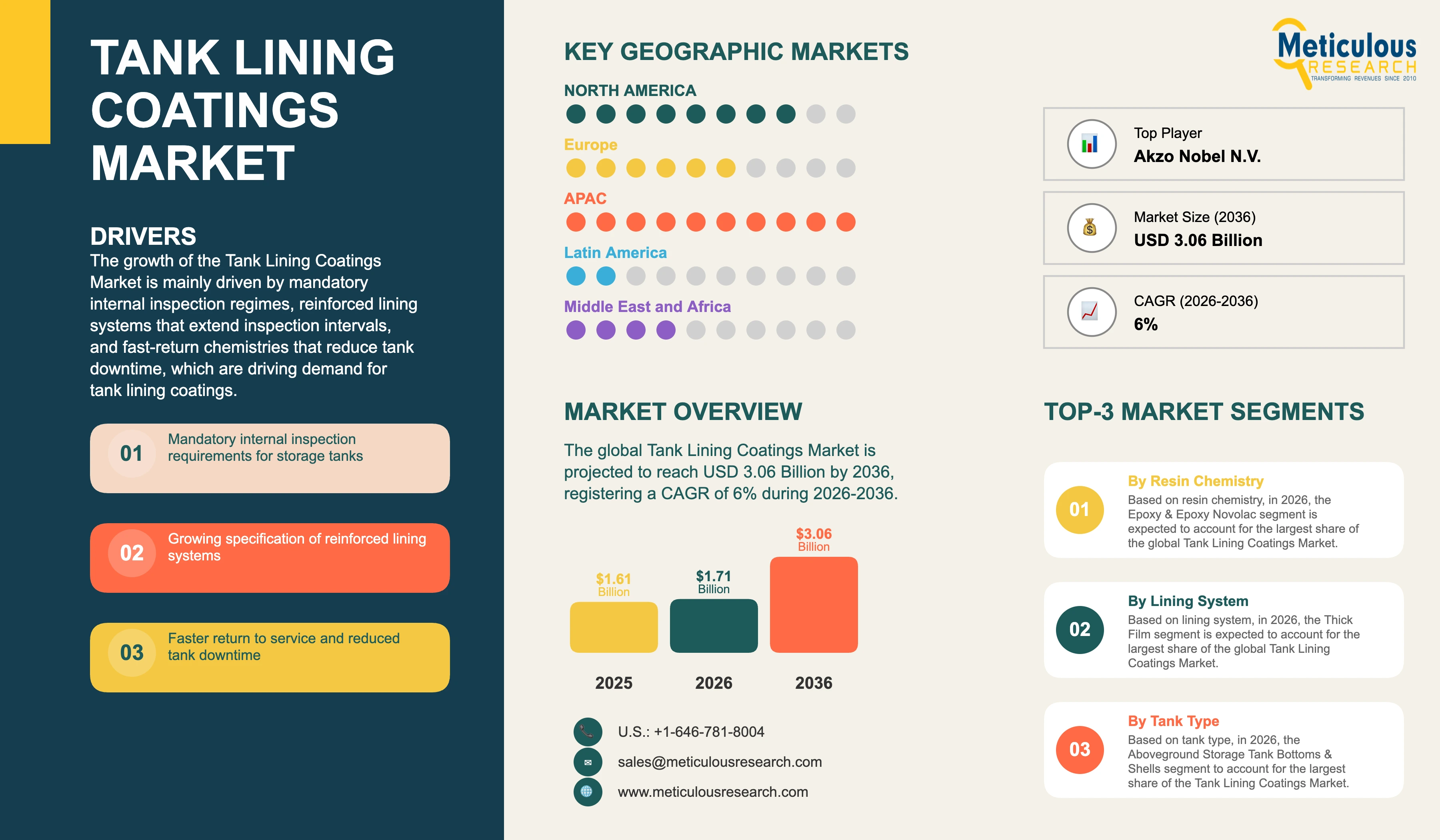
The global Tank Lining Coatings Market was valued at USD 1.61 billion in 2025. This market is expected to reach USD 3.06 billion by 2036 from an estimated USD 1.71 billion in 2026, registering a CAGR of 6.0% during the forecast period (2026-2036).
- Published
- Nov 2026
- Pages
- 250
- Format
- PDF + Excel
- Report ID
- MRCHM - 1042831
- Base year
- 2025
- 2025 · BASELINE
- $1.61B
- 2036
- $3.06B
- CAGR 2026–2036
- 6.0%
2025 baseline · 2026–2036 forecast at 6.0% CAGR · hover a bar for the value
Key highlights
The global Tank Lining Coatings Market is projected to reach USD 3.06 billion by 2036, driven by mandatory tank inspection regimes, reinforced lining systems that extend inspection intervals, faster return-to-service chemistries, and expanding secondary containment requirements.
Asia-Pacific is expected to account for the largest market share in 2026 and is also projected to register the fastest growth during the forecast period, supported by new refining, petrochemical and terminal capacity in which tanks are lined at construction rather than during a shutdown.
By resin chemistry, Epoxy & Epoxy Novolac systems are expected to account for the largest market share, whereas Polyurethane & Polyurea systems are projected to witness the fastest growth through 2036.
By lining system, Thick Film systems are expected to dominate the market, while Reinforced Thick Film & Laminate systems are projected to register the highest CAGR during the forecast period.
According to the American Petroleum Institute inspection practice for aboveground storage tanks, the initial internal inspection must be carried out no later than ten years after construction or refurbishment, with a thin film lining extending that interval by two years and a reinforced lining by five years, while soil-side cathodic protection adds a further five years.
The same practice sets the maximum subsequent internal inspection interval at twenty years under the corrosion rate method and thirty years where a release prevention barrier is installed, and reinforced linings applied at 50 to 60 mils are reported to bridge perforations of up to 2 inches in diameter at 30 pounds per square inch.
Reinforced thick film and laminate systems applied in a single layer at 20 to 150 mils dry film thickness, with some systems reaching above 100 mils, are increasingly replacing bottom plate replacement, converting a fabrication scope requiring hot work into a coating scope.
According to the United States Environmental Protection Agency technical standards for underground storage tanks, interior lining is not among the permitted corrosion protection methods for new tanks and is available only as an upgrade route for existing tanks, which must be internally inspected within ten years of lining and every five years thereafter.
Report summary
| Particulars | Details |
|---|---|
| Forecast Period | 2026-2036 |
| Base Year | 2025 |
| Estimated Year | 2026 |
| CAGR (Value) | 6.0% |
| Format | PDF, Excel & Cloud Portal · 250 pages |
| CAGR (Volume) | 4.2% |
| Market Size (Value) in 2026 | USD 1.71 Billion |
| Market Size (Value) in 2036 | USD 3.06 Billion |
| Market Size (Volume) in 2026 | 234.00 Kilotons |
| Market Size (Volume) in 2036 | 352.00 Kilotons |
| Segments Covered | By Resin Chemistry: Epoxy & Epoxy Novolac, Vinyl Ester & Polyester, Polyurethane & Polyurea, Glass-Flake & Reinforced Thick Film, Other Chemistries. By Lining System: Thin Film, Thick Film, Reinforced Thick Film & Laminate. By Tank Type: Aboveground Storage Tank Bottoms & Shells, Process Vessels & Reactors, Underground Storage Tanks, Water & Wastewater Tanks, Secondary Containment & Bunds. By End Use: Oil & Gas and Refining, Chemical & Petrochemical, Water & Wastewater Utilities, Food, Beverage & Pharmaceutical, Other End Uses. |
| Countries Covered | Asia-Pacific: China, India, Japan, South Korea, Rest of Asia-Pacific. North America: U.S., Canada. Europe: Germany, U.K., Netherlands, Rest of Europe. Middle East & Africa: Saudi Arabia, Rest of Middle East & Africa. Latin America: Brazil, Mexico, Rest of Latin America. |
| Key Companies | Akzo Nobel N.V., The Sherwin-Williams Company, PPG Industries, Inc., Hempel A/S, and Jotun A/S |
Report overview
Segments covered: resin chemistry, lining system, tank type, end use.
In volume terms, the market is estimated at 234.00 kilotons of lining as supplied in 2026 and is expected to reach 352.00 kilotons by 2036, registering a CAGR of 4.2% during the forecast period. The average selling price is estimated at USD 7,308 per ton in 2026 and USD 8,693 per ton in 2036.
The growth of this market is mainly driven by mandatory internal inspection requirements for aboveground storage tanks, increasing specification of reinforced linings that extend inspection intervals, growing adoption of fast-return systems that shorten tank downtime, rising municipal water and wastewater asset renewal, and expanding secondary containment and bund lining requirements. However, factors such as the exclusion of interior lining from permitted corrosion protection methods for new underground storage tanks, longer inspection intervals available through release prevention barriers, high turnaround and tank cleaning costs, and the technical difficulty of achieving holiday-free films in immersion service are expected to restrain the growth of this market to some extent.
Among tank types, Aboveground Storage Tank Bottoms & Shells are expected to account for the largest market share in 2026, while Secondary Containment & Bunds are projected to register the highest CAGR during the forecast period. Geographically, Asia-Pacific is expected to account for the largest share of this market in 2026 and is also expected to register the highest CAGR during the forecast period.
The Tank Lining Coatings Market comprises coatings applied to the internal surfaces of storage tanks, process vessels and secondary containment structures to resist the stored contents and to prevent the release of product to the environment. The market includes thin film, thick film and reinforced thick film systems based on epoxy and epoxy novolac, vinyl ester and polyester, polyurethane and polyurea, and glass-flake reinforced chemistries, applied to aboveground storage tank bottoms and shells, process vessels and reactors, underground storage tanks, water and wastewater tanks, and containment areas and bunds. The market ecosystem extends from resin and reinforcement suppliers through coating formulators and distributors to certified applicators, inspection contractors and the tank owners that operate these assets over multi-decade lifecycles.
The market is growing steadily as tank owners align lining programs with the mandatory inspection regimes that govern storage asset integrity. According to the American Petroleum Institute inspection practice for aboveground storage tanks, the initial internal inspection must be carried out no later than ten years after construction or refurbishment, while external ultrasonic thickness measurement of the shell is required every five years and can be performed without taking the tank out of service. Because the internal event requires the tank to be emptied, cleaned, gas-freed, inspected and recertified, it is by far the more expensive of the two, and a lining that defers it carries a value well in excess of the coating itself.
Lining systems are classified by thickness and reinforcement, and the classification determines the inspection credit available. Thin film linings sit below 20 mils, or 500 microns, and extend the initial internal inspection interval by two years. Thick film linings sit above that threshold, while flake and fiber reinforced thick film systems are applied in a single layer at 20 to 150 mils dry film thickness, with some systems reaching above 100 mils, and extend the initial interval by five years. Corrosion tolerance allowances of 0.1 inches for thin film and 0.05 inches for thick film are recognized in the inspection practice, and reinforced systems applied at 50 to 60 mils are reported to bridge perforations of up to 2 inches in diameter at 30 pounds per square inch, with a single fiber reinforced laminate bridging perforations of up to 8 inches, or 203 millimeters, at 37 pounds per square inch.
Combined corrosion control strategies extend inspection intervals further and are increasingly specified together. Solvent-free lining systems are offered with a twelve-year initial internal inspection interval, extendable to seventeen years where soil-side cathodic protection is also installed, while a reinforced bottom lining supports a fifteen-year initial interval extendable to twenty years with cathodic protection. The maximum subsequent internal inspection interval is twenty years under the corrosion rate method and thirty years where a release prevention barrier is installed, which means that lining, cathodic protection and secondary containment are evaluated together rather than as alternatives.
Underground storage tanks are governed by a separate and more prescriptive regime. According to the United States Environmental Protection Agency technical standards, the permitted corrosion protection methods for a new underground tank are fiberglass reinforced plastic construction, steel with a dielectric coating combined with field-installed cathodic protection, steel clad or jacketed with a non-corrodible material, bare metal at sites certified as non-corrosive by a corrosion expert, or an agency-approved alternative. Interior lining is available only as an upgrade route for existing tanks, under which the tank must be internally inspected within ten years of lining and every five years thereafter, and must be permanently closed where the lining no longer meets its original design specifications and cannot be repaired in accordance with a recognized code of practice.
Downtime economics are reshaping product selection across the market. Newer lining systems return a tank to service within 16 to 24 hours under proper application conditions, and one two-component epoxy lining returns clean petroleum product and crude oil tanks to service within 48 hours, is qualified on carbon steel, galvanized steel, stainless steel, concrete and previously coated surfaces, and is stated to resist crude oil at temperatures up to 120 degrees Celsius while meeting United States Food and Drug Administration requirements for dry and liquid food contact. Coating shelf stability of 18 to 24 months allows terminals to hold qualified material against unplanned openings, and epoxy novolac systems formulated at 67% volume solids and 340 grams per liter volatile organic compound content deliver the required chemical and temperature resistance at 85 to 125 microns per coat.
Chemical and petrochemical process vessels represent the most demanding part of the market, as reactors, scrubbers and neutralization vessels hold acids, alkalis and oxidizing media that are more aggressive than any hydrocarbon storage service and frequently operate at elevated temperature. In these applications chemistry is selected against the stored medium and its temperature rather than against a measured corrosion rate, with epoxy novolac and vinyl ester systems carrying the higher-temperature and acid service and reinforced systems used where mechanical abrasion accompanies chemical attack. Aggressive services including sour crude, water-contaminated fuels and seawater-contaminated crude are similarly driving specifications upward from thin film toward reinforced systems across petroleum storage.
A mandatory coating requirement exists in marine service and provides a useful comparison. Crude oil cargo tanks on tankers are covered by an International Maritime Organization performance standard for protective coatings, whereas a shore tank holding the same crude carries an obligation to inspect rather than an obligation to coat. This distinction explains why demand in this market follows inspection calendars, turnaround schedules and containment compliance rather than a direct coating mandate, and why water and wastewater and containment applications, which carry no turnaround penalty, are growing faster than petroleum tank lining.
Aboveground Storage Tank Bottoms & Shells are expected to account for the largest market share, as the mandatory internal inspection requirement applies to these assets.
Secondary Containment & Bunds are projected to register the highest CAGR, because the work requires no product removal, no gas-freeing and no confined space entry and can be scheduled independently of the tank inspection calendar.
Asia-Pacific is expected to account for the largest regional share in 2026, supported by new refining, petrochemical and terminal capacity in which tanks are lined at construction rather than during a shutdown.
Europe is expected to grow more slowly than other regions, as refining capacity is rationalized rather than expanded and demand is concentrated in maintaining an installed base, with secondary containment and bund lining a larger share of regional demand under major accident hazard requirements.
The Middle East & Africa is expected to record strong growth on Gulf refining, petrochemical and crude storage investment, with high ambient temperatures raising specifications toward reinforced and epoxy novolac systems. Latin America is expected to grow more modestly, with Brazil and Mexico carrying the regional refining and terminal positions.
Some of the key players operating in the tank lining coatings market are Akzo Nobel N.V., The Sherwin-Williams Company, PPG Industries, Inc., Hempel A/S, and Jotun A/S, among others.
Leading companies are focusing on reinforced thick film systems qualified for extended inspection intervals, fast-cure polyurethane and polyurea chemistries, solvent-free high-build epoxies, and broader substrate and food contact qualification, while expanding certified applicator networks and long-term maintenance framework agreements with refining, terminal and municipal owners.
Report infographic
Market dynamics
10 factors across 4 forcesMandatory Internal Inspection Requirements for Storage Tanks
Mandatory tank inspection regimes are a major factor driving the Tank Lining Coatings Market, as owners specify linings to defer the most expensive compliance event in the asset lifecycle. According to the American Petroleum Institute inspection practice for aboveground storage tanks, the initial internal inspection must be carried out no later than ten years after construction or refurbishment, and the inspection requires the tank to be emptied, cleaned, gas-freed, inspected and recertified. A thin film lining extends that interval by two years and a reinforced lining by five years, while soil-side cathodic protection adds a further five years, and solvent-free systems are offered with a twelve-year initial interval extendable to seventeen years in combination with cathodic protection. Because the deferred cost includes lost storage revenue as well as the turnaround itself, the inspection credit available from a qualified lining is the primary commercial justification for the purchase and is increasingly written into tank integrity management plans.
Growing Specification of Reinforced Lining Systems
The increasing specification of flake and fiber reinforced thick film systems is significantly increasing demand for higher-value lining products. These systems are applied in a single layer at 20 to 150 mils dry film thickness, with some systems reaching above 100 mils, and qualify for the five-year extension of the initial internal inspection interval where they meet the criteria set out in the aboveground tank lining practice. Reinforced linings applied at 50 to 60 mils are reported to bridge perforations of up to 2 inches in diameter at 30 pounds per square inch, and a single fiber reinforced laminate is reported to bridge perforations of up to 8 inches, or 203 millimeters, at 37 pounds per square inch, which allows a corroded tank bottom to be restored through a coating scope rather than through plate replacement and hot work. This substitution moves project value from fabrication contractors to coating suppliers and applicators and is expected to support sustained growth in the reinforced segment throughout the forecast period.
Faster Return to Service and Reduced Tank Downtime
Reduced return-to-service times are increasingly driving product selection, as the cost of an internal lining project is dominated by tank cleaning, gas-freeing, inspection and lost throughput rather than by the coating. Newer lining systems return a tank to service within 16 to 24 hours under proper application conditions, and one two-component epoxy lining returns clean petroleum product and crude oil tanks to service within 48 hours while remaining qualified across carbon steel, galvanized steel, stainless steel, concrete and previously coated surfaces. Coating shelf stability of 18 to 24 months allows high-throughput terminals to hold qualified material on site against unplanned openings, so that an adverse inspection finding can be addressed immediately rather than after a procurement lead time. The combination of faster cure and on-site availability is increasing demand for polyurethane and polyurea chemistries and is expected to continue supporting market growth.
Table of contents
12 chapters · 132 sections · 250 pages · click to expandSegmental analysis
| Segment | Largest share (2026) | Fastest growth (2026–2036) |
|---|---|---|
| By Resin Chemistry | Epoxy & Epoxy Novolac | Polyurethane & Polyurea |
| By Lining System | Thick Film | Reinforced Thick Film & Laminate |
| By Tank Type | Aboveground Storage Tank Bottoms & Shells | Secondary Containment & Bunds |
| By End use | Oil & Gas and Refining | Water & Wastewater Utilities |
| Other segments | Oil & Gas and Refining | — |
By Resin Chemistry
- The Epoxy & Epoxy Novolac segment is expected to account for the largest share of the global Tank Lining Coatings Market.
- The large share of this segment is mainly due to the chemical and temperature resistance delivered by high crosslink density in immersion service, supported by formulations at 67% volume solids and 340 grams per liter volatile organic compound content applied at 85 to 125 microns per coat, and by qualification across hydrocarbon, water and food contact applications.
- However, the Polyurethane & Polyurea segment is projected to register the highest CAGR during the forecast period.
- The rapid growth of this segment is attributed to cure speeds that return a tank to service within 16 to 24 hours, which addresses the turnaround cost that dominates internal lining projects.
- Epoxy & Epoxy Novolac systems are expected to account for the largest market share in 2026.
- Polyurethane & Polyurea systems are projected to register the highest CAGR during the forecast period, owing to cure speeds that return a tank to service within 16 to 24 hours.
- Thick Film systems above 20 mils are expected to account for the largest market share, as they carry the general immersion workload across tank bottoms, shells and process vessels.
- Reinforced Thick Film & Laminate systems are projected to register the highest CAGR, as they qualify for a five-year inspection interval extension and are reported to bridge perforations of up to 8 inches at 37 pounds per square inch.
- Water & Wastewater Utilities are projected to register the highest CAGR, as internal coating is a condition of operation and network redundancy removes the downtime penalty on specification.
By Lining System
- The Thick Film segment is expected to account for the largest market share because systems above 20 mils, or 500 microns, carry the general immersion workload where film continuity and chemical resistance take priority over perforation bridging.
- However, the Reinforced Thick Film & Laminate segment is projected to register the highest CAGR during the forecast period, as these systems extend the initial internal inspection interval by five years against two years for thin film and are reported to bridge perforations of up to 8 inches, or 203 millimeters, at 37 pounds per square inch.
By Tank Type
- The Aboveground Storage Tank Bottoms & Shells segment is expected to account for the largest market share, as the mandatory internal inspection requirement applies to these assets and the lining is the principal measure available to defer it.
- However, the Secondary Containment & Bunds segment is projected to register the highest CAGR during the forecast period, because this work requires no product removal, no gas-freeing and no confined space entry and can therefore be scheduled independently of the tank inspection calendar.
- Underground Storage Tanks are expected to record the slowest growth, as interior lining is excluded from the permitted corrosion protection methods for new tanks under United States Environmental Protection Agency technical standards.
By End use
- The Oil & Gas and Refining segment is expected to account for the largest market share due to the number and size of crude, intermediate and product storage tanks and the inspection regime that governs them.
- However, the Water & Wastewater Utilities segment is projected to register the highest CAGR during the forecast period, because internal coating is a condition of operation in potable and wastewater service and network redundancy allows tanks to be taken out of service without a production loss.
Other segments
- Oil & Gas and Refining is expected to account for the largest market share, reflecting the number and size of crude, intermediate and product storage tanks and the inspection regime governing them.
Geographic analysis
Asia-Pacific
Largest shareIn 2026, Asia-Pacific is expected to account for the largest share of the global Tank Lining Coatings Market and is also projected to register the highest CAGR during the forecast period. The regional lead is supported by new refining, petrochemical and terminal capacity under construction across the region, in which tanks are lined during fabrication and commissioning rather than during a shutdown, so that the lining specification competes against no deferral option and carries none of the turnaround cost that governs the decision in a mature market. China accounts for the largest country share on refining, petrochemical and terminal capacity, India is projected to register the fastest country growth on refinery and storage expansion, and South Korea contributes petrochemical and process vessel demand. Expanding regional applicator capacity and the growing adoption of reinforced systems on new tank bottoms are expected to support strong demand growth throughout the forecast period. Asia-Pacific is also expected to witness the fastest growth during the forecast period, supported by storage capacity additions, expanding applicator capacity and growing adoption of reinforced bottom lining systems.
North America
North America is expected to account for the second-largest share of the market. The region holds the largest aging storage tank population and is the origin of the inspection framework that sets the ten-year initial internal inspection baseline and the two-year and five-year lining interval extensions, which makes inspection-driven relining the dominant demand pattern. The United States accounts for most of the regional position across refining, terminal storage, chemical processing and municipal water, and the United States Environmental Protection Agency technical standards that exclude interior lining from new underground tank corrosion protection concentrate demand in aboveground and containment applications. Canada contributes upstream, refining and process vessel demand under colder service conditions.
Europe
Europe is expected to account for a substantial but slower-growing share of the market, as refining capacity is being rationalized rather than expanded and activity is concentrated in the maintenance of an installed base. Germany, the United Kingdom and the Netherlands carry the largest national positions, with the Netherlands disproportionate to its size on independent tank terminal storage, while major accident hazard requirements make secondary containment and bund lining a larger share of regional demand than elsewhere.
Middle East & Africa
The Middle East & Africa region is expected to record strong growth from a moderate base, supported by refining, petrochemical and crude storage investment across the Gulf states. Saudi Arabia carries the largest national position, and high ambient temperatures shorten lining service life on tank shells and roofs, raising specifications toward reinforced and epoxy novolac systems.
Latin America
Latin America is expected to account for a smaller share of the market, with Brazil and Mexico carrying the regional refining and terminal positions and demand concentrated in inspection-driven relining and containment compliance.
Competitive landscape
The global Tank Lining Coatings Market is moderately consolidated, with competition among global protective coatings manufacturers, specialty immersion lining suppliers and certified applicator networks. Market participants compete primarily on the inspection interval a qualified lining secures, return-to-service time, chemical and temperature resistance, substrate and food contact qualification, applicator network coverage, and technical service through specification and inspection.
Leading companies are investing in reinforced thick film and laminate systems that qualify for extended inspection intervals, fast-cure polyurethane and polyurea chemistries that shorten tank downtime, and solvent-free formulations offered with twelve-year and fifteen-year initial inspection intervals. Suppliers are publishing lining ranges mapped directly to the aboveground tank lining practice in order to support interval extension claims during specification, and are extending substrate qualification across carbon steel, galvanized steel, stainless steel and concrete so that a single specification can cover a tank, its bund and the associated pipework. Applicator certification programs, inspection support and long-term maintenance framework agreements with refining, terminal and municipal owners remain the key strategies adopted by major vendors.
The report provides a comprehensive competitive assessment of the leading companies operating in the global Tank Lining Coatings Market. The key players profiled in the report include Akzo Nobel N.V. (Netherlands), The Sherwin-Williams Company (U.S.), PPG Industries, Inc. (U.S.), Hempel A/S (Denmark), and Jotun A/S (Norway).
- Akzo Nobel N.V.
- Sherwin-Williams Company
- PPG Industries, Inc.
- Hempel A/S
- Jotun A/S
Expert perspectives
The Tank Lining Coatings Market is one in which the regulatory obligation is to inspect rather than to coat, and that distinction determines how value accrues to suppliers. The mandatory initial internal inspection of an aboveground tank falls no later than ten years after construction or refurbishment and requires the asset to be emptied, cleaned, gas-freed and recertified, so the commercial case for a lining rests on the interval it defers rather than on corrosion performance in isolation. A thin film lining buys two years, a reinforced lining five, and cathodic protection a further five, which places the coating inside a combined integrity strategy rather than at the center of one.
Suppliers that present a lining purely as corrosion protection are therefore competing on the weaker argument. The defensible position is a qualified system that maps explicitly to the lining practice criteria, carries the five-year interval extension, and returns the tank to service within 16 to 24 hours, because the owner is purchasing deferred turnaround cost and lost storage revenue rather than film thickness. The same logic explains why reinforced laminates that bridge perforations of up to 8 inches are displacing bottom plate replacement, converting a fabrication scope with hot work into a coating scope, and why release prevention barriers that take the maximum subsequent interval to thirty years are evaluated alongside rather than against the lining.
For companies planning entry or expansion, the most attractive positions over the forecast period are likely to be found in reinforced thick film systems qualified for extended intervals, fast-cure chemistries for high-throughput terminals, containment and bund lining where no turnaround is required, potable water and food contact qualified systems, and new refining and petrochemical capacity in Asia-Pacific and the Middle East where tanks are lined at construction. The principal risk for established suppliers is not demand but applicator capability, since reported lining failures are attributed to workmanship rather than to formulation and a localized failure removes the inspection credit on which the sale was made.
Customer perspectives
“The coating is the cheapest line in the project. Cleaning, gas-freeing, inspection and the storage we cannot sell while the tank is down are what the budget is actually spent on. So the first question I ask a lining supplier is how many years the system adds to my internal inspection interval, and whether that claim will survive an audit. If the answer is two years, I am generally better off looking at cathodic protection or a second bottom.”
“Owners underestimate how much of the outcome sits with us rather than with the product. On a reline we do not know what we are dealing with until the tank is open, and the old coating, the scale and the product residue all have to come off before we can establish a profile. Edges, welds and nozzles are where these linings fail, not in the middle of a plate, and a fast-cure system only helps if the preparation is right.”
“We are in a different position from a refinery. We have enough storage in the network to take a reservoir offline without interrupting supply, so cure speed matters far less to us than how long the lining lasts and whether it is approved for potable contact. Our programs are planned years ahead on condition surveys, and we would rather pay more for a system with a longer service life than save money and come back in eight years.”
Frequently asked questions
The global Tank Lining Coatings Market is estimated at USD 1.71 billion in 2026.
The market is projected to reach USD 3.06 billion by 2036.
The market is expected to grow at a CAGR of 6.0% during 2026-2036.
The market is driven by mandatory internal inspection requirements for aboveground storage tanks, increasing specification of reinforced linings that extend inspection intervals, faster return-to-service chemistries, municipal water and wastewater asset renewal, and expanding secondary containment requirements.
The American Petroleum Institute inspection practice requires the initial internal inspection of an aboveground tank no later than ten years after construction or refurbishment. A thin film lining extends that interval by two years and a reinforced lining by five years, while soil-side cathodic protection adds a further five years.
Solvent-free systems are offered with a twelve-year initial interval, extendable to seventeen years with cathodic protection, and reinforced bottom linings with a fifteen-year interval extendable to twenty years. The maximum subsequent internal interval is twenty years under the corrosion rate method and thirty years where a release prevention barrier is installed.
Achieving holiday-free films in immersion service, high tank cleaning and turnaround costs, confined space application constraints, variable substrate condition on relining projects, and dependence on applicator qualification remain the major market challenges.
Under United States Environmental Protection Agency technical standards, permitted corrosion protection for a new underground tank is limited to fiberglass reinforced plastic construction, coated steel with field-installed cathodic protection, clad or jacketed steel, certified bare metal, or an agency-approved alternative. Interior lining remains available only as an upgrade route for existing tanks.
Flake and fiber reinforced thick film laminates, fast-cure polyurethane and polyurea systems, solvent-free high-build epoxies, epoxy novolac chemistries for elevated temperature service, and polyurea containment linings are transforming the market.
Suppliers must satisfy aboveground tank inspection and lining practice criteria to support interval extension claims, United States Environmental Protection Agency technical standards for underground tanks, secondary containment requirements under major accident hazard regimes, United States Food and Drug Administration requirements for food contact service, and potable water approvals for municipal applications.
Epoxy & Epoxy Novolac systems are expected to account for the largest market share in 2026.
Polyurethane & Polyurea systems are projected to register the highest CAGR during the forecast period, owing to cure speeds that return a tank to service within 16 to 24 hours.
Thick Film systems above 20 mils are expected to account for the largest market share, as they carry the general immersion workload across tank bottoms, shells and process vessels.
Reinforced Thick Film & Laminate systems are projected to register the highest CAGR, as they qualify for a five-year inspection interval extension and are reported to bridge perforations of up to 8 inches at 37 pounds per square inch.
Aboveground Storage Tank Bottoms & Shells are expected to account for the largest market share, as the mandatory internal inspection requirement applies to these assets.
Secondary Containment & Bunds are projected to register the highest CAGR, because the work requires no product removal, no gas-freeing and no confined space entry and can be scheduled independently of the tank inspection calendar.
Oil & Gas and Refining is expected to account for the largest market share, reflecting the number and size of crude, intermediate and product storage tanks and the inspection regime governing them.
Water & Wastewater Utilities are projected to register the highest CAGR, as internal coating is a condition of operation and network redundancy removes the downtime penalty on specification.
Asia-Pacific is expected to account for the largest regional share in 2026, supported by new refining, petrochemical and terminal capacity in which tanks are lined at construction rather than during a shutdown.
Asia-Pacific is also expected to witness the fastest growth during the forecast period, supported by storage capacity additions, expanding applicator capacity and growing adoption of reinforced bottom lining systems.
Europe is expected to grow more slowly than other regions, as refining capacity is rationalized rather than expanded and demand is concentrated in maintaining an installed base, with secondary containment and bund lining a larger share of regional demand under major accident hazard requirements.
The Middle East & Africa is expected to record strong growth on Gulf refining, petrochemical and crude storage investment, with high ambient temperatures raising specifications toward reinforced and epoxy novolac systems. Latin America is expected to grow more modestly, with Brazil and Mexico carrying the regional refining and terminal positions.
Some of the key players operating in the tank lining coatings market are Akzo Nobel N.V., The Sherwin-Williams Company, PPG Industries, Inc., Hempel A/S, and Jotun A/S, among others.
Leading companies are focusing on reinforced thick film systems qualified for extended inspection intervals, fast-cure polyurethane and polyurea chemistries, solvent-free high-build epoxies, and broader substrate and food contact qualification, while expanding certified applicator networks and long-term maintenance framework agreements with refining, terminal and municipal owners.
Cite this report
Meticulous Research. (2026). Tank Lining Coatings Market - Global Opportunity Analysis and Industry Forecast (2026-2036) (Report No. MRCHM - 1042831). Meticulous Market Research Pvt. Ltd. https://www.meticulousresearch.com/product/tank-lining-coatings-market-7514