Enzyme Immobilisation Carriers Market (2026-2036)
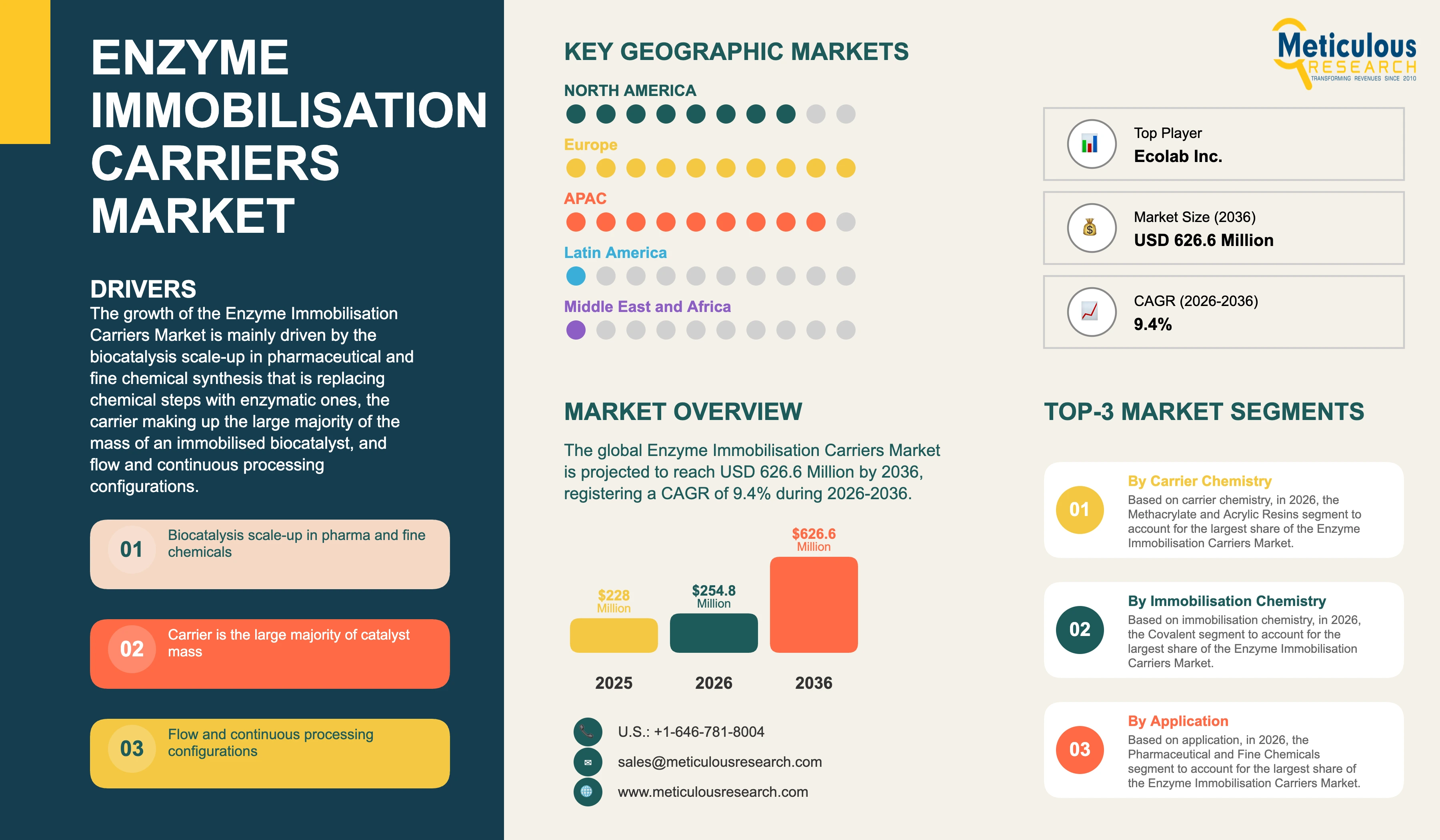
The global enzyme immobilisation carriers market was valued at USD 228.0 million in 2025. This market is expected to reach USD 626.6 million by 2036 from an estimated USD 254.8 million in 2026, registering a CAGR of 9.4% during the forecast period (2026-2036).
- Published
- Nov 2026
- Pages
- 260
- Format
- PDF + Excel
- Report ID
- MRCHM - 1042804
- Base year
- 2025
- 2025 · BASELINE
- $228.0M
- 2036
- $626.6M
- CAGR 2026–2036
- 9.4%
2025 baseline · 2026–2036 forecast at 9.4% CAGR · hover a bar for the value
Key highlights
The global enzyme immobilisation carriers market is estimated at USD 254.8 million in 2026 and is projected to reach USD 626.6 million by 2036.
Market volume is estimated at 2.60 kilotons in 2026 and is projected to reach 5.31 kilotons by 2036 at a CAGR of 7.4%, measured as carrier supplied on a dry mass basis.
Carriers ship as water-wet beads at a substantial moisture content, so a tonnage quoted as supplied would be materially larger than the figures here.
The average selling price is estimated at USD 98.00 per kg in 2026 and is projected to reach USD 118.00 per kg by 2036 as inorganic and engineered-surface carriers take a larger share.
Methacrylate and acrylic resins are expected to account for the largest carrier chemistry share in 2026, while silica and controlled pore glass are projected to register the highest CAGR of 12.4%.
Pharmaceutical and fine chemicals is expected to hold the largest application share in 2026 and is also projected to grow fastest at a CAGR of 12.0%.
Europe is expected to hold the largest regional share in 2026, while Asia-Pacific is projected to register the highest CAGR of 10.6%.
A study published in Chemical Communications on 25 August 2026 by authors at the University of Bern states that spent enzyme immobilisation resins make up more than 90% of the catalyst mass and are usually discarded, adding non-degradable material to waste streams.
That figure is the economic foundation of this market: the carrier rather than the enzyme is the mass being supplied, and it is consumed with each spent charge rather than recovered.
The same study reports that a first coupling achieved a loading of about 62 micromoles per gram, which it places within the typical range of 40 to 100 micromoles per gram for commercial supports.
On a single commercial methacrylate support the study obtained a 100% immobilisation yield for both enzymes tested but recovered activity of below 5% for one and 60% for the other, attributing the first to over-attachment.
That contrast on an identical carrier shows that matching the carrier and the immobilisation chemistry to the specific enzyme, rather than the quality of the carrier itself, is the governing technical problem in this field.
The study demonstrates a thermally reversible linker allowing the carrier to be stripped and reloaded, running six full load, use, cleave and reload cycles with three catalytic runs each, eighteen runs in total, at an average conversion of 27.4% plus or minus 8.4%.
The linker is priced at about EUR 80 per gram and used in trace amounts per cycle, which the authors describe as economically negligible, though they performed no formal cost analysis.
The authors describe the work as a proof of concept for a single resin type, note that cleavage removes the enzyme and so suits only the end of an enzyme useful life, and state that performance varied between cycles with a suspected gradual loss of accessible attachment sites.
They also state that the environmental benefit is inferred from reuse rather than measured, with no life-cycle or full economic assessment performed and no long-term carrier durability established beyond six cycles.
This market measures the carrier only and excludes the enzyme, chromatography and purification resins sold by the same manufacturers, and carrier-free immobilisation such as cross-linked enzyme aggregates, where no carrier is supplied at all.
Report summary
| Particulars | Details |
|---|---|
| Base Year | 2025 |
| Forecast Period | 2026-2036 |
| Market Size in 2025 | USD 228.0 million |
| Market Size in 2026 | USD 254.8 million |
| Market Size by 2036 | USD 626.6 million |
| Value CAGR (2026-2036) | 9.4% |
| Format | PDF, Excel & Cloud Portal · 260 pages |
| Volume in 2026 | 2.60 kilotons |
| Volume by 2036 | 5.31 kilotons |
| Volume CAGR (2026-2036) | 7.4% |
| Volume Basis | Carrier supplied on a dry mass basis, excluding the enzyme |
| Average Selling Price in 2026 | USD 98.00 per kg |
| Average Selling Price by 2036 | USD 118.00 per kg |
| Price Direction | The average selling price rises across the forecast period as silica, controlled pore glass and other inorganic and engineered-surface carriers take a larger share of a market led by methacrylate and acrylic resins, rather than through any change in the cost of an individual material |
| Volume Basis Note | Carriers are supplied as water-wet beads at a substantial moisture content, since drying a functionalised porous resin can collapse the pore structure the enzyme is meant to occupy, so a tonnage quoted as product as supplied would be materially larger than the figures here without representing any more carrier material |
| Scope Exclusion Note | The enzyme itself is not counted, only the support; chromatography and purification resins are excluded even though the leading carrier manufacturers sell far more of them, because those media separate molecules rather than hold a catalyst; and carrier-free immobilisation, in which enzyme molecules are cross-linked to one another into aggregates, is excluded because no carrier is supplied at all |
| Measurement Basis | Porous solid supports onto which enzymes are immobilised, including methacrylate and acrylic resins, polystyrene and styrenic resins, silica and controlled pore glass, polysaccharide supports and other inorganic materials, by carrier chemistry, immobilisation chemistry, application and geography |
| Relationship to Adjacent Markets | This market is not additive to the depolymerisation catalysts market, where an engineered enzyme is counted as the biocatalyst while any carrier it is immobilised on is counted here; it is also distinct from the chromatography and purification resin markets served by the same manufacturers |
| Note on Catalyst Mass | A study published in Chemical Communications on 25 August 2026 by authors at the University of Bern states that spent enzyme immobilisation resins make up more than 90% of the catalyst mass and are usually discarded, adding non-degradable material to waste streams, and that support regeneration after covalent immobilisation has been rare; the carrier rather than the enzyme is therefore the mass being supplied, and it is consumed with each spent charge rather than recovered, which makes this a consumables market |
| Note on Carrier and Enzyme Matching | That study obtained a 100% immobilisation yield for both enzymes tested on a single commercial methacrylate support while recovering below 5% activity for a formate dehydrogenase, attributed to over-attachment, against 60% activity and 8.4 units per gram for a glycosyl hydrolase; a first coupling achieved about 62 micromoles per gram of reactive groups, placed within the typical commercial range of 40 to 100 micromoles per gram; matching the carrier and attachment chemistry to the specific enzyme is therefore the governing technical problem rather than carrier quality |
| Note on Carrier Regeneration | The same study demonstrates a thermally reversible linker allowing a commercial methacrylate carrier to be stripped of spent enzyme and reloaded, running six full load, use, cleave and reload cycles with three catalytic runs each, eighteen runs in total, at an average conversion of 27.4% plus or minus 8.4%, with the linker priced at about EUR 80 per gram and used in trace amounts; the authors describe it as a proof of concept for a single resin type, note that cleavage removes the enzyme and so suits only the end of its useful life, report performance varying between cycles with a suspected gradual loss of accessible attachment sites, establish no durability beyond six cycles, and state that the environmental benefit is inferred rather than measured with no life-cycle or full economic assessment performed |
| Note on Supplier Disclosure | No manufacturer publishes carrier revenue separately from its wider resin business, the technical datasheets carrying loading capacities, particle sizes and pore specifications sit behind customer registration, and a substantial part of demand is captive within enzyme producers who prepare immobilised products in-house from purchased carriers and disclose neither the quantity nor the type, so the sizing here is built from application demand and published technical work |
| Largest Carrier Chemistry | Methacrylate and acrylic resins |
| Fastest-Growing Carrier Chemistry | Silica and controlled pore glass (CAGR 12.4%) |
| Largest Immobilisation Chemistry | Covalent attachment |
| Fastest-Growing Immobilisation Chemistry | Hydrophobic adsorption (CAGR 11.0%) |
| Largest Application | Pharmaceutical and fine chemicals |
| Fastest-Growing Application | Pharmaceutical and fine chemicals (CAGR 12.0%) |
| Largest Region | Europe |
| Fastest-Growing Region | Asia-Pacific (CAGR 10.6%) |
| Segments Covered | Carrier Chemistry, Immobilisation Chemistry, Application, and Geography |
| Geographies Covered | Europe, Asia-Pacific, North America, Latin America, and Middle East & Africa |
| Companies Profiled | 5 companies, being Ecolab Inc., Mitsubishi Chemical Group Corporation, LANXESS AG, Sunresin New Materials Co., Ltd., and EnginZyme AB |
Report overview
Segments covered: carrier chemistry, immobilisation chemistry, application.
In volume terms, this market is estimated at 2.60 kilotons in 2026 and is projected to reach 5.31 kilotons by 2036, registering a CAGR of 7.4% during the same period, measured as carrier supplied on a dry mass basis. Carriers are shipped as water-wet beads at a substantial moisture content, so a tonnage quoted as supplied would be materially larger than the figures here. The average selling price is estimated at USD 98.00 per kg in 2026 and is projected to rise to USD 118.00 per kg by 2036 as the inorganic and engineered-surface carriers take a larger share.
The growth of this market is mainly driven by the biocatalysis scale-up in pharmaceutical and fine chemical synthesis that is replacing chemical steps with enzymatic ones, the carrier making up the large majority of the mass of an immobilised biocatalyst and being consumed with it, the flow and continuous processing configurations that require a mechanically stable packed bed, and the newer enzyme classes being deployed industrially that need carrier development of their own. However, factors such as the loss of enzyme activity that over-attachment to a carrier can cause, the carrier being discarded with the spent enzyme at the end of a campaign, the in-house preparation by large enzyme producers that keeps much of the demand captive, and the very limited public disclosure across the field are expected to restrain the growth of this market to some extent.
Methacrylate and acrylic resins account for the largest carrier chemistry share of this market, while silica and controlled pore glass grow fastest from a smaller base. Europe holds the largest regional share and Asia-Pacific is the fastest-growing region.
Enzyme immobilisation carriers are the porous solid supports onto which an enzyme is attached so that it can be retained, reused and handled as a solid catalyst, including methacrylate and acrylic resins, polystyrene and styrenic resins, silica and controlled pore glass, polysaccharide supports such as agarose and chitosan, and other inorganic materials. Market sizing in this report is on both a value basis in USD and a volume basis in kilotons measured as carrier supplied on a dry mass basis.
The dry mass basis matters because these materials are not shipped dry. Carriers are supplied as water-wet beads at a substantial moisture content, since drying a functionalised porous resin can collapse its pore structure and destroy the surface the enzyme is meant to occupy, so a tonnage quoted as product as supplied would be materially larger than the figures here without representing any more carrier material.
Three exclusions define the scope. The enzyme itself is not counted, only the support. Chromatography and purification resins are excluded even though the leading carrier manufacturers sell far more of them, because those media separate molecules rather than hold a catalyst. And carrier-free immobilisation, in which enzyme molecules are cross-linked to one another into aggregates, is excluded because no carrier is supplied at all.
A study published in Chemical Communications on 25 August 2026 by authors at the University of Bern supplies the single most useful number available on this market. It states that spent enzyme immobilisation resins make up more than 90% of the catalyst mass and are usually discarded, adding non-degradable material to waste streams, and notes that support regeneration after covalent immobilisation has been rare.
That figure explains the economics of the whole field. The enzyme is the active and expensive part by unit cost but a minor part by mass, so the carrier is what is physically bought, stored, charged into a reactor and eventually thrown away. A carrier supplier is therefore selling a consumable that is replaced with every spent biocatalyst charge rather than a durable item that is reconditioned.
The same study gives a usable figure for commercial carrier loading capacity. A first coupling achieved about 62 micromoles per gram of reactive groups, which the authors place within the typical range of 40 to 100 micromoles per gram for commercial supports, and that range is the practical envelope within which a carrier manufacturer competes.
The most instructive result in that work concerns two enzymes on the same support. Using a commercial methacrylate resin, the authors obtained a 100% immobilisation yield for both a formate dehydrogenase and a glycosyl hydrolase, but recovered activity of below 5% for the first against 60% for the second, with an immobilised activity of 8.4 units per gram in the successful case, attributing the failure to over-attachment.
An identical carrier therefore produced a near-total loss of activity with one enzyme and a working biocatalyst with another. That is the governing technical problem in this field: the carrier and the immobilisation chemistry have to be matched to the specific enzyme, and a support that performs well in one application tells a buyer very little about another.
It is also why carriers are sold as screening sets rather than as single products, and why the supplier relationship carries application development alongside the material. A customer is buying access to a range of surface chemistries, pore structures and particle sizes to be tested against its own enzyme, and the value of the supply arrangement lies substantially in narrowing that search.
The same study addresses the waste problem it identifies by demonstrating a thermally reversible linker that allows the carrier to be stripped and reloaded. Six full load, use, cleave and reload cycles were run with three catalytic runs in each, eighteen runs in total, at an average conversion of 27.4% plus or minus 8.4%, with three load and cleave cycles separately confirmed by elemental analysis.
The authors are precise about the limits of that demonstration and those limits should travel with the result. They describe it as a proof of concept for a single resin type, note that the cleavage step removes the enzyme and so suits only the end of an enzyme useful life rather than an active campaign, and report that performance varied between cycles with a suspected gradual loss of accessible attachment sites.
They also record that nitrogen content rose across cycles through minor side reactions, that no long-term carrier durability was established beyond six cycles, and that the environmental benefit is inferred from reuse rather than measured, with no life-cycle assessment and no full economic assessment performed. The linker itself is priced at about EUR 80 per gram and used in trace amounts, which the authors call economically negligible without quantifying it.
A reusable carrier would change this market more than any growth in biocatalysis would, and that is worth stating plainly. If the carrier that constitutes more than 90% of the catalyst mass could be recovered and reloaded rather than discarded, carrier demand per unit of biocatalysis would fall even as biocatalysis expanded, and the published work is at proof-of-concept stage on one resin with six cycles demonstrated.
Pharmaceutical and fine chemical synthesis is the largest application and the fastest-growing, because it is where an enzymatic step most often replaces a chemical one. A biocatalytic route can achieve a selectivity that would otherwise require protecting groups and separations, and immobilisation is what makes the enzyme recoverable enough for the economics of a multi-step synthesis to work.
Food and beverage processing is the larger application by tonnage of immobilised biocatalyst in service but a smaller part of carrier demand, because the enzymes involved run for long campaigns and some of them are prepared without a discrete polymer carrier. Biodiesel and oleochemical processing uses immobilised lipases on hydrophobic supports, which is the application where adsorption rather than covalent attachment predominates.
Disclosure across this field is unusually thin and the sizing here reflects that. No manufacturer publishes carrier revenue separately from its wider resin business, the technical datasheets that carry loading capacities and particle specifications sit behind customer registration, and a substantial part of demand is captive within enzyme producers who prepare immobilised products in-house from purchased carriers and disclose nothing about either.
This market is not additive to the depolymerisation catalysts market, where an engineered enzyme is counted as the biocatalyst while any carrier it is immobilised on would be counted here, and it is distinct from the chromatography and purification resin markets served by the same manufacturers.
Europe is expected to account for the largest share in 2026, on the carrier manufacturers based there, the concentration of industrial biocatalysis development and enzyme producers, and the fine chemical and pharmaceutical intermediate manufacture that consumes them. The United Kingdom is projected to grow at 9.4%, Italy and the Netherlands at 9.0% and Germany at 8.6%.
Asia-Pacific is projected to register the highest CAGR of 10.6% during the forecast period, with India at 12.4%, China at 11.4% and Japan at 8.0%.
Europe holds the largest share, with the United Kingdom growing at 9.4%, Italy and the Netherlands at 9.0% and Germany at 8.6%. It consumes a disproportionate share in process development and screening, where small quantities of many carrier types are tested, which is a different purchasing pattern from the production charges that dominate Asia-Pacific consumption.
The Middle East & Africa is projected to grow at a CAGR of 7.0% and Latin America at a CAGR of 8.0%, both from small bases and both dependent on fine chemical manufacture developing locally rather than on any carrier-specific factor.
Ecolab Inc., Mitsubishi Chemical Group Corporation, LANXESS AG, Sunresin New Materials Co., Ltd. and EnginZyme AB together accounted for an estimated 56.4% of this market in 2026, which is also the share held by the 5 companies profiled in this report. A material further share is held by suppliers of general-purpose resins used as carriers without being sold as such, and by in-house preparation within enzyme producers.
Report infographic
Market dynamics
14 factors across 5 forcesBiocatalysis Scale-Up in Pharmaceutical and Fine Chemical Synthesis
An enzymatic step can deliver a selectivity that a chemical route would need protecting groups and additional separations to achieve, and immobilisation is what makes the enzyme recoverable enough for that substitution to be economic across a multi-step synthesis.
Pharmaceutical and fine chemicals accounts for the largest application share of this market and is also projected to register the highest CAGR of 12.0%.
The Carrier Constituting the Large Majority of the Catalyst Mass
The study published in Chemical Communications on 25 August 2026 states that spent enzyme immobilisation resins make up more than 90% of the catalyst mass, so every unit of immobilised biocatalyst placed in service is overwhelmingly carrier by weight.
Because the resin is discarded with the spent enzyme rather than recovered, carrier demand scales with the quantity of immobilised biocatalyst consumed rather than with the installed capacity of any plant.
Flow and Continuous Processing Configurations
A packed bed operated continuously requires a carrier with the mechanical strength, particle size distribution and pressure drop characteristics to hold its structure under flow for the length of a campaign, which a free enzyme or a soft aggregate cannot provide.
Continuous operation also consumes carrier on a schedule rather than per batch, which makes the demand more predictable and the specification more demanding than in stirred batch use.
New Enzyme Classes Reaching Industrial Deployment
Transaminases, imine reductases, nitrilases and other classes now being used industrially each present a different surface chemistry and stability profile, and each requires its own carrier and attachment chemistry to be identified before it can be used as a solid catalyst.
The Chemical Communications study illustrates how specific that matching is, obtaining recovered activity below 5% for one enzyme and 60% for another on the same commercial methacrylate support.
The second of these four drivers is unlike anything in the other catalyst titles in this series, and it is worth separating from the rest. Most catalyst markets grow when more catalysis is done; this one grows in proportion to the mass of catalyst consumed, and because the carrier is more than 90% of that mass, carrier demand tracks the quantity of spent biocatalyst discarded rather than the quantity of product made.
The consequence is that a process which uses its immobilised enzyme for longer generates less carrier demand, not more. Operational stability is what the user wants and what reduces the supplier revenue, which is an uncomfortable alignment and the reason application support is bundled with the material rather than charged separately.
The biocatalysis driver is the one that enlarges the market rather than redistributing it. An enzymatic step replacing a chemical one brings a new immobilised biocatalyst into service where none existed, and pharmaceutical and fine chemicals accordingly holds the largest application share and grows fastest at 12.0%.
The flow processing driver changes the specification rather than the quantity. A packed bed run continuously demands mechanical strength, a narrow particle size distribution and predictable pressure drop over a campaign, which excludes softer supports and raises the value per kilogram of those that qualify.
What none of the four rests on is a cost advantage over free enzyme use. Immobilisation adds the carrier cost, the preparation step and an activity loss on attachment, and it is chosen because it makes the enzyme recoverable and the process operable rather than because it is cheaper per unit of enzyme activity.
That is why the fastest growth sits in pharmaceutical and fine chemical synthesis, where product value absorbs those costs, rather than in the larger-tonnage food applications where it cannot.
Each driver accordingly acts on a different part of the proposition, and a supplier needs all four to hold for the demand to arrive as forecast.
Table of contents
11 chapters · 135 sections · 260 pages · click to expandSegmental analysis
| Segment | Largest share (2026) | Fastest growth (2026–2036) |
|---|---|---|
| By Carrier Chemistry | Methacrylate and acrylic resins | — |
| Other segments | — | Silica and controlled pore glass |
By Carrier Chemistry
- Methacrylate and acrylic resins are expected to account for the largest share in 2026, on the range of surface functional groups that can be built onto the backbone, the control available over pore structure and particle size, and most published and industrial immobilisation work having been done on them.
- Covalent attachment is expected to hold the largest share in 2026, on the stability of the resulting bond preventing the enzyme leaching into the product stream and on epoxy, amino and aldehyde surface chemistries being well established.
Other segments
- Silica and controlled pore glass is projected to register the highest CAGR of 12.4% during the forecast period, on mechanical strength and defined pore structure under continuous flow and on thermal and organic solvent tolerance beyond that of an organic resin.
- Hydrophobic adsorption is projected to register the highest CAGR of 11.0% during the forecast period, on avoiding the over-attachment that can destroy enzyme activity and on a simpler and cheaper preparation.
Geographic analysis
Asia-Pacific
Largest shareActive pharmaceutical ingredient manufacture and enzyme production are both expanding faster in Asia-Pacific than in the mature regions, and biocatalytic routes are being designed into new processes rather than retrofitted to existing ones. Asia-Pacific is projected to register the highest regional CAGR at 10.6%, with India at 12.4% and China at 11.4%, against Europe holding the largest share. These four opportunities divide into two that grow the market and two that change what is sold. Asia-Pacific manufacturing and the inorganic supports add volume and value; regenerable carriers and screening services alter the commercial model rather than enlarging it. The regeneration opportunity is the one that could reshape this market and the one furthest from commercial readiness. It is at proof-of-concept stage on a single resin with six cycles demonstrated, and the authors themselves note that cleavage removes the enzyme, which restricts the approach to the end of a biocatalyst useful life rather than to extending it. The screening opportunity is already how the market works rather than a future state. Because the same support can give a working biocatalyst with one enzyme and almost none with another, the supplier that can shorten a customer search is selling something more valuable than the beads, and the relationship formed during development usually determines who supplies production. The inorganic opportunity is where the technical requirement and the price point coincide. Continuous operation, organic solvents and elevated temperatures all favour silica and controlled pore glass, and all three are features of the pharmaceutical and fine chemical processes that dominate this market, so the fastest-growing carrier chemistry and the fastest-growing application reinforce each other. A fifth route sits alongside them and is the least developed. Carbonic anhydrase and other enzymes proposed for carbon capture and gas treating would require carriers in very large tonnages at a cost per kilogram far below anything this market currently supplies, so the opportunity is substantial in volume and would need a different product entirely. Taken together, the five opportunities describe a market that could grow faster in value than in tonnage, since each of them raises either the specification or the service content rather than the quantity of resin shipped. However, Asia-Pacific is projected to register the highest CAGR of 10.6% during the forecast period. The rapid growth of this region is attributed to active pharmaceutical ingredient manufacture and enzyme production both expanding faster there than in the mature regions, and to biocatalytic routes being designed into new processes rather than retrofitted to existing ones. India is projected to register a CAGR of 12.4%, China a CAGR of 11.4% and Japan a CAGR of 8.0%. Asia-Pacific Pharmaceutical and Enzyme Manufacturing Geographic Analysis
Europe
In 2026, Europe is expected to account for the largest share of the global enzyme immobilisation carriers market. The large share of this region is mainly due to the carrier manufacturers based there, to the concentration of industrial biocatalysis development and of the enzyme producers who prepare immobilised products, and to the fine chemical and pharmaceutical intermediate manufacture that consumes them. The United Kingdom is projected to register a CAGR of 9.4%, Italy a CAGR of 9.0%, the Netherlands a CAGR of 9.0% and Germany a CAGR of 8.6% during the forecast period.
North America
North America is projected to grow at 9.0%, with the United States at 9.0%, on pharmaceutical process development and on enzyme producers based there. Europe and North America consume a disproportionate share in process development and screening, where small quantities of many carrier types are tested, while Asia-Pacific consumption is weighted toward production charges of a carrier already selected, which is a different purchasing pattern at a different price point. Country rates within each region spread moderately and follow pharmaceutical manufacturing rather than carrier production: India at 12.4% and China at 11.4% against Japan at 8.0% within Asia-Pacific, and the United Kingdom at 9.4% against Germany at 8.6% within Europe. That pattern means carriers are increasingly made in one region and consumed in another, and the regional shares here describe consumption rather than manufacture. The development and production split also means that regional value shares and regional tonnage shares differ, since a screening programme consumes small quantities of many carrier types at high unit prices while a production charge consumes one carrier in bulk. Consumption rather than manufacture is therefore what the regional figures in this report measure, and the two diverge more here than in most materials markets.
Latin America
Latin America is projected to grow at 8.0% and the Middle East & Africa at 7.0%, both from small bases and both dependent on fine chemical manufacture developing locally rather than on any carrier-specific factor. What differs between regions is whether the carrier is bought for development or for production.
Competitive landscape
The global enzyme immobilisation carriers market is concentrated among a small number of specialty resin manufacturers, for whom immobilisation carriers are a minor line beside much larger chromatography, purification and ion exchange businesses. Competition is contested on the range of surface chemistries and pore structures offered for screening, on batch-to-batch consistency, on regulatory documentation for pharmaceutical use, and on application development support, rather than on price per kilogram. Ecolab Inc., Mitsubishi Chemical Group Corporation, LANXESS AG, Sunresin New Materials Co., Ltd. and EnginZyme AB together accounted for an estimated 56.4% of this market in 2026, which is also the share held by the companies profiled in this report.
A material further share is held by suppliers of general-purpose adsorption and ion exchange resins that are used as carriers without being sold specifically as such, and by the in-house preparation of immobilised products within enzyme producers. That second category is the reason a large part of this market is invisible: the carrier is purchased, loaded and sold onward as an immobilised enzyme, and neither the quantity nor the type is disclosed at any point.
No manufacturer publishes carrier revenue separately from its wider resin business, and the technical datasheets carrying loading capacities, particle sizes and pore specifications sit behind customer registration rather than in public literature. Shares here are built from application demand, published technical work and the carrier types named in it. Some of the key players operating in the enzyme immobilisation carriers market are Ecolab Inc. (U.S.), Mitsubishi Chemical Group Corporation (Japan), LANXESS AG (Germany), Sunresin New Materials Co., Ltd. (China), and EnginZyme AB (Sweden), among others.
Competition therefore rests on the breadth of the screening range offered and on the documentation behind it rather than on any single product. A manufacturer with twenty surface chemistries across several backbones and particle sizes can serve a search that a manufacturer with three cannot, whatever the quality of those three.
Regulatory documentation is the second barrier and the more durable one. A carrier used in pharmaceutical manufacture carries extractables and leachables data, residual monomer specifications and change control obligations, and a customer that has qualified a carrier under those terms does not revisit the choice for the life of the process.
- —
A study published in Chemical Communications on 25 August 2026 by authors at the University of Bern states that spent enzyme immobilisation resins make up more than 90% of the catalyst mass and are usually discarded, adding non-degradable material to waste streams, and that support regeneration after covalent immobilisation has been rare. Working from a commercial methacrylate support, the authors obtained a first coupling loading of about 62 micromoles per gram, which they place within the typical commercial range of 40 to 100 micromoles per gram, and reported a 100% immobilisation yield for both enzymes tested with recovered activity below 5% for a formate dehydrogenase, attributed to over-attachment, against 60% recovered activity and an immobilised activity of 8.4 units per gram for a glycosyl hydrolase. They demonstrated a thermally reversible linker allowing the carrier to be stripped of spent enzyme and reloaded, with three load and cleave cycles confirmed by elemental analysis and six full load, use, cleave and reload cycles run with three catalytic runs each, eighteen runs in total, at an average conversion of 27.4% plus or minus 8.4%. The bifunctional linker is priced at about EUR 80 per gram and used in trace amounts per cycle, which the authors describe as economically negligible though no formal cost analysis was performed. The authors describe the work as a proof of concept for a single resin type, note that the cleavage step removes the enzyme and so suits only the end of an enzyme useful life rather than an active campaign, report that performance varied between cycles with a suspected gradual loss of accessible attachment sites and that nitrogen content rose across cycles through minor side reactions, establish no long-term carrier durability beyond six cycles, and state that the environmental benefit is inferred from reuse rather than measured, with no life-cycle or full economic assessment performed.
- 5 companies
- Mitsubishi Chemical Group Corporation
- LANXESS AG
- Sunresin New Materials Co., Ltd.
- EnginZyme AB
Expert perspectives
Value grows at 9.4% against 7.4% in volume over the forecast period, and the average selling price rises from USD 98.00 per kg in 2026 to USD 118.00 per kg by 2036. The gap is the inorganic and engineered-surface carriers taking a larger share of a market led by methacrylate resins, not a change in the cost of any one material.
One published figure should govern how this market is understood. The study in Chemical Communications of 25 August 2026 states that spent enzyme immobilisation resins make up more than 90% of the catalyst mass and are usually discarded. The enzyme is the expensive part by unit cost and a minor part by weight, so the carrier is what is physically bought, charged and thrown away.
That makes this a consumables market rather than a capital one, and it also makes it vulnerable to a single technical development. The same study demonstrates a thermally reversible linker allowing a commercial methacrylate carrier to be stripped and reloaded across six cycles at an average conversion of 27.4% plus or minus 8.4%. A regenerable carrier would reduce carrier demand per unit of biocatalysis even as biocatalysis expanded.
The authors bound that result carefully and so should any reader. It is described as a proof of concept for a single resin type, the cleavage step removes the enzyme and so suits only the end of its useful life, performance varied between cycles with a suspected loss of accessible attachment sites, no durability beyond six cycles was established, and the environmental benefit is inferred rather than measured with no life-cycle or full economic assessment performed.
The governing technical problem is matching rather than carrier quality, and the same study shows it starkly. On one commercial methacrylate support, two enzymes both immobilised at 100% yield while recovered activity was below 5% for one and 60% for the other, the failure attributed to over-attachment. A carrier that works for one enzyme tells a buyer very little about another.
That is why carriers are sold as screening sets with application development support, and why loading capacity alone, typically 40 to 100 micromoles per gram on commercial supports, is a poor guide to value. Disclosure in this field is thin, much of the demand is captive within enzyme producers, and the sizing here is built from application demand and published technical work rather than from supplier reporting.
Customer perspectives
The Chemical Communications study of 25 August 2026 obtained a 100% immobilisation yield for two enzymes on the same commercial methacrylate support while recovering below 5% activity for one and 60% for the other, attributing the failure to over-attachment.
No general rule connects a carrier specification to the performance it will give with a particular enzyme, which is why carriers are sold as screening sets with application support rather than as single catalogue products.
That study states that spent immobilisation resins make up more than 90% of the catalyst mass, are usually discarded and add non-degradable material to waste streams, and that support regeneration after covalent immobilisation has been rare.
A packed bed operated continuously requires a carrier with the mechanical strength, particle size distribution and pressure drop characteristics to hold its structure for the length of a campaign, which is why silica and controlled pore glass is projected to grow fastest at 12.4%.
What these three accounts share is that none of them is about the enzyme. The development chemist is describing a search problem, the manufacturing manager a disposal obligation, and the process engineer a mechanical specification, and in each case the carrier rather than the biology is what is being discussed.
“We screen twenty carriers to find one that works with our enzyme, and the twenty that fail cost us months rather than money. What we are buying from the supplier is the shortlist.”
“The resin is most of what we buy by weight and all of what we throw away at the end of the campaign. Disposal is becoming a line item we have to explain.”
“In a packed bed the mechanical properties matter as much as the chemistry. A support that crushes or fines over a long run ends the campaign whatever its activity was.”
Frequently asked questions
This market was valued at USD 207.0 million in 2024 and USD 228.0 million in 2025, and is estimated at USD 254.8 million in 2026. In volume terms it is estimated at 2.60 kilotons in 2026, measured as carrier supplied on a dry mass basis and excluding the enzyme.
Cite this report
Meticulous Research. (2026). Enzyme Immobilisation Carriers Market - Global Opportunity Analysis and Industry Forecast (2026-2036) (Report No. MRCHM - 1042804). Meticulous Market Research Pvt. Ltd. https://www.meticulousresearch.com/product/enzyme-immobilisation-carriers-market-7487