Carboxymethyl Cellulose Market (2026-2036)
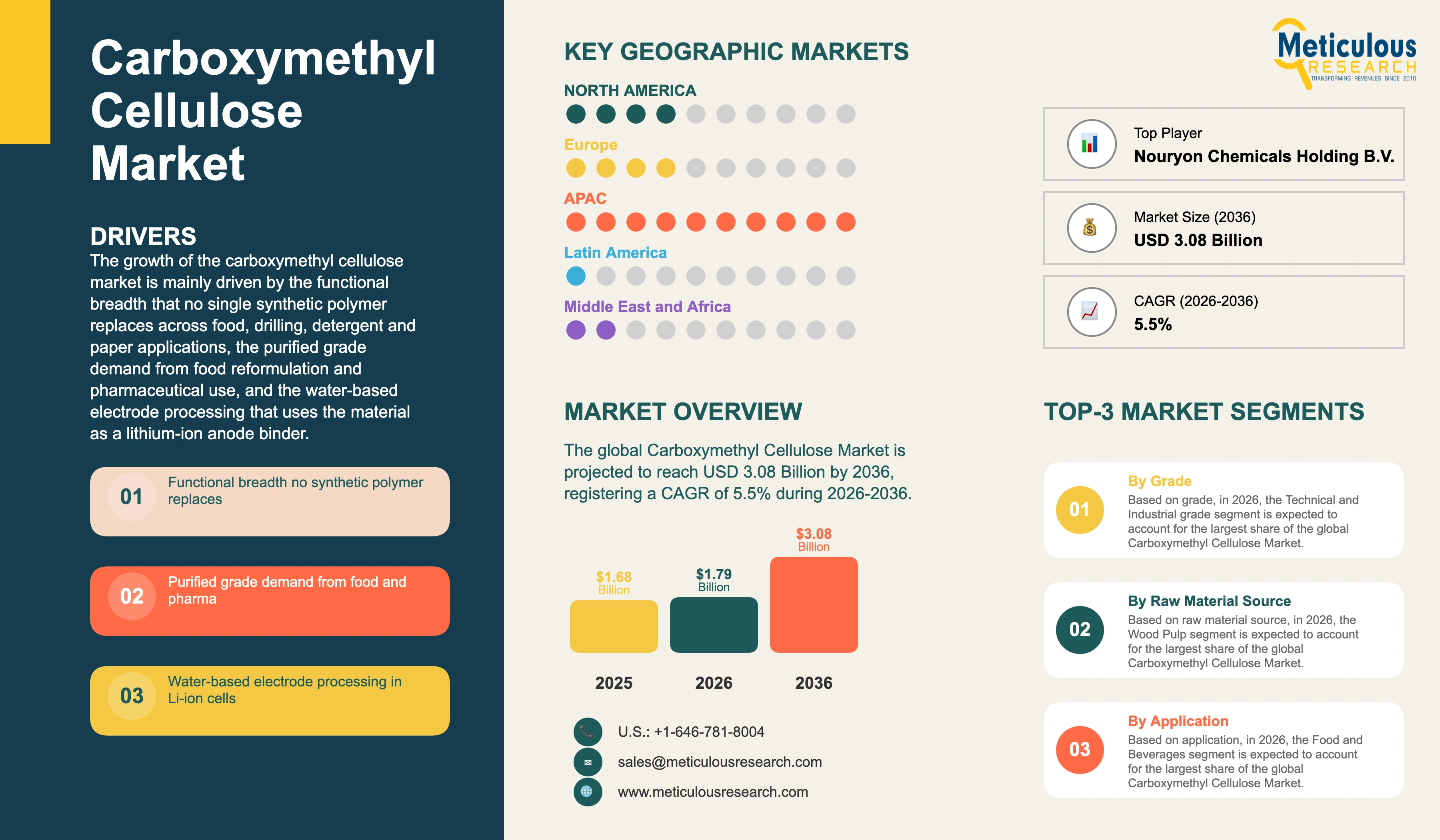
The global carboxymethyl cellulose market was valued at USD 1.68 billion in 2025. This market is expected to reach USD 3.08 billion by 2036 from an estimated USD 1.79 billion in 2026, registering a CAGR of 5.5% during the forecast period (2026-2036).
- Published
- Nov 2026
- Pages
- 270
- Format
- PDF + Excel
- Report ID
- MRCHM - 1042685
- Base year
- 2025
- 2025 · BASELINE
- $1.68B
- 2036
- $3.08B
- CAGR 2026–2036
- 5.5%
2025 baseline · 2026–2036 forecast at 5.5% CAGR · hover a bar for the value
Key highlights
The global carboxymethyl cellulose market is estimated at USD 1.79 billion in 2026 and is projected to reach USD 3.08 billion by 2036.
Market volume is estimated at 690.00 kilotons in 2026 and is projected to reach 1, 061.11 kilotons by 2036 at a CAGR of 4.4%, measured as product supplied as sold.
The average selling price is estimated at USD 2.60 per kg in 2026 and is projected to reach USD 2.90 per kg by 2036 on mix shift toward purified grades.
Technical and industrial grade is expected to account for the largest grade share in 2026, while purified food and pharmaceutical grade is projected to register the highest CAGR of 7.4%.
Wood pulp is expected to hold the largest raw material share in 2026, while agricultural residue and recycled cellulose is projected to grow fastest at a CAGR of 12.0%.
Food and beverages are expected to be the largest application in 2026, while pharmaceuticals and personal care is projected to register the highest CAGR of 8.4%.
Asia-Pacific is expected to hold the largest regional share in 2026, while the Middle East & Africa is projected to register the highest CAGR of 8.0%.
Nippon Paper Industries Co., Ltd. announced on 19 May 2025 that a completion ceremony for its new lithium-ion battery CMC factory in Hungary had been held on 13 May 2025.
The factory is operated by Nippon Paper Chemicals Europe Zrt., established in Hungary in September 2022, and produces carboxymethyl cellulose under the SUNROSE MAC brand as a lithium-ion battery anode material.
The May 2025 release stated that the plant would strengthen the CMC supply chain for the expanding European electric vehicle battery market, citing strict CO2 emission regulations, and gave no capacity, investment amount or production start date.
On 7 September 2026 the company announced the recognition of an extraordinary loss resulting from the temporary suspension of business at that Hungarian subsidiary.
The subsidiary, based in Vacratot, began local production in 2025 and had 24 employees as of 31 August 2026.
Business is to be suspended from 31 December 2026, and CMC production is to be consolidated at the Gotsu Mill in Japan.
The extraordinary loss is stated at about 5.0 billion yen, including an impairment loss on non-current assets, in the fiscal year ending 31 March 2027, and the company states that this is only a current estimate that may change through the subsequent closing process.
For the fiscal year ended 31 December 2025 the subsidiary reported net sales of 74, 000 euros and an operating loss of 5,981,000 euros.
The company cites a difficult electric vehicle market environment, including changes to environmental regulations, electric vehicle adoption policies and subsidy systems in Europe and North America, and states that securing stable earnings for the time being is likely to prove difficult and that returns commensurate with the investment can no longer be expected.
The notice refers to the slowing growth of the electric vehicle market in Europe and North America and to fiercer global competition, and does not state whether operations will resume.
This market excludes other cellulose ethers including methyl cellulose and hydroxypropyl methyl cellulose, and the downstream formulations into which carboxymethyl cellulose is compounded.
Report summary
| Particulars | Details |
|---|---|
| Base Year | 2025 |
| Forecast Period | 2026-2036 |
| Market Size in 2025 | USD 1.68 billion |
| Market Size in 2026 | USD 1.79 billion |
| Market Size by 2036 | USD 3.08 billion |
| Value CAGR (2026-2036) | 5.5% |
| Format | PDF, Excel & Cloud Portal · 270 pages |
| Volume in 2026 | 690.00 kilotons |
| Volume by 2036 | 1,061.11 kilotons |
| Volume CAGR (2026-2036) | 4.4% |
| Volume Basis | Carboxymethyl cellulose supplied as sold on a product-mass basis, since grades differ in active cellulose ether content |
| Average Selling Price in 2026 | USD 2.60 per kg |
| Average Selling Price by 2036 | USD 2.90 per kg |
| Price Direction | Average selling price rises across the forecast period as purified food, pharmaceutical and battery grades take a larger share of the tonnage, rather than on any increase in feedstock or reagent cost |
| Measurement Basis | Technical, semi-purified, purified and battery grade carboxymethyl cellulose by raw material source and application, measured as product as sold, and excluding other cellulose ethers including methyl cellulose, hydroxypropyl methyl cellulose and hydroxyethyl cellulose, microcrystalline and nanocrystalline cellulose, cellulose gum blends sold as compounded formulations, the dissolving pulp and cotton linter feedstocks, and the monochloroacetic acid and caustic soda reagents consumed in manufacture |
| Relationship to Adjacent Markets | This market is not additive to the other cellulose ether markets or to the compounded hydrocolloid and formulation markets downstream of it, and the lithium-ion battery anode binder application within it is a small part of the total rather than its principal driver |
| Largest Grade | Technical and industrial |
| Fastest-Growing Grade | Purified, food and pharmaceutical (CAGR 7.4%) |
| Largest Raw Material Source | Wood pulp |
| Fastest-Growing Raw Material Source | Agricultural residue and recycled cellulose (CAGR 12.0%) |
| Largest Application | Food and beverages |
| Fastest-Growing Application | Pharmaceuticals and personal care (CAGR 8.4%) |
| Largest Region | Asia-Pacific |
| Fastest-Growing Region | Middle East & Africa (CAGR 8.0%) |
| Segments Covered | Grade, Raw Material Source, Application, and Geography |
| Geographies Covered | Asia-Pacific, Europe, North America, Middle East & Africa, and Latin America |
| Companies Profiled | 8 companies, including Nouryon Chemicals Holding B.V., Ashland Inc., Daicel Corporation, Nippon Paper Industries Co., Ltd., DKS Co. Ltd., and Tate & Lyle PLC |
Report overview
Segments covered: grade, raw material source, application.
The growth of this market is mainly driven by the thickening, water retention and rheology control that no single synthetic polymer replaces across food, drilling, detergent and paper applications, the purified grade demand from processed food and pharmaceutical formulation, the water-based electrode processing that uses carboxymethyl cellulose as an anode binder, and the agricultural residue and recycled cellulose feedstocks that widen the raw material base. However, factors such as the retreat of dedicated battery-grade capacity illustrated by the Hungarian plant suspension that Nippon Paper Industries Co., Ltd. announced on 7 September 2026, the maturity of the largest applications, the monochloroacetic acid handling and effluent obligations in manufacture, and the price competition from a large number of technical-grade producers are expected to restrain the growth of this market to some extent.
Carboxymethyl cellulose is an anionic cellulose ether made by treating purified cellulose with sodium hydroxide and monochloroacetic acid, and it is used to thicken, suspend, retain water and control rheology across food, drilling, detergent, paper, textile, pharmaceutical and battery applications. Market sizing in this report is on both a value basis in USD and a volume basis in kilotons measured as product supplied as sold on a product-mass basis, with average selling price derived from the two. The measurement basis covers technical, semi-purified, purified and battery grades by raw material source and application, and it excludes other cellulose ethers including methyl cellulose, hydroxypropyl methyl cellulose and hydroxyethyl cellulose, microcrystalline and nanocrystalline cellulose, cellulose gum blends sold as compounded formulations, the dissolving pulp and cotton linter feedstocks, and the monochloroacetic acid and caustic soda reagents consumed in manufacture.
Measuring product as sold rather than on active content matters because grades differ substantially in the proportion of cellulose ether they contain, with technical grades carrying sodium chloride and sodium glycolate by-product while purified grades are washed to high active content. A tonnage figure converted to an active basis would describe a different market from the one that trades, and prices are quoted on product as shipped. The basis matters when comparing technical and purified volumes, since the same active quantity corresponds to more product mass at the technical end.
Nippon Paper Industries Co., Ltd. announced on 19 May 2025 that a completion ceremony for its new lithium-ion battery CMC factory in Hungary had been held on 13 May 2025, operated by Nippon Paper Chemicals Europe Zrt., established in September 2022, producing carboxymethyl cellulose under the SUNROSE MAC brand as a lithium-ion battery anode material. The release stated that the plant would strengthen the CMC supply chain for the expanding European electric vehicle battery market, citing strict CO2 emission regulations and the regional supply chains automakers were building, and gave no capacity, investment amount or production start date.
Sixteen months later the company announced the opposite. On 7 September 2026 it recognised an extraordinary loss resulting from the temporary suspension of business at that subsidiary, based in Vacratot, which began local production in 2025 and had 24 employees as of 31 August 2026. Business is to be suspended from 31 December 2026 and CMC production consolidated at the Gotsu Mill in Japan, with an extraordinary loss of about 5.0 billion yen including an impairment on non-current assets in the fiscal year ending 31 March 2027, stated as a current estimate that may change. The notice does not say whether operations will resume.
The financial figures in that notice are the clearest statement available of how little battery-grade demand materialised in Europe. For the fiscal year ended 31 December 2025 the subsidiary reported net sales of 74,000 euros against an operating loss of 5,981,000 euros, which is a plant that completed construction and then sold almost nothing. The company cites a difficult electric vehicle market environment including changes to environmental regulations, adoption policies and subsidy systems in Europe and North America, states that securing stable earnings for the time being is likely to prove difficult and that returns commensurate with the investment can no longer be expected, and refers to fiercer global competition.
That sequence should be read as evidence about localisation rather than about the material. Carboxymethyl cellulose remains the standard anode binder for water-based electrode processing and European cell plants continue to consume it, but they can be supplied from Asian capacity at prices a new European plant could not match, and the cell build-out that justified the investment arrived later and smaller than planned. Consolidating production at the Gotsu Mill is a decision about where to make the material, not about whether it is needed. The lesson generalises to other battery materials localisation projects.
The battery application is also a small part of this market, which is why the suspension does not change the forecast materially. Food, drilling, detergent and paper applications account for the great majority of the tonnage and move with food processing, oilfield activity and consumer goods demand rather than with electric vehicles. A reader approaching carboxymethyl cellulose through battery coverage would substantially misjudge what drives it. Lithium-ion battery anode binder consequently grows at 6.4% from a small base rather than leading the market.
Food and beverages are the largest application and the most durable, because carboxymethyl cellulose performs several functions at once in a formulation. It thickens, prevents ice crystal growth in frozen desserts, stabilises suspensions in beverages, retains moisture in baked goods and replaces fat in reduced-calorie products, and it is approved as a food additive across major markets. Reformulation toward reduced sugar, reduced fat and plant-based products generally increases the hydrocolloid content of a recipe rather than reducing it. Food demand therefore grows with processed food consumption and with reformulation at once.
Oilfield demand is the most cyclical part of this market and the hardest to forecast. Carboxymethyl cellulose controls filtration loss and viscosity in water-based drilling fluids, so consumption follows drilling activity rather than oil production, and drilling activity moves with oil prices on a short cycle. A producer serving that application carries volume swings that food and pharmaceutical customers do not impose. The Middle East & Africa consequently registers the highest regional CAGR at 8.0% on drilling and food processing demand together.
Purity is what separates the price bands, and the gap is wide. Technical grade is sold with the sodium chloride and sodium glycolate by-products of the etherification left in, semi-purified grade is partly washed, and purified grade is washed and dried to the active content that food, pharmaceutical and battery applications require, at several times the technical price. The washing step consumes water, solvent and energy and generates effluent, so purified capacity is a different investment from technical capacity. Purified food and pharmaceutical grade consequently registers the highest grade CAGR at 7.4%.
Supply is split between a small number of international specialists holding the purified and pharmaceutical positions and a large number of producers supplying technical grade on price. That structure means the market behaves as two businesses: a specification-led one where qualification and regulatory dossiers protect position, and a commodity one where cost and freight decide. A producer cannot move easily between them, because purified capacity requires washing trains and quality systems that technical plants do not have.
Feedstock is cellulose rather than petrochemical, which gives this market a bio-based character it is rarely credited with. Dissolving wood pulp and cotton linters are the established sources, and agricultural residue and recycled cellulose are being qualified where purity requirements allow, which widens the raw material base and reduces exposure to pulp pricing. Agricultural residue and recycled cellulose consequently registers the highest raw material CAGR at 12.0% from a small base.
Asia-Pacific is expected to account for the largest share in 2026, on the concentration of production capacity across China, Japan and India and the processed food, detergent, textile and paper industries that consume it. India is projected to grow at 7.6%, China at 6.0% and Japan at 3.4%.
The Middle East & Africa is projected to register the highest CAGR of 8.0% during the forecast period, with Saudi Arabia at 8.4%.
Europe is projected to grow at a CAGR of 4.4%, with Germany at 4.2%, on food, pharmaceutical and personal care demand, with the suspension of Hungarian battery-grade capacity from 31 December 2026 removing a local supply point rather than the underlying consumption, which continues to be served from elsewhere.
The Middle East & Africa is the fastest-growing region at a CAGR of 8.0%, with Saudi Arabia at 8.4%, on drilling activity, processed food manufacturing and detergent production. Latin America is projected to grow at a CAGR of 6.0%, with Brazil at 6.2%, on food processing and agricultural feedstock availability.
Nouryon Chemicals Holding B.V., Ashland Inc., Daicel Corporation, Nippon Paper Industries Co., Ltd. and DKS Co. Ltd. together accounted for an estimated 42.6% of this market in 2026. The 8 companies profiled in this report together accounted for an estimated 56.4%, with the balance held by a large number of technical-grade producers.
Report infographic
Market dynamics
15 factors across 5 forcesFunctional Breadth That No Single Synthetic Polymer Replaces
Carboxymethyl cellulose thickens, suspends, retains water, controls filtration loss and modifies rheology, and it performs several of those functions simultaneously in a single formulation, which means a substitute has to match a combination rather than one property. Across food, drilling, detergent, paper and textile applications there is no single synthetic polymer that does so at comparable cost. Demand is therefore embedded in formulations rather than competed for each cycle, which gives this market a stable base.
Reformulating a food, detergent or drilling system to remove the material is also expensive relative to its cost in the formulation, so incumbency is unusually durable even where a technical alternative exists.
The breadth also means demand does not correlate across applications, so a weak oilfield year is frequently offset by food or detergent demand, and a producer serving several applications experiences less volatility than any one of them.
The breadth also means demand does not correlate across applications, so a weak oilfield year is frequently offset by food or detergent demand and a producer serving several applications experiences less volatility than any one of them.
Purified Grade Demand From Food Reformulation and Pharmaceutical Use
Reformulation toward reduced sugar, reduced fat and plant-based products generally increases the hydrocolloid content of a recipe, and pharmaceutical use as a tablet binder, disintegrant, suspension stabiliser and ophthalmic viscosity agent requires tightly controlled purity supported by regulatory documentation. Both pull demand toward the washed grades that carry several times the technical price. The driver therefore raises the average selling price in this market as well as its volume. Purified food and pharmaceutical grade registers the highest grade CAGR at 7.4%.
Both pull demand toward the washed grades that carry several times the technical price, so the driver raises the average selling price in this market as well as its volume.
Water-Based Electrode Processing in Lithium-Ion Cells
Graphite anodes are coated from water-based slurries in which carboxymethyl cellulose acts as the thickener and binder alongside styrene butadiene rubber, avoiding the organic solvent and recovery equipment that cathode coating requires, and Nippon Paper Industries Co., Ltd. describes its SUNROSE MAC product as a lithium-ion battery anode material. Every water-processed anode therefore consumes the material. The application is small in tonnage against food and drilling use, so it adds growth rather than changing what drives this market.
The application is small in tonnage against food and drilling use, so it adds growth rather than changing what drives this market, and its geography is now consolidating rather than spreading.
Agricultural Residue and Recycled Cellulose Feedstocks
Dissolving wood pulp and cotton linters are the established feedstocks and both are priced by markets far larger than cellulose ether use, so qualifying agricultural residue and recycled cellulose where purity requirements allow widens the raw material base and reduces exposure to pulp pricing and availability. The route also supports a recycled content claim that some converters and brands now ask for. Agricultural residue and recycled cellulose registers the highest raw material CAGR at 12.0% from a small base.
The feedstock is cellulose rather than petrochemical, which gives the material a bio-based character it is rarely credited with and is increasingly relevant to buyers managing renewable content across a formulation.
A fourth driver is the bio-based and cellulose-derived character of the material itself. Buyers managing renewable content across a formulation can count carboxymethyl cellulose toward it without any reformulation, which has begun to favour it over synthetic thickeners in food, detergent and personal care systems where both would perform.
A fifth driver is the regulatory familiarity of the material. Decades of food additive approval, pharmacopoeial monographs and established toxicology mean a formulator adding it faces no new approval work, which matters increasingly as novel ingredients encounter longer authorisation timelines in major markets.
Table of contents
11 chapters · 134 sections · 270 pages · click to expandSegmental analysis
| Segment | Largest share (2026) | Fastest growth (2026–2036) |
|---|---|---|
| By Grade | Technical and industrial grade | Purified grade segment covering food and pharmaceutical use |
| By Raw Material Source | Wood pulp | Agricultural residue and recycled cellulose |
| By Application | Food and beverages | Pharmaceuticals and personal care |
| Other segments | Wood pulp | Agricultural residue and recycled cellulose |
By Grade
- Carboxymethyl Cellulose Market Analysis by Grade
- The technical and industrial grade segment is expected to account for the largest share of the global carboxymethyl cellulose market.
- The large share of this segment is mainly due to drilling fluids, detergents, paper and textile sizing consuming the greatest tonnage, the wide specification those applications accept, and the absence of a washing step, which keeps the cost base low and the available supply broad.
- However, the purified grade segment covering food and pharmaceutical use is projected to register the highest CAGR of 7.4% during the forecast period.
- The rapid growth of this segment is attributed to processed food reformulation toward reduced sugar, reduced fat and plant-based products, pharmaceutical excipient demand requiring documented purity and consistent degree of substitution, and the price that washed grades command over technical material.
- Semi-purified grade occupies the middle position, partly washed for applications that require more than technical purity without pharmaceutical documentation, including food-contact paper and some personal care uses.
- Battery grade is a small but distinct segment specified for anode slurry rheology and electrochemical cleanliness.
- Grade determines price band, capital requirement and competitive structure simultaneously, which is why a technical producer cannot move into purified supply without new washing and quality capability.
- Technical and industrial grade is expected to account for the largest share in 2026, on drilling fluids, detergents, paper and textile sizing consuming the greatest tonnage and accepting the widest specification.
- Purified grade covering food and pharmaceutical use is projected to register the highest CAGR of 7.4% during the forecast period.
By Raw Material Source
- Carboxymethyl Cellulose Market Analysis by Raw Material Source
- The wood pulp segment is expected to account for the largest share of the global carboxymethyl cellulose market.
- The large share of this segment is mainly due to dissolving pulp being available at scale with consistent cellulose content, its established qualification across all grades including pharmaceutical, and the integration of several producers with pulp supply.
- Grade also determines where a producer sits in the cycle.
- Technical grade volume moves with drilling and industrial activity and its margin is thin, while purified grade volume moves with food and pharmaceutical demand and holds its price through downturns, so a producer with purified capacity has materially more stable earnings than one without.
- However, the agricultural residue and recycled cellulose segment is projected to register the highest CAGR of 12.0% during the forecast period.
- The rapid growth of this segment is attributed to reduced exposure to dissolving pulp pricing and availability, the recycled and residue content claims that some brands now request, and the suitability of such feedstocks to technical grades where purity requirements are less demanding.
- Cotton linters hold the second position, valued for high cellulose purity and long fibre length that support high viscosity grades, with availability tied to cotton production and ginning.
- Raw material source determines the viscosity range and purity ceiling a producer can reach as well as its cost exposure, and it is fixed by qualification for regulated grades, so a producer serving pharmaceutical customers cannot switch feedstock as freely as one serving drilling fluids.
By Application
- Carboxymethyl Cellulose Market Analysis by Application
- The food and beverages segment is expected to account for the largest share of the global carboxymethyl cellulose market.
- The large share of this segment is mainly due to the several functions the material performs simultaneously in a formulation, including thickening, ice crystal control, suspension stability, moisture retention and fat replacement, its approval as a food additive across major markets, and its low cost relative to other hydrocolloids.
- Raw material source also affects the sustainability claim a producer can make, since residue and recycled cellulose support a recycled content statement that dissolving pulp does not, and some food and personal care brands now ask for that alongside functional specification.
- However, the pharmaceuticals and personal care segment is projected to register the highest CAGR of 8.4% during the forecast period.
- The rapid growth of this segment is attributed to use as a tablet binder, disintegrant, suspension stabiliser, ophthalmic viscosity agent and wound care component, the documented purity and regulatory dossiers those applications require, and the price obtained relative to technical grade.
- Oil and gas drilling fluids consume substantial tonnage for filtration loss and viscosity control, with demand following drilling activity rather than oil production and therefore moving on a short cycle.
- Detergents and home care use the material as an anti-redeposition agent, paper and board for surface sizing and coating rheology, and lithium-ion battery anode binder for water-based electrode processing.
- Application mix therefore spans stable, cyclical and emerging demand in one market, which is why no single end market explains its growth rate.
- Applications also differ in how a supplier is selected.
- Food and pharmaceutical customers qualify a supplier against specification, documentation and audit, while drilling, detergent and paper customers tender on price and availability, so the same producer competes in two different ways depending on which application it is serving.
- Viscosity grade is a further axis of differentiation within each source.
- High viscosity grades command a premium and require longer fibre feedstock and tighter molecular weight control, while low viscosity grades are easier to make and compete on price, so a producer holds a grade ladder rather than a single product and its average realisation depends on where it sits on that ladder.
- Application mix also determines the stability of a producer revenue.
- Food, pharmaceutical and detergent demand moves with consumption and reformulation and is comparatively steady, drilling demand moves with rig activity on a short cycle, and battery binder demand now follows a consolidating supply geography, so a producer serving all of them holds a portfolio whose components do not move together.
- Battery grade sits apart from the other three in how it is specified.
- It requires electrochemical cleanliness and slurry rheology control rather than food or pharmaceutical purity, so a purified food plant does not automatically qualify for it, and the grade has its own narrow approval path through cell makers rather than through regulators.
Other segments
- Wood pulp is expected to hold the largest share in 2026, on dissolving pulp being available at scale with consistent cellulose content and qualified across all grades including pharmaceutical.
- Agricultural residue and recycled cellulose is projected to register the highest CAGR of 12.0% during the forecast period from a small base.
- Food and beverages are expected to account for the largest share in 2026, on the several functions the material performs simultaneously in a formulation and its low cost relative to other hydrocolloids.
- Pharmaceuticals and personal care is projected to register the highest CAGR of 8.4% during the forecast period.
Geographic analysis
Asia-Pacific
Largest shareIn 2026, Asia-Pacific is expected to account for the largest share of the global carboxymethyl cellulose market. The large share of this region is mainly due to the concentration of production capacity across China, Japan and India, the processed food and detergent manufacturing base, the textile and paper industries that consume technical grade, and the battery-grade supply now consolidating at Asian sites. India is projected to register a CAGR of 7.6%, China a CAGR of 6.0% and Japan a CAGR of 3.4% during the forecast period.
Middle East & Africa
Fastest growthHowever, the Middle East & Africa is projected to register the highest CAGR of 8.0% during the forecast period. The rapid growth of this region is attributed to drilling activity consuming technical grade in water-based fluids, the processed food manufacturing being established across the Gulf and North Africa, and detergent production serving regional consumer demand, from a relatively small base. Saudi Arabia is projected to register a CAGR of 8.4%.
Europe
Europe is projected to grow at 4.4%, with Germany at 4.2%, on food, pharmaceutical and personal care demand, with the suspension of Hungarian battery-grade capacity from 31 December 2026 removing a local supply point rather than the underlying consumption.
North America
North America is projected to grow at 4.6%, with the United States at 4.6%, on food reformulation and pharmaceutical use alongside cyclical drilling demand.
Latin America
Latin America is projected to grow at 6.0%, with Brazil at 6.2%, on food processing and agricultural feedstock availability. Freight economics also differ by grade rather than by region, since a technical grade competing on cost tolerates far less shipping distance than a purified pharmaceutical grade whose price absorbs it, so purified supply is genuinely global while technical supply is regional. Production and consumption are better matched in this market than in most specialty chemicals, because the material is a dry powder that ships economically and the feedstock is available on several continents. What differs by region is grade mix rather than presence: purified and pharmaceutical demand concentrates in Europe, North America and Japan, while technical grade dominates where drilling, textile and paper industries are largest. Regional share therefore describes end market composition rather than capacity location. Grade mix within an application is a further element the segment totals conceal. Food applications span technical-grade use in low-cost processed products and purified-grade use in pharmaceutical-adjacent nutrition, drilling uses almost entirely technical material, and battery binder requires the tightest electrochemical cleanliness of any grade, so the price realised in an application depends on its internal grade split as much as on its tonnage.
Competitive landscape
The global carboxymethyl cellulose market is characterised by the presence of a small number of international specialists holding purified, food and pharmaceutical positions, Japanese producers supplying battery and specialty grades, and a large number of regional manufacturers competing on technical grade. Competition in purified grades is contested on qualification, degree of substitution consistency and regulatory documentation, while technical grade competes on cost and freight. Nouryon Chemicals Holding B.V., Ashland Inc., Daicel Corporation, Nippon Paper Industries Co., Ltd. and DKS Co. Ltd. together accounted for an estimated 42.6% of this market in 2026, while the companies profiled in this report together accounted for an estimated 56.4%. The balance is held by a large number of technical-grade producers, principally in China, and these shares describe identified suppliers across all grades.
Nippon Paper Industries Co., Ltd. announced on 19 May 2025 the completion ceremony for its lithium-ion battery CMC factory in Hungary, operated by Nippon Paper Chemicals Europe Zrt. and producing SUNROSE MAC as an anode material, and on 7 September 2026 announced the temporary suspension of that business from 31 December 2026 with CMC production consolidated at the Gotsu Mill in Japan, an extraordinary loss of about 5.0 billion yen in the fiscal year ending 31 March 2027, and fiscal 2025 subsidiary net sales of 74,000 euros against an operating loss of 5,981,000 euros. Expansion of purified and pharmaceutical capacity, qualification of residue and recycled feedstocks, and consolidation of battery-grade production accounted for most competitive activity through 2026.
Grade coverage rather than capacity separates the competitors, because purified supply requires washing trains, quality systems and regulatory dossiers that a technical producer does not hold. Nouryon Chemicals Holding B.V. and Ashland Inc. compete from the broadest purified and pharmaceutical positions, Daicel Corporation, Nippon Paper Industries Co., Ltd. and DKS Co. Ltd. from Japanese specialty and battery grade production, Tate & Lyle PLC from food hydrocolloid portfolios, and Lamberti S.p.A. and Shandong Head Co., Ltd. from regional technical and specialty supply. Some of the key players operating in the carboxymethyl cellulose market are Nouryon Chemicals Holding B.V. (Netherlands), Ashland Inc. (U.S.), Daicel Corporation (Japan), Nippon Paper Industries Co., Ltd. (Japan), DKS Co. Ltd. (Japan), Tate & Lyle PLC (U.K.), Lamberti S.p.A. (Italy), and Shandong Head Co., Ltd. (China), among others.
- —
Nippon Paper Industries Co., Ltd. announced on 19 May 2025 that a completion ceremony for its new lithium-ion battery CMC factory in Hungary had been held on 13 May 2025, operated by Nippon Paper Chemicals Europe Zrt., established in September 2022, producing carboxymethyl cellulose under the SUNROSE MAC brand as a lithium-ion battery anode material, with the release citing the expanding European electric vehicle battery market and strict CO2 emission regulations and giving no capacity, investment amount or production start date. On 7 September 2026 the company announced the recognition of an extraordinary loss resulting from the temporary suspension of business at that subsidiary, based in Vacratot, which began local production in 2025 and had 24 employees as of 31 August 2026. Business is to be suspended from 31 December 2026 and CMC production consolidated at the Gotsu Mill in Japan, with an extraordinary loss of about 5.0 billion yen including an impairment loss on non-current assets in the fiscal year ending 31 March 2027, stated as a current estimate that may change through the subsequent closing process. For the fiscal year ended 31 December 2025 the subsidiary reported net sales of 74,000 euros and an operating loss of 5,981,000 euros. The company cites a difficult electric vehicle market environment including changes to environmental regulations, electric vehicle adoption policies and subsidy systems in Europe and North America, states that securing stable earnings for the time being is likely to prove difficult and that returns commensurate with the investment can no longer be expected, refers to the slowing growth of the electric vehicle market and to fiercer global competition, and does not state whether operations will resume.
- Nouryon Chemicals Holding B.V.
- Ashland Inc.
- Daicel Corporation
- Nippon Paper Industries Co., Ltd.
- DKS Co. Ltd.
- Tate & Lyle PLC
Expert perspectives
Value grows at 5.5% against 4.4% in volume over the forecast period, and the average selling price rises from USD 2.60 per kg in 2026 to USD 2.90 per kg by 2036. The increase is mix rather than inflation, as purified food, pharmaceutical and battery grades take a larger share of the tonnage, so a tonnage reading understates this market and a value reading overstates the material supplied.
The Hungarian episode is the most instructive recent fact in this market and it reads as a warning rather than a verdict on the material. A completion ceremony on 13 May 2025 was followed on 7 September 2026 by a temporary suspension from 31 December 2026, an extraordinary loss of about 5.0 billion yen and consolidation of production at the Gotsu Mill in Japan. The subsidiary reported net sales of 74,000 euros against an operating loss of 5,981,000 euros for fiscal 2025, which is a plant that was built and then sold almost nothing.
What failed was localisation, not the application. Carboxymethyl cellulose remains the standard binder for water-based anode processing and European cell plants continue to consume it, but they can buy it from Asian capacity at prices a new European plant could not match, and the cell build-out that justified the investment arrived later and smaller than planned. The company cites changes to environmental regulations, adoption policies and subsidy systems in Europe and North America.
The battery application is small enough that none of this moves the forecast much, which is the point a reader coming from battery coverage would miss. Food, drilling, detergent and paper applications carry the great majority of tonnage and move with food processing, oilfield activity and consumer goods demand, so battery binder grows at 6.4% from a small base rather than leading the market.
Where the money is made is purity rather than volume. Technical grade competes on cost and freight against many producers with thin margins, while purified grade requires washing trains, quality systems and regulatory dossiers that technical plants do not have and commands several times the price, which is why pharmaceuticals and personal care grows at 8.4% and purified grade at 7.4%. A producer escapes commodity competition by investing in that capability, not by adding tonnes.
Two things make the forecast harder than the growth rate suggests. Oilfield demand follows drilling activity on a short cycle rather than oil production, and food demand grows with reformulation as well as consumption, so the applications do not move together. This market also excludes other cellulose ethers and the compounded formulations downstream, and is not additive to them.
Customer perspectives
Removing sugar or fat removes body and structure that a hydrocolloid must restore, so reformulation generally increases hydrocolloid content in a recipe rather than reducing it.
Low cost relative to other hydrocolloids is what makes it the default choice in that work rather than any unique functionality, so the application grows with reformulation activity rather than with a technical advantage.
Pharmaceutical use requires documented purity, consistent degree of substitution and regulatory dossiers, which few producers hold and which makes qualification rather than price the basis of competition in that grade.
Switching a qualified excipient supplier also requires regulatory filing changes on the finished medicine, which is why these positions persist for many years once established.
Because the binder is a small share of cell cost and ships economically as a dry powder, cell makers have accepted imported supply rather than paying for regional capacity, which is why battery-grade production is consolidating rather than localising.
Taken together the three perspectives describe a market where the food and pharmaceutical customer is buying consistency and documentation, the industrial customer is buying cost, and the battery customer was never going to pay for proximity.
“Every time we take sugar or fat out of a product we have to put structure back in, and this is the cheapest way to do it. Reformulation has increased our hydrocolloid spend, not reduced it.”
“We are not buying a viscosity, we are buying a dossier and a degree of substitution that does not move batch to batch. That narrows our supplier list to a handful, and price is some way down the list of what matters.”
“The binder is a small part of our bill of materials and it ships as a dry powder from anywhere. We were never going to pay a premium for a plant next door when the same product arrives from Asia on a container.”
Frequently asked questions
This market was valued at USD 1.60 billion in 2024 and USD 1.68 billion in 2025, and is estimated at USD 1.79 billion in 2026. In volume terms it is estimated at 690.00 kilotons in 2026 as product supplied as sold.
This market is projected to reach USD 3.08 billion by 2036 in value and 1,061.11 kilotons in volume.
This market is projected to register a value CAGR of 5.5% and a volume CAGR of 4.4% during the forecast period 2026-2036. The average selling price is projected to move from USD 2.60 per kg in 2026 to USD 2.90 per kg by 2036 on mix shift toward purified grades.
Growth is driven by functional breadth that no single synthetic polymer replaces across food, drilling, detergent and paper applications, purified grade demand from food reformulation and pharmaceutical use, water-based electrode processing in lithium-ion cells, and agricultural residue and recycled cellulose feedstocks.
Dedicated battery-grade capacity outside Asia has retreated, with Nippon Paper Industries Co., Ltd. announcing the suspension of its Hungarian plant from 31 December 2026. The largest applications are mature, manufacture carries monochloroacetic acid handling and effluent obligations, and technical grade competes on cost against many producers.
Pharmaceutical and personal care formulation requires documented purity that few producers supply, and reduced sugar, reduced fat and plant-based reformulation increases hydrocolloid content. Purified capacity serves specification-led demand, and consolidated Asian production serves global battery demand from a single cost base.
Technical and industrial grade is expected to account for the largest share in 2026, on drilling fluids, detergents, paper and textile sizing consuming the greatest tonnage and accepting the widest specification.
Purified grade covering food and pharmaceutical use is projected to register the highest CAGR of 7.4% during the forecast period.
Wood pulp is expected to hold the largest share in 2026, on dissolving pulp being available at scale with consistent cellulose content and qualified across all grades including pharmaceutical.
Agricultural residue and recycled cellulose is projected to register the highest CAGR of 12.0% during the forecast period from a small base.
Food and beverages are expected to account for the largest share in 2026, on the several functions the material performs simultaneously in a formulation and its low cost relative to other hydrocolloids.
Pharmaceuticals and personal care is projected to register the highest CAGR of 8.4% during the forecast period.
Asia-Pacific is expected to account for the largest share in 2026, on the concentration of production capacity across China, Japan and India and the processed food, detergent, textile and paper industries that consume it. India is projected to grow at 7.6%, China at 6.0% and Japan at 3.4%.
The Middle East & Africa is projected to register the highest CAGR of 8.0% during the forecast period, with Saudi Arabia at 8.4%.
Europe is projected to grow at a CAGR of 4.4%, with Germany at 4.2%, on food, pharmaceutical and personal care demand. The suspension of Hungarian battery-grade capacity from 31 December 2026 removes a local supply point rather than the underlying consumption.
The Middle East & Africa is the fastest-growing region at a CAGR of 8.0%, with Saudi Arabia at 8.4%, on drilling activity, processed food manufacturing and detergent production. Latin America is projected to grow at a CAGR of 6.0%, with Brazil at 6.2%, on food processing and agricultural feedstock availability.
Nouryon Chemicals Holding B.V., Ashland Inc., Daicel Corporation, Nippon Paper Industries Co., Ltd. and DKS Co. Ltd. together accounted for an estimated 42.6% of this market in 2026. The 8 companies profiled together accounted for an estimated 56.4%, with the balance held by a large number of technical-grade producers.
Nippon Paper Industries Co., Ltd. announced on 19 May 2025 the completion ceremony for its lithium-ion battery CMC factory in Hungary, and on 7 September 2026 announced the temporary suspension of that business from 31 December 2026, with CMC production consolidated at the Gotsu Mill in Japan and an extraordinary loss of about 5.0 billion yen.
Cite this report
Meticulous Research. (2026). Carboxymethyl Cellulose Market - Global Opportunity Analysis and Industry Forecast (2026-2036) (Report No. MRCHM - 1042685). Meticulous Market Research Pvt. Ltd. https://www.meticulousresearch.com/product/carboxymethyl-cellulose-market-7368