Cellulose Nanocrystals Market (2026-2036)
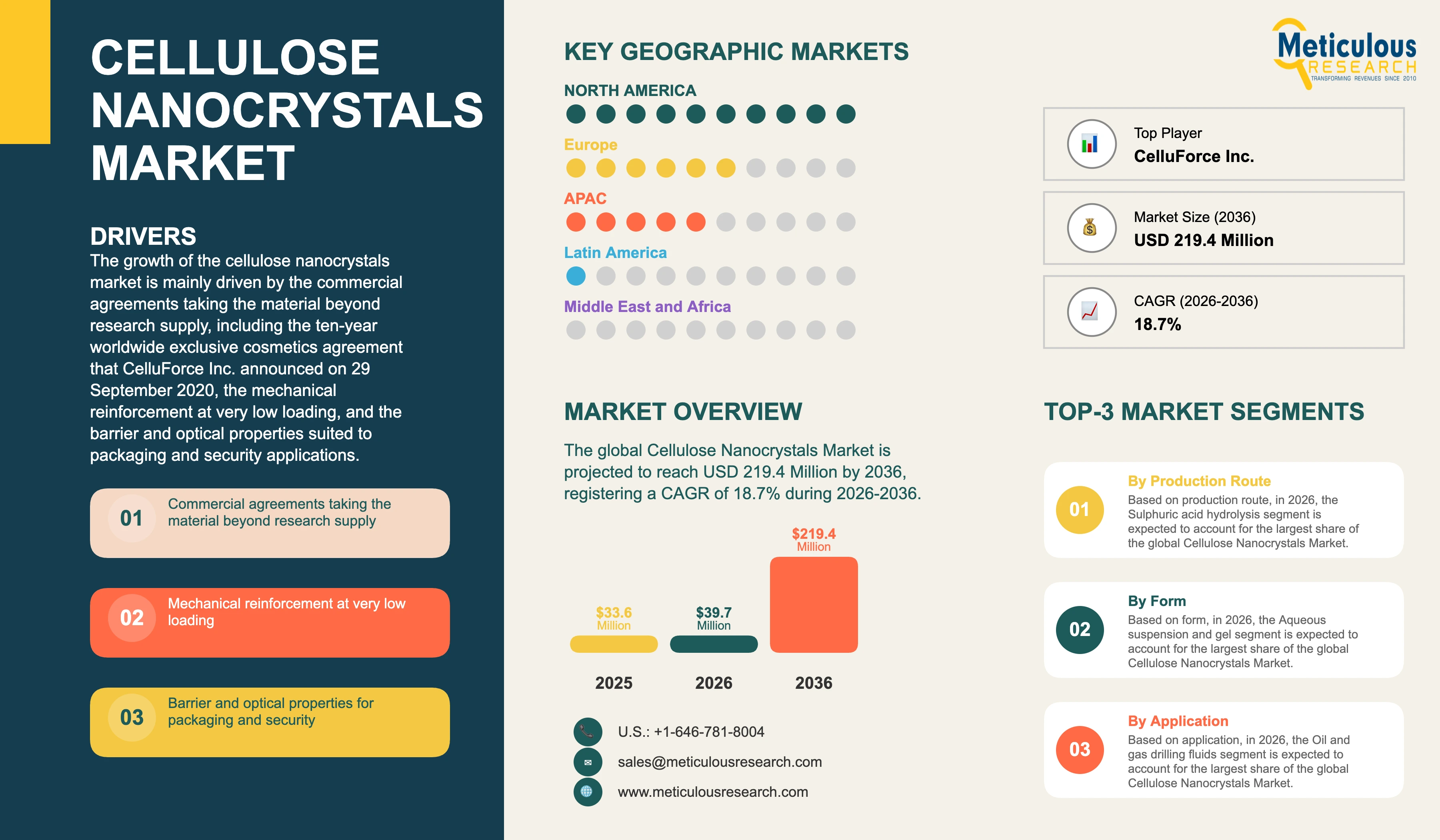
The global cellulose nanocrystals market was valued at USD 33.6 million in 2025. This market is expected to reach USD 219.4 million by 2036 from an estimated USD 39.7 million in 2026, registering a CAGR of 18.7% during the forecast period (2026-2036).
- Published
- Nov 2026
- Pages
- 278
- Format
- PDF + Excel
- Report ID
- MRCHM - 1042687
- Base year
- 2025
- 2025 · BASELINE
- $33.6M
- 2036
- $219.4M
- CAGR 2026–2036
- 18.7%
2025 baseline · 2026–2036 forecast at 18.7% CAGR · hover a bar for the value
Key highlights
The global cellulose nanocrystals market is estimated at USD 39.7 million in 2026 and is projected to reach USD 219.4 million by 2036.
Market volume is estimated at 620.00 tonnes in 2026 and is projected to reach 6, 453.25 tonnes by 2036 at a CAGR of 26.4%, measured on a dry solids basis.
The average selling price is estimated at USD 64.00 per kg in 2026 and is projected to reach USD 34.00 per kg by 2036 as production moves beyond single-plant scale.
Sulphuric acid hydrolysis is expected to account for the largest production route share in 2026, while carboxylated and oxidation routes are projected to register the highest CAGR of 28.0%.
Aqueous suspension and gel is expected to hold the largest form share in 2026, while spray-dried powder is projected to grow fastest at a CAGR of 22.0%.
Oil and gas drilling fluids are expected to be the largest application in 2026, while cosmetics and personal care is projected to register the highest CAGR of 30.0%.
North America is expected to hold the largest regional share in 2026, while Asia-Pacific is projected to register the highest CAGR of 24.0%.
CelluForce Inc. stated on 6 February 2019 that its cellulose nanocrystals plant has a capacity of 300 tonnes per year and described it as the only plant of its kind in the world.
The plant was built in 2011 using a first version of the production process, scaled up from laboratory work and small pilot trials.
A major upgrade project aimed to increase process efficiency by over 50% with new equipment, stabilise capacity at 300 tonnes per year, and produce several product grades that some customers require.
The company linked the timing to its cellulose nanocrystals inventory being depleted by two years of customer research, and the upgrade allowing that inventory to be rebuilt.
Applications then being marketed by customers were oil and gas drilling and anti-fog coatings, with biopolymers, packaging, electronics and 3D printing in advanced development.
CelluForce Inc. announced on 29 September 2020 a ten-year commercial agreement with an unnamed multinational cosmetics company, described as generating multi-million-dollar sales.
The agreement grants worldwide exclusivity for the commercialisation of cellulose nanocrystal based cosmetics products, with sales expected to rise gradually over the contract period.
The company stated that the agreement will require building a new plant with larger capacity in the near future, and described its existing Windsor, Quebec plant as capable of 300 tonnes per year.
Cellulose nanocrystals are used by several hydroalcoholic gel producers as a biodegradable gelling agent, and CelluForce NCC is described as coming from a 100% natural source with PEFC certification.
Natural Resources Canada states that a small amount of the material can increase resistance to stress threefold, without giving a baseline or test conditions.
Natural Resources Canada describes a CAD 32.4 million federal pilot-scale demonstration project supporting a facility at the Domtar pulp and paper mill in Windsor, Quebec, with the federal government, Quebec, Domtar and FPInnovations as partners.
That pilot plant was planned to produce one tonne of the material per day from hardwood chips, and was described as the first facility of this scale in the world.
This market covers cellulose nanocrystals only and excludes cellulose nanofibrils, microfibrillated cellulose and bacterial nanocellulose.
Report summary
| Particulars | Details |
|---|---|
| Base Year | 2025 |
| Forecast Period | 2026-2036 |
| Market Size in 2025 | USD 33.6 million |
| Market Size in 2026 | USD 39.7 million |
| Market Size by 2036 | USD 219.4 million |
| Value CAGR (2026-2036) | 18.7% |
| Format | PDF, Excel & Cloud Portal · 278 pages |
| Volume in 2026 | 620.00 tonnes |
| Volume by 2036 | 6,453.25 tonnes |
| Volume CAGR (2026-2036) | 26.4% |
| Volume Basis | Cellulose nanocrystals supplied on a dry solids basis, since much of the material ships as an aqueous suspension at low solids content |
| Average Selling Price in 2026 | USD 64.00 per kg |
| Average Selling Price by 2036 | USD 34.00 per kg |
| Commercialisation Status | The largest plant in the world is stated at 300 tonnes per year and described as the only one of its kind; a ten-year worldwide exclusive cosmetics agreement was announced in 2020 and a larger plant stated to be required, with its capacity, location and timing unstated, so supply rather than demand limits it and the growth rate reflects a base effect |
| Measurement Basis | Cellulose nanocrystals by production route, form and application, measured on a dry solids basis, and excluding cellulose nanofibrils and microfibrillated cellulose, bacterial nanocellulose, microcrystalline cellulose, cellulose ethers and esters, the dissolving pulp and hardwood chip feedstocks, and the coatings, composites and formulations into which the nanocrystals are compounded |
| Relationship to Adjacent Markets | This market covers nanocrystals only and is not additive to the cellulose nanofibril and microfibrillated cellulose markets with which it is frequently reported as nanocellulose, nor to the microcrystalline cellulose market or the formulations downstream of it; a combined nanocellulose figure overstates this market by an order of magnitude |
| Largest Production Route | Sulphuric acid hydrolysis |
| Fastest-Growing Production Route | Carboxylated and oxidation routes (CAGR 28.0%) |
| Largest Form | Aqueous suspension and gel |
| Fastest-Growing Form | Spray-dried powder (CAGR 22.0%) |
| Largest Application | Oil and gas drilling fluids |
| Fastest-Growing Application | Cosmetics and personal care (CAGR 30.0%) |
| Largest Region | North America |
| Fastest-Growing Region | Asia-Pacific (CAGR 24.0%) |
| Segments Covered | Production Route, Form, Application, and Geography |
| Geographies Covered | North America, Europe, Asia-Pacific, Latin America, and Middle East & Africa |
| Companies Profiled | 6 companies, including CelluForce Inc., Melodea Ltd., Anomera Inc., Blue Goose Biorefineries Inc., GranBio Investimentos S.A., and Cellulose Lab Inc. |
Report overview
Segments covered: production route, form, application.
In volume terms, this market is estimated at 620.00 tonnes in 2026 and is projected to reach 6,453.25 tonnes by 2036, registering a CAGR of 26.4% during the same period, measured as cellulose nanocrystals supplied on a dry solids basis, since much of the material ships as an aqueous suspension. The average selling price is estimated at USD 64.00 per kg in 2026 and is projected to decline to USD 34.00 per kg by 2036 as production moves beyond single-plant scale and process efficiency improves.
The growth of this market is mainly driven by the commercial agreements that have taken the material out of research supply, including the ten-year worldwide exclusive cosmetics agreement that CelluForce Inc. announced on 29 September 2020, the mechanical reinforcement that a small addition provides with Natural Resources Canada stating that a small amount can increase resistance to stress threefold, the barrier and optical properties that suit packaging and security applications, and the renewable wood-pulp origin with forest certification. However, factors such as world capacity measured in hundreds of tonnes against applications that would consume far more, the price that remains well above the additives it would displace, the energy and water required to dry and redisperse the material, and the absence of long-run performance data in most applications are expected to restrain the growth of this market to some extent.
Sulphuric acid hydrolysis accounts for the largest share of this market because it is the route on which the only commercial-scale plant was built and the one with the longest production record. Carboxylated and oxidation routes grow faster because the surface chemistry they produce disperses more readily in the polymer and personal care systems where the highest-value applications sit.
Cellulose nanocrystals are rod-shaped crystalline particles liberated from cellulose fibres by hydrolysing the amorphous regions away, leaving a high-aspect-ratio reinforcing particle with a large surface area. Market sizing in this report is on both a value basis in USD and a volume basis in tonnes measured as material supplied on a dry solids basis, with average selling price derived from the two. The measurement basis covers nanocrystals by production route, form and application, and it excludes cellulose nanofibrils and microfibrillated cellulose, bacterial nanocellulose, microcrystalline cellulose, cellulose ethers and esters, the dissolving pulp and hardwood chip feedstocks, and the coatings, composites and formulations into which the nanocrystals are compounded.
Separating nanocrystals from nanofibrils matters more here than almost any scope decision in this batch, because the two are routinely reported together as nanocellulose. A nanofibril is a long flexible bundle produced mechanically and sold in thousands of tonnes by paper companies, while a nanocrystal is a short rigid rod produced by chemical hydrolysis and sold in hundreds of tonnes by a handful of specialists. They differ in rheology, reinforcement behaviour, price and supplier base, so a combined figure describes neither, and a reader using a nanocellulose market size for nanocrystals will overstate this market by an order of magnitude.
Measuring on dry solids also matters because the material is frequently shipped as an aqueous suspension at low solids content. A tonne of suspension may contain a small fraction of a tonne of nanocrystals, so a shipped-mass basis would describe water transport rather than material supply, and prices are quoted on the solids delivered. The distinction is unusually large in this market because drying and redispersion are themselves difficult and costly steps.
CelluForce Inc. stated on 6 February 2019 that its plant has a capacity of 300 tonnes per year and is the only plant of its kind in the world, built in 2011 using a first version of the production process scaled up from laboratory work and small pilot trials, and described a major upgrade intended to increase process efficiency by over 50% with new equipment, stabilise capacity at 300 tonnes per year and produce several product grades that some customers require. The company linked the timing to its inventory being depleted by two years of customer research. Applications then being marketed by customers were oil and gas drilling and anti-fog coatings, with biopolymers, packaging, electronics and 3D printing in advanced development.
Three hundred tonnes a year is the number that frames this entire market. It is the capacity of the largest plant in the world, and it is a quantity a single mid-sized coatings or drilling fluid customer could absorb if the material were qualified at full rate. Everything about the commercial behaviour of this market follows from that: customers are allocated rather than supplied, applications are developed sequentially rather than in parallel, and the growth rate in the forecast describes a base effect as much as a market. Percentage growth and absolute quantity are separate facts here.
CelluForce Inc. announced on 29 September 2020 a ten-year commercial agreement with an unnamed multinational cosmetics company described as generating multi-million-dollar sales, granting worldwide exclusivity for the commercialisation of cellulose nanocrystal based cosmetics products, with sales expected to rise gradually over the contract period and a first application already launching. The company stated that the agreement will require building a new plant with larger capacity in the near future and described its existing Windsor, Quebec plant as capable of 300 tonnes per year. Cellulose nanocrystals are used by several hydroalcoholic gel producers as a biodegradable gelling agent, and CelluForce NCC is described as coming from a 100% natural source with PEFC certification.
A ten-year exclusive agreement is a different instrument from a development contract and tells a reader more than a volume figure would. It commits a multinational to a material whose world supply sits in one plant, which means the buyer accepted a single-source risk that most procurement functions would refuse, and the exclusivity indicates the buyer rather than the producer was protecting a position. The agreement value, the counterparty, the first application and the new plant capacity, location and timing are all unstated.
Cosmetics is the application where the economics work first, and the reasoning is price rather than performance. A gelling agent is a small fraction of the cost of a finished cosmetic, the renewable and biodegradable origin carries weight with the end consumer, and the quantities a personal care business requires are within what a 300 tonne plant can supply. Hydroalcoholic gels are an established use. Cosmetics and personal care consequently registers the highest application CAGR at 30.0% during the forecast period.
Oil and gas drilling remains the largest application because it was the first to qualify the material and because a drilling fluid tolerates a performance additive at a cost that a commodity plastic will not. Natural Resources Canada states that a small amount of the material can increase resistance to stress threefold, without giving a baseline or test conditions, and it is that reinforcement at low loading which makes a high unit price tolerable. Drilling demand follows rig activity rather than oil production, so the largest application in this market is also its most cyclical.
Reinforcement at very low loading is the general commercial argument and it is what keeps this market alive at its price. Because the particles are rigid, high-aspect-ratio and present an enormous surface area, a loading of a few per cent can change the mechanical, barrier or rheological behaviour of a system, so the cost per unit of finished product is a small multiple of the cost per kilogram. Dispersion is what determines whether that effect is realised, which is why surface chemistry rather than particle quality is where development effort concentrates.
Drying and redispersion are the practical obstacles that most assessments understate. The particles aggregate irreversibly if dried carelessly, so a producer either ships a dilute suspension and transports water, or spray or freeze dries at energy cost and accepts that the customer must redisperse successfully. Spray-dried powder consequently registers the highest form CAGR at 22.0%, because it is what a non-aqueous or solid processing customer can actually use.
Public funding rather than private capital has carried this material to its present position. Natural Resources Canada describes a CAD 32.4 million federal pilot-scale demonstration project supporting a facility at the Domtar pulp and paper mill in Windsor, Quebec, with the federal government, Quebec, Domtar and FPInnovations as partners, planned to produce one tonne per day from hardwood chips and described as the first facility of this scale in the world. The page does not state whether that plant was built, started operating or met its targets, which is worth noting when reading capacity claims in this field.
Forest certification and renewable origin are the attributes that open consumer-facing applications. The material is extracted from woody biomass and pulp, CelluForce NCC is described as coming from a 100% natural source with PEFC certification, and Natural Resources Canada states that testing to date suggests it is virtually non-toxic and its production poses no serious environmental risks, while noting that no data is provided. Those claims carry commercial weight in cosmetics and packaging, and they require substantiation rather than assertion in regulated uses.
North America is expected to account for the largest share in 2026, on the only commercial-scale plant being located at Windsor, Quebec and on the drilling fluid and coatings customers that qualified the earliest applications. The United States is projected to grow at 17.0% and Canada at 16.0%.
Asia-Pacific is projected to register the highest CAGR of 24.0% during the forecast period, with India at 26.0%, China at 25.4% and Japan at 22.0%.
Europe is projected to grow at a CAGR of 19.0%, with Sweden at 19.6%, Finland at 19.0% and Germany at 18.4%, on the forest products research base, the barrier coating developers established in the region and the packaging regulation that favours renewable materials.
The Middle East & Africa is projected to grow at a CAGR of 15.0% from a negligible base, principally on drilling applications, with Israel at 21.0% on barrier coating development. Latin America is projected to grow at a CAGR of 16.0% on pulp industry integration.
CelluForce Inc., Melodea Ltd., Anomera Inc., Blue Goose Biorefineries Inc. and GranBio Investimentos S.A. together accounted for an estimated 72.4% of this market in 2026. The 6 companies profiled in this report together accounted for an estimated 84.6%.
What comes next: Cellulose Nanomaterials and the Future of Lightweight Barriers, a Meticulous Next™ foresight brief.
Report infographic
Market dynamics
15 factors across 5 forcesCommercial Agreements Taking the Material Beyond Research Supply
CelluForce Inc. announced on 29 September 2020 a ten-year agreement with a multinational cosmetics company granting worldwide exclusivity for cellulose nanocrystal based cosmetics products, described as generating multi-million-dollar sales with revenue rising gradually over the term and a first application already launching. A commitment of that duration converts a development material into a supplied one and justifies the larger plant the company stated would be required. The driver acts on commercial credibility rather than on tonnage, which remains small.
The duration matters more than the stated value here. Ten years commits a buyer through the period in which new capacity would have to be financed, which is what allows a producer to raise it.
An exclusive arrangement also signals that the buyer rather than the producer was protecting a position, which is unusual for a material in short supply and indicates genuine competitive value in the application rather than a trial.
An exclusive arrangement also signals that the buyer rather than the producer was protecting a position, which is unusual for a material in short supply and indicates genuine competitive value in the application rather than a trial.
Mechanical Reinforcement at Very Low Loading
Natural Resources Canada states that a small amount of the material can increase resistance to stress threefold, without giving a baseline or test conditions, and the rigid high-aspect-ratio particles with large surface area change mechanical, barrier and rheological behaviour at loadings of a few per cent. The cost per unit of finished product is therefore a small multiple of the cost per kilogram, which is what makes a high unit price tolerable. Reinforcement efficiency rather than price is the basis on which the material is sold.
Reinforcement efficiency rather than price is therefore the basis on which the material is sold, and a formulator comparing it on cost per kilogram against a mineral filler is making the wrong comparison.
Barrier and Optical Properties for Packaging and Security
Natural Resources Canada notes that films appear iridescent, that optical films could help prevent counterfeiting, and that the material improves paper gloss, tensile strength, stiffness, surface smoothness and bulk, while giving no figures for those effects. Barrier coatings for flexible packaging and optical security features are both applications where a thin layer of expensive material is acceptable. The driver reaches applications that consume very little material at high value.
The driver reaches applications that consume very little material at high value, which is exactly what a supply-constrained producer needs, so it is being pursued ahead of larger uses.
Renewable Wood-Pulp Origin With Forest Certification
The material is extracted from woody biomass and pulp, with CelluForce NCC described as coming from a 100% natural source carrying PEFC certification covering sustainable forest management, and Natural Resources Canada states that testing to date suggests it is virtually non-toxic with no serious environmental risks from production, while noting that no data is provided. Those attributes open cosmetics, packaging and consumer applications that a petrochemical additive would struggle to enter.
Those attributes open cosmetics, packaging and consumer applications that a petrochemical additive would struggle to enter, and they are stated on the product rather than only in a supplier dossier.
A fifth driver is the application development support that producers supply alongside the material. Because dispersion determines whether the performance appears, a producer that establishes the protocol, loading level and performance case in a customer system removes the main barrier to adoption, and that support is frequently what converts a trial into a contract at this stage of the market.
A sixth driver is the breadth of application interest relative to supply. Natural Resources Canada lists paper, paints and varnishes, high-strength materials, specialty packaging, biosensors, security devices, magnetic paper, electronic memory products and aerospace and automotive composites among the uses identified, which means demand is limited by availability rather than by the number of applications seeking the material.
Table of contents
11 chapters · 127 sections · 278 pages · click to expandSegmental analysis
| Segment | Largest share (2026) | Fastest growth (2026–2036) |
|---|---|---|
| By Production Route | Sulphuric acid hydrolysis | — |
| Other segments | — | Carboxylated and oxidation routes |
By Production Route
- Sulphuric acid hydrolysis is expected to account for the largest share in 2026, on being the route on which the only commercial-scale plant was built in 2011 and the one with the longest production record.
- Aqueous suspension and gel is expected to hold the largest share in 2026, since the material is produced in water, aggregates irreversibly if dried carelessly, and the earliest applications accept a suspension directly.
- Oil and gas drilling fluids are expected to account for the largest share in 2026, on being among the first applications qualified and marketed by customers and on the tolerance of a drilling fluid for a performance additive at that cost.
Other segments
- Carboxylated and oxidation routes are projected to register the highest CAGR of 28.0% during the forecast period.
- Spray-dried powder is projected to register the highest CAGR of 22.0% during the forecast period.
- Cosmetics and personal care is projected to register the highest CAGR of 30.0% during the forecast period.
Geographic analysis
North America
Largest shareIn 2026, North America is expected to account for the largest share of the global cellulose nanocrystals market. The large share of this region is mainly due to the only commercial-scale plant being located at Windsor, Quebec, the public funding that established it including the CAD 32.4 million federal pilot-scale demonstration project that Natural Resources Canada describes with the federal government, Quebec, Domtar and FPInnovations as partners, and the drilling fluid and coatings customers that qualified the earliest applications. The United States is projected to register a CAGR of 17.0% and Canada a CAGR of 16.0% during the forecast period.
Asia-Pacific
Fastest growthHowever, Asia-Pacific is projected to register the highest CAGR of 24.0% during the forecast period. The rapid growth of this region is attributed to the cosmetics and personal care manufacturing concentrated there, the packaging converting base that would apply barrier coatings, the electronics and display customers for optical films, and research and pilot capacity being established across China, Japan and India. India is projected to register a CAGR of 26.0%, China a CAGR of 25.4% and Japan a CAGR of 22.0%.
Europe
Europe is projected to grow at 19.0%, with Sweden at 19.6%, Finland at 19.0% and Germany at 18.4%, on the forest products research base, the barrier coating developers established in the region and the packaging regulation that favours renewable materials.
Latin America
Latin America is projected to grow at 16.0% on pulp industry integration, and the Middle East & Africa at 15.0% from a negligible base, principally on drilling applications.
Middle East & Africa
Israel is projected to grow at 21.0% on barrier coating development. Research and public funding position also shapes regional outlook more than industrial capability does, because at this scale most participants are still drawing on grant and demonstration support rather than on commercial returns. Production and consumption are separated in this market to an unusual degree because there is so little production. One plant supplies customers worldwide, so regional share describes where the material is consumed rather than where it is made, and a regional growth rate reflects which applications are developing locally rather than any local supply. Capacity additions announced anywhere therefore change the regional picture more than demand shifts do. Grade proliferation is a further element the segment figures conceal. A producer typically supplies several surface chemistries in several forms at several solids contents, so a 300 tonne plant may carry a dozen stock-keeping units, and the resulting short production runs raise cost per kilogram independently of scale. Rationalising that range is one of the few cost levers available before a larger plant exists.
Competitive landscape
The global cellulose nanocrystals market is characterised by the presence of one producer at commercial scale and a small number of specialists operating pilot and demonstration capacity, several of them developing particular surface chemistries or applications. Competition is contested on surface functionalisation, form availability and application development support rather than on price, because supply rather than demand limits the market and because dispersion determines whether the material performs. CelluForce Inc., Melodea Ltd., Anomera Inc., Blue Goose Biorefineries Inc. and GranBio Investimentos S.A. together accounted for an estimated 72.4% of this market in 2026, while the companies profiled in this report together accounted for an estimated 84.6%, a concentration that reflects how few participants operate above laboratory scale.
CelluForce Inc. stated on 6 February 2019 that its plant has a capacity of 300 tonnes per year, is the only plant of its kind in the world and was built in 2011, and described a major upgrade intended to increase process efficiency by over 50%, stabilise capacity at that level and produce several product grades. On 29 September 2020 it announced a ten-year agreement with a multinational cosmetics company granting worldwide exclusivity for cellulose nanocrystal based cosmetics products and stated that a new plant with larger capacity would be required. Development of carboxylated grades, barrier coating qualification and spray-dried powder supply accounted for most competitive activity through 2026.
Surface chemistry and application development rather than capacity separate the competitors, because a particle that will not disperse in a customer system is unusable whatever its quality. CelluForce Inc. competes from the only commercial-scale plant and the longest production record, Melodea Ltd. from barrier coating development for packaging, Anomera Inc. from carboxylated grades for cosmetics and personal care, and Blue Goose Biorefineries Inc., GranBio Investimentos S.A. and Cellulose Lab Inc. from alternative routes and pilot supply. Some of the key players operating in the cellulose nanocrystals market are CelluForce Inc. (Canada), Melodea Ltd. (Israel), Anomera Inc. (Canada), Blue Goose Biorefineries Inc. (Canada), GranBio Investimentos S.A. (Brazil), and Cellulose Lab Inc. (Canada), among others.
Entry into this market also requires application development capability rather than only production capability, because a customer qualifying a novel nanomaterial expects the supplier to establish the dispersion protocol, the loading level and the performance case in its own system. That obligation is substantial relative to the revenue each early customer generates, which is a further reason the participant list is short and why several of those listed operate on grant and demonstration funding rather than on commercial returns.
- —
CelluForce Inc. stated on 6 February 2019 that its cellulose nanocrystals plant has a capacity of 300 tonnes per year and is the only plant of its kind in the world, built in 2011 using a first version of the production process scaled up from laboratory work and small pilot trials, and described a major upgrade project intended to increase process efficiency by over 50% with new equipment, stabilise capacity at 300 tonnes per year and produce several product grades that some customers require, with the timing linked to inventory depleted by two years of customer research. Applications then being marketed by customers were oil and gas drilling and anti-fog coatings, with biopolymers, packaging, electronics and 3D printing in advanced development. On 29 September 2020 the company announced a ten-year commercial agreement with an unnamed multinational cosmetics company, described as generating multi-million-dollar sales, granting worldwide exclusivity for the commercialisation of cellulose nanocrystal based cosmetics products with sales expected to rise gradually over the term and a first application already launching, and stated that the agreement will require building a new plant with larger capacity in the near future while describing its existing Windsor, Quebec plant as capable of 300 tonnes per year. Natural Resources Canada describes a CAD 32.4 million federal pilot-scale demonstration project supporting a facility at the Domtar pulp and paper mill in Windsor, Quebec, with the federal government, Quebec, Domtar and FPInnovations as partners, planned to produce one tonne per day from hardwood chips and described as the first facility of this scale in the world, and does not state whether that plant was built, started operating or met its targets.
- CelluForce Inc.
- Melodea Ltd.
- Anomera Inc.
- Blue Goose Biorefineries Inc.
- GranBio Investimentos S.A.
- Cellulose Lab Inc
Expert perspectives
Volume grows at 26.4% against 18.7% in value over the forecast period, and the average selling price falls from USD 64.00 per kg in 2026 to USD 34.00 per kg by 2036 as production moves beyond single-plant scale. The 2026 figure of USD 39.7 million is very small, and percentage growth and absolute quantity are separate facts in a market at this stage.
Three hundred tonnes a year is the fact that frames everything else. That is the capacity CelluForce Inc. states for the only plant of its kind in the world, and it is a quantity a single mid-sized coatings or drilling fluid customer could absorb at full qualification. Customers are allocated rather than supplied, applications are developed sequentially, and supply rather than demand is what limits this market on this market.
The most informative commercial fact is the shape of the cosmetics agreement rather than its size. A ten-year worldwide exclusive arrangement announced on 29 September 2020, described only as generating multi-million-dollar sales, means a multinational accepted single-source risk on a material made in one plant, and that the buyer was protecting a position. The counterparty, value, first application and the new plant capacity, location and timing are all unstated.
Separating this material from nanofibrils is the single most important thing a reader can do with this market. Nanocrystals are short rigid rods made by chemical hydrolysis in hundreds of tonnes; nanofibrils are long flexible bundles made mechanically in far larger quantity by paper companies. A nanocellulose market figure applied to nanocrystals overstates this market by an order of magnitude, and the two have different suppliers, prices and performance.
What is actually being sold is reinforcement at low loading, which is why the price is tolerable. Natural Resources Canada states a small amount can increase resistance to stress threefold, though without a baseline or test conditions, so the cost per unit of finished product is a small multiple of the cost per kilogram. Dispersion decides whether that effect appears, which is why carboxylated and oxidation routes grow at 28.0% and surface chemistry is the real product.
Two cautions on the evidence. The Natural Resources Canada page describing the CAD 32.4 million pilot-scale project at the Domtar mill does not state whether that plant was built, started operating or met its targets, and it provides no data behind its toxicity and environmental statements. Capacity and safety claims in this field should therefore be read as intentions and indications rather than as operating records.
Customer perspectives
In personal care the material is a very small share of finished product cost while the renewable origin reaches the consumer, so the price is readily absorbed and single-source supply rather than cost is the obstacle to adoption.
The pack claim is also part of what is bought, since a renewable and biodegradable gelling agent lets a brand state something on the label that a synthetic polymer would not support.
Dispersion rather than particle quality determines whether the performance effect is realised at production scale, and redispersion of dried material is a shared technical risk between producer and customer.
A customer that has reformulated around the material also becomes dependent on a single plant, which is a risk most procurement functions would normally refuse and which explains why long exclusive agreements have appeared in this market.
Barrier coatings consume very little material per unit of packaging so the price is tolerable, but allocation against limited world capacity rather than cost is what constrains adoption.
Taken together the three perspectives describe a material whose technical case is accepted and whose commercial constraint is availability, so adoption is paced by capacity decisions rather than by customer conviction.
“The gelling agent is a rounding error in our cost of goods and the natural origin is something we can put on the pack. What took longer was accepting that there is effectively one plant in the world making it.”
“We can see the performance in the lab. Getting it to disperse in our system at production scale is a different problem, and a powder that does not redisperse properly is worth nothing to us.”
“A barrier layer uses so little that we can live with the price per kilogram. What we cannot live with is being told how much we can have, which is where every conversation ends up.”
Frequently asked questions
This market was valued at USD 28.5 million in 2024 and USD 33.6 million in 2025, and is estimated at USD 39.7 million in 2026. In volume terms it is estimated at 620.00 tonnes in 2026 on a dry solids basis.
This market is projected to reach USD 219.4 million by 2036 in value and 6,453.25 tonnes in volume.
This market is projected to register a value CAGR of 18.7% and a volume CAGR of 26.4% during the forecast period 2026-2036. The average selling price is projected to move from USD 64.00 per kg in 2026 to USD 34.00 per kg by 2036 as production moves beyond single-plant scale.
Growth is driven by commercial agreements taking the material beyond research supply, including the ten-year worldwide exclusive cosmetics agreement CelluForce Inc. announced on 29 September 2020, and mechanical reinforcement at very low loading. Barrier and optical properties for packaging and security, and renewable wood-pulp origin with forest certification, also contribute.
World capacity is measured in hundreds of tonnes, with the largest plant stated at 300 tonnes per year, and the price remains well above the additives the material would displace. Drying and redispersion consume energy and water, and few applications have long-run performance data.
Carboxylated and oxidation routes improve dispersion and widen the systems a particle can serve, and cosmetics and personal care absorb the price readily. Spray-dried powder opens non-aqueous and solid processing applications, and packaging barrier coatings consume very little material per unit of pack.
Sulphuric acid hydrolysis is expected to account for the largest share in 2026, on being the route on which the only commercial-scale plant was built in 2011 and the one with the longest production record.
Carboxylated and oxidation routes are projected to register the highest CAGR of 28.0% during the forecast period.
Aqueous suspension and gel is expected to hold the largest share in 2026, since the material is produced in water, aggregates irreversibly if dried carelessly, and the earliest applications accept a suspension directly.
Spray-dried powder is projected to register the highest CAGR of 22.0% during the forecast period.
Oil and gas drilling fluids are expected to account for the largest share in 2026, on being among the first applications qualified and marketed by customers and on the tolerance of a drilling fluid for a performance additive at that cost.
Cosmetics and personal care is projected to register the highest CAGR of 30.0% during the forecast period.
North America is expected to account for the largest share in 2026, on the only commercial-scale plant being located at Windsor, Quebec and on the drilling fluid and coatings customers that qualified the earliest applications. The United States is projected to grow at 17.0% and Canada at 16.0%.
Asia-Pacific is projected to register the highest CAGR of 24.0% during the forecast period, with India at 26.0%, China at 25.4% and Japan at 22.0%.
Europe is projected to grow at a CAGR of 19.0%, with Sweden at 19.6%, Finland at 19.0% and Germany at 18.4%. This is on the forest products research base, the barrier coating developers established in the region and the packaging regulation that favours renewable materials.
The Middle East & Africa is projected to grow at a CAGR of 15.0% from a negligible base, principally on drilling applications, with Israel at 21.0% on barrier coating development. Latin America is projected to grow at a CAGR of 16.0% on pulp industry integration.
CelluForce Inc., Melodea Ltd., Anomera Inc., Blue Goose Biorefineries Inc. and GranBio Investimentos S.A. together accounted for an estimated 72.4% of this market in 2026. The 6 companies profiled in this report together accounted for an estimated 84.6%.
CelluForce Inc. stated on 6 February 2019 that its plant has a capacity of 300 tonnes per year and is the only plant of its kind in the world, and on 29 September 2020 announced a ten-year exclusive cosmetics agreement requiring a new larger plant. Natural Resources Canada describes a CAD 32.4 million federal pilot-scale demonstration project at the Domtar mill in Windsor, Quebec, without stating whether it was built or met its targets.
Cite this report
Meticulous Research. (2026). Cellulose Nanocrystals Market - Global Opportunity Analysis and Industry Forecast (2026-2036) (Report No. MRCHM - 1042687). Meticulous Market Research Pvt. Ltd. https://www.meticulousresearch.com/product/cellulose-nanocrystals-market-7370