Hydroxyethyl Cellulose Market (2026-2036)
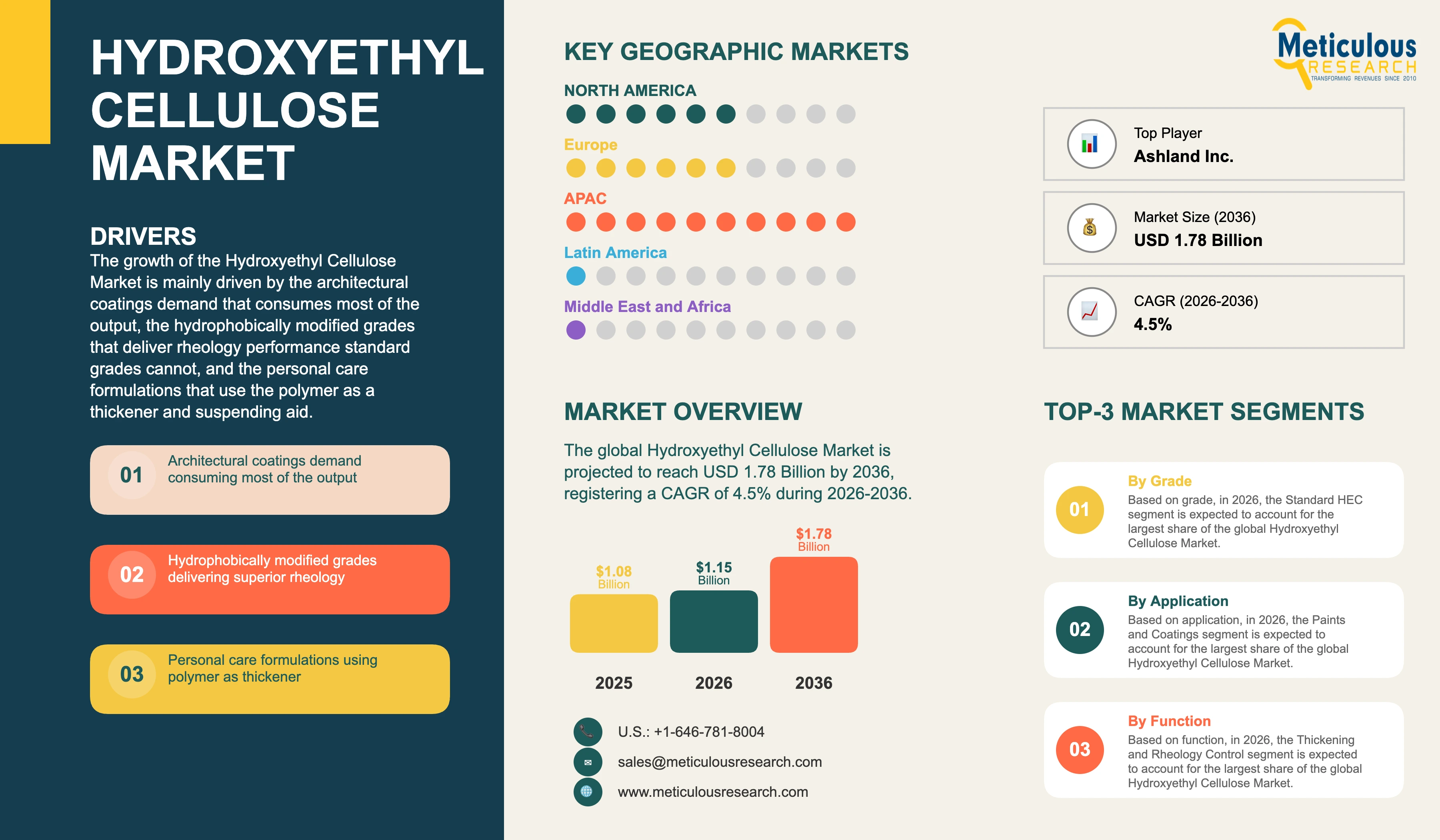
The global hydroxyethyl cellulose market was valued at USD 1.08 billion in 2025. This market is expected to reach USD 1.78 billion by 2036 from an estimated USD 1.15 billion in 2026, registering a CAGR of 4.5% during the forecast period (2026-2036).
- Published
- Nov 2026
- Pages
- 271
- Format
- PDF + Excel
- Report ID
- MRCHM - 1042807
- Base year
- 2025
- 2025 · BASELINE
- $1.08B
- 2036
- $1.78B
- CAGR 2026–2036
- 4.5%
2025 baseline · 2026–2036 forecast at 4.5% CAGR · hover a bar for the value
Key highlights
The global hydroxyethyl cellulose market is estimated at USD 1.15 billion in 2026 and is projected to reach USD 1.78 billion by 2036.
Market volume is estimated at 185.00 kilotons in 2026 and is projected to reach 258.45 kilotons by 2036 at a CAGR of 3.4%, measured as product as sold on a dry basis.
The average selling price is estimated at USD 6.20 per kg in 2026 and is projected to reach USD 6.90 per kg by 2036 as producers recover input inflation and the mix shifts to modified grades.
Standard hydroxyethyl cellulose is expected to account for the largest grade share in 2026, while hydrophobically modified hydroxyethyl cellulose is projected to register the highest CAGR of 6.2%.
Paints and coatings are expected to be the largest application in 2026, while personal care and cosmetics are projected to grow fastest at a CAGR of 6.0%.
Thickening and rheology control is expected to hold the largest function share in 2026, while suspension stabilisation is projected to register the highest CAGR of 5.4%.
Asia-Pacific is expected to hold the largest regional share in 2026 and is also projected to register the highest CAGR of 5.4%.
Ashland Inc. provided an update on 8 July 2025 on a USD 60 million manufacturing network optimisation plan under which the Parlin, New Jersey facility is closing and hydroxyethyl cellulose production moves to Hopewell, Virginia.
That release stated the consolidation completes the hydroxyethyl cellulose plans and that the consolidated network has capacity to meet demand, with production in the United States, Europe and China.
The company described hydroxyethyl cellulose and vinyl pyrrolidone and derivatives as core technologies that the optimisation strengthens.
The July 2025 release did not state closure dates, employee numbers affected, the capital amount invested at Hopewell, hydroxyethyl cellulose capacity volumes, or the specific European and Chinese sites producing the material.
Ashland Inc. reported fourth quarter and full-year fiscal 2026 results on 3 November 2026, stating that Hopewell hydroxyethyl cellulose productivity was below expectations.
Specialty Additives fourth quarter adjusted EBITDA fell 31% to USD 20 million, which the company attributed mainly to lower Hopewell productivity and related unfavourable absorption.
Specialty Additives fourth quarter sales were USD 131 million and flat year over year, with Coatings sales up 9% and Performance Specialties sales up 14% on favourable volumes, pricing and share gains across regions.
China posted a third consecutive quarter of year-over-year growth, while Energy and Resources demand was soft and Construction volumes were lower on deliberate portfolio actions.
Prices rose about 5% across the segment, which the company stated covered raw material inflation.
The company stated that key productivity investments are now complete, and reported full-year fiscal 2026 sales of USD 1.863 billion, up about 2%, with approximately 2,800 employees.
Demand grew while the consolidated production site underperformed, so the constraint in 2026 sat in manufacturing rather than in the end markets.
This market covers hydroxyethyl cellulose only and excludes carboxymethyl cellulose, the methyl and hydroxypropyl ethers, microcrystalline cellulose and cellulose nanocrystals.
Report summary
| Particulars | Details |
|---|---|
| Base Year | 2025 |
| Forecast Period | 2026-2036 |
| Market Size in 2025 | USD 1.08 billion |
| Market Size in 2026 | USD 1.15 billion |
| Market Size by 2036 | USD 1.78 billion |
| Value CAGR (2026-2036) | 4.5% |
| Format | PDF, Excel & Cloud Portal · 271 pages |
| Volume in 2026 | 185.00 kilotons |
| Volume by 2036 | 258.45 kilotons |
| Volume CAGR (2026-2036) | 3.4% |
| Volume Basis | Hydroxyethyl cellulose product as sold on a dry basis |
| Average Selling Price in 2026 | USD 6.20 per kg |
| Average Selling Price by 2036 | USD 6.90 per kg |
| Price Direction | Average selling price rises across the forecast period as producers recover raw material inflation through price and the product mix shifts toward hydrophobically modified and specialty grades, rather than through any constraint on supply |
| Scope Definition Note | The boundary is set by the ether itself rather than by the cellulose family, so the measure covers the nonionic ether made by reacting alkali cellulose with ethylene oxide and the modified and surface-treated grades derived from it, and it treats the other cellulose ethers as separate products supplied by overlapping but distinct capacity |
| Measurement Basis | Standard and hydrophobically modified hydroxyethyl cellulose with the surface-treated and specialty grades derived from them, by grade, application, function and geography, and excluding carboxymethyl cellulose, the methyl, hydroxypropyl, ethyl hydroxyethyl and methyl hydroxyethyl ethers, microcrystalline cellulose, cellulose nanocrystals, hydroxyethyl starch, and the finished paints, personal care products and drilling fluids into which the polymer is formulated |
| Relationship to Adjacent Markets | This market sits alongside carboxymethyl cellulose rather than within it, since the two are distinct ethers made by different routes and specified for different reasons, and it is not additive to microcrystalline cellulose or cellulose nanocrystals, which are physical forms of cellulose rather than ethers of it; a combined cellulose figure would merge products with separate supply bases, price levels and end markets and would obscure the ethylene oxide constraint specific to this one |
| Largest Grade | Standard hydroxyethyl cellulose |
| Fastest-Growing Grade | Hydrophobically modified hydroxyethyl cellulose (CAGR 6.2%) |
| Largest Application | Paints and coatings |
| Fastest-Growing Application | Personal care and cosmetics (CAGR 6.0%) |
| Largest Function | Thickening and rheology control |
| Fastest-Growing Function | Suspension stabilisation (CAGR 5.4%) |
| Largest Region | Asia-Pacific |
| Fastest-Growing Region | Asia-Pacific (CAGR 5.4%) |
| Segments Covered | Grade, Application, Function, and Geography |
| Geographies Covered | Asia-Pacific, North America, Europe, Latin America, and Middle East & Africa |
| Companies Profiled | 6 companies, including Ashland Inc., Dow Inc., Shin-Etsu Chemical Co., Ltd., Lotte Fine Chemical Co., Ltd., Shandong Head Co., Ltd., and Lamberti S.p.A. |
Report overview
Segments covered: grade, application, function.
In volume terms, this market is estimated at 185.00 kilotons in 2026 and is projected to reach 258.45 kilotons by 2036, registering a CAGR of 3.4% during the same period, measured as product as sold on a dry basis. The average selling price is estimated at USD 6.20 per kg in 2026 and is projected to rise to USD 6.90 per kg by 2036, since producers have recovered raw material inflation through price and the product mix is shifting toward modified grades.
The growth of this market is mainly driven by the architectural coatings demand that consumes most of the material, the hydrophobically modified grades that deliver rheology performance standard grades cannot, the personal care formulations that use the polymer as a thickener and conditioning aid, and the consolidated producer networks that have concentrated supply at fewer and larger sites. However, factors such as the ethylene oxide handling requirements that restrict who can make the product, the substitution pressure from associative thickeners and other cellulose ethers, the exposure to construction and oilfield cycles, and the productivity risk that site consolidation has introduced are expected to restrain the growth of this market to some extent.
Standard hydroxyethyl cellulose accounts for the largest share of this market because it is the established thickener in water-based paint and in a wide range of consumer formulations. Hydrophobically modified hydroxyethyl cellulose grows fastest because attaching hydrophobic groups to the backbone adds associative thickening behaviour, which improves spatter resistance, flow and levelling in paint beyond what viscosity alone delivers.
Hydroxyethyl cellulose is a nonionic water-soluble cellulose ether made by reacting alkali cellulose with ethylene oxide, and it is used to thicken, stabilise and retain water in water-based formulations. Market sizing in this report is on both a value basis in USD and a volume basis in kilotons measured as product as sold on a dry basis, with average selling price derived from the two. The measurement basis covers standard and hydrophobically modified hydroxyethyl cellulose and the surface-treated and specialty grades derived from them, and it excludes carboxymethyl cellulose, the methyl, hydroxypropyl, ethyl hydroxyethyl and methyl hydroxyethyl ethers, microcrystalline cellulose, cellulose nanocrystals, hydroxyethyl starch, and the finished paints, personal care products and drilling fluids into which the polymer is formulated.
Measuring product as sold on a dry basis matters because the material is shipped as a powder whose moisture content and surface treatment vary between grades, and because the degree of substitution and viscosity grade change the performance delivered per kilogram without changing the mass supplied. A thickener sold on performance is nonetheless bought and invoiced by weight, so the mass basis is the one that reconciles with producer shipments, and the value basis captures the grade premium that the mass basis does not.
Ashland Inc. provided an update on 8 July 2025 on a USD 60 million manufacturing network optimisation plan under which the Parlin, New Jersey facility is closing and hydroxyethyl cellulose production moves to Hopewell, Virginia, which has received increased investment to expand capacity and capabilities. The release stated that the consolidation completes the hydroxyethyl cellulose plans, that the consolidated network has capacity to meet demand with production in the United States, Europe and China, and that hydroxyethyl cellulose and vinyl pyrrolidone and derivatives are core technologies the optimisation strengthens. It did not state closure dates, employee numbers affected, the capital amount invested at Hopewell, capacity volumes, or the specific European and Chinese sites.
Reporting fourth quarter and full-year fiscal 2026 results on 3 November 2026, the same company stated that Hopewell hydroxyethyl cellulose productivity was below expectations, and that Specialty Additives fourth quarter adjusted EBITDA fell 31% to USD 20 million mainly on lower Hopewell productivity and related unfavourable absorption. Segment sales were USD 131 million and flat year over year, with Coatings up 9% and Performance Specialties up 14% on favourable volumes, pricing and share gains across regions, China recording a third consecutive quarter of year-over-year growth, and prices up about 5% covering raw material inflation. Key productivity investments were stated to be complete.
Those two statements, sixteen months apart, describe a consolidation that has cost more in output than expected while the demand it was sized against grew. The first said the network had capacity to meet demand; the second attributed a 31% fall in segment earnings to the receiving site running below expectations even as Coatings sales rose 9%. The constraint in 2026 therefore sat in manufacturing rather than in the end markets, which is the opposite of the position most specialty chemical segments were in.
Consolidating a cellulose ether plant is harder than consolidating most chemical capacity, because the etherification reaction has to deliver a consistent degree of substitution and a controlled molecular weight distribution across a long range of viscosity grades, and each grade is qualified in customer formulations against a specific rheology profile. Transferring that grade slate to a different reactor train means re-establishing the process window for each one. The shortfall reported in 2026 is consistent with that difficulty rather than with any weakening of the product.
Ethylene oxide handling is what limits who can make hydroxyethyl cellulose at all. The etherifying agent is flammable, toxic and reactive, so a plant needs the containment, permitting and safety systems that handling it requires, and that is a far higher barrier than the sodium monochloroacetate route used for carboxymethyl cellulose. Producers tend to sit either beside an ethylene oxide source or inside a group that has one, which is why the supplier list is short and has not lengthened materially.
Architectural coatings consume most of the output and set the demand pattern. In a water-based paint the polymer builds viscosity so the film does not sag, holds pigment in suspension during storage, and contributes to how the paint flows and levels after application, and it does so without the ionic sensitivity that an anionic thickener brings. Demand therefore tracks painting activity and repainting cycles rather than new construction alone. Paints and coatings accordingly account for the largest application share throughout the period.
Hydrophobic modification is where the performance differentiation sits and it is the fastest-growing grade. Attaching hydrophobic groups to the cellulose backbone makes the polymer associate with latex particles and with surfactant micelles rather than only thickening the water phase, which improves spatter resistance, flow and levelling and raises viscosity under the shear a brush or roller applies. That behaviour cannot be matched by raising molecular weight. Hydrophobically modified grades consequently register the highest grade CAGR at 6.2%.
Personal care is the fastest-growing application and it buys the polymer for different reasons. In shampoos, shower gels, lotions and gels the material thickens, suspends insoluble actives and improves the feel of the product, and its nonionic character means it is compatible with the anionic and cationic surfactants that these formulations combine. Natural-origin positioning adds to the argument where a brand is replacing synthetic thickeners. Personal care and cosmetics accordingly register the highest application CAGR at 6.0%.
Oilfield demand is the volatile component. Drilling and completion fluids use the polymer as a viscosifier and fluid-loss control agent, and because it is nonionic it tolerates the brines that anionic polymers struggle with, but the volumes move with drilling activity rather than with any product trend. Ashland Inc. reported soft Energy and Resources demand in its fourth quarter of fiscal 2026. Oil and gas therefore grows more slowly than the market as a whole.
Substitution runs in both directions. Synthetic associative thickeners based on polyurethane and acrylic chemistry compete directly in paint and sometimes deliver better flow at lower addition levels, while other cellulose ethers compete on cost in construction and on specific performance in pharmaceuticals. Hydroxyethyl cellulose holds position where nonionic behaviour, biological origin and established formulation history matter together, and loses it where a single performance metric dominates the choice.
This market sits alongside carboxymethyl cellulose rather than within it, since the two are distinct ethers made by different routes and chosen for different reasons, and it excludes microcrystalline cellulose and cellulose nanocrystals, which are physical forms of cellulose rather than ethers of it. Adding these together into a single cellulose figure would combine products with separate supply bases, separate price levels and separate end markets, and would obscure the ethylene oxide constraint that is specific to this one.
Asia-Pacific is expected to account for the largest share in 2026, on the coatings and personal care manufacturing base located there, the Chinese producers supplying domestic and export demand, and the production the major international producers already operate in the region. India is projected to grow at 6.6%, China at 5.8% and South Korea at 4.2%.
Asia-Pacific is also projected to register the highest CAGR of 5.4% during the forecast period, holding both the largest share and the fastest growth, with Ashland Inc. reporting that China recorded a third consecutive quarter of year-over-year growth in its fourth quarter of fiscal 2026.
Europe is projected to grow at a CAGR of 3.8%, with Germany at 3.6%, on coatings and construction demand and on resident cellulose ether capacity, growing below the global rate because repainting rather than new build dominates its volume.
The Middle East & Africa is projected to grow at a CAGR of 3.6%, where oilfield and construction applications carry a larger share of consumption and bring more volatility. Latin America is projected to grow at a CAGR of 4.2%, with Brazil at 4.2%, on architectural coatings demand and a growing personal care manufacturing base.
Ashland Inc., Dow Inc., Shin-Etsu Chemical Co., Ltd., Lotte Fine Chemical Co., Ltd. and Shandong Head Co., Ltd. together accounted for an estimated 72.4% of this market in 2026. The 6 companies profiled in this report together accounted for an estimated 78.8%, with the balance sitting largely with Chinese producers whose registered legal names could not be established to the standard applied in this report.
Report infographic
Market dynamics
14 factors across 5 forcesArchitectural Coatings Demand Consuming Most of the Output
In a water-based paint the polymer builds viscosity so the film does not sag, holds pigment in suspension through storage, and contributes to flow and levelling after application, without the ionic sensitivity an anionic thickener brings, and Ashland Inc. reported Coatings sales up 9% in its fourth quarter of fiscal 2026 on favourable volumes, pricing and share gains across regions. Demand tracks painting and repainting activity rather than new construction alone, which gives it a steadier base than construction chemicals.
Repainting also dominates the volume in mature markets, so a slowdown in building activity reduces growth without removing the underlying demand, and the coatings application therefore holds the largest share throughout the forecast period.
Coatings formulators also qualify a thickener against the full let-down and application sequence rather than against a viscosity target alone, so an incumbent grade is rarely displaced on cost, and the demand that exists is stable rather than contested from year to year.
Hydrophobically Modified Grades Delivering Rheology Standard Grades Cannot
Attaching hydrophobic groups to the cellulose backbone makes the polymer associate with latex particles and surfactant micelles rather than only thickening the water phase, which improves spatter resistance, flow and levelling and raises viscosity under the shear a brush or roller applies, performance that cannot be reproduced by raising molecular weight. The modified grades therefore defend the position against synthetic associative thickeners rather than merely competing on price.
They also carry a materially higher selling price than standard grades, which is why the average selling price in this market rises across the forecast period while volume growth stays modest.
The modified grades also reduce the addition level needed to reach a given application performance, so a formulator can accept a higher price per kilogram without raising formulated cost, which is what makes the substitution commercially straightforward rather than a trade.
Personal Care Formulations Using the Polymer as Thickener and Suspending Aid
In shampoos, shower gels, lotions and gels the material thickens, suspends insoluble actives and improves product feel, and its nonionic character makes it compatible with the anionic and cationic surfactants these formulations combine, which many alternative thickeners are not. Natural-origin positioning strengthens the case where a brand is replacing a synthetic thickener.
Personal care also qualifies formulations on sensory performance rather than on a single rheology specification, which favours an established polymer with a long formulation history, and the segment registers the highest application CAGR at 6.0%.
Personal care volumes per formulation are also small relative to coatings, so the segment grows on the number of products reformulated rather than on tonnage per account, which makes its growth less sensitive to any single customer decision.
Consolidated Producer Networks Concentrating Supply
Ashland Inc. stated on 8 July 2025 that the Parlin, New Jersey facility is closing with hydroxyethyl cellulose production moving to Hopewell, Virginia, that the consolidation completes the hydroxyethyl cellulose plans, and that the consolidated network has capacity to meet demand with production in the United States, Europe and China. Fewer and larger sites lower unit cost when they run as intended.
Concentration also supports price, since a short supplier list with little spare capacity gives producers the ability to recover input inflation, and Ashland Inc. reported segment prices up about 5% covering raw material inflation in its fourth quarter of fiscal 2026.
A consolidated network also carries a broader grade slate at each remaining site, which improves the service a formulator receives from one supply point and removes the grade-by-grade sourcing that a dispersed network required.
Unit cost also falls with scale in etherification, because the reactor, recovery and drying trains carry a high fixed cost that a larger throughput spreads, which is the economic case consolidation rests on when the site performs to plan.
Table of contents
11 chapters · 130 sections · 271 pages · click to expandSegmental analysis
| Segment | Largest share (2026) | Fastest growth (2026–2036) |
|---|---|---|
| By Grade | Standard hydroxyethyl cellulose | Hydrophobically modified hydroxyethyl cellulose |
| By Application | Paints and coatings | Personal care and cosmetics |
| By Function | Thickening and rheology control | Suspension stabilisation |
| Other segments | Standard hydroxyethyl cellulose | Hydrophobically modified hydroxyethyl cellulose |
By Grade
- Hydroxyethyl Cellulose Market Analysis by Grade
- The standard hydroxyethyl cellulose segment is expected to account for the largest share of the global hydroxyethyl cellulose market.
- The large share of this segment is mainly due to its established position as the thickener in water-based architectural paint, its long qualification history across consumer and industrial formulations, and the breadth of viscosity grades available from the major producers.
- However, the hydrophobically modified hydroxyethyl cellulose segment is projected to register the highest CAGR of 6.2% during the forecast period.
- The rapid growth of this segment is attributed to hydrophobic groups on the backbone producing associative thickening with latex particles and surfactant micelles, which improves spatter resistance, flow and levelling in ways that raising molecular weight cannot reproduce.
- Surface-treated and delayed-hydration grades serve formulators who need the powder to disperse before it thickens, avoiding lumping during addition, which is a handling requirement rather than a performance one.
- Low-viscosity and specialty grades serve pharmaceutical, ophthalmic and oilfield uses with tighter specifications and smaller volumes.
- Grade therefore determines both the price per kilogram and the addition level required, so value share and volume share diverge across this axis.
- Grade also determines the handling the customer must provide.
- An untreated powder hydrates on contact and will form lumps unless it is dispersed before the pH is raised, which is why surface-treated grades exist at a premium and why some formulators pay for delayed hydration rather than change their mixing sequence.
- The degree and molar substitution set behind that handling behaviour also govern solubility, salt tolerance and enzymatic resistance, so the grade choice fixes several properties at once rather than viscosity alone.
- Value share and volume share diverge furthest at the specialty end, where pharmacopoeial and ophthalmic grades sell at several times a coatings price on a small tonnage, so a producer can hold a modest volume position in those grades and a material share of the value.
By Application
- Hydroxyethyl Cellulose Market Analysis by Application
- The paints and coatings segment is expected to account for the largest share of the global hydroxyethyl cellulose market.
- The large share of this segment is mainly due to water-based architectural paint requiring a thickener that prevents sag, holds pigment in suspension and contributes to flow and levelling without ionic sensitivity, together with the repainting demand that gives the application a steadier base than new construction.
- However, the personal care and cosmetics segment is projected to register the highest CAGR of 6.0% during the forecast period.
- The rapid growth of this segment is attributed to the nonionic character of the polymer making it compatible with the anionic and cationic surfactant systems these formulations combine, and to natural-origin reformulation programmes replacing synthetic thickeners across brand portfolios.
- Oil and gas drilling fluids use the polymer as a viscosifier and fluid-loss control agent tolerant of brines, with volumes moving on rig activity.
- Construction materials use it for water retention in cement-based products, in competition with lower-cost ethers.
- Pharmaceuticals take low-viscosity and pharmacopoeial grades for film coating, topical gels and ophthalmic preparations at a much higher price per kilogram.
- Application therefore determines which grades and which documentation a producer must carry.
- Application also determines how exposed a producer is to the cycle.
- Coatings and personal care demand continues through an industrial downturn because repainting and consumer purchasing continue, while oilfield volumes move in programme-sized steps with rig activity and construction volumes move with building cycles, and Ashland Inc. reported soft Energy and Resources demand alongside lower Construction volumes in its fourth quarter of fiscal 2026.
- The application mix therefore sets the earnings volatility a supplier carries as much as the growth rate it earns.
By Function
- Hydroxyethyl Cellulose Market Analysis by Function
- The thickening and rheology control segment is expected to account for the largest share of the global hydroxyethyl cellulose market.
- The large share of this segment is mainly due to thickening being the reason the polymer is specified in paint, personal care and drilling fluids alike, and to the rheology profile rather than any other property determining whether a formulation performs.
- However, the suspension stabilisation segment is projected to register the highest CAGR of 5.4% during the forecast period.
- The rapid growth of this segment is attributed to formulations carrying higher loadings of insoluble actives, pigments and particulates that must stay dispersed through shelf life, which places a protective colloid requirement alongside the viscosity requirement.
- Water retention is the function that matters in cement-based construction products and in some cosmetic applications, holding moisture against a porous substrate or against evaporation.
- Film formation supports pharmaceutical coatings, topical products and some industrial uses.
- Most grades deliver several of these functions at once, so the axis measures the reason the formulator specified the polymer rather than an exclusive technical property.
- Function also explains why the material holds position against cheaper alternatives.
- A formulator choosing hydroxyethyl cellulose is usually buying two or three of these behaviours in one additive, so replacing it means introducing a second ingredient to cover what the single polymer did, which raises formulation complexity even where the direct material cost falls.
- That is the practical reason addition levels fall gradually under substitution pressure rather than accounts being lost outright.
- Suspension stabilisation is also the function least well served by the synthetic associative thickeners that compete in paint, since protective colloid behaviour depends on the polymer adsorbing at the particle surface rather than on associating with latex, which is why it grows fastest on this axis.
Other segments
- Standard hydroxyethyl cellulose is expected to account for the largest share in 2026, on its established position as the thickener in water-based architectural paint and its long qualification history across consumer and industrial formulations.
- Hydrophobically modified hydroxyethyl cellulose is projected to register the highest CAGR of 6.2% during the forecast period.
- Paints and coatings are expected to account for the largest share in 2026, on water-based architectural paint requiring a thickener that prevents sag, holds pigment in suspension and contributes to flow and levelling without ionic sensitivity.
- Personal care and cosmetics are projected to register the highest CAGR of 6.0% during the forecast period.
- Thickening and rheology control is expected to hold the largest share in 2026, since thickening is the reason the polymer is specified across paint, personal care and drilling fluids alike.
- Suspension stabilisation is projected to register the highest CAGR of 5.4% during the forecast period.
Geographic analysis
Asia-Pacific
Largest shareCoatings and personal care demand in Asia-Pacific is growing faster than in the mature regions, and Ashland Inc. reported that China recorded a third consecutive quarter of year-over-year growth in its fourth quarter of fiscal 2026, with production already located in the region. Local supply shortens the qualification and logistics path for regional formulators. Asia-Pacific is accordingly expected to hold the largest regional share in 2026 and also to register the highest regional CAGR at 5.4%, an unusual combination that reflects both resident capacity and resident demand growth. Regional production also removes the currency and freight exposure that importing a bulk powder carries, which matters in a market where the price per kilogram is moderate and the shipping weight is the full product mass. In 2026, Asia-Pacific is expected to account for the largest share of the global hydroxyethyl cellulose market and is also projected to register the highest CAGR of 5.4% during the forecast period. The large share and rapid growth of this region are attributed to the coatings and personal care manufacturing base located there, the Chinese producers supplying domestic and export demand, the construction activity that sustains water-retention applications, and the production the major international producers already operate in the region, with Ashland Inc. reporting that China recorded a third consecutive quarter of year-over-year growth in its fourth quarter of fiscal 2026. India is projected to register a CAGR of 6.6%, China a CAGR of 5.8% and South Korea a CAGR of 4.2%. What separates Asia-Pacific from the mature regions is the share of coatings volume going into new build rather than repainting, and the rate at which personal care manufacturing is being established, neither of which depends on where the polymer is made. Asia-Pacific Coatings and Personal Care Growth Geographic Analysis
North America
North America is projected to grow at 3.8%, with the United States at 3.8%, on architectural coatings and personal care demand and on the consolidated production now centred at Hopewell, Virginia following the Parlin closure.
Europe
Europe is projected to grow at 3.8%, with Germany at 3.6%, on coatings and construction demand and on resident cellulose ether capacity. Both regions grow below the global rate because repainting rather than new build dominates their volume.
Latin America
Latin America is projected to grow at 4.2%, with Brazil at 4.2%, on architectural coatings demand and a growing personal care manufacturing base.
Middle East & Africa
The Middle East & Africa is projected to grow at 3.6%, where oilfield and construction applications carry a larger share of consumption than they do elsewhere and bring correspondingly more volatility. Production and consumption are more closely aligned in this market than in most specialty chemicals, because the ethylene oxide requirement ties plants to industrial complexes that exist in the same regions as the coatings and personal care industries that consume the output. Trade therefore balances grade availability rather than bridging a structural capacity gap, and a regional supply interruption is felt locally rather than absorbed by imports. Regional growth differences in this market are demand-side rather than supply-side, since every region named has resident capacity of some form. The Middle East & Africa carries the highest oilfield share of any region, so its growth rate understates how much its demand moves from year to year.
Competitive landscape
The global hydroxyethyl cellulose market is characterised by a short supplier list built around access to ethylene oxide, with a clear leader, two diversified chemical groups, a Korean specialty producer and Chinese and European cellulose ether manufacturers. Competition is contested on grade range, rheology performance and supply reliability rather than on price alone, because formulations are qualified against a specific rheology profile. Ashland Inc., Dow Inc., Shin-Etsu Chemical Co., Ltd., Lotte Fine Chemical Co., Ltd. and Shandong Head Co., Ltd. together accounted for an estimated 72.4% of this market in 2026, while the companies profiled in this report together accounted for an estimated 78.8%. The balance sits largely with Chinese producers whose registered legal names could not be established to the standard applied in this report.
Ashland Inc. provided an update on 8 July 2025 under which the Parlin, New Jersey facility closes with hydroxyethyl cellulose production moving to Hopewell, Virginia, stating that the consolidation completes the hydroxyethyl cellulose plans and that the consolidated network has capacity to meet demand with production in the United States, Europe and China. Reporting fiscal 2026 results on 3 November 2026, the company stated that Hopewell hydroxyethyl cellulose productivity was below expectations, that Specialty Additives fourth quarter adjusted EBITDA fell 31% to USD 20 million on that productivity and related unfavourable absorption, that Coatings sales rose 9% and Performance Specialties sales rose 14%, and that key productivity investments are now complete, with full-year sales of USD 1.863 billion and approximately 2,800 employees.
Network consolidation and grade development rather than capacity addition accounted for most competitive activity through 2026. Ashland Inc. competes as the leading producer with the broadest grade range including hydrophobically modified products, Dow Inc. and Shin-Etsu Chemical Co., Ltd. from integrated chemical positions with their own ethylene oxide and cellulose ether operations, Lotte Fine Chemical Co., Ltd. from a Korean specialty position in which the product is a flagship line, and Shandong Head Co., Ltd. and Lamberti S.p.A. from regional cellulose ether manufacturing serving coatings, construction and oilfield customers. Some of the key players operating in the hydroxyethyl cellulose market are Ashland Inc. (U.S.), Dow Inc. (U.S.), Shin-Etsu Chemical Co., Ltd. (Japan), Lotte Fine Chemical Co., Ltd. (South Korea), Shandong Head Co., Ltd. (China), and Lamberti S.p.A. (Italy), among others.
- —
Ashland Inc. provided an update on 8 July 2025 on a USD 60 million manufacturing network optimisation plan under which the Parlin, New Jersey facility is closing and hydroxyethyl cellulose production moves to Hopewell, Virginia, which has received increased investment to expand capacity and capabilities. That release stated the consolidation completes the hydroxyethyl cellulose plans, that the consolidated network has capacity to meet demand with production in the United States, Europe and China, and that hydroxyethyl cellulose and vinyl pyrrolidone and derivatives are core technologies the optimisation strengthens, while not stating closure dates, employee numbers affected, the capital amount invested at Hopewell, capacity volumes, or the specific European and Chinese sites. Reporting fourth quarter and full-year fiscal 2026 results on 3 November 2026, the company stated that Hopewell hydroxyethyl cellulose productivity was below expectations, that Specialty Additives fourth quarter adjusted EBITDA fell 31% to USD 20 million mainly on lower Hopewell productivity and related unfavourable absorption, that segment sales were USD 131 million and flat year over year with Coatings up 9% and Performance Specialties up 14% and China recording a third consecutive quarter of year-over-year growth, that prices rose about 5% covering raw material inflation, and that key productivity investments are now complete, with full-year sales of USD 1.863 billion, up about 2%, and approximately 2,800 employees.
- Ashland Inc.
- Dow Inc.
- Shin-Etsu Chemical Co., Ltd.
- Lotte Fine Chemical Co., Ltd.
- Shandong Head Co., Ltd.
- Lamberti S.p.A
Expert perspectives
Value grows at 4.5% against 3.4% in volume over the forecast period, and the average selling price rises from USD 6.20 per kg in 2026 to USD 6.90 per kg by 2036. Price and mix rather than tonnage carry most of the growth in this market, which is characteristic of a mature specialty with a short supplier list.
The two Ashland Inc. statements read together are the most informative evidence available on this market. On 8 July 2025 the company said the Parlin closure and transfer to Hopewell completed its hydroxyethyl cellulose plans and that the consolidated network had capacity to meet demand. On 3 November 2026 it said Hopewell hydroxyethyl cellulose productivity was below expectations and attributed a 31% fall in Specialty Additives adjusted EBITDA to that and to related unfavourable absorption.
What makes that pairing significant is the direction of the demand alongside it. Coatings sales rose 9% and Performance Specialties sales rose 14% in the same quarter on favourable volumes, pricing and share gains, with China recording a third consecutive quarter of year-over-year growth, while segment sales were flat. What limited the segment in 2026 was therefore the plant rather than the market.
Consolidation is harder in cellulose ethers than the capital numbers suggest, because each viscosity grade is qualified in customer formulations against a specific rheology profile and the etherification has to deliver a consistent degree of substitution across the whole slate. Moving that slate to a different reactor train means re-establishing the process window grade by grade, and the company has since stated that key productivity investments are complete.
Ethylene oxide is the reason this market has a short supplier list and keeps one. The etherifying agent requires containment, permitting and safety systems far beyond those needed for the carboxymethyl cellulose route, so producers sit beside an ethylene oxide source or inside a group that has one, and new entry does not follow demand. That concentration is what allowed segment prices to rise about 5% covering raw material inflation.
The growth that exists sits in modification rather than in tonnage. Hydrophobically modified grades at 6.2% and personal care at 6.0% both reflect buyers paying for behaviour the standard grade does not deliver, while oilfield and construction volumes move on cycles unrelated to the product. This market sits alongside carboxymethyl cellulose rather than within it, and excludes microcrystalline cellulose and cellulose nanocrystals entirely.
Customer perspectives
Associative behaviour rather than solution viscosity determines application performance, so specifications describe viscosity across a shear range together with spatter and levelling, which favours grades developed against application performance.
A standard grade is consequently harder to substitute on a datasheet comparison than its viscosity figure alone would suggest.
A grade developed against application performance is also harder to benchmark, since the comparison requires running the full formulation rather than measuring a solution.
The nonionic character of the polymer makes it compatible with the anionic and cationic surfactants these formulations combine, while the ethylene oxide requirement keeps the supplier list short and the second-source options limited.
Buyers are therefore qualifying alternate suppliers across regions rather than within one, accepting a longer qualification to restore redundancy.
Supply concentration at fewer and larger sites removes the buffer a dispersed network provided, so a productivity shortfall at a consolidated plant has no ready regional alternative.
Qualifying cover across regions rather than within one is the practical response available to a buyer, and it is becoming standard practice in this market.
That cover is qualified and held rather than used, which adds cost without adding volume.
“We specify a rheology profile across the shear range now, not a viscosity number, because how the paint rolls out is what the customer notices. That is why the modified grades are worth their premium to us.”
“It survives our surfactant systems, which is more than most of the natural-origin thickeners we have trialled manage. The trouble is how few people we can actually buy it from.”
“When everything runs from one site per region, a bad quarter at that site is our problem too. We had to go looking for cover we did not need five years ago.”
Frequently asked questions
This market was valued at USD 1.04 billion in 2024 and USD 1.08 billion in 2025, and is estimated at USD 1.15 billion in 2026. In volume terms it is estimated at 185.00 kilotons in 2026 as product as sold on a dry basis.
Cite this report
Meticulous Research. (2026). Hydroxyethyl Cellulose Market - Global Opportunity Analysis and Industry Forecast (2026-2036) (Report No. MRCHM - 1042807). Meticulous Market Research Pvt. Ltd. https://www.meticulousresearch.com/product/hydroxyethyl-cellulose-market-7490