Regenerated Cellulose Films Market (2026-2036)
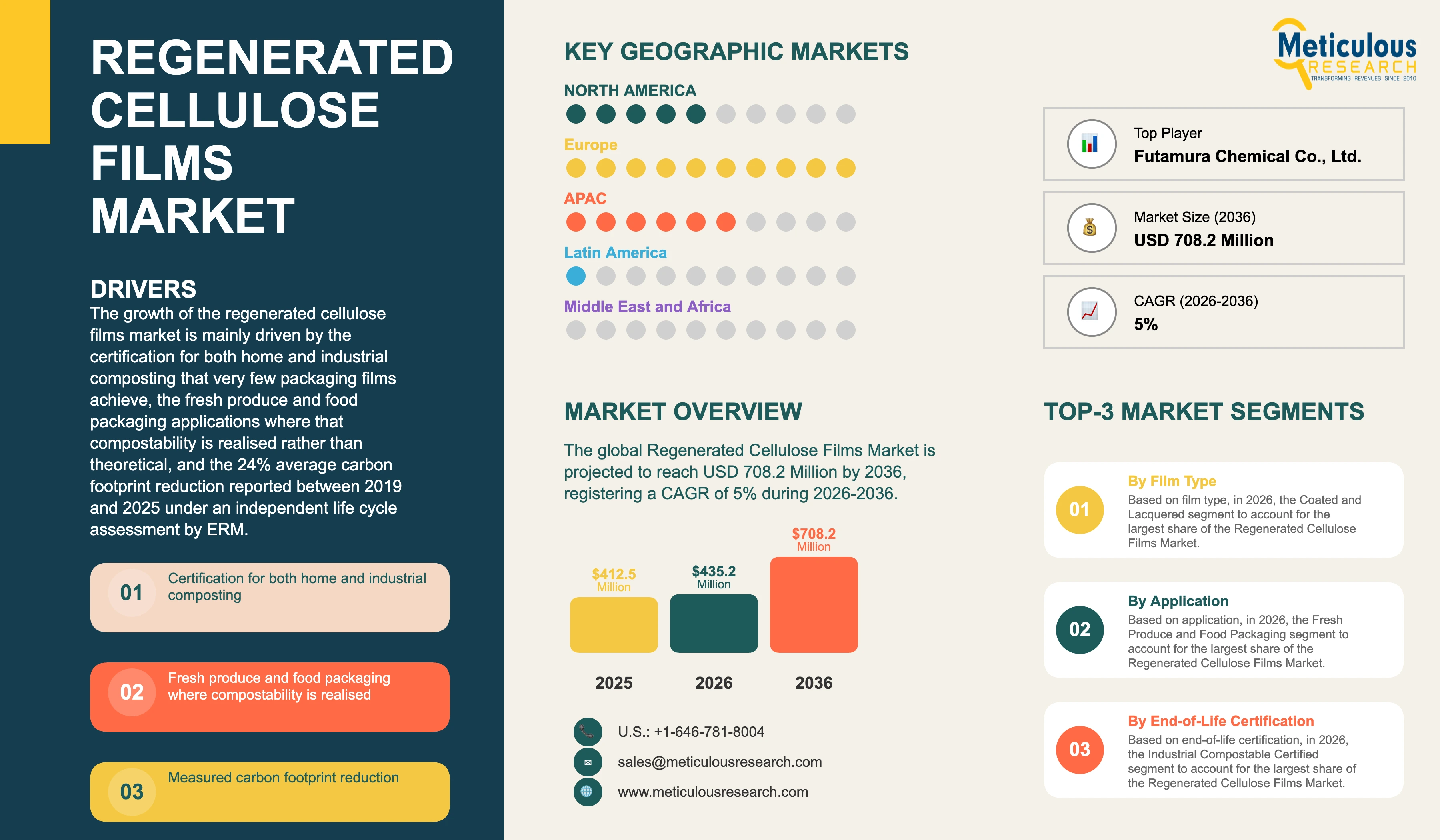
The global regenerated cellulose films market was valued at USD 412.5 million in 2025. This market is expected to reach USD 708.2 million by 2036 from an estimated USD 435.2 million in 2026, registering a CAGR of 5.0% during the forecast period (2026-2036).
- Published
- Nov 2026
- Pages
- 255
- Format
- PDF + Excel
- Report ID
- MRCHM - 1042823
- Base year
- 2025
- 2025 · BASELINE
- $412.5M
- 2036
- $708.2M
- CAGR 2026–2036
- 5.0%
2025 baseline · 2026–2036 forecast at 5.0% CAGR · hover a bar for the value
Key highlights
The global regenerated cellulose films market is estimated at USD 435.2 million in 2026 and is projected to reach USD 708.2 million by 2036.
Market volume is estimated at 68.00 kilotons in 2026 and is projected to reach 93.18 kilotons by 2036 at a CAGR of 3.2%, measured as film supplied on a mass basis.
The average selling price is estimated at USD 6.40 per kg in 2026 and is projected to reach USD 7.60 per kg by 2036 as energy and input costs are recovered and the mix shifts to coated and certified grades.
Coated and lacquered films are expected to account for the largest film type share in 2026, while metallised and specialty films are projected to register the highest CAGR of 7.4%.
Fresh produce and food packaging is expected to be the largest application in 2026, while personal care and pharmaceutical packaging is projected to grow fastest at a CAGR of 7.2%.
Industrial compostable certified film is expected to hold the largest certification share in 2026, while home compostable certified film is projected to register the highest CAGR of 8.0%.
Europe is expected to hold the largest regional share in 2026, while Asia-Pacific is projected to register the highest CAGR of 6.4%.
Futamura announced a GBP 15 million investment at its Wigton site in Cumbria on 2 July 2025, the largest investment at that site since the Japanese owners bought the cellulose plant in 2016.
The project diverts waste gases from production and uses an oxidation process to generate a raw material, with heat from the reaction producing steam, which the company describes as the main energy source in production.
Once operational the asset will generate 15% of the total energy requirement of the Wigton site, and the company expects to buy less natural gas from the grid.
The project is supported by up to GBP 4.5 million from the UK Government Industrial Energy Transformation Fund, and the release does not state whether the GBP 15 million figure includes that grant.
The release states no capacity figure and no capacity increase, so the largest investment at the site in nine years is directed at energy supply rather than at output.
Futamura employs 270 people at Wigton, has been on the site for over 90 years, and has about 1,500 employees worldwide with production in the United Kingdom, the United States and Japan following the acquisition of the cellulose business of Innovia Films.
A later Futamura item reports an average reduction of 24% in the carbon footprint of its NatureFlex films, based on the difference between 2019 and 2025, using IPCC AR6 GWP100 values from an independent third-party life cycle assessment by ERM.
That item states the reduction covers lacquered film based on NatureFlex NVS and plain film production, and reports a new compressed air system with heat recovery saving over 400 tonnes of carbon dioxide equivalent per year.
It also identifies the energy project as a Wet Sulphuric Acid installation scheduled for 2027/28, which is a later timing than the 2025 announcement indicated.
That item carries no date in its body text, describes its vehicle-equivalent comparisons as illustrative only, and does not state the carbon footprint per kilogram of film, the absolute baseline, or whether ERM verified the result.
This market covers films made by dissolving and regenerating cellulose and excludes cellulose acetate film, regenerated cellulose textile fibres and cellulose sausage casings.
Report summary
| Particulars | Details |
|---|---|
| Base Year | 2025 |
| Forecast Period | 2026-2036 |
| Market Size in 2025 | USD 412.5 million |
| Market Size in 2026 | USD 435.2 million |
| Market Size by 2036 | USD 708.2 million |
| Value CAGR (2026-2036) | 5.0% |
| Format | PDF, Excel & Cloud Portal · 255 pages |
| Volume in 2026 | 68.00 kilotons |
| Volume by 2036 | 93.18 kilotons |
| Volume CAGR (2026-2036) | 3.2% |
| Volume Basis | Film supplied on a mass basis |
| Average Selling Price in 2026 | USD 6.40 per kg |
| Average Selling Price by 2036 | USD 7.60 per kg |
| Price Direction | Average selling price rises across the forecast period as energy and input costs are recovered and the mix shifts toward coated, metallised and certified grades, rather than through any constraint on supply |
| Scope Definition Note | The boundary is set at cellulose that is dissolved and regenerated as a film, so cellulose acetate film falls outside it because its hydroxyl groups are acetylated rather than regenerated unchanged, and textile fibres and sausage casings fall outside because they use related processes to make different products for separate converters and buyers |
| Measurement Basis Note | The film is quoted, specified and often invoiced by area or by yield in square metres per kilogram, so a thinner gauge delivers more packaging from the same tonnage; mass is used here because it is the basis on which the material is produced and on which capacity and energy consumption are measured, with the consequence that gauge reduction appears as flat volume rather than as growth |
| Measurement Basis | Coated and lacquered, plain uncoated, and metallised and specialty regenerated cellulose films, by film type, application, end-of-life certification and geography, and excluding cellulose acetate film, regenerated cellulose textile fibres, cellulose sausage casings, the dissolving pulp feedstock, and the finished packs and labels into which the film is converted |
| Relationship to Adjacent Markets | This market is not additive to the cellulose acetate market, which measures a chemical derivative rather than a regenerated film, and a combined regenerated cellulose figure would merge film, textile fibre and sausage casing markets that share only a process family |
| Note on Investment Disclosure | The GBP 15 million project announced at Wigton on 2 July 2025, the largest at that site since 2016, states no capacity figure and no output increase and is directed at generating steam from waste gases to supply 15% of site energy; a later item identifies it as a Wet Sulphuric Acid installation scheduled for 2027/28, a later date than the earlier release indicated |
| Largest Film Type | Coated and lacquered |
| Fastest-Growing Film Type | Metallised and specialty (CAGR 7.4%) |
| Largest Application | Fresh produce and food packaging |
| Fastest-Growing Application | Personal care and pharmaceutical (CAGR 7.2%) |
| Largest End-of-Life Certification | Industrial compostable certified |
| Fastest-Growing End-of-Life Certification | Home compostable certified (CAGR 8.0%) |
| Largest Region | Europe |
| Fastest-Growing Region | Asia-Pacific (CAGR 6.4%) |
| Segments Covered | Film Type, Application, End-of-Life Certification, and Geography |
| Geographies Covered | Europe, Asia-Pacific, North America, Latin America, and Middle East & Africa |
| Companies Profiled | 3 companies, including Futamura Chemical Co., Ltd., Weifang Henglian Cellophane Co., Ltd., and Zhejiang Jiacheng Cellophane Co., Ltd. |
| Note on Profiled Share | The profiled share and the top-three share are the same figure because three companies are profiled; the balance sits with further Chinese cellophane producers whose registered legal names could not be established to the standard applied in this report, and Innovia Films is excluded because its cellulose business was acquired and its remaining film operations are in oriented polypropylene |
Report overview
Segments covered: film type, application, end-of-life certification.
The growth of this market is mainly driven by the compostability certification that the material holds at both home and industrial level, the fresh produce and food packaging applications where a compostable film answers a disposal requirement, the measured carbon footprint reduction the leading producer has reported, and the packaging rules that favour renewable and compostable structures. However, factors such as the energy intensity of the regeneration process, the cost disadvantage against polypropylene and polyester films, the absence of any announced capacity addition by the leading producer, and the dependence on dissolving pulp feedstock are expected to restrain the growth of this market to some extent.
Regenerated cellulose film is made by dissolving wood pulp cellulose, extruding the solution into a coagulating bath where the cellulose is regenerated as a film, and then washing, plasticising and drying it, with most grades subsequently lacquered or coated to add a moisture barrier. Market sizing in this report is on both a value basis in USD and a volume basis in kilotons measured as film supplied on a mass basis, with average selling price derived from the two. The measurement basis covers coated and lacquered, plain uncoated, and metallised and specialty films, and it excludes cellulose acetate film, regenerated cellulose textile fibres, cellulose sausage casings, the dissolving pulp feedstock, and the finished packs and labels into which the film is converted.
Measuring by mass rather than by area requires stating, because this film is quoted, specified and often invoiced by area or by yield in square metres per kilogram, and a thinner gauge therefore delivers more packaging from the same tonnage. Mass is nonetheless the basis on which the material is produced and on which capacity and energy consumption are measured, so it is the basis used here, with the consequence that gauge reduction shows as flat volume rather than as growth.
Futamura announced a GBP 15 million investment at its Wigton site in Cumbria on 2 July 2025, described as the largest investment at that site since the Japanese owners bought the cellulose plant in 2016. The project diverts waste gases from production and uses an oxidation process to generate a raw material, with heat from the reaction producing steam, which the company describes as the main energy source in production, and once operational the asset will generate 15% of the total energy requirement of the site with less natural gas bought from the grid. Up to GBP 4.5 million comes from the UK Government Industrial Energy Transformation Fund, and the release does not state whether the headline figure includes that grant.
The most informative feature of that announcement is what it is not. The largest investment at the site in nine years adds no capacity, states no capacity figure and offers no percentage uplift in output; it is directed at generating steam from the waste gases of the process and at buying less gas. That tells a reader more about the economics of this material than a volume forecast would, because the regeneration route is energy-intensive and steam is its principal input, so energy cost rather than demand is what the leading producer is attacking.
A later Futamura item reports an average reduction of 24% in the carbon footprint of its NatureFlex films, based on the difference between 2019 and 2025, using IPCC AR6 GWP100 values from an independent third-party life cycle assessment by ERM, covering lacquered film based on NatureFlex NVS and plain film production. It reports a new compressed air system together with heat recovery from compressor waste heat saving over 400 tonnes of carbon dioxide equivalent per year, and identifies the energy project as a Wet Sulphuric Acid installation scheduled for 2027/28.
Two details in that item warrant care. Its body text carries no date, so the October 2026 timing comes from page metadata rather than from a dateline, and it describes its vehicle-equivalent comparisons as illustrative only, which this report accordingly does not rely on. It also gives no carbon footprint per kilogram of film and no absolute baseline behind the 24%, and while it calls the assessment independent and third-party it does not say that ERM verified the figure or that any certification body was involved.
The scheduling disclosure matters more than the carbon number. The energy project announced in July 2025 as the largest investment in nine years is identified in the later item as scheduled for 2027/28, which is a materially later date than the earlier release suggested, so the energy cost relief this producer is working toward does not arrive within the first third of the forecast period.
Compostability is the property that sustains this material and the only one on which it wins outright. The films are certified for both home and industrial composting, which very few packaging films achieve, and in a market where a brand must demonstrate an end-of-life route for a flexible pack that distinguishes the material from polypropylene and polyester films that offer none. Home compostable certified film accordingly registers the highest certification CAGR at 8.0%.
Fresh produce and food packaging is the largest application because that is where the compostability is realised rather than theoretical. A film wrapping fruit, vegetables or bakery items is frequently collected with food waste or soiled beyond recycling, so a compostable wrap reaches a facility that composts it rather than a landfill, and the material also breathes in a way that suits produce. Fresh produce and food packaging accordingly accounts for the largest application share.
Coating is not optional for most uses and that shapes the product mix. An uncoated regenerated cellulose film passes moisture readily, which is useful for a breathable produce wrap and unacceptable for a dry snack, so nitrocellulose or compostable polymer lacquers are applied to deliver a moisture barrier and heat sealability. Coated and lacquered films therefore account for the largest film type share, with the lacquer chemistry determining whether the compostability certification survives.
The cost disadvantage against the incumbent films is structural and permanent. Polypropylene and polyester films are made from monomers produced at petrochemical scale on highly optimised lines, while this material is regenerated from dissolved pulp through a wet process with substantial water, chemical and steam consumption, so it costs several times as much per square metre. It is specified where compostability, renewable origin or the particular feel and printability of the film justify that.
Supply is concentrated to an unusual degree for a packaging film. One producer operates sites across three continents following its acquisition of the cellulose business of Innovia Films, and the balance sits largely with Chinese cellophane producers, so a converter qualifying this material accepts a narrow supplier base from the outset. No capacity addition has been announced by the leading producer, which is the clearest indication of how it reads the demand outlook.
This market is not additive to the cellulose acetate market, which measures a chemical derivative in which the hydroxyl groups are acetylated rather than a film in which the cellulose is regenerated unchanged, and it excludes regenerated cellulose textile fibres and cellulose sausage casings, which use related processes to make different products with separate converters and separate buyers. A combined regenerated cellulose figure would merge film, fibre and casing markets that share only a process family.
Europe is expected to account for the largest share in 2026, on the Wigton plant that has operated for over 90 years and employs 270 people, the packaging requirements favouring compostable structures, and the organic waste collection that makes the claim meaningful. The United Kingdom is projected to grow at 4.6%, Germany at 4.4% and France at 4.2%.
Asia-Pacific is projected to register the highest CAGR of 6.4% during the forecast period, with India at 8.0%, China at 7.4% and Japan at 3.0%.
Europe holds the largest share, with the United Kingdom growing at 4.6%, on the Wigton production site, the packaging requirements that favour compostable and renewable structures, the retailers specifying compostable produce packaging, and the organic waste collection infrastructure that makes the end-of-life claim meaningful.
The Middle East & Africa is projected to grow at a CAGR of 3.0% from a small base. Latin America is projected to grow at a CAGR of 4.0%, where compostable produce and food packaging carries most of the consumption.
Futamura Chemical Co., Ltd., Weifang Henglian Cellophane Co., Ltd. and Zhejiang Jiacheng Cellophane Co., Ltd. together accounted for an estimated 74.6% of this market in 2026, which is also the profiled-company share since three companies are profiled. The balance sits with further Chinese cellophane producers whose registered legal names could not be established to the standard applied in this report.
Report infographic
Market dynamics
15 factors across 5 forcesCertification for Both Home and Industrial Composting
The films are certified for home as well as industrial composting at end of life, which very few packaging films achieve, and in a market where a brand must demonstrate a recovery route for a flexible pack that distinguishes the material from polypropylene and polyester films which offer none.
Home certification matters disproportionately because it does not depend on a municipality operating organic collection, so the claim holds for a consumer who composts at home as well as for one served by a collection scheme.
Very few flexible films hold either certification, so the material competes on a property its main alternatives cannot offer at any price rather than on a performance margin that a competitor could close.
Home certification also lets a brand make a single claim across markets rather than tailoring it to each municipality waste arrangements, which simplifies packaging artwork and compliance.
That is a commercial advantage independent of the technical performance of the film.
Fresh Produce and Food Packaging Where Compostability Is Realised
A film wrapping fruit, vegetables or bakery items is frequently collected with food waste or soiled beyond recycling, so a compostable wrap reaches a facility that composts it rather than a landfill, and the breathability of an uncoated or lightly coated grade suits respiring produce.
That combination means the compostability is used rather than merely claimed, which is the condition under which a converter can justify the price difference against conventional film.
Produce packs are also replaced continuously with the goods they wrap rather than held in an installed base, so a qualified film generates recurring volume on a weekly cycle.
Retailers also set compostable packaging requirements for produce lines ahead of other categories, so the application is where the regulatory and commercial pressure arrives first.
The same certification also survives the lacquering step only where a compostable coating is used, so the claim depends on the whole construction rather than on the base film alone.
Measured Carbon Footprint Reduction
A Futamura item reports an average reduction of 24% in the carbon footprint of its NatureFlex films between 2019 and 2025, using IPCC AR6 GWP100 values from an independent third-party life cycle assessment by ERM, covering lacquered film based on NatureFlex NVS and plain film production, with a new compressed air system and heat recovery saving over 400 tonnes of carbon dioxide equivalent per year.
A dated figure from a named assessor is what a brand owner needs for its own reporting, and it is considerably more useful to a buyer than a qualitative renewable origin claim.
A reduction measured against a 2019 baseline also demonstrates a direction of travel rather than a single result, which is what a customer tracking supplier performance over several years asks for.
Reductions achieved through compressed air, heat recovery and lighting are also permanent rather than dependent on continued investment, so the improvement is retained in the cost and carbon base.
Packaging Rules Favouring Renewable and Compostable Structures
Packaging requirements that set compostability for particular items, restrict conventional single-use alternatives or demand a demonstrated recovery route for flexible packaging all specify a property this material holds and the incumbent films do not.
Adoption consequently tracks regulation and brand commitment rather than any performance improvement, which is why Europe holds the largest regional share.
Requirements of that kind also tend to name the property rather than the material, so the film competes for the position against other compostable options rather than being specified directly.
Rules of that kind have also tightened faster in Europe than elsewhere, which is why the region holds the largest share of this market despite its mature packaging volumes.
Table of contents
11 chapters · 127 sections · 255 pages · click to expandSegmental analysis
| Segment | Largest share (2026) | Fastest growth (2026–2036) |
|---|---|---|
| By Film Type | Coated and lacquered | Metallised and specialty |
| By Application | Fresh produce and food packaging | Personal care and pharmaceutical |
| By End-of-Life Certification | Industrial compostable certified | Home compostable certified |
| Other segments | Fresh produce and food packaging | Personal care and pharmaceutical packaging |
By Film Type
- Regenerated Cellulose Films Analysis by Film Type
- The coated and lacquered segment is expected to account for the largest share of the global regenerated cellulose films market.
- The large share of this segment is mainly due to an uncoated film passing moisture readily, which most packaging applications cannot tolerate, together with the heat sealability that a lacquer provides and the established position of lacquered grades in food and confectionery wrap.
- However, the metallised and specialty segment is projected to register the highest CAGR of 7.4% during the forecast period.
- The rapid growth of this segment is attributed to metallised constructions delivering a barrier that a lacquered film cannot, which opens applications in confectionery, dry snacks and personal care that would otherwise require a conventional laminate.
- Plain uncoated film retains a position where breathability is wanted rather than avoided, principally in respiring fresh produce and in twist wrap.
- Film type therefore determines both the barrier available and whether the composting certification survives, since the lacquer chemistry rather than the cellulose base governs the end-of-life claim, and that makes the axis a commercial rather than a technical division.
- Film type also determines where the cost sits.
- Coating and metallising are separate conversion steps applied after regeneration, so a higher-barrier grade carries both the energy cost of the base film and the cost of the treatment, which is why the price range across this axis is wider than the physical differences suggest and why the value share and volume share diverge.
- Gauge is the other variable buried in this axis, since a thinner film of the same type delivers more area per kilogram and therefore more packaging from the same measured volume.
- Coated and lacquered films are expected to account for the largest share in 2026, since an uncoated film passes moisture readily and most packaging applications require both a barrier and heat sealability.
- Metallised and specialty films are projected to register the highest CAGR of 7.4% during the forecast period.
By Application
- Regenerated Cellulose Films Analysis by Application
- The fresh produce and food packaging segment is expected to account for the largest share of the global regenerated cellulose films market.
- The large share of this segment is mainly due to such packs being frequently collected with food waste or soiled beyond recycling, so the compostability is realised rather than theoretical, together with the breathability that suits respiring produce.
- However, the personal care and pharmaceutical segment is projected to register the highest CAGR of 7.2% during the forecast period.
- The rapid growth of this segment is attributed to higher value per unit tolerating a material premium more readily, the clarity, stiffness and printability the film offers, and frequent brand redesign giving the material repeated opportunities to be specified.
- Confectionery and bakery wrap draws on the twist retention and dead fold of the film, properties that oriented plastic films do not reproduce.
- Labels, tapes and adhesive substrates use its dimensional stability and printability.
- Industrial uses take it where a renewable substrate is specified.
- Application determines whether the compostability is used or wasted, which matters more to the value of this material than the size of the end market does.
- Application also determines which properties are paid for.
- Twist wrap buys dead fold, produce wrap buys breathability and compostability, labels buy dimensional stability and print quality, and personal care buys clarity and stiffness, so a producer serving the full range carries a wider grade slate than the tonnage implies.
- Confectionery wrap also remains a legacy position held on properties oriented plastic films cannot reproduce rather than on any environmental argument, which is why it grows below the market rate.
By End-of-Life Certification
- Regenerated Cellulose Films Analysis by End-of-Life Certification
- The industrial compostable certified segment is expected to account for the largest share of the global regenerated cellulose films market.
- The large share of this segment is mainly due to industrial certification being the established requirement in commercial and food service waste streams, and to its applying to the coated and metallised grades that carry most of the volume.
- However, the home compostable certified segment is projected to register the highest CAGR of 8.0% during the forecast period.
- The rapid growth of this segment is attributed to brands specifying a claim that holds irrespective of whether a municipality operates organic collection, which is a materially more defensible position for consumer packaging.
- Uncertified film covers industrial and technical uses where the end-of-life claim is not required and the material is chosen for its physical properties alone.
- This axis measures the claim a converter can make rather than the chemistry of the film, and it is included because the certification rather than the cellulose is what customers are paying the premium for in most of this market.
- Certification also determines whether a converter can sell into a retailer programme at all, since several require a named standard rather than a general compostability claim, so the axis measures commercial access as much as technical performance and is the one on which the premium in this market actually rests.
- Uncertified volume is consequently shrinking as a share, since a producer gains little by supplying film that cannot carry the claim its cost base exists to deliver.
- Certification therefore sets the commercial ceiling of this market more directly than film type or application does, which is unusual and specific to a material sold on end-of-life performance.
- Read together the three axes describe one proposition: a cellulose base film that must be coated to be useful, is bought for an end-of-life claim rather than a performance advantage, and earns its premium only where that claim can be realised.
- Each axis measures a different part of that chain, which is why none of them can be read on its own.
Other segments
- Fresh produce and food packaging is expected to account for the largest share in 2026, since such packs are frequently collected with food waste or soiled beyond recycling, so the compostability is realised rather than theoretical.
- Personal care and pharmaceutical packaging is projected to register the highest CAGR of 7.2% during the forecast period.
- Industrial compostable certified film is expected to hold the largest share in 2026, since industrial certification is the established requirement in commercial and food service waste streams.
- Home compostable certified film is projected to register the highest CAGR of 8.0% during the forecast period.
Geographic analysis
Europe
Largest shareIn 2026, Europe is expected to account for the largest share of the global regenerated cellulose films market. The large share of this region is mainly due to the Wigton plant in Cumbria that has operated for over 90 years and employs 270 people, the packaging requirements that favour compostable and renewable structures, the retailers and brand owners specifying compostable produce packaging, and the organic waste collection that makes the claim meaningful at end of life. The United Kingdom is projected to register a CAGR of 4.6%, Germany a CAGR of 4.4% and France a CAGR of 4.2% during the forecast period.
Asia-Pacific
Fastest growthHowever, Asia-Pacific is projected to register the highest CAGR of 6.4% during the forecast period. The rapid growth of this region is attributed to the Chinese cellophane producers supplying domestic and export demand, the Japanese production operated by the leading producer, the food and confectionery manufacturing concentrated in the region, and the single-use plastic restrictions introduced across several markets. India is projected to register a CAGR of 8.0%, China a CAGR of 7.4% and Japan a CAGR of 3.0%. Asia-Pacific grows fastest despite holding less production than Europe, because food and confectionery manufacturing and single-use restrictions are both expanding there faster than in the mature regions.
North America
North America is projected to grow at 4.6%, with the United States at 4.6%, on compostable food service and produce packaging and on the resident production the leading producer operates there, with adoption varying by state and municipality according to whether organic collection exists. North America grows close to the European rate, with resident production and compostable food service demand, though adoption varies by state and municipality. Composting infrastructure rather than film supply is consequently the regional variable that matters, and it differs more sharply between countries than between continents.
Latin America
Latin America is projected to grow at 4.0%, and the Middle East & Africa at 3.0% from a small base. Production and demand are more closely matched in this market than the growth rates suggest, because the leading producer operates in each of the three largest consuming regions. What differs between regions is whether a compostable claim can be realised at end of life, since a film that reaches landfill delivers nothing while carrying a premium, so regional adoption follows organic waste collection rather than converting capability or film availability. Latin America and the Middle East & Africa both grow on imported film rather than on resident production, which caps how quickly either can adopt the material.
Competitive landscape
The global regenerated cellulose films market is unusually concentrated for a packaging film. One producer operates sites across three continents following its acquisition of the cellulose business of Innovia Films, and the balance sits largely with Chinese cellophane producers. Competition is contested on certification, coating technology and supply reliability rather than on price, because the material is specified for an end-of-life property rather than chosen on cost. Futamura Chemical Co., Ltd., Weifang Henglian Cellophane Co., Ltd. and Zhejiang Jiacheng Cellophane Co., Ltd. together accounted for an estimated 74.6% of this market in 2026, which is also the share held by the companies profiled in this report, since three companies are profiled.
Three profiled companies is few for a market of this size, and the reason is stated rather than estimated around. The balance sits with further Chinese cellophane producers whose registered legal names could not be established to the standard applied in this report, and no attempt has been made to fill the gap with approximations. Innovia Films is not included, since its cellulose business was acquired and its remaining film operations are in oriented polypropylene rather than regenerated cellulose.
Energy investment and carbon footprint reduction rather than capacity accounted for the significant activity through 2026. Futamura announced a GBP 15 million project at Wigton on 2 July 2025, the largest at that site since 2016, diverting waste gases through an oxidation process to generate steam and supply 15% of site energy with up to GBP 4.5 million from the UK Industrial Energy Transformation Fund, stating no capacity figure or output increase; a later item reports a 24% average reduction in the carbon footprint of its NatureFlex films between 2019 and 2025 under IPCC AR6 GWP100 values from an independent life cycle assessment by ERM, and identifies the energy installation as a Wet Sulphuric Acid project scheduled for 2027/28. Some of the key players operating in the regenerated cellulose films market are Futamura Chemical Co., Ltd. (Japan), Weifang Henglian Cellophane Co., Ltd. (China), and Zhejiang Jiacheng Cellophane Co., Ltd. (China), among others.
Supply concentration of that degree is unusual in packaging films and it is the exposure a buyer in this market accepts in exchange for a property no other film offers.
- —
Futamura announced a GBP 15 million investment at its Wigton site in Cumbria on 2 July 2025, the largest at that site since the Japanese owners bought the cellulose plant in 2016, under which waste gases from production are diverted through an oxidation process to generate a raw material, with heat from the reaction producing steam, the main energy source in production; once operational the asset will generate 15% of the total energy requirement of the site and the company expects to buy less natural gas from the grid, with up to GBP 4.5 million from the UK Government Industrial Energy Transformation Fund. The release states no capacity figure, no capacity increase, no commissioning date, no quantified emissions reduction and does not state whether the headline figure includes the grant, and records 270 employees at Wigton, a site presence of over 90 years, about 1,500 employees worldwide and production in the United Kingdom, the United States and Japan following the acquisition of the cellulose business of Innovia Films. A later Futamura item reports an average reduction of 24% in the carbon footprint of its NatureFlex films based on the difference between 2019 and 2025, using IPCC AR6 GWP100 values from an independent third-party life cycle assessment by ERM, covering lacquered film based on NatureFlex NVS and plain film production, together with a new compressed air system and heat recovery saving over 400 tonnes of carbon dioxide equivalent per year, and identifies the energy project as a Wet Sulphuric Acid installation scheduled for 2027/28; that item carries no date in its body text, describes its vehicle-equivalent comparisons as illustrative only, and does not state the carbon footprint per kilogram of film, the absolute baseline, or whether ERM verified the result.
- Futamura Chemical Co., Ltd.
- Weifang Henglian Cellophane Co., Ltd.
- Zhejiang Jiacheng Cellophane Co., Ltd
Expert perspectives
Value grows at 5.0% against 3.2% in volume over the forecast period, and the average selling price rises from USD 6.40 per kg in 2026 to USD 7.60 per kg by 2036. A value rate well above the volume rate reflects energy and input cost recovery and a shift toward coated and certified grades rather than any tightening of supply.
The most revealing fact about this market is what the leading producer chose to spend its money on. The GBP 15 million committed at Wigton on 2 July 2025, the largest investment at that site since 2016, diverts waste gases to generate steam and supply 15% of site energy. It states no capacity figure and offers no output increase.
That is a rational decision and it is informative. The regeneration route dissolves pulp, coagulates it, then washes, plasticises and dries the film, with steam as the principal energy input, so energy is the largest controllable cost and the one worth attacking. A producer in a market it expected to expand rapidly would be adding lines instead.
The carbon disclosure is the strongest evidence a buyer in this market has to work with, and it is properly sourced: a 24% average reduction between 2019 and 2025 on NatureFlex films, under IPCC AR6 GWP100 values from an independent life cycle assessment by ERM, covering lacquered NVS and plain film. It gives no footprint per kilogram, no absolute baseline, and does not state that ERM verified the figure.
One detail in that item changes the timeline materially. The energy project announced in 2025 is identified there as a Wet Sulphuric Acid installation scheduled for 2027/28, which is later than the earlier release implied, so the cost relief this producer is working toward falls outside the first third of the forecast period and the near-term cost base stays as it is.
Compostability at both home and industrial level is what this material sells, and it is why the certification axis rather than the chemistry carries the premium here. The cost gap against polypropylene and polyester films cannot be closed by scale, since those films are already made at far greater scale, so this market grows where a compostable claim is required and is realised at end of life rather than where a film is merely wanted.
A market this concentrated also means a single plant outage is a market event rather than a supplier problem, which is a consideration a buyer weighs alongside price and certification.
Customer perspectives
Produce and bakery packs are frequently collected with food waste or soiled beyond recycling, so compostability is realised rather than theoretical, and certification at both levels holds irrespective of whether a municipality operates organic collection.
That is the condition under which a converter can justify the price difference against conventional film.
Certification at both levels is also harder to displace once specified, since a competitor offering only industrial certification cannot match the claim.
Reductions published under a stated methodology by a named assessor can be used in a customer own reporting, which is why the methodology and the assessor are being requested alongside the figure.
A figure published without its methodology or assessor cannot be carried into a customer own disclosure, whatever its size.
No capacity addition has been announced at any of the three sites the leading producer operates, so a converter planning growth cannot point to committed supply expansion, which limits the size of position a brand owner will build.
That constraint is the practical limit on how fast this market can grow, rather than demand for the property itself.
Certification at both levels is what makes that acceptable to most buyers.
“Our wrap goes out soiled and ends up with food waste. A film certified for home composting as well as industrial is the only one where that story actually holds together.”
“We need the methodology and the assessor, not just the percentage. A reduction figure we cannot source is no use to us in our own disclosure.”
“Price we can explain to a customer who wants compostable. What I cannot explain is what happens if we win a big programme and there is no new capacity anywhere.”
Frequently asked questions
This market was valued at USD 390.4 million in 2024 and USD 412.5 million in 2025, and is estimated at USD 435.2 million in 2026. In volume terms it is estimated at 68.00 kilotons in 2026 as film supplied on a mass basis.
This market is projected to reach USD 708.2 million by 2036 in value and 93.18 kilotons in volume.
This market is projected to register a value CAGR of 5.0% and a volume CAGR of 3.2% during the forecast period 2026-2036. The average selling price is projected to move from USD 6.40 per kg in 2026 to USD 7.60 per kg by 2036 as costs are recovered and the grade mix shifts.
Growth is driven by certification for both home and industrial composting, the fresh produce and food packaging applications where that compostability is realised, the 24% average carbon footprint reduction reported between 2019 and 2025 under an independent life cycle assessment by ERM, and the packaging rules favouring renewable and compostable structures.
The regeneration process is energy-intensive with steam as its principal input, and polypropylene and polyester films cost several times less per square metre, a gap that cannot be closed by scale. No capacity addition has been announced by the leading producer, and the process depends on dissolving pulp supplied to much larger markets.
Compostable lacquers preserve the certification while extending the material into drier products, and metallised and high-barrier grades open applications a lacquered film cannot serve. Energy self-supply reduces the cost base structurally, and personal care and pharmaceutical packaging tolerates a premium and is redesigned frequently.
Coated and lacquered films are expected to account for the largest share in 2026, since an uncoated film passes moisture readily and most packaging applications require both a barrier and heat sealability.
Metallised and specialty films are projected to register the highest CAGR of 7.4% during the forecast period.
Fresh produce and food packaging is expected to account for the largest share in 2026, since such packs are frequently collected with food waste or soiled beyond recycling, so the compostability is realised rather than theoretical.
Personal care and pharmaceutical packaging is projected to register the highest CAGR of 7.2% during the forecast period.
Industrial compostable certified film is expected to hold the largest share in 2026, since industrial certification is the established requirement in commercial and food service waste streams.
Home compostable certified film is projected to register the highest CAGR of 8.0% during the forecast period.
Europe is expected to account for the largest share in 2026, on the Wigton plant, the packaging requirements favouring compostable structures, and the organic waste collection that makes the claim meaningful. The United Kingdom is projected to grow at 4.6%, Germany at 4.4% and France at 4.2%.
Asia-Pacific is projected to register the highest CAGR of 6.4% during the forecast period, with India at 8.0%, China at 7.4% and Japan at 3.0%.
Europe holds the largest share, with the United Kingdom growing at 4.6%, on the Wigton production site, the packaging requirements that favour compostable and renewable structures, the retailers specifying compostable produce packaging, and the organic waste collection infrastructure that makes the end-of-life claim meaningful.
The Middle East & Africa is projected to grow at a CAGR of 3.0% from a small base. Latin America is projected to grow at a CAGR of 4.0%, where compostable produce and food packaging carries most of the consumption.
Futamura Chemical Co., Ltd., Weifang Henglian Cellophane Co., Ltd. and Zhejiang Jiacheng Cellophane Co., Ltd. together accounted for an estimated 74.6% of this market in 2026. The balance sits with further Chinese cellophane producers whose registered legal names could not be established to the standard applied in this report.
Futamura announced a GBP 15 million investment at its Wigton site in Cumbria on 2 July 2025, to generate steam from waste gases and supply 15% of site energy, with up to GBP 4.5 million from the UK Government Industrial Energy Transformation Fund and no capacity increase stated. A later item reports a 24% average carbon footprint reduction for NatureFlex films between 2019 and 2025 under an independent life cycle assessment by ERM, and identifies the energy project as a Wet Sulphuric Acid installation scheduled for 2027/28.
Cite this report
Meticulous Research. (2026). Regenerated Cellulose Films Market - Global Opportunity Analysis and Industry Forecast (2026-2036) (Report No. MRCHM - 1042823). Meticulous Market Research Pvt. Ltd. https://www.meticulousresearch.com/product/regenerated-cellulose-films-market-7506