Microcrystalline Cellulose Market (2026-2036)
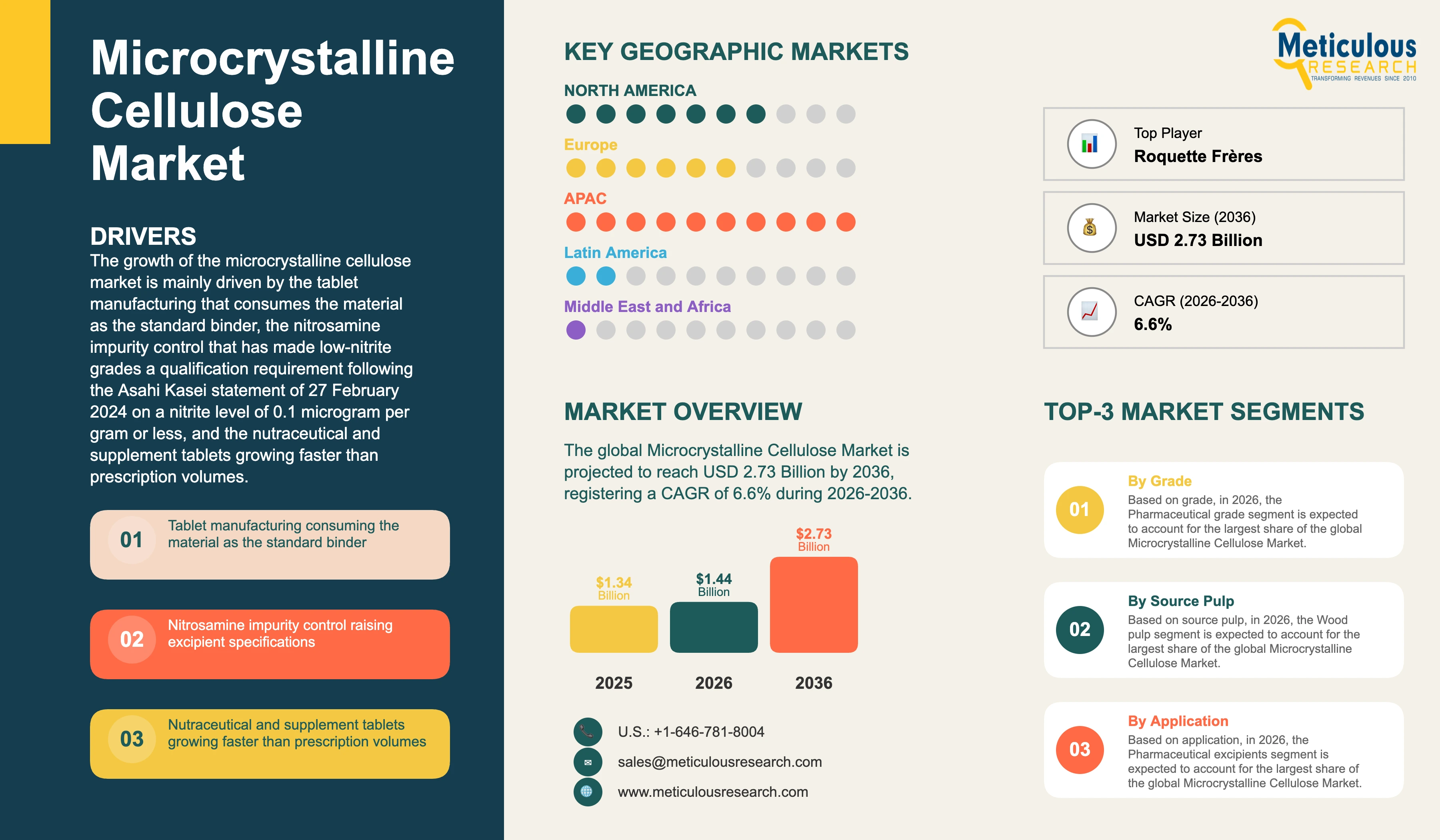
The global microcrystalline cellulose market was valued at USD 1.34 billion in 2025. This market is expected to reach USD 2.73 billion by 2036 from an estimated USD 1.44 billion in 2026, registering a CAGR of 6.6% during the forecast period (2026-2036).
- Published
- Nov 2026
- Pages
- 247
- Format
- PDF + Excel
- Report ID
- MRCHM - 1042813
- Base year
- 2025
- 2025 · BASELINE
- $1.34B
- 2036
- $2.73B
- CAGR 2026–2036
- 6.6%
2025 baseline · 2026–2036 forecast at 6.6% CAGR · hover a bar for the value
Key highlights
The global microcrystalline cellulose market is estimated at USD 1.44 billion in 2026 and is projected to reach USD 2.73 billion by 2036.
Market volume is estimated at 352.00 kilotons in 2026 and is projected to reach 562.54 kilotons by 2036 at a CAGR of 4.8%, measured as product as sold on a dry basis.
The average selling price is estimated at USD 4.10 per kg in 2026 and is projected to reach USD 4.85 per kg by 2036 as impurity control requirements tighten and the grade mix shifts.
Pharmaceutical grade is expected to account for the largest grade share in 2026, while co-processed and speciality grades are projected to register the highest CAGR of 10.4%.
Wood pulp is expected to be the largest source pulp in 2026, while non-wood and agricultural residue pulp is projected to grow fastest at a CAGR of 9.0%.
Pharmaceutical excipients are expected to be the largest application in 2026, while nutraceuticals and dietary supplements are projected to register the highest CAGR of 9.4%.
Asia-Pacific is expected to hold the largest regional share in 2026 and is also projected to register the highest CAGR of 8.0%.
Asahi Kasei stated on 27 February 2024 that its Ceolus microcrystalline cellulose is maintained at 0.1 microgram per gram of nitrite or less, to help reduce the risk of potentially carcinogenic nitrosamine impurities in pharmaceuticals and nutritional supplements.
The company described nitrosation between secondary or tertiary amines and nitrites during or after drug manufacturing as a risk factor for nitrosamine formation, and reducing nitrite in pharmaceutical raw materials as an effective way to lower that risk.
That release noted a potentially carcinogenic nitrosamine impurity detected in several pharmaceuticals in 2018, since when the industry has run assessments and research guided by regional authorities including the European Medicines Agency and the United States Food and Drug Administration.
Asahi Kasei has manufactured the material at Nobeoka in Miyazaki, Japan since 1970, and a second Ceolus facility at Mizushima Works in Okayama Prefecture began full commercial operation in January 2024, which the company stated raises supply capacity and improves supply stability through production at multiple sites.
That release did not name specific grades covered by the nitrite limit, state test methods, give production volumes or capacity figures for either plant, name the pharmaceuticals affected in 2018, or cite specific regulatory requirements.
Roquette completed its acquisition of the IFF Pharma Solutions business on 1 May 2025, following the acquisition of Qualicaps in 2023.
Neither the Roquette release nor the corresponding IFF release names microcrystalline cellulose or the Avicel brand, states a transaction value, identifies sites or plants, or gives the number of employees transferred.
IFF Industrial Solutions describes Lattice as the trade name it uses for microcrystalline cellulose in industrial applications outside food, pharmaceutical and personal care, and refers to Avicel as the pioneer brand of microcrystalline cellulose, without stating current ownership of either.
The same chemistry is therefore sold through pharmaceutical, food and industrial channels under separate brands, specifications and commercial ownership, which is the structural feature of this market.
This market covers microcrystalline cellulose only and excludes powdered cellulose, carboxymethyl cellulose, hydroxyethyl cellulose, cellulose acetate and cellulose nanocrystals.
Report summary
| Particulars | Details |
|---|---|
| Base Year | 2025 |
| Forecast Period | 2026-2036 |
| Market Size in 2025 | USD 1.34 billion |
| Market Size in 2026 | USD 1.44 billion |
| Market Size by 2036 | USD 2.73 billion |
| Value CAGR (2026-2036) | 6.6% |
| Format | PDF, Excel & Cloud Portal · 247 pages |
| Volume in 2026 | 352.00 kilotons |
| Volume by 2036 | 562.54 kilotons |
| Volume CAGR (2026-2036) | 4.8% |
| Volume Basis | Product as sold on a dry basis, including co-processed grades at total product mass |
| Average Selling Price in 2026 | USD 4.10 per kg |
| Average Selling Price by 2036 | USD 4.85 per kg |
| Price Direction | Average selling price rises across the forecast period as impurity control requirements tighten and the mix shifts toward co-processed and high-performance grades, rather than through any constraint on supply |
| Scope Definition Note | The boundary is set at cellulose that has been hydrolysed to the microcrystalline form, so powdered cellulose that has not been hydrolysed falls outside it even where it serves a similar function, and the chemical derivatives made by substituting the hydroxyl groups are separate products rather than grades of this one |
| Measurement Basis | Powder, colloidal and co-processed microcrystalline cellulose grades at total product mass, by grade, source pulp, application and geography, and excluding powdered cellulose that has not been hydrolysed, carboxymethyl cellulose, hydroxyethyl cellulose, cellulose acetate, cellulose nanocrystals, the dissolving pulp feedstock, and the tablets, foods and cosmetics into which the material is formulated |
| Note on Co-Processed Grades | Co-processed products contain a second excipient, most commonly a disintegrant, a glidant or carboxymethyl cellulose in the colloidal grades, so a tonne counted here is not a tonne of microcrystalline cellulose alone; they are counted at total product mass because they are sold and qualified as single excipients and because a cellulose-fraction basis would not reconcile with producer shipments |
| Relationship to Adjacent Markets | This market excludes the other cellulose derivatives rather than sitting within a cellulose aggregate, since microcrystalline cellulose is a physical form of purified cellulose while carboxymethyl, hydroxyethyl and acetate products are chemical derivatives; it also sits upstream of cellulose nanocrystals, for which it is a common feedstock, so the two are not additive |
| Largest Grade | Pharmaceutical grade |
| Fastest-Growing Grade | Co-processed and speciality grades (CAGR 10.4%) |
| Largest Source Pulp | Wood pulp |
| Fastest-Growing Source Pulp | Non-wood and agricultural residue pulp (CAGR 9.0%) |
| Largest Application | Pharmaceutical excipients |
| Fastest-Growing Application | Nutraceuticals and dietary supplements (CAGR 9.4%) |
| Largest Region | Asia-Pacific |
| Fastest-Growing Region | Asia-Pacific (CAGR 8.0%) |
| Segments Covered | Grade, Source Pulp, Application, and Geography |
| Geographies Covered | Asia-Pacific, North America, Europe, Latin America, and Middle East & Africa |
| Companies Profiled | 7 companies, including Roquette Frères, Asahi Kasei Corporation, J. Rettenmaier & Söhne GmbH + Co KG, International Flavors & Fragrances Inc., Sigachi Industries Limited, Mingtai Chemical Co., Ltd., and Accent Microcell Limited |
Report overview
Segments covered: grade, source pulp, application.
The growth of this market is mainly driven by the tablet manufacturing that consumes the material as the standard binder and filler, the nitrosamine impurity control that has made low-nitrite excipient grades a qualification requirement, the nutraceutical and dietary supplement tablets growing faster than prescription volumes, and the co-processed grades that deliver compaction and flow properties single-component excipients cannot. However, factors such as the dependence on dissolving and speciality pulp feedstock, the pharmacopoeial qualification burden that makes supplier changes slow, the direct compression alternatives competing for the same formulation position, and the exposure to generic tablet pricing pressure are expected to restrain the growth of this market to some extent.
Microcrystalline cellulose is purified, partially depolymerised cellulose produced by hydrolysing dissolving or speciality pulp under acid conditions and drying the crystalline residue, and it is used as a binder, filler and flow aid in tablets and as a bulking and stabilising agent in food, supplements and cosmetics. Market sizing in this report is on both a value basis in USD and a volume basis in kilotons measured as product as sold on a dry basis, with average selling price derived from the two. The measurement basis covers powder, colloidal and co-processed grades at total product mass, and it excludes powdered cellulose that has not been hydrolysed, carboxymethyl cellulose, hydroxyethyl cellulose, cellulose acetate, cellulose nanocrystals, the dissolving pulp feedstock, and the tablets, foods and cosmetics into which the material is formulated.
Counting co-processed grades at total product mass needs stating because those products contain a second excipient, most commonly a disintegrant, a glidant or carboxymethyl cellulose in the colloidal grades, so a tonne counted here is not a tonne of microcrystalline cellulose alone. The alternative, counting only the cellulose fraction, would not reconcile with producer shipments or with what a formulator buys and specifies, and the co-processed products are sold and qualified as single excipients rather than as blends.
Asahi Kasei stated on 27 February 2024 that its Ceolus microcrystalline cellulose is maintained at 0.1 microgram per gram of nitrite or less, to help reduce the risk of potentially carcinogenic nitrosamine impurities in pharmaceuticals and nutritional supplements, describing nitrosation between secondary or tertiary amines and nitrites during or after drug manufacturing as a risk factor and the reduction of nitrite in raw materials as an effective way to lower it. The release noted a nitrosamine impurity detected in several pharmaceuticals in 2018 and the assessments the industry has since run under guidance from authorities including the European Medicines Agency and the United States Food and Drug Administration. It did not name the grades covered, state test methods, give capacity figures or cite specific regulatory requirements.
That specification is the most consequential thing to have happened to this market in a decade, and it arrives from a direction a commodity excipient would not predict. The nitrosamine problem originates in the active ingredient and the amine chemistry of the drug, not in the filler, but nitrite carried by a bulk excipient supplies the other half of the reaction, and because microcrystalline cellulose is present at high loadings in a tablet, even trace concentrations matter in absolute terms. A material bought on price and compendial compliance has therefore acquired an impurity specification that distinguishes suppliers.
Roquette completed its acquisition of the IFF Pharma Solutions business on 1 May 2025, following the acquisition of Qualicaps in 2023, in a transaction neither party described in product terms. Neither the Roquette release nor the corresponding IFF release names microcrystalline cellulose or the Avicel brand, states a transaction value, identifies sites or plants, or gives the number of employees transferred. IFF Industrial Solutions separately describes Lattice as the trade name it uses for microcrystalline cellulose in industrial applications outside food, pharmaceutical and personal care, and refers to Avicel as the pioneer brand of microcrystalline cellulose, without stating current ownership of either.
What that leaves is a market in which the same chemistry reaches pharmaceutical, food and industrial customers under separate brands, separate specifications and, after the 2025 transaction, separate commercial ownership. A buyer cannot therefore read a producer position in one channel as a position in another, and a brand that has defined the product category for decades may be split across owners by application. The releases do not resolve that question, and it is stated here as it stands rather than inferred.
Tablet manufacturing is what consumes the material and sets its requirements. A tablet needs a filler that compacts under pressure into a coherent compact, releases the active ingredient on disintegration and flows reliably through a press, and microcrystalline cellulose does all three better than the alternatives at the loadings involved, which is why it has been the standard binder for half a century. Pharmaceutical excipients accordingly account for the largest application share throughout the period.
Co-processed grades are the fastest-growing part of the market and the reason is physical rather than chemical. Drying microcrystalline cellulose together with a disintegrant, a glidant or a second excipient produces particles in which the components are intimately associated, and the resulting compaction and flow behaviour cannot be reproduced by blending the same ingredients afterwards. A formulator buying a co-processed grade is buying particle engineering. Co-processed and speciality grades consequently register the highest grade CAGR at 10.4%.
Nutraceuticals and supplements grow faster than prescription pharmaceuticals and buy differently. Supplement tablets are formulated and manufactured in far greater numbers than new drug products, qualification is lighter than for a regulated medicine, and the loadings per tablet tend to be higher because the actives are bulk materials rather than potent compounds. Asahi Kasei names nutritional supplements alongside pharmaceuticals in its nitrite release. Nutraceuticals and dietary supplements therefore register the highest application CAGR at 9.4%.
Pharmacopoeial qualification is what makes this market stable and slow. An excipient is named in a drug registration, so changing supplier means a regulatory variation and, depending on the jurisdiction, comparability work, which a manufacturer will not undertake to capture a small price difference. Positions are consequently held for the life of a product, and a new entrant finds that compendial compliance qualifies it to be considered rather than to be bought.
Feedstock is the constraint that links this market to pulp. The hydrolysis requires a high-purity cellulose source, so producers buy dissolving pulp or cotton linter rather than ordinary paper pulp, and that feedstock is produced by a small number of mills for a small number of uses. Cotton linter gives a different crystallinity and particle character than wood pulp, which is why some formulations specify the source and why the source pulp axis carries commercial meaning rather than describing only origin.
Direct compression alternatives compete for the same position in a formulation. Spray-dried lactose, dibasic calcium phosphate, co-processed starch and mannitol each serve as compressible fillers, and each has an argument in particular cases, lactose on cost, phosphate on moisture sensitivity and mannitol on taste and on compatibility with moisture-sensitive actives. Microcrystalline cellulose holds the position where compaction performance and chemical inertness matter together.
This market excludes the other cellulose derivatives rather than sitting within a cellulose aggregate, since microcrystalline cellulose is a physical form of purified cellulose while carboxymethyl, hydroxyethyl and acetate products are chemical derivatives made by substituting the hydroxyl groups. It also sits upstream of cellulose nanocrystals, for which it is a common feedstock, so the two are not additive and a combined cellulose figure would merge products with separate supply bases, price levels and regulatory treatment.
Reducing nitrite in a bulk excipient addresses half of the nitrosation reaction that produces nitrosamine impurities, and because the material is dosed at high loadings in a tablet the absolute contribution is material, so a manufacturer managing nitrosamine risk in an amine-containing product has reason to specify the excipient rather than accept any compendial grade.
That converts an impurity specification into a commercial position, since a formulator who has qualified a low-nitrite grade into a registration has a strong reason not to change it.
Impurity control of this kind is also verifiable by the customer, unlike many quality claims, which makes it a durable basis for differentiation rather than a marketing position.
Avoiding water exposure also matters for moisture-sensitive actives, so direct compression is sometimes a formulation necessity rather than only a cost saving.
Direct compression avoids the granulation step entirely, which removes equipment, time and a water-exposure risk from tablet manufacture, but it demands a filler with both compaction strength and reliable flow, which is precisely what co-processing delivers by associating the components during manufacture rather than afterwards.
Formulators moving to direct compression therefore adopt co-processed grades as part of a process change rather than as a material substitution, and those grades register the highest grade CAGR at 10.4%.
The grades also command a materially higher price than standard powder, so the opportunity raises value faster than volume and is the principal reason the average selling price in this market rises.
Residue feedstocks also carry a renewable content and waste-valorisation argument that a customer reporting on sourcing can use, independent of the cost position.
Producing the material from bagasse, bamboo, cereal straw or other agricultural residues would loosen the dependence on dissolving pulp and cotton linter, both of which are made by few mills for few uses, and would locate feedstock close to the growing Asian manufacturing base.
Qualifying such a source for pharmaceutical use requires demonstrating equivalent purity and crystallinity rather than new chemistry, and non-wood and agricultural residue pulp registers the highest source pulp CAGR at 9.0%.
Residue feedstocks are also available where the pulp industry is not, which would allow production in regions that currently import the material.
Qualification nonetheless requires demonstrating equivalent purity, crystallinity and compaction behaviour across batches, which is a longer exercise than establishing the chemistry.
Spray-dried lactose, dibasic calcium phosphate, co-processed starch and mannitol each serve as compressible fillers and each has an argument in particular cases, lactose on cost, phosphate on moisture sensitivity and mannitol on taste and on compatibility with moisture-sensitive actives, so microcrystalline cellulose holds its position where compaction and inertness matter together rather than by default.
A formulation that needs only bulk and compressibility can often be built more cheaply, which caps the price the material can carry in high-volume generic products.
Those alternatives are also made at far larger scale as food and mineral commodities, so their cost position does not depend on the excipient market at all.
Generic medicines are sold into tendered and reference-priced markets where the manufacturer has limited ability to recover input cost, so excipient price increases are resisted even where the specification is tightening, and the two pressures act on a producer at the same time.
That is why value growth in this market depends on mix shifting toward grades sold on performance rather than on raising the price of the standard powder.
Impurity specification is the one place where a producer can escape that pressure, since a grade qualified for its nitrite level is not competing against the standard powder on price.
Both pressures act on a producer at once, which is why differentiation on specification matters more here than scale.
Asia-Pacific is expected to account for the largest share in 2026, on the generic tablet and supplement manufacturing concentrated in India and China, the excipient producers established across the region, and the regional dissolving pulp and cotton linter supply. India is projected to grow at 9.8%, China at 8.4% and Japan at 4.6%.
Asia-Pacific is also projected to register the highest CAGR of 8.0% during the forecast period, holding both the largest share and the fastest growth.
Europe is projected to grow at a CAGR of 5.4%, with Germany at 5.4%, on the pharmaceutical manufacturing base and the excipient producers located there, growing below the global rate because its tablet volumes are mature.
The Middle East & Africa is projected to grow at a CAGR of 6.0%, where growth follows local tablet manufacturing being established. Latin America is projected to grow at a CAGR of 6.4%, with Brazil at 6.4%, on domestic generic manufacturing and a resident producer base.
Roquette Frères, Asahi Kasei Corporation, J. Rettenmaier & Söhne GmbH + Co KG, International Flavors & Fragrances Inc. and Sigachi Industries Limited together accounted for an estimated 58.2% of this market in 2026. The 7 companies profiled in this report together accounted for an estimated 64.8%.
Report infographic
Market dynamics
11 factors across 5 forcesTablet Manufacturing Consuming the Material as the Standard Binder
A tablet requires a filler that compacts under pressure into a coherent compact, releases the active ingredient on disintegration and flows reliably through a press, and microcrystalline cellulose performs all three better than the alternatives at the loadings involved, which is why Asahi Kasei describes Ceolus as primarily used as a tablet binder providing shape and increasing tablet volume.
Tablets also remain the dominant dosage form across prescription medicines, over-the-counter products and supplements, so the application base is broad rather than dependent on any therapeutic area.
A filler is also dosed at a far higher proportion of tablet weight than the active ingredient in most products, so the volume consumed scales with tablet mass rather than with dose strength, which makes demand track tablet output rather than therapeutic value.
Tablets also remain preferred by prescribers and patients for dosing accuracy, stability and cost, so no shift in dosage form is displacing the application at the rate new formats are introduced.
Nitrosamine Impurity Control Raising Excipient Specifications
Asahi Kasei stated on 27 February 2024 that Ceolus is maintained at 0.1 microgram per gram of nitrite or less to help reduce the risk of potentially carcinogenic nitrosamine impurities, describing nitrosation between secondary or tertiary amines and nitrites as a risk factor and noting the industry assessments run since a nitrosamine impurity was detected in several pharmaceuticals in 2018 under guidance from authorities including the European Medicines Agency and the Food and Drug Administration.
Because the material is present at high loadings in a tablet, trace nitrite concentrations matter in absolute terms, which turns a compendial commodity into a specified input and allows suppliers to differentiate on impurity control.
Asahi Kasei also stated that its second facility at Mizushima Works began full commercial operation in January 2024 alongside the Nobeoka plant operating since 1970, raising supply capacity and improving supply stability through production at multiple sites, which is the other half of what a buyer managing excipient risk now asks about.
Nutraceutical and Supplement Tablets Growing Faster Than Prescription Volumes
Supplement tablets are formulated and manufactured in far greater numbers than new drug products, qualification is lighter than for a regulated medicine and loadings per tablet tend to be higher because the actives are bulk materials rather than potent compounds, and Asahi Kasei names nutritional supplements alongside pharmaceuticals in its nitrite release.
That segment also adopts new grades more readily than regulated pharmaceutical manufacturing, which is why it registers the highest application CAGR at 9.4%.
Supplement products are also reformulated and relaunched far more often than medicines, which creates repeated opportunities to specify a different grade rather than a single decision held for years.
Loadings per supplement tablet also tend to exceed those in a medicine, because the actives are bulk vitamins and minerals rather than potent compounds, so each tablet consumes more of the material.
Co-Processed Grades Delivering Properties Single Excipients Cannot
Drying microcrystalline cellulose together with a disintegrant, a glidant or a second excipient produces particles in which the components are intimately associated, and the compaction and flow behaviour that results cannot be reproduced by blending the same ingredients afterwards, so a formulator buying such a grade is buying particle engineering rather than a mixture.
These grades also carry a materially higher price than standard powder, which is why the average selling price in this market rises across the forecast period while volume growth stays moderate.
Direct compression also removes the granulation step from tablet manufacture, so the grade is adopted as part of a process change that saves equipment and time, which is a stronger argument than a material comparison alone would make.
A co-processed grade is also qualified as a single excipient rather than as two, which simplifies the dossier a formulator must assemble and is part of why the grades are adopted.
Table of contents
11 chapters · 132 sections · 247 pages · click to expandSegmental analysis
| Segment | Largest share (2026) | Fastest growth (2026–2036) |
|---|---|---|
| By Grade | Pharmaceutical grade | — |
| Other segments | — | Co-processed and speciality grades |
By Grade
- Pharmaceutical grade is expected to account for the largest share in 2026, on tablets being the dominant dosage form, the pharmacopoeial listings that name the material in registrations worldwide, and the impurity control requirements that command a premium.
- Wood pulp is expected to hold the largest share in 2026, on dissolving pulp being available in far greater quantity than cotton linter and suiting the majority of formulations.
- Pharmaceutical excipients are expected to account for the largest share in 2026, on the tablet remaining the dominant dosage form and the compaction and disintegration behaviour the material provides at high loadings.
Other segments
- Co-processed and speciality grades are projected to register the highest CAGR of 10.4% during the forecast period.
- Non-wood and agricultural residue pulp is projected to register the highest CAGR of 9.0% during the forecast period.
- Nutraceuticals and dietary supplements are projected to register the highest CAGR of 9.4% during the forecast period.
Geographic analysis
Asia-Pacific
Largest shareGeneric tablet manufacturing and supplement production are concentrated and growing in India and China, excipient producers are established in both, and the regulatory expectations applied to exported product increasingly match those of the destination markets, which raises the grade requirement alongside the volume. Asia-Pacific is accordingly expected to hold the largest regional share in 2026 and also to register the highest regional CAGR at 8.0%, with India at 9.8% and China at 8.4%. Indian and Chinese producers are also qualifying into regulated export markets, which widens the supplier base available to a formulator without requiring a new chemistry. Supplement manufacturing in the region is also growing alongside the pharmaceutical base, so a producer serving both captures two growth rates from one site. Adoption in regulated pharmaceutical use also follows the supplement channel rather than leading it, since a grade with commercial history is easier to defend in a dossier than one without, which gives the opportunity a sequence rather than a single entry point. Each of these four openings raises realised price rather than tonnage, which is the shape of growth available in a mature excipient. In 2026, Asia-Pacific is expected to account for the largest share of the global microcrystalline cellulose market and is also projected to register the highest CAGR of 8.0% during the forecast period. The large share and rapid growth of this region are attributed to the generic tablet and supplement manufacturing concentrated in India and China, the excipient producers established in both together with the long-standing Japanese and Taiwanese producers, the regional dissolving pulp and cotton linter supply, and the regulatory expectations applied to exported product increasingly matching those of the destination markets. India is projected to register a CAGR of 9.8%, China a CAGR of 8.4% and Japan a CAGR of 4.6%. Asia-Pacific Generic and Supplement Manufacturing Geographic Analysis
North America
North America is projected to grow at 5.6%, with the United States at 5.6%, on prescription and over-the-counter tablet manufacturing, a large supplement industry and the nitrosamine assessment work that has raised excipient specifications. North America and Europe remain the largest consumers of the highest-specification grades, which is why their value shares exceed what their volume growth rates would imply.
Europe
Europe is projected to grow at 5.4%, with Germany at 5.4%, on the pharmaceutical manufacturing base and the excipient producers located there, with both regions growing below the global rate because their tablet volumes are mature.
Latin America
Latin America is projected to grow at 6.4%, with Brazil at 6.4%, on domestic generic manufacturing and a resident producer base. Latin America and the Middle East & Africa are both adding local tablet manufacturing, which is where their growth comes from rather than from any change in the applications themselves. Grade requirements are converging across regions faster than prices are, because a tablet exported into a regulated market must satisfy that market standards whatever its origin, which is why the regional value and volume shares differ less here than in most speciality chemical markets.
Middle East & Africa
The Middle East & Africa is projected to grow at 6.0%, where growth follows local tablet manufacturing being established rather than any change in the applications themselves. What distinguishes the regions in this market is the regulatory standard applied rather than the volume consumed. A tablet exported into a regulated market must satisfy that market requirements whatever its origin, so manufacturers in the growth regions buy to the same impurity and documentation standards as those in the mature ones, and the grade mix converges faster than the price levels do. That is why the regional value shares and volume shares differ less here than in most speciality chemical markets.
Competitive landscape
The global microcrystalline cellulose market is characterised by a small number of established pharmaceutical excipient suppliers holding the regulated grades, Indian and Taiwanese producers supplying the broader market, and a channel separation between pharmaceutical, food and industrial applications that the 2025 transaction has reinforced. Competition is contested on impurity control, documentation and supply security rather than on price, because an excipient named in a registration cannot readily be changed. Roquette Frères, Asahi Kasei Corporation, J. Rettenmaier & Söhne GmbH + Co KG, International Flavors & Fragrances Inc. and Sigachi Industries Limited together accounted for an estimated 58.2% of this market in 2026, while the companies profiled in this report together accounted for an estimated 64.8%.
Roquette completed its acquisition of the IFF Pharma Solutions business on 1 May 2025, following the acquisition of Qualicaps in 2023, in releases that named neither microcrystalline cellulose nor the Avicel brand and stated no transaction value, sites or employee numbers, while IFF Industrial Solutions describes Lattice as its trade name for the material in industrial applications outside food, pharmaceutical and personal care. Asahi Kasei stated on 27 February 2024 a nitrite level of 0.1 microgram per gram or less for Ceolus to help reduce nitrosamine risk, and noted that its second facility at Mizushima Works began full commercial operation in January 2024 alongside the Nobeoka plant operating since 1970.
Portfolio restructuring and specification tightening rather than capacity addition accounted for most competitive activity through 2026. Roquette Frères competes from the acquired pharmaceutical excipient portfolio alongside its own starch and polyol excipients, Asahi Kasei Corporation from a high-performance pharmaceutical position with two qualified Japanese sites, J. Rettenmaier & Söhne GmbH + Co KG from a broad fibre and excipient range serving pharmaceutical and food customers, International Flavors & Fragrances Inc. from the industrial channel, and Sigachi Industries Limited, Mingtai Chemical Co., Ltd. and Accent Microcell Limited from Asian production serving pharmaceutical, food and industrial customers across regions. Some of the key players operating in the microcrystalline cellulose market are Roquette Frères (France), Asahi Kasei Corporation (Japan), J. Rettenmaier & Söhne GmbH + Co KG (Germany), International Flavors & Fragrances Inc. (U.S.), Sigachi Industries Limited (India), Mingtai Chemical Co., Ltd. (Taiwan), and Accent Microcell Limited (India), among others.
- —
Asahi Kasei stated on 27 February 2024 that its Ceolus microcrystalline cellulose is maintained at 0.1 microgram per gram of nitrite or less to help reduce the risk of potentially carcinogenic nitrosamine impurities in pharmaceuticals and nutritional supplements, describing nitrosation between secondary or tertiary amines and nitrites during or after drug manufacturing as a risk factor and the reduction of nitrite in raw materials as an effective way to lower it, noting a nitrosamine impurity detected in several pharmaceuticals in 2018 and the assessments since run under guidance from authorities including the European Medicines Agency and the United States Food and Drug Administration. The company has manufactured the material at Nobeoka in Miyazaki since 1970, and a second Ceolus facility at Mizushima Works in Okayama Prefecture began full commercial operation in January 2024, which the company stated raises supply capacity and improves supply stability through production at multiple sites; the release did not name the grades covered, state test methods or give capacity figures. Roquette completed its acquisition of the IFF Pharma Solutions business on 1 May 2025, following the acquisition of Qualicaps in 2023, in releases that named neither microcrystalline cellulose nor the Avicel brand and stated no transaction value, sites, plants or employee numbers, while IFF Industrial Solutions describes Lattice as the trade name it uses for the material in industrial applications outside food, pharmaceutical and personal care and refers to Avicel as the pioneer brand of microcrystalline cellulose, without stating current ownership of either.
- Roquette Frères
- Asahi Kasei Corporation
- International Flavors & Fragrances Inc.
- Sigachi Industries Limited
- Mingtai Chemical Co., Ltd.
- Accent Microcell Limited
Expert perspectives
Value grows at 6.6% against 4.8% in volume over the forecast period, and the average selling price rises from USD 4.10 per kg in 2026 to USD 4.85 per kg by 2036. Mix and specification rather than tonnage carry the growth, which is what happens when a mature excipient acquires a new requirement.
That requirement is nitrite. Asahi Kasei stated on 27 February 2024 that Ceolus is held at 0.1 microgram per gram or less to reduce the risk of nitrosamine impurities, citing nitrosation between secondary or tertiary amines and nitrites and the industry assessments run since a nitrosamine was detected in several pharmaceuticals in 2018 under guidance from the European Medicines Agency and the Food and Drug Administration.
The significance is in the arithmetic rather than the chemistry. Nitrosamine risk originates in the active ingredient, but nitrite from a bulk excipient supplies the other half of the reaction, and because this material is dosed at high loadings in a tablet, trace concentrations matter in absolute terms. A commodity bought on price and compendial compliance has therefore acquired a specification that distinguishes suppliers and that a formulator will not lightly requalify.
The 2025 transaction is harder to read than it looks, and the report says so rather than filling the gap. Roquette completed its acquisition of IFF Pharma Solutions on 1 May 2025, but neither that release nor the IFF release names this product or the Avicel brand, states a value, or identifies sites, while IFF Industrial Solutions presents Lattice as its own trade name for industrial grades outside food, pharmaceutical and personal care.
What follows is a market where the same chemistry reaches three channels under separate brands, specifications and ownership, so a producer position in one cannot be read as a position in another. That is unusual, and it matters commercially, because the pharmaceutical channel is where the impurity specification and the price premium sit while the industrial channel is where the volume is least defended.
Qualification is what makes the whole market slow and stable. An excipient named in a registration cannot be changed without a regulatory variation, so positions are held for the life of a product and a new entrant finds compendial compliance qualifies it to be considered rather than bought. This market excludes powdered cellulose and the chemical derivatives, and sits upstream of cellulose nanocrystals, for which it is a common feedstock.
Customer perspectives
Nitrosation requires both an amine and a nitrite source, and because the material is dosed at high loadings in a tablet its trace nitrite contribution is material in absolute terms, which has moved impurity control from a compendial matter to a specified purchasing requirement.
Compendial compliance is consequently the entry requirement rather than the specification a buyer works to.
A supplier able to demonstrate and hold that control therefore competes on something a customer can verify rather than on price alone.
An excipient named in a drug registration cannot be changed without a regulatory variation, so positions are held for the life of a product and buyers assess the number of qualified production sites as part of supplier selection rather than as a logistics matter.
Multi-site qualification has consequently become part of supplier assessment rather than a logistics consideration.
Supplement manufacturing qualifies new grades more readily than regulated pharmaceutical production, which is why co-processed grades and the supplement application both grow well above the market rate.
Lighter qualification also makes the supplement channel the route by which new grades reach the market before pharmaceutical adoption follows.
“Nitrite in the filler was not something we specified five years ago. Now it is on the questionnaire, because with an amine in the molecule the excipient is where the other half of the reaction comes from.”
“Once it is named in the registration we are not changing it for a few cents. What we do care about is how many qualified sites the supplier can make it at.”
“We can adopt a co-processed grade in months rather than years, and the direct compression saving is real for us. The pharmaceutical side cannot move that fast.”
Frequently asked questions
This market was valued at USD 1.26 billion in 2024 and USD 1.34 billion in 2025, and is estimated at USD 1.44 billion in 2026. In volume terms it is estimated at 352.00 kilotons in 2026 as product as sold on a dry basis.
This market is projected to reach USD 2.73 billion by 2036 in value and 562.54 kilotons in volume.
This market is projected to register a value CAGR of 6.6% and a volume CAGR of 4.8% during the forecast period 2026-2036. The average selling price is projected to move from USD 4.10 per kg in 2026 to USD 4.85 per kg by 2036.
Growth is driven by tablet manufacturing that consumes the material as the standard binder, nitrosamine impurity control that has made low-nitrite grades a qualification requirement, nutraceutical and supplement tablets growing faster than prescription volumes, and co-processed grades that deliver properties single excipients cannot.
Acid hydrolysis requires dissolving pulp or cotton linter, whose price and availability are set outside this market, and pharmacopoeial qualification makes supplier changes slow. Direct compression alternatives such as spray-dried lactose and mannitol compete for the same position, and generic tablet pricing pressure resists excipient price increases.
Low-nitrite grades convert an impurity specification into a commercial position, and co-processed excipient platforms support the move to direct compression. Non-wood and agricultural residue feedstocks loosen the dependence on dissolving pulp and cotton linter, and Asia-Pacific generic and supplement manufacturing is growing.
Pharmaceutical grade is expected to account for the largest share in 2026, on tablets being the dominant dosage form, the pharmacopoeial listings that name the material in registrations worldwide, and the impurity control requirements that command a premium.
Co-processed and speciality grades are projected to register the highest CAGR of 10.4% during the forecast period.
Wood pulp is expected to hold the largest share in 2026, on dissolving pulp being available in far greater quantity than cotton linter and suiting the majority of formulations.
Non-wood and agricultural residue pulp is projected to register the highest CAGR of 9.0% during the forecast period.
Pharmaceutical excipients are expected to account for the largest share in 2026, on the tablet remaining the dominant dosage form and the compaction and disintegration behaviour the material provides at high loadings.
Nutraceuticals and dietary supplements are projected to register the highest CAGR of 9.4% during the forecast period.
Asia-Pacific is expected to account for the largest share in 2026, on the generic tablet and supplement manufacturing concentrated in India and China, the excipient producers established across the region, and the regional dissolving pulp and cotton linter supply. India is projected to grow at 9.8%, China at 8.4% and Japan at 4.6%.
Asia-Pacific is also projected to register the highest CAGR of 8.0% during the forecast period, holding both the largest share and the fastest growth.
Europe is projected to grow at a CAGR of 5.4%, with Germany at 5.4%, on the pharmaceutical manufacturing base and the excipient producers located there. It grows below the global rate because its tablet volumes are mature.
The Middle East & Africa is projected to grow at a CAGR of 6.0%, where growth follows local tablet manufacturing being established. Latin America is projected to grow at a CAGR of 6.4%, with Brazil at 6.4%, on domestic generic manufacturing and a resident producer base.
Roquette Frères, Asahi Kasei Corporation, J. Rettenmaier & Söhne GmbH + Co KG, International Flavors & Fragrances Inc. and Sigachi Industries Limited together accounted for an estimated 58.2% of this market in 2026. The 7 companies profiled in this report together accounted for an estimated 64.8%.
Asahi Kasei stated on 27 February 2024 that its Ceolus microcrystalline cellulose is maintained at 0.1 microgram per gram of nitrite or less to help reduce nitrosamine risk, and its second facility at Mizushima Works began full commercial operation in January 2024. Roquette completed its acquisition of the IFF Pharma Solutions business on 1 May 2025, following the acquisition of Qualicaps in 2023.
Cite this report
Meticulous Research. (2026). Microcrystalline Cellulose Market - Global Opportunity Analysis and Industry Forecast (2026-2036) (Report No. MRCHM - 1042813). Meticulous Market Research Pvt. Ltd. https://www.meticulousresearch.com/product/microcrystalline-cellulose-market-7496