Antimicrobial Textile Finishes Market (2026-2036)
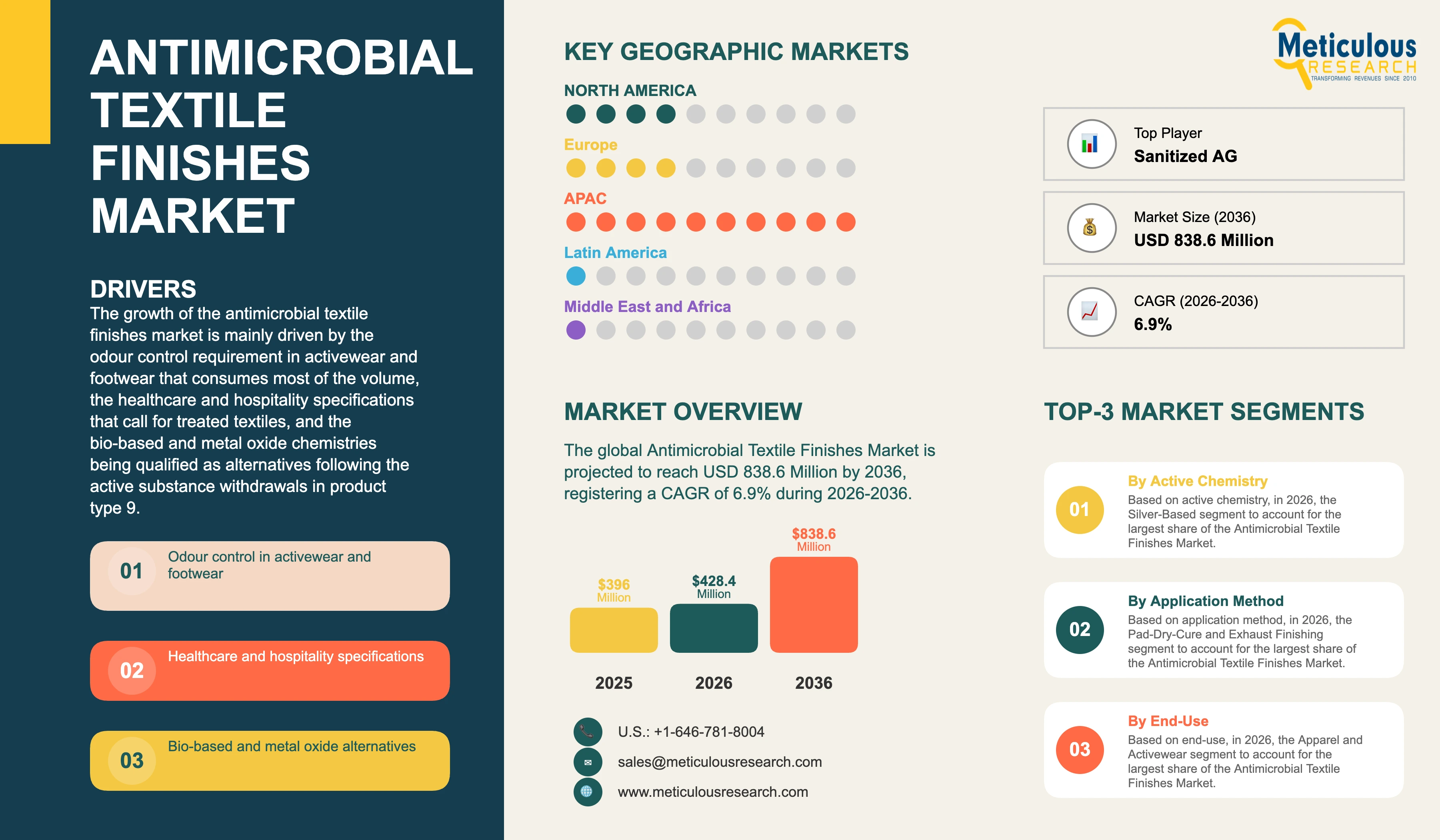
The global antimicrobial textile finishes market was valued at USD 396.0 million in 2025. This market is expected to reach USD 838.6 million by 2036 from an estimated USD 428.4 million in 2026, registering a CAGR of 6.9% during the forecast period (2026-2036).
- Published
- Nov 2026
- Pages
- 260
- Format
- PDF + Excel
- Report ID
- MRCHM - 1042794
- Base year
- 2025
- 2025 · BASELINE
- $396.0M
- 2036
- $838.6M
- CAGR 2026–2036
- 6.9%
2025 baseline · 2026–2036 forecast at 6.9% CAGR · hover a bar for the value
Key highlights
The global antimicrobial textile finishes market is estimated at USD 428.4 million in 2026 and is projected to reach USD 838.6 million by 2036.
Market volume is estimated at 42.00 kilotons in 2026 and is projected to reach 71.07 kilotons by 2036 at a CAGR of 5.4%, measured as formulated finish supplied on a product mass basis.
The average selling price is estimated at USD 10.20 per kg in 2026 and is projected to reach USD 11.80 per kg by 2036 as the mix shifts toward registered and bio-based chemistries.
Silver-based chemistry is expected to account for the largest active chemistry share in 2026, while bio-based and metal oxide chemistries are projected to register the highest CAGR of 10.4%.
Pad-dry-cure and exhaust finishing is expected to hold the largest application method share in 2026, while fibre incorporation at spinning is projected to grow fastest at a CAGR of 8.4%.
Apparel and activewear are expected to be the largest end-use in 2026, while healthcare and medical textiles are projected to register the highest CAGR of 9.0%.
Asia-Pacific is expected to hold the largest regional share in 2026 and is also projected to register the highest CAGR of 8.0%.
A Great Britain Biocidal Products Regulation non-approval decision dated 15 August 2023 withdrew a group of active substances for lack of applicant support, including several in product type 9, which covers fibre, leather, rubber and polymerised materials preservation.
The product type 9 substances named in that decision include bronopol, metam-sodium and thiram, together with silver nanomaterial and a titanium dioxide and silver chloride reaction mass.
Under that decision supply in Great Britain ended on 15 August 2024, use ended on 15 February 2025, and stocks were to be cleared from the supply chain by 15 August 2024.
New treated articles containing those substances could not enter the Great Britain supply chain or be imported after 11 February 2024, while articles already in supply could continue to be supplied and used.
A further Great Britain non-approval decision dated 1 April 2026 covers 16 substances described as unsupported, with the substance names and product types held in a separate decision document rather than on the published decisions page.
The Health and Safety Executive treated articles guidance, updated 14 April 2026, states that a treated article may not be placed on the market unless all its active substances are approved for the relevant product type and use or are on the Great Britain Simplified Active Substance List.
Where an active substance is not yet approved but is marked as usable in treated articles on that list, an article may be placed on the market until the approval date or 180 days after a non-approval decision.
Turning a treated article into a more complex article creates a new treated article, and the party placing that new article on the market takes on the labelling duties.
Anyone in the supply chain must provide consumers, on request, with information on the biocidal treatment within 45 days and free of charge.
Making a biocidal claim triggers additional labelling, and a claim presenting the biocidal function as the prominent or primary feature can make the article a biocidal product, which changes the regime that applies to it.
This market measures the formulated finish supplied to mills and fibre producers, and is not additive to the markets for the active substances it contains.
Report summary
| Particulars | Details |
|---|---|
| Base Year | 2025 |
| Forecast Period | 2026-2036 |
| Market Size in 2025 | USD 396.0 million |
| Market Size in 2026 | USD 428.4 million |
| Market Size by 2036 | USD 838.6 million |
| Value CAGR (2026-2036) | 6.9% |
| Format | PDF, Excel & Cloud Portal · 260 pages |
| Volume in 2026 | 42.00 kilotons |
| Volume by 2036 | 71.07 kilotons |
| Volume CAGR (2026-2036) | 5.4% |
| Volume Basis | Formulated finish supplied on a product mass basis, not on an active substance basis |
| Average Selling Price in 2026 | USD 10.20 per kg |
| Average Selling Price by 2036 | USD 11.80 per kg |
| Price Direction | Average selling price rises across the forecast period as the mix shifts toward chemistries with a secure registration position and toward fibre incorporation concentrates, rather than through any constraint on supply |
| Scope Definition Note | The boundary is set at the formulated finish rather than at the active it delivers, because a finish is a dispersion or emulsion in which the active is a small percentage of the delivered mass and the carriers, binders and dispersants determine whether it fixes to the fibre and survives washing, which is what a mill specifies and pays for |
| Measurement Basis | Silver-based, quaternary ammonium, zinc pyrithione, polymeric biguanide, bio-based and metal oxide antimicrobial textile finishes, by active chemistry, application method, end-use and geography, and excluding the active substances measured as actives, inherently antimicrobial fibres sold as fibre, insect repellent and flame retardant finishes, textiles regulated as medical devices, and the treated fabrics and garments into which the finish is incorporated |
| Relationship to Adjacent Markets | This market is not additive to the markets for silver antimicrobial additives, quaternary ammonium biocides or zinc pyrithione, since the active content of these finishes is counted at the active level in those reports; adding them together would count the same chemistry twice at two points in the chain, and those markets also cover plastics, coatings and personal care uses unrelated to textiles |
| Regulatory Note | A Great Britain Biocidal Products Regulation non-approval decision dated 15 August 2023 withdrew active substances for lack of applicant support, including bronopol, metam-sodium, thiram, silver nanomaterial and a titanium dioxide and silver chloride reaction mass in product type 9, which covers fibre, leather, rubber and polymerised materials preservation; supply ended 15 August 2024, use ended 15 February 2025, and new treated articles containing those substances could not enter the supply chain or be imported after 11 February 2024 |
| Note on an Undetermined Decision | A further Great Britain non-approval decision dated 1 April 2026 covers 16 substances described as unsupported, with the names and product types held in a separate decision document rather than on the published decisions page, so no textile effect is attributed to it in this report; the same page describes an earlier decision as covering 28 substances while listing 19, and shows a last update of 24 March 2026 while including decisions dated 1 April 2026 |
| Largest Active Chemistry | Silver-based |
| Fastest-Growing Active Chemistry | Bio-based and metal oxide (CAGR 10.4%) |
| Largest Application Method | Pad-dry-cure and exhaust finishing |
| Fastest-Growing Application Method | Fibre incorporation at spinning (CAGR 8.4%) |
| Largest End-Use | Apparel and activewear |
| Fastest-Growing End-Use | Healthcare and medical textiles (CAGR 9.0%) |
| Largest Region | Asia-Pacific |
| Fastest-Growing Region | Asia-Pacific (CAGR 8.0%) |
| Segments Covered | Active Chemistry, Application Method, End-Use, and Geography |
| Geographies Covered | Asia-Pacific, Europe, North America, Latin America, and Middle East & Africa |
| Companies Profiled | 7 companies, including Sanitized AG, HeiQ Plc, Polygiene Group AB, Milliken & Company, Arxada AG, Rudolf GmbH, and Dow Inc. |
Report overview
Segments covered: active chemistry, application method, end-use.
In volume terms, this market is estimated at 42.00 kilotons in 2026 and is projected to reach 71.07 kilotons by 2036, registering a CAGR of 5.4% during the same period, measured as formulated finish supplied on a product mass basis rather than on an active substance basis. The average selling price is estimated at USD 10.20 per kg in 2026 and is projected to rise to USD 11.80 per kg by 2036 as the mix shifts toward registered chemistries and compliant bio-based alternatives.
The growth of this market is mainly driven by the odour control requirement in activewear and footwear that consumes most of the volume, the healthcare and hospitality specifications that call for treated textiles, the bio-based and metal oxide chemistries being developed as approved alternatives, and the durability requirements that favour fibre incorporation over topical treatment. However, factors such as the withdrawal of active substances from the fibre preservation product type, the treated article obligations that fall on whoever first places an article on the market, the risk that a prominent biocidal claim reclassifies an article as a biocidal product, and the wash durability limits of topical finishes are expected to restrain the growth of this market to some extent.
Silver-based chemistry accounts for the largest share of this market because it delivers broad-spectrum activity at low addition levels across a wide range of fibres. Bio-based and metal oxide chemistries grow fastest because active substance withdrawals have obliged mills and brands to qualify alternatives rather than reformulate within the established options.
Antimicrobial textile finishes are formulated chemical products supplied to textile mills and fibre producers to impart antimicrobial or odour control function, applied by pad-dry-cure, exhaust, spray or foam finishing, or incorporated into synthetic fibre at the spinning stage. Market sizing in this report is on both a value basis in USD and a volume basis in kilotons measured as formulated finish supplied on a product mass basis, with average selling price derived from the two. The measurement basis covers silver-based, quaternary ammonium, zinc pyrithione, polymeric biguanide, bio-based and metal oxide finishes, and it excludes the active substances measured as actives, inherently antimicrobial fibres sold as fibre, insect repellent and flame retardant finishes, textiles regulated as medical devices, and the treated fabrics and garments into which the finish is incorporated.
Measuring the formulated product rather than its active content is what keeps this market separable from those for the actives themselves. A finish is typically a dispersion or emulsion in which the active is a small percentage of the delivered mass, the rest being carriers, binders and dispersants that determine whether the active fixes to the fibre and survives washing, and it is that formulation rather than the active that a mill buys, specifies and pays for. The active content of these products is counted at the active level in the markets for silver antimicrobial additives, quaternary ammonium biocides and zinc pyrithione, so the figures here are not additive to those.
A Great Britain Biocidal Products Regulation non-approval decision dated 15 August 2023 withdrew a group of active substances for lack of applicant support, including several in product type 9, which covers the preservation of fibre, leather, rubber and polymerised materials. The product type 9 substances named include bronopol, metam-sodium and thiram, together with silver nanomaterial and a titanium dioxide and silver chloride reaction mass. Supply in Great Britain ended on 15 August 2024, use ended on 15 February 2025, stocks were to be cleared from the supply chain by 15 August 2024, and new treated articles containing those substances could not enter the Great Britain supply chain or be imported after 11 February 2024, while articles already in supply could continue.
That decision is the most consequential regulatory event this market has absorbed, and the reason is the mechanism rather than the number of substances. The actives were not withdrawn on a finding of harm; they were withdrawn because nobody supported them through the review, and the result is the same for a mill either way. A silver chemistry that had been used in textile finishing for years ceased to be available for new treated articles entering that market from a date set by an administrative process rather than by any change in its performance.
A further Great Britain non-approval decision dated 1 April 2026 covers 16 substances described as unsupported, with the substance names and product types held in a separate decision document rather than on the published decisions page. Whether any of them sit in product type 9 cannot be established from the published list, so this report records the decision and its date without attributing any textile effect to it. The same page carries internal inconsistencies, describing one earlier decision as covering 28 substances while listing 19, and showing a last update of 24 March 2026 while including decisions dated 1 April 2026.
The Health and Safety Executive treated articles guidance, updated 14 April 2026, sets out the regime that governs a treated textile. An article may not be placed on the market unless all its active substances are approved for the relevant product type and use, or are on the Great Britain Simplified Active Substance List with any conditions met. Where an active is not yet approved but is marked as usable in treated articles, the article may be placed on the market until the approval date or 180 days after a non-approval decision; where it is marked as not usable, the article may not be placed on the market at all.
The provision that matters most to a textile chain is the one on complexity. Turning a treated article into a more complex article creates a new treated article, and the party placing that new article on the market takes on the labelling duties. In textiles that sequence runs from treated yarn to fabric to garment, so the compliance obligation moves down the chain and lands on parties progressively further from the chemistry, each of whom must know what the finish contains in order to discharge it.
Claims rather than chemistry determine how far the regime reaches. Making a biocidal claim triggers additional labelling, which must state that the article incorporates biocidal products, the substantiated biocidal property where applicable, the names of all active substances, and any nanomaterials followed by nano in brackets. A claim presenting the biocidal function as the prominent or primary feature can make the article a biocidal product rather than a treated one, which changes the regime that applies, so how a product is marketed carries regulatory consequence independent of what it contains.
The consumer information duty is a quieter obligation with real operational weight. Anyone in the supply chain must provide, on request, information on the biocidal treatment within 45 days and free of charge, which means a retailer must be able to obtain from its supplier what the finish contains. A brand that cannot trace a finish through a contract manufacturer cannot answer that request, which is why traceability documentation from the finish supplier has become part of what is purchased.
Odour control in activewear and footwear is what consumes most of the volume, and it is the application where the function is wanted rather than required. Perspiration supports bacterial growth that produces odour in worn garments, a finish that suppresses it extends wear between washes, and the consumer benefit is immediate and perceptible. Apparel and activewear accordingly account for the largest end-use share throughout the period.
Healthcare and medical textiles grow fastest and buy for different reasons. Bed linen, curtains, uniforms and upholstery in clinical settings are specified against infection control protocols rather than consumer preference, the purchasing is institutional and specification-led, and the durability requirement is higher because these textiles are laundered industrially at high temperature. Healthcare and medical textiles consequently register the highest end-use CAGR at 9.0%.
Wash durability is the technical limit on topical finishing and the reason fibre incorporation grows faster. A finish applied to fabric surface is progressively removed by laundering, so the claim a brand can make is bounded by the number of washes the treatment survives, whereas an active dispersed within a synthetic fibre is protected by the polymer matrix and lasts the life of the garment. Fibre incorporation at spinning accordingly registers the highest application method CAGR at 8.4%.
This market is not additive to the markets for the active substances it delivers, since a finish supplied to a mill contains a small percentage of silver, quaternary ammonium compound or zinc pyrithione that is counted at the active level in the reports on those materials. Adding the formulated finish market to the active markets would count the same chemistry twice at two points in the chain, and the active markets also cover uses in plastics, coatings and personal care that have nothing to do with textiles.
Asia-Pacific is expected to account for the largest share in 2026, on the concentration of textile finishing and synthetic fibre production there, so the finish is applied in the region whatever the destination market. Bangladesh is projected to grow at 9.6%, India at 9.4%, Vietnam at 9.0% and China at 8.2%.
Asia-Pacific is also projected to register the highest CAGR of 8.0% during the forecast period, holding both the largest share and the fastest growth.
Europe is projected to grow at a CAGR of 5.2%, with Germany at 5.0% and the United Kingdom at 4.4%, on healthcare and hospitality specifications and technical textile demand, below the global rate because active substance withdrawals have removed chemistries from the market rather than replaced them, and because the regulatory framework raises compliance cost per kilogram supplied.
The Middle East & Africa is projected to grow at a CAGR of 5.0%, where hospitality and healthcare textiles carry most of the consumption. Latin America is projected to grow at a CAGR of 6.0%, on apparel manufacturing and domestic demand.
Sanitized AG, HeiQ Plc, Polygiene Group AB, Milliken & Company and Arxada AG together accounted for an estimated 48.6% of this market in 2026. The 7 companies profiled in this report together accounted for an estimated 56.4%.
Report infographic
Market dynamics
14 factors across 5 forcesOdour Control in Activewear and Footwear
Perspiration supports the bacterial growth that produces odour in worn garments and footwear, a finish that suppresses it extends wear between washes, and the benefit is immediate and perceptible to the wearer, which makes the function a selling feature rather than a specification requirement.
That also makes the application the most price-tolerant in this market, since a consumer brand recovers the finish cost in the garment price rather than absorbing it, and apparel and activewear accordingly hold the largest end-use share.
Activewear is also laundered frequently, so a treatment that survives repeated washing is worth more than one that performs well when new, which pushes buyers in this category toward the more durable chemistries and methods.
Footwear linings and insoles concentrate perspiration more than apparel does, so the same argument applies more strongly there and the treatment is specified on most performance footwear.
Healthcare and Hospitality Specifications Calling for Treated Textiles
Bed linen, curtains, uniforms and upholstery in clinical and hospitality settings are specified against infection control and hygiene protocols rather than consumer preference, with institutional purchasing that is specification-led and renewed on contract cycles.
Those textiles are also laundered industrially at high temperature, which raises the durability requirement and favours the more laundering-resistant chemistries and fibre incorporation, and healthcare and medical textiles register the highest end-use CAGR at 9.0%.
Institutional contracts also cover large volumes of a narrow range of fabrics, so a qualified finish supplies a predictable annual tonnage rather than following fashion cycles.
Hygiene expectations in hospitality have also risen with guest-facing specifications, which has extended treated textiles from clinical settings into hotel linen and soft furnishings.
Bio-Based and Metal Oxide Chemistries as Approved Alternatives
Active substance withdrawals under the Great Britain Biocidal Products Regulation, including the product type 9 substances named in the non-approval decision of 15 August 2023, have obliged mills and brands to qualify alternatives rather than reformulate within the established options.
A finish built on an approved or simplified-list active is therefore worth more than its performance alone would suggest, because it carries a regulatory position the withdrawn chemistries no longer have, and bio-based and metal oxide chemistries register the highest active chemistry CAGR at 10.4%.
The withdrawals were made for lack of applicant support rather than on a finding of harm, which means the replacement must meet the same performance requirement while carrying a registration somebody is willing to maintain, and that is a narrower field than performance alone would suggest.
A supplier able to show a secure registration alongside efficacy data therefore competes on two dimensions where it previously competed on one.
Durability Requirements Favouring Fibre Incorporation
A topical finish is progressively removed by laundering, so the claim a brand can substantiate is bounded by the number of washes the treatment survives, whereas an active dispersed within a synthetic fibre is protected by the polymer matrix and persists for the life of the garment.
Brands making a durability claim over a garment lifetime therefore specify fibre incorporation, and that method registers the highest application method CAGR at 8.4%.
Fibre producers also qualify an additive once and then run it across a product family, so a position won at the spinning stage covers more volume than an equivalent position at a finishing house.
A lifetime claim is also more valuable to a brand than a wash-count claim, because it does not have to be qualified on the garment label.
All four drivers rest on the function being wanted, specified or required rather than on it being cheaper, which is characteristic of a market whose product is a claim as much as a chemistry.
Table of contents
11 chapters · 135 sections · 260 pages · click to expandSegmental analysis
| Segment | Largest share (2026) | Fastest growth (2026–2036) |
|---|---|---|
| By Active Chemistry | Silver-based | Bio-based and metal oxide |
| By Application Method | Pad-dry-cure and exhaust finishing | Fibre incorporation at spinning |
| By End-Use | Apparel and activewear | Healthcare and medical textiles |
| Other segments | Pad-dry-cure and exhaust finishing | Fibre incorporation at spinning |
By Active Chemistry
- Antimicrobial Textile Finishes Market Analysis by Active Chemistry
- The silver-based segment is expected to account for the largest share of the global antimicrobial textile finishes market.
- The large share of this segment is mainly due to broad-spectrum activity at low addition levels, compatibility across natural and synthetic fibres, the long qualification history behind silver chemistries in textile finishing, and the availability of forms suited to both topical application and fibre incorporation.
- However, the bio-based and metal oxide segment is projected to register the highest CAGR of 10.4% during the forecast period.
- The rapid growth of this segment is attributed to active substance withdrawals obliging mills and brands to qualify alternatives, and to the preference for chemistries whose regulatory position is secure rather than those whose registration depends on continued applicant support.
- Quaternary ammonium and silane quaternary chemistries bond to fibre surfaces and are widely used where cost matters more than durability.
- Zinc pyrithione serves applications where fungal as well as bacterial activity is wanted.
- Polymeric biguanides occupy a narrowing position.
- Active chemistry determines the regulatory exposure of a finish as much as its performance, which is why this axis has moved faster than the underlying technology.
- Active chemistry also determines how the finish interacts with the rest of the finishing recipe, since softeners, water repellents and dyes are applied in the same bath or sequence and can interfere with fixation or activity.
- A chemistry that tolerates a full finishing recipe is therefore worth more to a mill than one requiring a dedicated pass, and that compatibility is part of what distinguishes the formulated product from the active it carries.
- Add-on levels also differ by chemistry, so two finishes delivering comparable performance can consume very different masses of product per tonne of fabric treated.
- Silver-based chemistry is expected to account for the largest share in 2026, on broad-spectrum activity at low addition levels, compatibility across fibre types, and a long qualification history in textile finishing.
- Bio-based and metal oxide chemistries are projected to register the highest CAGR of 10.4% during the forecast period.
By Application Method
- Antimicrobial Textile Finishes Market Analysis by Application Method
- The pad-dry-cure and exhaust finishing segment is expected to account for the largest share of the global antimicrobial textile finishes market.
- The large share of this segment is mainly due to the method running on equipment every finishing house already operates, its suitability to woven and knitted fabric of any fibre composition, and the ability to add the function late in the chain without committing fibre.
- However, the fibre incorporation at spinning segment is projected to register the highest CAGR of 8.4% during the forecast period.
- The rapid growth of this segment is attributed to an active dispersed in the polymer matrix surviving laundering for the life of the garment, which supports a durability claim that a surface treatment cannot substantiate.
- Spray and foam finishing serve applications where add-on must be controlled closely or where only one face of the fabric is treated.
- Application method determines who the customer is as much as how the finish performs, since topical treatment is sold to finishing houses and fibre incorporation to synthetic fibre producers, and those are different industries with different scale and qualification practice.
- Application method also fixes the point in the chain at which the treated article is created, which has regulatory consequence as well as technical.
- A fibre treated at spinning is already a treated article when it reaches the mill, so every subsequent transformation creates a new one, whereas a topical finish applied to finished fabric starts that sequence later and shortens it.
- Equipment constraints also decide the method, since a mill without a suitable curing range cannot run a pad-dry-cure finish whatever its chemistry preference.
By End-Use
- Antimicrobial Textile Finishes Market Analysis by End-Use
- The apparel and activewear segment is expected to account for the largest share of the global antimicrobial textile finishes market.
- The large share of this segment is mainly due to odour control being a benefit the wearer perceives directly, the scale of activewear production relative to other treated categories, and the ability of consumer brands to recover the finish cost in the garment price.
- However, the healthcare and medical textiles segment is projected to register the highest CAGR of 9.0% during the forecast period.
- The rapid growth of this segment is attributed to bed linen, curtains, uniforms and upholstery being specified against infection control protocols rather than consumer preference, with institutional purchasing renewed on contract cycles.
- Home textiles and furnishings take treated fabric into mattresses, upholstery and bathroom textiles where damp conditions support growth.
- Technical and industrial textiles use it in filtration, geotextiles and transport interiors.
- Footwear treats linings and insoles where perspiration concentrates.
- End-use determines whether the function is a consumer feature or a procurement requirement, and those two buyers respond to entirely different arguments.
- End-use also determines how the claim is expressed and therefore how far the regime reaches.
- A consumer garment describes odour control, an institutional textile is specified against a hygiene protocol, and a technical textile may make no claim at all, so three products carrying the same chemistry can sit in three different regulatory positions depending on what is said about them.
- Laundering conditions vary as widely, from domestic washing to industrial processing at high temperature, which sets a different durability requirement for each end-use.
- Read together the three axes describe one proposition: a formulated finish whose commercial value rests on the registration of its active, the durability of its fixation and the claim its buyer intends to make.
- Those three variables move independently of one another, which is why a single segmentation axis cannot describe this market and why the chemistry a mill selects is rarely decided on technical grounds alone.
Other segments
- Pad-dry-cure and exhaust finishing is expected to hold the largest share in 2026, since the method runs on equipment every finishing house already operates and suits fabric of any fibre composition.
- Fibre incorporation at spinning is projected to register the highest CAGR of 8.4% during the forecast period.
- Apparel and activewear are expected to account for the largest share in 2026, since odour control is a benefit the wearer perceives directly and consumer brands can recover the finish cost in the garment price.
- Healthcare and medical textiles are projected to register the highest CAGR of 9.0% during the forecast period.
Geographic analysis
Asia-Pacific
Largest shareTextile finishing and synthetic fibre production are concentrated in Asia-Pacific, so the finish is applied in the region whatever the destination market, and the regulatory expectations of the destination increasingly reach back to the mill that applied it. Asia-Pacific is accordingly expected to hold the largest regional share in 2026 and also to register the highest regional CAGR at 8.0%, with Bangladesh at 9.6%, India at 9.4% and Vietnam at 9.0%. Regional mills also serve several destination markets from one finishing line, so they tend to adopt the most demanding requirement they face rather than maintaining separate chemistries. Domestic demand for activewear and home textiles in the region is also growing, so mills are serving local as well as export customers with the same treated fabric. Three of these four openings follow from the regulation rather than from product development, which is unusual and reflects how far administrative process shapes this market. In 2026, Asia-Pacific is expected to account for the largest share of the global antimicrobial textile finishes market and is also projected to register the highest CAGR of 8.0% during the forecast period. The large share and rapid growth of this region are attributed to the concentration of textile finishing and synthetic fibre production there, so the finish is applied in the region whatever the destination market, together with growing domestic demand for activewear and home textiles and the destination-market compliance expectations that now reach back to the mill. Bangladesh is projected to register a CAGR of 9.6%, India a CAGR of 9.4%, Vietnam a CAGR of 9.0% and China a CAGR of 8.2%. Asia-Pacific Mill and Fibre Capacity Geographic Analysis
Europe
Europe is projected to grow at 5.2%, with Germany at 5.0% and the United Kingdom at 4.4%, on healthcare and hospitality specifications and on technical textile demand, with growth below the global rate because the active substance withdrawals under the Great Britain and European biocidal regimes have removed chemistries from the market rather than replaced them. The regulatory framework in the region is also the most demanding, which raises the compliance cost per kilogram of finish supplied.
North America
North America is projected to grow at 6.0%, with the United States at 6.0%, on activewear and footwear demand and on healthcare textile specifications. North America grows on activewear, footwear and healthcare specifications under its own registration framework rather than the one described here.
Latin America
Latin America is projected to grow at 6.0%, on apparel manufacturing and domestic demand. Latin America and the Middle East & Africa both grow on apparel manufacturing and hospitality demand respectively rather than on any regulatory driver of their own.
Middle East & Africa
The Middle East & Africa is projected to grow at 5.0%, where hospitality and healthcare textiles carry most of the consumption. Where the finish is applied and where the regulation bites are different places in this market, which is its defining structural feature. The treatment is applied at a mill in Asia-Pacific, the article is placed on the market in Europe or North America, and the obligations attach to whoever places it there, so compliance requirements written in one region determine which chemistries a mill in another can use. Regional demand shares therefore understate how far the regulatory position of the destination governs the product. Compliance requirements written in the destination market therefore reach back to the mill that applied the treatment, which is why chemistry selection in Asia-Pacific follows European and North American rules more closely than regional demand would imply.
Competitive landscape
The global antimicrobial textile finishes market is characterised by specialist textile hygiene companies holding the brand and certification positions, diversified chemical groups supplying actives and formulated finishes, and textile chemical houses selling the function within broader finishing ranges. Competition is contested on registration status, wash durability data and the documentation a downstream party needs rather than on price, because an unsupported chemistry carries a timetable to withdrawal whatever its performance. Sanitized AG, HeiQ Plc, Polygiene Group AB, Milliken & Company and Arxada AG together accounted for an estimated 48.6% of this market in 2026, while the companies profiled in this report together accounted for an estimated 56.4%.
Regulatory position rather than product launch accounted for most competitive movement through 2026. The Great Britain non-approval decision of 15 August 2023 withdrew product type 9 actives including bronopol, metam-sodium, thiram, silver nanomaterial and a titanium dioxide and silver chloride reaction mass, with supply ending 15 August 2024, use ending 15 February 2025 and new treated articles barred from entering or being imported into that market after 11 February 2024. A further decision dated 1 April 2026 covers 16 unsupported substances whose names and product types are held in a separate document, so no textile effect is attributed to it here.
The treated articles guidance updated on 14 April 2026 shapes how these companies compete, since an article may not be placed on the market unless its actives are approved or on the Simplified Active Substance List, an unapproved active marked as usable in treated articles permits supply only until approval or 180 days after a non-approval decision, and each step that makes a treated article more complex creates a new treated article with new labelling duties. Some of the key players operating in the antimicrobial textile finishes market are Sanitized AG (Switzerland), HeiQ Plc (U.K.), Polygiene Group AB (Sweden), Milliken & Company (U.S.), Arxada AG (Switzerland), Rudolf GmbH (Germany), and Dow Inc. (U.S.), among others.
Certification schemes and testing standards also differ between buyers, so a supplier that holds the recognitions a brand specifies competes on paperwork as much as on chemistry.
- —
A Great Britain Biocidal Products Regulation non-approval decision dated 15 August 2023 withdrew active substances for lack of applicant support, including bronopol, metam-sodium and thiram together with silver nanomaterial and a titanium dioxide and silver chloride reaction mass in product type 9, which covers fibre, leather, rubber and polymerised materials preservation; supply in Great Britain ended 15 August 2024, use ended 15 February 2025, stocks were to be cleared from the supply chain by 15 August 2024, and new treated articles containing those substances could not enter the supply chain or be imported after 11 February 2024, while articles already in supply could continue to be supplied and used. A further Great Britain non-approval decision dated 1 April 2026 covers 16 substances described as unsupported, with the substance names and product types held in a separate decision document rather than on the published decisions page. The Health and Safety Executive treated articles guidance, updated 14 April 2026, states that an article may not be placed on the market unless all its active substances are approved for the relevant product type and use or are on the Great Britain Simplified Active Substance List, that where an active is not yet approved but is marked as usable in treated articles an article may be placed on the market until the approval date or 180 days after a non-approval decision, that turning a treated article into a more complex article creates a new treated article whose labelling duties fall on the party placing it on the market, that anyone in the supply chain must give consumers information on the biocidal treatment within 45 days free of charge on request, and that a claim presenting the biocidal function as the prominent or primary feature can make the article a biocidal product rather than a treated article.
- Sanitized AG
- HeiQ Plc
- Polygiene Group AB
- Milliken & Company
- Arxada AG
- Rudolf GmbH
- Dow Inc
Expert perspectives
Value grows at 6.9% against 5.4% in volume over the forecast period, and the average selling price rises from USD 10.20 per kg in 2026 to USD 11.80 per kg by 2036. The gap reflects a mix shift toward chemistries with a secure registration and toward fibre incorporation, both of which command more than a commodity topical finish.
What governs this market is not performance but whether an active substance has someone willing to pay for its registration. The Great Britain non-approval decision of 15 August 2023 withdrew product type 9 actives, which covers fibre preservation, for lack of applicant support, and named bronopol, metam-sodium, thiram, silver nanomaterial and a titanium dioxide and silver chloride reaction mass among them.
The dates are what made that bite. Supply in Great Britain ended 15 August 2024 and use ended 15 February 2025, but new treated articles containing those substances could not enter the supply chain or be imported from 11 February 2024, which is the earliest of the three and the one that reached a mill in another country. A finish perfectly serviceable in 2023 became unusable for that market on an administrative timetable.
The treated articles regime then determines who carries the burden. An article may not be placed on the market unless its actives are approved or on the Simplified Active Substance List, an unapproved active marked as usable permits supply only until approval or 180 days after a non-approval decision, and each step that makes an article more complex creates a new treated article. In textiles that moves the duty from yarn to fabric to garment.
Claims carry their own consequence. Additional labelling is triggered by making a biocidal claim rather than by applying a treatment, and a claim presenting the biocidal function as prominent or primary can make the article a biocidal product rather than a treated one, which changes the regime entirely. How a benefit is described is therefore a compliance decision, not a marketing one.
For a supplier the implication is that registration is the product. A chemistry with a supported approval inherits positions from withdrawn competitors without having to win them on performance, which is why bio-based and metal oxide finishes grow at 10.4%. This market measures the formulated finish and is not additive to the active substance markets, which also cover plastics, coatings and personal care uses unrelated to textiles.
Customer perspectives
Active substances withdrawn for lack of applicant support rather than on a finding of harm leave mills to requalify a replacement on a timetable set by the phase-out dates, which for new treated articles entering the Great Britain market fell earliest.
That is why the registration status of a chemistry is now specified alongside its efficacy.
An active marked as usable but not approved also permits supply only until approval or 180 days after a non-approval decision, which is a deadline set outside the business.
Turning a treated article into a more complex article creates a new treated article whose labelling duties fall on whoever places it on the market, while the consumer information duty requires an answer within 45 days free of charge, so traceability through the chain is a compliance requirement rather than good practice.
The first party placing an article on the market carries the labelling duty, and later suppliers of an unchanged article do not, so the obligation attaches where the article is transformed.
A claim presenting the biocidal function as the prominent or primary feature can make an article a biocidal product rather than a treated article, which changes the applicable regime, so claim wording is managed as carefully as formulation.
Claim wording is therefore reviewed alongside the technical file rather than after it.
“We lost a chemistry we had run for years, not because anything was wrong with it but because nobody paid to keep it registered. We had months to requalify, not years.”
“Every time the fabric becomes a garment, somebody new owns the labelling. If I cannot find out what is in the finish, I cannot answer a consumer inside 45 days.”
“We talk about odour, deliberately. The moment the claim becomes the headline feature, we are in a different regulatory category and the whole product changes.”
Frequently asked questions
This market was valued at USD 368.6 million in 2024 and USD 396.0 million in 2025, and is estimated at USD 428.4 million in 2026. In volume terms it is estimated at 42.00 kilotons in 2026 as formulated finish supplied on a product mass basis.
This market is projected to reach USD 838.6 million by 2036 in value and 71.07 kilotons in volume.
This market is projected to register a value CAGR of 6.9% and a volume CAGR of 5.4% during the forecast period 2026-2036. The average selling price is projected to move from USD 10.20 per kg in 2026 to USD 11.80 per kg by 2036 as the chemistry and method mix shifts.
Growth is driven by odour control in activewear and footwear, healthcare and hospitality specifications that call for treated textiles, bio-based and metal oxide chemistries qualified as alternatives after the product type 9 active substance withdrawals, and durability requirements that favour fibre incorporation over topical treatment.
Active substances were withdrawn from product type 9 for lack of applicant support, and treated article obligations fall on whoever places each more complex article on the market. A prominent biocidal claim can reclassify an article as a biocidal product, and topical finishes are limited by wash durability.
Active substance withdrawals create requalification demand that a supplier with a supported registration inherits. Fibre incorporation supports lifetime durability claims, traceability documentation is needed for the 45-day consumer information duty, and Asia-Pacific holds the mill and fibre capacity where finishes are applied.
Silver-based chemistry is expected to account for the largest share in 2026, on broad-spectrum activity at low addition levels, compatibility across fibre types, and a long qualification history in textile finishing.
Bio-based and metal oxide chemistries are projected to register the highest CAGR of 10.4% during the forecast period.
Pad-dry-cure and exhaust finishing is expected to hold the largest share in 2026, since the method runs on equipment every finishing house already operates and suits fabric of any fibre composition.
Fibre incorporation at spinning is projected to register the highest CAGR of 8.4% during the forecast period.
Apparel and activewear are expected to account for the largest share in 2026, since odour control is a benefit the wearer perceives directly and consumer brands can recover the finish cost in the garment price.
Healthcare and medical textiles are projected to register the highest CAGR of 9.0% during the forecast period.
Asia-Pacific is expected to account for the largest share in 2026, on the concentration of textile finishing and synthetic fibre production there. Bangladesh is projected to grow at 9.6%, India at 9.4%, Vietnam at 9.0% and China at 8.2%.
Asia-Pacific is also projected to register the highest CAGR of 8.0% during the forecast period, holding both the largest share and the fastest growth.
Europe is projected to grow at a CAGR of 5.2%, with Germany at 5.0% and the United Kingdom at 4.4%, below the global rate because active substance withdrawals have removed chemistries from the market rather than replaced them. The regulatory framework also raises compliance cost per kilogram supplied.
The Middle East & Africa is projected to grow at a CAGR of 5.0%, where hospitality and healthcare textiles carry most of the consumption. Latin America is projected to grow at a CAGR of 6.0%, on apparel manufacturing and domestic demand.
Sanitized AG, HeiQ Plc, Polygiene Group AB, Milliken & Company and Arxada AG together accounted for an estimated 48.6% of this market in 2026. The 7 companies profiled in this report together accounted for an estimated 56.4%.
A Great Britain non-approval decision dated 15 August 2023 withdrew product type 9 active substances including bronopol, metam-sodium, thiram, silver nanomaterial and a titanium dioxide and silver chloride reaction mass, with supply ending 15 August 2024 and use ending 15 February 2025. A further decision dated 1 April 2026 covers 16 unsupported substances, and the Health and Safety Executive treated articles guidance was updated on 14 April 2026.
Cite this report
Meticulous Research. (2026). Antimicrobial Textile Finishes Market - Global Opportunity Analysis and Industry Forecast (2026-2036) (Report No. MRCHM - 1042794). Meticulous Market Research Pvt. Ltd. https://www.meticulousresearch.com/product/antimicrobial-textile-finishes-market-7477