Dry Film Preservatives Market (2026-2036)
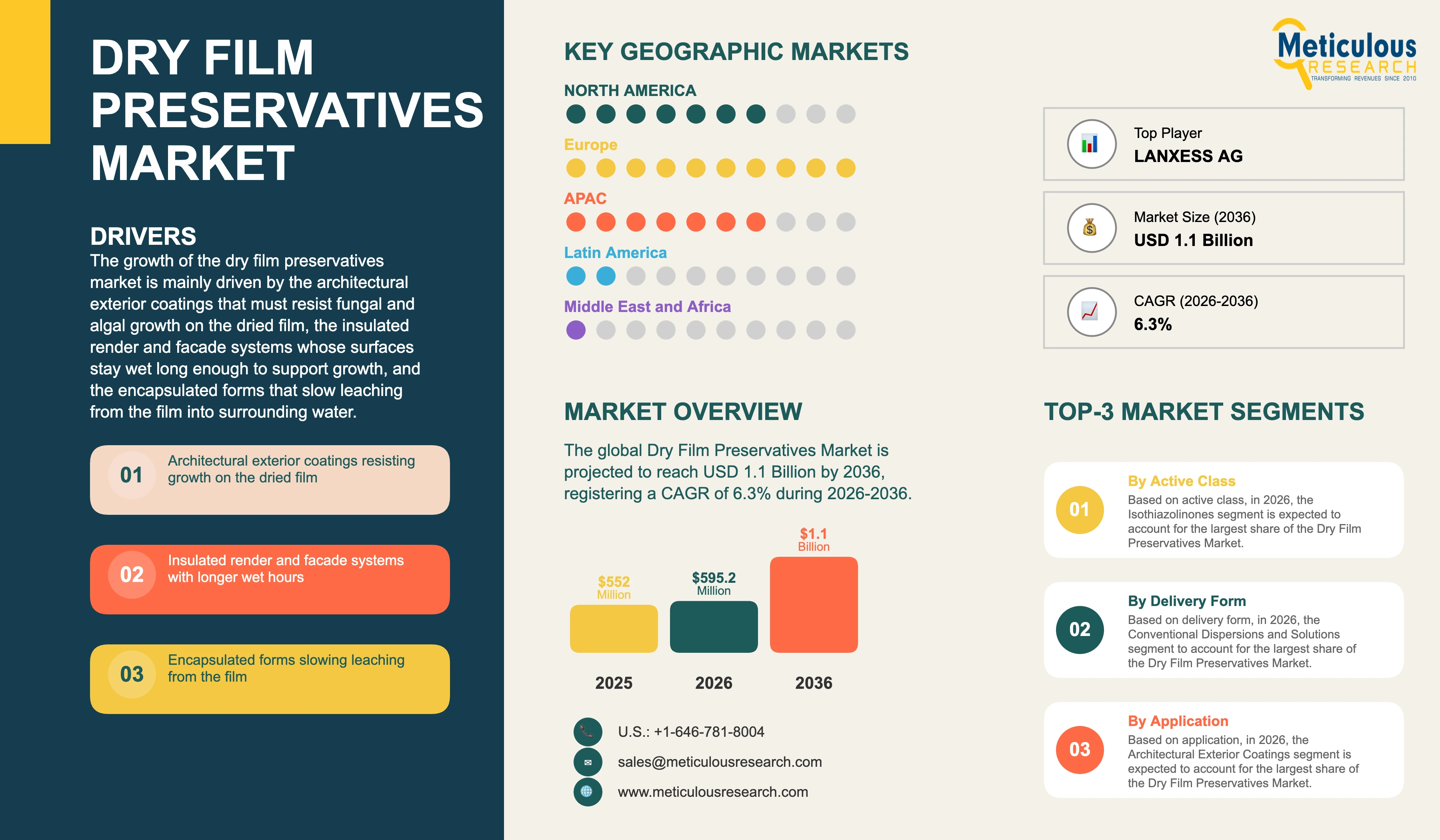
The global dry film preservatives market was valued at USD 552.0 million in 2025. This market is expected to reach USD 1.10 billion by 2036 from an estimated USD 595.2 million in 2026, registering a CAGR of 6.3% during the forecast period (2026-2036).
- Published
- Nov 2026
- Pages
- 263
- Format
- PDF + Excel
- Report ID
- MRCHM - 1042802
- Base year
- 2025
- 2025 · BASELINE
- $552.0M
- 2036
- $1.10B
- CAGR 2026–2036
- 6.3%
2025 baseline · 2026–2036 forecast at 6.3% CAGR · hover a bar for the value
Key highlights
The global dry film preservatives market is estimated at USD 595.2 million in 2026 and is projected to reach USD 1.10 billion by 2036.
Market volume is estimated at 48.00 kilotons in 2026 and is projected to reach 72.43 kilotons by 2036 at a CAGR of 4.2%, measured as formulated preservative supplied on a product mass basis.
The average selling price is estimated at USD 12.40 per kg in 2026 and is projected to reach USD 15.20 per kg by 2036 as encapsulated and controlled-release forms take a larger share.
Isothiazolinones are expected to account for the largest active class share in 2026, while silver-based and other chemistries are projected to register the highest CAGR of 11.0%.
Conventional dispersions and solutions are expected to hold the largest delivery form share in 2026, while encapsulated and controlled-release forms are projected to grow fastest at a CAGR of 12.4%.
Architectural exterior coatings are expected to be the largest application in 2026, while renders, plasters and external insulation systems are projected to register the highest CAGR of 8.0%.
Europe is expected to hold the largest regional share in 2026, while Asia-Pacific is projected to register the highest CAGR of 9.0%.
Commission Implementing Regulation (EU) 2024/2635 of 3 October 2024 approved silver zinc zeolite as an existing active substance for use in biocidal products of product types 2, 7 and 9 under Regulation (EU) No 528/2012, with entry into force on 24 October 2024.
Product type 7 is film preservatives, so that approval covers use in the preservation of dried films and coatings rather than only the disinfectant and fibre preservation uses in the other two product types named.
The approval period and expiry, the conditions of approval in the Annex, the minimum degree of purity, any candidate for substitution status and any treated article requirements could not be established from the text retrieved for this report.
A Great Britain Biocidal Products Regulation non-approval decision dated 15 August 2023 withdrew a titanium dioxide and silver chloride reaction mass for lack of applicant support across product types 1, 2, 6, 7 and 9, so product type 7 was directly affected in that jurisdiction.
Under that decision supply in Great Britain ended on 15 August 2024, use ended on 15 February 2025, and new treated articles containing the substance could not enter the supply chain or be imported after 11 February 2024.
The two decisions concern different substances in different jurisdictions, so they do not represent the same chemistry being treated differently, but they do leave the European Union and Great Britain moving in opposite directions on silver chemistry for film preservation.
Dry film preservatives protect the dried coating against fungal and algal growth and are distinct from in-can preservatives, which protect the wet product during storage and fall under a separate product type.
The Health and Safety Executive records a further Great Britain non-approval decision dated 1 April 2026 covering 16 unsupported substances, with names and product types held in a separate decision document, so no film preservation effect is attributed to it in this report.
This market measures the formulated preservative supplied to coating manufacturers and is not additive to the markets for the isothiazolinone or zinc pyrithione actives it contains.
Report summary
| Particulars | Details |
|---|---|
| Base Year | 2025 |
| Forecast Period | 2026-2036 |
| Market Size in 2025 | USD 552.0 million |
| Market Size in 2026 | USD 595.2 million |
| Market Size by 2036 | USD 1.10 billion |
| Value CAGR (2026-2036) | 6.3% |
| Format | PDF, Excel & Cloud Portal · 263 pages |
| Volume in 2026 | 48.00 kilotons |
| Volume by 2036 | 72.43 kilotons |
| Volume CAGR (2026-2036) | 4.2% |
| Volume Basis | Formulated preservative supplied on a product mass basis, not on an active substance basis |
| Average Selling Price in 2026 | USD 12.40 per kg |
| Average Selling Price by 2036 | USD 15.20 per kg |
| Price Direction | Average selling price rises across the forecast period as encapsulated and controlled-release forms take a larger share of the mix and as formulations combine algicidal with fungicidal actives, rather than through any constraint on supply |
| Scope Definition Note | A dry film preservative protects the dried coating against fungal and algal growth over its service life and falls under product type 7, while an in-can preservative protects the wet product in the container during storage and falls under a separate product type; they are different functions at different addition levels, a single paint typically contains both, and this report measures only the former |
| Measurement Basis | Isothiazolinone, carbamate, triazine algicide, zinc pyrithione, silver-based and other film preservative formulations in conventional and encapsulated forms, by active class, delivery form, application and geography, and excluding in-can preservatives, wood preservatives, antifouling products, antimicrobial textile finishes, the active substances measured as actives, and the finished paints and renders into which the preservative is incorporated |
| Relationship to Adjacent Markets | This market is not additive to the markets for isothiazolinone biocides or zinc pyrithione, which measure those actives across all uses including in-can preservation, metalworking fluids, personal care and plastics, whereas this report measures the formulated film preservative supplied to coating manufacturers; adding them would count the same chemistry twice and combine uses unrelated to coatings |
| Regulatory Note | Commission Implementing Regulation (EU) 2024/2635 of 3 October 2024 approved silver zinc zeolite as an existing active substance for product types 2, 7 and 9 under Regulation (EU) No 528/2012, with entry into force on 24 October 2024; the approval period and expiry, the conditions of approval in the Annex, the minimum degree of purity, any candidate for substitution status and any treated article requirements could not be established from the text retrieved for this report |
| Note on Jurisdictional Divergence | A Great Britain non-approval decision dated 15 August 2023 withdrew a titanium dioxide and silver chloride reaction mass for lack of applicant support across product types 1, 2, 6, 7 and 9, with supply ending 15 August 2024, use ending 15 February 2025 and new treated articles barred after 11 February 2024; that substance differs from the one approved in the European Union, so the two decisions do not represent the same chemistry being treated differently, but they leave the available options for film preservation differing between the two jurisdictions |
| Largest Active Class | Isothiazolinones |
| Fastest-Growing Active Class | Silver-based and other (CAGR 11.0%) |
| Largest Delivery Form | Conventional dispersions and solutions |
| Fastest-Growing Delivery Form | Encapsulated and controlled-release (CAGR 12.4%) |
| Largest Application | Architectural exterior coatings |
| Fastest-Growing Application | Renders, plasters and external insulation systems (CAGR 8.0%) |
| Largest Region | Europe |
| Fastest-Growing Region | Asia-Pacific (CAGR 9.0%) |
| Segments Covered | Active Class, Delivery Form, Application, and Geography |
| Geographies Covered | Europe, Asia-Pacific, North America, Latin America, and Middle East & Africa |
| Companies Profiled | 6 companies, including LANXESS AG, Arxada AG, Dow Inc., Thor Group Limited, Clariant AG, and Vink Chemicals GmbH & Co. KG |
Report overview
Segments covered: active class, delivery form, application.
In volume terms, this market is estimated at 48.00 kilotons in 2026 and is projected to reach 72.43 kilotons by 2036, registering a CAGR of 4.2% during the same period, measured as formulated preservative supplied on a product mass basis rather than on an active substance basis. The average selling price is estimated at USD 12.40 per kg in 2026 and is projected to rise to USD 15.20 per kg by 2036 as encapsulated and controlled-release forms take a larger share of the mix.
The growth of this market is mainly driven by the architectural exterior coatings that must resist fungal and algal growth on the dried film, the insulated render and facade systems whose surfaces stay wet long enough to support growth, the encapsulated forms that slow leaching from the film into surrounding water, and the active substance approvals that have given particular chemistries a secure position for this product type. However, factors such as the leaching of actives from facades into stormwater, the withdrawal of actives from film preservation in some jurisdictions, the skin sensitisation profile of the isothiazolinone class, and the divergence between regulatory regimes are expected to restrain the growth of this market to some extent.
Isothiazolinones account for the largest share of this market because octylisothiazolinone and dichlorooctylisothiazolinone deliver broad activity against the fungi that colonise coated surfaces at low addition levels. Silver-based and other chemistries grow fastest because approvals granted for film preservation have made them usable where the established classes face restriction or withdrawal.
Dry film preservatives are biocides incorporated into a coating, render, plaster, sealant or adhesive to protect the dried film against fungal and algal growth on its surface, remaining in the film and acting over its service life. Market sizing in this report is on both a value basis in USD and a volume basis in kilotons measured as formulated preservative supplied on a product mass basis, with average selling price derived from the two. The measurement basis covers isothiazolinone, carbamate, triazine algicide, zinc pyrithione, silver-based and other film preservative formulations in conventional and encapsulated forms, and it excludes in-can preservatives, wood preservatives, antifouling products, antimicrobial textile finishes, the active substances measured as actives, and the finished paints and renders into which the preservative is incorporated.
The distinction between a dry film preservative and an in-can preservative is the one most often confused and it defines this market. An in-can preservative protects the wet product in the container against spoilage during storage and is consumed or diluted when the product is applied; a dry film preservative has to survive film formation and then remain active in the coating for years of exposure. They are different functions, different addition levels and different product types under biocidal regulation, and a single paint typically contains both.
Measuring the formulated product rather than its active content keeps this market separable from those for the actives. A film preservative is supplied as a dispersion, solution or encapsulated concentrate in which the active is a fraction of the delivered mass, and the carrier system determines how the active distributes through the film, how fast it migrates to the surface and how quickly it leaches out, which is what a coating formulator is buying. The active content is counted at the active level in the reports on those materials.
Commission Implementing Regulation (EU) 2024/2635 of 3 October 2024 approved silver zinc zeolite as an existing active substance for use in biocidal products of product types 2, 7 and 9 under Regulation (EU) No 528/2012, with entry into force on 24 October 2024. Product type 7 is film preservatives, so the approval reaches the preservation of dried films and coatings and not only the disinfectant and fibre preservation uses the other two product types cover. The approval period and expiry, the conditions in the Annex, the minimum degree of purity, any candidate for substitution status and any treated article requirements could not be established from the text retrieved for this report.
A Great Britain non-approval decision dated 15 August 2023 moved in the other direction. It withdrew a titanium dioxide and silver chloride reaction mass for lack of applicant support across product types 1, 2, 6, 7 and 9, with supply in Great Britain ending 15 August 2024, use ending 15 February 2025, and new treated articles containing the substance barred from entering the supply chain or being imported after 11 February 2024. Product type 7 was directly within that scope.
Those two decisions concern different substances, and this report does not present them as the same chemistry being treated inconsistently. What they do show is a European Union approval of one silver chemistry for film preservation in October 2024 alongside a Great Britain withdrawal of another in August 2023, so a formulator supplying both markets cannot assume a silver-based option is available in each. The Health and Safety Executive also records a further Great Britain non-approval dated 1 April 2026 covering 16 unsupported substances whose names and product types sit in a separate document, so no film preservation effect is attributed to it here.
Lack of applicant support rather than evidence of harm is how most actives leave this market, and that shapes how formulators behave. A film preservative active supports a small volume relative to the cost of a dossier and a renewal, so a supplier may decline to fund continued registration for a chemistry that still performs, and the user loses it anyway. Coating manufacturers consequently track which actives have a committed applicant as closely as they track efficacy data.
Architectural exterior coatings are the largest application because that is where the biological challenge is greatest. A painted facade is wet from rain and dew, warm in sun, and carries airborne spores and nutrients, so fungal and algal colonisation disfigures the surface within a few seasons without protection, and the cost of repainting is many times the cost of the preservative. Architectural exterior coatings accordingly account for the largest application share throughout the period.
Renders, plasters and external insulation systems are the fastest-growing application and the reason is physical. An insulated facade has little thermal mass at its surface, so it cools below air temperature overnight and holds condensation for longer each morning than a solid wall does, which gives algae and fungi more wet hours per year to grow in. The better a wall is insulated, the harder its surface is to keep clean. Renders, plasters and external insulation systems consequently register the highest application CAGR at 8.0%.
Leaching is the problem that defines the technical agenda in this market. A preservative must be mobile enough within the film to reach the surface where growth occurs, but that same mobility carries it out of the film in rainwater and into soil and surface water around the building, where it has no function and is the subject of environmental scrutiny. The requirement is therefore to deliver the active at the surface while releasing as little as possible, which is a formulation problem rather than an active substance problem.
Encapsulation is the response and it is the fastest-growing delivery form. Enclosing the active in a polymeric or inorganic shell slows its migration so that the film releases it over years instead of months, which extends service life at a given loading and reduces the quantity leaving the film in runoff. The formulated product costs more per kilogram than a conventional dispersion, which is why the average selling price in this market rises while volume growth stays modest.
The isothiazolinone class carries a sensitisation profile that constrains where and how much can be used. These actives are effective at low concentrations and are the backbone of film preservation, but they are recognised skin sensitisers, which has led to labelling thresholds and to formulators limiting concentrations particularly in interior products. That pressure is part of why carbamate, zinc pyrithione and silver-based options hold the positions they do.
This market is not additive to the markets for isothiazolinone biocides or zinc pyrithione, which measure those actives across all their uses including in-can preservation, metalworking fluids, personal care and plastics, whereas this report measures the formulated film preservative supplied to coating manufacturers. Adding them together would count the same chemistry twice and would combine uses that have nothing to do with coatings.
Europe is expected to account for the largest share in 2026, on the external wall insulation installed across its building stock, the temperate maritime climate that keeps facades damp, and the coatings and biocide industries based there. Germany is projected to grow at 4.6%, France at 4.4% and the United Kingdom at 4.2%.
Asia-Pacific is projected to register the highest CAGR of 9.0% during the forecast period, with India at 10.6%, China at 9.4% and Japan at 5.0%.
Europe holds the largest share, with Germany growing at 4.6%, on external wall insulation systems installed at scale, the temperate maritime climate that keeps facades damp for much of the year, and the architectural coatings and biocide suppliers based in the region, under the product type system described in this report.
The Middle East & Africa is projected to grow at a CAGR of 6.0%, concentrated in coastal and humid areas. Latin America is projected to grow at a CAGR of 6.4%, with Brazil at 6.4%, on tropical climate exposure and growing coatings consumption.
LANXESS AG, Arxada AG, Dow Inc., Thor Group Limited and Clariant AG together accounted for an estimated 58.4% of this market in 2026. The 6 companies profiled in this report together accounted for an estimated 64.6%.
Report infographic
Market dynamics
14 factors across 5 forcesArchitectural Exterior Coatings Resisting Growth on the Dried Film
A painted facade is wet from rain and dew, warm in sun, and exposed to airborne spores and nutrients, so fungal and algal colonisation disfigures the surface within a few seasons without protection, while the labour cost of repainting is many times the cost of the preservative in the coating.
That ratio is what sustains the application through cost pressure on paint formulations, since removing the preservative saves cents per litre and risks a warranty claim measured in thousands.
Appearance is also the attribute a building owner judges a coating on, so disfigurement is treated as failure even where the film remains intact and protective, which keeps the preservative specification tied to warranty terms rather than to technical performance alone.
Exterior coatings are also applied over very large areas per building, so the preservative consumption per project is substantial even at the low addition levels used.
That gives the application a volume base that no specialty use in this market matches.
Insulated Render and Facade Systems With Longer Wet Hours
An insulated facade has little thermal mass at its surface, so it cools below air temperature overnight and holds condensation longer each morning than a solid wall, giving algae and fungi more wet hours per year in which to establish.
Energy efficiency requirements therefore increase the biological challenge on the surfaces they create, and renders, plasters and external insulation systems register the highest application CAGR at 8.0%.
Retrofit insulation programmes are also being applied to existing buildings at scale, so the affected surface area grows faster than new construction alone would suggest.
Rendered surfaces are also textured, which holds water in the surface profile for longer than a smooth paint film does and compounds the exposure.
Encapsulated Forms Slowing Leaching From the Film
A preservative must be mobile enough to reach the film surface where growth occurs but that mobility also carries it out in rainwater, and enclosing the active in a polymeric or inorganic shell slows migration so that release extends over years rather than months.
That delivers longer protection at a given loading while reducing the quantity leaving the film, which addresses the service life requirement and the environmental objection with one formulation change.
Release control also lets a formulator meet a service life requirement without increasing the loading, which matters where a loading limit rather than a cost limit is the binding one.
Extending the release period also keeps the surface concentration above the inhibitory level for longer, which is what determines when growth becomes visible rather than when the film runs out of active altogether.
Active Substance Approvals Securing Particular Chemistries
Commission Implementing Regulation (EU) 2024/2635 of 3 October 2024 approved silver zinc zeolite as an existing active substance for product types 2, 7 and 9 under Regulation (EU) No 528/2012, with entry into force on 24 October 2024, and product type 7 is film preservatives.
An approval for the relevant product type is what allows a formulator to design a chemistry into a product with confidence, which is worth more in this market than a performance advantage over an active whose registration is unsupported.
A chemistry approved for the relevant product type can also be designed into a product range rather than a single formulation, which spreads the qualification cost across more volume.
Approval also allows a coating carrying the chemistry to be sold across the whole market the regulation covers rather than market by market.
All four drivers rest on the biological challenge to a coated surface rather than on any change in the chemistry available to meet it, which is why this market grows steadily rather than in steps.
Table of contents
11 chapters · 133 sections · 263 pages · click to expandSegmental analysis
| Segment | Largest share (2026) | Fastest growth (2026–2036) |
|---|---|---|
| By Active Class | Isothiazolinones | — |
| Other segments | — | Silver-based and other chemistries |
By Active Class
- Isothiazolinones are expected to account for the largest share in 2026, on octylisothiazolinone and dichlorooctylisothiazolinone delivering broad activity against the fungi that colonise coated surfaces at low addition levels.
- Conventional dispersions and solutions are expected to hold the largest share in 2026, on simple incorporation into existing paint manufacturing and lower cost per kilogram of formulated product.
- Architectural exterior coatings are expected to account for the largest share in 2026, since painted facades are repeatedly wetted and exposed to airborne spores and the repainting cost is many times the cost of the preservative.
Other segments
- Silver-based and other chemistries are projected to register the highest CAGR of 11.0% during the forecast period, from a small base.
- Encapsulated and controlled-release forms are projected to register the highest CAGR of 12.4% during the forecast period.
- Renders, plasters and external insulation systems are projected to register the highest CAGR of 8.0% during the forecast period.
Geographic analysis
Asia-Pacific
Largest shareArchitectural coatings consumption is growing faster in Asia-Pacific than in the mature regions, much of it in humid subtropical and tropical climates where biological growth on exterior surfaces is more aggressive than in temperate Europe. Asia-Pacific is accordingly projected to register the highest regional CAGR at 9.0%, with India at 10.6% and China at 9.4%, against Europe holding the largest share. Humid climates also shorten the interval before growth appears, so the loading required for a given service life is higher there than in temperate regions, which raises consumption per litre of coating. Facade appearance expectations in new residential construction are also rising in the region, which turns a cosmetic issue into a specification requirement. Three of these four openings raise value per kilogram rather than tonnage, and the fourth depends on where coatings consumption is growing, which together explain why value outpaces volume here. None of them requires a new active substance, which matters in a market where registering one is rarely economic. Each also addresses a different part of the problem, so a supplier can pursue release control, metal-based registrations and algicidal combinations in parallel rather than choosing between them, and the regional opportunity applies to all three. The first three also act on products already in the range rather than requiring new approvals, which is the fastest route to value in a market where registering a new active is seldom economic. However, Asia-Pacific is projected to register the highest CAGR of 9.0% during the forecast period. The rapid growth of this region is attributed to architectural coatings consumption growing faster than in the mature regions, much of it in humid subtropical and tropical climates where biological growth on exterior surfaces is more aggressive, together with rising expectations of facade appearance in new residential construction. India is projected to register a CAGR of 10.6%, China a CAGR of 9.4% and Japan a CAGR of 5.0%. Asia-Pacific Architectural Coatings Growth Geographic Analysis
Europe
In 2026, Europe is expected to account for the largest share of the global dry film preservatives market. The large share of this region is mainly due to the external wall insulation systems installed at scale across its building stock, the temperate maritime climate that keeps facades damp for much of the year, the architectural coatings industry based there, and the biocide suppliers that develop film preservatives in the region. Germany is projected to register a CAGR of 4.6%, France a CAGR of 4.4% and the United Kingdom a CAGR of 4.2% during the forecast period.
North America
North America is projected to grow at 5.4%, with the United States at 5.4%, on architectural exterior coatings and on humid southern climates where growth pressure is high, under its own registration framework rather than the European product type system described here. North America operates its own registration framework rather than the product type system described here, so an approval in one does not transfer to the other. Climate and building practice therefore shape regional consumption as much as coatings volume does, which is unusual for an additive and specific to a product whose duty is biological.
Latin America
Latin America is projected to grow at 6.4%, with Brazil at 6.4%, on tropical climate exposure and growing coatings consumption.
Middle East & Africa
The Middle East & Africa is projected to grow at 6.0%, concentrated in coastal and humid areas. Climate rather than regulation sets the dose in this market, which distinguishes it from most biocide applications. A facade in a humid subtropical climate carries a biological load that a dry continental one does not, so the loading needed for the same service life differs by region irrespective of what is permitted, and a formulator supplying several regions designs to local exposure as well as to local approval. Regional value shares therefore reflect climate and building practice as much as coatings volume. Supplying several regions therefore means designing to local exposure as well as to local approval, which is why formulation ranges in this market are regional rather than global.
Competitive landscape
The global dry film preservatives market is characterised by a small number of specialist biocide houses supplying formulated preservatives to coating manufacturers, alongside diversified chemical groups that hold active substance positions. Competition is contested on release profile, registration support and formulation service rather than on active substance price, because the actives are long established and the carrier determines performance in the film. LANXESS AG, Arxada AG, Dow Inc., Thor Group Limited and Clariant AG together accounted for an estimated 58.4% of this market in 2026, while the companies profiled in this report together accounted for an estimated 64.6%.
Regulatory decisions rather than product launches accounted for most movement through 2026. Commission Implementing Regulation (EU) 2024/2635 of 3 October 2024 approved silver zinc zeolite for product types 2, 7 and 9 with entry into force on 24 October 2024, while the Great Britain non-approval decision of 15 August 2023 withdrew a titanium dioxide and silver chloride reaction mass across product types 1, 2, 6, 7 and 9, with supply ending 15 August 2024, use ending 15 February 2025 and new treated articles barred after 11 February 2024. The approval period, conditions and purity specification attaching to the European approval could not be established from the text retrieved for this report.
Arxada AG holds the Troy Corporation film preservative businesses it acquired, and LANXESS AG, Dow Inc., Thor Group Limited, Clariant AG and Vink Chemicals GmbH & Co. KG supply formulated preservatives under their own ranges to architectural and industrial coating manufacturers. Some of the key players operating in the dry film preservatives market are LANXESS AG (Germany), Arxada AG (Switzerland), Dow Inc. (U.S.), Thor Group Limited (U.K.), Clariant AG (Switzerland), and Vink Chemicals GmbH & Co. KG (Germany), among others.
Formulation service also weighs heavily in the award, since a coating manufacturer losing an active needs help reformulating rather than a drum of something else.
Positions here are held through registration portfolios and formulation service rather than through capacity, since the actives are produced in modest volumes and the value sits in the carrier system and the regulatory coverage behind it.
- —
Commission Implementing Regulation (EU) 2024/2635 of 3 October 2024 approved silver zinc zeolite as an existing active substance for use in biocidal products of product types 2, 7 and 9 under Regulation (EU) No 528/2012, with entry into force on 24 October 2024; product type 7 is film preservatives, so the approval reaches the preservation of dried films and coatings, while the approval period and expiry, the conditions of approval in the Annex, the minimum degree of purity, any candidate for substitution status and any treated article requirements could not be established from the text retrieved for this report. A Great Britain Biocidal Products Regulation non-approval decision dated 15 August 2023 withdrew a titanium dioxide and silver chloride reaction mass for lack of applicant support across product types 1, 2, 6, 7 and 9, with supply in Great Britain ending 15 August 2024, use ending 15 February 2025, stocks to be cleared by 15 August 2024 and new treated articles containing the substance barred from entering the supply chain or being imported after 11 February 2024; that substance differs from the one approved in the European Union, so the two decisions do not represent the same chemistry being treated differently. The Health and Safety Executive also records a further Great Britain non-approval decision dated 1 April 2026 covering 16 substances described as unsupported, with the names and product types held in a separate decision document rather than on the published decisions page, so no film preservation effect is attributed to it in this report.
- LANXESS AG
- Arxada AG
- Dow Inc.
- Thor Group Limited
- Clariant AG
- Vink Chemicals GmbH & Co. KG
Expert perspectives
Value grows at 6.3% against 4.2% in volume over the forecast period, and the average selling price rises from USD 12.40 per kg in 2026 to USD 15.20 per kg by 2036. The gap is encapsulation: a controlled-release product costs more per kilogram and delivers more service life per unit of active, so value rises while the tonnage of formulated product grows slowly.
The two regulatory decisions that frame this market point in opposite directions, and they need stating carefully. Commission Implementing Regulation (EU) 2024/2635 of 3 October 2024 approved silver zinc zeolite for product types 2, 7 and 9, product type 7 being film preservatives. A Great Britain decision of 15 August 2023 withdrew a titanium dioxide and silver chloride reaction mass across product types including 7.
These are different substances, so this is not one chemistry being judged two ways. The consequence is nonetheless real: a formulator supplying both markets cannot assume a comparable silver-based option is available in each, and must either carry separate formulations or restrict itself to actives approved in both. Neither response improves the coating.
How actives leave this market matters more than how many. The Great Britain withdrawal followed from a lack of applicant support rather than from evidence of harm, which means a working chemistry can be lost because the volume it supports does not justify the cost of a renewal dossier. Coating manufacturers consequently assess committed registration support alongside efficacy, and design out unsupported actives ahead of any decision.
The technical agenda is set by a conflict the chemistry cannot resolve on its own. A preservative must be mobile enough to reach the film surface where growth occurs, and that same mobility carries it into runoff where it has no function and attracts scrutiny. Delivering the active at the surface while releasing as little as possible is a carrier problem, which is why encapsulated forms grow at 12.4% and why competition has moved from the active to the formulation.
The demand side has an irony worth noting. Insulating a facade reduces its surface thermal mass, so it cools below air temperature overnight and stays damp longer, which gives algae and fungi more wet hours each year. Energy efficiency therefore increases the biological challenge on the surfaces it creates, and renders and external insulation systems grow fastest at 8.0%. This market measures the formulated preservative and is not additive to the isothiazolinone or zinc pyrithione active markets.
Breadth of registered portfolio is therefore the most durable competitive asset in this market, because it determines who can still offer a formulation after an active is withdrawn.
Customer perspectives
Repainting labour costs many times the preservative content of a coating, so the application is defended through cost pressure on paint formulations rather than being treated as a discretionary additive.
A warranty claim on premature disfigurement is the risk that decision is weighed against.
The preservative is consequently one of the last components removed under cost pressure, rather than one of the first.
An insulated facade has little surface thermal mass, so it cools below air temperature overnight and holds condensation longer than a solid wall, extending the wet hours in which algae and fungi can establish.
Energy efficiency requirements therefore increase the biological challenge on the surfaces they create, which is why this application grows fastest in the market.
Actives have been withdrawn for lack of applicant support rather than on evidence of harm, so committed registration support is assessed alongside efficacy and unsupported chemistries are designed out ahead of any decision.
Suppliers with deep registration portfolios are favoured accordingly, since breadth is what allows a reformulation to be offered when an active is lost.
That is also why the leading positions in this market have been stable for years despite repeated changes in the actives available.
“The preservative is cents a litre and a facade failure is a repaint. That arithmetic has never been close, which is why this is the last thing we take out of a formulation.”
“The better we insulate, the longer the surface stays wet in the morning. We are solving a problem our own thermal performance creates.”
“We now ask whether anyone is funding the renewal before we ask how well it works. Losing an active because nobody supported the dossier is the risk we cannot engineer around.”
Frequently asked questions
This market was valued at USD 520.7 million in 2024 and USD 552.0 million in 2025, and is estimated at USD 595.2 million in 2026. In volume terms it is estimated at 48.00 kilotons in 2026 as formulated preservative supplied on a product mass basis.
Cite this report
Meticulous Research. (2026). Dry Film Preservatives Market - Global Opportunity Analysis and Industry Forecast (2026-2036) (Report No. MRCHM - 1042802). Meticulous Market Research Pvt. Ltd. https://www.meticulousresearch.com/product/dry-film-preservatives-market-7485