Tax Technology Market (2026-2036)
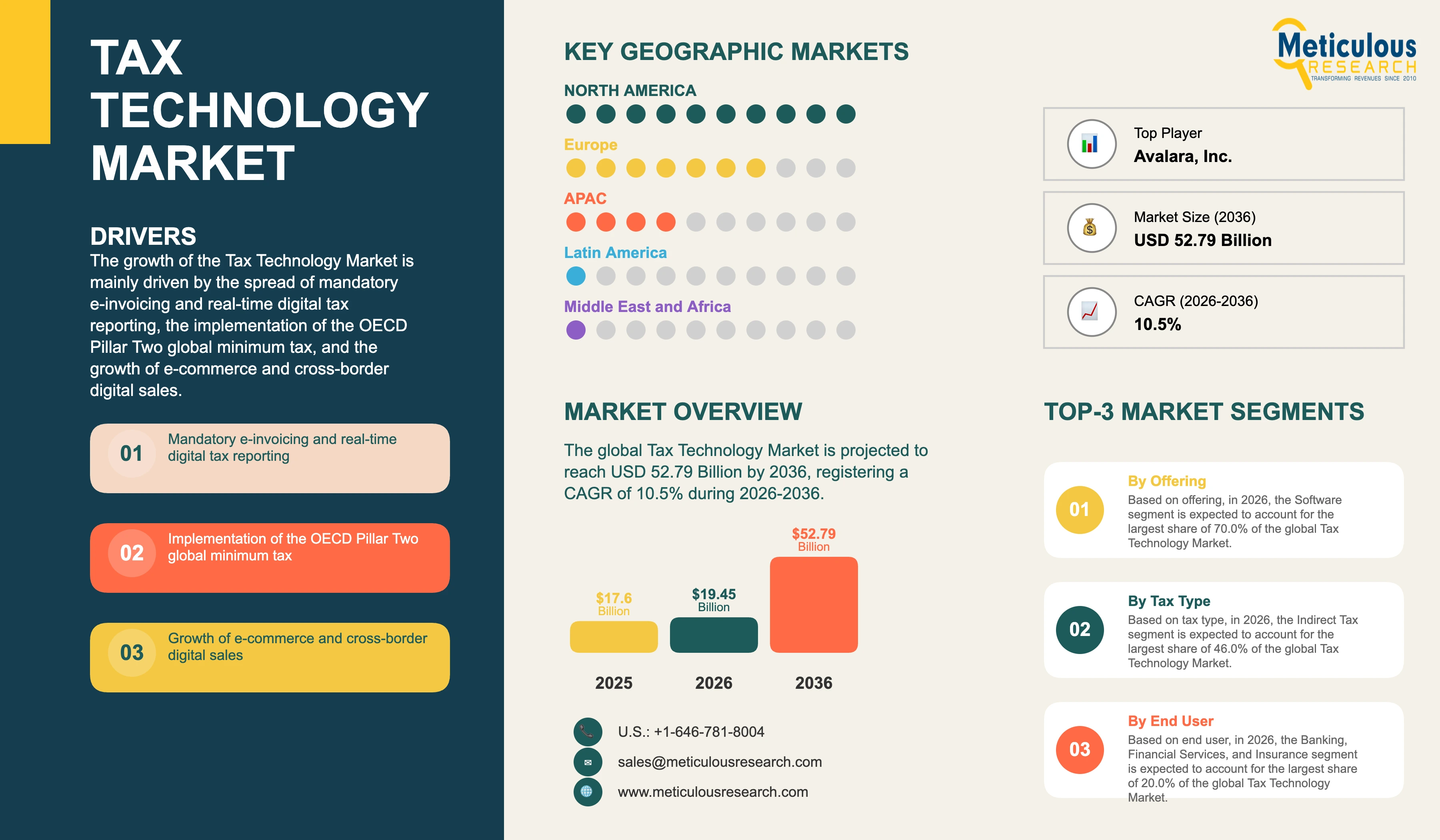
The global tax technology market was valued at USD 17.60 billion in 2025. This market is expected to reach USD 52.79 billion by 2036 from an estimated USD 19.45 billion in 2026, registering a CAGR of 10.5% during the forecast period (2026-2036).
- Published
- Nov 2026
- Pages
- 278
- Format
- PDF + Excel
- Report ID
- MRICT - 1042514
- Base year
- 2025
- 2025 · BASELINE
- $17.60B
- 2036
- $52.79B
- CAGR 2026–2036
- 10.5%
2025 baseline · 2026–2036 forecast at 10.5% CAGR · hover a bar for the value
Key highlights
Vertex, a leading provider of indirect tax technology, reported 2025 revenue of USD 748.4 million, up 12.2%, with cloud revenue up 27.9% to USD 352.9 million and annual recurring revenue of USD 671.0 million, and it expects 2026 revenue of USD 823.5 million to USD 831.5 million, supported by e-invoicing.
On 5 January 2026, the 147 members of the OECD/G20 Inclusive Framework agreed on a side-by-side package for the Pillar Two global minimum tax, which includes simplification measures and a new safe harbor, while large multinational groups must still calculate and report their effective tax rates under the global minimum tax rules.
Many countries are introducing mandatory e-invoicing and real-time digital reporting requirements, including Belgium, Poland, France, Germany, Croatia, the UAE, and Malaysia, and the EU's VAT in the Digital Age (ViDA) package will require e-invoicing and digital reporting for intra-EU business transactions from 2030.
Vertex's cloud revenue is expected to grow by about 25% in 2026, reflecting the migration of large companies from on-premise tax software to cloud platforms as they move to cloud ERP systems, such as SAP S/4HANA and Oracle Cloud.
The shortage of tax professionals and the growing volume of tax data are encouraging companies to automate compliance and to use managed services, which combine technology with outsourced tax operations.
Tax technology providers are adding AI agents and assistants to their platforms, such as Avalara's agentic tax and compliance capabilities, Sovos' Sovi AI layer, and Vertex's AI-enabled tax configuration with Microsoft Dynamics 365, to automate tax research, configuration, and compliance tasks.
Consolidation has continued in the market, with large providers buying specialized companies, including Thomson Reuters' acquisitions of Pagero, an e-invoicing provider, and SafeSend, a tax workflow automation provider, and Vertex's partnership with Kintsugi to serve small businesses.
By offering, software accounts for the largest share of 70.0% in 2026 and also registers the highest CAGR.
By tax type, indirect tax accounts for the largest share in 2026 and also registers the highest CAGR.
By deployment mode, cloud accounts for the largest share in 2026 and also registers the highest CAGR.
By end user, banking, financial services, and insurance accounts for the largest share of 20.0% in 2026, while retail and e-commerce registers the highest CAGR.
By geography, North America accounts for the largest share of 44.0% in 2026, while Asia-Pacific registers the highest CAGR of 13.3%.
Report summary
| Particulars | Details |
|---|---|
| Base Year | 2025 |
| Estimated Year | 2026 |
| Forecast Period | 2026-2036 |
| Market Size in 2025 | USD 17.60 billion |
| Market Size in 2026 | USD 19.45 billion |
| Market Size by 2036 | USD 52.79 billion |
| CAGR (2026-2036) | 10.5% |
| Format | PDF, Excel & Cloud Portal · 278 pages |
| Largest Segment by Offering (2026) | Software (70.0%) |
| Largest Segment by End User (2026) | Banking, Financial Services, and Insurance (20.0%) |
| Largest Region (2026) | North America (44.0%) |
| Fastest-Growing Region | Asia-Pacific (CAGR 13.3%) |
| Segments Covered | Offering, Tax Type, Deployment Mode, End User, and Geography |
| Geographic Scope | North America, Europe, Asia-Pacific, Latin America, and Middle East and Africa |
| Key Companies Profiled | Avalara, Vertex, Thomson Reuters, Wolters Kluwer, Sovos, SAP, Oracle, Intuit, Bloomberg Tax, Corptax, insightsoftware, Workiva, Fonoa, and Kintsugi |
Report overview
Segments covered: offering, tax type, deployment mode, end user.
The growth of this market is mainly driven by the rapid spread of mandatory e-invoicing and real-time digital tax reporting, the implementation of the OECD Pillar Two global minimum tax, the growth of e-commerce and cross-border digital sales that create tax obligations in many jurisdictions, the migration of enterprise resource planning systems to the cloud, and the use of artificial intelligence to automate tax research, compliance, and reporting. However, factors such as the complexity of integrating tax technology with legacy systems, data quality problems, a shortage of tax professionals with technology skills, and concerns about data security and the reliability of AI-generated outputs are expected to restrain the growth of this market to some extent.
Tax technology refers to software and technology-enabled services that help businesses, tax professionals, and governments calculate, collect, report, and pay taxes accurately and on time. It includes software for indirect tax determination, such as sales tax, value-added tax, and goods and services tax, tax compliance and filing, corporate income tax provision and reporting, Pillar Two global minimum tax calculations, transfer pricing, payroll tax, tax information reporting, such as 1099 and FATCA reporting, exemption certificate management, and tax data management and analytics, along with related implementation, managed, and support services.
This market covers the global sales of tax technology software and services to businesses, governments, and tax and accounting firms, measured in value, and is segmented by offering, tax type, deployment mode, end user, and geography. Consumer tax preparation software for individuals and traditional tax advisory and consulting services that are not delivered through technology are not included.
Tax compliance has become much more complex and data-intensive over the past decade, and tax departments now handle far larger volumes of transaction data than before. Governments are moving from periodic tax returns to real-time or near real-time digital reporting, requiring businesses to send invoice and transaction data to tax authorities through approved formats and platforms. The growth of e-commerce and digital services has created tax obligations for businesses in many jurisdictions where they have no physical presence, such as U.S. states following the Supreme Court's 2018 Wayfair decision and countries that tax digital services and imported goods. At the same time, the OECD Pillar Two rules require large multinational groups to calculate their effective tax rates in every jurisdiction where they operate and pay top-up taxes where those rates are below 15%.
These changes have made manual processes and spreadsheets inadequate for many businesses, and they are driving demand for automated tax engines integrated with enterprise resource planning, e-commerce, and billing systems, for compliance and reporting platforms that can handle many jurisdictions, and for data management tools that can bring together tax data from different systems. Tax departments are also under pressure to reduce costs and do more with smaller teams, which encourages the use of technology and managed services. Chief financial officers increasingly view tax technology as part of their broader finance transformation programs, alongside cloud ERP, automated close and consolidation, and data analytics. Tax authorities are also using data analytics to select companies for audit, which increases the importance of accurate and consistent tax data.
The market includes specialized tax technology providers, such as Avalara, Vertex, Sovos, Corptax, and Fonoa, large information and software companies, such as Thomson Reuters, Wolters Kluwer, Bloomberg Tax, and Intuit, enterprise software vendors, such as SAP and Oracle, which embed tax functions in their platforms, and professional services firms, which provide implementation and managed services. Cloud-based software has become the main delivery model, and providers are increasingly adding AI capabilities to automate research, configuration, data preparation, and reviews. Business models are also shifting from one-time licenses to subscriptions and transaction-based pricing, which creates recurring revenue for providers and lowers upfront costs for customers. E-commerce platforms, accounting software, and payment providers are embedding tax calculation and filing into their products, which brings tax technology to millions of small businesses.
Over the forecast period, the market is expected to grow strongly, supported by the spread of e-invoicing and digital reporting mandates, the ongoing implementation of Pillar Two, the growth of cross-border commerce, cloud migration, and AI. Demand is expected to grow particularly fast in Asia-Pacific, Latin America, and the Middle East, where governments are introducing new digital tax requirements, and among mid-sized businesses that are adopting tax automation for the first time. Government tax authorities are also expected to remain important buyers. The market is also expected to see continued consolidation, as large providers acquire specialized companies to expand their coverage of taxes, countries, and AI capabilities, and as private equity firms invest in the sector.
We report to tax authorities in dozens of countries, including FATCA, CRS, and Pillar Two. Automating data collection and calculations has cut our reporting time significantly, and we are now testing AI to review results.
Financial institutions are expected to continue investing in tax reporting automation as regulatory requirements expand.
The complex reporting needs of financial institutions are why banking, financial services, and insurance account for 20.0% of the market.
We sell in more than 20 countries, and each one has different VAT and GST rules and, increasingly, e-invoicing requirements. A cloud tax engine connected to our e-commerce platform lets a small finance team manage this.
Small and mid-sized online sellers are increasingly adopting cloud tax engines and embedded tax tools, which supports strong growth in retail and e-commerce demand.
Cross-border e-commerce and new digital tax requirements are why retail and e-commerce is the fastest-growing end user and Asia-Pacific is the fastest-growing region.
Report infographic
Market dynamics
15 factors across 5 forcesSpread of mandatory e-invoicing and real-time digital tax reporting
Governments around the world are introducing mandatory e-invoicing and continuous transaction controls, which require businesses to issue invoices in structured digital formats and to report invoice data to tax authorities in real time or near real time. These systems help governments reduce VAT fraud and close tax gaps, and they have spread from Latin America, where Mexico and Brazil pioneered them, to Europe, Asia, the Middle East, and Africa.
In Europe, Italy has required e-invoicing for years, Belgium introduced mandatory B2B e-invoicing in January 2026, Poland launched its national KSeF system in 2026, France is phasing in mandatory e-invoicing from September 2026, and Germany is phasing in requirements between 2025 and 2028, while the EU's ViDA package will require e-invoicing for intra-EU B2B transactions from 2030. The UAE, Saudi Arabia, Malaysia, and other countries have also introduced or announced mandates. Businesses operating in several countries need technology that can handle different formats, platforms, and rules, which is driving demand for indirect tax and e-invoicing solutions. Indirect tax is the largest and fastest-growing tax type in this market. Each mandate has its own formats, timelines, and technical requirements, and many countries update their rules frequently, which makes it very difficult for businesses to manage compliance without specialized providers.
Implementation of the OECD Pillar Two global minimum tax
The OECD Pillar Two rules require multinational groups with annual revenue of EUR 750 million or more to pay a minimum effective tax rate of 15% in each jurisdiction where they operate. Many jurisdictions, including EU member states, the U.K., Japan, South Korea, Canada, and Australia, have implemented these rules, and groups must calculate their effective tax rates, prepare GloBE Information Returns, and pay top-up taxes where required.
These calculations require large amounts of financial and tax data from every entity in a group, which is difficult to manage without specialized software. The side-by-side package agreed in January 2026 includes simplification measures and a new safe harbor, but most large groups still need to perform the calculations and reporting. Tax technology providers, such as Thomson Reuters, Wolters Kluwer, Corptax, Workiva, and Oracle, have developed Pillar Two solutions, and demand for corporate income tax technology is growing strongly. The first GloBE Information Returns are due in 2026 for many groups, which has increased demand for data collection, calculation, and reporting tools. Companies are also using the data gathered for Pillar Two to improve their tax provision and country-by-country reporting processes.
Growth of e-commerce and cross-border digital sales
The growth of e-commerce, marketplaces, and digital services has created tax obligations for businesses in many jurisdictions. In the U.S., businesses must collect sales tax in states where they exceed economic nexus thresholds, and there are thousands of sales tax jurisdictions with different rates and rules. In Europe and many other countries, sellers of digital services and imported goods must collect VAT or GST, and marketplaces are increasingly responsible for collecting tax on behalf of sellers.
Small and mid-sized online sellers, software companies, and digital platforms need automated tax calculation and filing to comply with these rules, which is driving demand for cloud-based tax engines that integrate with e-commerce platforms, billing systems, and payment providers. Retail and e-commerce is the fastest-growing end user in this market. The U.S. Supreme Court's 2018 Wayfair decision allowed states to require remote sellers to collect sales tax, and all states with a sales tax now have economic nexus rules, which has greatly increased the number of businesses that must collect tax in multiple states.
Cloud ERP migration and AI automation
Many large companies are moving their enterprise resource planning systems to the cloud, such as SAP S/4HANA, Oracle Cloud, Microsoft Dynamics 365, and Workday, and these migrations are an opportunity to replace legacy tax processes with modern tax engines and compliance platforms. Vertex has reported that ERP cloud migrations, particularly to SAP S/4HANA and Oracle Cloud, are an important source of new business.
At the same time, AI is changing how tax work is done. Tax technology providers are adding AI assistants and agents that can research tax rules, classify products, map data, configure systems, prepare returns, and identify anomalies. These capabilities can significantly increase the productivity of tax teams, which face a shortage of skilled staff. Cloud is the largest and fastest-growing deployment mode in this market. However, customers expect AI outputs to be accurate and explainable, which means that providers with reliable tax content and data have an advantage.
Table of contents
12 chapters · 139 sections · 278 pages · click to expandSegmental analysis
| Segment | Largest share (2026) | Fastest growth (2026–2036) |
|---|---|---|
| By Offering | Software | Software |
| By Tax Type | Indirect tax | Indirect tax |
| By Deployment Mode | Cloud | Cloud |
| By End User | Banking, financial services, and insurance | Retail and e-commerce |
By Offering
- Tax Technology Market Analysis by Offering
- The software segment is expected to account for the largest share of 70.0% of the market and is also projected to register the highest CAGR during the forecast period.
- The large share and fast growth of this segment are mainly due to the growing adoption of cloud-based tax engines, compliance platforms, e-invoicing solutions, and corporate tax software by businesses of all sizes.
- Tax software is increasingly delivered as a cloud subscription service, with providers updating tax content and rules continuously, which creates recurring revenue and long-term customer relationships.
- Leading software providers include Avalara, Vertex, Sovos, Thomson Reuters with its ONESOURCE platform, Wolters Kluwer with its CCH products, Corptax, and Bloomberg Tax, along with ERP vendors, such as SAP and Oracle, which offer tax functions within their platforms.
- Software spending is being driven by e-invoicing mandates, Pillar Two, cloud ERP migrations, and AI capabilities, and providers are expanding their platforms to cover more taxes and jurisdictions.
- Software is expected to remain the largest offering over the forecast period.
- Spending on software is also supported by the need to replace older systems that cannot handle real-time reporting.
- Services make up the rest of the market and include implementation, integration, managed services, and support services provided by tax technology providers and professional services firms.
- Demand for managed services is growing as companies outsource tax compliance processes to reduce costs and address staff shortages.
- Professional services firms, such as the Big Four accounting firms, and tax technology providers, such as Avalara and Sovos, offer managed compliance services that combine software with outsourced filing and reporting.
By Tax Type
- Tax Technology Market Analysis by Tax Type
- The indirect tax segment is expected to account for the largest share of the market and is also projected to register the highest CAGR during the forecast period.
- The large share and fast growth of this segment are mainly due to the complexity of sales tax, VAT, and GST compliance across many jurisdictions and the rapid spread of e-invoicing and real-time reporting mandates.
- Indirect taxes are applied to almost every transaction, and businesses must calculate the correct tax for each product, customer, and location, collect it, report it, and pay it to tax authorities.
- In the U.S., there are thousands of sales tax jurisdictions, and in Europe and other regions, VAT rules and e-invoicing requirements differ by country.
- Indirect tax technology includes tax engines, exemption certificate management, returns and filing, and e-invoicing and continuous transaction control solutions, which are provided by Avalara, Vertex, Sovos, Thomson Reuters, Fonoa, and others.
- Indirect tax is expected to remain the largest tax type over the forecast period.
- Providers maintain large databases of tax rates, rules, and product taxability, which are updated continuously, and this content is one of their most valuable assets.
- E-invoicing and continuous transaction controls are the fastest-growing area within indirect tax.
- Corporate income tax, payroll and employment tax, and tax information reporting and other taxes make up the rest of the market.
- Corporate income tax technology is growing strongly because of Pillar Two, tax provision automation, and transfer pricing requirements.
By Deployment Mode
- Tax Technology Market Analysis by Deployment Mode
- The cloud segment is expected to account for the largest share of the market and is also projected to register the highest CAGR during the forecast period.
- The large share and fast growth of this segment are mainly due to the shift of businesses to cloud ERP systems, the need for continuously updated tax content, and the requirement to connect with government e-invoicing platforms in real time.
- Cloud-based tax engines and compliance platforms allow providers to update tax rates, rules, and e-invoicing formats centrally, which reduces the burden on customers and ensures that calculations remain accurate as rules change.
- Cloud platforms also make it easier to integrate with e-commerce, billing, and payment systems through application programming interfaces, and to add AI and analytics capabilities.
- Vertex reported that its cloud revenue grew by 27.9% in 2025 and expects about 25% growth in 2026, as customers migrate from on-premise software.
- This shift also increases recurring revenue for providers.
- Avalara, Sovos, Fonoa, and other providers deliver their solutions mainly through the cloud.
- Cloud is expected to remain the largest deployment mode over the forecast period.
- On-premise deployment makes up the rest of the market and is used mainly by large enterprises with legacy ERP systems, strict data residency requirements, or highly customized processes.
- Its share is expected to decline as these companies migrate to cloud ERP systems and as providers encourage migration to their cloud platforms.
By End User
- Tax Technology Market Analysis by End User
- The banking, financial services, and insurance segment is expected to account for the largest share of 20.0% of the market.
- The large share of this segment is mainly due to the complex tax obligations of banks, insurers, and asset managers, including corporate income tax, withholding tax, tax information reporting, such as FATCA, the Common Reporting Standard, and U.S. 1099 reporting, and indirect taxes on financial services.
- Financial institutions operate in many jurisdictions and handle very large volumes of transactions and customer accounts, which creates significant tax reporting requirements.
- They are also subject to Pillar Two and increasing scrutiny from tax authorities.
- Banks and insurers use tax technology for corporate tax provision, Pillar Two calculations, tax information reporting, withholding tax, and indirect tax, and many use managed services to handle reporting.
- Providers such as Thomson Reuters, Wolters Kluwer, Sovos, Corptax, and Bloomberg Tax serve this segment.
- Banking, financial services, and insurance is expected to remain one of the largest end users over the forecast period.
- Insurance companies also face premium taxes and complex indirect tax rules, and asset managers must manage withholding tax reclaims for their funds and investors.
- However, the retail and e-commerce segment is projected to register the highest CAGR during the forecast period.
- The rapid growth of this segment is driven by the growth of online sales, marketplaces, and cross-border commerce, which create tax obligations in many jurisdictions.
- Manufacturing, accounting and tax firms, technology and telecommunications, healthcare and life sciences, energy and utilities, and other end users make up the rest of the market.
- Manufacturing companies use tax technology for indirect tax, customs, and corporate tax across global supply chains, while accounting and tax firms use tax preparation, workflow, and research software to serve their clients.
Geographic analysis
North America
Largest shareIn 2026, North America is expected to account for the largest share of 44.0% of the global tax technology market. The large share of this region is mainly due to the complexity of the U.S. sales tax system, the large number of multinational companies headquartered in the U.S., the early adoption of tax technology, and the presence of leading providers, such as Avalara, Vertex, Thomson Reuters, Intuit, Corptax, and Bloomberg Tax. The U.S. has thousands of sales tax jurisdictions, and economic nexus rules following the 2018 Wayfair decision have made sales tax compliance much more complex for businesses that sell across states. Large U.S. companies must also manage corporate income tax provision, international tax rules, and Pillar Two obligations in other countries, and tax information reporting requirements. Accounting and tax firms in the U.S. are major users of tax preparation and workflow software. Canada and Mexico add demand, with Mexico's electronic invoicing system being one of the most advanced in the world. North America is expected to remain the largest region throughout the forecast period. The U.S. is also home to many of the largest tax technology providers and private equity investors in the sector.
Asia-Pacific
Fastest growthAsia-Pacific is projected to register the highest CAGR of 13.3% during the forecast period. Growth is driven by the introduction of e-invoicing and digital tax reporting in Malaysia, India, Singapore, Australia, Japan, and other countries, the implementation of Pillar Two in Japan, South Korea, Australia, and other countries, and the growth of e-commerce and multinational businesses in the region. India's Goods and Services Tax system, with its e-invoicing and e-way bill requirements, is one of the largest digital tax systems in the world, and Malaysia has been phasing in mandatory e-invoicing since 2024. Japan's qualified invoice system, introduced in 2023, has also increased demand for invoice and tax compliance solutions.
Europe
Europe holds a significant share of the market, supported by complex VAT rules, the rapid spread of e-invoicing mandates, the EU's ViDA package, and Pillar Two implementation.
Latin America
Latin America and the Middle East and Africa hold smaller shares but are growing quickly, supported by e-invoicing systems in Brazil, Mexico, Chile, and Colombia and new mandates in Saudi Arabia, the UAE, and other countries. Brazil is also implementing a major reform of its consumption taxes, which will replace several taxes with a dual VAT system over the next several years and require significant changes to tax systems.
Competitive landscape
The tax technology market is moderately fragmented, with a group of large providers and many specialized and regional companies. Leading companies in the market include Avalara, Vertex, Thomson Reuters, Wolters Kluwer, Sovos, SAP, Oracle, Intuit, Bloomberg Tax, and Corptax, along with newer providers, such as Fonoa, Anrok, and Kintsugi.
Providers compete mainly on the breadth, depth, and accuracy of their tax content, the number of jurisdictions and taxes covered, integrations with ERP, e-commerce, and billing systems, ease of use, scalability, and AI capabilities. Some providers focus on specific tax types or customer segments, such as indirect tax or corporate income tax, while others offer broad platforms covering many tax types. Pricing models vary, including subscriptions based on transaction volumes, the number of returns or entities, and the modules used. Customer retention is generally high. Professional services firms are important partners for implementation, integration, and managed services. ERP vendors, such as SAP and Oracle, offer tax functions within their platforms and partner with specialized providers for advanced tax content and compliance.
The top five players are estimated to account for 34.0% of the tax technology market in 2025, reflecting the strong positions of large providers in indirect tax and corporate tax technology and the large number of specialized and regional providers.
Players use several strategies to grow in this market, including developing cloud platforms and AI capabilities, expanding e-invoicing and global compliance coverage, acquiring specialized providers, partnering with ERP vendors, e-commerce platforms, and professional services firms, and targeting mid-sized and small businesses. Thomson Reuters has acquired Pagero and SafeSend, Vertex has partnered with Kintsugi, and Avalara and Sovos have launched AI capabilities.
Competition is expected to center on AI capabilities, global compliance coverage, e-invoicing, integration with cloud ERP systems, and the ability to serve both large enterprises and smaller businesses. Providers with broad platforms, reliable content, and strong partner ecosystems are expected to perform best. New AI-native providers may also gain share by offering faster and more automated solutions, particularly for smaller businesses. Large information companies, such as Thomson Reuters and Wolters Kluwer, benefit from their extensive tax content, research databases, and relationships with tax professionals.
Some of the key players operating in the tax technology market are Avalara, Inc., Vertex, Inc., Thomson Reuters Corporation, Wolters Kluwer N.V., Sovos Compliance, LLC, SAP SE, Oracle Corporation, Intuit Inc., Bloomberg Industry Group (Bloomberg Tax), Corptax, Inc., insightsoftware, Workiva Inc., Fonoa Technologies Ltd., and Kintsugi.
- —
The OECD Inclusive Framework agreed on the Pillar Two side-by-side package in January 2026, Belgium, Poland, and France introduced e-invoicing mandates in 2026, Vertex reported 27.9% cloud revenue growth in 2025, and providers launched AI agents for tax compliance.
- Avalara
- Vertex
- Thomson Reuters
- Wolters Kluwer
- Sovos
- SAP
- Oracle
- Intuit
- Bloomberg Tax
- Corptax
- Workiva
- Fonoa
- Kintsugi
Expert perspectives
The tax technology market is being reshaped by several powerful forces, including digital tax reporting, the global minimum tax, cross-border commerce, cloud migration, and AI. Tax compliance is becoming continuous, data-driven, and closely linked to everyday business transactions, and businesses need technology that can calculate, report, and reconcile taxes in real time across many jurisdictions. This shift is turning tax technology from a back-office tool into a core part of business operations.
Over the forecast period, the market is expected to grow at about 10.5% per year, supported by e-invoicing mandates, Pillar Two, e-commerce, cloud ERP migrations, and AI. Vertex's 2026 guidance of USD 823.5 million to USD 831.5 million in revenue and its expectation of 25% cloud revenue growth show the strength of demand. Demand is expected to be supported by regulatory changes that are largely non-discretionary, which makes the market resilient during economic downturns. Pillar Two and e-invoicing, in particular, are expected to generate significant demand over the next several years as more countries implement their rules.
Software is both the largest and fastest-growing offering, indirect tax is both the largest and fastest-growing tax type, cloud is both the largest and fastest-growing deployment mode, and retail and e-commerce is the fastest-growing end user. Banking, financial services, and insurance is the largest end user.
North America remains the largest region, while Asia-Pacific is the fastest-growing region at a CAGR of 13.3%, supported by new e-invoicing and digital reporting requirements. The main swing factors are the timing of e-invoicing mandates, the implementation of Pillar Two and the side-by-side package, the pace of cloud ERP migrations, and the adoption of AI.
For businesses, the key decisions are which tax processes to automate first, how to integrate tax technology with ERP and other systems, and how to use AI safely. For providers, success depends on reliable tax content, global coverage, strong integrations, and AI capabilities that customers trust. Providers that can combine indirect tax, e-invoicing, and corporate tax in integrated platforms are expected to gain share, as customers seek to reduce the number of systems and vendors they manage. Professional services firms are expected to remain important partners, particularly for large enterprises with complex requirements.
Overall, tax technology is expected to become an essential part of the finance function, with its market growing steadily as tax compliance becomes more digital and complex. AI is expected to be the most important factor shaping competition over the forecast period. Providers that can deliver accurate and trustworthy AI capabilities are likely to gain significant market share. Smaller specialized providers may become acquisition targets for larger companies seeking to expand their capabilities.
Customer perspectives
Vice President of Tax - global consumer goods company, U.S.
Between Pillar Two, e-invoicing in a dozen countries, and U.S. sales tax, we simply cannot keep up with spreadsheets. Our tax engine and compliance platform are now as important as our ERP.
Large multinational companies are investing in integrated tax platforms that cover indirect tax, e-invoicing, and Pillar Two, which supports strong demand for tax software.
The growing complexity of tax compliance is why software accounts for 70.0% of the market and indirect tax is both the largest and fastest-growing tax type.
Frequently asked questions
The market was valued at USD 17.60 billion in 2025 and USD 15.90 billion in 2024, and is estimated at USD 19.45 billion in 2026.
The market is expected to reach USD 52.79 billion by 2036, supported by e-invoicing mandates, Pillar Two, e-commerce, cloud ERP migrations, and AI.
The market is expected to register a CAGR of 10.5% from 2026 to 2036.
Tax technology refers to software and technology-enabled services that help businesses, tax professionals, and governments calculate, collect, report, and pay taxes, including indirect tax engines, compliance and filing platforms, e-invoicing solutions, corporate tax provision and Pillar Two software, and tax data management tools.
Growth is driven by the spread of mandatory e-invoicing and real-time digital tax reporting, the implementation of the OECD Pillar Two global minimum tax, the growth of e-commerce and cross-border digital sales, and cloud ERP migration and AI automation.
Integration complexity and data quality problems and a shortage of skilled tax professionals restrain growth, while rapidly changing regulations and data security and AI reliability remain key challenges.
Key opportunities include mid-sized and small businesses, governments and tax authorities, AI agents and autonomous tax compliance, and ESG, customs, and trade compliance.
Pillar Two requires large multinational groups to calculate their effective tax rates in every jurisdiction and pay top-up taxes where rates are below 15%, which requires large amounts of data and specialized software, driving demand for corporate income tax technology.
E-invoicing is one part of tax technology, covering the creation and exchange of structured digital invoices and their submission to tax authorities, while tax technology also includes tax calculation, compliance and filing, corporate tax provision, Pillar Two, and tax data management.
Cloud deployment is projected to register the highest CAGR and also holds the largest share, as companies migrate to cloud ERP systems and need continuously updated tax content.
Tax technology is used by corporate tax departments, finance teams, accounting and tax firms, e-commerce sellers, and tax authorities, with banking, financial services, and insurance companies accounting for the largest share of demand.
Software is expected to account for the largest share of 70.0% of the market in 2026 and is also projected to register the highest CAGR.
Indirect tax is projected to register the highest CAGR and also holds the largest share, driven by e-invoicing and real-time reporting mandates.
Banking, financial services, and insurance is expected to account for the largest share of 20.0% of the market in 2026, while retail and e-commerce is projected to register the highest CAGR.
North America is expected to account for the largest share of 44.0% of the market in 2026, led by the U.S.
Asia-Pacific is projected to register the highest CAGR of 13.3% during the forecast period.
The report profiles 14 companies, including Avalara, Vertex, Thomson Reuters, Wolters Kluwer, Sovos, and SAP. The top five players account for an estimated 34.0% of the market in 2025.
The OECD Inclusive Framework agreed on the Pillar Two side-by-side package in January 2026, Belgium, Poland, and France introduced e-invoicing mandates in 2026, Vertex reported 27.9% cloud revenue growth in 2025, and providers launched AI agents for tax compliance.
Cite this report
Meticulous Research. (2026). Tax Technology Market - Global Opportunity Analysis and Industry Forecast (2026-2036) (Report No. MRICT - 1042514). Meticulous Market Research Pvt. Ltd. https://www.meticulousresearch.com/product/tax-technology-market-7197